You know, Fidel… this could be the beginning of a beautiful friendship
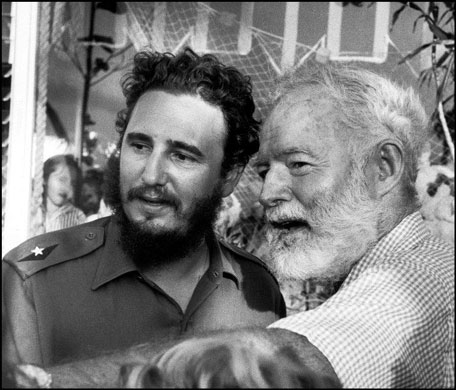
From Cuba Debate (my translation):
Ernest Hemingway, who died 50 years ago next July 2, was not one of those Americans who came to Cuba as a refuge, but one who came because he felt himself to be Cuban, according to one expert.
Ada Rosa Alfonso Rosales, director of the Museo Finca Vigia, the suburban Havana estate Hemingway made his home from the 1930s until he returned to the United States shortly before his death, said that research demonstrates that the author of “For Whom The Bells Tolls” and other novels “definitely felt Cuban”, although he never stopped being a “complete” American.
The controversial matter of Hemingway’s “Cubaness” has lingered since 1961. The author left the island, never to return, a few months after the well-publicized meeting with Fidel Castro at a marlin fishing tournament Hemingway had founded.
 Hemingway is probably the most beloved American in Cuba. He is well remembered in a country that dedicates seminars, conferences, fishing tournaments and public memorials to a foreigner born in 1899 and who committed suicide in his homeland.
Shortly before his departure from Cuba at age 62, Hemingway and Castro were photographed at a fishing tournament. They appear to be cordial with one another, and historians claim that this was hardly their only meeting, the two speaking privately on several occasions.
Alfonso Rosales said that the novelist “definitely felt Cuban and loved this country before and after the Revolution” of 1959. She indirectly rejected the U.S. contention that Hemingway fled the “specter of communism” when Castro began to implement a socialist system.
[I’m no Hemingway expert, but I tend to think he left because the Island didn’t have the facilities he needed to treat his deteriorating mental and physical health, and that the semi-forced departure as a result of U.S. pressure on American residents in Cuba (especially prominent ones like Hemingway) probably had a negative impact on his depression]
Although the writer’s direct links to Castro’s revolution are well known, less publicized (in Cuba) were the author’s activities during the Second World War, when Hemingway attempted to organize an anti-Nazi operation on the Island. Then U.S. ambassador in Havana Spruille Braden was apprised of a proposal by Hemingway to use diving expeditions in the Caribbean aboard his yacht, El Pilar as cover for hunting German submarines. Braden got Washington’s approval for Hemingway to equip his boat with machine guns, grenades and home-made bombs, as well as recruiting an anti-fascist network on the island.
Still, the eternal “antiyanquí” sensibility lingers, with an intellectual current that sees the writer as a would-be Robinson Crusoe, surrounding himself with Cuban Men Fridays.
The truth is that “Papa”, as the author was called, greatly enjoyed Cuba, devoting himself to his estate, to “kissing Martha (his wife at the time) and writing “The Old Man and the Sea,” a novel that [for Cubans] transcends the writer’s Nobel Prize.


 mexfiles.net
Ernest Hemingway left Cuba in 1960, before the Bay of Pigs.
The photo of Fidel and Hemingway was taken on May 15th 1960 during the National Marlin Fishing Tournament.
Aha!
Funny, I was just talking to someone yesterday about the pitfalls for native English-language readers in the complex sentences Spanish language newspaper articles favor, too. I should have noticed it first round through.
The original reads:
La polémica al respecto no terminó desde que en 1961 y tras un encuentro meses antes con el líder cubano Fidel Castro … el escritor norteamericano se fue para siempre.
.I’d tried to “straighten” the sentence out, and managed to twist it into a pretzel. Much clearer broken into two sentences.
I often think about people like Hemmingway with his many virtues and vices. And like Robert Capa, who reinvented himself to go on to become a world-famous war photographer taking some of the most famous Spanish Civil War and D-Day photos we know.
In today’s extraordinarily rigid world, with biometric ID, and the constant “papers, please” across the world but even most prominent in the USA, how would Hemmingway be treated? Would his drunkenness land him in prison? Would his risk-taking result in an involuntary commitment? Would he be denounced as as “hopeless” and shut away from the world?
What of people like Capa? Because there were no biometric ID devices and DNA registers, he was able to reinvent himself from his poverty-stricken past, create a new name, and deliver famous images that influenced the world.
When our “protection” from “terror” circumscribes our former great freedoms, what have we gained? When a person is permanently locked into their “permanent record,” regardless of their potential or talents or even capacity to change, how many present-day Hemmingways and Capas are prevented from sharing their abilities with the rest of us.
Rigid societies are not dynamic. Locked-down peoples are not able to pursue their dreams. We all lose as a result.
As I read this entry, I wondered if Hemmingway had left Cuba due to some falling-out with Castro, or more likely, the pressure from the USA. This pressure is just another form of a rigid society and oppressive government. Here we are 50 years later and Americans are still not permitted to travel to Cuba, 90 miles off the Keys.
Yet trade with Communist China — a far greater threat to our geo-political, economic and military interests — is actively encouraged and travel is promoted as beneficial to the USA.
What an F-d up system.
Look Behind the Hero, have we been coned?
ISBN-9783734749162
Spires-CIA-Lies-Terrorist-Che Guevara.