Fracking… with a side of snark
The BEST article I’ve seen on “energy reform” in Mexico …. and the dubious economics and political maneuvering (and the guy leading the charge) behind it … comes from Lisa Wines at the U.S. political humor site, Wonkette. The video, from Narco News is … while simplistic … a better look at fracking, and its effects on Mexico, than anything else I’ve seen or could possibly say.

caricature of Peña Nieto, Revista Replicante.
… what about Peña Nieto’s spicy butt sex and wife murdering rumors, you ask? Not a whisper. That I could find. Sorry! But he sure has been busy rubbing up against industrialists and giving American capitalists and Chinese commie-capitalists erections. So let’s have some verdad about all these “reforms” Peña Nieto has been making. We can start with one of his controversial energy reforms, like how he’s inviting outsiders to enter Mexico’s soft, verdant love garden, drill deeply past her crusty exterior and frack her, frack her hard.
Read it and snicker… then weep…
Mexican President Enrique Pena Nieto Wants Mexico To Get Fracked
Unsafe at any speed?
Must be bad Canuck week here at Mexfiles… From the Victoria (BC) Times Colonist, via Vancouver Sun.
VICTORIA — The man acquitted of driving a motorcycle up to 299 kilometres an hour on the Trans-Canada Highway through Greater Victoria thinks media coverage of a viral YouTube video may be to blame for him being denied entry to Mexico — twice.
[…]
Scott told the Victoria Times Colonist he was taken into a holding cell and interrogated about his criminal record. He came clean about past weapons charges and an assault charge but didn’t mention the dangerous driving charge. He was never convicted on any of the charges.
“I forgot to mention the dangerous driving because I don’t even consider that criminal or whatever,” Scott said, even though the criminal trial lasted several days and was extensively reported.
Mexican officials said, “motorcycle, motorcycle,” and made throttle-twisting hand gestures, “and I said, ‘Oh, I totally forgot about that.’ ”
Scott was acquitted last fall by Judge Robert Higinbotham, who said he had reasonable doubt as to who was in the driver’s seat. The video, shot from a camera mounted on the motorcycle, showed the bike weaving at high speed through traffic in April 2012. It has been viewed almost 1.8 million times on YouTube.
Scott said he has no idea how officials in Mexico became aware of the Victoria case.
Uh… Youtube, maybe?
.
Or… maybe Scott’s “27 driving infractions, five different license suspensions”, driving without insurance and … in the words of one official-looking guy… “extremely moronic behaviour”, being reported everywhere, the youtube videos … and a couple of weapons violations… might have had something to do with it.
Mexico’s embassy in Canada said immigration authorities may refuse someone entry into the country if “the applicant is subject to criminal process or has been convicted of a serious crime . . . or if the applicant’s background in Mexico or abroad could compromise national or public security.”
Mexican immigration officials — like immigration officials anywhere — can also just decide you’re a dick. that probably factored into the whole thing, too.
Cherchez la Presidenta Municipal…
Elections have consequences.
Sara Luz Herrera Cano was the PRI municipal president of Alvardo, Veracruz up until midnight 31/December/2013. With the state prosecutor’s offices closed New Year’s Day, it was the morning of the Second when she received the “honor” of receiving the first criminal indictment in the State of Veracruz for 2014… case# 1/2014.

Photo: heraldodelbajio.com
The arrest in itself is no surprise. Elected officials are immune from prosecution, unless the immunity is lifted by the legislature. Although state prosecutors had requested the Veracruz legislature to lift Herrera’s immunity last October, she managed to hold on to her office. And, as it was, incoming PRD municipal president Octavio Ruiz Barroso, campaigned on a promise to audit municipal accounts upon assuming office, and pursuing criminal charges where it could.
State Attorney General Amadeo Flores Espinosa wrote an arrest warrant for Ms. Herrera on New Year’s Eve… but not for anything as mundane as spending municipal funds on the usual things politicians expect the taxpayers to provide… trips to Las Vegas, a few face-lifts, real estate … but for murder.
Herrera’s private secretary, Michel Martinez Corro, had gone missing at the end of July. His body was found in a shallow grave a week later, beaten to death with a blunt object. Martinez was more than just Herrera’s secretary, her casa was his casa, but… just to complicate things, Martinez was openly gay. Just to make things weirder, it was initially reported that a second body, that of “Nicolas N.” was found in the grave with Martinez — suggesting the crime had to do with gay bashing, and not with dirty politics or Martinez’ role in the Herrera (mal)administration. However, if there ever was a “Nicolas N.” the body… and mention of the body… has disappeared.
What did show up was a confession, by another municipal employee that she had been asked by the Municipal President to hire a couple of hitmen to get rid of Martinez. On the basis of that testimony, the state prosecutor had asked the state legislature for a “disafuero” (removal of immunity). Herrera brazened it out… not only claiming the prosecution was politically motivated and sexist… that she was targeted because she represented the PRI and was a woman.
Whether or not the committee quite believed her when she did Richard Nixon’s “I am not a crook” one better, telling the committee, and the media, “I am not a killer” is beside the point. The PRI legislators were reluctant to vote for a disafuero, and admit to corruption within their own party in a year when their party had just regained the Presidency, and as in a somewhat triumphalist mood. Plus, they wanted to recess for the year, and just… didn’t … get … around … to… it.
So… as Presidenta Municipal of Alvarado, Sara Luz was untouchable. Until the end of her term. Which looks very much like the start of her sentence.
Now, if we only knew why she had Martinez killed.
SOURCES:
“De alcaldesa a presunta asesina, Sara Luz acusada de homicidio”, La Politica (24 October 2013)
“Veracruz mayor suspected in murder of her secretary, embezzlement in office” Justice in Mexico (20 November 2013)
“Former Veracruz mayor arrested for murder of her secretary” Justice in Mexico (7 January 2014)
Pepe Lozada, “‘No soy una asesina’: Sarita, alcaldesa de Alvarado,” eConsulta.com Veracruz (27 November 2013)
Édgar Ávila Pérez and Rodrigo Barranco, “Sara Luz Herrera Cano, ex edil en Alvarado, es señalada como autora intelectual del homicidio de quien fuera su secretario particular, Michel Martínez Corro”, El Universal (2 January 2014).
WHAAAAT? French-Canadian terrorists attack Mexico
There’s gotta be more to this story.
A Mexican man and two Canadian women — identified as Fallon Poisson Rouiller and Amelie Pelletier — were caught in the act of throwing molotov cocktails at a Nissan dealership and an office of the Mexican Secretariat for Communications and Transportation.
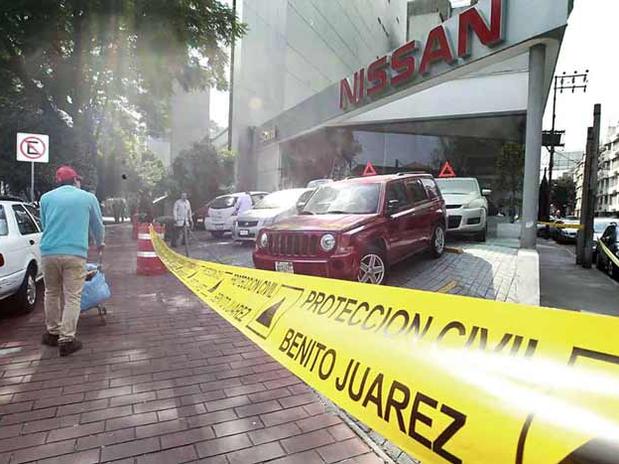
Photo: Reforma
Initially charged by the Federal District’s prosecutor (with “causing damages in excess of 750 times the minimum daily
wage”… around 50,000 pesos) for damages to the Nissan dealership, they did indeed attack a federal installation. While the Secretary of Communications and Transportation downplays the assault, noting the office was just highway administrative personnel, the case was turned over to federal authorities and — because the women are foreigners (who either refused to identify themselves, or were not carrying identification), the incident is being treated as what could have been a foreign terrorist attack. The alleged perps were questioned by, among others, agents from CISEN, the Mexican equivalent of the CIA.
The Canadian press, and some Mexican media, are making note of the fact that the women had recently been in Chiapas, which a lot of tourists wander around this time of year, but which also suggests some sort of lefty radicalism, at least in Canadian papers.
Danged if I know what all this was about. Already in the Canadian media, I’m seeing comments suggesting it was a “set-up” and — of course — the Canadians are being railroaded, but somehow I doubt it was just Tres Reyes night highjinks gone astry.
SOURCES:
“Despreocupa a SCT ataque con bombas” Reforma, via AM (6 January 2014)
“Detienen a 2 canadienses por ataques a la SCT en el DF” Publimetro, (6 January 2014)
“Envían a la PGR a tres detenidos por ataque a SCT; dos son canadienses”, Proceso, (7 January 2014)
Tristin Hopper, “Canadian women detained after Molotov cocktail attacks on Mexico City government offices” National Post (7 January 2014)
Arturo Sierra, “Sujetos lanzan bombas molotov a la SCT” Noticias Terra.mx (6 January 2014)
“Two Canadian women detained after fire-bomb attack in Mexico City ” Globe and Mail, (7 January 2014)
¿Viva la contra-revolucción?
Lorenzo Meyer in Reforma (via Mexico Voices, translation by Sally Seward):
It took the Mexican Revolution thirty years to dismantle Porfirio Díaz’s regime and to create the small or large amount of good it could, from 1910 to 1940. It took almost the same amount of time, from 1982 to 2013, for the neoliberal right to dismantle that small or large amount of good created by the governments of Madero through Lázaro Cárdenas, leaving the country today at the mercy of the “invisible hand” of the market or, rather, of the very visible hands of the few that control the market and politics.
[…]
… after the economic system that had been in force since World War II-that of import substitution through protectionism-was declared bankrupt. Another bankruptcy had already taken place: the moral one, as a consequence of the open repression of anti-authority movements, like that in 1968, or of the electoral fraud in 1988. The Presidency of Carlos Salinas (1988-1994) no longer found any use for the revolutionary discourse, or the possibility to legitimize themselves with it, since it could no longer be credibly mixed with globalization and neoliberalism.
The lackluster and absurd official celebration of the centenary of the Mexican Revolution in 2010 was the preamble to the third death of the Mexican Revolution, which can be dated to December 2013 when the coalition of the PRI [Institutional Revolutionary Party] and the PAN [National Action Party] reformed the Constitution to throw out the last trace of the movement: nationalized petroleum.
This third and definitive death of what was born in 1910 was celebrated only by the privileged elite. The true celebration took place outside of Mexico in the winning international circles, as is shown clearly by what was published in the Wall Street Journal, Bloomberg, the Financial Times, Forbes, etc. Who celebrates, who protests and who stays on the sideline-the majority-are the best indicators of who won and who lost with this historic change.
NAFTA at 20 … even Mexican beer isn’t Mexican
Timothy Wise, policy research director at Tufts University’s Global Development and Environment Institute, on the effects of NAFTA on Mexico’s agriculture and food security. Even our beer is made with imported barley.
Twenty years ago, on January 1, 1994, NAFTA took effect, and Mexico was the poster child for the wonders of free trade. The promises seemed endless.
Mexico would enter the “First World” of developed countries on the crest of rising trade and foreign investment. Its dynamic manufacturing sector would create so many jobs it would not only end the US immigration problem but absorb millions of peasant farmers freed from their unproductive toil in the fields. Mexico could import cheap corn and export electronics.
So much for promises.
[…] twenty years into NAFTA, 55 million Mexicans — about half the population — are estimated to be in poverty, many without secure access to food.
By far, this is the best short article I’ve seen on NAFTA: How beer explains 20 years of NAFTA’s devastating effects on Mexico
Mexican politician of the year: 2013
Candigato Morris, an independent candidate for Presidente Municipal in Xalapa, Veracruz, not only inspired a slew of other domestic animals to run for public office (dogs, cats and burros received an unprecedented number of votes in municipal and state elections around the country), he acquired an international following for his simple campaign promise to “clean out the rats” at the Municipal Palace. Without a doubt, he’s the only local polico in Mexico to acquire an international following, and one of the few not to make an international media story for not committing a crime.

Photo: Reuters via Time
Shop til you drop?
I did not even bother trying to drive to the shop today (I took the bus). Besides the New Years’ tourists, everyone is stocking up before new taxes go into effect on the first of January:
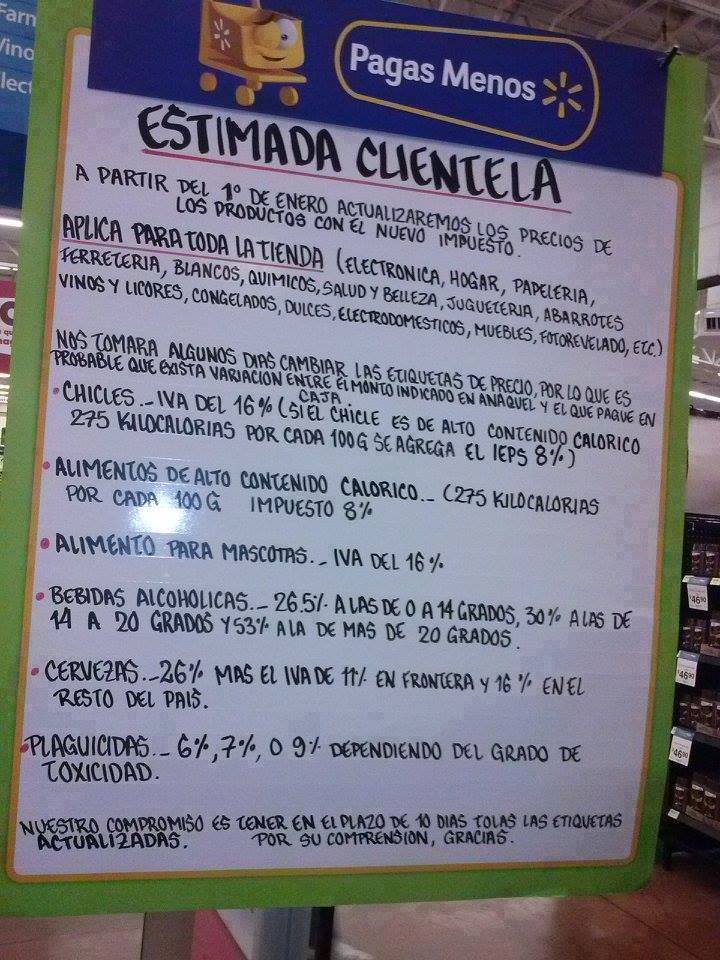
16 percent IVA (Value Added Tax) on just about everything that’s not food or medicine. That’s the same as its been, though pet food and chewing gum are taxable now. Yeah, I did lay in 20 kilos of dog food, but that lasts about four months.
High calorie food products (i.e. junk food) has an extra eight percent tax, and alcoholic beverages are taxed based on alcohol content. For our health, or so we’re told. Between stocking up for New Years… and the new year… there were lines outside the local liquor store and corner “Deposito” (beer store).
The odd one (and one I didn’t even know about) is the new tax on insecticides… this is the tropics and I just worry too much about bugs, but get a little testy with the annual winter ant invasion. I wonder if it wouldn’t be cheaper (and more ecologically sound) to hire some geckos.
Mexican historian John Eisenhower, 3 August 1922 — 21 December 2013
John S. D. Eisenhower’s father skipped his son’s graduation  from West Point, but it wasn’t as if his dad wasn’t interested in his son’s career. The future general, ambassador and military historian graduated on 6 June 1944 and Ike was rather tied up that day. While his long and active political and military career was spent in the shadow of his father (whom, as he aged, he physically resembled more and more), in his later years, he emerged in his own right as a fine historian, writing two impressive (and seminal) works on Mexican history: So Far From God:The U.S. War With Mexico, 1846 – 1848 (Random House, 1989) and Intervention!: The United States and the Mexican Revolution, 1913 – 1917 (W.W. Norton, 1993).
Both of this books naturally reflect the U.S. view of those conflicts. However, the retired U.S. Army General and diplomat are surprisingly even-handed in his 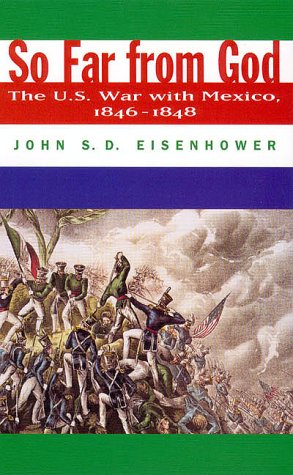 treatment of the motives and actions of both Mexican and U.S. personnel. He acknowledges not only the atrocities of war (although, as a military writer, sometimes explains them away as necessities or as simply something accepted in those pre-Geneva Convention days), and doesn’t shy away from depicting the horrors of war inflicted on the civilian populace by his own countrymen. More importantly, for those of us who are not military historians, Eisenhower writes well, and writes clearly on the art and science of killing people and breaking things.
Both of Eisenhower’s books were essential to me when writing my own book on Mexican history. So Far From God stands out as an essential work for both 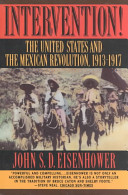 Mexican and U.S. historians seeking to understand the 1846-48 war, which — despite its near erasure from the collective memory of the U.S. had a profound and lasting affect on the history and culture of the United States and Mexico (where it is very much a part of our collective memory). Of the many books on the Mexican Revolution, Intervention! stands out as the best on this one incident, that has been romanticized out of all proportion, or seen only as a minor incident (which it certainly was not) by other writers less deft at understanding the military/political significance of the Expedition.
As a historian, John Eisenhower stepped off the path laid out for the son of the legend… but the turn-off for the trail was blazed by his father. Although Ike was revered for his wartime military career in Europe, it was his activities — or rather non-activity — in Mexico that planted the seed for John Eisenhower’s late-blooming second career. As a teenager, John Eisenhower discovered (during a family argument) that his parent’s early romance was saved by the most unlikely of matchmakers… Pancho Villa.
To bring the young couple together (and later produce the future historian), Villa went to a lot of trouble… although Ike had given Mamie his West Point ring on Valentine’s Day 1916, expecting a long engagement, and already having second thought when Pancho attacked Columbus, New Mexico on 9 March. On 15 March President Woodrow Wilson ordered a “Punitive Expedition” into Mexico. Nothing like the prospect of a real war, and a real death, to help one make up one’s mind… and Ike decided to marry Mamie at the first opportunity.
Although George S. Patton and Douglas MacArthur were sent to Mexico, it was Ike — the one who didn’t go — whose future military and political career was most affected. His heroic status as a military man, and his later appeal as a Presidential candidate (and President) rested on his competence at solving complex logistical problems. Like arranging for a wedding, while gathering the trucks and cars and gasoline and spare parts needed for Pershing to get to Mexico, at a time when the U.S. Army had no mechanics (Ike visited every auto dealership in Texas and went out and hired “military contractors”). Mission accomplished, and the Punitive Expedition hunkered down in Chihuahua, Ike and Mamie had a traditional June wedding and… John S.D. was the result a few years later.
While the expedition itself was a failure, Ike’s role in mechanizing the Army was critical to modernizing the Army, and, in a roundabout way, to creating the U.S. automotive culture. A minor footnote in American history, and a minor family squabble that only John Eisenhower — having a background in both the military and diplomacy, and the access that only the son of a legend could have, to write two books that are critical to any serious student of Mexican or United States history.
Ashes, ashes…
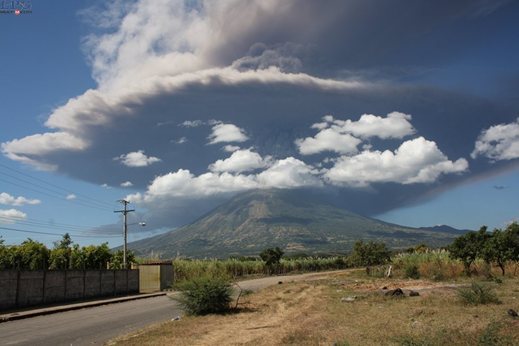
Photo: La Prensa Grafica (San Salvador)
WHOA! Chaparrastique de San Miguel in El Salvador spewed ash FIVE KILOMETERS into the atmosphere when it erupted yesterday morning at 10:30. One of the most active volcanoes in el Salvador, Chaparrastique last erupted in 1976.
(More at La Prensa Grafica)
The real scandal
Matt Taibbi in Rolling Stone:
… Assistant Attorney General and longtime Bill Clinton pal Lanny Breuer has a message for you: Bite me.
Breuer this week signed off on a settlement deal with the British banking giant HSBC that is the ultimate insult to every ordinary person who’s ever had his life altered by a narcotics charge. Despite the fact that HSBC admitted to laundering billions of dollars for Colombian and Mexican drug cartels (among others) and violating a host of important banking laws (from the Bank Secrecy Act to the Trading With the Enemy Act), Breuer and his Justice Department elected not to pursue criminal prosecutions of the bank, opting instead for a “record” financial settlement of $1.9 billion, which as one analyst noted is about five weeks of income for the bank.
The banks’ laundering transactions were so brazen that the NSA probably could have spotted them from space. Breuer admitted that drug dealers would sometimes come to HSBC’s Mexican branches and “deposit hundreds of thousands of dollars in cash, in a single day, into a single account, using boxes designed to fit the precise dimensions of the teller windows.”
[…]
Though this was not stated explicitly, the government’s rationale in not pursuing criminal prosecutions against the bank was apparently rooted in concerns that putting executives from a “systemically important institution” in jail for drug laundering would threaten the stability of the financial system.
 It should be pointed out that the major money laundering centers are mostly British dependencies, and the United States — while not as problematic as most countries — is extremely lax when it comes to currency and banking controls. Mexican banks saved the U.S. banks (Banamex was the only thing that kept Citibank from folding, and it took some fancy — and rather dubious — legalistic footwork by Agustín Carstens to keep Banamex from being seized and resold as any bank with a foreign government holding a substantial interest is supposed to be, when the U.S. government had to buy Citi’s assets for a time when the U.S. government had to bail out Citi, and ended up being a major stockholder). And there is some feeling that it was “drug dealers” that kept the rest of the banking industry from complete collapse. Not even a thank-you note?
The scandal is not the “slap on the wrist” for the British banking giant… it’s the assumption that this crime was committed against the United States… which simultaneously supports both the criminal enterprise and the “war” on that enterprise… costing Mexico untold billions of wasted dollars, and killing at last estimate around 100,000 of its people. I don’t see the U.S. government even making a token payment of that token payment to those who are the real victims — both here and in Colombia and elsewhere — nor that Latin American will receive any justice from a government set up to meet the needs of “just US”.
Working for a living… or not
That this appeared, not in one of the usual lefty sources, but as the main story in El Financiero — Mexico’s national business daily (equivalent to what the Wall Street Journal used to be in the United States), means this is something that will have to be taken seriously by the administration, and by all of us. Unlike the United States, where the argument in favor of not raising the minimum wage is the false one that minimum wage workers can find other employment (or are only seeking a “starter job”) and — as low wage workers argue, the state is forced to pick up differences between what they are paid and what is needed for survival, here no one can claim minimum wage workers are have other opportunities or that such jobs are never seen as a means to support a family. Nor does the state have the resources to pick up the tab for employers who are paying only the “salario minimo” for workers.
I would note that there are actually TWO “salarios minimos“. Zone A is the major urban areas and the states (mostly those bordering the U.S.) where goods and services are more expensive, and the second covers mostly rural and smaller communities, where theoretically costs are lower (at least for things like housing), but then, so are the job opportunities.
Translated from “Trabajadores perdieron 9.43% de poder adquisitivo este año“, Edgar Amigón, El Financiero 26 December 2013
The purchasing power provided by the increase in the minimum daily wage (salario mimimo) for 2014 by 2.53 pesos has already been wiped out by workers’ loss of 9.43 percent of their buying power, according to a new UNAM study.
The study, by the Centro de Análisis

I guess she’d be one of those extra family workers needed to earn enough to buy one’s daily tortillas. Should she work 8 hours a day and earn a third of what’s needed, or 12.5 hours and bring in half?
Multidisciplinario (CAM) of UNAM’s economics department, found that the rise in basic commodities prices over the last year, means the new salario mimimo of 64.76 pesos only has the purchasing power of 58.65 pesos
On December 18 , the National Wage Minimum Commission, decided on a 3.9 percent raise for the two economic zones: 67.29 for Zone A and 63.77 for Zone B.
CAM Coordinator , Luis Lozano Arredondo, told El Financiero that this income is far below that needed to meet a family’s basic necessities. The recommended food basket (CAR: with a deficit continue to meet their basic needs: the price of the “Canasta Alimenticia Recomendable” (CAR: a basic food basket… mostly beans and tortillas, some eggs and a mango or two) for a family of five) now costs 193.52 pesos per day .
The CAM study noted that as of December 16, 1987 , a worker had to labor 4 hours 53 minutes a day to earn enough to purchase the basic food basket, whereas, in the second half of this year, it would require 23 hours and 44 minutes of labor to earn enough — which is humanly impossible. Families living on the salario mimimo need to have more than one worker, and/or outside assistance (normally from extended family members) just to cover food costs.
Lozano Arredondo said that based on the foregoing , Mexican workers have no chance to improve their standard of living and there is no way for the internal market to recover unless emergency action is taken to reverse the loss in purchasing power.


 mexfiles.net