Mais où sont les Mexicains d’antan?
… our history suggests that having an open border with our continental neighbors isn’t such a bad thing.
Exactly how many French Canadians made the trek is difficult to calculate, because before 1895 no federal immigration officials monitored the northern land border. Neither Canada nor the United States had seen the free movement of people across their common border as a problem seeking a solution.
Even when the United States finally built land border posts in the late 1800s and early 1900s, they were aimed primarily at Eastern and Southern Europeans who were using Canada to sidestep immigration screenings at seaports like New York and Boston.
Canadian migrants, despite their huge numbers — by 1900 the number of Canadian-born United States residents equaled an astounding 22 percent of Canada’s entire population — continued to receive special treatment.
[…]
So how did the United States fare during this period of largely unregulated border crossings? And what happened to all those French Canadians, whose linguistic and religious differences made them stand out more sharply than Anglo-Canadian migrants?
Most flocked to mill towns in New England, where they powered the textile factories that boomed after the Civil War. In a pattern that reflects today’s Mexican migration, they followed family members to places where jobs were plentiful, but hard and undesirable.
Their labor was in such demand that mill owners sent recruiters to Quebec to hire more. Entire villages would relocate south, usually by train, swelling the populations of towns like Biddeford, Me.; Southbridge, Mass.; and Woonsocket, R.I., whose populations by 1900 were more than 60 percent French Canadian.
[…]
Bonjour, America! Stephen R. Kelly ( Associate Director of the Center for Canadian Studies at Duke University), New York Times (28 July 2013)
Man’s inhumanity to boy…
This 36 seconds of cinema vérité, from Villahermosa, Tabasco, was a one-day wonder in the Mexican media, though the issues it raises are those that could fill any number of web posts, news columns and probably doctoral dissertations. And maybe should.
The little boy is a Triqui Mayan, from the Chiapas highlands. For lack of other opportunities, Triqui eke out a small living as street vendors throughout Mexico, often as not, traveling with their children who are also put to work. Child labor has been CONSTITUTIONALLY outlawed in Mexico since 1917, and — as a signatory to the 1990 United Nations Convention on the Rights of the Child — the little boy should not be working on the streets, but one accepts in Mexico that life is less than perfect, especially for the indigenous people. Whether we should just accept that, and how exactly we achieve that, is something I can’t answer.
During the Fox Administration, the outstanding Secretary of Health, Chiapas physician and public health administrator Julio Frenck pushed through restrictions on cigarette sales,

How some Triqui children spend their time … photo by Olga Rosario
including the sales of “sueltos”… single cigarettes. And, of course, sales and purchase of tobacco products by minors were forbidden. Getting people to not smoke … let alone smoke less… has been something of a cultural battle, given that this is the country where cigarettes were invented and it is still customary when — if you have a pack of cigarettes and you smoke one in a group — you offer a cigarette to everyone else (being a smoker, when I first moved here, and most of my cohorts were poor Mexican artists and teachers, I very quickly learned to buy the cheapest brands!).
This incident occurred in one of my favorite places in Mexico, the Zona Luz of Villahermosa. 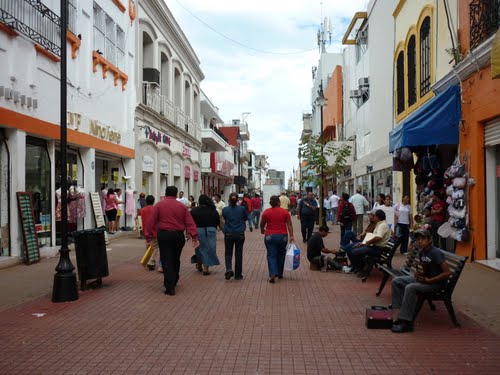 Perhaps, as some locals claim, it’s the Italian-immigrant influence, but the main activity (if you can call it activity) in the Zona Luz is to sit at a cafe, lingering over your coffee, having a cigarette and talking with friends, strangers and the friends of strangers as you watch the world go by… and perhaps, suggesting that after a leisurely lunch later, you might conduct whatever business you came to town to accomplish… which means, of course, sitting around the Zona Luz with your client, and his friends, and the friends of his friends…
Nobody has a lot of money, and it is a lot of trouble to go down to the 7-11 for a whole pack of cigarettes, when only one person wants one, and buying a single cigarette from a passing vendor is a socially acceptable way of satisfying one’s own addictions and evading the inevitable obligation to treat one’s acquaintances of the moment.
Anthropology, social history, public health regulations, child labor laws and the basic laws of supply and demand all are worthy of voluminous studies of their own, but it comes down to this: small boys will sell you a cigarette… and even light it for you.
Although Tabasco has a radically progressive history (Andrés Manuel López Obrador has 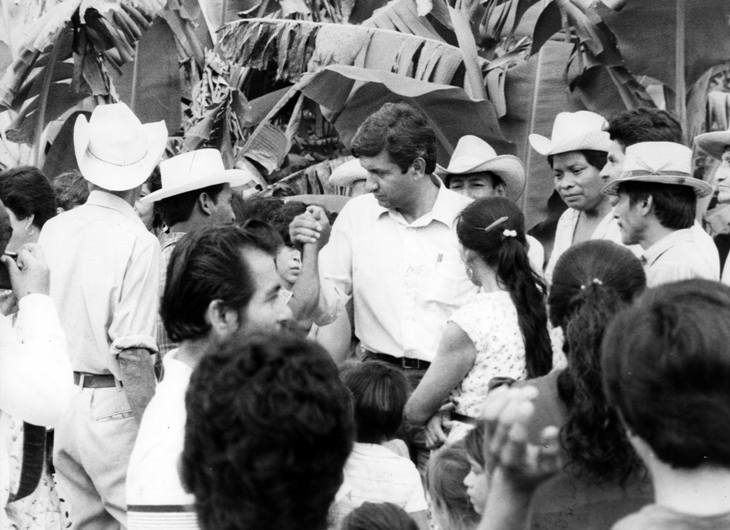 never lost his thick Tabasco accent), the indigenous people are still dismissed as lesser people. One still hears the word “indo” used, as much to dismiss people like the little vendor, as a way of saying “shiftless” — much the way the word “nigger” was used in the United States until relatively recently (and still is, though not in polite company). Which of course, is nonsense. One perhaps needs to be an outsider to notice that in the Zona Luz, laid back as it is, there is a lot of real work being done.
The Mayans do the crap work and the physical labor… as porters (I saw a two Mayans carrying a refrigerator though the crowd on those traffic-free streets one lazy afternoon on the Zona Luz) … the things WE don’t want to do, or — more to the point — see as beneath us to do. Beneath our dignity. And, the whole concept of dignitad, personal dignity and the integrity of our ego, is a difficult subject to wrap one’s mind around. I’ve tried.
What happened in this video is not just that the boy was forced by a meddling bureaucrat (named Juan Diego López Jiménez if you must know) to dump out his wares, ostensibly because the cigarette sales were illegal; not just that an adult is bullying a small boy; not just that there are uncomfortable suggestions of race and class bias in the encounter; but that the boy’s dignidad — his basic human worth — has been offended.
The individual abuses go on around us all the time, but seldom are we forced to witness them wrapped together and presented in such a way that we have to sit back and analyze our own role in each of the elements of this small drama.
The “rest of the story” — Juan Diego López Jiménez has been fired by the municipal authorities, and the state’s Human Rights Commission has been asked to make a report and issue recommendations for avoiding incidents like this in the future — save it from being a tragedy. One hopes, though, that that we aspire to at least the level of humanity of the man in the red shirt.
Sources:
Autoridades de Villahermosa deciden qué hacer con funcionario que humilló a menor de edad (SDPNoticias)
Autoridades de Villahermosa deciden qué harán con funcionario que obligó a un niño vendedor a tirar su mercancía (Sin Embargo)
Cesan a funcionario que humilló a menor en Tabasco (El Universal)
Separan de su cargo a funcionario por humillar a niño en Tabasco (Milenio)
VIDEO: Funcionario humilla a niño por vender cigarros en plaza de Villahermosa (SDPNoticias)
VIDEO: “Abuso de Autoridad”, TVX Canal 16 de Cablecom
UPDATE: A bit of justice. The boy, who lives with two aunts, has been offered legal and psychological assistance by the State’s Human Rights Commission, and Sr. López Jiménez was charged yesterday not just with abuse of authority but also theft by moral violence”.
Los Hermanos Blues?
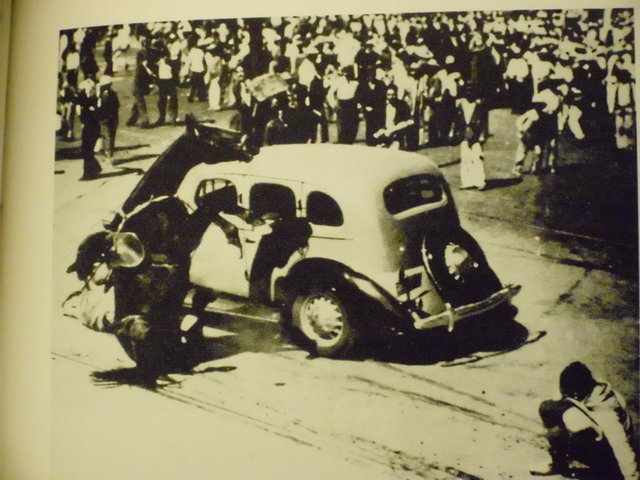 For those who never heard of them, los Camisas Dorados (Gold Shirts) were the Mexican Nazis (about which I hope to write something this week). In August 1936, they ran into the Mexican version of Jake and Ellwood … there wasn’t a river around, but they hated Mexican Nazis.
Beware of the Crocodile
 “El Caiman”… The Crocodile… is “the baddest-ass of the bad-ass pimps” in Tenancingo, Tlaxcala — a small city whose main industry is said to be sex trafficking. Being aa “bad-ass pimp” in a town of pimps you gotta have a gimmick. Or a live crocodile in your basement.
A well-chiseled man, “El Caiman”, it is claimed, comes across as charming and gallant when he “rescues” young country girls from bus stations and malls around the country, only to turn on the other side of his personality. He gives the girls a choice: work as prostitutes in Mexico City and Puebla, or he’ll kill their families… or worse.
Girls who don’t pay up when El Caiman’s runners come to town, are “invited” for a visit to Tenancingo. From which they never return.
After all, it’s not like you can find Purina Crocodile Chow in Tenancingo.

Apparently, it’s a true story!
According to former Federal Deputy Rosi Orozco, of Unidos Contra la Trata (Union against Sex-Trafficking), Tenancingo has built an entire industry based on sexual exploitation since the 1990s, its resident pimps overseeing illicit sex workers throughout the Republic and as far away as the United States and Great Britain. An anonymous city official claims that between 30 and 50 percent of Teancingo’s residents are in the illicit sex trade in one capacity or another. The municipal official also says that El Caiman not only is for real, but adds that his generosity to local charities and in providing scholarships and stipends for students (especially those studying for careers as lawyers) makes him a well-regarded local figure.
Several women interviewed by El Universal (including one who paid 170,000 pesos to buy herself out of El Caiman’s stable and is now working as an independent sex worker elsewhere) all say the story of the crododile in the basement is true.
While feeding people to crocodiles is certainly illegal and pimping is a serious criminal offense (that can get you 18 years in the slammer), prostitution is, in itself, not illegal in Mexico. In a few places, the sex workers have a strong union … probably the only union in the world that discourages apprentices … who — although technically independent contractors — have at least the normal labor rights.
Don’t bug out, but…
Mexico has some 300 to 550 species of edible insects, more than any country in the world, according to the UN Food and Agriculture Organisation (FAO), which issued a 200-page report this year in praise of entomophagy – insect-eating – as a promising source of sustainable protein. “The case needs to be made to consumers that eating insects is not only good for their health, it is good for the planet,” the FAO report read. The tiny comestibles are very high in protein, it noted, especially compared to meats such as beef and pork.
Nick Miroff in Washington Post, via The Guardian
¡Buen provecho!
Unrealistically high hopes
Mexico’s prohibition of pot actually came in 1920, a full 17 years before the U.S. federal government pot crackdown started (with the Marihuana Tax Act of 1937). And while there may have been a class dimension to the movement against marijuana in Mexico, Campos suggests, people were banning the drug because they were seriously freaked out about what it could do.
[…]
We have a fairly low-resolution understanding of what “marijuana use” looked like in Mexico and the U.S. at the turn of the century — how much people consumed, how they ingested it, what substances it might have been combined with. Someone smoking a joint packed half with tobacco and half with cannabis indica (the version of the drug that typically produces a sedentary, mellow high) would have had a very different experience than someone who’s drinking the Mexican liquor pulque and eating something laced with cannabis sativa (the version of the drug likelier to produce anxiety).
Matt Thompson, “The Mysterious History of Marijuana” NPR Code Switch: Frontiers of Race, Culture and Ethnicity 22 July 2013

From a political cartoon… even the “left” sees marijuana legalization — and/or Vicente Fox — as ridiculous.
Several people in the U.S. have recently been … er… buzzed … about a statement by ex-President Fox to the effect that he expected Mexico to legalize marijuana production within the next few years. Leaving aside the low opinion in which Fox is held by the Mexican media (having come out against his own party in the last presidential election, and — despite having left office with historically low approval ratings — his claim that his presidency was the best in Mexican history, isolated him for Mexican opinion makers, long before his partnership with a U.S. would-be marijuana mogul made him a comedic figure), and Fox’s obvious wishful thinking (his family business is exporting agricultural crops to the United States), I doubt there is much interest in legalizing marijuana here.
What is said in the U.S. media (and by commentators on U.S. sites) is based on the mistaken premise that what benefits the consumer benefits the supplier. Usually, one reads that the end of liquor prohibition in the United States having ended criminal violence in the liquor supply industry, it follows that an end to marijuana prohibition would end criminal violence in the Mexican supply industry. First off, the end of liquor prohibition might have created some new direct markets for some agricultural products like wheat, corn and grapes … but they were already legal. I don’t see that the clandestine liquor trade had much effect on agriculture in general: Al Capone was never an investor in farmland, nor was he driving farmers off their land to protect his supplies of basic commodities.
I grew up in the Finger Lakes region of New York — wine country — so I suppose (or, rather  know for a fact) that some of our rural gentry were involved in providing grapes they knew were being used for illegal products, so I suppose there is some validity to the argument that if marijuana farming (and export) were legal, this might benefit some Mexican farmers… and agricultural exporters like Vicente Fox.
However, the marijuana farms here are run by our Al Capones. In the 8 August 2012 “News Alert” from the Internal Displacement Monitoring Centre, we read:
According to local authorities, up to 2,300 families have been displaced from the mountainous area in the Pacific-coast State of Sinaloa, known as the Sierra de Sinaloa. Families have not only fled from confrontations between two cartels, the Cartel de Sinaloa and the Beltrán Leyva Organization, but also from extortion, kidnappings and threats. They have sought refuge in more populated municipalities, including Mazatlán, where many have settled on empty plots of land without water or sewer systems, with authorities becoming overwhelmed by the arrival of displaced people.
Does anyone really believe gangsters are just going to hand back land to displaced persons (and this is only one instance from one state) … or that these mostly subsistence farmers are going to just accept that they’ve been driven out of their homes to make way for somebody else’s investment in foreign exports?
While we read occasionally in the local media about farm workers having been murdered at

“Clandestine” marijuana field in Baja Calfornia. Photo: BBC
the end of the marijuana harvest, and legal growing would (presumably) end that particular labor violation, clandestine marijuana growers already operate on an agro-industrial scale and legalized commercial production would not be possible without displacing small landholders, or forcing (convincing, coercing, bribing or threatening) local farmers to grow marijuana for commercial exporters.
The “libertarians” north of the border have this fantasy that the grand-children of someone like Chapo Guzmán will be wealthy business people who sometimes whisper about the misdeeds of their ancestor. Not bloody likely. While I can see that legalization — of growing and exporting — might cut into some criminal profits, and maybe it would be possible to legitimize some of those gangsters (which perhaps would not be moral, but could presumably be justified as a means of bringing down the violence) … what evidence is there that criminals are just going to give up a life of crime, and not practice their trade in a different venue? And that the “intellectual authors” of the narcotics trade (i.e., U.S. and European bankers) are going to stop financing a profit center like international crime?
We are told that crime dropped after the end of liquor prohibition in the United States, but that was merely the incidental violence associated with the retail end of the supply chain, which had nothing to do with the acquisition of raw materials. There are huge environmental problems with monoculture (especially of crops that require a lot of water, like marijuana, especially in countries where there is a water shortage now,like Mexico), which OUGHT to be criminal, but that’s another issue.
Crime — and violence (perhaps not as splashy) — won’t disappear with a wave of some magic  wand of legalization by the the “invisible hand” of the marketplace. I can’t name one luxury (or quasi-luxury) agricultural product in history that hasn’t depended on human rights abuses (and as often as not basic criminality): the history of sugar, coffee, bananas and palm oil… just to name a few… is the history of slavery, peonage, murder, extortion and theft. As I pointed out once before, what makes the distribution end of the commodities trade “respectable” is that it is in the hands of “first worlders”… and I expect that marijuana growing and export would be in the hands, not of the Mexicans now in the business, but under foreign economic control… with perhaps the former industry leaders (aka gangsters) reduced to the role of “enforcers” of the rules under which such commodities are produced… i.e., peonage, murder, extortion, etc.
And all for… as I’ve been hinting… an export crop. Matt Thompson’s little introduction to the history of marijuana prohibition is well worth reading (and even better are his links to some solid academic writing) not so much for the “whys” of prohibition, but that “wheres”.
There’s different types of marijuana and different cultural attitudes towards its use. I wasn’t aware that prohibition here goes back to the Porfiriate, but it makes sense. As Thompson hints, there are logical cultural reasons, which may have to do with 19th century class biases, on why marijuana has been illegal here longer than in the United States, but what he misses — or only hints at — is that today there is very little sympathy or support for legalization, or even use. Not having any interest in smoking marijuana (I’m weird that way for a gringo, I suppose), I suppose it was fairly easy for me to adopt the generic Mexican middle-class attitude that marijuana smoking is, at best, cursí… tacky.
Class biases, maybe.. but the fact is marijuana smoking isn’t tolerated. When I lived in Mexico City, I was somewhat taken aback when the smell of marijuana wafting out of a 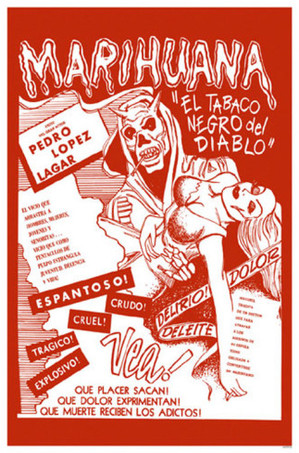 workshop down the street so upset one neighbor that he whipped out his cell-phone to call the police. I thought he might just be a particularly puritanical sort, but have come to accept that’s the general attitude. I was somewhat amused by the college kids downstairs from me (someplace in Mexico… perhaps their relations read this site) who went to all kinds of trouble to avoid even tolerant, decadent gringos like myself, from even smelling the joint (singular) they smoked one (and only one) evening. Seriously, whatever the roots of it, marijuana USE in Mexico is considered the province of the decadent rich, the wannabe gringos and social deviants.
I saw that Uruguay is about to reluctantly implement a state project to grow their own. But that is because Uruguay is a consumer nation. While Uruguay’s marijuana-user population is quite small (about eight percent of the country) compared to that of the United States (about a third to a half of the population), it wants to deal with the criminal issues that come with usage. Mexico’s issues are completely different…the percentage of marijuana smokers is about two percent of the general population… and since there is no real political or social interest in legalization beyond what already is in the law (a small amount for personal use), and a cultural bias against marijuana use, those who think we’re going to legalize the crop and start supplying the U.S. are blowing smoke.
Got smog?
From CNN:
Zapotel? Telpotec?
When the Spanish believed they’d gained control of the Sierra Negra in Oaxaca, they sent out a couple of royal tax officials, who the Zapotecs, not having much use for the niceties of Mexico City bureaucrats, ate. While like most hill-country people around the world, they don’t have much use for outsiders, they of course, like everybody else in the world, have to deal with the outside world, which sometimes is reluctant to deal with them. But, there’s always a way.
Indigenous-language FM stations have been serving remote areas of Mexico since the 1950s. At the time, the FM band was not much used and the stations were more or less “pirate radio”, but were left alone, not being of of any particular economic interest to corporate interests. With the Zapatista uprising of the 1990s at least in part 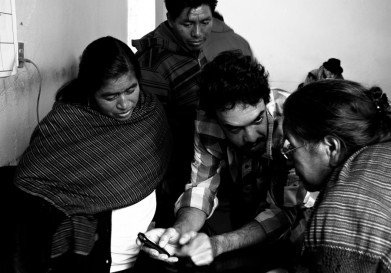 rooted in resistance to privatization of public goods (like radio frequencies) and to what was seen as unwanted control of the indigenous communities by outside business interests, there was a need for including a clause in the San Andreas Accords (which ended the uprising) recognizing the rights of these communal stations, and ceding their bandwidth to indigenous communes.
Zapotecs in Oaxaca’s Sierra Negra region … which include some of the 50,000 indigenous Mexicans without access to telephone service… have been trying for several years to convince telephone companies to at least put in cellular towers, only to be told it is not economically feasible to service the region.
It’s not that the Zapotecs don’t have cell phones… they do, but use them either to connect to the internet and download music (or listen to the community radio), and as a calculator or a camera. But they haven’t been able to use their telephones to make telephone calls. Until now.
Having installed their own towers, a computer system at Radio Comunitaria Dizha Kieru, based in Telea de Castro handles calls directed to a single number at the station, which is transferred to individual phones. At present, to avoid over-taxing the system, calls are automatically disconnected after five minutes. Still, at fifty centavo per call, as opposed to the six pesos per minute it would cost on a land line, it means Zapotecs in the Sierra Negra can say in contact with the family members working in Seattle or Los Angeles.
While Zapotel or Telpotec or whatever you want to call it has a financial hurdle to overcome… if they want to expand, they need to find less expensive equipment … the real challenges are regulatory. The Federal agency overseeing telephone service (Cofetel) is set up to deal with corporate telephone companies, not communal services. Regional phone companies have to cover at least four states, and while the communal cellular system could be expanded to cover other indigenous communities, whether it would be able to claim to be a Zapotec communal system and covered by the San Andreas Accords, rather than the regulatory framework, or if it is even a telephone company as defined in the regulations (and, more to the point, what the major telephone companies will do about the upstart) isn’t at all clear.
Source: Agencia de Noticias del Ithmo.
One tough mother…

Senator Rosario Ibarra… 87 years old and not about to quit! When her son, Dr. Jesus Piedra Ibarra was “disappeared” in April 1975, the middle-aged, middle-class housewife from Saltillo, became overnight a thorn in the side of the elites, and an unlikely champion of the oppressed.
Hounding the government for answers got no response, so in 1982 … needing a platform from which the powers that be HAD to listen to her, she became the Presidential candidate for the Workers’ Revolutionary Party… and the first woman to run for President.
Not that she had any chance of winning (she asked her supporters NOT to vote for her, but for Cuauhtemoc Cardenas), but it gave her an opportunity to hound the ruling party for answers. Which, STILL not forthcoming, led her to found Comité ¡Eureka! … seeking not only justice from those responsible for political disappearances, but FOR all political prisoners and victims of state oppression. She has been nominated for the Nobel Peace Prize several times. Twice a Federal Deputy, she joined the Senate at age 80, becoming one of the leaders of the opposition who locked themselves in the Senate Chamber to prevent Felipe Calderón being sworn in as President.
As a Senator, she continues to push for human rights legislation, railing against corruption and human rights abuses. And sometimes winning a few battles.
When people tell you not to get cross-wise with a Mexican’s mom… they mean it!
(And she takes a great photo!)
A sign of the times
Pancho Villa in 1914, hanging… not a recalcitrant landlord or perverted priest… but a street sign on what had been since the 1540s “calle de los Plateros” (Silversmith’s Street) in Mexico City, renamed (at Villa’s “suggestion”) calle Franciso I. Madero.
Villa threatened to shoot anyone who removed the sign… and no one has… even though he, himself, was shot 90 years ago today.

Peru: Here comes the sun
EFE, via Latin American Herald Tribune:
The National Photovoltaic Household Electrification Program will benefit more than 2 million people in Peru, Energy and Mining Minister Jorge Merino said.
 The program will provide electricity to poor households using solar panels, Merino said.
The first phase of the program will focus on providing solar panels to 500,000 extremely poor households in areas that lack access to the power grid.
Bidding will be opened later for contractors to install the rest of the panels, Merino said.
The energy minister inaugurated the first phase of the project Monday in Contumaza, a province in the northeastern region of Cajamarca, where 1,601 solar panels were installed.
The program will allow 95 percent of Peru to have access to electricity by the end of 2016, when President Ollanta Humala’s term ends, Merino said.
“This program is aimed at the poorest people, those who lack access to electric lighting and still use oil lamps, spending their own resources to pay for fuels that harm their health,” the energy minister said.
The National Photovoltaic Household Electrification Program will cost about $200 million, Merino said.
Even if there are the usual cost over-runs, kick-backs and hinky contracts meaning nowhere near 2,000,000 people get solar panels, a program like this should be considered successful. Solar power to SOME people is better than no power to no people. And that much less need for fossil fuels.
And I say it’s all right!
Yaquí Deer Dance
Via White Wolf Pack:


 mexfiles.net