Everyday surreality
When crossing the street in Argentina, one should look both ways… for motorboats.
La resistencia es inútil
Montezuma’s revenge… or at least Bolivar’s… Latin Americans are taking over.
First, an Argentinian in the Papacy, Now either a Brazilian — Roberto Carvalho de Azevedo — or Mexican — Herminio Blanco Mendoza, will be calling the shots at the World Trade Organization.
What next … President of the United States? (Julían Castro, 2016?).
Saints and martyrs
John Donaghy, who works for the Catholic diocese of Santa Rosa de Copán, Honduras, writes about the largely forgotten (north of the Rio Bravo del Norte) Guatemalan Bishop Juan Geradi, Conedera, murdered for investigating the genocide in his country, supported and excused by the Reagan Administration.
“Walk The Way“:
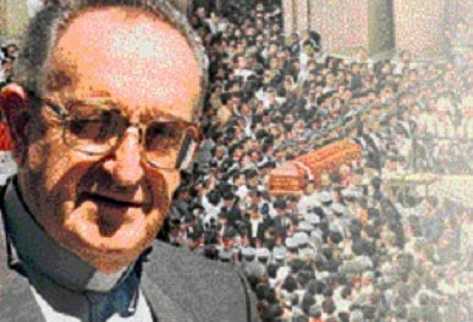
The history of Central America, especially in the 1970s and 1980s, is bloody. Many know of the violence in El Salvador, partly because of the killings of Archbishop Romero and the four US women missionaries in 1980, partly because of the overt US support of the government and military – in the mid-1980s at a rate of about one million US dollars a day.
The history of Guatemalan oppression is much less known, though it is bloodier and lasted longer…
After the war was over, the Guatemalan Archdiocesan Human Rights Office supported the Recovery of Historical Memory Project [REMHI], to investigate the killings. The project released a report that implicated the Guatemalan government and military in 90% of the 200,000 plus killings and disappearances. Guatemala City auxiliary bishop Juan Gerardi led the investigation and spoke at the release of the report.
…
Two days after the REMHI report was released, Bishop Gerardi was killed on April 26, 1988, fifteen years ago today.
I noticed the other day that the cause for canonization of Oscar Romero was moving forward, and there was mention that the Vatican may consider Jean Donavan, Dorothy Kazel, Ita Ford and Maura Clarke) not raped and murdered because — as Alexander Haig said “they weren’t just nuns, they were social workers” — of their faith… i.e., as saints and martyrs.
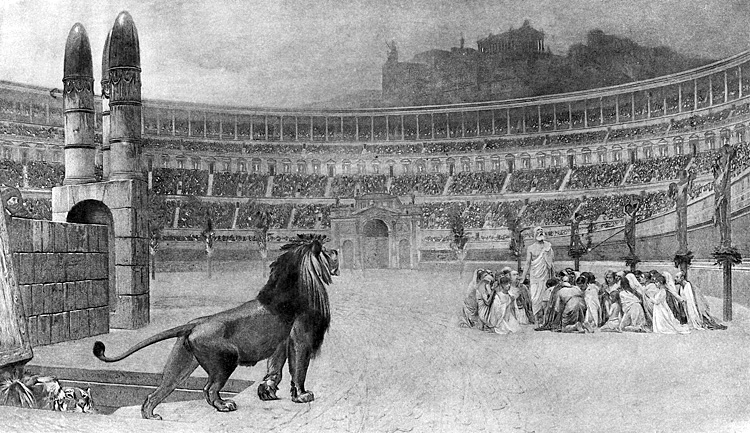
The Church recognized several of the victims of the Mexican Cristero War of the 1920s as saints and martyrs, but in future histories of the Church Ronald Reagan is going to give Plutarco Elias Calles a run for the title as the creator of the most saints in the Americas. In the larger world, Calles may only be an also-ran… when it comes to offing Christians, Reagan will rank up there with the Emperor Diocletian.
Less than a perfect spy
TWO spies in the news today.
The United States is seeking extradition of former Agency for Interntional Development officer Marta Rita Velazquez. In October 2002, Defense Intelligence Agency senior analyst Ana Belen Montes named Vazquez as the person who recruited her to work for Cuban intelligence. However, Velazquez was not indicted until 2004, by which time she had quietly retired from the U.S. government and moved to Sweden.
Montes and Vazquez seem kind of old fashioned… profession intelligence officers working as spies for another country’s secret service. The kind of people who know what they’re doing, and don’t make for all that intriguing of stories.
Which perhaps can’t be said for U.S. spy… er… alleged spy Timothy Hallet Tracy. Venezuelan Interior Minister Miguel Rodriguez Torres named Tracy as “el gringo”, the bag-man (and a possible adviser) to a a ring of right-wingers seeking to foment violence and chaos ahead of, and after the recent Presidential elections, supposedly to justify U.S. intervention on behalf of “democratic restoration”.
Tracy’s family claims the accused spy was only making a documentary. Frank Bajek, writing for the Associated Press quotes a friend of Tracy, who refers to the 35-year old film-maker as a “kid”, as saying:
“This whole thing came about with him at a party in South Florida,” he said. “He met this cute girl who says, `If you really are a documentary filmmaker you’ll come tell the story of what is happening in Venezuela,’ and if you say something like that to Tim he goes, whether or not he knows a single person there or knows anything about the political situation or the consequences.”
Tracy’s resume doesn’t indicate any familiarity with political reporting, or show any experience in serious reportage or coverage of anything to do with Latin America. His film samples feature some guy (who looks to be Tracy himself) running around with a high powered weapon, but… if the videos show by the Interior Minister today are Tracy’s work, he is either a really poor film maker, or he just didn’t know what he was doing.
Cherchez la femme… South Florida has a long history as the meth lab of bad ideas when it comes to exile plots against Latin American regimes. The Venezuelan community — not known for their sympathies for the Bolivarian Republic — undoubtedly includes its share of “cute girls” more than willing to convince a poor sap who advertises himself as, among other things, a “mischief maker” — to act as the go-between with so-called “student groups” that (again, given the video shown by the Interior Minister) appear to be third rate operatives.
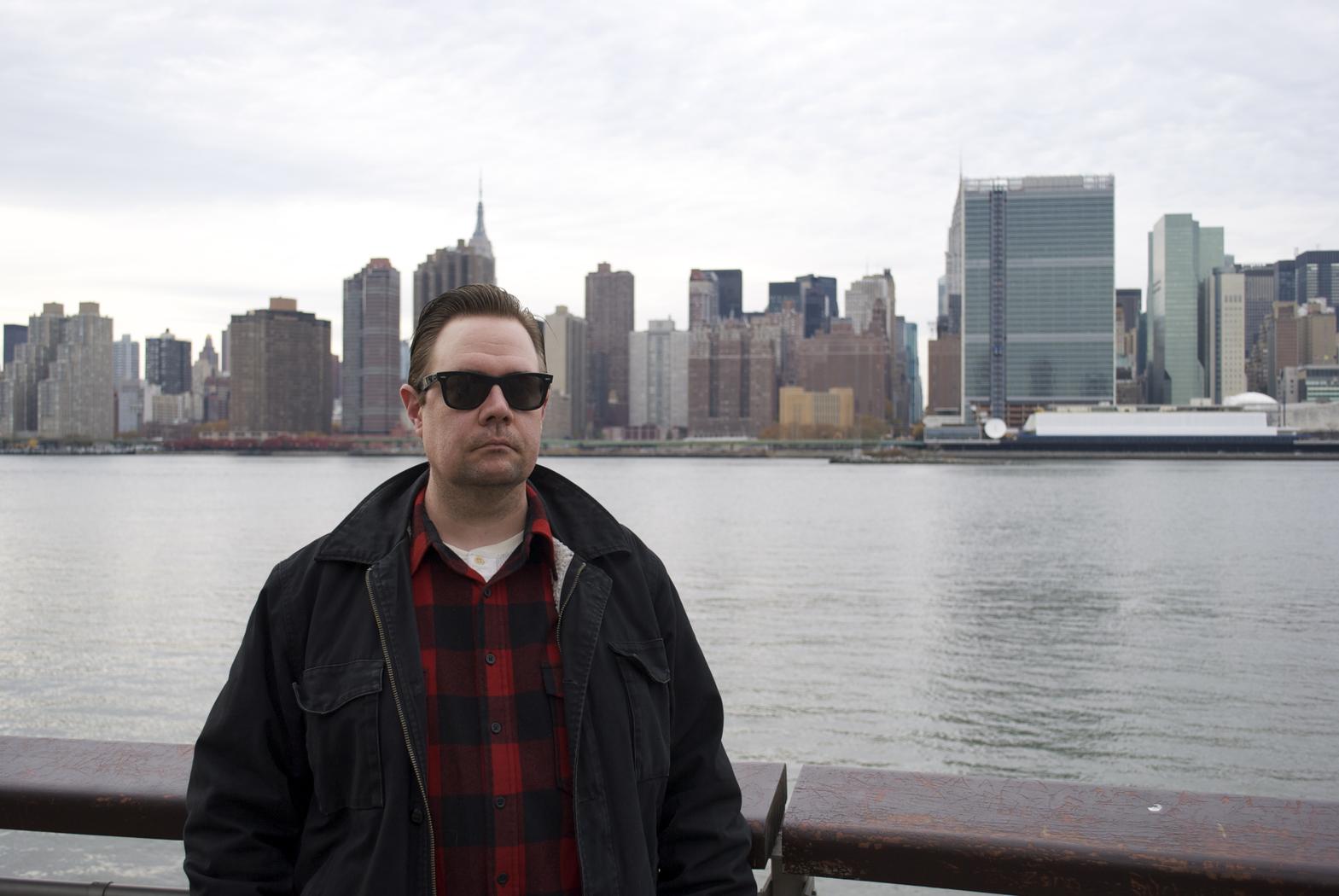 Yeah, I suppose this upper middle class guy from Grosse Point could be a U.S. government agent, and it’s not like the U.S. government hasn’t hired some less-than-competent spies before (or, as with Ms. Velazquez and Ms. Montes, did have competent agents… working for the other guys), but it doesn’t look as if he could be the mastermind of anything.
That the group he is accused of was engaged in domestic terrorism (and a lot more people… about 70 more… were killed in the violence they set off than were killed by the Tsarnaev brothers in Boston), he may indeed get to make a documentary on about Latin America… a first-hand look at Venezuelan prison life.
Terror in the hills, or on the stock market?
Yesterday (24 April 2013) IncaKolaNews posted the following:
Could Sierra Metals (SMT.v) please tell us more about the four company employees kidnapped, with whereabouts still unknown, by Mexican narcoterrotists recently?
After all, any normal public listed company would feel obliged to inform the market about such an event, wouldn’t it? The fact that the four men working for Sierra Metals (SMT.v) are still missing weeks after the event and nobody seems to know what has happened to them also adds to the mystery.Or perhaps SMT just wants everybody to ignore what’s happening in and around its Chihuahua operations, which is why they’ve been so quiet about it.
The Inca knows more about the hinky world of foreign mining operations in Latin America than anyone, but I wonder if “narcoterrorist” is the right word here. Assuming mining company employees were kidnapped by people involved in the narcotics trade, it would seem to be an intermural squabble between two competing export industries.
“Terrorism”, which is usually defined as violence against civilians meant to influence state policy, and while gangsters involved in narcotics exports are said in some instances to be a de facto state in parts of Chihuahua, this would still be a common crime.
It COULD be quasi-political, simply in that mining operations are staples of local economies in some areas of this country, and reforms in mining laws are being debated in Congress, making them a political issue. Sierra Metals press releases have been talking about their on-going lawsuits with Polo y Ron Metals over the validity of an option agreement on properties to which Sierra may, or may not, have had a concession. Sierra Metals was not working the concession, and concessions not being exploited are supposed to be cancelled, which would have made the option problematic, to say the least.
If — as has been said — this is a chronic issue with Canadian owned mining operations, and new mining laws come into effect here in Mexico, mines with dubious concessions might be at risk throughout the country. More to the point for some, the values of shares in the companies holding questionable (or clearly illegal) concessions may plummet… and those are the kind of thing companies kill (and kidnap) people to prevent, or at least prevent from becoming known.
What’s wrong with this picture?

Another first
Siglo 21 was a small, scrappy newspaper with a young and untried staff back in 1992 when cub investigative reporter Alejandra Xanic convinced her father to chauffeur her around the back of a PEMEX plant and give her a boost over the wall, checking out reports of gas leaks into the sewage lines in Guadalajara… a story ignored by the tame press of the era until the lines DID explode on 22 April… to the shock of everyone, except the PEMEX technicians who had warned Xanic of the problem, and the few readers of Siglo 21.
Although Siglo 21 never survived as an independent publication, it’s short existence was a factor in convincing the Mexican media of the need to take a more critical attitude towards “official” pronouncements, and to do their own investigation. Xanic herself moved on to working for several national publications, and for the foreign media.
 Now associated with the Center for Public Integrity, her work in uncovering, and unraveling, an explosive situation of another sort … and one that while not producing as many immediate fatalities probably was much more damaging to the economy in this country (and not just in one locality) was recognized last Monday when, together with U.S. reporter David Barstow, her investigation into WalMart’s expansion into Mexico through bribery for the New York Times made her the first Mexican woman to win a Pulitzer Prize.
Sources: Washington Post, Guadalajara Reporter)
Let us tend to our own gardens
On Wednesday, the American Secretary of State, John Kerry, called Latin America the “back yard” of the United States.
During a speech before the Foreign Affairs Committee of the House of Representatives, and following the old Monroe Doctrine, regardless of the sovereignty of Latin American countries, Kerry considers these countries as their “back yard” and added that plans are being made to change the attitude of some of these nations.
… which I guess means we’re in the garden, minding our own business, and the USA is out on the street.
Kerry is making a good start for being the most asinine Secretary of State to issue statements on Latin America since, oh, at least Hillary Clinton. Who needs to change their attitude, dude?
A tale of two cities: Boston and Guadalajara
While I’d be the first to admit that I’ve spent more than a healthy dose of my time reading (and commenting on) the bombing last week in Boston, I hesitated to say anything about it here, since I try to limit comments about the U.S. to matters related to Latin America (or at least Latin Americans) and, frankly, there isn’t much to say.
That the bombing appears to have received more media attention here in Mexico than more serious international crimes, like the 11 April 2004 Madrid subway bombing and almost as much as a more devastating domestic terrorist attack, the 15 September 2008 grenade attack in Morelia, in which eight people were killed and 100 wounded is probably more a reflection of U.S. political and economic power (and U.S. cultural influence) than anything.
While violence in the United States often tends to be completely irrational (compared to here, where other than drunken spouses or an occasional psychopath, most murders are purely rational acts, generally involving economic decisions), whatever motive there was for the Boston “massacre” simply doesn’t apply here. If it was a political act, there is no reason for it to happen in Mexico, The country has friendly, or at worst, indifferent, relations with every other country on the planet, and no real interest in any other country’s internal affairs. While we have ethnic conflicts within the country, no real overt attempts to demonize any particular minority. As to immigrants, as I wrote way back in January 2004:
People worry about crime (though statistically, the crime rate is dropping), but they worry almost as much about police abuse. What they don’t worry about are foreigners – and terrorists. There are concerns about SOME illegal aliens: mostly Guatemalans working at shamefully low wages for some agricultural concerns here or likely to be abused by gangsters (most of whom are ex-soldiers from El Salvador). Belizians and Colombians sometimes find themselves accused of drug dealing (and sometimes ARE drug dealing), but that’s about it. Undocumented aliens from just about everywhere – including the United States – are all over the Republic, causing… not a stir. As long as people pay their taxes, stay out of trouble and don’t take jobs from unemployed citizens (like the Guatemalan workers), Mexicans just don’t see much terrorist potential in gringo schoolteachers, Russian cooks, Ecuadorian vendors or Argentinian models…
That our crime rate ratcheted up alarmingly after 2006, when — aided and abetted by the United States — the Calderón Administration launched an ill-planned, unfocused “war on organized crime” (meaning, against those gangsters the U.S. would start referring to as “Transnational Criminal Organizations” who had the temerity to provide U.S. consumers with the goods and services they wanted outside the control by U.S. corporations) has, however, forced us to become more sensitive to not so much the violence itself, as to the reaction to violence.
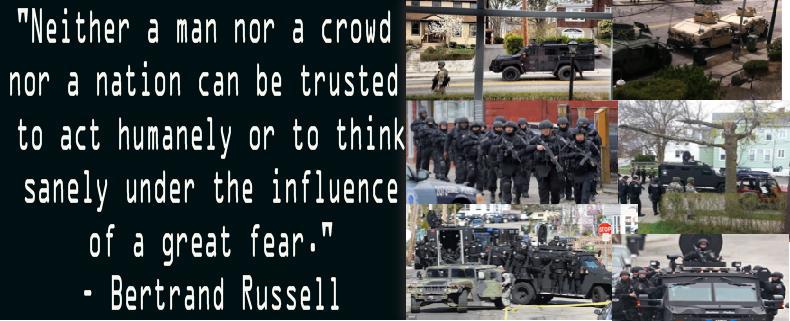 What was really shocking was less the images of bloodshed (we have Blog de Narco if we need a fix of crime porn) than of a metropolitan area under a self-imposed state of siege. The images of armed police in military battle gear storming through a residential neighborhood, pulling people out of their homes at gunpoint, is something we’ve seen, and reacted to with mixed sentiments.
All too often, the “bad guys” here are dead before anyone has a chance to question them about their superiors or motives, and the U.S. authorities are due a grudging respect for taking their target alive (if it wasn’t pure chance that Dzhokhar Tsarnaev is alive… and there is a every chance the public will never hear his story). The scenes of our paramilitary and military operations against major criminals (and even, occasionally, against 19 year old students) often look very similar to the robo-cops of Boston. With an important difference.
Metropolitan Boston has a slightly larger population than Metropolitan Guadalajara. In April 1992, a gasoline leak into the sewage lines caused an explosion that killed over 250 people, injured over 500 and left 15,000 people homeless. A grenade attack on a bar in that city in February this year killed 12 people, and in March, 26 buses were high-jacked and burned at 16 separate locations, 11 within central Guadalajara, at the same time that gangsters and police engaged in running gun battles in our second city. None of which paralyzed the metro area: schools stayed open; buses (the ones not on fire) and the metro system were running; families did not find themselves in “lock down“; and the messy, unpredictable thing called normal life continued.
I’m told that when the capture of young Tsarnaev was announced, people began cheering “USA! USA! USA!” as if they had just won… won what? If Tsarnaev was a “foreign terrorist” and not just a common criminal (though honestly, what’s the difference, other than possible motive?), or even a domestic terrorist, then the “terrorists won”, not the USA. Although the most stringent definitions of a “failed state” is one in which the police are powerless, the term has been loosely used by people who should know better (like Hilary Clinton when she was U.S. Secretary of State) to describe Mexico as a whole. But, if we use the definition of states where basic services have collapsed under a criminal threat, then USA, or Metro Boston at any rate, was clearly a “failed state”. A failed state is one in which a million people (a quarter of the entire metro area) is ORDERED to stay in their homes… and willingly obeys.
Cheering a state of siege, or celebrating its end (perhaps simply as a break from their ordinary lives?) was, I assume, a minority reaction. Surely, USAnians are freedom-loving, independent types and not the collectivist, passive, state-dependent Mexicans… and maybe the cheering reflects their support for the Second Amendment to the U.S. Constitution and the functioning of a “well-regulated militia”. Oh, I know that sounds cynical, and understand that people in the U.S. trust their police more than most people do, but it is amazing that we haven’t heard of anyone being killed among the million people who were effectively put under house arrest. I suppose without the “lock-down” you might had even more chaos, and more casualties with armed, self-defined militias or free-lance security types hunting for… Muslims? White Muslims? Guys with foreign accents? Teenagers with backwards baseball caps? White kids? Anyone they heard rumors might be involved?
Massachusetts in general, and Boston in particular, has had a reputation for well-educated people who tend to act sensibly, but even so… and even given that the state has slightly stricter gun laws than other places in the United States (that is to say, it has some minor restrictions, but nothing like those in countries like Australia or, oh, say Mexico) … it’s amazing to me that we didn’t hear of “accidents” or — as during the recent hunt for rogue cop Christopher Dorner in California — innocent people being shot by nervous policemen.
So the police, and the temporary police state comes out this one time as the good guys. And people cheer their lost liberty. What if, next time there is something described as a “terrorist attack” it occurs in a less urban setting, or where there is not the overwhelming capacity for police state tactics you had available in Boston.
Not the best of times, nor the worst of times.
Will Mexicans stomach a Canadian invasion?
Foreign foods of various kinds have been incorporated into Mexican cuisine. While there are obvious exceptions like the cream cheese on a cracker and hunk of dead fish called “sushi” (and last time… and it will be the last time… I tried some, I came closer to admitting myself to the emergency room than any time in my 12 years in Mexico), “foreign” foods in Mexico usually do well, when they are Mexicanized. Some of our most “traditional” foods are foreign — tacos al pastor being Arab cuisine and bollios being a Mexican version of French bread… and about the only thing worthwhile the French occupation troops in the 1860s left behind.
But, of course, the Arabs and French cuisine can be eaten just as it comes originally, but , we’ve managed to incorporate a few items from the … er… cuisine-challenged corners of the world by Mexicanizing them into a more edible and tasty product: back in the early 19th century, Cornish miners working in Pachuca introduced “Cornish pasties” which aren’t bad, just boring. Mexicans who had the good sense to at least add chiles and create pastis. And, “thanks” to NAFTA (and U.S. cultural imperialism), Mexicans are eating crap like potato chips and hamburgesas, though the best of the lot comes with chiles and lime or at least something more intriguing than the U.S. version … but, until now, the OTHER NAFTA partner’s cuisine has been overlooked.
If you’re wondering what Canadian cuisine is… and I was… the Canadian Ministry of Agriculture is trying to change that. They’ve invested $50,000 (that’s Canadian dollars… about 600,000 Mexican pesos) in answering that question. They’ve dispatched a clean, well mannered roach-coach to serve out such “traditional” fare (concocted in the finest greasy-spoons of rural 1950s Quebec) as “poutine.”

Papas fritas en salsa de carne con cuajada not exactly being familiar to your average Mexican, the Canadian marketing geniuses (?), taking their cue perhaps from the Mexican cooks who spiced up Cornish pasties to create pastis have put a lot of work and research into finding secret that will get Mexicans to raise their cholesterol levels … and think they have the answer: replacing the curds with hunks of Oaxaca cheese.
No chiles?
(National Post, thanks also to David Agren)
¡Ai, Papí!
These guys are not going to make father of the year.
49-year old Peruvian man was charged with dousing his son with gasoline and setting him on fire allegedly because he was laughed at for having a gay son.
Rescued by an aunt, the twenty-two year old son — HIV positive and suffering from tuberculosis (as well as having suffered serious burns) — is now in a church-run shelter in Iquitos.
That the father is named Hitler — Hitler Baneo Núñez — and from the backwoods (ok, back jungle) of Peru, makes me think he wasn’t exactly raised with the values of tolerance and love…

NOOOOOOOOOOOOOO!
… which makes me wonder what excuse there is (obviously none) for Horacio Cartes. Cartes is the U.S. favored Liberal Party (i.e., neo-liberal capitalist) candidate for President of Paraguay, and — in the Paraguayan view of such things, despite known dabblings in cigarette smuggling and narcotics trafficking, a fine upstanding businessman. Running for President in a country bordered by tolerant Uruguay and Argentina (both of which permit same-gender marriage), I guess a candidate needs to make some gesture to show he’s his own man… but geeze, at the expense of your own kids?
Cartes, who has compared gays to monkeys, said he’d shoot himself in the balls if his son married another man. Maybe one of his sons would be willing to do a unique service to his country… which at least would guarantee that, unlike a recent supposedly celibate president, he didn’t become father of his country out of season.
Justice deferred, justice denied
Elisabeth Malkin, New York Times:
A Guatemalan judge on Thursday annulled the genocide trial against the former dictator Gen. Efraín Ríos Montt, a stunning ruling that could force prosecutors to begin the case all over again.
The decision, by Judge Carol Patricia Flores, brought an abrupt halt to a trial that has become a test case of Guatemala’s judicial system and has reopened painful memories of the bloodiest chapter in the country’s long-running civil war.
Judge Flores was involved in the case early on but was not the trial judge hearing the evidence. Her ruling appeared to be based on a Supreme Court decision first to recuse her, in late 2011, and then to reinstate her a few months later. But the judge said Thursday that the reinstatement decision was never communicated to lower courts, which she said nullified all the court proceedings related to the case, including the decision to send it to trial.
[…]
Guatemala’s attorney general, Claudia Paz y Paz called Judge Flores’s ruling illegal and said her office would appeal.
>The decision was a blow to prosecutors and lawyers for survivors’ groups that have worked for 20 years to bring high-ranking military commanders to trial for the atrocities committed in the early 1980s.
“We won’t be able to convince many witnesses to testify again,” said Andy Javalois, a legal adviser to the Myrna Mack Foundation, a human rights group.
I’m no expert on Guatemalan court procedures, but this is the first time I’ve ever heard of a judge basically saying she wasn’t the right court… in the middle
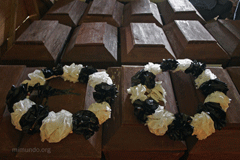
Exhumed bodies of genocide victims prepared for re-burial in Ixil (photo: James Rodriguez, mimundo.org)
of a trial… and the whole thing is more than a little hinky. One suspects that the betting is that the genocidal General Efraín Rios Montt, now 86 years old, will do everyone a favor and die of old age before the evidence embarrasses more than just the Guatemalan killers, but raises evidence of the “intellectual authors” of the crime, some of whom, like Ronald Reagan, obviously are unavailable for testimony.
As big a disappointment in the annals of justice as this is, at least the Guatemalans credit for getting a case for crimes against humanity this far in their own courts. Fat chance the “advanced” legal system in the United States will even indict, let alone bring to trial any one of like Henry Kissinger or Donald Rumsfeld or Dick Cheney.


 mexfiles.net