Did the Border Patrol commit a murder inside Mexico?
Isidro Alvarado, 36, said he was walking less than 20 feet behind José Antonio Elena Rodríguez when two other young men suddenly ran past him and into a side street. He then heard gunshots come from different directions and he saw José fall to the ground.
Alvarado ran south in the same direction as the two men to take cover and call the police, he said earlier this week as he retraced his steps near the DeConcini Port of Entry.
On Oct. 10, 2012, Nogales, Ariz., police and the Border Patrol responded to a 911 call about 11:30 p.m. Officers reported seeing two people with marijuana bundles wrapped around their body on International Street, according to police reports.
They were trying to climb back into Mexico, the report said, when a group started to throw rocks at the officers over the border fence.
When they refused to stop, a Border Patrol agent who was near it opened fire into Mexico, hitting one of them.
[…]
José’s body was found on a sidewalk across Calle Internacional – about 40 feet from the border fence that sits on a descending bluff – with only an orange plastic lighter and a Blackberry in his pockets.
He was shot about eight times: twice to the head, once on his arm and five times on his back. At least five bullet wounds clustered on his upper back had to have struck him after he was down, according to a ballistics report by Sonora state investigators, obtained by the Arizona Daily Star.
Investigators concluded the shots came from the United States because they didn’t find any shell casings on the Sonora side. They noted seeing 14 casings through the 20-foot tall fence in two different spots: 11 casings in one area and three about 26 feet east.
Mexico Trucker comments:
After a summer where the murders of Mexican citizens by Border Patrol firing their weapons across international borders became almost a monthly occurrence, with the excuse being that they were “under attack by rock throwers”, and the outcry raised by the murder of 16 year old José Antonio Elena Rodríguez, the incidents have stopped.
No more suspicious shooting by Border Patrol agents and no claims of rock throwing to justify the crimes of these rogue agents. So are we expected to believe that all of a sudden, from Matamoros to Tijuana, that these “rock throwers” have seen the light and decided to no longer assault the BP agents? Or is a more realistic scenario being that the claims by Border Patrol agents of being attacked by rock throwers to justify their criminal actions (ie: murdering innocent civilians) were totally bogus from the beginning?
I really doubt the U.S. government is going to fess up to having invaded another country (which is what these incidents are), or to extradite the individuals responsible, but something beyond a stiffly worded diplomatic note is required… like a huge payout to the families, a public apology from the United States, an open trial of those involved, and … oh… kicking in some bucks for youth services and facilities — basketball courts, soccer fields, computer centers — on this side of the border wouldn’t be out of line, if the U.S. wants to pretend the problem is Mexican kids hopping the fence for lack of anything better to do.
How to talk Mexican

The first country-western song…
José Marín was apparently a good composer and a very bad priest. He got tossed in the slammer for murder, went over the wall and wrote this piece about 1670 while on the lam. OK, so the country is Spain, and that’s west of here, so with a title like “My heart’s in jail” and a hard-luck story like that… it was Nashville before Nashville was Nashville…
Life, liberty and the pursuit of geekdom
 The new telecommunications act, that is now going to the Senate here is in some ways a disappointment. It was initially meant to open the airwaves to communal interests — including indigenous language channels and union, public access and university run channels, but somehow ended up allowing for up to 100 percent foreign ownership of new television channels and a “must carry” provision that only says that cable television providers “must” provide access to any channel with more than 50 percent national coverage (stations are basically networks here… Televisa has several different channels, and controls about 80 percent of television broadcast now. Basically, it’s like having FOX, FOX and FOX (and maybe CNN) unless you subscribe to one of the overpriced cable networks. Adding FOX (the most likely foreign company to buy into a Mexican channel) and something carrying U.S. sitcoms dubbed into Spanish doesn’t sound like much of an improvement. But things aren’t all THAT horrible.
The good part of the Chamber bill (which may or may not get through the Senate without huge changes) is a provision that would require the government to guarantee that at least 70 percent of households, and 85 percent of businesses had access to at least 5 Mb download capacity (not high, but the average among OECD nations) and…a CONSTITUTIONAL GUARANTEE OF … along with equality before the law regardless of color, belief (or lack thereof), political opinion, primary language, sexual preference, gender, and the right to free speech, collectively struggle for common goals, access “decent and sanitary” housing and family planning (yup, all those are in the Mexican Constitution, though we don’t always get them) the bill would add the right to broadband access.
Mexicans Unite! We have nothing to lose but dial-up!
Water, water… and not a drop to waste

One hates to see traditions die, especially when they were for so long seen as harmless fun… like the neighborhood water wars that used to break out every Holy Saturday in Mexico City. With water shortages no joke, the traditional water fight can earn you up to 36 hours in the slammer for wasting resources, or a fine of 40 days minimum wage. 15 adults and two minors were arrested today for… having some fun, alas…
Meanwhile in Chihuahua, water fights are deadly serious:
Over the past decade, Mexican Mennonites have been changing their style — not how they dress or interact socially but their traditional farming patterns. Once forbidden as a transgression of God’s natural laws, irrigated agriculture backed by increasingly deep wells and the most advanced farming machinery has become the norm. Mennonite farmers are meeting — and taking advantage of — the challenges of climate change and intensifying drought cycles by embracing the most unsustainable practices of capital-intensive, resource-depleting agribusiness.
With large families — typically six or more children — Mennonites in Chihuahua routinely outgrow their original colonies, obligating them to establish new farming colonies. Leaving the original colonies, they are converting barren rangeland and desert expanses into agribusiness plantations by tapping groundwater reserves with new wells descending to unprecedented depths.
[…]
… As the Mennonite colonies have expanded to previously uncultivated areas of the state, the proliferation of hundreds of deep wells for irrigation is rapidly depleting aquifers and basins as neighboring farmers and ranchers see the yields from their shallower wells dramatically diminish.[…]
One result has been escalating demands by small farmers and members of ejidos (government granted land), along with environmental organizations, that the federal and state governments halt and reverse the proliferation of deep wells, leading to heated and sometimes violent incidents. The most tragic and ominous was the Oct. 21 assassination of a leader of the small farmers’ organization El Barzón and his wife. They had been organizing against the illegal and unsustainable pumping of groundwater by a Canadian mining company and new agribusiness operations in central Chihuahua. […]
Several months previously, on July 2, the first shots of the new water war in Chihuahua were fired by rogue police in an unsuccessful attempt to end the mobilization of more than 300 small farmers who had gathered to prevent the drilling by Mennonite farmers of yet another illegal well south of Flores Magón. Wielding semi-automatic weapons, the police barged into the gathering of unarmed farmers and forcibly attempted to confiscate the camera of a reporter/photographer — me — who was chronicling the Barzón-organized action.
When the farmers pushed closer to prevent the police from successfully seizing my camera, the uniformed gunmen began firing up in the air and into the ground — a confrontation that is now regarded as the first skirmish in the new water wars.
At a late-night meeting in the Palacio de Gobierno in Chihuahua City, top state and federal officials met with the frightened and indignant farmers and agreed to form a collaborative working group to identity and shut down illegal wells in that water basin. In response, a few days later a quickly organized small group of Mennonite farmers declared that they would protect their wells and their livelihoods, taking up arms if necessary despite their religiously professed pacifism.
“Several months previously, on July 2, the first shots of the new water war in Chihuahua were fired by rogue police in an unsuccessful attempt to end the mobilization of more than 300 small farmers who had gathered to prevent the drilling by Mennonite farmers of yet another illegal well south of Flores Magón. Wielding semi-automatic weapons, the police barged into the gathering of unarmed farmers and forcibly attempted to confiscate the camera of a reporter/photographer — me — who was chronicling the Barzón-organized action. When the farmers pushed closer to prevent the police from successfully seizing my camera, the uniformed gunmen began firing up in the air and into the ground — a confrontation that is now regarded as the first skirmish in the new water wars. At a late-night meeting in the Palacio de Gobierno in Chihuahua City, top state and federal officials met with the frightened and indignant farmers and agreed to form a collaborative working group to identity and shut down illegal wells in that water basin. In response, a few days later a quickly organized small group of Mennonite farmers declared that they would protect their wells and their livelihoods, taking up arms if necessary despite their religiously professed pacifism.”
(Full story by Tom Barry at Desert Exposure)
Making Mexico “just like US”?
I hope Frontera NorteSur forgive me for a direct cut and paste, but given the number of “privileged migrants” who come to this site (“rentistas” and other “expats”), and how much they piss and moan about about the bureaucratic snafus with the new immigration system, it’s important to read about the issues facing the bulk of immigrants to (and migrants thru) Mexico…
March 30, 2013
Special Report
Mexico’s Immigration Policies under Renewed Fire
Mexican immigrant advocates and their supporters are ramping up demands for changes in the country’s immigration policies. For starters, 50 civil society organizations are calling for the dismissal of National Migration Institute (INM) Commissioner Ardelio Vargas Fosado, the new head of the federal agency responsible for enforcing Mexican immigration law.
Citing Vargas’ long career in the national security field, critics contend the official and his top subordinates represent the imposition of a “policing profile and criminalization” in migration policy under the new Pena Nieto administration.
Pro-migrant activists including Father Alejandro Solalinde, the internationally-recognized director of a Catholic Church-supported migrant shelter in Oaxaca who spent two months in forced exile last year due to threats, point to Vargas’ participation in the 2006 repression of the rebellious town of San Salvador Atenco in Mexico state, an incident in which at least 27 female detainees alleged they were sexually assaulted by police officers, as well as the suppression of the Oaxaca teachers’ strike and popular rebellion in the same year.
In 2006 Vargas was a high-ranking official with the old Federal Preventative Police, which played a key role in both the Atenco and Oaxaca crackdowns.
>From 1994 to 2005, Vargas was the delegate for the national intelligence agency CISEN in Chiapas and Oaxaca. His assignments in the southern states coincided with armed revolts organized by the Zapatista National Liberation Army (EZLN) and Popular Revolutionary Army, the rise of government-supported paramilitary organizations, the deportation of foreigners sympathetic to the EZLN, and the killings and/or forced disappearances of hundreds of people.
After the Fox administration ended in 2006, Vargas served as a federal congressman for the Institutional Revolutionary Party (PRI) before taking the post as head of state public safety in Puebla under the administration of Gov. Rafael Moreno Valle.
A rancher and lawyer by trade, Vargas was the municipal president of Xicotepec, Puebla, from 1987 to 1990.
In an appeal issued earlier this month, Solalinde and other migrant advocates urged the replacement of Vargas and other high INM officials possessing police backgrounds with “functionaries that have ample moral solvency, a professional profile appropriate to the post and legitimacy in the eyes of society…”
Just prior to the Holy Week-Easter vacation, Vargas’ critics got a boost in the Mexican Congress when Senator Layda Sansores of the Citizen Movement party presented a resolution demanding that President Pena Nieto fire Vargas because of the latter’s alleged history as a repressive official.
Sansores called for a thorough revamping of the INM. “It does not function for what it was created to do,” the senator from Campeche insisted. “It’s punctured everywhere by ineptness, and because it criminalizes migrants,” she added. “Let it serve as the fertilizer for a new, renovated institution which responds to the social reality in which we Mexicans live.”
Sansores’ resolution was turned over to the Mexican Senate’s migrant affairs commission. There was no immediate public comment from Vargas or other Pena Nieto administration officials concerning the criticisms of the INM chief and the mounting calls for his ouster.
Four months into the Pena Nieto administration, Mexico’s migration policies stand at a crossroads. While advocates of Central American and other foreign nationals who pass through the country on their way to the U.S. demand a humanitarian approach to the migrant question, Mexico’s role as a kind of exterior Border Patrol for the United States continues under the Pena Nieto government just as it did during the previous two administrations.
At the same time, immigration policies are getting more attention in the Mexican Congress. As in the U.S., tensions and contradictions swirling around human rights, border security and economic insecurity underpin immigration controversies in Mexico.
Rights organizations and institutions including the official National Human Rights Commission, Amnesty International, Sin Fronteras and others have long documented a litany of abuses of migrants traveling in Mexico, ranging from mass murder and kidnapping to sexual assaults and slavery. Many migrants have died or wound up mutilated from accidents on railways used to cross the Mexican Republic.
Estimates of the number of Central Americans who have disappeared in Mexico run into the tens of thousands. And speaking up for undocumented migrants is risky business. Defenders like Father Tomas Gonzalez and Ruben Figueroa of the Catholic Church-supported “72” migrant shelter in Tabasco have been the targets of frequent threats and attacks.
Earlier this month, Amnesty International warned that the migrant crisis had not gone away with the advent of the new federal administration. “The government of Enrique Pena Nieto, which yesterday completed 100 days in office, has not taken any step towards correcting the absolute failure of the previous administration in confronting the humanitarian crisis,” Amnesty International charged.
In recent weeks, the Federal Police (PF) has been very active in detaining migrants. In March, the PF detained at least 59 migrants in Oaxaca and 19 in San Luis Potosi. Although the vast majority of the migrants were from Central American nations, two of the detainees were from China and four from Albania.
State police forces have also stepped up migrant detentions. In Zacatecas, for instance, the State Preventative Police picked up seven Central American nationals at a checkpoint this month who were traveling from Chiapas.
On March 22, Chiapas state police, in coordination with the PF, INM, federal attorney general’s office and the Mexican military, detained 41 Central American migrants. Typically, bus drivers are held for investigation of human trafficking in such detentions.
In an episode reminiscent of high-speed U.S. border chases, one Honduran migrant was killed and another injured March 18 after an unidentified police patrol chased a truck carrying migrants on the border line between Chiapas and Oaxaca. The dead man was identified as 23-year-old Jonathan Mondragon Sarmiento. The Chiapas state attorney general’s office said it was investigating the fatal chase.
This year’s detentions follow in the path of massive detentions carried out during the presidential administrations of Vicente Fox (2000-2006) and Felipe Calderon (2006-2012). According to the Interior Ministry’s Migrant Studies Center, Mexican authorities detained 1,114,874 migrants during the Fox administration and 508, 361 during the Calderon administration.
On the other hand, government officials increasingly stress the humanitarian nature of their actions. They routinely say detained migrants are turned over to the INM, given medical exams and accorded full respect of their human rights. The legal authorities also frequently report rescuing migrants from the clutches of human traffickers, as in the recent case of 18 women from Central America and southern Mexico who were purportedly forced into prostitution in San Cristobal de las Casas, Chiapas.
Migrant advocates contend that women and children have especially suffered in the prevailing immigration regime, with women sexually abused or coerced by corrupt agents and minors inappropriately detained and not given access to consular officials from their respective nations. Like the United States, family separation has been an issue.
INM statistics show that 9,160 women and girls were detained in Mexican immigration stations during 2011, with the number of female detainees rising to 11,958 the following year. During the Calderon administration, the non-governmental organization Sin Fronteras documented verbal, psychological and physical violence against women by INM agents. In some cases, women were suddenly taken from dormitories in the evening and later returned visibly shaken and unwilling to talk about their experience, according to Sin Fronteras.
The lower house of the Mexican Congress approved reforms this month to the national immigration law, requiring the INM to notify consulates of the presence of unaccompanied minor children and mandating the transfer of children to the Integral Family Development (DIF) shelter system instead of holding them in immigration detention centers. The legislation passed by a unanimous vote of 434 representatives, with across-the board political support.
“The problem is that our country requires guaranteeing protection of human rights in this sector,” said Green Party (PVEM) Congressman Eduardo Ramirez Aguilar. “The reality is that this right is not preserved in the immigration stations, but it’s positive for the DIF to attend (minors) so they are given adequate spaces.”
As the Easter holiday loomed, about 100 undocumented Central Americans and supporters from the Mesoamerican Migrant Movement once again staged a public protest. Gathered in the state of Tabasco to reenact the Stations of the Cross, the activists simulated the crucifixion of a 16-year-old young man from Guatemala, Kevin Barrientos, on one of the cars of “The Beast,” the infamous train that transports migrants north across perilous territory.
“The migrants have to be taken down from the train where they are massacred,” said activist Ruben Figueroa. “The train tracks are stained with migrant blood.”
Figueroa’s words proved more than metaphorical. On Good Friday, unknown assailants shot up a train station in Tabasco, killing 22-year-old Kelvin Saul Cruz of San Pedro Sula, Honduras.
Sources: Cimacnoticias, March 25 and 26, 2013. Articles by Patricia Chandomi and Adriana Franco Rosales. La Jornada, March 19 and 29, 2013. Articles by Elio Hernandez, Roberto Alberto Lopez and Notimex. Mexican Editorial Organization/El Sol de Tijuana/El Sol de Mexico, March 6, 19, 20, 21, 22, 26, 29, 2013. Articles by Bertha Becerra, Gabriel Xantomila and DPA. El Diario de Juarez/Notimex, March 22, 2013. Somos Frontera (El Paso Times)/Reforma, March 12, 2013. Proceso/Apro, March 11, 2013. Article by Gloria Leticia Diaz.
Frontera NorteSur: on-line, U.S.-Mexico border news
Center for Latin American and Border Studies
New Mexico State University
Las Cruces, New Mexico
For a free electronic subscription
email:fnsnews@nmsu.edu
Soroya Jimènez, D.E.P.
Soroya Jimènez Mendivil, the first Mexican woman to win a gold medal in the Olympics (in Women’s 58 Kg. weightlifting, at the Sydney Summer Games in 2000) died earlier today at the age of 35.
Raised in the Mexico City suburb of Satellite, the athletically inclined Soroya and her twin sister Magali were recognized as outstanding basketball players while still young girls, although were steered towards more traditional “women’s sports” — swimming and badminton — as they reached adolescence. In turning to weightlifting, Soyara had to move for a time to Bulgaria, serious training for her sport not being available in Mexico.
Her unexpected victory at the Sydney Summer Games made her an object of official pride, and genuine popularity. In November 2001, I was living in a hotel on calle Cinco de Mayo, with a window facing the  street, and had a better view of the Revolution Day parade than probably even the President of the Republic, that having been Vicente Fox. One thing I always appreciated about Fox was that he tried to de-empahsize militarism. With some success, he turned military displays like the Revolution Day parade into celebrations of more peaceful national activities… like sports. Soyara was genuinely and enthusiastically embraced by the crowd, and was indeed a popular, not a manufactured heroine.
While ironically, serious health problems prevented her from commercializing on her achievement(like Arnold Schwarzenegger in the United States) or becoming a public figure, her unexpected accomplishment at Sydney destroyed the idea that it was unfeminine or freakish for girls and women to go to the gym… something even Mexican men began doing in greater numbers thanks to the sickly suburban girl’s unlikely victory in an unlikely sport.
Bullshit reloaded
The national media has perpetually portrayed an extremely inaccurate image of life on the border, all based on sensational lies created by politicians like McCain. I felt as if the visit of these four senators to my hometown was going to turn into a circus and we were the stage being used for their “war zone” propaganda.
My biggest fear soon became a reality…
(Nogales radio reporter, Mucho Martinez, on the “Too Convenient” border jumper incident, writing for Latino Rebels).
You need more than a willing suspension of disbelief to imagine a woman would do a flying jump over the border fence in the middle of the afternoon, while the Border Patrol is standing by (and a couple of U.S. Senators just happen to be there “researching” border security). Who you going to believe… people who live (or have lived) along the border or a couple of politicians with an agenda?
Worst Ambassador ever! Even the CIA agrees with that.
Studies in Intelligence is not a psychology magazine, as you might expect, but rather, it is the “Journal of the American Intelligence Agent”… i.e., the C.I.A.’s in-house trade rag.
I had never run across it before, Mark E. Benbow’s “All the Brains I Can Borrow: Woodrow Wilson and Intelligence Gathering in Mexico, 1913-15” is the best short, readable piece (other than my book, naturally) on Henry Lane Wilson, who all by himself did more to sour Mexican-U.S. relations than James Knox Polk, Winfield Scott, Zachary Taylor and Sam Houston combined.

He even looked like a villain!
The US ambassador in Mexico City, Henry Lane Wilson, was a conservative Republican and an appointee of Wilson’s predecessor, William Howard Taft. Ambassador Wilson strongly advocated US recognition of the Huerta government. He also actively assisted the plotters who overthrew President Madero in February 1913.
Just three days after President Wilson was inaugurated on 4 March 1913, the New York World published a front page story revealing Ambassador Wilson’s role in Huerta’s coup. The World was the president’s strongest supporter in the press and it was the newspaper he most trusted. The World’s report reinforced the president’s decision to delay recognition of Huerta’s government, despite the ambassador’s strenuous lobbying. Also as a result of the World’s reports, President Wilson considered any information coming from the US embassy in Mexico to be tainted.
Too convenient
This was just coincidence, right?
Via Latino Rebels:
I swear before you, I swear by the God of my fathers, I swear on their graves, I swear on my Country that I will not rest body or soul until I have broken the chains binding us to the will of Spanish might!..
— Símon Bolívar, 1805
While Bolívar himself is not much associated with Mexico, Bolivarianism is. The term itself was coined by José Vasconcelos (along with its forgotten antonym, “Monrorism”) to distinguish between two currents in pan-Latinamerican political and cultural discourse that have existed since liberation: the Bolivarians being (for Vasconcelos) those who turn to the common Iberian experience to interpret their history (and guide their future) and those who look northward to the history and experience of the Anglo-Americans.
Of course, Vasconcelos was politically to the far right (and became a fascist), but how the term has come to be applied doesn’t have any more to do with Vasconcelos’ politics than Jeffersonian concepts of “life, liberty and the pursuit of happiness” have anything to do the author’s slave-holding or 18th century sexual mores (or lack thereof). Bolívar and Jefferson (and, by extension, James Monroe — whose name was applied to a “doctrine” written by John Quincey Adams — that Vasconcelos used as the symbol of Ango-American attitudes towards the part of the world Napoleon III dubbed “Latin America”) were products of their respective 18th century upbringing as colonial landowners. What Thomas Jefferson wrote in Philadelphia in 1776, and what Símon Bolívar swore in Rome in 1805 reflected specific conditions, and we can safely jettison their thinking on race and class that no longer apply just as easily as we can the specifics of their grievances agains their respective colonial overlords. What matters is how we have interpreted the terms within our own time, and how the “core values” have affected us.
What we still hold to, even under vastly changed conditions are Jefferson’s IDEAS of individualism and “self-reliance”, and — incidentally — a broad tolerance for religious non-conformity and the Iberian (and LatinAmerican) TRADITIONS Vasconcelos read into Bolívarwere those of a hierarchical society that fostered communal values, which naturally assumes religious conformity.
In 1805, the Papacy and Spain (and it’s colonial possessions) were satellites of a superpower… Napoleon Bonaparte’s French Empire. I think there’s some significance in that, since Bolívar had famously attended Napoleon’s coronation the previous year and come to the realization that Empire led to tyranny. He couldn’t have helped notice that among the other witnesses was Pope Pius VII, underscoring the Empire’s control of the Church itself. Bolívar did not swear by his (personal) honor, but by the God of my fathers, by my country”. That is, where the North Americans, Jefferson, et. al., thought in terms of personal rights (white, English-speaking, Protestant male people) Bolívar’s loyalty was to institutional traditions — the God of my fathers — and communities… a country. In North America we have (often with a lot of bloodshed) expanded the definition of those people who should be free, and so has our understanding of what it means for a country to “break the chains binding us to the will of” imposed outside control.
If Vasconcelos erred in his assumptions about la raza cosmica in defining Bolivarianism solely in terms of the colonial and Iberian tradition, he was correct in recognizing that the rival for the “soul” of Las Americas had appeared in the 19th and 20th — the Ango-American, Monrovians.
Semi-colonized economically and “Monroized ” in political forms, Bolivar’s country of many borders was peripheral to the intellectual movements of the last two centuries. Or so it seemed.
Just as the United States expanded its sense of who was, and wasn’t a person, and the notion of “life, liberty and the pursuit of happiness” was to change over time, so too, at the Bolivarian periphery, even under the cloak of Monroe, the meaning of “country” was expanding. The God of my fathers was still there, but understood to include Pachakuti, the Virgin of Guadalupe, Quetzecoatl and Jesus. Bolívar himself recognized, and celebrated, the multi-cultural humanity of his “country” which has only become more inclusive since his era. Benito Juárez, Eva Peron, Vicente Guerrero, Manuel Belzu — who no one in 1805 would have considered leaders rose to the top, and people with names not normally considered part of the “raza cosmica” (Spanish-Native American-African) — Fujimori, Kubitschek, Fox, Kirschner and Stossner) for better or worse, led one or another part of the country.
Under the radar, while being robbed and left behind, Latin Americans were not only expanding the boundaries of “raza cosmica”, but, as a peripheral part of the world, not forced to abide by the orthodoxies of the “mainstream” ideologies. The 19th and 20th century “isms”… the religions of the marketplace… were alien “Gods of my fathers”, but — like Questzcoatl and Jesus, could co-exist out of sight. The chains that bound Latin America might be rattled by orthodox Marxism or Fascism or Capitalism, but in a “country” of mixed people and beliefs who saw themselves as part of the same community, somehow our peripheral ways of doing things escaped the notice of the wider world.
Latin politics was peripheral merely because it went unreported, and unremarked by the wider (imperial) world, until the outside world was forced, by scarce resources, by new competitors for those resources, and by the Bolívar’s county to take notice.
Latin America has no trouble seeing an Afro-Mestizo soldier from the jungles of Venezuela and the pious son of Italian immigrants as part of the same “country” and part of the same family, a family at the periphery. To those that rattle the chains, though, it seems as if something new has appeared in the universe.
Anthony M. Stevens-Arroyo, the Director of the Research Center for Religion in Society and Culture, writes in the Washington Post:
… The linking of the Venezuelan president to the Argentine pope is similar to how U.S. Catholics linked John F. Kennedy and the vigor of Kennedy’s Camelot administration to Blessed Pope John XXIII and the reforms of the II Vatican Council. In the 1980s, Ronald Reagan’s combination of charm and conservative principles was considered in tune with Blessed Pope John Paul II. These associations sprung from popular culture and did not carry an imprimatur. The comparison in Latin America of the combative Hugo Chavez with the humble Pope Francis is just as revealing.
People who only get news in English from mainstream U.S. media may not understand the linkage.
[…]
Chavez’ Bolivarian Revolution […] voices principles of concern for economic equality in harmony with the social justice perspectives of Catholicism. The witness to this similarity comes from Pope Francis when in 2007 as archbishop he addressed the Latin American episcopate with a stark statement of the need for economic change on the continent: “We live in the most unequal part of the world, which has grown the most yet reduced misery the least.” He added “The unjust distribution of goods persists, creating a situation of social sin that cries out to Heaven and limits the possibilities of a fuller life for so many of our brothers.”
[…] the pope’s social justice commitment does not come from Mr. Chavez: it is the other way around, with Chavez and the continents governments siding with the church. It not just some tiny anti-American “left” that thinks this way. In the U.S. colony of Puerto Rico, in the San Juan cathedral, the Mass for the repose of the soul of Chavez featured the same message of the need to redistribute wealth so as to attack systemic poverty. The collapse of neo-liberal economics no longer debates the need to redistribute wealth in our 21 republics, the challenge is rather how to do so.
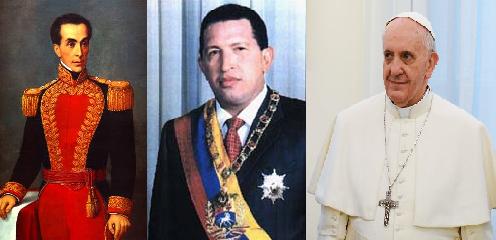
Three of a kind?
The message of Pope Francis, therefore, is faithful to the experience of the church in his hemisphere where the majority of the world’s Catholics reside. What was once considered the periphery of the church is now its center.
Cuban Cardinal Jaime Ortega mentions that hours before being elevated to the Papacy, Pope Francis:
… called for the Vatican to emerge from self-absorption and what he called “theological narcissism.”
He urged the church to refocus its energy on the “peripheries,” not only geographical but existential: sin, suffering, injustice and ignorance.
Pachakuti (the world turned upside down)?, or simply the peripheral people, the cosmic race, in Rome, where they swore to break the chains binding them?
U.S. Supreme Court… look southward!
I hope people realize that even if the Supreme Court in the U.S. rules in favor of the two same-gender marriage cases, it does not legalize same-gender marriage in all states. In only means the U.S. has caught up to Mexico on this basic human rights issue.
The Mexican Supreme Court has already settled the issue now before the U.S. Supreme Court… marriages in one state (even if of persons of the same gender) are valid for purposes of federal law in all states… which is what United States v. Windsor is trying to settle. IN the U.S., the issue is taxation (Windsor was a legally married to another woman in Canada. Although residents of New YOrk, where same-gender marriages were subsequently recognized as valid in state law, Windsor had to pay federal estate taxes to the federal government that — were she recognized as the surviving spouse — she would not owe). In Mexico, it was national health care insurance. IMSS, our social security/national health care system assumed that any couple with a marriage license was entitled to be enrolled at the family rate, but just asked the Supreme Court to validate the regulatory ruling. AND… in a pre-emptive strike against anything as ridiculous as the U.S. “Defense of Marriage Act” (which is what U.S. v Windsor seeks to overturn in part), the Supremes ruled against several states that din’t want to recognize same-gender marriages in other jurisdiction, confirming that one jurisdiction’s marriage is valid everywhere in the Republic.
As in the United States, marriage law is state law. he Federal District and the State of Quintana Roo explicitly allow for same-gender marriage, which are recognized throughout the Republic, and by most foreign jurisdictions that recognize the validity of same-gender marriages (as Mexico does those performed in foreign jurisdictions). One state (Coahuila) allows for same-gender “civil unions” (which seem to be accepted at the Federal level as equal to “uniones libres”, informal marriages, with most federal rights recognized).
For now, as in the United States, “one man-one woman” marriage laws are on the books in several states, but unlike the United States, the Mexican Constitution specifically grants equal rights before the law regardless of gender or sexual preference. State laws have been challenged in two states (Oaxaca and Colima)where there have been challenges to state laws that specify marriage can only be between a man and a woman, with the federal courts issuing injunctions (amparos) allowing the same-gender couples to marry.
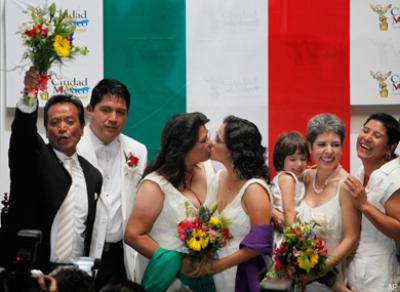 The Oaxaca and Colima cases only dealt with individuals, and were different enough that the court could not rule broadly on all state laws regarding marriage. The Oaxacan legislature had tried to outfox the Supreme Court by defining marriage in terms of producing children, but the Constitution also include4s the rights of families to limit the number of children they produce (down to zero, if they so decide), making the Oaxaca marriage law invalid for reasons other than the equal protection clause regarding sexual preference. In Colima, the marriage law did not actually specify that marriage was only between people of opposite genders, but state officials presumed it did. Morelos, Chiapas, Sonora and Yucatan also appear to not disallow same-gender unions, but the wording in the State Code uses pronouns that presume opposite gender couples. Challenges from those states would likely have the same results as the case from Colima.
In another difference with the United States, the Mexican Supreme Court can solicit cases… and in the definition of marriage has been looking for challenges to the states with “one man-one woman” laws (mostly written after the Federal District changed its own civil code to be non-gender specific). The Superemes will more than likely find cases and rule same-gender marriages are perfectly legal everywhere … keeping Mexico still a step ahead of the U.S…. at least in theory.
And, if the legislature here in Sinaloa could get their act together, even if the U.S. Supreme Court rules the right way, we could boost our tourism industry 🙂


 mexfiles.net