So what if the lady was a tramp?
I wouldn’t make fun of Giselle Arellano Avila. Who am I kidding? Of course I would! A former escort seeking to become a candidate for the Zacatecas state legislature is just too tempting a target for humor (kind of a step down for a high-class hooker).
STILL…
Although I’m a bit surprised that Ms. Arellano seeks to run on the PAN ticket, PAN being the Catholic/”Family values” party, she’s also a smart, successful young businesswoman … which is a dream candidate for PAN as a pro-business party. With her state being one of the few in this country that has been losing population (due to migration to the United States), her story is one that will resonate with the voters, and her own proposals for providing state assistance to migrants (and allowing for their safe return) is well-thought out, intelligent and just might work.
But he who filches my good name…
Can every orchard sue those guys in Cupertino, California for taking the name of a useful fruit in vain?
Via Brittany Hillen, Slashgear
In 2003, a Mexican telecommunications company trademarked the name “iFone,” which sounds the same as a certain handset we’ve all come to know and some of us have come to love. Apple went after iFone in 2009, attempting to have its trademark revoked under claims that it had expired and was too similar to “iPhone“. What Apple didn’t know at the time, however, was that its plans would backfire.
iFone argued that it had registered the iFone trademark years before Apple released the iPhone. As a result, the Mexican company countersued Apple for damages and tried to have an injunction put in place on the iPhone to ban its sales under that name in Mexico. The injunction didn’t happen and Apple still has two iPhone trademarks in the country.
The Mexican Supreme Court sided with iFone, upholding the decision  already made by a lower court that Apple isn’t privvy to the trademark. The case in question is different than another iFone infringement legal issue ongoing with Apple and three carriers in Mexico for damages, which could end up being a substantial sum.
According to the telecommunications company’s lawyer, who spoke with the Wall Street Journal, legally the company can get at least 40-percent of the infringing sales. It is now up to Apple to make its next move, and we’ll have to wait and see how the current legal spat plays out. For now, though, the score is one for the underdog.
It’s not like Mexican companies haven’t occasionally just “acquired” trademarks from U.S. businesses (famously, Pascual Boing soft drinks featured a Disney-esque looking duck for several years before anyone in the Magic Kingdom caught wind of it). And we have a K-mart here, not that anyone is going to mistake a souvenir shop for a deparment store (or a defunct chain of department stores), but still… not often the Mexicans win against the big, bad boys from the north.
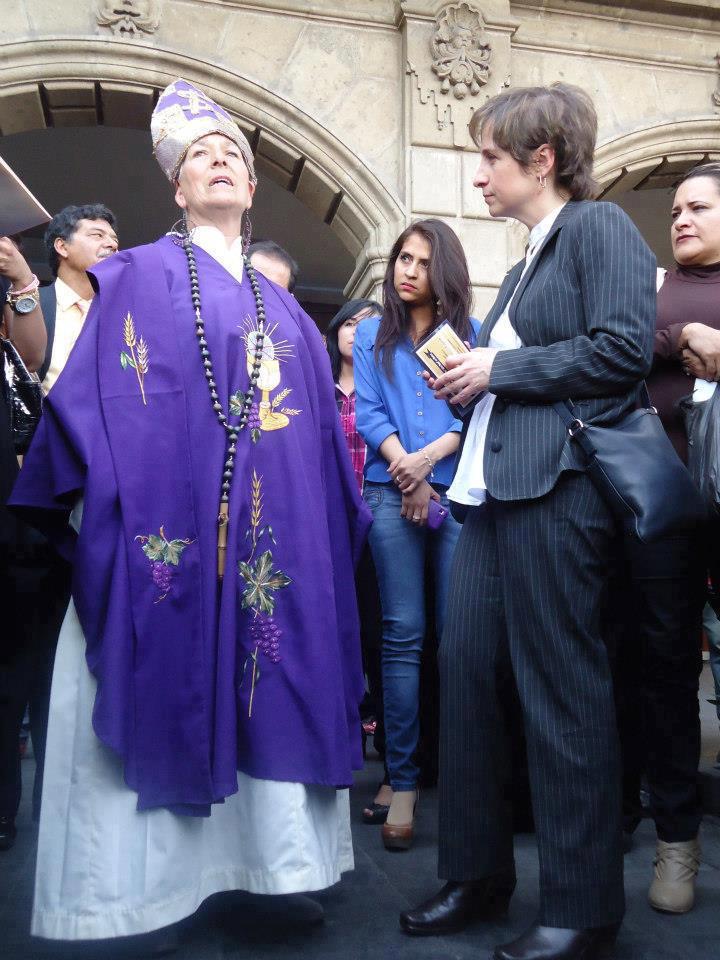
I have no way if knowing if Julia Klug’s past is as she says it is (she claims she was raped by a priest as a child in Guatemala, forced to marry him, and beaten by her mother-in-law before fleeing to Mexico), but she has been tireless in fighting for justice for victims of clerical sexual abuse, for preservation of the secular state and the rights of sexual minorities and women.
Klug son, Air Force pilot Lt. Ricardo Martinez Klug, was killed in a mysterious crash in 2010, at the time when his mother was leading a fight to head off plans to hire military chaplains. She says she was warned that “something” would happen to hurt her if she continued her fights against the church (she’d already been hit by Cardinal Rivera’s car, then threatened with a lawsuit for “attacking” the car with … a petition in 2007), but she keeps on fighting… she says, not against the Church, but against clerical interference in politics and against discrimination against women and sexual minorities.
She was arrested again today, as she regularly is, out in front of the Cathederal in Mexico City.
Half right…
Via Reuters:
A major reform bill to increase competition in Mexico’s phone and television markets on Thursday cleared its first hurdle when it was approved by a committee in the lower house of Congress with no changes.
The reform, which aims to curb the dominance of Carlos Slim’s America Movil and broadcaster Televisa , is expected to be presented to the floor of Mexico’s lower house for a vote next week.
…
The constitutional reform, which was unveiled on Monday, will allow foreign companies greater participation in Mexico’s phone and television markets…
 Uh… “greater participation” means complete ownership. The law now is that foreign companies can’t own more than 49% of a telecom or communications firm in Mexico. The “reforms” would allow up to 100% foreign ownership (i.e. dominance).
Interesting that the one of the biggest cheerleaders for this is Baker and MacKenzie, for whom the “reforms” are “nearly perfect”. Baker and MacKenzie is described in the Mexican press as a “consulting firm” which, I suppose, it is, in one of its many branches, but Baker and MacKenzie is actually a law firm that specializes in suing small businesses for copyright and patent infringement. Or, rather, it’s a “Swiss Verhein”… a world-wide network of law firms, all of which operate together, but can’t be held responsible as a unit for the actions of any one of the supposedly independent companies.
Hi, spy…
FinFisher is a line of remote intrusion and surveillance software developed by Munich-based Gamma International GmbH. FinFisher products are marketed and sold exclusively to law enforcement and intelligence agencies by the UK-based Gamma Group. Although touted as a “lawful interception” suite for monitoring criminals, FinFisher has gained notoriety because it has been used in targeted attacks against human rights campaigners and opposition activists in countries with questionable human rights records.
(You Only Click Twice, Citizen Lab Org, 13 March 2013)
Among those countries where FinFisher has been found is… you guessed it… Mexico. Specifically on TelMex’s UniNET servers.
Via #Y0 Soy Red (my translation):
FinFisher has been used in Bahrain, Ethiopia and Egypt reportedly to reported track activists and designated as targets by the authorities. While a Citizen Labs report of the program on servers in any country does not mean they are being operated by the government, the mere presence of FinFisher in Mexico, and the history of attacks on freedom of expression raise some reasonable questions.
What FinFisher network (there are several versions) has been installed in Mexico, and under what governmental or other authority is it operated?
Has TelMex detected such a sophisticated system in its own network, or is housed in UniNet with the company’s consent?
Considering that this software is only available to governments and intelligence agencies under what justification is it being used by the Mexico Government. If it is in use, and if you have no knowledge of it, or if it is not a the government agency operating the system, is there it a violation of national sovereignty or a violation of the privacy rights of citizens?
Or both?
By the way, FinFisher is also used (presumably by “responsible” government agencies) in twenty five countries: Australia, Bahrain, Bangladesh, Brunei, Canada, Czech Republic, Estonia, Ethiopia, Germany, India, Indonesia, Japan, Latvia, Malaysia, Mexico, Mongolia, Netherlands, Qatar, Serbia, Singapore, Turkmenistan, United Arab Emirates, United Kingdom, United States, and Vietnam.
It’s pretty scary stuff. Here’s part of their promo package:
Even scarier… I’m not wearing anything but my skivvies right now, and some DEA agent is probably watching me. Hey, dude!
Eppur si muove? Papa Pancho
Writing a little over a week ago about the possible effects of a Latin American pope on financial markets (“Pope Matters”) , I made the point that what matters (in financial and more celestial spheres) to those in the wealthy countries may not be all that important to those of us in the less-wealthy world. I can’t help but wish I had also made mention of Bro. John Donaghy’s “Cardinals, popes, and prophets” which had appeared the day before my post on one of his blogs.
 Discussing what he calls “in-crowd thinking”, Donaghy highlights an “in-crowd writer”… or at least “inside the Washington beltway” writer — E. J Dionne — who wrote in Commonweal on a different way of looking at the major splits in Catholicism. Getting beyond political labels of “conservative” and “liberal” (as members of a two milliena old institution, even radical reformers are going to be “conservatives” from the perspective of outsiders anyway), Dionne refers to “Kingdom” and “Communion” Catholics:
The Kingdom Catholics, corresponding to those we usually call progressive, were “exhilarated by the [Second Vatican] council’s embrace of modernity” and “see our church as primarily the People of God on pilgrimage towards the Kingdom.”
“The Christ whom they cherished,” he writes, “was the one who overthrew the boundaries between human beings, who touched lepers, reached out to foreigners and gathered us into the People of God.” Theirs was “an outward-looking theology” that was “rooted in experience” and emphasized “liberation.” The Kingdom Catholics look back to the council era as a time when “everything seemed possible.”
The Communion Catholics view the same period quite differently — as the equivalent of “ecclesiastical urban planning, tearing up our neighborhood.” This group, in which Pope Benedict XVI is the leading figure, insists that the church “stand firm in the proclamation of our faith.”
Radcliffe explains their skepticism of the Kingdom Catholics’ attitude toward modern ideas: “If one embraces the language of modernity too uncritically, then we are likely to lose our identity and be absorbed without a trace. … We must not let ourselves be assimilated to the world. We must not be afraid to underline what is distinctive about our faith, otherwise we will disappear.”
While the Communion Catholics can fairly be seen as conservative, their views do not always conform to what most American conservatives believe. Benedict, for example, was tough on the injustices of capitalism, a view consistent with a traditionalist critique of modern materialism.
Dionne was writing for — and from the perspective of — U.S. Catholic intellectuals, who probably paid more attention to Benedict’s rather mild critiques of materialism than the bulk of U.S. and European commentators, and who are more focused on various scandals in the Church, and critiques of the Church for not responding to recent political and social issues — things more discussed in first-world circles than in the global south.
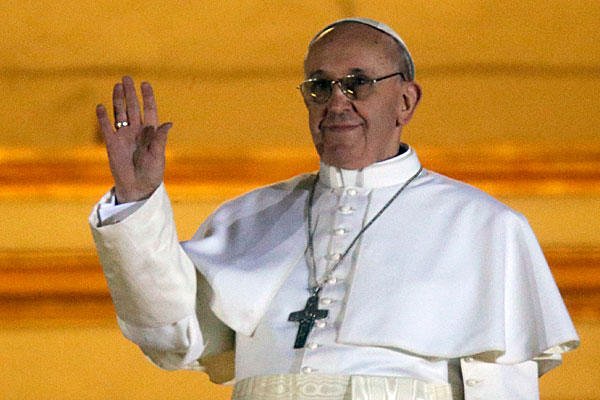
The new pope had not even tried on the infamous ruby slippers before every Western media outlet suddenly turned expert on a figure they hadn’t really heard of before, analyzing a minutes old papacy NOT in terms of the “Kingdom/Communion” dichotomy, but in the old “Liberal/Conservative” terms.
Jorge Mario Bergoglio’s simple lifestyle… and his statements suggesting the Church’s “preference for the poor” were taken as evidence that Francis will be a “liberal”. That as the Archbishop of Buenos Aires Jorge Mario Bergoglio made some strong statements opposing same-gender marriage and gay adoptions in his own country was broadcast immediately as counter-evidence that he is a “conservative”[1].
Neither of these, it seems, are as serious — or as important overall — in thinking of the meaning of a Latin American Pope as Cardinal Bergoglio’s record in dealing with the Argentine government, during and after the dictatorship. That record (said to include collaboration with, or at least, a failure to challenge, the dictators) suggest a “conservative kingdom” Catholicism, which makes more sense in Latin American terms.
Until 1994, the President of Argentina had a veto power over the Papal selection of Bishops, and although Bergiglioni was not consecrated as a Bishop until 1992, he was the Jesuit Superior during the Dirty War, when any high ranking cleric would have needed to pass muster with the political power. The most that can be said against the new Pope is that he failed to act as forcibly as he could (presumably) have acted to protect individuals.
Although there were standouts, like Chile’s Cardinal Raúl Silva Henriquez, who did openly defy military regimes during the time, very few of the hierarchy did more than try to survive (and sometimes assist individuals trying to survive) during a difficult period. And, it has to be pointed out that Cardinal Silva was a labor lawyer before he became a Salesian priest (which as an order, is supposed to assist the poor and downtrodden) and a liberationist (from the “liberal kingdom” wing of Catholicism). Bergiglioni’s Jesuits are something of a mixed bag in Latin America… and while active in the liberationist movement of the time as individuals… are also better known in Latin America for training the elites and (at times) trying to influence governments being the scenes. Historically, too, as an Argentine, Bergiglioni would have been keenly aware that the Jesuits, although running Paraguay directly, were tossed out of all of Latin America in 1783.
Latin Americas think long term, so I don’t read a whole lot into the new Pope’s attitude towards the military regime in Argentina, other than to see him as not particularly sympathetic towards the activities of the Liberationists. That in itself is to be expected. Being named to a position like Primate of Argentina during John Paul II’s reign, one wouldn’t expect anyone sympathetic towards liberation theology. BUT… as a Latin American… Cardinal Bergiglioni is very much, whether to his taste or not, in the Kingdom of Kingdom Catholicism.
Even in anti-clerical Mexico the Church is expected to play an important role in national affairs. Although in Mexico, the Primate Norberto Rivera is seen as an arch-reactionary, backed the the socialist administration in the Federal District when it started providing vouchers to the elderly (since adopted by the Federal Government) and on small-scale social service projects (famously, providing a retirement home for prostitutes). On national issues, one isn’t surprised that even reactionaries like Rivera weigh in on the side of broader access to public services. Of course, his concept of a better educational system would include religion in the classroom, the fact that he’s been pushing as much as anyone for educational reforms has had its impact on the Federal Government. One tends to forget that long before anyone thought of “Liberation Theology” the Archbishop of Mexico — during a time of extreme official anti-clericalism — who was the key to selling oil nationalization to his countrymen and women, a move that was (and still is) seen as a radical socialist concept.
The point being, the Latin America Church, while not particularly “liberal” on social issues, is not necessarily buying the whole “conservative” package as its understood in the northern countries (“free-market” capitalism) and is hostile to the entire idea of economic growth at the cost of social equality.<
Theologically, the new Pope is said to be a “moderate”, meaning not a whole-hearted “communion Catholic”. A bizarre criticism of the new Pope, by right-wing U.S. writer Michal Brendon Dougherty in Slate complains of Francis’ apparent indifference to Latin Masses (as opposed to the mass of Latins) and the old pre-Vatican II order of service (something the outgoing Pope Has-Ben quietly permitted to flourish. Dougherty carps:
But the other way to look at the dawn of this papacy is that it is one more in the pile of recent Catholic novelties and mediocrities. He is the first Latin American pope, the first Jesuit to be pope, and the first to take the name Francis. And so he falls in line with the larger era of the church in the past 50 years which has been defined by ill-considered experimentation: a “pastoral” ecumenical council at Vatican II, a new synthetic vernacular liturgy, the hasty revision of the rules for almost all religious orders within the church…
Apparently, for Dougherty, being Latin American is tantamount to mediocrity all by itself. But his other complaints (I leave the choice of the Pope’s regnal name aside as just plain silly), suggest a Pope who at least accepts that while the Church might be the heir to the Roman Empire, the world has changed quite a bit in the last 1600 years, and the Church has to deal with a lot more of us Barbarians than the Romans ever encountered. While Argentina is, at least on the surface, more Europeanized than your average Latin American country, Argentine Catholicism isn’t that much different than in the rest of the Americas… or, to put it another way, as diverse among Argentinians as it among Mexicans or Bolivians. Even a guy like Cardinal Rivera here, who rails against congregants in mini-skirts, has nothing to say when congregants show up in loin-clothes and feathers, banging drums and burning copal to honor the Mother of Jesus… and Quetezecoatl. Even the much milder syncretic traditions down on the Pampas are probably anathema to Dougherty, but a Pope who doesn’t find it at all weird, or even remarkable, is not likely to roll back liturgical and theological reforms.
And, finally, sex and money — the two things everybody in the global north is hung up on. Latin Americas don’t expect sexual perfection, even in their clergy, and although as Cardinal the new Pope railed against changes in Argentine law that improved the lives of gays and lesbians (sort of part of the job description), he’s learned to live with it, just as Cardinal Rivera has learned to live with GLBT rights in the Federal District and usually backs off when the state tells him to forget about it. Not knowing who the new Pope is appointing as subordinates, we don’t have a clue how he is going to deal with the pedophilia scandals or the questions of clerical celibacy (something just ignored in Latin America, “don’t ask, don’t tell” being the rather humane alternative to dealing with married priests here for the last 500 or so years), but given Dougherty’s complaints about the Papal “collegial” style I expect a few changes.
The new Pope made public appearances meant to highlight AIDS awareness, and has expressed tolerance for birth control methods meant to prevent disease. The “collegial style” might mean a loosening of top-down pronouncements on sexual health (and identity), and, if nothing else, a Latin American style of simply accepting what is, and not what should be, among the clergy and laity.
It may just be public relations, but Cardinal Bergiglio wasn’t unique among the Latin hierarchy in toning down the bling and glitz. Besides the havoc it would create in the world markets if the Church just sold off its art works, and precious metals (and I’d rather the Bernini Doors remained on St. Peter’s rather than melted down for cheap faucets any day), I don’t expect the Church is going to sell off the Vatican (can you sell a country, and who’d buy the Vatican anyway) or any of the other rather silly and unworkable reforms suggested every time there’s a new Pope. In Mexico, where the State seized all the Church property back in the 1850s, and the Church has managed to thrive (especially after 1992, when they were again allowed to own property) with less bling, and more focus on becoming self-supporting. Again, it depends on who Francis chooses as “department heads”, but I expect some major changes in the Vatican’s substantial portfolio that may not be to the taste of first-world investors, but will infuse cash into our part of the world.
Links:
Why Pope Francis May Be a Catholic Nightmare (Slate).
Christian Science Monitor (photo)
Questions remain over Pope Francis’ role during Argentina’s dictatorship (Guardian, via Raw Story)
Meet the new boss. Same as the old boss?/updated (Mercury Rising)
Special Semi-Nice New Pope Time: Maybe He Is Not So Bad? (Wonkette)
Cardinals, popes, and prophets (Walk the Way)
Jorge Bergoglio, acusado de entregar jesuitas a dictadura (La Jornada)
Pope Francis: the quiet man of Buenos Aires known for his humble tastes (The Guardian)
etc, etc., links without end… Amen 🙂
[1] Within minutes of his election, his Wikipedia biography was edited to read “Bergoglio attained the position of novice master there and became professor of theology. He is another homophobic bastard indeed.” The second sentence quickly disappeared, although there is a discussion of his attitudes on homosexuality in what is now an entry on “Pope Francis”.
Fleeing down Rio Way…
I tend to think the story is a bit … uh… enhanced, but according to Shifra Unger of Your Jewish News
Thousands of Orthodox Jews fled a city in Brazil, after immodest women were dancing on the street, according to press reports in Brazil.
While the Brazilian Carnival attracts hundreds of thousands of tourists every year, in recent years it has been driving away some local residents.
Jewish residents of Rio de Janeiro, one of the main centers of celebration in Brazil, have fled their homes and moved to a city nearby in order not to expose their children to indecent women.
Which led to this rather pointed comment:
Immodest women dancing in the street!
Orthodox Jewish reaction- Leave town,come back when it’s over.
Orthodox Muslim reaction- Round them up and behead them in a soccer stadium.
Orthodox American reaction- Take away their voting rights, make healthcare impossible, call them names on the radio
Orthodox Brazilian reaction- Yawn. You call that immodest? That’s what my aunt wore to my first communion!
I have no idea how “serious” a publication Your Jewish News is, but there is some sly humor in illustrating the story with a photo of an guy in immodest Brazilian lady clothes.
Spring break warning…
Via Frontera NorteSur: on-line, U.S.-Mexico border news (Center for Latin American and Border Studies, New Mexico State University, Las Cruces, New Mexico… fnsnews@nmsu.edu

… “More shootouts in the U.S.,” proclaimed a teaser on Televisa. On a recent newscast, announcer Joaquin Lopez-Doriga reported that 1,800 people had been killed by gun violence in the U.S. during the previous two months. “The numbers, undoubtedly, could be higher,” Lopez-Doriga added.
In both print and electronically, Mexican media have given ample coverage to Newtown, ex-cop Chris Dorner’s southern California killing spree, 15-year-old Nehemiah Griego’s murderous rampage in Albuquerque, and more. “For the umpteenth time,” led off a news announcer on a recent edition of Mexico’s TVCN news, before digging into February’s Las Vegas strip shooting that left two innocent passerby in a taxi dead.
If current trends continue, it should come as no surprise if the Mexican media and government begin to issue broader advisories to their citizens traveling to the United States…
Word of the day: rocambolesco
I learned a new, and highly useful, word today: “rocambolesco“. I don’t know how I managed to survive in a culture like this as long as I have without at least running across it. It’s a great word to use when talking about bureaucratic regulations and political arguments. The automatic translations will give you “bizarre, though “head scratcher” might be closer to the literal translation.
“WTF?” or “HUH?” might be good synonyms also.
Call me Al, Fred, Juan, Franciso Franco…
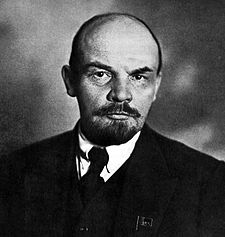
Llamarse Lenin de nombre de pila en España está prohíbido. La razón es que invita a confusión, porque el “sentir popular” -errado- piensa que es un apellido, aunque en realidad fue el seudónimo del líder de la revolución rusa de 1917.
Este rocambolesco argumento …
And the rationale is a head-scratcher: the Civil Registry judges justify not using “Lenin” as a name on the grounds that people tend to assume Lenin was a surname, and not the pseudonym of a Russian guy named Vladimir Illich Ulianov. Which is clear as mud.
Lenin is not an uncommon given name in Latin America (I’ve written before on the then-presidente municipal of Ciudad Acuña, Lenin Perez who enjoyed great popularity among his Texas counterparts) and the Vice-President of Ecuador, business executive Lenin Moreno). I’ve known a couple of Lenins here in Mexico, one who had a brother named Stalin. Neither of them were Communists, by the way.
The Spanish bureaucratic regulation only triggered a request for a rationale because a Parliamentary Deputy had heard from Latin Americans named Lenin seeking Spanish nationality that they had been told to change their names … although I don’t think they would expect a guy named Juan-Pablo to be mistaken for a Karol Józef Wojtyła, nor think guys with the given name Felipe de Jesus (like Felipe de Jesus Calderón Hinojosa) might be confused with Felipe de las Casas, the late 16th century Mexican Manila-trade merchant turned monk.
That would be logical, but the rationale would still be rocambolesco.
That “New American Character”
“El_Longhorn”, who often respectfully (and perceptively) disagrees with MexFiles, commented on my post “This New American Character” (in which I sort of tried to place Hugo Chavez in the tradition of various nationalist leaders in the “emerging world”, starting with Andrew Jackson). Two good points he makes, that perhaps need to be discussed further:
[Chávez] took government money that was going to oil production and diverted it to social spending. The result has been lower oil production and decreasing oil revenues. The only reason the plan was not a total disaster was that oil prices have been high enough to hide most of the revenue loss. Not all but most. If oil prices do fall back down, Venezuela is going to have a severe and difficult economic crisis. And oil production continues to decline. His lack of investment in public infrastructure outside of popular social service programs is a serious problem. And the Venezuelan economy is basically a disaster. High inflation, high crime, high unemployment, shortages of electricity and vehicles.
I’m not sure what’s wrong with shifting oil production money to social spending. There’s no rule that says income generated from any particular resource must be reallocated to further use of that resource… and, when it’s a non-renewable resource (like petroleum), perhaps it is better spent elsewhere. Norway spends theirs on social spending, and Alaska goes beyond rhetorical socialism, doling out the oil industry revenue directly to its citizens.
While high crime is something one expects in a country undergoing rapid social change (and the crime rate is not out of line, and somewhat lower, than other Caribbean countries), high inflation and shortages of electricity and vehicles are usually seen when consumer demand outstrips supply. In other words, the downside of rapid growth and increasing wealth. More people can afford vehicles and are using electrical appliances, which should, in time, bring down the unemployment rate. And, the answer to high unemployment is … social spending: education for changing job requirements, like working in the automotive and electrical fields.
His political legacy is equally questionable. No one gives a damn about Chavez outside of Venezuela and Cuba. South Americans from other countries that I know are basically indifferent to him. And pretty close to half of Venezuela hates him. The people that like him have developed this weird cult of personality around him. It reminds me of North Korea. Whatever his accomplishments politically (no question he had great political talent), I don’t see a philosphy or model that can be replicated or is even coherent. And not one that will survive long after his death.
Pretty close to half of Mexicans (if not more) despised Calderón and now despise Enrique Peña Nieto, and… from what I gather from U.S. media, Barack Obama is not universally loved, either. The fact that Chavéz’ passing has led to so much press and that we are even discussing it here, shows that his influence is felt throughout the world, and his career was not seen as indifferent outside of Cuba and Venezuela. I’m doubtful the average Englishman or Frenchwoman in 1838 could tell you who Andrew Jackson was, but they had heard of the United States and probably had an opinion about it. Today, though, if your average USAnian or Russian or Palestinian has heard of Venezuela, he or she probably has heard of Hugo Chávez.
Even so, your average Englishman or Frenchwoman or USAnian or Russian or Palestinian or South American… most likely is interested first in tending his own garden, and doesn’t care all that much about the niceties of foreign affairs. But, then again, your average person is not running a country or large chunks of the planet… and the people that do, and those of us who comment on those people, have paid attention to Hugo Chávez.
I donno, but riding around with a giant mouse is kinda weird
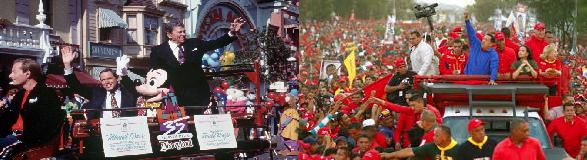
I don’t know what El_Longhorn means by a “weird cult of personality”. Or, at least, it was no weirder than the adulation surrounding Ronald Reagan — another deft politician sometimes given to completely daft remarks. Where El_Longhorn sees “North Korea”, I think he’s talking about those media presentations of mass rallies. And, as El_Longhorn knows, color-coordinated campaigns and free tee-shirts are a staple of Latin American political events. Think of those “million people marches” Televisa endlessly promoted where one was expected to wear white. These aren’t at all new… Graham Greene’s Travels With My Aunt, set in the 1950s, featured a rally of red-shirted (reactionary) mobs in Paraguay.
Coherent political philosophy? I’ve said Europeans write mission statements before their revolutions, and Latin Americans write them afterwards. I don’t think Bolivarianism is so much a single philosophy, any more than Álvaro Obregón (a figure much like Chávez, but now unrecognized outside of Mexico) did in synthesizing a social and political system that brought together nationalists, capitalists, socialists, anarchists and intellectuals. For that matter, how coherent was Benito Mussolini, or Mao Zedong, or even the Republican Party in the United States? It seems that the ideology grows out of pragmatic decisions that not only reflect the individual leader, but also their advisers, changing conditions, and the need to gain popular support.
Whether Hugo Chávez’ personal vision of Bolivarianism can be replicated, I don’t know. I don’t know if it has to be. That CELAC exists, and that there is popular resistance to U.S. intervention in Latin America (and that there are elites now supporting such resistance) and that there is a consensus that governments should invest in social spending rather than relying on “trickle down” show a huge change in the psychology of the way the Americas look at their own countries and how they react to the world. Chávez no more created that than Andrew Jackson created the “era of good feeling”… but as the figure we associate with this new sensibility in Latin America, Hugo Chávez IS a seminal figure and will remain one in our historical analysis of the early 21st century.
Except maybe for the mining companies, who hire thugs to do their dirty work for them, you don’t expect Canadians to get physical with Mexicans. Or vice-versa. But, then again, being in Arizona tends to bring out the worst in people, and both teams being foreigners things were already a bit tense.
HUH?
Michael O’Boyle and Krista Hughes at Reuters (“Analysis: Mexico central bank: closet currency warrior and inflation gambler“)
Unlike other Latin American markets, Mexico enjoys a combination of healthy public finances and liquid, open markets, and growth is still seen at 3.5 percent this year.
I don’t think any of the major Latin American economies are having trouble with public finances right now… even Argentina, having shed (or rather disavowed) the debts run up by the dictatorship, isn’t having much trouble finding the money it needs to function. If anything, public expenditures have been increasing, and the usual consensus is that Mexico is lagging behind the rest of Latin America when it comes to growth.
While I wouldn’t want to even try arguing money or economics with Agustìn Carstens, who knows what he wants for the Mexican economy and knows how to achieve his goals, I’m not convinced that either the Peña Nieto administration will be able to push through the “reforms” the foreign investors want… nor even that they should. As it is, I’d expect a PRI administration — even one from the neo-liberal Salinas wing of the party — to invest more in social spending, if nothing else, to distract from their goal of opening PEMEX to foreign capital.
Still, an excellent read… the outside world forgets that Mexico is a major economic power (Brazil comes close, simply because it’s a much larger country) and what happens to the peso does affect the dollar, the Euro and the Swiss Franc (not to mention the Ringgat, the Pound Sterling and the Nuevo Sol).


 mexfiles.net