Waste not, want not
Mexicans are nothing if not creative when it comes to making use of what has been left behind by others. Every few days, someone comes through my neighborhood buying up broken appliances, and if you expect to furnish your house through dumpster diving… forget it. Nothing of any value is going to sit in the trash pile for very long, and if there is anything of value, the trash collectors have first dibs, anyway.
Heck, even the birds of the air are recyclers here:
Cigarette butts are widely reviled as an urban nuisance but birds in Mexico City see them as a boon, apparently using them to deter parasites from their nests, scientists say.
Local sparrows and finches incorporate smoked cigarette butts in their nests to provide cosy cellulose lining for their chicks and nicotine to ward off mites, they believe.
[…]
The behaviour is an intriguing example of how birds adapt to an urban environment, according to the study, which appears on  Wednesday in the journal Biology Letters, published by Britain’s Royal Society.
In non-urban settings, some birds line their nests with aromatic plants, which are thought to have antiparasitic properties or to stimulate the nestlings’ immune system.
Nicotine, a byproduct of the tobacco plant, has also been used in some pest repellents for crops and in controlling poultry parasites.
Democracy now and then
… considering democracy not only as a legal system and as a political regime but also as a way of life based on the permanent improvement of the people from an economic, social and cultural point of view.
(Mexican Constitution, Art. 3)
There are two “memes” being floated in the foreign and Mexican media on the recent violence that accompanied Peña Nieto’s inauguration. First is the suggestion is that the vandals were integral to the protest and secondly, that the protesters themselves were anti-democratic in their outlook.
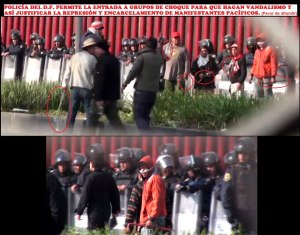
Several accounts of paid provacateurs have surfaced. There is some evidence presented of police or military provocation (something that anyone familiar with the history of Mexican state action against dissidents — Tlatelolco, 1968 to give only one obvious example — would consider a possibility), but usually police agents would not be “day laborers”. Given the association made in the media between the leftist parties and the anti-Peña Nieto protests, I have speculated that the “autor intellectual” of the agentes provocateurs might be found within the PRI. I raised this possibility with Dutch journalist Jan-Albert Hootsen on his “facebook” page, but he is skeptical of PRI involvement, responding:
I’ve been talking to some of the guys in YoSoy132, and they insist these kids were from the ´radical wing´ of the movement and they are incredulous of any PRI-involvement. I wouldn’t immediately discard the possibility, but it seems a little far-fetched to me.
It could very well be that vandalism was committed by the “radical wing” of the non-party movement — and in the days leading up to the First of December, there were on-line posts from the more militant sources that strongly suggested that participants in the demonstrations should come prepared for violent reactions by the police. Nor does it mean those in the “radical wing” weren’t paid to commit vandalism. But, if there was a commitment to vandalism (and given the targets — banks, corporate chain outlets, and state or political party facilities… but NOT small merchants or non-political facilities — there very well could have been an ideological rationale to the vandalism) presumably one wouldn’t need to pay for it.
Not that “voluntary” rioters weren’t there, but it doesn’t mean that paid vandals couldn’t have also been involved, nor that police or military personnel weren’t looking to “kick-start” a riot.
It should be noted that Hoosten and I had our exchange over his posing of a link to an article by PRI central-committee member Federico Berrueto on the Madrid-based, Spanish-corporate financed (Repsol, Movistar, BBVA, etc.) Infolatam.com website. Unsuprisingly, Berrueto argues that the violent protests to Peña Nieto’s presidential installation discredit the left in general, Andrés Manuel López Obrador specifically.
It’s not suprising that a PRI party leader would make this sort of argument, and it is one that might sell well to the foreign media (and foreign observers in Mexico, even the snarky ones) make the assumption that election results are the same thing as democracy. From Burro Hall (the snarky guy):
Look, amigos, we share your unhappiness at the outcome, and we know that the Powers That Be were all behind the man, and Televisa, too; and we’ve heard all the stories of gift-giving and petty fraud – but then the Mexican people went out and voted and EPN got almost 3.5 million more votes than his nearest competitor. That’s a lot of Soriana cards. You can say whatever you like about him – most of it negative and probably correct – but he wasn’t “imposed.” Dude won by seven points in a four-person race.
While López Obrador may have been the preference of many of the protesters, to criticize “yosoy132” for not being united behind that one candidate is half-way to buying Berrueto’s spin on the protests… that they were meant to impose one politician into the existing political regime over another.
Imprecise as the definition of “democracy” is in Article 3 (which happens to deal with education), it is less a matter of what “dude won” than that the dude won in an election marked by what many say were manipulations and frauds in the legal system and is seen as perpetuating a political regime that is not bringing perpetual economic, social and cultural improvement. Certainly, there was anger over the method by which Enrique Peña Nieto was elected, and the unfair advantage he was said to have over other candidates. And, anger over a political regime that has allowed itself to launch a war against its citizens for the benefit of a foreign power… and over economic decisions taken by the existing regime that haven’t benefited the protesters economically or socially or culturally.
The Constitution presumes that people will “struggle” for their rights (including the democratic ones) and that among those rights is the right of the people to change the form of government (or, if you prefer, the “political regime”) should mean that the protests were a democratic exercise, not a display of petulance. While I suppose some Trotskyites might have welcomed violence from the protesters as a means of forcing the “political regime” to discredit itself by engaging in more overt repression, frankly it looks as if the violence was meant not to discredit any particular individual (although, thanks to people like Central Committeeman Berrueto and the “mainstream” press and some foreign observers that is an added benefit), but to prevent the people from exercising that messiest of political activities… the practice of democracy.
Cut to the chase: the Calderón era
Shannon O’Neil’s “Latin American Moment” crunches the numbers on the Calderón era. Mexicans are slightly better educated and live longer, but they’re poorer, and much more likely to get murdered.
Gum control…
One of those Mexican gifts to world agriculture that has returned as processed goods and a bane to the Republic is chicle (from the Nahuatl tziktli — “sticky stuff”). Possibly as far back as the Olmecs, people in southeast Mexico have been chewing chicle sap to clean theirs teeth.
Like so many other “good idea at the time” things that haven’t worked out all that great for Mexico, the commercialization of chicle owes a lot to General Antonio de Padua María Severino López de Santa Anna y Pérez de Lebrón. In 1869, the 74 year old Santa Anna — still plotting a comeback from his less than lavish exile in a Staten Island, New York City boarding house, of course wanted to keep his pearly whites looking good and present a dazzling smile to the masses whenever he got around to returned to Mexico, but in the meantime….
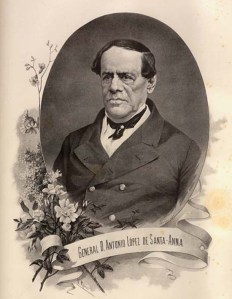 Whether he was behind in the rent, or his landlord was just nosy, there’s no way to tell,but the landlord, candy-maker Thomas Adams got into Santa Anna’s chicle stash and adding some sugar coating and mint flavoring invented Chicklets. OK, so adding sugar to a natural tooth cleaner isn’t exactly the recommended way to obtain a cleaner, brighter smile, but if one anyone who has ever had the opportunity to eat a ripe zapote — which has the consistency of custard and the flavor of bubblegum — can understand why the cheap commercial version of chicle is so popular with the Mexicans. They love the stuff. A lot. Mexican chew an average four pounds of gum a year.
Four pounds of gum works out to about a stick and a half a day per person… which leaves behind a wad of “sticky stuff” and saliva stuck on sidewalks, under bus seats, hanging on walls and generally creating a mess. While a stick of gum only costs about half a peso, according to Federal Deputy Juan Manuel Diaz Franco’s research, it costs 2.50 pesos to remove a wad of gum. The Federal District spends 2800 pesos a day just on gum removal, and how much is spent by private citizens (just in time alone) is incalculable.
F
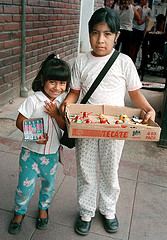
“Chicklet girls, Nogales, Son., Mexico” Rick Soloway, photo
ederal Deputy Juan Manuel Diaz Franco is seeking to recoup some of that cost, through legislation that would impose a fifty percent tax on a pack of gum plus 0.15 pesos per stick… the revenue to be divided between the federal and municipal governments. It’s not a bad bill, but there’s one sticky situation that comes up… while there’s no gum lobby per se, there is a sense that those most affected by the tax bill would be the gum sellers. It’s not exactly taking candy from a baby… but it is taking the income from candy sales from cute little moppets.
(Sources: Mexico Unmasked [Tim Johnson], Guadalajara Reporter [Duncan Tucker], Gods, Gachupines and Gringos)
A better “red” Mexico
According to the latest statistics, almost a third of all Mexican households have computers. However, only about a quarter of Mexican homes are on the “red”… the web. That doesn’t mean only a quarter of Mexicans use the internet… we still have cyber-cafes everywhere, even in the tiniest villages, and most schools now use at least some on-line training material.
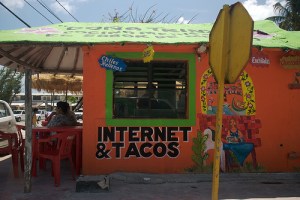 Over half of all internet users are on the web for educational reasons, and just under a half use it for personal communications… whether that includes planning for the next demonstration (and we can expect some doozies over the next few days, as Peña Nieto is sworn in, and sworn at) isn’t mentioned in the short article in the on-line magazine, Sin Embargo.
¿Viviremos major?
Felipe Calderón has arranged for a cushy exile to Harvard University … where he is unlikely to be extradited to The Hague to stand trial on the plethora of human rights indictments, and where somebody will inevitable ghost write his “memoir”. I expect there are Mexican who are themselves victims, or relatives of victims of outgoing administration’s policies who are residents of the Bay State, and who could at the very least file civil suits which might at least force FeCal to explain what he was up to over the last several years. As a historian, I certainly hope so.
The biggest embarrassment — or rather, disappointment — with my Gods, Gachupines and Gringos was not an annoying typo that somehow made it into the book more than once (“Bryant” for “Bryan”, as in William Jennings Bryan), nor an error that only came to my attention this last week (Sam Houston had no children by his first marriage, and was not fleeing child support when he lit out for Texas), but having so wrongly predicted the future. Writing in 2007 — before Plan Mérida was proposed or implemented, “Calderón’s adminstration, having begun with a military operation against drug dealers, appears to be fostering better relations with the United States. ”
I wasn’t wrong, but had no way of predicting the extent of “mission creep”… policy creep, media creep… no way of predicting that “a military operation” would mean not so much “better relations with the United States” as it would would interventionist rhetoric not heard since the Coolidge Administration, and the introduction of armed agents of a foreign power in levels not seen since the Emperor Maximiliano was propped up by French, Austrian and Belgian troopers.
Nor was it possible to predict that talk of the “drug war” would suck the air out of all discussion, making it next to impossible to discuss anything BUT narcotics trafficking and the violence engendered by the Calderón Administration’s “military operation”. Impossible to predict that even writings about subjects as far removed from narcotics trafficking as traditional sports editors apparently were compelled to drop in a paragraph or two on narcotics and violence.
How much of the violence was due to the gangsters themselves, and how much fomented by the state are questions we still don’t have answers for. How much of the so-called “drug related violence” is “drug related”… and how much related to the outgoing (and probably in-coming) administration’s “war on subsistance farmers” (did anyone notice that the foreign press only noticed the on-going assassination and violence against environmentalists and those defending their traditional way of life from opportunists who, like the “drug cartels” are feeding an inordinate appetite for Mexican resources)?
As far back as January 2007, I compared Felipe Calderón to Porfirio Díaz and not in a good way. State violence has been justified and excused on the grounds that it was enforcing “stability” on the country (which wasn’t all that unstable — simply having a rather loud, and out of the polling booth, exercise in democracy when Calderón came to office), and — at the behest of the foreign economic interests — extreme violence in rural regions, and the imposition of what is, in all but name, a police state. The “shock doctrine” was nothing new… simply the recognition that the processes by which radical change could be imposed was understood to be something that could be artificially created. As was this “narco war”.
Will it end? Probably not, but dubious as I am about the incoming President, his electoral legitimacy is slightly less problematic than Calderón’s and a sort of battle fatigue has settled in. Not that there won’t be dissent, but we can (at the risk of writing another cliché) let the smoke of battle clear, step back slightly and figure out what the Hell it was all about. Drugs? Not really. The imposition of a chaos to force through unpopular change? Perhaps. A calculated move to maintain control of resources? Likely. A cock-up of monumental proportions, based on miscalculations, wrong assumptions and continued out of bone-headed stubbornness? That we’d like to know.
I’ve got six-pence, jolly, jolly six-pence
From Science News:
Chemical studies of old English coins are helping unravel a centuries-old mystery: What happened to all the silver that Spaniards dug out of the New World?
The impurities in precious metals provide a “signature” that indicates where the metals are mined. Mexican silver has a specific lead content that isn’t found in “old world” or Peruvian mines. Peruvian  silver was mostly used in trade with the Philippines and the East Asian mainland, while Mexican silver went to Spain…. or, at least from the early 16th to mid 17th Centuries to Britain. The Science News article doesn’t really get into what the British were doing to acquire Mexican silver, but it’s not that hard to figure out. They were pirates.
No fear?
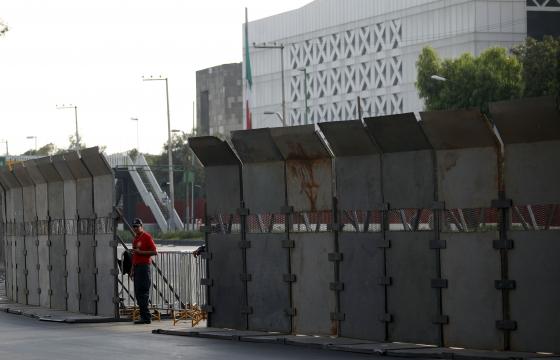
This is not a prison… but San Lazaro, where the Chamber of Deputies sits, conducting the “people’s business”.
Besides the security wall, metro and bus service near the Chamber has been temporarily suspended and a thousand federal police are to be on hand for the ceremony. The costs to taxpayers aside, the disruption is said to have already caused 200 million pesos in business losses to area merchants. All this to prevent anyone from possibly swearing AT to prevent the people from swearing AT Enrique Peña Nieto who is due to be sworn IN as President here on Saturday.
How about Anáhuac?
The country’s formal name is the United Mexican States, but few people use it. President Felipe Calderón wants to make it simply Mexico.
Calderón said the name was adopted in 1824 to imitate the country’s northern neighbour, but Mexicans did not need to emulate anyone.
The constitutional reform would have to be approved by both houses of congress and a majority of the 31 state legislatures. Calderón leaves office on 1 December.
He first proposed the name change as a congressman in 2003. The bill did not make it to a vote.
I suspect Calderón’s ridiculous and pointless obsession with this is a result of the Mexican conservatives tradition, with it’s deep distrust of religious and cultural differences (over 50 plus national languages!). For the first half century of the nation’s existence, “States’ Rights” was a cause for 19th century liberals, with the conservatives taking the position that only a strong centralized government (obviously, one run by said conservatives) could govern the country. While the country has always been governed from the center, and the Federal government has always had an unequal role in local affairs compared to the various state governments, the name of the country reflects — and celebrates — the fact that Oaxacanos are not Sinaloense are not Veracruzanos are not Chilangos are not — and that diversity is a strength. Chilpacingo or Chapala or Chihuahua, ¡viva la diferencia!
Much more than the United States to the north, the Mexican states, and the people within their states celebrate their differences. Sure, up north you can get New York strip steak, or New England clam chowder or Kentucky Fried Chicken anywhere in Iowa, or Wyoming or Oregon, prepared by cooks from Alabama or Michigan or, for that matter, Guatemala, and never know the difference. Here, there are entire state cuisines — estilo Guerrero, or Jaliescence or Sinalonense or Veracruzano — and if the chef is a ringer from another state, you’ll know it the minute the food touches your lips.
The one thing the states have in common here — whatever their language, customs, cuisine or music — is the people themselves are… Mexicans. Thus, not the United States of Mexico (the states themselves are united, but states are just political entities), but the United Mexican States… a bunch of different regions all united by one thing… the people are all Mexicans.
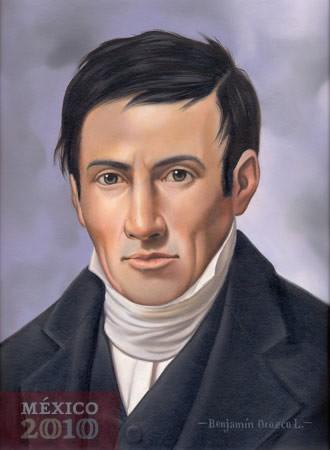
Andrés Quintana Roo
Well, just borrowing the name of the capital and applying it to the whole place was something of a letdown (and a bow to the conservatives). Our Declaration of Independence was penned mostly by Andrés Quintana Roo* at the Congress of Anáhuac… which would have been a pretty good name, especially considering that when the Congress wrote the Declaration they called the place América Septentrional which might have been a really crappy name… and hard to turn into a cheer at futbol games like Meh-he, Meh-he, Meh-he-KO!
* Quintana Roo would later have one of the the newest of the 31 United Mexican States named for him in honor of his role in preventing the disuniting of those Mexican states in the 1840s when the country was forced to unite to stave off financial and military invasions from both the United States and the British.
At home with the Yuks
The difficulty of being an independent press in a niche market is that we can’t always schedule our production as well as we’d like. I’d hoped to have the journals of artist and explorer Dimitar Krustev much further advanced by now (and, I believe Krustev himself expected we’d be further along, too).
But, seeing this is a long-term project, and the financial returns are not expected to be all that impressive (I’ve resigned myself to the fact that we’ll never recoup the costs of our own editing time), we had to take on other projects that popped up and offered a better return… and were more likely to pay the rent.
Still, the project is finally moving along. The first installment, as a short run book (mostly for academics and scholars who might be willing to take on the entire project), we are publishing Lacondón Journal 1969: From the Journals of Dimitar Krustev Artist-Explorer in the next week, and should have eBook and paper copies available within two weeks.
A sample:
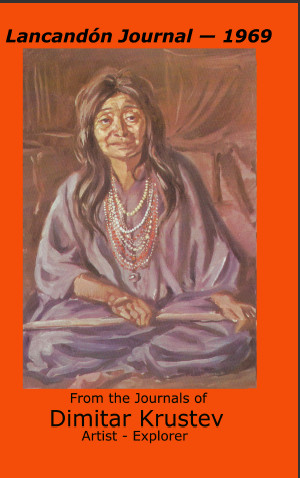 The members of the camp at Nueva Providencia were as follows: Kin Yuk, whose name means Sun Deer, is the chief; his wife, Chana K’in [who is also known as “Carmita”][i], and he have two girls, one six and the other three; the couple was expecting a third child soon.
Chan Bor, meaning armadillo, is Kin Yuk’s uncle. Chan Bor’s first marriage was to his own sister, who had the Spanish name María, but they had no children. With his number two wife, Kin Nak’in, Chan Bor has four children aged 10, 7, 4 and 1. The third family is headed by Kin Nak’in’s brother, also named Kin13[ii].
Kin Yuk’s brother, Kayun, meaning “chief of the song” lives with Uncle Kin’s family. The three families seemed very dependent on each other. They shared everything and seemed to live in absolute harmony. Parents and their children got along admirably. The girls were always with their mother, and the older boys were always with the father. The girls helped around the fire and learned to make tortillas beginning at the age of four. It was enjoyable to see mother and children making tortillas together, the children patting and spreading dough over a banana leaf.
Starting at age seven, the boys went hunting with their fathers; they also helped gather corn. The girls were betrothed as young as six or seven, a practice common among all the Lacandón. The men would not live with the girl sexually until the first menstrual period. Until then, the girl was only his companion and would follow the man everywhere except hunting. During the maturation period, the girl would take care of the man’s children and help in the kitchen. The boys would marry their first wife around the age of 16 or 17 but waited to start a family until the girl was of age.
Based on my experiences with the Lacandón, I had come to the conclusion that they were very moral people. The fact that Chan Bor is married to his sister has a simple explanation: They like each other. When I was in Lacanja, Chan Bor tried to please the missionary by changing wives but he missed his sister and eventually took her back to his hut.
The Lacandón ate almost as well as the Tzeltals, using the jungle as their “supermarket” to hunt wild game to supplement their low-protein diets. Here and in Lacanja, they hunted with a 22 caliber rifle. In Naja and Metzabok, some of the younger Indians still hunted with a bow and arrow.
Game available in the jungle was varied and included paloma deer, tepezcuintle and monkey. Birds they hunted included the loro, the green variety of the parrot, toucan, wild turkey, pheasant and chacalaca. The Lacandón and Tzeltal considered the wild boar a delicacy. Fish was an important part of the Lacandón meals. The main course included maíz – corn – as is common in Latin America. I found a wide range of gourds, pumpkins, melons, onions, small tomatoes, bananas and beans all a part of their diet also.
I was very interested to see how the Lacandón prepared tortillas. They boiled the dried corn in a pot, which they would have bought from a traveler such as me or from a missionary.
One of the ingredients they used was ground-up shells, which they had gathered from the gravel beaches of the river and then baked. These ground-up shells were added to the boiling corn. When I asked why this was done, Kin Yuk said that the tortillas is much better when the shell of the corn is removed, and that the only way to do this is to boil the ground shells together with the corn. After boiling for an hour, the shell powder is washed from the corn.[iii]Then it is ready to be ground up by hand with a stone or by the grinder that most of the Indians had purchased in San Quintín. To buy this item they used money they had made by selling bows and arrows to visitors.
The Lacandón here and in Lacanja are Protestants. That is the result of efforts by an American, I believe Lutheran, missionary Phillip Baer, known here as Don Felipe, who has worked and lived with his family here for many years.
Kin Yuk was the high priest in Nueva Providencia. Each Sunday, and sometimes during the week, the Lacandón also sang Protestant songs that had been translated into Mayan. Kin Yuk was a fiery speaker, a Billy Graham of the jungle.
[i] The words in brackets are an editorial insertion. Outside of this one mention, Krustev consistently calls Chana K’in “Carmita”.
[ii] To avoid confusing readers, where Krustev’s original referred to Kin Yuk as “Kin” the editor changed the text to read “Kin Yuk” and references to the elder Kin were changed to “Uncle Kin”.
[iii] This is the pre-historic treatment of dried corn kernels by Mesoamericans – nixtimalization – that not only softens the hull, but also makes niacin nutritionally available, which prevents pellagra – a niacin deficiency disease often caused by a diet high in untreated corn, something common in the late 19th and early 20th centuries in the rest of the world before the cause was discovered by western scientists in 1937.
¡Graciás! mates…
APF:
GUADALAJARA, Mexico. Mexican tequila makers celebrated on Wednesday Australia’s decision to recognize Mexico as the only place in the world that can use the drink’s name.
The Tequila Regulatory Council of Mexico said that Australia joined Russia and Thailand in giving Mexico the protected designation of origin for the drink, which is made from the blue agave plant found in Jalisco state.
Council director Ramon Gonzalez said the decision means that Australia will remove at least 10 “pseudo-tequilas” from the market in January.
“It is a big step to allow the industry to have a market totally free and clean of unfair competition in Australia,” he said.
The council says 18 Mexican companies exported almost 825,000 liters of tequila to Australia last year. Mexico produced more than 261 million liters of tequila last year, exporting 60 percent of it.
Imitation may be the sincerest form of flattery, but Chinese and South African agave distilled drinks are in no way Tequila.


 mexfiles.net