Juvenile delinquents
Ah, the good old days… when being an agitated student was as anti-social as eating junk food.

Ah, nuts!
Who knew? I never knew that Mexico produced Macademia nuts, but getting them to market can drive you… uh… nuts!
Esther (From Xico):
Getting them out of the interior shell is the really hard part. One day we came home to find our neighbor Ismael drenched in sweat sitting on our curb hammering away. It wasn’t a hot day. I want to tell you, each nut is a big deal. Ingrid, his wife, and their three kids were watching. Ismael gave us a nut. That was extremely generous, given the labor involved. Macadamias get a good price, but it is hard-earned.

A rising tide sinks all boats?
While Edward Luce, writing in the Financial Times (registration required), is correct in noting that Mexico is probably much more important to the United States than any of the recent political discussion (or rather lack of discussion) by the presidential candidates would indicate, there might be a flaw in his argument.
Mexico is rapidly becoming as important to the US economy as China.
[…]
Much of this is driven by the rise in the cost of oil, which makes transport costs increasingly pricey for US companies to make goods for domestic consumption as far away as east Asia. And most of the rest is driven by Chinese wage inflation. In 2000, the average Chinese worker was paid 35 cents an hour versus $1.72 in Mexico, according to HSBC. Now the Mexican gets paid $2.11 an hour and the Chinese $1.63. Pretty soon Mexico will have the lower labour costs.
 Exports account for just over 30 percent of the GDP in both countries, meaning close to 70 percent of economic activity depends on domestic spending. If wages go down, or rather, don’t rise, Mexicans won’t be able to spend as much, to the detriment of a much larger sector of their own economic system. And, while Mexico has a theoretical advantage over China, at least in transportation costs to the United States, U.S. wages are also trending downwards… meaning U.S. consumers are buying less… to the detriment of both their domestic and import economy. And the Mexicans, buying less, are going to buy less imported U.S. goods…
What’s troubling about this is that Mexico and China are even considered equivalent economies. While both depend on exports for about 30 percent of the GDP, the similarities end there. Mexico is a “high middle income” nation (with an GNI — personal purchasing power — of about 15000 US$ per person, compared to China’s 7500 US$ (both World Bank figures). Granted there are a lot more Chinese than there are Mexicans, but individuals with only half the income of Mexicans spend a lot less. Once they take care of the necessities, there isn’t much left over. It would take a large family pooling their money to buy even a small car. But even a childless Mexican couple, with both partners working, can afford the big ticket items… a car, a washing machine, a vacation.
Much of that is due to the Mexican domestic economy: the reason things like automobiles and washing machines are available is that they aren’t made just for export, but in the assumption that Mexicans themselves will buy the products, and they do.
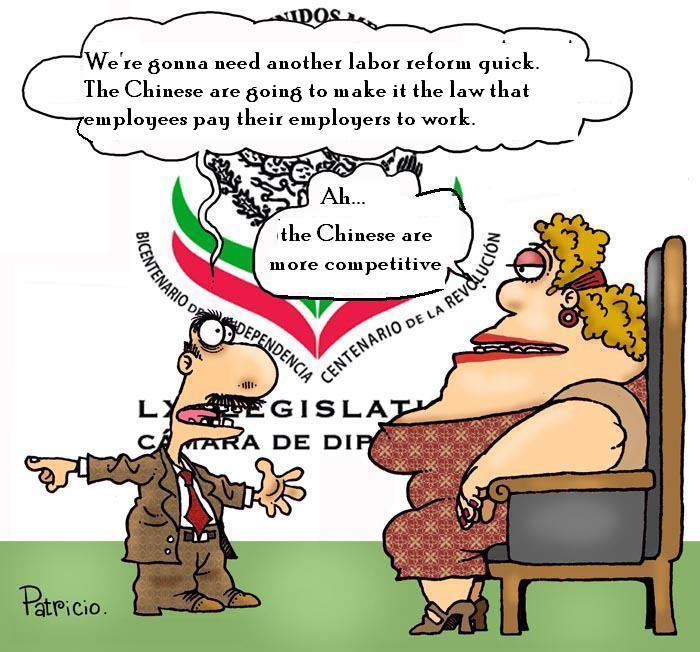
IN THEORY, proposed changes in Mexican labor law will make employment and wages more “flexible”. We’re being told this will create more jobs, but whether it creates more wages and means more money in Mexican households rather than more hours of work and less to spend is not clear. As German economist (and Director of the Division on Globalization and Development Strategies of the United Nations Conference on Trade and Development) points out in the Real News Network interview below, that lowering wages to boost exports is counter-productive, and ends up meaning less money, and less economic activity for everyone: worldwide. IF lower wages (or wages competitive with China) are the norm, then Mexicans would have less to spend not just on domestic goods, but on U.S. imports as well. And, U.S. workers, having less to spend (their own wages being held down in the hope of boosting exports) would buy not just less Mexican goods, but less Chinese ones as well.
All to the bad and worse. But, what really is bothersome is the assumption that Mexico should emulate China (at least when it comes to wages). China has lower wages in good part because Chinese workers don’t have a Hell of a lot to say about wages, hours and working conditions. The social problems — not to mention environmental and public health concerns — that are bound to develop when a country doesn’t pay its workers enough to live a decent life are bound to affect China much sooner than a country where there is some social safety net, labor standards and the basic expectations for a decent life are already met for the most part. That is, lowering wages is likely to cause unrest in China as expectations rise, more than in Mexico where at least the minimum expectations for a decent life are met (for the most part). I doubt U.S. consumers concern themselves much with working and living conditions by their suppliers, but it does affect them in their pocketbooks.
Of course, I think that Mexico depends too much on exports… and specifically on exports to the United States. While I question whether consumption for its own sake is sustainable in the long run, there are still huge pockets of poverty in this country, and higher wages might cut into the exporters incomes, but strengthen the bulk of the economy, as the poor are able to “catch up” with the rest of the country, buying those washing machines and taking those vacations that put more money immediately into the economy than exports.
Technical difficulty…
Mexicanos en el exilio is a El Paso nonprofit organization assisting Mexican reporters, photo journalists, political activists, human rights activists, businessmen, and former members of law enforcement and others who have had to flee to the United States for their own safety.
The organization has absolutely no funds to speak of, and is in desperate need of a a couple of computers (used are fine) with wireless and video capability to be used by exiled Mexicans for “skype” conferencing with Mexican therapists and others.
If you can help, please contact Alejandra Spector at: mexenex@gmail.com
“Tell them they are being attacked”
Making the rounds of the media this weekend has been a report listing the world’s fifty most dangerous cities, the top twenty all being Latin American (and nine of them in Mexico) from the Consejo Ciudadano para la Seguridad Pública y la Justicia Penal (CCSPJP).
Although there is no question that violence has skyrocketed in Mexico, especially over the course of the present administration, (and in turn has focused media attention on the high levels of violence throughout Latin America), there are reasons to question the data, and — more troubling — to ask ourselves what the purpose of this study is.
The non-appearance of places like Baghdad, or Damascus or Kinshasha on the list is surprising. There is no real indication of how the numbers were crunched, other than using the reported murder rate per 100,000. That Mexican numbers appear to be an internal estimate by CCSPJP which are much higher than the “official” numbers. They don’t jive with either those put out by the Mexican government, or those used by serious number crunchers like Diego Valle-Jones. I am going out on a limb somewhat and assuming the other Latin American numbers are also based on worst-case estimates, whereas those from the rest of the world are simply “official” ones. My reason for making the assumption is that CCSPJP is a Mexican organization and would, naturally, be focused more on Mexico, and Latin America in general.
There may be a reason for that. CCSPJP describes itself as a “non-governmental, non-clerical and apolitical organization”. To a large extent, this is true, in that it has no official ties to the government, to any sect, or to any particular recognized political party. However, this does not mean it is non-partisan.
According to Jorge Carizo McGregor, former UNAM rector and Supreme Court justice, CCSPJP President José Antonio Ortega is a high-ranking member of “el Yunque,” the fascist “secret society” originally meant to defending the Catholic  Church in Latin America and Spain from “the forces of Satan”, and suspected of organizing death squads. Ortega does not deny his ties to el Yunque. He was one of the more prominent promoters of the theory that the the murder of Guadalajara Cardinal Juan Jesús Posadas in 1993 was a state-sanctioned assassination, and not — as seems most likely — “collateral damage” during a shootout between gangsters.
The CCSPJP itself is a great defender of former Colombian President (presently under indictment for crimes against humanity) Álvaro Uribe and the group advocates a Colombian solution, a la Uribe, for Mexico’s insecurity… best summed up as “kill them all and let the Lord sort ’em out”.
The group attempted to have Mexican survivors of the Colombian attack on a FARC camp in Ecuador arrested in this country, and claims the left-leaning government of that South American nation, along with Venezuela and Bolivia, are part of some secret plot to foment violence. Ortega himself, as an attorney, tried to have Lucia Morett (one of those survivors, and an UNAM student) arrested as a “narcoterrorist”. While the group supposedly is focused on violence reduction in Mexico, it also finds the time to attack the motives of student protesters in Chile, claiming student leader Carmen Vallejo’s visit to Mexico was part of a communist plot (various CCSPJP podcasts here).
Leftists of all stripes are, in the CCSPJP view, “criminals”. Ortega opined in a 3 October column that the PRD should be de-listed as a political party on the supposed grounds that it encouraged criminality. For that matter, all the political parties are too soft on crime. The present administration is a failure for only going after the leaders of criminal organizations, and the incoming one doesn’t look so good either: unlikely to detain more criminals (as CCSPSJ proposes), and not really changing the present strategy (if there ever was one) for reducing violence.
 The CCSPJP does put out “position papers”, but what they boil down to is “socialism = insecurity” In ¿Pobreza = Delito? the group explicitly attacks social programs meant to reduce crime (like the rather successful “Todos somos Juárez” program that helped turn around the crime rate in what CCSPJC claims is the second most dangerous city in the world, by simply offering citizens better access to social services and inclusion in the Mexican safety net) only create more “socialism” and fail to punish the wicked. Other material is meant to disprove that social inequality and crime are related.
Punishment… and destroying the secular left (or secularism in general) is what CCSPJP is all about. Looking through its material, it has less to do with crime in general (although concern about crime is a good “hook” for garnering public support) than about a need for more “final solutions” to criminals… even if it means bringing in foreign forces (the United States).
Fascist? Consider what Hermann Göring — who knew something about Fascism — said about war… whether a war on France and the Soviet Union, or a “war on crime”:
“Naturally, the common people don’t want war; neither in Russia nor in England nor in America, nor for that matter in Germany. That is understood. But, after all, it is the leaders of the country who determine the policy and it is always a simple matter to drag the people along, whether it is a democracy or a fascist dictatorship or a Parliament or a Communist dictatorship…. All you have to do is tell them they are being attacked and denounce the pacifists for lack of patriotism and exposing the country to danger. It works the same way in any country.”
CCSPSJ has a need to tell the people they are being attacked… and to denounce the “pacifists” for their lack of patriotism — and insistence on human rights, or their squeamishness about methods, or even reporting on abuses — “exposes the country to danger”. Fear-mongering, as a way of building support for Fascism, works the same way in any country.
When the going was good

- Fidel, not dead in 1964 (Deana Stryker, photo) and still not dead in 2012 (Alex Castro, photo)

From Fox News Latino (and a plethora of Kennedy-assassination sites):
A CIA document outlining a Mafia-connected plan to assassinate Cuban leader Fidel Castro for $150,000 is among thousands of Robert F. Kennedy documents made public Thursday, just days before the 50th anniversary of the Cuban missile crisis.
In the 1964 plan, the mob and “patriotic Cuban exiles” eventually settled on a payment of $100,000 for assassinating Castro, $20,000 for his brother Raúl and $20,000 for revolutionary Ernesto “Che” Guevara, plus $2,500 for expenses.
The Slim-line Obama-phone
I admit I haven’t been all that wrapped up in the U.S. elections, and I haven’t seen Fox News in years, so the whole “Obama-phone” thing passed me by.
Back when Ronald Reagan was President… and the whole conservative response to poverty was “get a job”… somebody with a few brain cells realized that to get a job (even a temporary one… especially a temporary one) your potential employer had to have some way to contact you. Which, at the time, meant having a telephone. So, since 1985, the “Lifeline Program for Low-Income Consumers” has provided a discount on phone service for poor people in the United States.
When the program was upgraded (just like communications technology itself) a while back, cell phones were included in the program… which only makes sense… so naturally, given that the new regulations came in under the Obama Administration, Fox has decided it’s some nefarious plot to perpetuate what they weirdly consider “socialist” for using government programs to foster U.S. businesses (sort of like… oh… pumping the railways via the Homestead Act of 1862) .
Of course, the Reagan Administration was also the beginning of the whole “Free Trade” mania that affects the U.S. although when it’s not U.S. companies exploiting foreigners and driving down U.S. wages, the party of Reagan, it’s all part of the socialist plot, too.
And… with the Foxistas having branded the whole idea of making it possible for poor people to earn a pittance in an honest way some sort of evil socialist plot, there has to be an evil socialist villain (well, Obama, obviously… but then, he’s only the tool of someone… anyone). Even better if he can be a foreign villain. And, if not an Arab, then a MEXICAN villain.

Mwaaaahaaahaahaahaa!
The lady with the “Obama-phone” apparently got her cell phone through “Trak-Phone” … the bottom of the line, utilitarian cell-phones sold by a company, owned by a company, controlled by Carlos Slim. Geeze, I don’t think you can do anything involving telephones in the Americas without some connection to Carlos Slim. He should be a hero to the heirs of Ronald Reagan, having not only taken over a government enterprise (and actually made it better, I do have to admit), but made himself beyond filthy rich in the process and actually trickling down some jobs. Should… but he’s a Mexican. And worse, the President of Trak-phone doesn’t support the Republican Party. Which — to those great minds at Fox (a few digits short of an area code in the brains department) means Carlos Slim is an “Obamination”.
Slim has, on occasion, worked with leftists, and rightist, and centerists. As Fidel Castro once pointed out, he’s the kind of guy who’d be a “one percenter” in any economic system. And he ain’t stupid. He was a child prodigy in mathematics, and could probably still figure out the Republican tax plan… which means… if he was giving his own money to U.S. politicians, I doubt it would be to the Rs. After all, Slim’s whole fortune rests on having people earn enough to buy the stuff he’s selling.
But, did I mention he’s a Mexican? Wait until Fox figures out that his dad was an Arab.
(16-October 2012: for the first time ever, I closed comments on a site. Not that I didn’t appreciate the comments, and not that I didn’t enjoy them, but the post was about Carlos Slim, and how Fox News reports on his business activities … nothing to do with U.S. tax policy and the two neo-liberal political party positions on the same. )
12-10-1492
In 1492, the natives discovered they were Indians, discovered they lived in America, discovered they were naked, discovered that sin existed, and that they they had to obey a king and a queen who lived in another world, and a God who lived in another sky who had invented sin and clothes, and who commanded that people be burned alive for worshiping the sun and the moon and the rain.
Eduardo Galeano

Baby photo?
 I don’t know who picks gangster names, but suspected mass murderer Salvador Martínez Escobedo got the moniker “la ardilla”… the squirrel.
The Squirrel? Who’d fear a squirrel?

… then the drug war happened
Diego Valle-Jones, the Izaak Walton of data fishing, looks at the rather lugubrious data on homicides over the last century. While looking at the age data on killers and their victims (murders do “pick on people their own age” for the most part), he manages to find some good news. Apart from wars — we’ve become less homicidal in each generation. Overall, our great-grandparents were a much more murderous lot than our grand-parents, who killed each other much more than our parents did, and… while we still have that killer instinct … our children are a more peaceable lot than we are.
In general, that is.
Ever since the end of the Mexican Revolution and the Cristero War violence in Mexico inched down in fits and starts from a high of about 60 homicides per 100,000 people to its lowest level sometime during the middle of the last decade (there’s some uncertainty about the number of homicides in 2007). Then, the drug war happened and the homicide rate shot straight up.
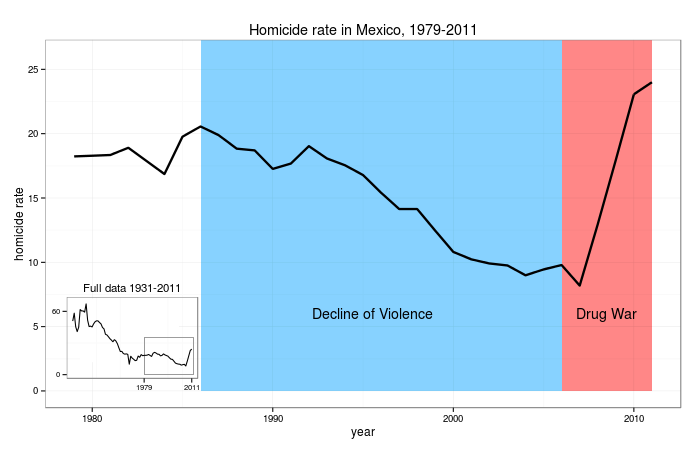
Actually, as Valle-Jones notes in his highly readable explanation of his angling for data, there was a second factor, that might be as important as the “drug war”… the end of the ban in the United States on the sale of automatic weapons.
Homicide rates in North America had been dropping since the 1990s — and still are dropping in Canada* and the United States. Again, in 2007…
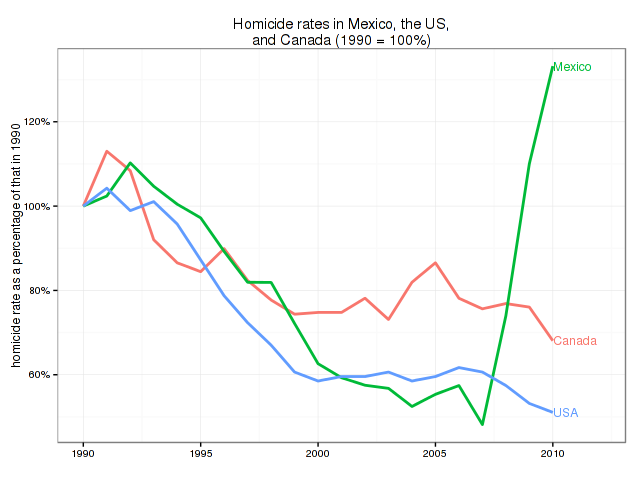
As always, young people are the majority of victims … and perpetrators… of murder, but the question we should be asking is not “what’s wrong with these kids today?” but what’s wrong with us that made the decisions that permitted a perversion of the natural order of things… who was it that started this drug war, and unleashed those weapons. And to what end?
* Canadians, relax! Yes, your homicide RATE dropped much less than in the U.S. and Mexico, but it was a very low rate to begin with, and — human nature being perverse — the homicide rate will never drop to zero, and a twenty percent drop in a low rate is something to be celebrated. Alas, poor Mexico… we’d seen the murder rate nearly halved and could have been a country where any murder for any reason was an anomaly, if not for … well… you know.
Satellite dish
Mexican legislators get a ridiculously huge “dieta” … spending allowance … that they can pretty much spend any way the want. On satellite TVs… or on satellites.
Astronomer and Morelia PRD deputy Andrés Eloy Martínez is spending about eight thousand U.S. dollars out of his “dieta” for a a 30 cm. satellite to be launched late next year. From the Latin American Herald Tribune:
Esperanza I, which is being built by Interorbital Systems of Mojave, California, is expected to be launched at the latest in January 2014 from the Pacific nation of Tonga, but efforts are being made to have the launch take place in southeast Mexico’s Yucatan Peninsula, the congressman said.
“It’s an economic satellite, very small, and its useful cargo capacity is limited, but it would undoubtedly be sufficient to include experiments of great creativity from students or others with an interesting project,” Martinez said.
The Mexican Space Agency, which was created in 2010 by Congress, will provide advisory services on the technical aspects of the project during the approximately four months that the satellite will be in orbit, the congressman said.
The guidelines for selecting the experiments to be carried into orbit will be revealed soon, Martinez said.
Science education from a legislator? It might be noted that Eloy Martínez is a member of the Chamber of Deputies committee equivalent to the U.S. House of Representatives Committee on Science, Space and Technology … you know, where Todd “rape can’t cause pregnancy” Aiken and Paul “Evolution is straight from the pits of Hell” Broun make the decisions that determine the future of science and education for our “first world” neighbor to the north.
I ain’t got no body…
Jorge Zepeda Patterson, viewing the widely distributed photographs[1] of the presumably dead Herbierto Lazcano Lazcano noticed something weird… the guy has no ears. Side photos of the corpse clearly show he DID have ears, but in the head shot, they appear to have been cropped off… or they were photoshopped out. As it is, there’s a lot missing… not the least being the body itself. Lazcano Lazcano, according to the Drug Enforcement Agency, stood 1.72 meters tall; the body on the slab was was measured as being 1.60 meters. Obviously, someone should have taken a closer look, or checked again… but for unexplained reasons the body was released to a funeral home before the autopsy… which is mandatory under Mexican law when the suspected cause of death is homicide or suicide.
The missing corpse (and his missing six inches… and missing ears) are the least hinkey thing about this whole story.
[1] If you’re into dead gangster photos, they’re at: Semar difunde imágenes del presunto cuerpo de Heriberto Lazcano Lazcano, líder de los Zetas


 mexfiles.net