THE debate
It really isn’t all that big a deal in Mexico, and I’m surprised the Mexican press had anything to say about it, but with all the news in the foreign press, I suppose it eventually was going to come up.
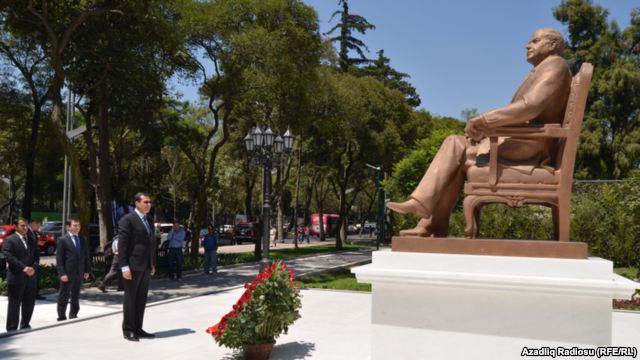
I’m referring of course, to “urbanist” Andrés Lajous being quoted by the BBC and picked up (free?) by Huffington Post, over a supposed “debate” over a statue of late Azerbaijani dictator Heydar Aliyev popping up in Mexico City.
Azerbaijan and Mexico have a few commonalities… besides being a non-European culture with a European overlay, they produce a lot of oil and have a large economic power with nuclear weapons on their northern border. That their first president, the bronze.memorialized Heydar Aliyeza was a soviet era secret police official isn’t worth more than a shrug, given that they were part of the Soviet Union until 1991, and the biggest chunk of that old union … Russia… is run by a ex-secret policeman, Vladimir Putin. Anyway, with a few notable exceptions, going back to the days of Benito Juárez, Mexican foreign policy, has been to stay out of the internal affairs of other nations.
It was sort of an accident of history that Mexico was the first country to exchange ambassadors with Azerbaijan, which is why the oil-rich Turkic-speaking country paid for a park in Mexico City, and shipped over the statue of their great leader. No different really than a corporation paying for a park or public facility in the U.S. and wanting naming rights.
Lajous — whose attempts to become politically relevant through the old PSD (one of a string of parties Dr.Simi’s niece, Patricia Mercado, attempted to get on the ballot) fell through spectacularly in 2008 — is an occasional writer for Nexos, and other Mexican publications, so should know that a debate usually means there are two points of view under discussion. maybe he has a few interesting things to say, but there’s no debate to speak of. OK, it’s a butt-ugly monument, to an odious dictator, but a park is a park. Debate over.
Anything else worth debating?
Three way in Oaxaca
Deborah Bonello (Mexico Reporter) from Juchitán, Oaxaca. While, as usual, Ms. Bonello does an excellent job, before one gets the idea that Juchitán is some sort of rural South Beach or San Francisco, a comment. I wonder if Ms. Bonello isn’t somewhat over-simplifying (and misinterpreting) things when she uses “gay” and “muxe” pretty much interchangeably.
In part this is a language issue… both Spanish and English use the word “gay” to refer to persons who have sexual and emotional relationships with their own gender (often specifically male-male relationships).
As with most European-based cultures, we defining gender based on physical characteristics. AFTER defining gender, then we define “normal” gender behavior. There is a secondary sense of “gay” — and one that is used as a negative stereotype — based on behavior: effeminate men and “manish” women being called “gay” (or usually one of the many cruder terms available in English, Spanish and just about every other language).
But the Zapotecs do things their own way. behavior — not biology — defines gender. Muxes are recognized as having the behavioral norms of females although the body parts of males. They are a third gender… “two-spirit people”, as Oaxacan muxe politician and activist Amaranta Gomez defines herself… which leads me back to the definitions of “gay”. Since muxes are not having sex or forming intimate relationships with other muxes, AND their behavior is not considered atypical for their gender, can we say tolerance for muxes is the same as tolerance for gays?
I have wondered whether our surprise that muxes are considered “normal” and unremarkable in this region doesn’t have more to do with our own cultural assumptions. Although Miguel Covarrubias’ classic work on the Isthmus of Tehuanatepec, Mexico South (1946) glosses over the existence of the muxes, he devotes quite a bit of text (and some humorous drawings) to the unusual situation in the Zapotec region, where women have the upper hand in economic and political affairs, not men. We just assume that other cultures work like ours, and there’s an innate advantage to being male. Successful women in the wider culture are described in terms of male behaviors, and — sometimes metaphorically — in biological terms (“She’s got brass balls!”) as well. But, for us, it’s still a man’s world.
Not everyone in the Isthmus is a Zapotec, and — as I’ve written before — Mexican culture is more nuanced in the power-relationships between men and women than we Anglo-Saxon types realize. Sure, there are huge advantages to being a male — but — if you live in a community where the local culture has been heavily influenced (or the majority culture) is one where females are the more powerful gender, a muxe in the family would be nothing to be ashamed of… the (literal) balls being of less importance than the behaviors that make for success in a woman’s world.

2 de Octubre 1968: ¡No se olvida!
Corrido by Judith Reyes, remembering a slaughter particularly memorable for the government’s inability to spin it as part of some anti-crime activity, or the deaths as “collateral damage.
Is Chiapas burning?
 In Chiapas, several municipalities are under siege. Although Milenio is only reporting on the uprising in Motozintla —where citizens set fire to the municipal building as well as police trucks (and opened the doors to the city jail besides) — and alleging the rioters are PRD activists refusing to accept state’s Electoral Tribunal’s award of the municipal presidency to a Green Party (PVM) candidate (the Greens are in coalition with the PRI), other media outlets are reporting “occupations”of local government buildings in at least six communities.
I can’t vouch for my information, but along with reports that the city officials in Cintalapa fled a lynch mob that formed after city workers caught them trying to destroy municipal documents, that more community uprisings are likely, as word spreads that the Ioutgoing administration of Juan Sabines (PRD) left the state bankrupt, leaving municipalities without funds to pay their employees.
Labor pains
On its way out the door, the Calderón Administration has pushed through a labor “reform” package with undue haste that frankly I haven’t had time to digest, nor — I suspect — has anyone else.
Introduced under new PAN sponsored laws that allowed the president to “fast track” legislation, the Calderón Administration introduced a bill on September first, giving the Chamber of Deputies only 30 days to consider a package that — on the face of it — conflicts with several international treaties, radically changes the nature of the relationship between labor and management and probably force major constitutional changes. When the bill emerged from committee, 270-odd clauses were “reserved” — one party or another wanted to discuss modifications — but only two days to discuss the modifications. The sitting speaker supposedly became ill on Thursday and was rushed from the chamber in a wheel-chair, forcing an adjournment, and cutting further into the time allotted for modifications. The bill passed (from the balcony of the Chamber, after opponents, in a last minute bid to halt the proceedings, occupied the podium) 351 to 130 with 10 abstentions.
The most talked about change is that wages will be calculated by the hour. Right now, as every “concern troll” mentions, the minimum wage is about 5 US dollars a day. That sounds low… and it is. But, that minimum wage applies no matter how many hours the job takes (as long as it is less than eight) and includes a substantial benefits package including health insurance. If the job lasts all day, most employers also have to feed their employee. At least, in theory, that wage is enough to support a family of four (not well, but enough to cover the basics). In reality, at least two members of any family will be bringing in at least some income, and they will have some small measure of financial security, as well as the time and energy to devote to familial life. However, calculated by the hour, the minimum wage is closer to 60 cents an hour. Employee benefits will be calculated based on the percentage of a “full day”… that is, a four hour worker will only receive half the benefits package points when it comes to things like social security and retirement. While this will, as the defenders of the new system claim, create “more employment” it also creates less security. The advantage to employers to create more half time jobs, saving the overhead paid out for benefits like those meals, are obvious.
And, for low-paid workers like house-cleaners, who seldom have to work a full eight hours, their only recourse is either to work several jobs, or to fall even deeper into poverty. In theory, maybe a minimum wage worker could earn more by working a couple of different jobs… but just consider the time between jobs. Bus fare where I live is 6 pesos (about fifty U.S. cents… or 40 minutes labor under the new minimum wage). A workers with two minimum wage jobs, even if they were almost back to back, is going to not only lose an hour or so of his or her personal time in transportation, but those 12 pesos, or more than an hour’s wage. There is no way a minimum wage worker comes out ahead.
Foreign commentators (and those pushing this bill) have spoken of making “it easier for employers to hire and fire workers, streamline the settlement of time-consuming labor lawsuits and formally regulate outsourcing”. Workers who have been fired (which, under the new regulations could be something as a simple text message saying “adios, pendejo”… in other words, turning Mexico into Texas with it’s “fire at will” provisions in employment contracts), or laid off, weren’t usually the source of those “time consuming labor lawsuits”. Of course, you hear stories (usually from employers) about not being able to fire a light-fingered cleaner, or a lazy and terminally stupid employee, but nearly every instance I’ve known about personally was a matter of the employer unwilling or unable to to pay out the severance package (based on a number of factors, including length of service) — or where the employer didn’t really have a logical reason to let their employee go and was just making up a story they thought sounded believable. Regulated outsourcing, while an option for some kinds of work (I was a “freelance” tech writer for years, and while the rent-a-geek trade paid well, there was no guarantee from one day to the next I’d still have a job) is usually not considered an option for any sort of long-term employment.
And, perhaps most alarming of all — at least to historians — is the assault on the letter and spirit of the Constitution, specifically of the “sacred” Article 123.
There are streets and colonias and communities in Mexico named “Articulo 123” for a reason. That section of the Constitution of 1917 is of more than just a theoretical interest to lawyers and policy wonks: rather, it changed the world. The 1917 Constitution was the first to spell out the rights of workers, and although continually tweaked over the years, was a milestone in the history of human rights… establishing a baseline for working conditions, and for spelling out the basics of labor-management relationships. Mexico was, back in the 1920s and 30s, sometimes called “Bolshevik Mexico” — usually by corporate management types — not so much because the new Soviet Union used the Mexican constitution as a template for their own (soon discarded) Constitution of 1924-25 — as because Mexico had altered the balance of power between labor and management.
What made Articulo 123 so “radical” was that it acknowledged the rights of workers to combine and act in their own self-interest (and gave management the same rights. While this was hardly a dictatorship of the proletariat, even calling Mexico — as many did — a “worker’s state” is something of a misnomer. The article does give labor more extensive rights than most places, and does upend the usual balance of power between workers and management, but in spelling out the specific rights of labor, it gave to both labor and management the right to combine in pursuit of their own interests. In other words, while the Constitution blessed unions, it also blessed Chambers of Commerce and trade associations. And, much to everyone’s surprise, it also legitimized the first clerical strike in history… when the Catholic Church, hoping to force changes in the parts of the Constitution defining the religious rights, was within their rights to simply stop providing services to their “customers”.
That labor rights were enshrined in the Constitution, and that Mexico was a “workers’ state”, is largely a reflection of the important role organize labor played in the Revolution itself. While proto-unions (unions did not exist under the Diáz dictatorship, although there were underground anarchist and syndicalist organizations), and skilled workers — especially railroaders — were of importance in organizing resistance to Diáz, and the anarchist Flores Magon brothers helped swing worker support to Francisco Madero, it was Alvaro Obregón who recognized that organized labor was key to creating a modern state. While the Red Brigades — the workers’ militias Obregón relied on to put down challenges to his “consolidated” government — more importantly, his government fostered unionization as a means of creating a counterweight to anti-revolutionary groups, like the Catholic Church and foreign corporate interests.

Luís Napoleón Morones
One of the more important unions, SME (Sindicato Mexicano de Electricistas), founded by Luís Napoleón Morones in 1915, became the backbone of CROM (Confederación Regional Obrera Mexicana) which, under Morones, was for all practical purposes an arm of the state under Calles. Appointed Secretario de Economía in 1924, Morones’ flamboyance (he liked to wear diamond rings… about 10 at a time) earned him a reputation as particularly “corrupt”. Given that the Cuernavaca neighborhood where several of Calles’ cabinet ministers and cronies had homes was known locally as “the Street of 40 thieves” it’s hard to say that Morones was any more, or less, “corrupt” than any other high-ranking Mexican official at the time, but — especially among the corporate-minded and the conservatives who rejected the Revolution — “union corruption” has always been somehow seen as worse than some other kinds.
With Cárdenas (who incidentally forced Morones into exile… in Atlantic City, New Jersey) openly encouraging unions to take a proactive role in challenging the status quo, and giving his administration cover to take seemingly radical actions like nationalizing the oil industry (technically done to enforce a court order resolving an oil workers’ strike), the conservatives saw independent unions — and the workers in general — as more and more an impediment to their own vision of a modern state.
With the PRI, founded after World War II, seeking at least on paper to preserve the Revolution, but at the same time, meet the demands of foreign investors and the emerging new industrial leaders, the answer seemed to be to bring the unions under state control. While the best of the PRI sought (in all sincerity, I think) to create stakeholders in the party/state out of the workers, simply co-opting the union leadership, making the unions simply appendages of the party. This was the era of the “cowboy unions” (sindicatos charro) — so named for the sartorial style of several early leaders.
Unionists who went along with the party were generously rewarded, and the party and the administration did everything possible (including, quite likely, assassinating union dissidents) to guarantee the tame leaders stayed in place, and the union’s goals matched those of the administration… even when such administrative goals were not in the worker’s best interests. The railway workers, PEMEX employees, miners and the SME (Morones’ old union) were the major holdouts.

Handling recalcitrant labor organizers. Railroader Demetrio Vallejo taken before a judge in 1959.
The 1958 railway strike, which threatened to turn into a general strike, was put down by the army, and was used to both to force the railroad workers into the “family” and to destroy the Communist Party (David Alvaro Siquiros, the Stalinist artist, was among those who spent several years in prison for his part in organizing anti-government actions). Students, of course, could not be unionized easily, and the student strike of 1968 which was rapidly spreading to the workers, also led to a violent backlash, followed by a complete revision of basic labor law in 1970.
One needs to remember that at the time, mining, oil production and the railroads were all under state control. While under the 1970 labor bill, unions continued to focus on “lunch bucket issues” — salaries and benefits, the Party continued to focus on union control, although a dissident faction within PEMEX (which is where Andres Manuel López Obrador made his political debut) and in other unions (notably the Teachers’ Union) would emerge, and ally itself with the dissidents who backed Cuauhtemoc Cárdenas in the stolen 1988 Presidential election.
A friend of mine, who was the Human Resources Manager for a large foreign owned company, once shared some insights on contract negotiations in the post 1970 era. Basically, management would propose some minor adjustments in salary, and the union leaders were “advised” on how to sell the package to their rank and file. And given a “consideration” for their assistance in preserving labor peace for the previous contract period. And assistance in any upcoming union elections.
Although PRI continued to have both labor support (at least that of its tamed union’s leadership), its economic vision — in the eyes of the left — was became indistinguishable from that of the U.S. oriented PAN after 1988. Vicente Fox’s victory in 2000 only verified the trend towards a management-focused labor policy. With denationalization well under way, the Fox Administration — when

The face of modern labor… or one of the many lifted faces, anyway.
it just didn’t ignore labor — openly courted PRI unionists like Elba Esther Gordilla in pushing issues not directly related to labor, but within line with Fox’s conservative party’s values. That is, in exchange for Gordilla’s support in radical changes to the educational curriculum, Fox turned a blind eye to the suppression of the dissident teachers’ union seeking to oust Gordilla.
Under Calderón, the benign neglect of labor has ended. Starting with the heavy-handed suppression of teachers’ union unrest in Oaxaca, under the rubric of “security”, the Calderón Administration’s labor policy has been somewhat analogous to his “drug policy”. The fight against narcotics traffickers has focused on weakening opponents to the Sinaloan “cartel”, much as Calderón’s attacks on union “corruption” have focused not on charros like Gordilla, but on the few remaining independent unions: the miners and — most notably — the SME, Morones’ old union. SME, of course, also stood in the way of privatizing cable access in the Federal District (the union owned the electric company, and had the access rights to underground cable) and under the claim that SME’s leadership was “corrupt”, he used military force (in the middle of the night) to seize the union’s assets and decertify the union. Mining taking place mostly in relatively isolated places, or at least outside the Federal District, force used against miners and their unions on behalf of management (mostly Canadian) has been less noticed by the outside world. Again, under the claim that the miners’ unions are “corrupt”, they have been broken up into manageable pieces (as with the smaller “drug cartels”) and made ripe pickings for the government supported unions (as those smaller cartels are by the Sinaloans, or the Zetas).
So, who really benefits and why would anyone in Mexico support this bill?
The answer to that comes courtesy of U.S. neo-liberal apologist Fareed Zakaria (or rather, Ravi Agrawal, “senior producer of Gareed Zakaria GPS):
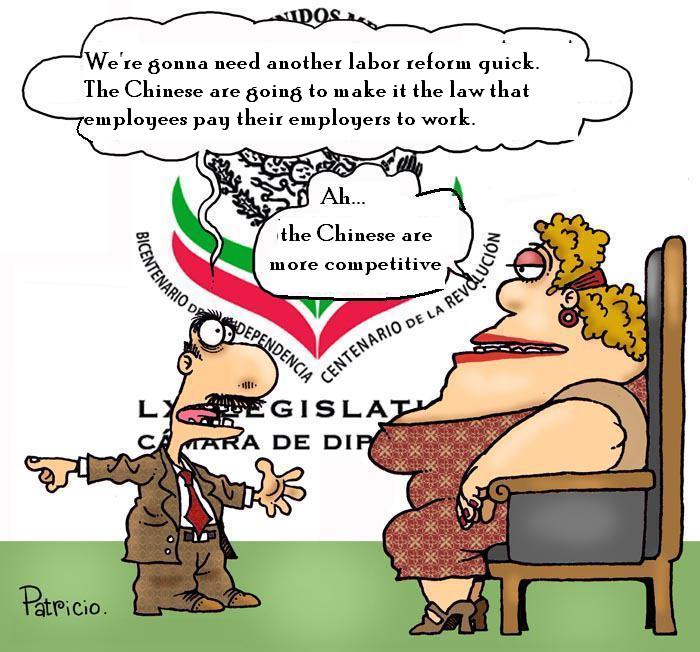
Part of Mexico’s appeal to investors is tied into what I think may be the country’s key weakness: inequality. You see, at the lowest-end, labor remains cheap. The Economist points out that in 2003, Mexican pay was three times China’s rates; now it is only 20 percent higher. So Mexican manufacturing is poised for a boom. And while in the past few years Mexico banked on its proximity to the U.S. (lower transport costs) and trade deals like NAFTA to compete with China, it will now be able to manufacture and price products at an advantage.
The advantage, as Zakaria’s minion gleefully suggests, is that by creating more inequality in Mexico is making the country “competitive” in a race to equal the appalling conditions of workers in a one-party, anti-democratic state… to the benefit of U.S. corporations and investors.
Socialist is a dirty word?
The Economics Secretariat (S.E.) has a little list. Susana González G. in this morning’s La Jornada:
“Socialist” was listed by the Ministry of Economy (SE) as one of the 352 “disturbing, humiliating, offensive, discriminatory or violent” words that may not be used to register companies or associations.
Added to the list were other terms including “social democracy”, “government” or “Legion” and the names of Beltran Leyva, Chapo, Bin Laden, Hitler and Osama, as well as (Spanish-language) words referring to murder, narcotics traffickers, assassins, terrorists, “making do”, shit-stains and the KKK.
Regulations on corporate names recently changed, and the Economics Secretariat, in compiling their black-list breaks down its list by category: 171 “disturbing”, 159 “humiliating and offensive”, “violent” words. The categories don’t make much sense. While “faggot”, “asshole” and “mother-fucker” are merely considered “disturbing,” the thirteen variations of the verb “chingar” (to fuck) are “offensive and discriminatory — as are “beaner”, testicles, vagina. The violent words mostly deal with physical assault and include both “violar” (to rape) “biolar”, the sound of “B” and “V” being the same in spoken Mexican Spanish.
“Socialist and “social-democratic” made the “offensive and discriminatory” category for some reason, which includes terms like “syphilitic” and and least thirteen variations on the verb “chingar” (to fuck).
While in one sense, this sounds like bureaucrats with too much time on their hands (or to look at the bright side, an attempt to take the “creative interpretation” of regulations so common in Mexican bureaucracy out of the hands of low-level civil servants). On the other — like the undue haste with with the outgoing administration pushed through radical changes in labor law — part of a larger effort to erase even the symbols of the Mexican Revolution as possible before PAN leaves office on the first of December. One can, presumably, register a company named “Ayn Rand, S.A.” or “Cerdos capitalistas imperialistas, S.C. de C.V.”
Plagiarise! Plagiarise! Plagiarise!
Alonso Lujambio set something of a record in the Calderón cabinet, having lasted nearly three years in the job. He had replaced Josefina Vasquez Mota (PAN’s presidential candidate) who — despite being a Calderón loyalist — had not been willing to bend the department to the will of Esther Elba Gordilla. So, Vasquez Mota had to go, and Lujambio was brought in. As Education Secretary, he’s best remembered for overseeing a steep decline in the quality of Mexican education, and for claiming that telenovelas were educational material. Despite his lackluster (or worse) record, his resignation in March of this year was unexpected. Lujambio, who was only fifty years old, had an inoperable brain tumor.
As something of a consolation prize, or perhaps as a mark of this party’s appreciation of his career, he was awarded a plurinomial Senate seat (one chosen by the party) in this election, taking office on the first of September. Lujambio passed away earlier this week (25 September).
While the irony of Lujambio’s cabinet position, and his senate seat, being due to his ability to work with what is certainly Exhibit A when when speaks of corrupt union bosses… just as his party was ramming through radical changes in the labor laws, claiming they were curbing union corruption, his substitute will be another notable educational figure.
Named by PAN to replace the former Education Secretary in the Senate, María del Pilar OrtegaMartínez has made her own mark in the world of learning. With government funding provided by the Secretary of Energy, Ortega was taking graduate courses at Harvard University’s John F. Kennedy School of Government… that is, until she was bounced out of the program for plagiarism: her thesis was written (under orders handed down by Calderón’s Energy Secretary, Georgina Kessel) by an Energy Department sub-secretary.
Aguachile, being an academic himself, is appalled:
Ortega Martínez was in 2008 revealed to have handed in a thesis for Harvard University, no less, that was simply lifted from the works of others, and to boot put together in final form by her own staff! Reportedly Dr. Kelly Gallagher of Harvard as a consequence sought to have her expelled from the university. I wonder what kind of interventions took place behind the scenes to protect the then-federal deputy.
It speaks to just how low the conservative PAN has sunk when it comes to the quality of their nominations for national office.
There is an up-side to all this. Besides the snark value, I don’t get to mention plagiarism and Harvard in this venue very often… which is an open invitation to sneak in the work of one of my favorite American satirists, Harvard mathematician Tom Leher on the values of plagiarism:
New Fire Ceremony?
… they waiting for the first signs that the world would continue, and life would go on. If it did, the Aztecs celebrated with the New Fire Ceremony, sacrificing a victim on top of the pyramid that became Cerro de la Stella… rekindling their fires that had been doused in anticipation of the event and renewing their lives.
(Gods, Gachupines and Gringos)
Whether the Mexico we know will still exist once the labor “reforms” are passed, and whether these “reforms” will be for good or ill, is the question that has the country on edge right now. With undue haste, the Calderón Administration is forcing though Congress a “fast track” bill which could change everything we know about Mexican labor and… well… life itself. I started a piece about this, but at 1 in the AM am not about to try to think my way through it.
The legislature adjourned due to illness of one member this afternoon, pushing back consideration until tomorrow, and cutting into what little discussion the bill has received. Outside Congress today, there were major protests, which — while not as violent as those outside the Spanish Congress — could very quickly turn ugly.
We reserve the right to refuse service to anyone

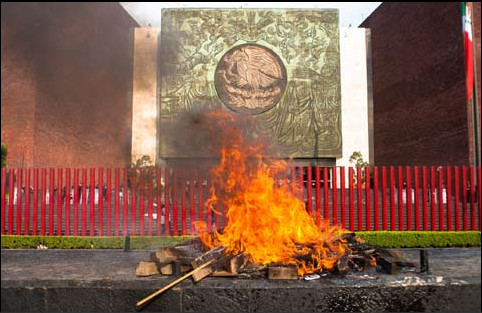
This ballsy Madrid restauranteur is my new hero. The Spanish government is doing everything in its power to prevent its citizens from seeking redress of their grievances, and peaceful protests have been met with force. Democracy ain’t always pretty, and it ain’t always nice.
More from The Real News Network:
Dying for water?
Supposedly, recently-elected Sonoran State Legislator Eduardo Castro Luque (PRI) was murdered by by hitmen paid by 25-year old Manuel Fernandez Felix. In most Mexican elections, there is a “B-team” candidate listed for each candidate — the “supliente” — who takes office should the candidate be unable to hold his or her seat for some reason… normally because one cannot be a candidate for federal office while holding elective office, and office-holders resign en masse six months to the day before the next general election, and the “supliente” fills in for the remainder of the term. Being killed, though, is another very good reason one might not be able to serve.
The 25-year old Fernandez was supposedly looking for a short-cut to a political career, was the “intellectual author” behind the hit, but political ambition may not be the motive behind the crime.
Follow the money — or rather the water. State Prosecutor Carlos Navarro has refused to consider Castro and Fernandez’s winning campaign issue. The PRI candidates (both from the smaller, “reformist” wing of the party) promised to fight a proposed transfer of billions of gallons of water from the own district in the agricultural region of Ciudad Obregón to state capital Hermosillo. The water transfer was backed by PAN (which presently controls the state government). Fernandez, according to his supporters, was a reluctant candidate, and only ran because — as a young (25 year old) hydraulic engineer, running as a supliente gave him a platform to discuss an issue of importance to him.

Would you kill for a drink of water?
The PRI is asking for a federal prosecutor to take over the case, and Fernandez is presently a fugitive. And his constituents have no representative to speak for them at a time when the state legislature takes up considering a project that PAN Governor Guillermo Padrés Elías has been pushing, despite judicial orders to halt the project.
I haven’t followed this story (my source was AP coverage, which naturally crow-barred in some reference to narcotics) but this isn’t the first time environmental activists have been accused of murder (or, had hitmen “confess” to being paid by environmentalists), nor would it be the first time people have been killed in fights over water rights.
Hey, Preacher… leave them kids alone

Raúl Tinoco/EL UNIVERSAL
A bit of good news… it may have take surrounding the building with federal and state police, but Nuevo Jerusalen students can FINALLY get started on their classes… only a month late. The unregistered religious sect that controls the small community in Turicato, Michoacán, rejects public education, and destroyed the previous school, under the kind of argument that you’d expect from U.S. “TEA Party” idiots… if I want my kids to be uneducated dolts, you don’t have any right to an education.


 mexfiles.net