She’s a witch, she’s a witch!
So, now the U.S. taxpayers are supporting a war on witch-doctors? From Adriane Pine’s Honduran site, Quotha. net:
Last week police raided a woman’s house in Choloma and found evidence of a traditional Garifuna medicinal drink, Guífiti (El Tiempo, whose reporters went along for the raid, puts “guífiti” in scare quotes), which they confiscated as evidence of witchcraft along with, allegedly, pictures with pins in them. And something that is presumed to be marijuana. They also arrested a suspected witch. For allegedly being a witch. Way to go, U.S.-trained crack Honduran police force, going after the real criminals.
Does guífiti turn you into a newt?
We expected better?
I have a sick computer at home, so don’t have access to my usual files. This piece, from New Mexico State University’s Center for Latin American and Border Studies on-line news letter, Frontera NorteSur, lists its references, but does not include links. Given the recent disappearance of Ruy Salgado, and a string of disappearances among political dissidents, what has been nagging at me is the sense that it is a perfectly logical extension of the “war on drugs”. It is an open secret that the state has been, shall we say, less than scrupulous about protecting the rights of those considered inconvenient. While one might cheer the fact that “narcos” seldom live long enough to get to court, let alone to be arrested, one senses that the sting of unsolved murders and disappearances usually credited to organized crime are seldom major crime figures — more socially inconvenient types like what we call “narcomenudistas” (retail drug dealers… i.e., the kid down the street selling marijuana) or petty thieves or maybe just the neighborhood ne’er-do-well.
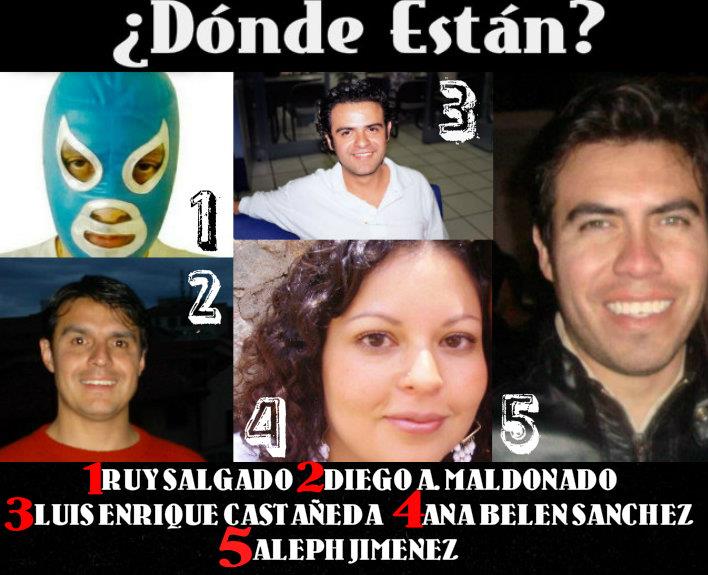
Very few are going to mourn their demise, or put much effort into finding them. We always seem shocked when we discover, as happened in Ahome, Sinaloa (detailed in Rio Doce, two weeks ago), that the local police are doubling as a hit squad… or that a U.S. “contractor” hired under Plan Merida is tied to training death squads in Juarez (Your U.S. tax dollars at work). But, as long as it was “those people”, it was to all too many easily overlooked, or just not considered. It’s not a leap of logic to go from eliminating “them” in the same of social peace (or, rather, in the name of market stability) and protecting the state to eliminating opposition to the state as it is now composed. With the state willing to use military force (designed not to “serve and protect” but to destroy enemies) and legitimized one set of non-conformists as the “enemy” (as in rebranding common criminal organizations as first “cartels” then as TCOs… transnational criminal organizations… and increasingly as “terrorists”), we are long on the way of defining all dissent and disruption as “terrorism”. And, having turned a blind eye to military “excesses” (or rather, the logical method of military control — killing the “enemy” ) as normal, it’s not to a surprise if civilians also adopt these methods.
In this climate, disappearances are politics by other means.
Friends and supporters of Baja California resident Aleph Jimenez Dominguez are demanding the young man’s safe return. The 32-year-old spokesperson for the Ensenada branch of the Mexican youth activist group #YoSoy 132 (I am Number 132) was reported last seen at a local bank on Thursday, September 20.
An oceanographer who collaborated with a research project involving the Mexican national oil company Pemex, Jimenez has also been a very visible and vocal activist with the 132 Movement, which arose last May as a protest against the ultimately successful presidential candidacy of Enrique Pena Nieto of the Institutional Revolutionary Party (PRI).
According to Raul Ramirez Baena, director of the independent, Baja-based Northwest Citizen Human Rights Commission, Jimenez was among 20 people detained for protesting at the annual Independence Day ceremony in Ensenada on September 15, an event in which journalists also suffered aggressions. Ramirez said Jimenez had also criticized the mayor of Ensenada, the PRI’s Enrique Pelayo, for the politician’s aspirations to become the governor of Baja California.
“Because of the antecedents mentioned and Aleph’s leadership in the #YoSoy 132 group in Ensenada, it is presumed that this is one more case of forced disappearance, a crime against humanity…,” Ramirez wrote in a statement posted on Proceso newsweekly’s website. He demanded that the authorities immediately locate the activist and punish those responsible for the disappearance.
Jimenez’s associates were quoted in the media as saying that their friend had been followed by a vehicle with tainted windows and a mysterious man in the days prior to his disappearance.
In response to the disappearance, Mayor Pelayo called Jimenez a valuable young man and dedicated professional. He pledged to collaborate until the end with “all the authorities to find the young man.” Francisco Sanchez Corona, state legislator for the Party of the Democratic Revolution, said he would seek to make forced disappearance a crime in Baja California.
… increasingly, 132 activists in different regions of Mexico have been subjected to a pattern of threats, mass arrests and physical aggressions by local police or unknown individuals. In addition to Baja California, detentions and threats have been reported in Puebla, Guadalajara, Aguascalientes, Acapulco and other places.
In July, six members of 132 accused police officers in Leon, Guanajuato, of driving them around the city and molesting female members of the group after they were detained during an anti-Pena Nieto protest. In San Nicolas de la Garza, Nuevo Leon, three activists alleged they were stripped naked and beaten by local cops.
Jimenez’s disappearance came only days before the 132 Movement and allies in labor and popular movements announced a new round of mobilizations against Pena Nieto’s ascendancy to the presidency in December. Meeting in Oaxaca this past weekend, the Second National Convention against the Imposition unveiled a series of national mobilizations beginning with a September 25 demonstration in Mexico City against the labor reform legislation pending in the Congress and culminating in a massive gathering in the capital city on December 2 and 3.
In the interim, activists plan student strikes, protests against media monopolization, a presence at the youth-popular Cervantino Festival in Guanajuato and a commemoration of this year’s Day of the Dead holiday festivity as “The Day of the Drug War Dead.” Convention participant Camilo Valenzuela characterized the fall season as the birth of a “national liberation movement.”
Sources: Frontera, September 24, 2012. Elinformadorebc.info, September 22 and 24, 2012. Articles by Elizabeth Vargas and editorial staff. El Sol de Tijuana, September 23, 2012. Article by Rocio Galvan. La Jornada (Jalisco Edition), September 22, 2012. Article by Alejandro Velazco. Monitoreconomico.org, September 20 and 22, 2012. Articles by Nicte Madrigal and Elviga. Elviga.net, September 19, 2012. Articles by Miguel Ramirez and the Reforma news agency. La Jornada (Guerrero Edition), September 16, 2012. Article by Francisca Meza Carranza. El Semanario de Nuevo Mexico, September 13, 2012.
La Jornada, September 8, 21 and 22, 2012. Articles by David Carrizales, Vicente Juarez, Rubicela Morelos, Fernando Camacho Servin, and Abraham Nuncio. Proceso/Apro, July 23, 2012; September 8, 15, 23, 24, 2012. Articles by Gabriela Hernandez, Pedro Matias, Maria Luisa Vivas and editorial staff. El Universal, August 24, 2012. Article by Javier Cabrera Martinez.
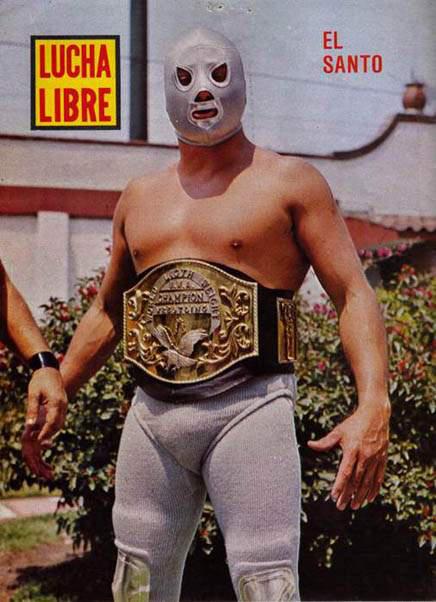
23 Septiember 1917
Rodolfo Guzmán Huerta born in Tulancingo, Hidalgo.
The midwife managed to lift him by his ankles and slap his bottom, at which point young Rudy got her in a scissors-hold and pinned her to the floor.
Pro Bono?
I’m not sure what exactly Bono has done to merit el Orden Mexicana del Águila Azteca. Apparently, the U2 singer is being so honored for “expressing solidarity with Mexico over the country’s drug violence during a concert in the capital“. Not that there’s anything wrong with “expressing solidarity” , but being honored by the outgoing administration for that suggests not solidarity with the people, but with the present administration’s policy… which — after 60,000 needless deaths — isn’t something easily considered a benefit either to Mexico or humankind in general.
 Don’t get me wrong… since the Aztec Eagle — which is reserved for foreigners — can be awarded for just being a generic good guy… I have no problem with Calderón bestowing a medal on Bono. But, if he was going to give a chunk of bling to Bono for just having the good manners to say he was in “solidarity” with Mexico, a medal is well-overdue for a guy who has been not just “expressing solidarity” but actually striving successfully to not just improve Mexico’s image, and defend the country, but to make the lives of Mexicans and foreigners in Mexico better.
Life in the afternoon
The cult of life, if it is truly profound and total, is also the cult of death because the two are inseparable. A civilization that denies death ends by denying life.
(Octavio Paz)

What next, wooden huraches?
Even since Heineken bought out Cervecerías Cuauhtémoc Moctezuma (Dos Eqques, Sol, Indio, etc.) it was only a matter of time before something like this happened to the Dutch:
A safe morning commute

Photo by René Soto for Milenio.
I guess some people just like to be extra-cautious when taking public transportation!
The soldiers were on their way to the Independence Day parade, and the metro was the most logical way of getting them to the Zocalo…and the cheapest: uniformed service members ride free. Come to think of it, even without the high-powered weaponry and paying the three peso fare, the Metro is the best way to get around Mexico City any time.
Every picture tells a story
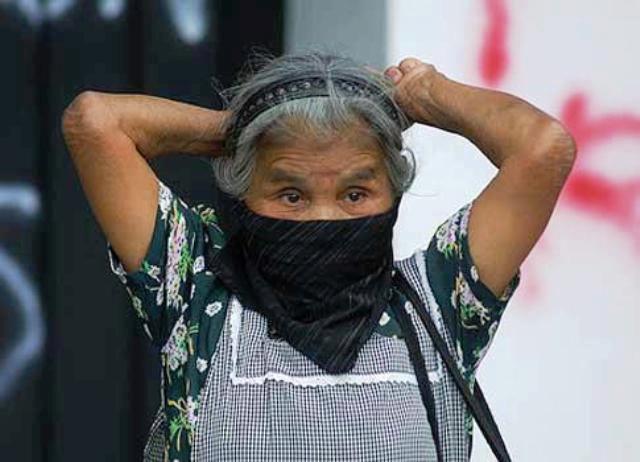
Although I saw this photo on the El Mexicambio HA Llegado Facebook page, apparently it is not “current events”, but from an ad in a Swiss Indymedia site for a film about the 2006 Oaxacan resistance movement. But, whoever the photographer was, whoever the subject was, and whatever her cause, the story is a never-ending one of the the Mexican people’s demand for dignity and respect.
Where is Ruy Salgado, El5anto?
“El5antuario” …on podcast, youtube, ustream and facebook… as well as via a “traditional” blog site … has been, by far, the best source of information on both the “yo soy #132” movement, and on dissenting movements in the Republic. By no means a “pirate” operation, El5antuario has been taking advantage of the new communications technology… which has somewhat limited its ability to distribute its message, and — of course — it can’t begin to compete with the big names, Televisa, Azteca, Radio W, El Universal, etc. Even so, El5antuario has already been having an outsize influence on the on-going political/social debate and often as not the mainstream journalists are not so much being scooped by El5antuario as following their lead when writing about protests and the student-led movement.
“The most trusted name in alternative news” is — or was — Ruy Salgado, who as the masked “El5anto”, was live-streaming news and commentary as always a week ago Saturday (8 September), when an hour before he was scheduled to leave the air (er… cyberspace)… his transmission suddenly ended. This was not unusual, given the sometimes flaky state of Mexican cyber-connections, and the still imperfect state of ustream broadcasting. Salgado was sent a message by Skype, which he received, but did not respond to.
In his Thursday and Friday cyber-casts, Salgado had spoken of meeting with other cyber-cast dissidents on Sunday (9 September) at the Palacio de Bellas Artes before heading to the Zocalo for the speech by Andres Manuel Lopez Obradór. He never showed up, nor has he been heard of since he abruptly ended his cybercast on Saturday.

El5anturario is not a media “company” but more a collective of independent and voluntary citizen-journalists. While it is possible that “something came up” (he has had to leave in the middle of cybercasts before), he has on previous occasions kept in contact with his fellow “5antuarioistas”.
When I first ran across El5antuario and El5anto, I thought the luche libre mask was a clever devise… a gimmick…. meant to emphasize the “struggle” (luche). However, given Salgado’s disappearance — which, if mentioned at all in the “mainstream media” calls him simply a “blogger” — and the seeming indifference of the organizations that are supposed to protect journalists, perhaps the low-tech masking of a high-tech social dissident was a necessity. And that alone should have those that call themselves “real” journalists not waiting for official answers but going out and asking uncomfortable questions.
Susto de guerra?
Ironically, since I live on calle 16 de Septiembre, mine is the only house flying the bandera nacional today (and a modest one — tangled in phone wires — it is). Of course, like migrants anywhere, I tend to overdo it when it comes to giving out signals that I feel I belong where I am. It’s not that I think my neighbors are “un-patriotic” or that they find the symbolism silly, but that Mexicans in general are ambivalent about the nature of the Mexican state.
Is a government that came into office with support of only a third of the voters, with serious questions raised about its legitimacy, only to be followed by one widely assumed to have been elected through massive fraud, the same as the nation… or even a reflection of the will of the nation? Local returns were overwhelmingly PRI (and local PRI headquarters is just around the corner) but the number of votes didn’t come anywhere near matching the number of residents. But low voter turnout, and even indifference to politics is not the same as indifference to national identity.
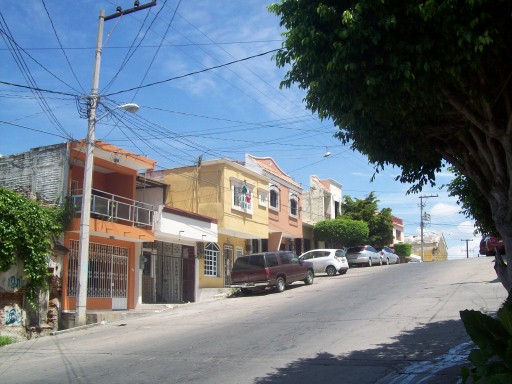 Are my neighbors simply reflecting the globalist perspective, in which nation-states are less important than economic interdependence? The two major economic engines in Mazatlán dependent on foreign trade — tourism and narcotics exports — are not particularly major employers of those of us living on calle 16 de Septiembre. Anyway, one expects a sense of being forced into colonial (or, neo-colonial) economic status usually brings out the nationalist in people.
Or maybe people just feel disconnected to the state right now. Or, after the orgy of green-white-red that lined the street for the bicentennial (when the government delivered every household a flag) was enough.
OR …
Although I haven’t been paying much attention to it, or written about it, there have been calls by what is presumed to be the “left” to boycott the national celebrations in rejection of the political and economic policies (and proposals by the incoming administration) they see as a betrayal of Mexico.
I don’t sense any loss of patriotism, nor of consciousness of Mexicanidad as something to be celebrated, but I do sense the always deep distrust of the present state — and the sense that the political and economic system is in serious need of an overhaul — goes well beyond the active “yo soy #132” activists and those that see the state’s fixation on de-nationalization and on prosecuting a “war on drugs” that has turned into a fratricidal blood-bath to no good purpose and a militarization one associates with insecure and repressive regimes.
The evidence of things unseen is troubling, but at the same time, I find those gritos AGAINST the present administration, and AGAINST supposedly necessary “reforms” a hopeful sign. It means Mexicans are giving thought and acting in defense of their country, their culture, their Mexicanidad… and not simply flag-waving.
Volcán de Fuego
Antigua, Guatemala (Photo by Luís Echeverria/Xinhua Press/Corbis):

Politics by other means
In a way, this SDPNoticias heading is the most disturbing statement I’ve seen since the presidential elections:
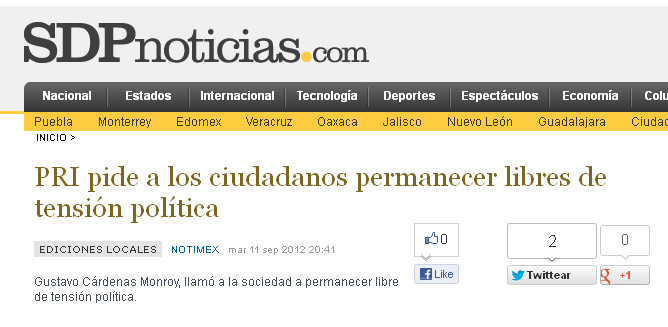
While I realize that Gustavo Cárdenas Monroy, of the Federal District’s PRI Central Committee was only calling for people to put their differences behind them… the sort of remark that most political actors make after winning an election (or at least being declared the winners). But if Cárdenas Monroy is quoted correctly, what he is saying is that the CITIZENRY should be relieved of taking any role in the decision-making process.
He considers it a good sign that the left has understood that the way forward is to respect the institutions and that all social and political organizations recognize the critical role they play in the country’s development.
He also assured that president-elect Enrique Peña Nieto´s newly-appointed transition team is committed to outlining the actions that Mexico needs to be strong, democratic and modern.
While I am not a citizen, and take no part in Mexican political decisions (nor seek to influence them), I would certainly expect my co-workers, friends, neighbors, conocidos, etc. who are citizens presumably depend on “social and political organizations” to represent their own varied and conflicting interests. Even a quasi-one party state, conflict was build-in to the “Mexican system” best defined by a friend of mine as a “consensus capitalist state”: that is, while officially a Socialist party, the PRI itself included not just labor and bureaucratic interests, but business and financial leaders, traditionalists, nationalists, modernists, and intellectuals… all of whom were expected to slug it out (within the Party itself, though sometimes spilling into the streets) eventually coming to some sort of compromise that — if not satisfactory to all — was either something everyone could live with, or something that the losers were expected to resist. The amount and nature of resistance acted as a counterbalance to complete top-down decision making.
I suppose there are those who would like a return to one-party dominance — not that I know anyone like that. And I suppose you might be able to enforce some sort of consensus even in a multi-party system among party leaders.
When Andres Manuel Lopez Obradór announced last Sunday that he was leaving his old party, the PRD, to work in an undefined role in an undefined organization (which may end up being another political party), it was not necessarily either a break in the leftist coalition, nor a withdrawal from politics. As Aguachile noted:
This is, then, a separation from party politics, though he may next turn his social movement MORENA into a party in near future:
In this new stage of my life, I will dedicate all my imagination and work to the cause of the transformation of Mexico. I will do this from the space that MORENA represents, and therefore separate myself from the parties of the Movimiento Progresista [the name of the 2012 coalition].
This is not a rupture; I leave on the best terms. I separate myself from the the progressive parties with my deepest thanks to their leaders and activists.
Yesterday, the left’s governors-elect and PRD, the largest party on the left, declared they will accept Enrique Peña Nieto’s victory, however grudgingly – which clearly distinguished them from AMLO. There is rarely such a thing as a coincidence in politics.
The PRD, after all, as a political party HAS to govern or legislate under the existing system… which means that “grudgingly” or otherwise, it has no choice BUT to accept Peña Nieto’s de facto role as President-elect. By stepping outside of the established system, AMLO, and those who he represents, or have chosen him and his movement as their representatives — are not obliged to do so, and are free to continue their fight, in politics, but not in the political system.
What I mean is that both legally and practically, representation is through political PARTIES for right now, but there is widespread dissatisfaction both with the political options, and with the choice of candidates. And, one needs to remember that one of Peña Nieto’s campaign promises (though there were too many to count, it was one of the bigger though less commented on ones) was to “downsize” the legislature, making it even harder for minority — dissenting — voices to be represented in the legislature. The practical effect of doing away with plurinomial seats would be to drive out the minor parties, forcing them to either merge with the larger parties (and hoping to be heard much the way dissident groups within the one big party of the pre-1990s PRI hoped to have SOME effect on the overall party structure) or go outside party politics altogether… either violently (as some of the Communist groups did in the 1960s and 70s) or non-violently, as AMLO as proposed.
Secondly, from both left and right, there have been serious proposals for an overhaul of the electoral/political system, to allow “independent” candidates, law-making by initiative and referendum, or other changes in how the system functions. Good luck making those kinds of changes when the people making the rules got where they were by making the rules they wanted. Think about the difficulties there are in the United States just in getting legislatures to conceive of allowing more than the two existing parties there are now on the ballot as other than window dressing. Systems don’t change easily. Not from inside, anyway.
And third. The “mainstream” leadership of the PRD is largely made up of what I call the “Euro-socialist” wing of the Mexican left. They are technocrats (like the French educated Marcelo Ebrard Casaubón), academics (like former UNAM rector,Juan Ramón de la Fuente), or professional politicians (uauhtémoc Cárdenas Solórzano and Manuel Camacho Solís). While, like AMLO, their base is largely Mexico City and environs, AMLO’s faithful are less the urban upper bourgeois as it is the working class and the campesinos. And, AMLO — while a wily pol, comes from a very different background… rural Tabasco, with his political schooling being in union and community organization, not the Sorbonne or being born into the party. He is from the trenches of the old PRI and a product of more traditionalist Mexican leftism. That the “new, improved PRD” is defining itself as a Social Democratic Party does not mean its interests won’t coincide with whatever organization AMLO allies himself with, but it does mean that the traditionalist left will be critical to the PRD’s electoral success.
And the price of those votes? We’ll see…


 mexfiles.net