Our man in Tres Marias?
The incident last Friday, in which an armored Toyota SUV with diplomatic plates was fired on by Federal Police, wounding two U.S. “diplomatic personnel” and slightly injuring a Mexican marine officer, is still under investigation. Despite the apparent attempts to simply blame the nearest suspect (the Federal Police), I tend to believe that they were indeed trying to stop a fleeing kidnapping suspect.
I certainly don’t tend to always believe the police (quite the opposite, living in Mexico) but the undue haste to arrest the officers in what appears to be a communications failure, and a type of incident that has happened to non-diplomatic types in unarmored cars that look a lot less than gangster-mobiles that that SUV did, have been killed in the past.
While I’m not all that surprised that a diplomatic car… or any other car… was on that particular stretch of that particular highway, which is, after all, the main route to Cuernavaca, I am dubious about the nature of a trip in which presumed DEA agents were travelling with diplomatic plates to what appears to have been a semi-clandestine meeting… that is, it certainly looks like neither the Federal Police, nor the Army (which the Mexican naval escort called for backup) knew anything about the travel plans.
And… while we’re at it. I can’t vouch for this photo, said to have been taken at the scene, but who is the guy in civilian clothing wearing a mask and a Mexican marine helmet, and carrying a pistol?
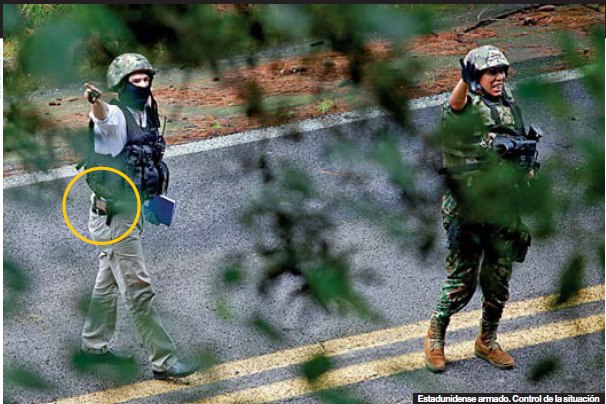
One small step for Mexico…
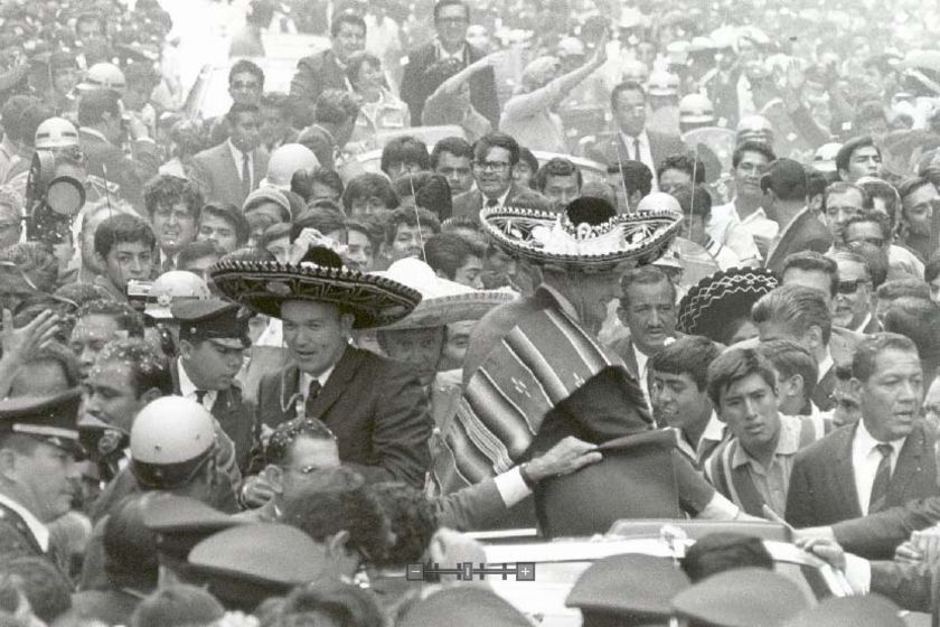
NASA photo. Apollo 11 crew in Mexico City, 13 September 1969
Mexican science played a small… and critical… part in the moon landing, one that gave the achievement a world-wide immediate impact, and changed our concept of not just the heavens, but life here on earth as well.
Mexico was a pioneer in innovative television technology (Guillermo González Camarena invented color television in 1939) and in creative uses of what poet and dramatist Salvador Novo called the “monstrous daughter of the hidden intercourse between radio and cinema” for disseminating information. Being a country which very early (in the 1960s) began using satellite transmissions — for academic lectures to hard to reach parts of the country — Mexico was the ideal testing ground for the one thing that made it possible for the Apollo 11 Mission to be seen as it happened.
The 1968 Summer Games, while mostly remembered for other things, or for the Tlatelolco Massacre which was not televised, it was the first time sound and moving images were broadcast directly to satellites, for distribution in “real time” across the planet. What the Summer Games showed was that it was possible for something happening in Mexico to be seen by people in Australia. For NASA scientists (who then called in Mexican technicians for assistance), it wasn’t implausible for people on Earth to see what was happening on the Moon.
That in itself was a unprecedented technical breakthrough, allowing for the mixed blessing of of 24/7 news cycle today… affecting not only what we know of events, but how events occur. What happened in Tahrir Square in the spring of 2012 might have been more like what occurred in the Plaza de Tres Culturas in October 1968 had it not been for this technical achievement.
For those of us who are earthbound, the Mexican contribution to the moon landing has been a mixed blessing. Being able to know 24/7 what happens almost anywhere on the planet has affected not only what we know of events, but how events occur. We are all witnesses… often helpless ones. How we contextualize what happens somewhere on the planet has been altered forever… watching something like missile attacks on Baghdad, or the people daring a dictator to attack them in Egypt, means we are forced to give meaning to what we see as it happens, without time to reflect, or consider it in the long perspective. On the other hand, would the outcome of Tahrir Square in the spring of 2012 been more like what occurred in the Plaza de Tres Culturas in October 1968 had it not been for this technical achievement.
They went, they conquered, we saw… even those of us who were at Boy Scout Camp Babcock-Hovey in Ovid, New York… on 20 June 1969.
Justice for just U.S.?
Porter Corn at Mexico Trucker has been following the travails of “Wrong Way Bogan”… Jabin Akeen Bogan, a trucker carrying a load of military grade ammunition to Phoenix who “accidentally” — according the him — crossed into Mexico and was arrested by customs agents for smuggling.
Just on the face of it there were more than enough “troubling” facts about the incident — Bogan’s employer folded up in the middle of the night soon after the incident; the trucker’s own explanations of the story was, shall we say, evolutionary — at one point strongly suggesting the load was meant to go to Juarez, and not Phoenix; and there were competing simultaneous claims (often by the same individuals) that Bogan was being singled out because he is a U.S. citizen, while at the same time demanding special rights because of his nationality. Of course, almost any time a USAnian is arrested down this way for almost anything, especially when the USAnian was in Mexico on some shady business (or, in Bogan’s case, working for one), there’s usually an “evolving” story that somehow is meant to exonerate the accused, and that claim that U.S. nationality has been taken into account… or, should be.
But with Wrong Way Bogan, there were two only tangentially related political issues that turned this into not just another gringo afoul of the law abroad story, but a Grade-A, Prime-Cut Clusterfuck. First, the United States had finally — and begrudgingly — given into the legal demands that would allow Mexican truckers to operate in the United States. And secondly, the furor (created and otherwise) over the botched anti-smuggling operation, “Fast and Furious”.
For the first to be an issue, it was necessary to overlook that Bogan wasn’t supposed to be in Mexico (although, in the course of the pre-trial investigation, he said at one point he was supposed to meet people in Juarez…with a truckload of NATO-grade ammunition?) but was making a delivery to a gun dealer in Phoenix. Never mind… somehow his arrest justified reversing legal decisions that finally, several years after the fact, finally allowed Mexican truckers to carry legitimate loads into the United States. Somehow, the argument went that allowing Mexican drivers into the United States would also mean U.S. drivers entering Mexico where they’d be likely to face arrest. Of course, the fact that neither U.S. nor Mexican drivers are suddenly permitted to carry contraband across borders is left out, and the corollary argument .. that just letting Mexicans drive in the United States quickly degenerated into the usual slathering howl-at-the-moon xenophobia and stereotyping one hears whenever Mexicans are involved in anything. I suppose it does show some sort of progress in human affairs that Bogan — an African-American fellow with a criminal record for aggravated robbery — was being defended by the know-nothings on the basis of his nationality, without regard to his race, color, etc. But, not much.
The second issue — the gun-running, smuggling thing — was something of a hard sell for the guns-for-all crowd, but — having spun the botched anti-smuggling investigation, “Fast and Furious”, into a public campaign to reign in not smugglers, but anti-smuggling operations (and, incidentally, if possible, discredit the work of African-Americans who uphold the law — like the President, and the Attorney General of the United States), there’s been attempts to rope in the Mexican ammunition seizure as somehow discrediting what few and pathetically weak restrictions on firearms exist in the United States. Not that you can apply anything like normal logic (or even common sense) in making the argument that a foreign government’s seizure of contraband is an attempt to destroy a U.S. company (which… common sense suggests was selling to smugglers headed for Mexico) and undermine the U.S. Constitution.
Porter has done an excellent job of keeping the whole thing in perspective, and he has seen a Federal Magistrate’s decision to reduce the charges to the relatively minor one of “possession of ammunition [reserved for the military]” as a vindication of the Mexican legal system.
In some ways, yes:
This decision this morning also shows the great strides Mexico has made in reforming it’s justice system. No longer the model of corruption it was for years, the Bogan case is showing how Mexico has moved into the 21st century in it’s reforms.
In the sense that everything was “by the book”, and the recent changes in court procedure (and better trained customs officers) have a lot to do with having built a good case, I am somewhat reluctant to assume that
Years ago, Bogan would have been beaten and tortured into signing whatever “confession” the prosecutors chose to give him, summarily convicted and locked away and forgotten.
Not that I’m reluctant to accept that accused criminals are beaten and tortured and coerced into signing confessions, but in a criminal investigation where foreigners are involved, it’s normally some slightly involved Mexican (or simply handy usual suspect) who is the one summarily convicted and locked away and forgotten.
No… what makes me say this isn’t much of a breakthrough is I am not sure justice is really served. Bogan was originally charged with smuggling and weapons-trafficking, which would make him eligible for a thirty-year prison sentence. The appeals court reduced the charge to one that only carries a three to six year sentence, but could be reduced to a fine or “community service”. As Porter Corn himself admits: “One can’t imagine Bogan doing anything other than hot footing it for the border if released, much less paying a fine or doing community service.”
It appears that the court is hoping just that… that Bogan will leave the country and never return: sort of the way kidnapper, xenophobe pin-up boy and convicted felon “Dog the Bounty Hunter” was allowed to flee Mexican jurisdiction as much to assuage U.S. political crazies as any other discernible reason.
 Allowing Bogan to flee might be “fair” to American’s Dumbest Smuggler”. Still, one wonders whether the justice in this case isn’t at the expense of those who pays the price for the U.S. arms racket and their contempt for Mexican laws: i.e., the Mexican people. Is it justice when the courts seem echo the laws of Stalin (who knew how to mete out injustice better than almost anyone) coming close to saying “one gringo’s conviction would be a tragedy, but 60,000 gun deaths are a statistic”?
A healthy trend
A revamp of Mexico’s beleaguered health-care system is proving to be a runaway success and offers a model for other nations seeking to reform their own systems, according to a review published this week in The Lancet. The key to the scheme’s success is the way in which it has modified its reforms in response to scientific assessments of their effectiveness, the authors say.
(Eric Vance in Nature 17 August 2012)
I just wanted to point to this article in Nature, dealing with one of the bigger successes in Mexico… the public health system. While there are the occasional scandals (and always present scandalitos), the system works very well here. As Vance notes in his article it’s not perfect 100% coverage, it’s pretty close to minimal 100% coverage. While there is better coverage through employer-paid plans (like my own, through IMSS, the Mexican Social Security Institute), basic coverage through Seguro Popular — which covers those with no other insurance — has enrolled 50 million clients since it was set up in 2003.
There are “challenges” (benefits being calculated on their cost-effectiveness, meaning some chronic illnesses are excluded from coverage). Seguros Popular system clinics and hospitals are “woefully poor, particularly in rural areas” — but then, so are the clients, and doctors often complain that they are overworked and underpaid. That is true, but one needs to remember that doctors do not enter their profession with a mountain of debt, their education being paid for by the state. They do have to pay back the state with public service work, and many supplement their income working in the country’s numerous private clinics.
Those latter are probably the biggest surprise to visitors — the pharmacy chains all advertise their walk-in clinics, and compete to offer the lowest prices. They even run ads like “HALF OFF ON ALL PROSTATE EXAMS THIS WEDNESDAY” though whether that pulls in the casual shopper I can’t say. While I still can’t understand how a “sophisticated” country like the United States managed to create such a complicated health system (and only in theory, and subject to change), it seems that a simple public health system or two is no real threat to capitalism… maybe to the insurance companies, but not to the doctors.
Right and left
Dutch journalist Jan-Albert Hootsen on Latin American politics:
One of the reasons I am so fascinated by Latin America is its politics: the left and the right are still, from an ideological point of view, ´traditional´ and not nearly as opaque and blurry as they are in the United States or Europe.
Politicians can be very ´classic´ in this region of the world. There are filthy rich, cynical right-wing hawks such as Álvaro Noboa, hardline militarists such as Otto Pérez Molina, socialist firebrands such as Hugo Chávez and their archaic overminds in the Castro brothers, classic neocons such as Felipe Calderón or leftist-liberal brainiacas such as Michelle Bachelet and Tabaré Vázquez. They are poster childs of their respective movements and far easier to define than many of their European equivalents, with the notable exception of the peronists, who reamain as inexplicable as they have always been.
One question I´ve been asking myself lately is: what constitutes the ‘real left´ in Latin American politics? Is it the confrontational, rebellious and nationalist branch championed by Hugo Chávez, Evo Morales and Rafael Correa? The archaic dogmas of Castro´s Cuba? Or is it the more intellectual and moderate variety of Chile, Brazil and Uruguay? And is the kirchnerist branch of peronism even leftist at all?
What you can certainly say about Latin America, is that it proves Francis Fukuyama wrong: the left is energetic and vibrant in this part of the world, and there certainly is an alternative to neoliberalism and free market capitalism.
Trotski cha cha cha
Cuban singer and songwriter Frank Degado:
Gimme shelter: León Trotsky and Julian Assange
Today is the 72nd anniversary of one of the most most outrageous violations of the rights of nations to provide political asylum… Soviet agent Ramon Mercador’s attack on León Trotsky, which led to his death the following day.
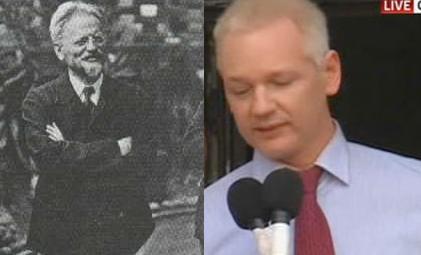 Julian Assange is in the title to this post, but don’t worry… I’m not about to claim that the British, or the C.I.A. … with or without Swedish assistance… are planning to kill Assange,or that Assange is some major political theorist, but only that … like Trotsky, Assange was pushing for a devolution of power — in his case, in control of access to information. And, that is something the powers cannot abide.
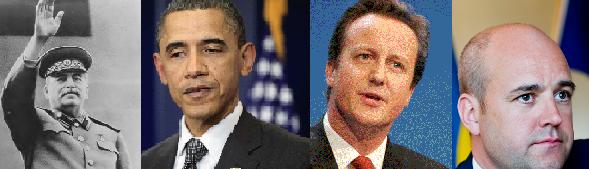
Four of a kind?
I don’t think David Cameron or Barack Obama or Frederik Reinfeld want to be thought of as acting like Stalin, nor to have their nations compared to the Soviet Union, but it’s becoming harder not to make the analogy.
Perhaps “soft pressure” is acceptable: I notice that with Ecuador’s decision to grant Assange asylum, there has been a concerted effort to paint that 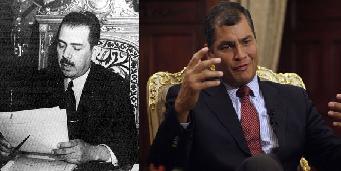 country’s own struggle to devolve media power as “dictatorial”, much as the Stalinists suddenly changed their tune, deciding the Mexican Revolution was not a “true” revolution — and a model for their own. All that is to be expected… Lazaro Cardenas did not have to justify himself to Josef Stalin, and Rafael Correa owes no explanation to Great Britain, or the United States or Sweden.
But, in financing the Mexican Communist attack on Trotsky (24 May 1940) and Mercador’s hit on the 20th of August, Stalin proved (as if there wasn’t proof already) that his was a rogue state. Whether the governments of Messers Cameron, Obama and Reinfeld “like” Assange or not, they lead nations that have always claimed the “rule of law” is of paramount importance. That the “rule of law” is that countries have the right to offer asylum, but if Cameron, Obama and Reinfeld find it inconvenient or a threat — tough luck… unless they mean to “go rogue” themselves, in which case they deserve to be compared to Stalin. And should be. And will be.
All your bases belong to Televisa

(Apologies to Aguachile … who had every right to object to my initial description of his (and other commentator’s) response to the events last February. Corrections in italics— my reply to his comment in the “comments” section.)
From Aguachile last Thursday:
The director of the MVS Comunicaciones media group, whose TV concession provides a rare alternative to Mexico’s electronic media duopoly dominated by the infamous Televisa and TV Azteca, has confirmed what many has suspected: The PAN government of Felipe Calderón has launched a political attack on the station.
The government’s decision to put up MVS’s concession claiming that it is under-utilizing its 2.5 GHz bandwidth appears only to have been an excuse, as MVS head Joaquín Vargas Guajardo confirmed that the government told him its license would only be renewed if he fired the renowned investigative journalist Carmen Aristegui, as well as to desist from an earlier MVS complaint against a proposed Televisa purchase of Iusacell, a cell phone provider.
Aristegui, one of the most respected journalists in Latin America (and in the hemisphere as a whole) was fired in February of this year for reporting on wide-spread and long-standing reports that Felipe Calderón had a problem with alcohol.
There was some surprising support (from Aguachile among others) for firing Even among those normally critical of the administration, many (like Aguachile) saw Ms. Aristegui’s reportage as unfair and unwarranted rumor mongering, which made it understandable that a “mainstream” news organization would fire her. But public demand supposedly led to her reinstatement. However, if the claims by Joaquín Vargas that he was told by Calderón’s Labor Secretary, Javier Lozano, that his company’s broadband access permits were “fucked” if the journalist was reinstated, are true, then it appears that MVS was indeed taking it’s role as an independent media source seriously.
At one point, the Calderón Administration was making big noises about breaking up monopolies — though it then proceeded to forcibly liquidate the union owned electric company LyFC and turn its assets over to the semi-privatived CFE and to force both Carlos Slim’s various companies and MVS to make concessions designed to strengthen Televisa’s position in the media market.
Sheer poetry
Maybe it takes a poet to say the obvious:
Maricopa County Sheriff Joe Arapaio is a “weakling, who hides behind an anti-immigration shield,” Mexican activist Javier Sicilia told the Associated Press on Friday, following a meeting between the two on Thursday.
Presently leading a “Caravan of Peace” across the United States to bring attention to the U.S. public’s collaboration with gangster-related violence in Mexico (though both narcotics consumption and support for criminalizing such consumption; its unwillingness to halt cross border traffic in firearms and laundered money) and to protest the treatment of Mexican and Central American migrants to the U.S.
Sicilia met with Arapaio for an hour and a half on Thursday. It did not go well. Said the well-known internationally known religious poet, journalist and reluctant activist of the internationally despised federally indicted Arizona politician:
He is stubborn and servile with serious problems, including psychological ones… At base, he is a weakling: in his heart he is fragile and insecure. I see in his feeble sense of humanity a greater weakness: when a person is strong, they have no need for cruelty.
To which Arapio could only respond… or rather, to which a Sheriff’s Department spokesman responded with a non-sequitor:
“It’s their fault we have illegal immigration.”
“They” being… Mexicans? Peace activists? Catholic intellectuals?
(El Universal, my translation)
The bigger the sombrero, the bigger the mariachi
So Shaquille O’Neill’s venture into rap music wasn’t all hot…maybe he just was trying the wrong musical form … ay… ay… ay… aiiiii!

What do women want?
An I-pad, of course. But … er.. uh… EWWWW!
Mexico’s Saba brand is asking ladies to take a picture of themselves near their “favorite tampon” and submit it for a chance to win an iPad, because… really, what else can you do?
Remember: Nothing says “I love my tampon” better than posing next to, well, your own tampon.
For tasteful advertising, probably matched only by this classic from the early 1970s (and for those not from the U.S., or old enough to remember, it was a parody of a cigarette advertising campaign):
On the street where you live: or, What’s in a name?
It’s not really Perfidious Albion Week here at MexFiles, but thanks to a commentator on a post having nothing to do with Britain at all (rather with Argentine discussion of the Mexican electoral mess) , I ran across Block Usado, a wonderful English-language website on Argentina’s political and cultural history.
If it WERE Perfidious Albion Week, Mila’s recent post on the vagaries of Argentina’s official position towards all things British would be particularly apt:
Nothing’s left to luck when trying to clarify your political position. Not even the streets’ names, if you are the official government. Your every decision, your every move, should reflect coherency with your ideals.
And that’s what’s been happening here in Buenos Aires for the last century.
There is one concurred and commercial avenue reaching Palermo. It even has it’s own subway station. The name’s Scalabrini Ortiz. But, many still remember when that street was named ‘Canning’ […] [for] George Canning, [who] was the responsible for the UK’s recognition of freedom from the Spanish Kingdom of: Argentina, Colombia and Mexico, and the one who pushed the recognition of Brazil as independent from the Kingdom of Portugal, all of this in 1825.
[…] this wasn’t just out of Canning’s good and pure heart.
“Spanish America is free, and if we do not mismanage our affairs, she is English”
Gral. Juan Domingo Peron […] replaced the name of the English liberal, diplomat, and even Prime Minister for a little time, with the name of an Argentinian nationalist writer and thinker: Raúl Scalabrini Ortiz.
[…]
During the military’s illegal stay at the head of the country, and faithful to it’s admiration towards England, Scalabrini Ortiz Av. became Canning again…
In 1984, after a failed war against England (coherence?) for the Malvinas Islands […] the illegal government called for presidential elections… in 1985, the government renamed the avenue after the nationalist and revolutionary thinker, Scalabrini Ortiz.

Scalabrini Ortiz looks a lot like the main streets in Polanco… which thankfully were named for ancient Greek philosophers and unlikely to become politically inconvenient. (photo from Wikimedia Commons)


 mexfiles.net