Doble Moral
 The Table Dancers’ Tale, like Oscar Lewis’ classic study of the Mexican family, The Children of Sanchez, is a close and unflinching observation of the everyday lives of overlooked Mexicans. As an anthropologist, and as a foreigner, Lewis remained the detached observer of the sometimes cruel and perverse relationships of Jesus Sanchez to his brood. Lupita Dominguez also records the less than comfortable truths about los de abajo — with one crucial difference: Lupita Dominguez is writing about her own culture and her own life.
In the original Spanish, Dominguez uses the phrase “doble moral” — something perhaps lost in English, where even an excellent, sensitive translator like Sabina Becker, is forcrealed to use the English equivalent, “Double Standards”. “Standards” are merely conventional norms of propriety. And there is much in The Table Dancers Tale to offend propriety.
The very existence of a commercial sex industry is enough to make some uncomfortable. A trade that caters to fantasy — erotic or otherwise — is bound to reek of double standards. That Lupita tells of the clandestine (or frankly illegal and often dangerous) activities that occur in these entertainment centers is not so much meant to shock us, or even raise our consciousness, as it is to show rather than tell the high price women pay for economic and social independence in this particular society. That, to meet the fantasy of their clients, the women often resort to dangerous (and sometimes fatal) surgery, and are encouraged to do so, and are proud of it, shows us the extremes we accept when it comes to meeting the “standards” of our fantasies.
The untranslatable word mamitis — “mommy-itis” —the unspoken, and unchallenged, assumption that women exist to support their sons, fathers, husbands, boyfriends (even paying boyfriends) is the basis of doble moral — not double standards, but moral duality. It is the duality that give’s The Table Dancer’s Tale its moral force.
The women we meet in The Table Dancer’s Tale have to live within a universe of impossible moral opposites. Few of these women have been, as we might comfortably think in our superior way, “lured” into the sex trade. Yes, there is the story of the underage girl whose father has groomed her for the trade, and is “managing” her career (i.e., taking her money) but that only reinforces the portrait we get of women’s misplaced moral duty in this society … economic support being but a different sort of mothering. Marriage or children — a traditional means of escaping family control — often just means a new form of bondage, and for the young woman seeking autonomy, the lure of what Lupita ironically calls “easy work” is another.
Perhaps what most bothers us is that women chose to take a socially or morally objectionable path in the hope of achieving economic and social liberation. In one poignant and horrifying story, albeit with a relatively hopeful ending, Lupita tells of a dancer who is supporting not just her only her own mother, but three brothers as well: a non-traditional means of fulfilling one’s daughterly obligations, but one the dancer sees as honorable and honest . Yet, to the mother she remains “My daughter the whore.”
The Table Dancer’s Tale was not an easy book to publish, nor an easy book to read. Raw, raunchy and brutally honest, it is not the work of a polished author but a primary document that presents a slice of Mexican culture neither wrapped in the gaudy trappings of sensationalism, nor swathed in academic impartiality. We are continually confronted with uneasy questions about doble moral… moral duality… the double standard… as they apply not just to table dancing, and not just to Mexican women, but to the role our own assumptions and moral duality play in the lives of workers and women in our own society.
The Table Dancer’s Tale might make for an uneasy read, but that makes it an important book that Editorial Mazatlán is proud to have published.
¡Si, se puede!
Odd… the battle cry of the United Farm Workers, attributed to Cesár Chavez, was picked up by the Barack Obama campaign to taunt conservatives, and has come back, via British Conservative Boris Johnson, to attack that son of a Mexican immigrant, Mitt Romney.
Don’t cry for my Friday night video
What other possible video fits this weekend, the 60th anniversary of the death (25 July 1952) one of only Latin American political figure to ever rate a musical?

Eva Duarte Perón 7 May 1919 – 25 July 1952
I’ve long thought Eva Peron was in some ways a female Ronald Reagan… or Reagan a male version of Eva: both were actors turned politician whose ardent nationalism and appeal to blue-collar populism has been claimed by politicians of often widely divergent political views as their true political heirs.
Others compare her to Hugo Chavez, I suppose simply because they’re both Latin Americans, and excellent public speakers. Chavez himself often mentions Eva in his speeches, as a fighter for the rights of the working class and the poor (which was genuine).
But when you come down to it, there never was anyone like Eva Perón. Other women throughout history have been the power behind the throne, and other women have held power as the wives or daughters of leaders. Or, simply by appealing to glitz and glamour, were taken seriously by their nation’s people. Evita, in some ways was all that… but the very young second wife of Juan Perón was the one who used what she was given to not just become a populist nationalist leader in her own right, but to pave the way for Latin American women of whatever political persuasion, to openly seek to lead their countries and social movements, without depending on a father, a husband, glitz or glamour.
Let Eva be Eva… Paloma San Basilio, with “No llores por mi Argentina”
Well, just fine
So… HSBC has ponied up 379,000,000 pesos to the CNBV (Comisión Nacional Bancaria y de Valores, the Mexican bank regulatory agency), or 27.5 million U.S. dollars, which is about half the bank’s yearly profits. Fine by me.
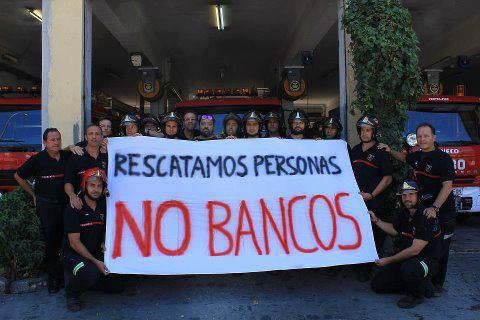
This photo is from Spain, but the sentiments are pretty much universal.
Big banks here, like elsewhere, have generally managed to get politicians to write the regulations the way they want them. Typically, they seek to privatize gains and socialize losses, great and small. When I first moved the Mexico, the bankers were in a pissing match with the Federal District, over local regulations meant to minimize the chances of bank robbery… you know, things like bullet-proof glass in the windows and protection around the teller’s windows. The bankers found it extremely unfair that they had to pay for those renovations. Of course, you know who (hint… his initials were AMLO) had a field day, sticking up for the protection of Mexico City cops (who the banks expected to guard them for free) against the guys we all love to hate.
I think we’re a bit out in front of the U.S. on this — in theory, Mexican banking regulations are some of the toughest in the world, but in this instance, HSBC just swallowed hard and paid up when CNBV, which apparently had begun investigations before this scandal was known in the United States.
Guillermo Babatz, president of the banking commission, said:
… in the past HSBC had appealed fines that regulators had levied in the courts. It was unclear whether the Wednesday announcement marked a change in that policy.
The banking commission president said details of the scandal first emerged in the US Senate committee report because Mexico’s “extremely restrictive” legal framework doesn’t allow regulators to announce investigations or fines until all appeals are exhausted.
He said banks in Mexico had used intensive lobbying to get favorable regulatory rules, and said those rules should be changed because they favor financial institutions and put regulators at a disadvantage.
TEPJF begins deliberations
As of today, the Federal Elections Tribunal has begun deliberating the evidence that the July first election was tainted. What has been going up up to now has been receiving claims and counter-claims, and presentation of the evidence.
Seven citizen complaints were dismissed on the grounds that political parties, not private individuals, have standing, although Magistrate Constancio Carrasco Daza, is analyzing those complaints for presentation to the three-member panel and which may be used in their deliberations.
One relatively minor complaint against the PRI was upheld. The PRI was appealing a decision by the State of Jalisco’s Election Tribunal, which had sanctioned the party for improper placement of party propaganda.
And the beat goes on…
Much projection there, Diego?
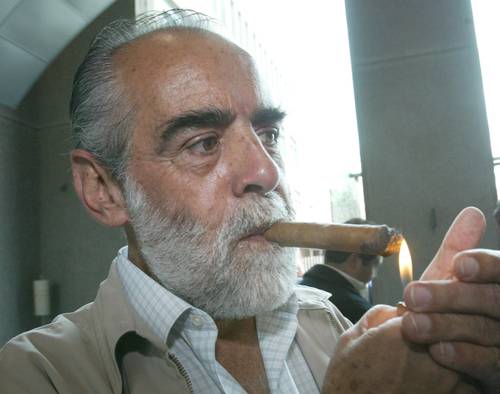
In Queretaro, PAN party leader and former presidential candidate Diego Fernández de Cevallos criticized Andrés Manuel López Obrador as a “a crazy and violent guy, a liar and thief, a sneaking swindler …”
Diego Fernández de Cevallos, aka Jefe Diego, is the guy who made his millions swindling poor farmers out of their land around Acapulco and other beach resorts, defending narcos and using legislative clout to pass bills benefiting his clients. He also was the guy who lined up support in his own party to accept the 1988 “election” of Carlos Salinas after that “mysterious fire” destroyed the computers that had been showing Cuauhtémoc Cárdenas ahead in the vote count.
Did I mention that I think his kidnapping a while back has all the earmarks of a money laundering scam?
And that he doesn’t exactly project an image of a sane, easy-going, honest guy…
Mazatlán, do we have a problem?
The selling point for tourism here is that Mazatlán, for various reasons, is well insulated from many of the more dramatic events in Mexico, being pretty much sheltered from hurricanes, much less prone to tsunamis and earthquakes than most places on the Pacific and obviously not having blizzards. Nor, are there any nearby volcanoes to erupt.
Nor, does it appear that we have much in the way of human eruptions Yeah, gangsters rub-outs make the news from time to time, but you expect that in a seaport and embarcation point for the United States’ favorite unregulated agricultural exports. What we don’t have much of, and what I find strange, is that the usual political street theater, that is practically a national sport in Mexico, is missing.
I heard someone say the other day that it is because this is a tourist town, and the tourists don’t like demonstrations. That seems unlikely, given that over 2000 marched in Cancún, and 900 to a thousand people turned out for demonstrations in Puerto Vallarta last Sunday for the national “yosoy#132” actions. Even in the tiny beach resort of Puerto Escondido there were organized protests.
Cancún has a population of about 750,000; PV about 300,000; and Mazatlán in the middle, about 500,000. The latter has a much more mixed economy than the other two, and is less dependent on tourism, so tourism can’t be the reason that only about 200 people — nearly all students — turned out. Admittedly, there were better attended, and better publicized protests in the state capital, Culiacán, but it should be pointed out that neither Cancún nor Puerto Vallarta are state capitals, although Cancún is the largest city in its state.
While both the Mazatlán municipal government and the state government are in the hands of a PAN-PRD coalition, one wonders if the answer isn’t that the PRI isn’t still the only party that counts in Sinaloa. Certainly PAN is by far the stronger of the two in the present ruling coalition, and there has been a concerted effort to paint the protests as associated only with the PRD (and their allies, which have almost no presence in the Sinaloa) but given that PAN and the Peña Nieto wing of PRI are basically the same on economic (and many social) issues, the parties are just not willing to put their organizational skills behind the national protests… or that they are just too disorganized here to do much of anything.
It is possible that being a mixed economy seaport/tourism center has something to do with it. Acapulco (population ca. 630,000) had a very small turnout.
As it is, about the only local media coverage was a one and a half minute video from the on-line edition of Noroeste.
Twisted sister
It’s a shame that Xóchitl Gálvez Ruiz never has been as well known outside Mexico as she deserved to be (there isn’t even a Wikipedia entry on her), and an even greater shame that her political career has come to an abrupt end due to the criminal activities of her sister.
I had mentioned Gálvez in my 2008 Gods, Gachupines and Gringos as a representative of those who were changing the social and cultural presumptions we have about Mexico and Mexicans, and the stereotypes Mexicans hold about their own.
Like the Zapotec lawyer, Benito Juárez, Galvéz began life with a strike against her… being an Indian. Unlike Juárez, her gender also stacked the odds against her becoming a national leader. From an impoverish indigenous background in the State of Hidalgo, she moved to Mexico City on her own in her late teens, while she worked as a beggar and street vendor to earn the money needed to put herself through UNAM, often splitting the costs of textbooks between her fellow squatters.
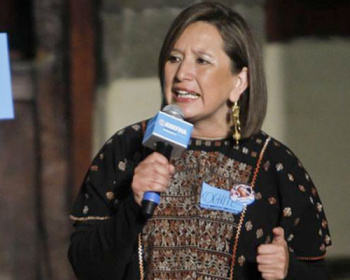 As an indigenous woman, even one with a degree in computer engineering, Galvéz found it impossible to find a job that would match her talents… so… she started her own. Her firm, “High Tech Services” was hugely successful in designing and selling process controls for office buildings and Galvéz won international recognition not only as a creative engineer, but as a sucessful international business executive. Although she had carved out a place for herself within the elites, she had continued to push for a more inclusive role for indigenous Mexicans. She founded and provided much of the initial funding for Fundacón Porvenir, which assists indigenous communities with health, education and nutrition programs, and provides academic scholarships for indigenous students.
While it was mostly a front for presenting a “leftist” version of neo-liberalism (and financed mostly by the shadowy U.S. “quasi-governmental agency, the National Endowment for Democracy) the short-lived Social Democratic Party opened the way for Galvéz to assume a role in national politics. As the “leftist” party in Vicente Fox’s presidential coalition, Galvéz along with party leader, U.S. academic Jorge Castañeda, was rewarded with a position within the Fox Cabinet.
Castañeda, of course, received a plum assignment as foreign secretary (where he proceeded to try to align Mexican policy with that of his larger neighbor to the north), while Galvéz, relegated to head of the Commission on Indigenous Affairs. Unable to force the administration to restructure the Commission and give it genuine power, she quit out of frustration.
Having come to the cabinet as a business executive, and the Social Democratic Party having disappeared, she was a natural PAN candidate, although in her run for Governor of her native Hidalgo, she ran as a PAN-PRD coalition candidate. Although defeated (seen by both PAN and PRD to have been the result of dirty tricks … including erasing her biography from Wikipedia… propagated on behalf of, or by, PRI — sound familiar?) she has remained a respected, and highly regarded natural leader for the 21st century.
Until this week. Her sister, Malanali, was arrested by federal agents as one of the ring-leaders in a kidnapping gang operating inn the State of Mexico that, among other things, sent videotapes of the abuse and mutilation of their prisoners to the families of their victims as part of their extortion scheme. Malanali was caught basically red handed, and has been whisked off to prison.
Xochitl is not implicated in any of her sister’s crimes (or alleged crimes), but is probably the most prominent of Malinali’s victims… in light of the scandal she has announced her immediate retirement from all political activity, ending one facet of Xochitl Galvéz’ quest to open the doors to Mexico leadership to all Mexicans.
Oh, Pioneers!
The media wasn’t necessarily more “fair and balanced” in the good old days, but they were a lot more colorful in their descriptions.
A well-known emigrant to Mexico was described in an Arizona newspaper as:
… a mass of putrid pus and rotten goose pimples; a skunk with the face of a baboon, the character of a louse, the breath of a buzzard and the record of a perjurer and common drunkard…
Know who he was?
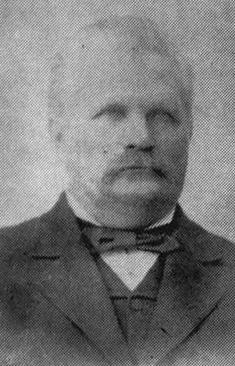
Answer here: Sandwalk: strolling with a skeptical biochemist
Quote via GQ.
Thou shalt not launder money
Rejecting what he calls a “narco-team” preparing to take over the government of the nation, Bishop Raul Vera of Saltillo weighed in yesterday on post-election legal process:
We can not, under the guise of a false social peace, sanction a process full of irregularities and even crimes such as using laundering money that covers up the the dark processes of other crimes, and leads to a bogus justice process and the application of weak sanctions, as if these were minor offenses.
Don Porfirio is still dead
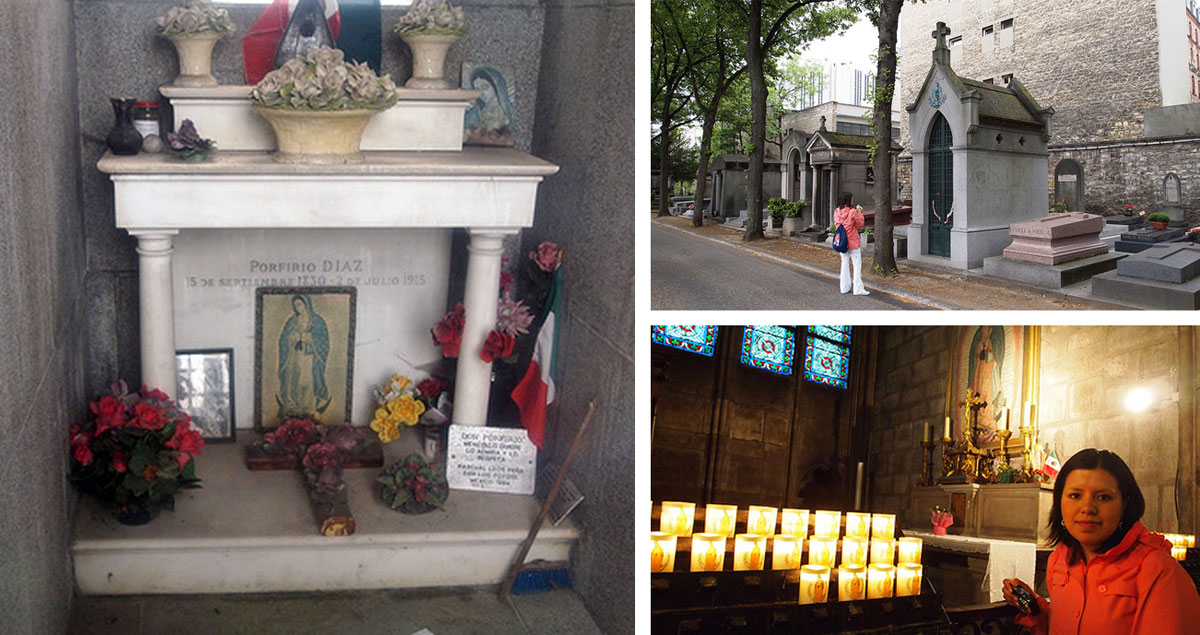
It’s not a bribe, it’s a service contract.
Now I understand why a wonk like Gabriel Quadri was running for President… so he could get his kid a job.
It’s a bit complicated here, but besides the 300 Deputies in the Chamber (the lower house in Congress… similar to the U.S. House of Representatives), 200 seats are apportioned to the political parties depending on how well their party did in the national vote. As long as they get at least two percent of the national vote, they get a couple of Deputies. The parties publish a list of their “plurinomial” candidates (who will be appointed depending on how many seats they get after the votes are counted), and it looks like Quadri’s son, Luciano Quadri Barba, was high up on the PANAL list, basically guaranteed a job as a Deputy, if his father got at least two percent of the vote. Which he did, thanks to party’s, or rather, party leader Elba Esther Gordilla’s, machine.
Quadri “junior” has started out his public career defending Enrique Peña Nieto, by assessing vote buying as a “private contract”.
“Vote buying is immoral, but it’s a matter of private contract law,” the young law-giver opines. “And AMLO is a stickler for legality.”
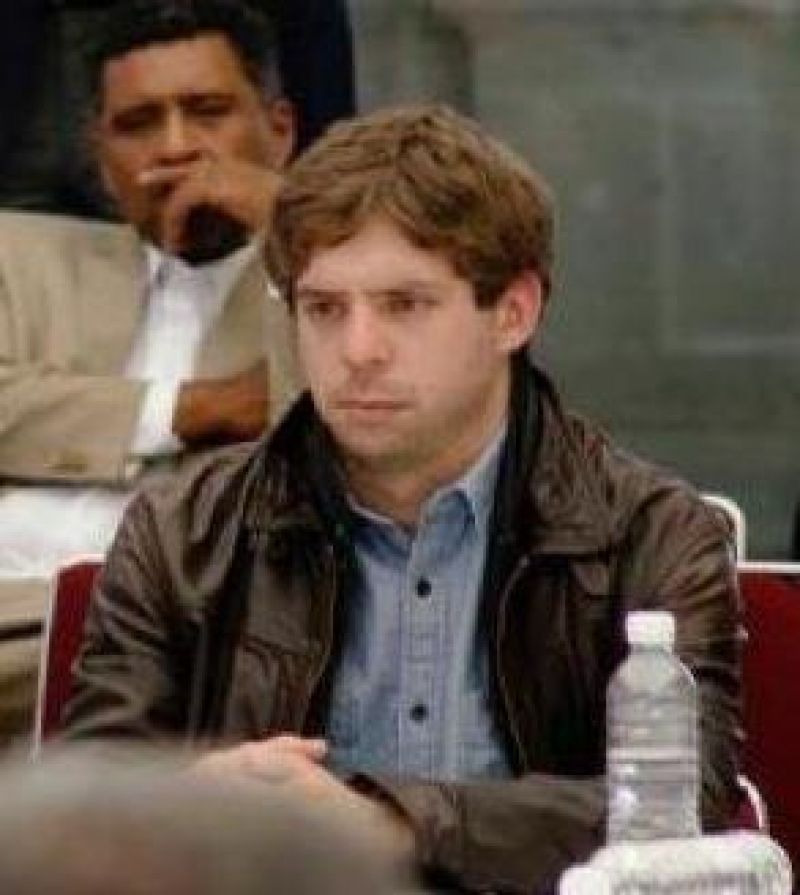
Junior Quadri: this vote for sale?
Quadri senior, at one point in the debates (the yosoy132 debate I believe) made some statement to the effect that he was the only “Liberal” in the
campaign. I barely registered it at the time, but it makes perfect sense. “Liberal” in Mexico usually refers to the original meaning of the term — adherents of the 18th century economic theories of Adam Smith. Although Smith, like Karl Marx, presumed the rich should contribute more proportionally to society than the poor, at its simplest, “liberalism” in Latin America is the classic “Free minds and free trade,” as the U.S. Republican Party used to label it, back in the 19th century when “liberal” wasn’t a dirty word in the United States. At least it was in Benito Juárez’ day, when freedom of religion and the press was considered as important as the free passage of financial instruments.
That was then, this is now. Like the U.S. Republicans, who’ve sort of given up on the “free minds” part of the equation, modern liberalism in the Americas has more to do creating financial incentives for public investments. That is, privatization of public services.
Liberal, in this sense, is more like “Libertarian” in the U.S., and, although “Libertarianism” is a form of anarchism, usually associated with the right, or the far right. With the exception of the Canadian Liberal Party, all the American parties in Liberal International are right-wing (Honduran Liberal Party) or far-right-wing (Authentic Radical Party of Paraguay) parties. I don’t think Esther Elba, who is after all supposedly represents a union for state workers, is going to be all that happy with representatives like the libertarian junior Quadri… but then, those making private contracts (like Enrique Peña Nieto?) will no doubt embrace him.


 mexfiles.net