Chelonoidis nigra abingdoni became extinct yesterday, with the demise of Lonesome George, of apparently natural causes at an estimated 100 years of age.
The only known Pinta Island tortoise, a sub-species of the Gálapagos giant tortoise, was kidnapped or rescued from Pinta in 1971, and spent the rest of his life at the Charles Darwin Research Station on Isla Santa Cruz, Gálapagos. Although he had several mates in his later years, all were from other subspecies of Gálapagos giant tortoises, and none were able to produce fertile eggs.
As the last of his kind, Lonesome George was a living symbol of the struggle to protect the Gálapagos — and other fragile environments — from the destruction wrought through human activity. While Pinta Island Giant Tortoises, like other Chelonoidis nigra were hunted for their meat, the introduction of goats to the Island destroyed their habitat, leaving George as the only known survivor of his sub-species.
As has been done when other iconic and irreplaceable national figures have passed on — Lenin, Ho Chi Minh, Eva Peron, Trigger — the Ecuadorians have announced plans to have Lonesome George embalmed for public display.

A mother of a megamarch
In… uh… “honor” of departing Jalisco governor Emilio González Márquez, the Consejo Estatal de Comerciantes y Prestadores de Servicios — State council of retailers and service providers — is organizing what it hopes will be a 10 thousand strong ““megamentada de madre”” (Motherfuckin’ March).
González attempted to “donate” 30 million pesos of state funds to the Archbishop of Guadalajara in the spring of 2008. Claiming it was tourism  development funds (the Archdiocese is building a resort complex for Catholic priests, that includes a shrine to the Cristeros) led to a new world record… for the most criminal complaints ever lodged against a public official by taxpayers.
González defended his actions in a speech to a young Catholics conference, where he shared the podium with the aforementioned Archbishop (Cardinal Juan Sandoval Íñiguez) telling his audience, that those objecting to his generosity could “go fuck their mothers” — a chingar a su madre was the exact quote, used in all print media, though Televisa for some reason saw fit to bleep out those words of wisdom from the well-lubricated Governor.
With his term at an end, it’s all-together fitting and proper that we remember his famous words.
UDPATE: Only 5000 showed up, but they set a new world record for group swearing, 122 decibels of cussing, beating out the old record of 120 decibels.
“#$% good job!
Whoopsie! The pre-election surprise
CNN (and just about everybody else) reported on Thursday:
The son of Mexico drug lord Joaquin “El Chapo” Guzman was arrested in western Mexico on Thursday, officials said.
Alfredo Guzman Salazar was arrested in Jalisco state, the Mexian navy said in a statement.
…
“We congratulate the government of Mexico and the Calderon administration on another victory against the ruthless cartels,” said U.S. Drug Enforcement Administration spokesman Rusty Payne. “This is the first step in bringing another ruthless drug baron to justice.”
…
The arrest of El Chapo’s son comes less than two weeks before Mexico’s presidential elections.
According to a U.S. law enforcement official, the DEA was on the scene for the arrest and assisted the Mexican navy with intelligence to help locate Guzman Salazar.
A slight problem, and a bit troubling, given the information in the last two paragraphs (that I bold-faced) of that story:
From Friday’s Guadalajara Reporter:
The federal Attorney General’s Office (PGR) admitted on Friday that it misidentified a man arrested by the Mexican military in Zapopan Thursday as the son of Joaquin “El Chapo” Guzman, the world’s most wanted drug capo.
The news of the arrest of “Jesus Alfredo Guzman Salazar” echoed around the world after he was flown to Mexico City Friday afternoon and subsequently presented to the capital’s media.
But just after noon on Friday, the arrested man’s lawyer told reporters that his client’s real name is Felix Beltran Leon and is not related to “El Chapo,” who allegedly runs the powerful Sinaloa drug cartel.
A PGR spokesperson said the erroneous identification of Beltran as El Chapo’s son was based on information supplied by U.S. security agencies.
U.S. Ambassador to Mexico Anthony Wayne said it would be up to Mexico to clarify everything related to the identity of the detainee.
There was quite a bit of speculation that the Calderón Administration was going to strike a major blow against Chapo Guzmán timed to come just before the Presidential election. While I don’t think all the speculation was just wishful thinking, there was a sense that it was based on two possibly wrong premises: first, that the Calderón Administration really wants to “strike a blow” against Sr. Guzmán’s organization; and second, that such an action would turn the election back towards PAN candidates.
 ON the first premise, it’s been painfully obvious that when the “kingpins” are taken down (usually, and conveniently, killed before they can be sent to trial), they are rivals of the Sinaloans, or break-away factions from the Sinaloans. The government itself credits the “victory” of the Sinaloans over their rivals in Juarez in the fight for control of the export corridor with lowering that city’s murder rate to an almost acceptable level.
ON the second point, violence (and the response to violence) has not been the overriding campaign issue in this election, and Calderón’s faction within PAN has not been particularly thrilled with their party’s candidate, Josefina Vásquez Mota. While Vásquez Mota would possibly benefit from a strike against Chapo, a strike against his organization (or family) does little except undercut the first premise… which MIGHT cut into the votes for the leftist candidate, since neither Vásquez Mota, nor the PRI’s Peña Nieto have shown much initiative in outlining a real “strategy” that’s at all different from the present one.
More baleful is the U.S. Drug Enforcement Agency’s attempts to get at least reflected credit for what turned out to be a botched operation. Read this again: “…the DEA was on the scene for the arrest and assisted the Mexican navy with intelligence…” All this means is something we knew, and which Mexican voters may not appreciate. That the Mexican government is allowing foreign secret police agents to “ride along” (or participate in) operations here… and, that the DEA’s vaunted intelligence operations are of dubious value. It’s not at all over the top to ask how much “DEA intelligence” was used to plan the extra-judicial murders of various other alleged kingpins… and maybe of other low level operatives.
Assuming they weren’t mistaken (or careless) in deciding who to target — yes, I am saying it’s very probable that the DEA is involved in murders here. With the U.S. Administration making the unilateral decision that it can order the execution of foreigners any where, any time for any reason, a good place to start the judicial reforms (something we were promised years ago, as sweetener for signing on to this U.S. backed “war”) would be to stop depending on dubious foreign sources with no compunction about “collateral damage.”
A history of violence
There have been all kinds of discussions of the possible dangers of a close loss by AMLO in the July First presidential elections. But what if the by-a-whisker loser is Enrique Peña Nieto?
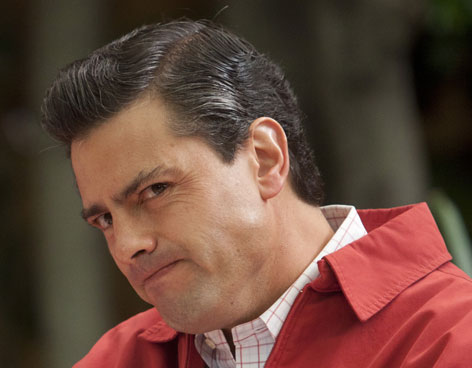 There have been all kinds of dire predictions that an AMLO loss would mean a repeat of what followed his (presumed— or at least official) loss in the 2006 election… which as I recall was noisy, interrupted traffic, annoyed a lot of Mexico City suburban commuters… but as far as I recall didn’t get anybody killed.
As it is, I don’t think you’ll find much of a record of forced disappearances, suspicious one-car accidents, murders or politically motivated police raids connected to his various parties. If anything, it’s been PRD and the leftist party activists who’ve been most likely to come to a violent end, or get tossed in the slammer.
The PRI has, through its long history, not hesitated to turn to violence for political ends, and I think it’s a fair question.
Consumed by consumption: or, all we need is love
You need to realize that the water crisis and aggression against the environment means we must changing our way of life and putting a stop to the consumer society and pulling the plug on that culture.
The current model of development and consumption by rich societies are depleting the world’s natural resources…
… the first element of the environment is human happiness.
Must be Uruguay Weekend here at MexFiles. President José Mujica (whose only personal asset is his beat old old VW bug — his wife owns their small commercial floral farm) addressed the Rio Summit on the trap of consumerism and sustainable development:
For those who don’t understand Spanish, there is a (not perfect) English-translation caption with the video
Opiates (sorta) for the masses
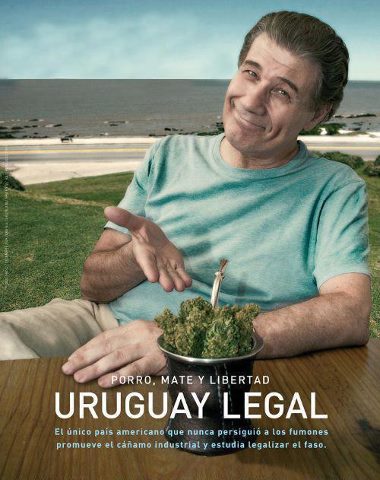 The Uruguayan government is considering going into the marijuana business. Next door neighbor Paraguay is the world’s largest marijuana producing nation and smoking marijuana is not illegal in Uruguay, but marketing and importing it is. Uruguayans having rather… um… high levels of consumption (an estimated 8.5 percent of Uruguayans smoke weed) a bill to create a government-run marijuana sales and distribution system is being packaged by President Jose Mujica’s administration as a crime-fighting measure.
The goal was for “strict state control over the distribution and production” of cannabis, said Defence Minister Eleuterio Fernandez Huidobro.
The government will also urge that marijuana sales be legalised worldwide, [Fernandez] Huidobro said, adding the measure could discourage the use of so-called hard drugs.
Using NationMaster figures (probably inaccurate, but relatively so), in the United States… one of the top marijuana-using countries… about 12.3 percent of the populace uses marijuana (other statistics say anywhere between 45 and 60 percent of USAnians have used marijuana at one time or another). For Mexico … a producer country… the usage rate is only about 1.15 percent.
Legalizing marijuana in Mexico wouldn’t have much effect one way or the other on crime in Mexico. I’m dubious that our largest customer would consider legalization except in some overly complicated half-assed way (sort of like the way they handled a simple thing like a national health plan) and the U.S. is allergic to the idea of state control of any industry, so I’d expect all that would happen here would be that we traded one set of gangsters — like the Sinaloan hillbillies — who bring some of their money back to Mexico, but put the the bulk of it into U.S. banks for a bunch of more refined gangsters — Montsanto, or Archer-Daniels-Midland, that would not only sock ALL their profits in the U.S. (or, perhaps the Caymans) but controlling the production as well.
Tell me again when Mexicans should be expected to kill each other for U.S. consumers?
Another “constitutional coup”?
Paraguay’s Chamber of Deputies voted Wednesday to impeach President Fernando Lugo for, well, basically doing a crappy job (mal desempeño de sus funciones, to be formal about it). The complaints are, depending on who you listen to, either that he has been slow to implement land reform, or that he has been unable to control violence in rural areas over land reform (and the slow pace thereof).
 Which may be true, but Lugo was elected on a coalition ticket to counter the Colorado Party, which — even more than the PRI in Mexico — dominated Paraguay, where the same president (Alfredo Stroessner) held office for 34 years until he was run out of the country. Although from the left (he’s was a prominent Roman Catholic Liberation Theologian, and former Bishop), he has been forced to share power with the right, which opposes his land reforms. And, yes… for you conspiracy minded types, Paraguay does have U.S. troops, and the Bush Family (along with Sun Myong-Moon and some other equally shady very rich people) owns huge tracts of those lands that needed reforming .
It may be simple Paraguayan politics, or it may be a coup. When it comes to corruption, the Colorados are to the PRI, as Norwegian political parties is to Mexican parties. Or, as Inca Kola News puts it:
The parliamentary vote was on a snap resolution and we should keep in mind that the (non-Lugo) Colorado Party controls Paraguay’s congress, is dying to get back into executive power and is perhaps the single most corrupt political party in all of South America (and believe me folks, that takes some doing).
The Chamber vote was 76 to 1, but you have to take into account that the Colorado Party holds 37 of those seats, and the Vice President (who would replace Lugo) is from the “Authentic Radical Liberal Party”, which holds 21 seats. “Radical Liberal”, by the way means free-market capitalist in Latin America. In Mexico, Nuevo Alianza (Esther Elba’s party) is the “liberal” party. In the English-speaking world, the best known similar parties are the Canadian Liberal Party and the British Liberal Democrats.
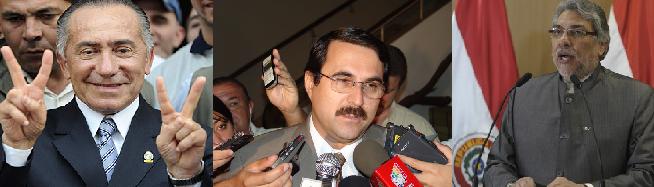
L-R: Lino Oviedo, Federico Franco, Fernando Lugo
The “Beloved Fatherland Party” … which describes itself as Christian Conservative holds another 10. The next largest party, the “Ethical Citizens” party (also with 10 seats) is something of a contradiction in terms, Lino Oviedo, its standard bearer in the last presidential election having just been sprung from prison for trying to stage a military uprising against the new democratic government when he was a Colorado Party leader.
In other words, the country has a lefty president (actually, a Catholic Liberationist), a right-of-center Vice President, a legislature dominated by parties from the right-of-center to fascist, and whatever Lugo’s faults as head of state, the legislative branch has every incentive to replace him with someone more in line with themselves. Like Vice-President Federico Franco (conveniently, the brother of his party’s Senate leader).
What makes this look like a coup is that, while since democracy was restored in 1989, Paraguay has impeached a president before. Raúl Cubas (who had been the Colorado Party candidate until candidate Lino Oviedo — yup, him again — had been tossed in the slammer) was impeached the day after his anti-Oviedo Vice President was assassinated. Cuevas was given ample time to prepare a defense for his Senate trial (but chose to resign, and went into exile), whereas Lugo is not being given any time to prepare any sort of defense in the Senate… which is, of course, overwhelming controlled by the same parties controlling the Chamber.
A little respect for your elders might be in order
Mexican-born Nogales Arizona resident Raul Héctor Castro was detained last week at the U.S. Border Patrol internal checkpoint in Tubac, Arizona as a “nuclear threat”. Despite assurances that any radiation detection was caused by a medical test Castro had undergone the day before, he was forced to get out of the air conditioned car in which he was traveling, and sit in a tent in the desert wearing a suit in 40° C [100°F] heat as the Border Patrol agents scooted around looking for the right forms and did whatever it is they do to confirm the obvious. Well, after all, he is a brown guy, and this was in Arizona, but still…
OK, maybe it is a little elitist to presume Castro should have been entitled to “special rights” just because he was a United States Ambassador under three Presidents (Johnson, Nixon and Carter), or because he is well-known in at least Democratic Party circles in his home state. Maybe having been the Governor of Arizona from 1975 to 1977 should have carried some weight, but I suppose even that might be a stretch. But, maybe… just maybe… the Border Patrol should have given some consideration to the fact that Castro was on his way to his birthday party… he turned 96 on 12 July
We shouldn’t be surprised… it’s not the Governor’s first run in with the Border Patrol. Interviewed by Arizona Public Media earlier this year, Castro mentioned that:
… when he was a Pima County Superior Court judge, the first person of Mexican descent elected to a judgeship, Border Patrol officers almost arrested him as he painted a fence in front of his house. When they realized he was a Superior Court judge, they fled, he says.
“Even though the law provides no profiling, do you think if I had been blue-eyed and freckle-faced, they would have stopped me? Of course not.”

The nuclear threat. Photo: Arizona Public Media
Governor Castro was born in Cananea, Sonora, emigrating to the United States at the age of 10. He was not the first U.S. governor to have been born in Mexico (that would have been George P. Romney — Mitt’s dad — who came to the United States from his native Chihuahua at the age of five), but the first — and only — Arizona governor of Mexican heritage. An outstanding athlete (both as a runner and as a boxer) he earned an athletic scholarship to what is now Northern Arizona State University, graduating in 1939. Despite the scholarship, he had to work summers, as a copper miner, earning, as he recalled last year, half of what Anglo miners were paid.
After graduation, he worked as a State Department clerk in a border post, he entered law school, and began his political career as a county prosecutor, mostly running as a challenge to friends who said a Mexican could never win public office in Arizona. He was serving as Pima County Superior Court Judge when he was named by Lyndon Johnson to serve as U.S. Ambassador to El Salvador in 1964. From 1968 until 1972, he served as U.S. Ambassador to Bolivia.
After “retiring” from the State Department, he moved to Nogales to practice International Law, running unsuccessfully for Arizona Governor in 1970, and successfully in 1974. He resigned office three years into his four year term when he was again named to a diplomatic post: President Jimmy Carter appointing Castro Ambassador to Argentina.
He is still active, occasionally showing up at party events (and his own birthday party, if he can get there) and is the oldest living former U.S. state governor.
The man is gonna get you.. or the woman
I don’t know what exactly it is that makes this so newsworthy… that more and more Mexican women are proving to be perfectly competent to work in non-traditional jobs … or that some Mexican cops caught some robbers.
Both.
Nice work by oficialas Joanna Sujey Vázquez Morales and Paola Jaramillo Barba.
And this is bad… why?
Tim’s El Salvador Blog writes:
Tuesday marked the 100th day of the truce between El Salvador’s gangs which has dramatically dropped the homicide rate in the country.
[…]
While the homicide rate has dropped from around 14 a day at the beginning of the year to approximately 5 per day under the truce, levels of other crime seem to have dropped little if at all. There are also reports that the number of missing persons is increasing, suggesting that some of the drop in the homicide rate is simply that the bodies are not being found. Yet even with those caveats, there seems to be little doubt that the gang truce has momentarily improved the security situation in El Salvador. The government and all sectors of society should take every measure possible to try to make those improvements permanent and to enhance a culture of peace.
The notion of negotiating with the “cartels” here sends shivers up spines mostly in Washington, not in Sinaloa, or Juarez or Michoacan. Considering that governments negotiate all the time with malfactors (consider all the times the U.S. government has reached a negotiated settlement with some corporation in exchange for a promise not to do whatever they did again… or to pay a fine after some egregious fraud or oil spill or whatever) it’s nonsensical to say one never negotiates with criminals.
In El Salvador, the “deal” is to create more job opportunities for marginal youths (the gangsters aren’t stupid people, and understand very well their employment base) and some prison reforms. Whether it holds or not (and so far it has), at the very least, it frees up state resources to deal with more than the roots, and the not fruits, of anti-social behavior.
Here, the criminal gangs are just better organized, and have some legitimacy in providing social services (and employment) in under-serviced regions. At least at the lower levels of these organizations (where the “employees” are more contractors and temps than on the payroll), steering them towards less violent could be effective both in reducing the amount of violence, and reducing the role played by organized crime in the economy.
Some accommodations could go a long way… better schooling, jobs programs, alternative crops, speeding up the reforms to the judicial process… there’s plenty of “carrots” that would free up the “sticks” (guns and the Army and prisons) for those not open to persuasion.
Hey kids, let’s put on a show! The 132 Debate
I am not sure the Yosoy132 debate will have the impact, even among those looking for a political change, the organizers hoped.
I was unable to bring the site up under any of the on-line sites listed on the poster I reproduced earlier today, and — being at our shop at the time — was only able to catch the very end of the two hour debate when I found it on SDPNoticias (a pro-Lopez Obradór news site).
I was not the only one who had trouble logging in: comments on the SDPNoticias site, with time stamps from the scheduled start of the debate (8 PM Mexico City time) up through the first hour were mostly of the “Where is the video?” or listing other possible alternative site… or suggesting people listen to the debate on the radio (on Mexico City stations, which wasn’t much good to those of us out in the hinterlands).
A common theme in the SDPNoticias comments was the suspicion that there was some sort of collusion in keeping the livestream off the internet… something that crossed my mind. A commentator using the name “JuanCarlos” suggest that it naivety and a certain amount of elitism on the part of the organizers undercut the webcast’s effectiveness. At the last minute, several television networks (including Televisa) petitioned to broadcast the debate, but were turned down by “yosoy#132” on the grounds that the group didn’t want to favor any particular television network, and besides, was already committed to distribution via Google.
While this made some sense in that the perception of political manipulation by the television networks was the single biggest issue in launching “yosoy#132”, I’m probably not the only one noting the irony in that Google is just another media corporation… and a foreign-controlled one at that.
Elitism , on the part of the organizers, is perhaps unintentional, but as “JuanCarlos” wrote:
…[they] did not want to not favor any [of the media companies] … but they also disfavor he thousands of Mexicans who want to see and hear this discussion and do not have internet access: remember that we are considered a privileged group. And the others? Don’t they want to be heard from? So why the nonsense about Internet transmission?
Be that as it may, the entire debate was posted on youtube within minutes of its completion (much too large a file to repost on this site): #Debate132 here. Unfortunately, it’s unlikely to be rebroadcast on the medium where most Mexicans get their news: television (or, if broadcast, only in”soundbites” meant to bolster whatever some talking head is trying to spin).
As to the actual debate… cutting back and forth between student questioners and the candidates via webcam was gimmicky (and kinda elitist) and didn’t work very well. I realize the event was meant to be unrehearsed, but the technical issues could have been worked out ahead of time. The candidates themselves, undoubtedly rehearsed, mostly giving their predictable answers to the questions. The questions and responses will, undoubtedly, be fodder for the talking heads and news columnists for the next few days (which is the point of the exercise), so I won’t concentrate on them here. As to style, none of the candidates seemed to stick to the clock (nor did the moderator try to hold them to their allotted response time) though Quadri appeared to have mastered the format. Even when talking nonsense, he’s able to rattle off a seemingly complete answer timed almost to the second in this sort of format. However, he talks so fast, he’s hard to follow. Vasquez Mota doesn’t always seem to catch the question, but as a professional pol, she knows how to speak to a camera. Surprisingly, Lopez Obardór — considered a master at dominating media events (as “mayor” of Mexico City, his daily 6 A.M. press conferences were legendary) and with a campaign that has been at the forefront of exploiting new media — just doesn’t come across as very impressive in this kind of event. He speaks slowly, with numerous pauses. On the other hand, it forces you to listen to what he has said, and saying less, maybe he’s going for sound-bites.
But judge for yourself. Much too long (just shy of two hours) to post on MexFiles, the “peoples’ debate” — warts and all — is something new and different, and well worth the investment in your time.
The “PEOPLE’s DEBATE” tonight
It won’t be shown on Televisa or Azteca (fancy that), and Enrique Peña Nieto is avoiding this, and I don’t know how much impact (if any) it will have, but here are places you can see or hear tonight’s unofficial debate sponsored by “#yosoy132”



 mexfiles.net