Azteca Stadium holding only about 90,000, the Paul McCartney concert in Mexico City was simulcast on jumbotrons on the Zocalo (one of the better uses of public funds I can think of) for another 70,000 or so. From the balcony of the Majestic Hotel, facing the Zocalo, someone hung out a banner supporting Enrique Peña Nieto and the crowd went wild….
… alas, for Peña Nieto, what they were yelling was “¡Fuera! ¡Fuera!”
They did, however, break into applause when PRD supporters hung a banner out the window of the District Assembly building around the corner.
(Source: SDPNOticias.com)
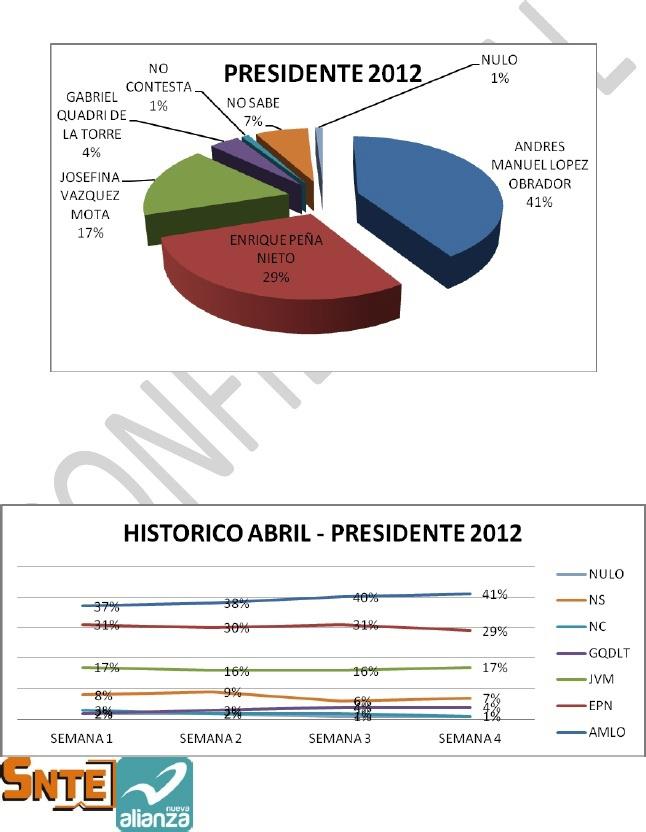
This can’t be right… or rather, it probably is right: internal polling from SNTE, the teacher’s union controlled by Elba Esther Gordillo (aka Señora Hoffa), shows AMLO is the preferred candidate of the union rank and file.
Gabriel Quadri does about twice as well in this poll as he does nationally, but even with being Esther’s hand-picked choice to run as presidential candidate in a party supposedly designed to keep SNTE in power (actually, to keep Elba Esther in power, and unindicted) four percent can’t be good. Especially when the union membership is backing the guy who calls Elba Esther a mafiosi and makes attacks on her union a regular part of his stump speeches is polling over 40 percent in a four-candidate field.
Art and death
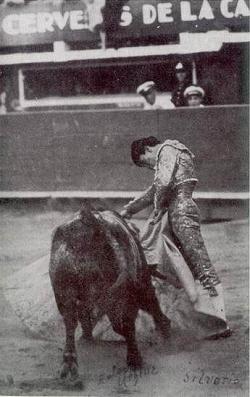
Only in the bullring is there the certainty that death is wrapped in dazzling beauty (Federico Garcia Lorca)
When the great Silverio Pérez, “El Faraón de Texcoco” passed away in 2006, I tried — unsuccessfully — to translated an appreciation of the philosophical matador I had read in one of the Mexican sports magazines. I could puzzle out the meanings of the technical terms only with great difficulty, but understanding art criticism written in the language of sports-writing, with a subtext of culture and philosophy not my own, was simply impossible. I’d only lived in Mexico for about five years then, and … to be quite honest … I am not sure I could undertake such a translation even now.
The world of the bullring is a complex interplay of range management, animal science, sport, Iberian and Latin American history and art. Whether we chose to participate or turn away in horror, our tendency to a reductionist consideration of the interaction of the natural and the artificial… seeing the world of bulls and men as merely a blood sport, or an art form or (as I like to point out in its defense) an ecologically sound economic practice, or even as a cultural artifact, we miss the meaning when we fail to consider it as a “cultural ecology”.
Richard Finks had already been attending and considering the meaning of tauromaquia for many years when he first started working on Brave Blood: The words… the experience… several years ago. Considering tauromaquia in all its facets — writing what is as much a lexicon as an apologia — has been the product of years of work. Considering that Finks has held down an overly full teaching schedule at the Autonomous University of Guadalajara for many years, the serious work of contemplating and explicating the many facets of the world of bulls and men was a tremendously ambitious undertaking. Naturally, having been written in fugitive hours over several years, the excellent manuscript that emerged was in need of revisiting and revising. We knew there would be a long editing process ahead of us before Editorial Mazatlán could publish.
We expected, perhaps unreasonably, to have this work out by now, but like any true writer knows, the editorial process is a time to rethink and retool and reshape. Given the complexity of the subject and the time commitments of both the author and the editor(s) to other necessary (though more mundane) matters, it perhaps has taken longer than we would like, but as long as was needed.
The art of the bullfight is the art that carves out truth—and the beauty of the creation lies all in the frank, clean lines of its starkly tragic form. The essence of the corrida can be seen as man’s struggle to put the tools of art to the wild, horned mass that is the raw life-force, and even and especially as it charges to dominate it—to make it reveal all the splendor and sadness that is life.
…
A dancer puts only his reputation on the line when he muffs a move or falls out of step; his long-range future may be jeopardized, but nothing strikes him dead the instant he falters. Even a diamond cutter lives on to breathe his regret should he botch a crucial tap; he may be destined to penniless despair, but it will be only the stone that is reduced to just so many broken pieces in that fateful instant of cleaving—not his body.
With the bullfighter, it is different. One wrong flick of his wrist, one step a fraction off, one instant’s lack of luck—and his life may be cut off faster than he can exclaim “¡Ay!…” – “Oh!…”. One false move in the bullring, and there is death, ready to make it the last.
Of course not everyone who makes blunders in the plaza de toros drops dead on the spot—but anyone who does bungle knows all too well that there is all too often simply no margin for error. No other art form contains so severe a built-in penalty for the artist who in any way, at any second in the performance of the art, might fall short of perfection.
“It is the matter of death that makes all the confusion,” Hemingway said. It is the presence of death that emboldens the art, and the thought of death that can inspire sufficient fear to be the art’s undoing. It is the possibility of death that gives the art its edge of urgency, and it is the reality of death that either underscores or undercuts creation. It is the death of the bull that is the climax of the performance; it is the bull’s death that is the very point of the whole artistic statement the fight is designed to make; and it is precisely this death that gives rise to the controversy and indignation that lead many people to classify the bullfight as at best only within disdainful quotation marks an “art”.
Ultimately, though, death is only a part of it all. An irreplaceable part, for there would be no tragedy without it, no art and no truth; but, still, just part. If the corrida de toros can be considered dramatic art, the drama must be regarded as tragic allegory. Nobility and Bravery are the stars, center-stage. And Death?—on call; in the wings.
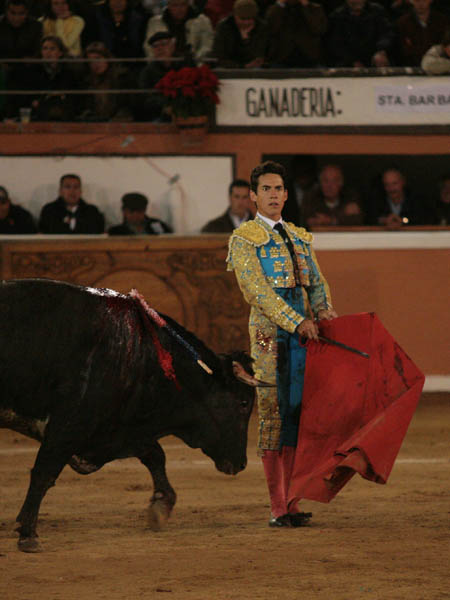
Photo: Edgar Mendoza, Ciudad Taurina
Cheesecake or just cheesy?
This “transparency” thing can get a little extreme. Yup, this is a real political ad for a federal deputy (the Mexican version of the House of Representatives) and not from a fringe party, either. I don’t know which one of these ladies is Ms. Juárez.

Thanks to Deborah Bonello (MexicoReporter.com) for highlighting this.
Thom Shankar of the New York Times whitewashes the not-so-creeping U.S. intervention in Honduras:
This new offensive, emerging just as the United States military winds down its conflicts in Iraq and Afghanistan and is moving to confront emerging threats, also showcases the nation’s new way of war: small-footprint missions with limited numbers of troops, partnerships with foreign military and police forces that take the lead in security operations, and narrowly defined goals, whether aimed at insurgents, terrorists or criminal groups that threaten American interests.
The effort draws on hard lessons learned from a decade of counterinsurgency in Afghanistan and Iraq, where troops were moved from giant bases to outposts scattered across remote, hostile areas so they could face off against insurgents.
As Dawn Paley, who normally covers Latin America (and is not a state-sanctioned “embedded reporter” — like “Pentagon correspondent” Shanker), writes on the Times piece:
Shanker does his best to set the story up as being all about drugs, even though it is common knowledge that U.S. militarization doesn’t decrease drug production or trafficking. “Forty years of increasingly violent efforts to stamp out the drug trade haven’t worked,” reads a recent piece in Foreign Policy magazine.
Then Shanker slips into a description that is perhaps a little more indicative of the U.S. role in Honduras:
This new offensive, emerging just as the United States military winds down its conflicts in Iraq and Afghanistan and is moving to confront emerging threats, also showcases the nation’s new way of war: small-footprint missions with limited numbers of troops, partnerships with foreign military and police forces that take the lead in security operations, and narrowly defined goals, whether aimed at insurgents, terrorists or criminal groups that threaten American interests.
Is this about drugs, or is it about securing U.S. sweatshops in Honduras? Is it about drugs, or is it about seeing the entire population of Honduras as a latent “criminal” group that could, at any moment, become “illegal” immigrants? Is it about drugs, or is it about controlling insurgents (aka rebels or revolutionaries), namely the members of a massive popular movement that has risen up since the illegal coup d’etat in Honduras in 2009?
You’d be forgiven for reading this piece and not knowing about the coup: Shanker left out that, ahem, little detail in his piece. The U.S. media don’t like to talk about how the coup, carried out by the Honduran army and supported by Honduras’ tiny transnational elite, has sparked a massive popular movement all across the country. But acknowledging that there is a huge (and generally peaceful) popular movement in Honduras makes war boosterism more complicated. Better to stick to the fighting drugs and bad guys, you know the quasi criminal terrorist line…
I’d add, and Ms. Paley would have more on this, that the region where those “forward operating bases” are located just happen to be areas where local peasants have been forced off their land by palm-oil speculators… with the armed assistance of said “military and police forces”.
This has always been the worry in our part of the world… since the Wilson Administration, the U.S. has continuously intervened militarily in Latin America, and has “rediscovered” some “threat” our direction every time it is faced with winding down some other operation somewhere else on the planet and rather than find something constructive for its bloated military to do at home, foists them on us.
Palely loitering
Canadian Garry Ledouce recently relocated to Mexico after living in Switzerland. He blogs at Mexico Observer . This originally appeared in MexConnect “General Living forum”, and reprinted (with a few minor editorial changes) with Don Garry’s kind permission:
… I am a North American Indian. I get a few stares, but only because people think that I am a rather large size Mexican. I can wander for days and no one looks at me. I can spotch down on the street in a doorway and people walk around my feet without looking at me. Like Kermit said… its nice to be brown.
In Canada and in Europe it is different. In Canada I get looked at suspiciously and if I am in the west, say Saskatoon or northern Ontario, people look at me with disgust often. I get followed by security in department stores and policemen glare at me.
In Europe, i get looks of puzzlement. There is something familiar about me but people don’t get it … People smile sometimes and say, “Hey you are an Indian eh?”, or “Is it not terrible what people are doing to the wolves?”,. and that sort of stuff.
In Mexico, i just get ignored and I love it.
I see gringos a lot. wandering and palely loitering. Always in some conspiracy on a corner or darting furtively from here to there. These folks stand out. Shorts. baseball hats, red skin and the women in Mexican artisanal clothing that a Mexican would not be caught dead in except for feast days where it is a costume. And the shoes: Mexican have beautiful shoes. It seems that most have a shoe fetish for example. And everything is fashion and it is a delight.
I dress more Mexican. Long pants. pressed, golf shirt, no hat usually and a thousand yard stare. I wear good solid shoes with socks.
Dressing any other way is an insult to your neighbours. I usually give money to the beggars, certainly the old ones who need it. They really dont have pension. To the kids i say like the mexicans do, “Go to school” or “Get a job”. The usual stuff.
I always call ladies, regardless of their age, “señorita”; the boys who serve me, “joven.”; and I always refer to the elders who have stores or do expert work as either “maestro” (a carpenter etc.) or “Don”. with the persons first name — Don José or Don Miguel. It is only polite to do this. I have some even now calling me “Don Garry” — my hair is greying more each day.
IFE: we didn’t do it, and won’t do it again
IFE, the Federal Elections Commission, has been falling all over itself to apologize for the debate… not the failure to get it onto the networks, or to set it up as a real debate, rather than a series of answers (or non-answers) to pre-selected (and largely PRI-selected) questions, but for the “distraction” that arose when Julia Orayan had her 20 seconds of so of camera time. While IFE is also apologizing for using sexist imaging in the debate, they’re also claiming they were not responsible, shifting blame to the production company, which is shifting blame to a production assistant who is shifting the blame to Ms. Orayan for wearing exactly what she was told to wear… a long white dress. If they’d meant a long white dress that didn’t show off her cleavage, they should have said so.
IFE would just as soon you forgot that they were the idiots who were responsible for the debate, and hope that one of the new edecanes they’re interviewing will prove less controversial:

Da bait for debate?
The Mexican Presidential debate is, by design, a rather staid affair (though there were the verbal fireworks, and more on that later), presented as being a neutral exercise in democratic education. In keeping with the neutrality meme, viewers and the candidates were told that a random card selection would determine the order in which they would speak.
Said cards were then handed to the candidates by … Playboy Bunny (and November 2008 centerfold) Julia Orayen.
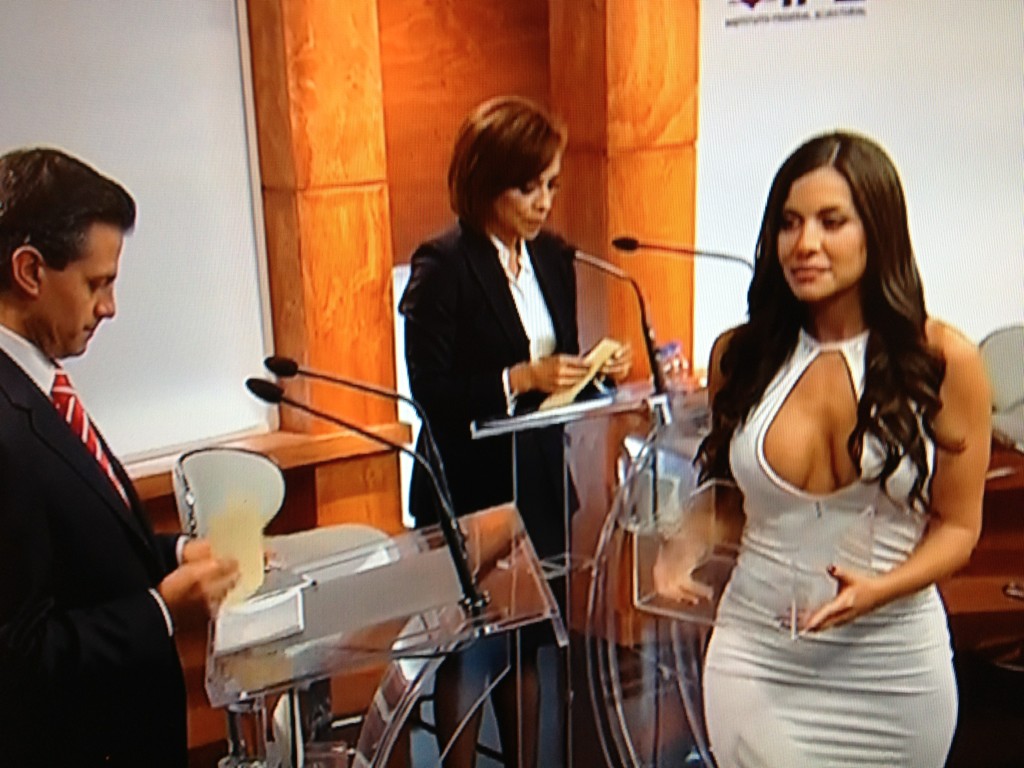
Neutral… yeah. And you can see how serious the process is taken… after all, Ms. Orayen did wear a non-partisan white dress.
Mexico is weird, but never boring.
And the horse he rode in on
… Congratulations to another Mexican athlete nobody knew was out there: Mario Gutierrez.
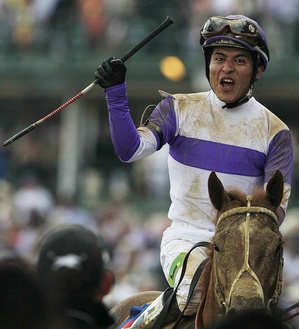
Photo: Portland Press-Herald
Despite all the press reports that call him a “rookie jockey” — the Veracruz native has been riding professionally since he was 14. As is common in Mexico, he was apprenticed by his father.
While Mexico is the source of the rodeo, it has to be pointed out that Mexicans have also mastered the more genteel equestrian sports as well. Mexicans have garnered seven Olympic medals in equestrianism at the Summer Games, and took the bronze in polo at the very first Summer Games in 1900, as well as another Bronze at the 1936 Berlin games (it was a bad year for the master race, and the master horses. Argentina took the gold, and the British the silver… and polo was dropped from the Summer Games).
Just in passing, something I read the other night pointed out that in the early 1500s about the only Europeans who rode horses and used them for anything other than pulling carts and plows were the era’s “one-percenters”… the nobility. The exception was the Iberian peninsula, where due to Arab and Moorish influence, horsemanship was widespread, and relatively well-off commoners like Hernan Cortés considered good riding skills to be essential.
The horse was a critical factor in the Spanish conquest. When Bernal Díaz del Castillo (himself a commoner-horseman) sat down to write his memoirs of the conquest at the age of 80, he couldn’t always remember the names of his fellow human soldiers, but he could recall every one of the horses’ characteristics.
Once the indigenous people’s got over their shock and realized the horses were just animals, and not some mythological creature, they adopted. The Iberians, recognizing the value and the power horsemanship conferred on them, tried to limit ridership to themselves. Because a horseman wears spurs, and some Nahuatl humorist noted the resemblance to the back toe of a turkey. As a result, the all-purpose ethnic insult for Spaniards have been to call them “Gachupines” — turkey-toes.
The native people did acquire horses (and the Tlaxcalans, as soon as they had horses, turned conquistador themselves, carving out new territory in the north of Mexico, and founding Saltillo and San Antonio), and the criollo settlers brought their democratic sense that anyone who could own a horse should ride it well, and anyone who could ride a horse well deserved respect. Emiliano Zapata might have been a village nobody if he wasn’t favored by the dictator Porfirio Díaz’ son-in-law, Ignacio de la Torre y Mier for his ability to handle a horse.
Normally I wouldn’t steal an entire articles from a newspaper, but I’ll make an exception this once. Notice how long it took to get the news in those days — and that the New York Times, always a conservative paper when it comes to spelling and word usage, still used British spelling in the 1860s.
Besides just the surprise of the crappy, ad-hoc Mexican army beating what was then considered the best military force in the world, there was another reason Cinco de Mayo was a BFD in the United States long before it was “discovered” by beer distributors and politicians pandering for the Hispanic vote: the United States was in the middle of a large-scale organized insurgency seeking to create a break-away southern republic. Some claim Zaragoza and his army saved the Union.
France and Britain were ostensibly neutral, but the governments in both of the two superpowers openly supported the Confederacy — not only because they wanted favorable terms for buying U.S. (Confederate) cotton for their mills, but because they suspected (rightly, as it turned out) that a strong United States would rival their own economic and political hegemony. At the time, something everyone forgets is that the United States was sort of seen by the European monarchies sort of the way today’s major powers see China… an up and coming superpower, with a weird political system and not to be trusted. Even if the Confederate insurgency was contained, a pro-European Mexico would have meant the United States was surrounded by enemy (or at least unfriendly rival) states.
Neither British-controlled Canada on the northern borders of the United States, nor the British and French Caribbean possessions had the facilities to provide more than token assistance to the insurgency. A European-puppet state in Mexico, under French tutelage, would have permitted France openly to support the insurgent Confederacy, and the British to openly conduct business with the rebel government and, channel military and economic “assistance” through the Mexican “Empire” supposedly ruled by Queen Victoria’s cousin and her none-too-bright Hapsburg hubby.
Luckily for the United States, what happened on 5 May 1862 meant the French had to commit 30,000 troops to Mexico, and spend a year bogged down just trying to take back this one city. More than enough time for the United States to push back the insurgency from the South, which would manage to mount one last major offensive into Gettysburg Pennsylvania two months later, and then, effectively, collapse from lack of support.
Published: June 13, 1863
IMPORTANT FROM MEXICO.; Detailed Account of the Surrender of Puebla. Official Order from General Ortega. His Announcement of the Surrender. REPLY FROM THE MEXICAN GOVERNMENT. A PROCLAMATION BY JUAREZ. The City of Mexico to be Defended. We translate from the monthly review of the Heraldo of Mexico City the following account of the surrender of Puebla, the general order of ORTEGA, his correspondence with the Minister at War, and the proclamation of President JUAREZ:
MEXICO, Saturday, May 23, 1862.
With the purpose of introducing provisions and ammunition into Puebla, the army of observation moved early in May nearer the besieged city. On the 8th inst, the first division of that corps d’armee was surprised by the French at San Lorenzo. Our soldiers defended themselves like heroes, but were driven back and forced to give way. The loss which we experienced in that affair was of no small amount, and the Army of the Centre, now very much diminished, was compelled to fall back as far as the bridge of Tosmelucan. Neither our review nor the present situation of the Republic appear to us like the proper place or occasion for making recriminations, impartial history will before long decide upon all that has passed at the memorable siege of Puebla, and will say whether the Government displayed all the activity and all the energy that were required to aid Puebla, and whether the Commander-in-chief of the Army of the Centre complied with the duties which are imposed upon every one who exercises a similar command Perhaps all have fulfilled their duty, perhaps only some.
The city was in need of provisions, for on the 21st of last month we were written to on the subject, that we might use our influence to get them sent in. It was scantily supplied with artillery, the consequence of which made themselves felt every day more dreadfully.
Gen. ORTEGA had thought of leaving the city with its hero defenders, when it was not very difficult, (live have before the 8th of the present month,) but the project agreed to by him, to send into the city the indispensable articles which he asked for, and the natural dislike which he felt to leave the city which he had defended with so much courage and self-denial, stopped him. Later, when the army of the Centre could not, assist him, he attempted to do so; but fate or Providence, who wishes to prove in this unjust war the decision and firmness of conviction of loyal Mexicans, prevented it. The city continued to be defended heroically until the 16th, when the soldiers, worn out from the want of provisions, could not support themselves, and when there only remained an insignificant amount of war like materials, expecting to be attacked on the following day by the enemy, who now judged them to be much weakened.
Perhaps in gain time, on that same day — the 16th — the Quartermaster-General, GONZALEZ MENDOZA, went to the French camp, to propose to its Commander-in-chief the abandonment of the city by its garrison, the soldiers being allowed to carry away their arms, and, with unfurled flags, to proceed to the seat of the supreme Government. It is said that FOREY, appreciating the indomitable courage of our soldier, allowed the honor, but required that the march should be to Orizaba, where they were to remain that the termination of the war, without taking any part in it. Gen. MENDOZA withdrew after completing his mission.
At 4 P.M. of the same day, the 16th, Gen. ORTEGA herd a meeting of Generals in the Government-house, where he lived. Having heard the opinion of his comrades, he resolved and so declared, in a general order, published for the purpose, that on that night all the arms should be broken and rendered useless, the cannon that remained should be spiked and thrown into the ditches, and the flags of the corps collected, which some assert were burned. All was done according to order, the soldiers disbanding according to the same regulation. At 5 A.M. a white flag was raised and the Commander-in-Chief, commanders and officers awaited the enemy with firmness, resolved not to ask any kind of pledge, as in fact they did. The French army, full of admiration at an act so sublime and unparalleled, could not help showing themselves affected and respectful. Glory to the hero of Puebla in May, 1863! Glory to the unconquered army of his command.
Some gangs of traitors were the first who entered the city, and giving proofs of their vandal-like instincts, took out of the houses the horses of the Commanders of the Army of the East, and began to commit excesses. Fortunately, some Zouaves entered, and with their weapons forced them to desist, showing, as did all the French army, the contempt with which they look upon the spurious Mexicans who have sold their country.
The generates, commanders and officers were treated with some consideration at first, perhaps with the hope that they would sign a declaration or oath that was presented to them, but all indignantly refused to sign it. We have heard that generals had not even a chair sit down upon; what must be the lot that fell to the subalterns?.
Several commanders, officers and soldiers escaped from Puebla, who brought the news, confirmed by the general order published by Gen. ORTEGA on the 17th, as we have mentioned, and which the Supreme Government received the day before yesterday.
General COMONFORT having given up the command of the Army of the Centre, after the battle of the 8th, it was accepted by the Government, and the young and valiant Gen. ROSE DE LA GARZA was appointed in his stead. As soon as there had information of the surrender of Puebla to the French, he gave the orders he thought necessary to attack the enemy if they advanced, and to avoid being cut off in the place which they occupied. Gen. GARZA has given proofs of intelligence and great activity.
It having been ordered by the Supreme Government to concentrate in the Capital all the forces that can contribute to its defence, the divisions which formed the Army of the Centre have already entered.
Gen. GARZA is taken charge of the civil and military command of the district, and is untiringly occupied in preparing the defence of the city, in case the French should care to attack it.
By a decree of the 18th the Government ordered that all French subjects who are in the City of Mexico and other places of the Federal district should leave by way of Morella or Queretaro, for a distance not less than forty leagues from the Capital, with the exception only of those physically prevented, according to the opinion of three medical men, appointed by the government of the district. That on the same day the French should give up to the Government the arms which they had in their possession. That the French comprised in this resolution can dispose freely of their property, with the exception of their arms.
The Federal district was declared on the same day in a state of siege, the military authority assuming the civil command, which, as we have just mentioned, is exercised by Gen. GARZA.
The Minister of War has addressed a circular to all the Governors and military commanders of the States, in which, after informing them of the occupation of Puebla by the invading army, after a defence so glorious for Mexico, he invites them to send all the forces that they can muster, to increase the number of defenders of the Capital, allowing them, in order to carry this resolution into effect, the powers with which the General Government is invested.
The Supreme Magistrate of the nation has published a manifesto full of patriotism, and in which he shows his firm resolution to defend the independence and liberty without rest and without reserve of sacrifices. The following are some paragraphs of this important document:
PROCLAMATION BY JUAREZ.
“MEXICANS: The nation has just suffered a severe blow. Puebla of Zaragoza, immortalized by high and numerous heroic actions, has just succumbed, not from the bravery of the French, whom our soldiers were accustomed to repel, but from causes which the Government must consider insurmountable for heroism itself.
None of our Generals and chiefs who had so distinguished themselves in the defence of that city, have sent to the Government information respecting that deplorable event; but a multitude of private accounts make it certain, although they do not allude to or differ on points of the greatest interest.
But the occupation of Zaragoza, which could not be taken in any of the repeated assaults of the enemy, nor by the most formidable means of war, in no Wise diminishes nor mars the glory of our valiant warriors, who have raised the name of Mexico, in spite of its proud invaders.
Our country is vast, and contains innumerable elements of war which we will take advantage of against the invading army. Not only the Capital of the Republic will be defended to the last extremity by all the means at our disposal, but the defence of all our places shall be made with a similar vigor. The National Government will urge unflinchingly every where resistance and attack against the French, and will listen to no proposition of peace from them which is hurtful to the independence, the entire sovereignty, the liberty and the honor of the Republic, and its glorious antecedents of this war.”
Since the date of our last review until the 17th, [when the occupation of Puebla by the French took place] the latter had made no progress, being confined to the ruins of San Javier and the blocks of houses which they occupied, in consequence of taking those ruins. In all the attacks which they made against the different places, either fortified or defended by the soldiers of the people, they were revised. The French have entered Puebla without glory, never obtained a triumph, over its defenders, whom they met disarmed, awaiting death serenely.
There having been rejected by the Congress of the Union the majority report of the commission formed by it, which advised the concession of universal powers to the Executive, with a few restrictions, it was made the subject of debate, and the minority report, which grants him all kinds of powers, even that of making treaties, will be approved.
We give, in continuation, the order of the day published by the worthy Quartermaster-General of the Army of the East, by direction or the Commander-in-Chief, the dispatch sent to the Supreme Government, and the reply of the latter — documents of the greatest importance.
GENERAL ORDER OF THE ARMY OF THE EAST,
May 17, 1863.
The garrison of this city not being able to continue its defence on account of the utter lack of provisions, and of being completely out of provisions.” so as to be unable longer to resist the attack which undoubtedly the enemy will make with the first dawn of the morning, judging from the points and positions which they occupy, and the knowledge which they have of the condition of this city.
Having heard through the Generals the opinion of the majority of the officers who compose the army. which opinion is in absolute conformity with the contents of this order, the General-in-Chief orders that, for the preservation, of the honor and dignity of the Army of the Orient and the arms of the Republic, between the hours of 4 and 5 A.M. to-day, all the armament be broken up which has been used by the divisions during the heroic defence which this city has made — which sacrifice the country exacts of its noble sons in order that the said armament may not in any way be made useful to the invading army.
At the same hour the Commander-in-Chief of the Ordnance will order that all pieces of artillery with which this place is armed be destroyed.
GEN. ORTEGA’S ANNOUNCEMENT OF THE SURRENDER.
ARMY OF THE EAST.
The Commander-in-Chief to the Minister of War.
With this date and at this hour, 4 A.M., I send the following communication to the Commander-in-Chief of the French army:
GENERAL: As it is impossible for me to continue defending this city, from the want of ammunition and provisions, I have disbanded the army that was under my command, and destroyed its equipments, including all the artillery. The City is therefore at the order of your Excellency, and you can direct it to be occupied to-day, if you think fit, the measures dictated by prudence, to prevent the evils that a violent occupation will bring with it when there is no motive for it. The generals, commanders, and officers of which this army consists are at the Government-House, and surrender as prisoners of war. I cannot, General, continue defending myself any longer. If I could, do not doubt that I would do so. Please accept, &c., &c.”
The above I transcribe for the information of the supreme magistrate of the Republic, to whom I hope you will explain, that the army — the command of which he was pleased to intrust to me — defended itself as was suitable to the honor and reputation of the Republic, and that it would have continued doing so, it an absolute physical impossibility had not interposed to prevent it. Since some days past it had consumed all the provisions, and the small quantity of ammunition which remained to it, after the fierce attacks which it lately suffered, and in which, fortunately, it did not lose a single redoubt.
I believe, Sir, that I have fulfilled the wishes of the supreme Government, and complied with the duties imposed upon me by honor and the office intrusted to me, but if it should not be so, I will with pleasure submit to a trial as soon as I am at liberty for in a few hours I shall be a prisoner. J.G. ORTEGA.
LIBERTY AND REFORM.
HEADQUARTERS AT ZARAGOZA, May 17, 1863.
To the Minister of War, Mexico.
THE REPLY OF JUAREZ.
OFFICE OF THE MINISTER OF WAR AND MARINE.
The Citizen Constitutional President has been informed of the note that you addressed to the Commander-in-Chief of the French army to communicate to him that as it was impossible to continue the defence of Puebla from the want of ammunition and provisions, you had disbanded the army which was under your immediate command, and broken up its equipments with all the artillery, so that he might order the city to be occupied, which from that time remained subject to his orders. He has also been informed of the resolution taken by you to deliver yourself up a prisoner, with the staff of Generals, commanders, and officers, for which reason, as well as for the other arrangements ordered by you, you explain that, notwithstanding your belief that you have compiled with your duties, yet you will with pleasure submit to a trial as soon as you are at liberty, if the Supreme Government should thus determine.
The citizen President has been observing with deep interest all and each of the events that have taken place during the glorious defence of this city, and and sees with pride that the last which has put an end to the tenacious and vigorous struggle, corresponds to the former ones, if not in its victorious results, at east in other things, because it leaves untainted the fame of the nation, without in any way diminishing the lustre of its unconquered arms, or compromising by any offer the sacred word of its warriors.
The President is therefore satisfied with your conduct, and that of the generals, commanders, officers and privates who formed the immortal army of the East, and orders me to say, as I have the power to do in this dispatch, that the manner in which that well-deserving army has disappeared, confirms its being worthy of the honors and congratulations which the sovereign Congress and supreme Government have addressed to it in the name of the nation which they represent.
LIBERTY AND REFORM,
MEXICO, May 22, 1863.
To Gen. J.G. ORTEGA. Commander-in-Chief of the Army of the East.
THE PLEDGE SUBMITTED BY FOREY.
PUEBLA DE ZARAGOZA.
EXPEDITIONARY CORPS OF MEXICO.
GENERAL-IN-CHIEF The undersigned, officers of the Army of the East, declare by our word of honor:
1. Not to take part again in the politics of the country, and to be neutral in the present struggle.
2. Not to go cut of the limits of the place that the commander-in-chief of the French army may appoint for us.
3. Not to hold communication with anybody, nor with our families, without his previous consent.
PUEBLA, May 18, 1863.
REPLY OF THE MEXICANS.
The above paper having been read by Gen. LLAVE, and those present questioned, they all replied unanimously “Long live Mexico” “Down with the traitors.”
Moreover, the Generals, Commannders and officers signed the following answer
“The laws of the country, military honor, and our private convictions, not permitting us to sign the paper that has been presented to us. We protest against it, signing our name as follow: Puebla.”
In view of this dignified reply, the Commander-in-Chief ordered the Generals to pass us prisoners to the house of ISUNZA, in Victoria-street: the Commanders to the suppressed monastery of Soledad; and the subaltern officers to the Custom-house, all under guard, and without being able to go out.


 mexfiles.net