The geek in the machine
I usually have some idea who the second-sting political players are in Mexico, or can at least look them up, but had never heard of Gabriel Quadri de la Torre until earlier this week, when his named popped up as PANAL’s presidential candidate. There was little about him in the Mexican press, other than he was a civil engineer and environmentalist, most recently running a carbon credit exchange and working for a sustainable development think tank.
Perhaps a candidate for a Green Party and not one created to create a voting bloc beholden to a single union leader. And there is a Green Party… Partido Verde Ecologico de Mexico (PVEM). But then, this is Mexico, where politics seems designed to confound the experts, and make even less sense to the average voter.

Quadri (not Elba Esther, and not Jimmy Hoffa)
PANAL (Partido Nueva Alianza) is basically a creature of Elba Esther Gordilla. Sometimes called Señora Hoffa not because she looks like the Teamster’s President of the 1960s, Jimmy Hoffa (though she does, depending on the results of her latest cosmetic surgery), but because she is a similarly powerful union leader (her union, SNTE, representing most of the country’s teachers) whose rise to power came through violence against dissident union organizers and through her skills as a political player. When Gordilla was dumped from the PRI Central Committee in 2002, she took her faction in the Chamber of Deputies and Senate with her into an unofficial alliance with PAN, then seemingly made up with PRI, although by then having her own party, PANAL available to the highest bidder.
While PANAL has gone a faction within PRI to a junior partner of PAN, the Greens went the opposite direction, having provided perhaps the margin of victory in Vicente Fox’s victory over the Revolutionary parties that had run the country since the 1920s. The Greens had joined with the conservatives in the expectation of receiving the Secretariat of the Environment, which instead went to a PAN political appointee, leading PVEM to go into coalition with PRI. Not able to get much traction as a “green” Green party, they’re better known for pushing restoration of the death penalty (which hasn’t existed in Mexico since the mid-1960s) and mostly being a party for urban yuppies than for any environmentalist concerns.
Being a teachers’ union party, you’d think education would be a natural issue for PANAL, but like the environmentalism of the Greens, ideology is secondary to their real purpose of creating a voter bloc that can be swung to the major parties (in return for … ahem… considerations). The Greens, by now, are basically irrelevant to environmentalists, and while issues like climate change and environmental degradation are taken quite seriously by Mexican policy-makers and business leaders, the Greens aren’t taken seriously, and the environmental vote is up for grabs.
Gordilla, by now “toxic waste” as far as both PAN and PRI leaders are concerned — at least publicly — has to protect her own position, and while Calderón (to his credit) has been a world-leader on climate change issues, neither of the two largest parties are giving much attention to environmental concerns. MORENA, the PRD-left coalition would seem to be the natural ally of the green (as opposed to the PVEM) voter.
So…
Bring in the geek. PANAL’s machine doesn’t have to sell their candidate to their regular voters, but it will need to bring in enough outsiders to at least maintain its party registration. The 58 year old Gabriel Quadri de la Torre has some crediblity in the environmental field and could bring in at least enough to keep PANAL in existence. His profile on the LEAD website (an “international non-profit organisation focused on leadership and sustainable development”) lists several academic and NGO positions, his only government position being as Director of Environmental Planning in the Federal District during the Lopez Obrador administration. I also found articles in Letras Libres on issues like climate change, and mention of various articles for El Economista and one book on sustainable development.
From PANAL’s perspective, selecting this virtual unknown environmentalist may be to drain PVEM (which still has committed greens, who had nowhere else to go) of enough votes to make PANAL the likely junior partner in an expected PRI-led government, especially one weakened (as it will be) as its candidate’s obvious deficiencies become more and more apparent to the voters. And, with no real political history there aren’t likely to be a lot of skeletons in Quadri’s closet to tie him directly to the corrupt and disgraced Gordilla, it creates an image for the party that it wouldn’t otherwise have.
Environmental concerns, as I’ve said, taken seriously by the power-elites, could get more emphasis than we’d otherwise have expected. I don’t see where Quadri’s proposals (like shifting water resources away from agriculture towards urban use) are likely to resonate with green (or other) voters particularly, but Quadri’s candidacy might also shift the conversation to include these concerns. I expect MORENA (and AMLO) has an edge here in speaking to these issues, although PAN may also be able to benefit.
No country for old men (and women)?
Still on this computer’s desktop is a copy of an article from Jornada about Portuguese scholar Boaventura de Sousa Santos, that I intend to translate because of his provocative remarks on the “war on drugs”, democracy and new forms of political participation. I’ll get to it, but one thing I noticed was that in giving an example of how the entrenched defenders of the status quo discredit any attempt at radical change, de Sousa noted the latest “meme” in the “we aren’t campaigning” campaign that’s a build-up to the Presidential campaign that kicks off on April Fool’s Day.
Andres Manual Lopez Obradór has been gathering some mainstream support (or at least tamping down immediate rejection of his candidacy by the “powers-that-be”) by naming his prospective cabinet officers. While the shadow nominees are, of course, from the left, they are “mainstream” type figures, mostly “elder statemen and women” of impeccable reputation as technocrats, academics or masters in their respective fields. Some are, indeed, elders: Elena Poniatowska (proposed as head of a new position, Secretary of Culture) will be 80 in May.
PAN candidate Josefina Vasquez Mota, not campaigning mind you, and not naming her own team, snipes that the proposed Lopez Obrador cabinet would be 1500 years old. To which AMLO responded,
With all due respect to the lady, I’d say 1500 years of experience and honesty. The best cabinet this country every had was under Benito Juarez. Those men were giants. Now we’re putting together a cabinet of honest men and women. That’s all I have to say to the lady.
This is why I think AMLO is such a good politician. Besides the put-down of his opponent, couched in the most gentlemanly of language, he snuck in what in U.S. politics is called a “dog whistle” that not only will appeal to his own supporters, but some of Vasquez’ as well. Benito Juarez is the Holy Ghost of secular Mexico, of course, and everyone knows two things about him: he separated Church and State and he solidified Mexican nationalism. Comparing his own proposed administration to that of the little Zapotec is a subtle reminder not only that Vasquez Mota (and, unmentioned Enrique Peña Nieto) are seeking clerical approval, but also implying that neither of his two rivals are quite the nationalist that he is. And, while it’s not the first thing to pop into the mind of the Mexican electorate, most people know Juarez served as president into his 7os.
Nicely done, old man*!
* He is, one admits, the oldest guy in the race, being 60. Vasquez Mota is 51, Peña Nieto is 45. PANAL candidate, Gabriel Quadri de la Torre is 58. He’s a virtually unknown environmental bureaucrat and civil engineer. apparently in his 50s, although there doesn’t seem to be much biographical information about him anywhere.
Fool’s gold
The IncaKolaNews (and, let me remind you once more… it’s absolutely required reading if you’re at all interested in Latin American business, or have investments related to Latin America) wrote on the widely reported story here in Mexico about the State of Veracruz rejecting permission for the installation and operation of the gold mines promoted by the Canadian company Goldgroup. The State’s Departments of Environmental Protection, Social Development, Civil Protection, Health, and Economic Development all found enough problems with GoldGroup and their mining projects to reject the company’s operation plans.
My link to the story comes from a national magazine’s updated daily website, although IKN salted his post with several Veracruz-based media reports and one from the mining industry press. All in Spanish.
Which it appears, the flacks at GoldGroup either can’t read, or assume their investors can’t read. GoldGroup’s press release dated yesterday touts the project’s on-going successes, and likely profitability, but overlooks the wee detail that it’s been shit-canned.
 The wily Inca has a suggestion for would-be investors:
… if you don’t understand Spanish well enough to read [local media] you should really ask yourself exactly why you’re in this stock in the first place, because if you have to rely on the filtered and selective information that’s dripped to you by obviously biased sources you’re at a woeful disadvantage. If you don’t do your own [due diligence] you only have yourself to blame. … Until a company has proven itself to be a trustworthy source, its information should be considered just as bad as some asshole blogger spouting off on the interwebs.
Advice for anyone having anything to do with Latin America worth its weight in gold.
Head-lines
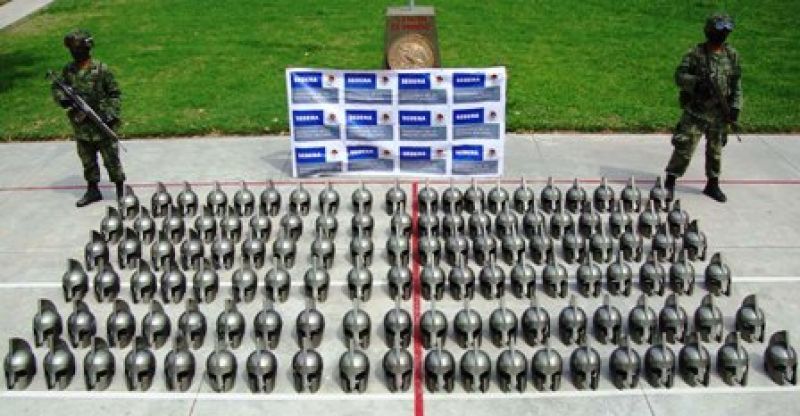
Go tell the Spartans, thou who passest by, That here, obedient to their laws, we lie.
This would perhaps be more suitable material for Burro Hall ( “La Cebolla para Gringos)… the Army called in on a search and destroy mission in Apatzingán, Michoacán… their target: 120 plastic helmets.
One of the odder organized gangs in Mexico, Los Caballeros Templarios, the successor to La Familia Michoacana — was at one time held out by the Administration (both here in Mexico and in Washington) to be the baddest of our assorted varieties of bad guys.
I sense it wasn’t so much that they were as ruthless as any of the other gangsters that made them considered a priority as much as it was that they had a social agenda. La Familia Michoacana was decidedly weird as criminal organizations go, combining traditional criminal activities like meth production and kidnapping with “community outreach” programs. La Familia members eschewed narcotics use themselves (and assassinated local dealers) and presented themselves as an champions of a rural culture threatened by outsiders, although it was fairly obvious that their programs and ideology was based on a foreign model… the American evangelical organization, Focus on the Family.
La Familia was broken up (and, as usual, it’s leaders died in gun-battles, saving everyone the embarrassment of a trial) but the Caballeros appear to carry on with not just the tradition gangsterism, but with the attempts to give an ideological justification to their activities. The off-the-shelf American Protestant “self-help” program maybe just being too foreign and too out of tune with the traditions in Michoacan. Something a little dressier, a little more… oh… Catholic and medieval perhaps… like the Knights Templars.
The Cabelleros are said to wear these helmets during some sort of “secret ritual”, though if they were, wouldn’t there be some plastic swords or spears or something to go along with them. The “knights” would have looked mighty silly in these things if they were carrying around the normal modern accoutrements of your scary Mexican gangster (AK-47, six of seven cell phones, a beer gut and a bad attitude).
Not that historical authenticity is all that important, but those hemets are more fake ancient Greek than fake middle ages, but what the Hell. Fake armor seems appropriate to a fake war prosecuted under false pretenses.
Apocolypse manaña?
Amenaza EU con asesinar a “El Chapo” Guzmán
La secretaría de Seguridad de EU, Janet Napolitano, dijo que si les llevó 10 años acabar con Osama Bin Laden, lo mismo ocurrirá con “El Chapo” Guzmán, quien se fugó de una prisión de máxima seguridad en Puente Grande, Jalisco, el 19 de enero de 2001.
It’s not that I am defending the well-known Sinaloan exporter, but I would suggest the implication that Mexico is a client-state of the United States, where it can kill people it finds inconvenient, might not be wise. The need for the United States to use it’s loose definition of “terrorism” to terrorize its own people is bad enough. When it’s exported, it can be deadly.
I have noted before the tendency to use military force against criminals, and the rarity of the honchos being taken alive… which means not so much that they never get their day in court (although even criminals have human rights, and Mexico is not so barbaric and backwards as to have a death penalty), but that it spares the public any embarrassing revelations about these guys’ contacts and associates within U.S. and Mexican (and other) organizations and institutions. I don’t think that’s accidental.
Secondly, given that the Sinaloan narcotics industry is fueled by U.S. demand for products, a violent military “solution” to is unlikely to resolve the social problem the United States has with its rampant narcotics use. If they wanted to eliminate narcotics growers and distributors through murder, they have plenty in their own country to start with… but then, perhaps the problem isn’t Chapo, but that Chapo — as a commodities broker — is outside the “first world” command and control of the world’s resource distribution system that keeps coffee, and sugar, and mineral, and oil in the hands of the users, and not the suppliers.
Third, eliminating Chapo, while unlikely to end the trade (or even put more than a dent in it), will — like the hunt for Osama Bin Ladin — more than likely create resistance: and not just to what will be seen as foreign interlopers, but to those who will be viewed as collaborators with interfering with a long-established traditional culture in the Sinaloan hills.
Fourth, given the slaughter that accompanied the U.S. “elimination” of Osama and other “targets” by the U.S., there will be “collateral damage”… I’ve always dreaded the inevitable use of drone strikes here, expecting that sooner or later, someone would seriously propose one, and we’ll have a wedding, or a funeral, or a quineceña “taken out”… at who knows what political cost to U.S. Mexican relations (not to mention the appalling prospect of blowing up people who had nothing to do with the “target”, or who are being denied the most basic right of all).
And, I would not be surprised if Mexicans pointed out that even if the present administration approves, it is considered an invasion.
Cementing Mexican-Irish relations
Via Latin American Herald Tribune:
MEXICO CITY – Mexico’s Cemex, one of the world’s three largest cement companies, said it has agreed to acquire all of the shares in Ireland’s Readymix PLC it did not already hold for 10.6 million euros ($14.2 million).
The Mexican firm said in a filing with the Mexican stock exchange that it would make the share acquisition through its Cemex Spain unit.
Cemex said in the filing that it agreed to acquire the stake it did not already own in its subsidiary – approximately 39 percent of the total – for 0.25 euros ($0.36) per share.
The transaction must still be approved by Readymix’s shareholders, although the filing said that the company’s Irish shareholders consider Cemex’s offer to be “fair and reasonable.”
Founded in 1906, Cemex operates in more than 50 countries and is one of the world’s “big three” cement makers along with France’s Lafarge and Switzerland’s Holcim.
I think it’s still sinking in that Mexico’s economy is relatively robust, and Mexico does have multi-nationals, besides the … uh… unlicensed agricultural export ones. It makes it all that much harder to understand why there’s the assumption that foreign firms have to run (or even should be allowed to operate) in key industrial sectors like petroleum and mining, which were only opened to foreigners for reasons that seem more ideological (there is no God but profits, and Milton Friedman is his prophet) than logical.
¡Dime su dinero!
Not exactly seeking consolation, Sterling Bennett finds meaning — or rather, sense — in an otherwise stupid street robbery.
This is the pattern of colonial extraction, both internal and foreign. It is a form of constant mugging which weakens youth’s chance of getting an education and finding a job. 60% of the population lives in poverty. The strong and bright flee north. The border gets tighter and tighter. There is nowhere to go. So why not pick off a few foreigners, and extract the cash they get with their debit and credit cards? Except that they also rob Mexicans: students, merchants, and tourists from South America. All this, while the wealthy, beautiful Mexicans send their children to Harvard.
The Holy Ghost of the Cristeros
In the Catholic Church calendar, today is the feast of Santo Toribio Romo Gonzalés, a Catholic priest born in Santa Ana, Jalisco, who died (or multiple gunshot wounds) in Tequila (the town that is) on 25 February 1928, and canonized in May 2000.
Born in 1900, Toribio Romo Gonzalés entered the seminary at the age of 12 and was ordained in 1922. His education and ministry spanned a critical time in the history of Church-State relations in Mexico, and — in Romo’s native Jalisco — a particularly violent one.
I tell the story of the political, theological and ideological struggles of Romo’s time in my Gorostieta and the Cristiada: Mexico’s Catholic Insurgency 1926-1929. As a short introduction to the tragic, and perhaps unnecessary violence that erupted throughout Mexico in the late 1920s, especially in Jalisco, I couldn’t begin to focus on individual victims like Romo.
The struggles between the State and the Roman Catholic Church long pre-dated the 1917 Constitution, which sought to limit the role of the Church in secular affairs. The philosophical and economic issues were bitterly contested, but when these arguments turned to violence (which they did on a massive scale between 1926 and 1929), the victims were not often the elites, but ordinary men and women like Toribio Romo. A country priest, and brother of a priest, he was forced to go into hiding after the initial successes of the Cristero rebels were pushed back by Agrianista militia forces — mostly landless farm workers who were promised their own lands in return for fighting the Catholic led (or misled) insurgents. Priests, seen as the ones fomenting the insurgency, were the obvious target of the state forces and the militias. Cornered in a Tequila factory by the Agrarianistas, Toribio’s brother managed to hide, while he was shot at least twice, and died in the arms of his sister.
For the Church, the young rural priest’s death was a martyrdom, and if the Church considers his life and death to have been one of “heroic virtue” so be it. But how he came to be the patron saint of emigration to the United States (especially of the undocumented variety) is a mystery. Although the Cristiada did set off a wave of emigration from the Bajío and beyond to the United States, Toribio Romo never visited the country, and doesn’t seem to have ever left the State of Jalisco in his life. Perhaps, his unusually good looks — besides being well-featured, he was a blue eyed trigueña [with a natural light-tan skin and blonde-haired], which is not all that rare in Jalisco, but is in Mexico as a whole — and tragic death combine to make him the perfect folk hero. As one cynical foreign writer once said, “Latin Americas prefer their heroes to be young, good-looking and dead.”
Since the 1970s at least, stories have circulated of the young, blonde, handsome stranger with the Jalisco accent who stops to assist migrants, carrying them in an old pickup truck around border patrol stations, and the inexplicable failure of border patrol communications devices when he appears. The young stranger asks migrants to look him up in Santa Ana, or ask for Toribio Romowhen they are back in that part of the country… and, of course, what they find is his tomb and portrait.
Seeing the guy has been dead for the last 85 years, never spent any time in the United States when he was alive, and — as far as anyone can tell — never learned to drive (let alone owned a truck), it’s a pretty neat trick. Or a miracle?
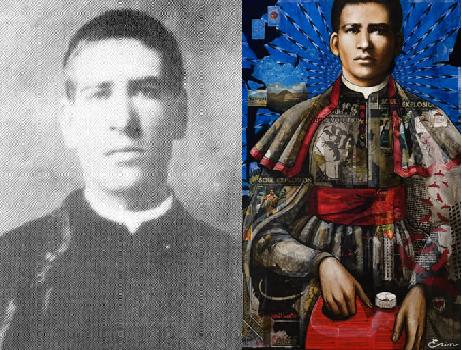
Left, in life (ca. 1924). Right... as a spiritual champion (note the gas can). Erin Currier (erincurrierfineart.com)
La Conquistada
Although The Rolling Stones (which first spent the night together back in 1962) are slightly older than Los Jaivas (1963), the Chilean “rock-andino” group probably will be around longer… being Latin Americans after all… having sons to inherit their father’s job and seeing tradition as something to be continually updated and renewed…
Miss-ing links
Sabina Becker (News of the Restless) posted yesterday on the demise of “Madamoiselle” on French bureaucratic forms, and “Fräulein” in everyday German usage, in favor of “Madame” and “Frau” when referring to women.
Both the French and German words for an unmarried female adult are diminutives of the forms used for married women (“Madame” and “Frau” respectively), as they are in Spanish… “Señorita” being diminutive of Señora. While the change in French and German usage is largely fueled by concerns about sexism, in Spanish it is still considered more polite to the diminutive for women whose marital status is unknown, or irrelevant.
This will probably change if for no other reason, it’s too much keyboarding. Writing a gender neutral document in a gendered language can be tedious on the typist. Although one could get away with using the male form of compound nouns in the past, THAT is considered sexist now: no one wants to put together, say, an employee manual is going to want to keep writing “todos los empleados y empleadas…” to mean all employees (male and female) when they can more easily type “todos los empleado/as” and be done with it. And, even the most old-fashioned of letter writers is going to being his/her business correspondence “Estimado Señor, Señora o Señorita”, when they save themselves a lot of keystrokes writing “Estimado Señor/a”
In spoken conversation, “oh-slash-ah” is rather clumsy and other rules apply. Oddly, the argument for referring to Mexican women as “Señorita” — the diminutive of “Señora” — is a feminist one, although a very old-fashioned, odd form of feminism. Traditionally, a woman’s status has been largely a reflection of her relationship to men, but also traditionally a married woman had to defer to her husband in business or financial matters. To refer to any woman as “Señorita” is to imply she has the right to her own decisions… including whether or not to correct you by using “Señora”… or… in a society that, like the Germans, uses professional titles with abandon, “Arciteca”, “Licenciata”, “Doctora”, “Colonela”, “Presidenta”, etc…. which still leaves her marital status in doubt. As it should, having nothing to do with her status as an architect, executive or lawyer, doctor, military officer or president.
When you´re only #2, you try harder?
I’m just old enough to remember one of the most creative spins in advertising history, in which the car rental company, Avis, made a virtue out of the fact that they were only the second largest company of their kind. W ith Enrique Peña Nieto and PRI still the front-runner in the 2012 presidential campaign, both PAN and MoReNa (PRD-PT-Moviemento Ciudadano) are both attempting to sell the viability of their campaigns on being #2. The presumption being, of course, that the second place party will “try harder” (and be worthy of serious consideration by the undecided voters and those not beholden to any of the parties) … and that Peña Nieto is beatable (which, even PRI has to admit, is more an more likely).
Understanding the desire to sell the #2 slot, I have to take 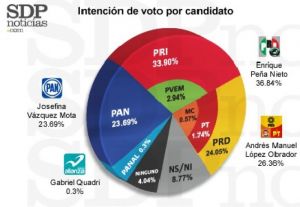 these results from a Covarrubias y Asociados poll with a grain of salt. Covarrubias is the PRD’s usual pollster, and there is a tendency in political parties to use those pollsters that give them the best results. However, it has to be added that Covarrubias has a good track record when it comes to polling.
The much better know Mitofsky polls, like Covarrubias polls show show a rapid drop in support for Peña Nieto, but Mitofky generally put the MoReNa vote in the “also-ran” category… third place if it is even mentioned in foreign news reports. I presume (perhaps wrongly) that Mitofsky gets the most foreign coverage not just because the international firm is used by the larger media companies, but also because its methodology is something foreign reporters (the very few who understand statistical analysis (and I do not count myself among them) are more comfortable with Mitofsky´s methodologies.
Mitofsky polls tend to show results favoring their conservative and corporate clients. It appears that Mitofsky relies extensively on telephone surveys (in a country where land-line ownership is still skewed towards the wealthier, and presumably more conservative, minority) and random street surveys, whereas Covarrubias uses a more innovative approach (including sampling cellular phone users) to sample a cross section of voters broken down by economic status.
Covarrubias also shows Peña Nieto hemorrhaging supporters, but shows AMLO in second place, and support likely to trend upwards much more than it will for Vasquez Mota. I’m not sure this was reported just to give bragging rights to MoReNa, or if it is a relatively accurate reflection of where the election stands today … during a black-out period as far as party propaganda goes … but both polls suggest Vasquez Mota and AMLO need to “try harder” if they are to be Number Two… let alone have a chance at snagging Los Pinos.


 mexfiles.net