Sneaky political advertising
One of the better things about Mexico is that political campaigning is tightly controlled, and the candidates can’t start bombarding the helpless citizenry with ads until 90 days before the election. Which doesn’t mean they don’t try to put their best foot forward before they go toe to toe with the opposition.

Photo: Cuartoscuro via SDPNoticias
Banda-itos?
Two more tubas have been stolen from an area high school, extending a rash of thefts of the expensive instruments at Southern California campuses in recent months that instructors say is likely related to the popularity of Mexican banda music
…
With the surge in banda’s popularity, tuba players have become sought-after and are paid more than -– sometimes even double -– what other banda musicians earn.
No religion too…
It’s Constitution Day. Well, it’s celebrated today anyway… or celebrated to the extent that we’d have to pay holiday pay to the store clerk, so I’ll be flogging the slightly used and one-owner paperbacks today.
All to honor Venustiano Carranza’s reluctant approval (5 February 1917) of the radically secular worker’s state Constitution which the last several administrations, in the spirit of Carranza, has been doing their darndest to undermine.
Under the indulgent regime of Porfirio Dìaz, whose second wife, Carmen Romero Rubio was ostentatiously pious, and guided by particularly gifted clerics like Archbishop Josè Mora y Del Rio, the Catholic Church — if no longer officially the state religion — continued to exert an inordinate, if unofficial, weight in state affairs. The new Constitution sought to protect the State from the Church. To clerics like Mora y Del Rio, and to anti-Revolutionaries, it appeared more that the Church needed protection from the State. The new restrictions, especially on political activity, were even more restrictive on the clergy than those in the previous 1857 Constitution, which not only had severed the connection between Church and State, but had sought to deprive the Church of its economic power and influence.
Carranza, an old-fashioned cattle baron, was only President mostly because every faction in the Revolution agreed on one thing… they despised him. While, like most late 19th century liberals, he was an old fashioned anti-clerical, the last thing Carranza needed was a fight with the Catholic Church. At the national level, Carranza was willing to bend the rules in the Church’s favor. State officials, which tended to come from those revolutionary factions seeking to dislodge Carranza and much more zealous to implement a social revolution as well as a political one, were seen by Carranza as much more an immediate problem than the clergy.
Carranza’s overthrow brought de la Huerta and Obregón to the Presidency, both of whom recognized that if the Revolution was to be consolidated, those in favor of the new system had to be mollified, even if it meant creating enemies outside the “Revolutionary family.” Which, of course, is a very superficial overview of the buildup to the Cristiada, and the subject of my Gorostieta and the Cristiada: Mexico’s Catholic Insurgency 1926-1929. (and, you can buy it here, although they show the wrong cover art, too)

Church-State conflict resolution the old fashioned way
With the “neo-liberal” PRI of the 1980s and 90s having less and less interest in remaking Mexican society, and the Catholic Church having gone through a renewal in the 1960s, in the 1990s, the Constitutional restrictions on religious activity were relaxed. Denominations could, for the first time since the 1850s, directly own property (as long as it was for religious activities), clerics were allowed to vote, and the more galling restrictions (especially to the Catholic Church) on wearing clerical garb in public, or holding religious services outside of the designated place of worship, were rescinded.
Remaining are prohibitions on religious education in public schools and against denominational participation in political affairs. Minor restrictions on non-religious activities by denominations (private schools, hospitals, charities, etc.) remain, but since the 1930s, there has been a work-around that allowed for private foundations or societies though which the denominations indirectly can influence public discourse. And, of course, the clergy — especially the Roman Catholic clergy — have mastered the art of indirectly making their wishes know about political candidates and issues through sermons, religious publications and, at times, street demonstrations passed off as religious processions.
The Roman Catholic Church is still the most powerful and most influential of the denominations… and the most vociferous in claiming the remaining restrictions are discriminatory. None of the non-Catholic denominations are wealthy enough, or large enough to have much influence over more than local affairs. As it is, most of the other denominations see the clerical restrictions as protecting them from the Catholic Church, rather than the state. And, the second largest Mexican denomination, the Jehovah’s’ Witnesses, avoid politics altogether for theological reasons.
It is not at all surprising then, that the only real support for attempts to further change the Constitutional restrictions on religious activity, came from the Catholic Church. PAN, having begun as a clerical, anti-Revolutionary Party, introduced legislation to do away with the remaining restrictions. With PRI presidential candidate Enrique Peña Nieto trying mightily to capture the “piety vote” … going so far as to make an unprecedented (for the leader of what is, in theory, an anti-clerical party) call on the Pope to bless his secular marriage (and, of course, get in a photo op with the #1 Catholic)… PRI delegates in the Chamber of Deputies joined with PAN, enough to send the bill to the Senate.
Where it promptly died last week, so we can celebrate having at least some of what we celebrate today left intact.
Victor Mayén in The [Mexico City] News writes:
On Wednesday, Institutional Revolutionary Party (PRI) and Democratic Revolutionary Party (PRD) senators shot down proposed reforms to Article 24 of the Constitution, arguing that the amendments, which concern freedom of religion, were unnecessary duds, and not a priority for the Mexican people.
PRI spokesman Carlos Jimenéz Macías said that the majority of his party opposed the modifications to the Constitution, as Mexico already guarantees full freedom of religion.
He added that these untimely proposals had only polarized religious minorities.
“This is not an urgent issue for Mexicans. I don’t see why we should treat it urgently. I think [the reforms are] excessive and unnecessary.”
Pablo Gómez Alvarez, a PRD senator, agreed that the reform was trivial, considering that religious groups have been able to practice freely since 1857, when state religion was abolished.
“This is a false debate,” he said. “We don’t need artificial divisions between Catholics and non-Catholics… I believe [the debate] has its origins at the highest level of the ecclesiastical hierarchy, which is using PRI deputies to promote this reform.”
Brother Jack and Bishop Sam
John Donaghy takes a short break from his somewhat daunting duties as associate director of Caritas (Catholic Social Services) for the Diocese of Copan, Honduras to visit friends in San Crisobal de las Casas, and makes time to visit the very humble tomb of the late, great (and very humble) Samuel Ruiz.
From Hermano Juancito:

Samuel Ruiz' tomb, San Crisobal de las Casas. Photo by John Donaghy
Soon after he became bishop of San Cristóbal, Don Samuel went out to the countryside to visit the villages. In at least one place he accepted the hospitality of a large landowner who fed and housed him and provided him with a horse to get to the villages. The bishop would go out each morning and return in the evening to stay at the landowner’s hacienda. How generous the landowner was!
After a number of visits he asked the people if they appreciated his visits to their villages. “No,” they answered, surprising the bishop. “Why?” he asked. “Because it’s expensive for us.” They then explained that the landowner had them pay for the bishop’s expenses. The landowner was not generous but was again exploiting the poor. After that Don Samuel began to see with a clearer vision and began to take the side of the poor.This, of course, did not please everyone, including some Vatican officials who appointed an auxiliary bishop, Monseñor Raul Vera, who some think was sent to rein in Don Samuel. Well, God works in mysterious ways. Monseñor Raul Vera also had an experience which changed him. Now bishop of another diocese he is an outspoken defender of the poor and of human rights.
More on Bishop Sam here and here. On Raul Vera here and here.
Come over to the dark side?
5-Feb-2012, 12:00 Oops… a bit of post-posting editing… a paragraph got moved and a few words were lost, making a mishmash of things. Not to mention my usual 2 AM misspellings.
El Blog de Izquierda (and a tip of the sombrero to Erich Moncada for pointing me to an excellent political resource) has a fascinating post on an routine “drug war” story. General Bernardo Pineda Solís, the new brigade commander in Zacatecas is newsworthy for saying “the Army is not the solution to resolving security and crime problems in the country.”
Quoting Cicero, General Pineda said, “‘If you fight violence with violence, you end up with either anarchy or a dictatorship. Is that what we want?” While willing to take up duties in Zacatecas, Pineda was emphatic that the need is for legal change, as well as economic and social restructuring. ”
Of course, Blog de Izquierda sees that as evidence of support for AMLO, and it might be. While the military, as an institution is a conservative one, I have never assumed that the officers themselves are necessarily knee-jerk reactionaries. Indeed, the opposite. Career officers, if not from military families, generally started out as ambitious kids from “traditional” families, and usually rural ones. And, if you remember your history, the modern left, the PRD, was formed largely from PARM, which itself was originally the military cadre of Lazaro Cardenas PRM, when the party was reorganized as the PRI. However, with restrictions on military participation in elections, and the strong sense that the military services, as institutions, are “above” politics, there is no way to gauge sentiment in the armed forces. As I mentioned in my last post on the elections, we just don’t know how strong the left’s support is, but there are signs that there is more support for the left from sectors we (we foreigners, at least) tend to overlook.
Harder to overlook is that the more “conventional” opinion makers are also hinting that the upcoming elections are tilting further left than it appeared even a couple weeks ago. Vicente Fox and Enrique Krauze both grudgingly admit some value to “AMLO-ismo.”
Ex-President Fox, who tried mightily to have AMLO disqualified from holding public office, now admits that old age pensions (introduced in the Federal District during AMLO’s tenure as head of government) were a good idea. Of course, Fox turns 70 the day after the upcoming Presidential election, so maybe he’s starting to appreciate state support for those of the “third age” (as Mexico euphemistically refers to old people).
More seriously, as a practitioner of the dark arts of politics, Fox and AMLO aren’t all that different. Like AMLO, he has not been adverse to fomenting “populist” d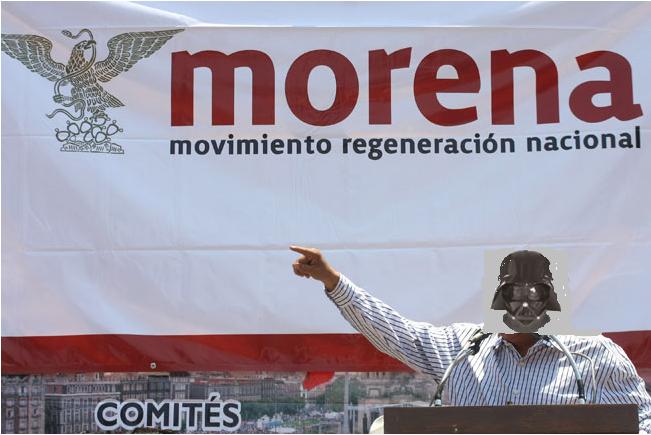 emonstrations to overturn electoral results (people forget Fox became a national figure when he led street protests and shutting down the state capital in Guanajuato after losing an election for governor in 1991). Fox’s presidential campaign depended, like AMLO’s now in both presenting himself to a party with often discordant factions as the most electable of possible candidates, and to the middle class and intellectuals as a useful alternative to the status quo.
Which is what makes Krauze’s semi-support not all that shocking. The dean of conservative Mexican intellectuals, is suggesting he will support AMLO in the upcoming Presidential elections. Maybe.
Carlos Fuentes — who in 2000 could in good conscience back Vicente Fox despite ideological differences with PAN on the basis that a vote for Fox was a “useful vote” for change — can now back AMLO for the simple reason like other intellectuals, he senses that neither Enrique Peña Nieto nor whomever PAN selects in today’s primary, have either the intellectual or political vision the Presidency demands. Krauze is holding back, waiting for a sign that AMLO is not “Mesías Tropical” of his June 2006 essay in Letras Libres.
Picked up and vulgarized (to the point of aburdity) by George Grayson, the William and Mary University Mexicanist and “usual suspect” quoted by U.S. media whenever Mexican political issues are mentioned, Krauze’s essay created image of AMLO as a radical, anti-democratic rabble-rouser that dominated the hostile media image of the leftist leader in the 2006 election.
Specifically, as Krauze later tweeted (and, twitter posts are now media fodder in this weird election), that although he said on television that AMLO was the “cleanest” of the candidates, the historian will only vote for him if the Tabascan shows that he has given up his “intolerance and redeemerism*”.
“Redeemering” and rousing the rabble may be democratic, although being “outside the (ballot) box”, it doesn’t fit into Krauze’s neat definitions of what is, and what isn’t the way a modern state should operate.
Krauze is not so much important for his politics but for providing a historically-referenced basis for political discourse: no mean feat in a country where historical references and allusions are not the province of the academics, but of any intelligent conversation about national affairs. As a popular historian (Biography of Power is his best know work in English translation), especially influential through his inexpensive, widely distributed “Clio” television and booklet series, Krauze is a “brand-name”. That is not a put-down by any means… a few chance encounters with the guy, as well as his books, were of enormous help in writing Gods, Gachupines and Gringos… only that one more or less knows what to expect from Krauze from his historical assessments of Mexican leaders.
Whether AMLO is intolerant and has a Jesus complex (as vulgarized to the point of absurdity by U.S. writer and “go-to guy” for English-language mainstream media discussions of Mexican politics, George Grayson in his anti-AMLO screed, Mexican Messiah) based in part on the anti-clerical traditions of Tabasco politics is not for me to say. That AMLO does seem, as I’ve said before, to be putting his effort into downplaying the “radical, fiery leftist populist” image Grayson and others projected of him in 2006, and is going out of his way to win over the urban middle class and reassure the business community that he is neither Oliver Cromwell nor Ché Guevara, suggests that while Fox may have learned a lesson from AMLO, AMLO is learning from Fox… positioning himself to be the “useful vote” for change.
* Krauze’s tweet used the word “redentorismo”, which doesn’t translate into any English word I know, and I had to coin a rough equivalent…
The package tour
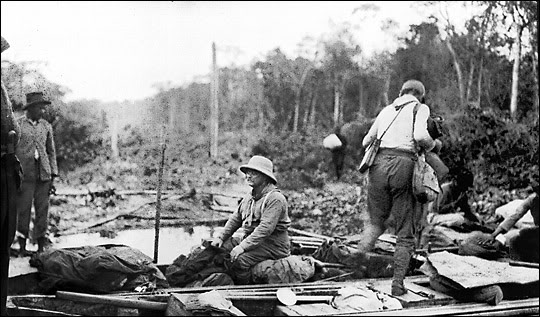
The ordinary traveller, who never goes off the beaten route and who on this beaten route is carried by others, without himself doing anything or risking anything, does not need to show much more initiative and intelligence than an express package.
Theodore Roosevelt, Through the Brazilian Wilderness (1914)
Feed the kitty
The Mexican way to serve up kibbles …
Occupy el campo: a mind is a terrible thing to waste
While the Mexican rural teachers’ colleges have specific issues that may not translate elsewhere, Mexico is hardly the only country where cuts in funding for higher education is leading to protests, some more violent than others.
A thought or two
An Alabama state legislator, in justifying salary raises for himself and his peers, while cutting those for teachers, said:
It’s a Biblical principle. If you double a teacher’s pay scale, you’ll attract people who aren’t called to teach…
And these teachers that are called to teach, regardless of the pay scale, they would teach. It’s just in them to do. It’s the ability that God give ‘em. And there are also some teachers, it wouldn’t matter how much you would pay them, they would still perform to the same capacity.
If you don’t keep that in balance, you’re going to attract people who are not called, who don’t need to be teaching our children. So, everything has a balance.
It goes without saying that Shadrack McGill (and, that is indeed, the blithering idiot from Alabama’s name) is a politician[i] and he provides ample anecdotal evidence social conservatives are indeed intellectually challenged . But, just for the sake of argument, assume he’s onto something here.
Not all teachers are motivated by financial reward. I was taught to read, wrtie and cipher by very good teachers, who weren’t well paid. But, then again, they were from an alternative lifestyle all-female commune. The Sisters of Saint Joseph didn’t do too bad a job, but outside the most doctrinaire PAN circles, I doubt you’ll find anyone who wants, or expects, nuns to take over rural education in this country.
What you are more likely to find among conservatives is just, as the video suggests, an abandonment of rural education, especially public education. As the video notes, Lazaro Cardenas, who was a Marxist, after all, fomented the creation of rural teachers’ colleges. He was building on the work of José Vasconcellos (who was, politically, from the extreme right) in identifying teachers — especially rural teachers — as the vanguard of the Revolution and of modernity.
I suspect that the rush towards neo-liberalism, and — what do we call it? Miltonfriedmanismo? — privatization of public services, has done more to radicalize those essential public services like rural education than anything else. While it is certainly justifiable to think that underfunding rural teachers’ colleges was intended to create a generation of uneducated, easily exploitable peons, there are those dedicated few who are going to get an education somehow… even at crappy underfunded rural normal schools. And, being dedicated to education, are going to be educators themselves.
In a society which traditionally grants the educated person, even the lowly “maestra”… schoolma’arm… a dignity and respect not given to those who merely have achieved some higher economic level but aren’t seen as contributing to society, if the rightists and neo-liberals are bothered by the portraits of Ché and friends at rural universities, they have no one to blame but themselves.
[i] Suppose you were an idiot. And suppose you were a member of Congress. But I repeat myself. – Mark Twain, a Biography
Dudley does right
Via MSNBC:
Canadian Mounties canceled plans to send hundreds of officers to Arizona for training after finding out the Maricopa County Sheriff’s Office is accused of racial profiling, unlawful stops and other offenses against Latinos.
Royal Canadian Mounted Police officers were to receive training on recognizing and testing drug-impaired drivers in the Phoenix area between April 2012 and March 2013, the Vancouver Sun reported. The Phoenix area was picked for the training for a relatively large and consistent number of drug-impaired people taken into custody, the paper said.
But a scathing U.S. Justice Department report about Maricopa County Sheriff Joe Arpaio and his department, charged with wide-ranging civil rights violations against Latinos, led to the RCMP scrapping the training, the Sun reported on Monday.
The Mounties don’t need any lessons from Arapio on how to deal with border issues… as shown in this Mexican-made classic (Producciones Animadas Gamma S.A.) they’ve been pretty clever in dealing with border issues for a long time…
Obligatory “drug war” post for the week
“[The drug war] is like a stationary bike. You look up and around and you’re in the same place. The scenary’s changed but the problem persists.”
Colombian President Juan Manuel Santos, quoted in Pan-American Post.
The politics of the Barack Obama Government in this matter have scrupulously followed the Nixonian model. And every time the president has a political problem, he invokes Mexican drug cartels as a threat of “national dimensions” to ask Congress for fresh resources – without, however, cutting off support for the multinational corporations making billions on “war on drugs” related business. In 2006, the weakness of the spurious Felipe Calderón [administration] allowed Washington to maximize its domination of Mexico while expanding its business network here.
Luis Javier Garrido in La Jornada (Halszka Czarnocka, trans).
El va, pero yo no voy: Clerical comings and goings
El va:
Via Aguachile, the … um.. less than beloved Cardinal Juan Sandoval Iñiguez of Guasdalajara is retiring:
He did a disservice to Mexicans through spewing hatred against women, gays, political parties, and Mexican political institutions. He did a disservice to Roman Catholicism, his religion, by acting as a caricature of so many of the evils the church has been criticized for: intolerance, narrow mindedness, misogyny, homophobia, downright authoritarianism, and so much more.
At least C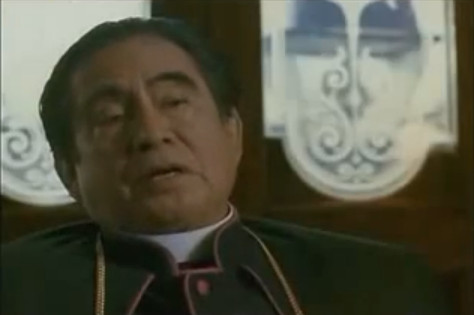 ardinal Sandoval can say he was a role model for something worthwhile : Ernesto Goméz Cruz was brilliant in the 2002 film, El Crimen de Padre Amaro. It is no secret that Goméz Cruz modeled his impersonation of a corrupt and sinister Bishop on the best known corruptest and sinisterest (yes, I just made up that word) cleric in Mexico…
Yo no voy:
I doubt too many of those (and there are more than a few) who will miss Cardinal Sandoval are putting this sticker on their front door:
 As David Agren (who is making a return appearance in today’s Mex Files) reported for Catholic News Service, Pope Benedict XVI’s visit to Guanajuato is seen to have a political agenda, meant possibly to favor the conservative (and pro-clerical) PAN party. News that the City of León will be charging for “preferred seating tickets” to see the Pope, which will not even begin to meet the public expenses for this trip, have not just those who never intended to go see Ben XVI, nor only those who object to some faithful being more equal than others, publically stating their objection to the papal visit, but also some of the faithful who would rather the funds allocated for the event be used for relieving hunger among rural indigenous people in the drought-stricken north.
Could AMLO do it?
… I think so.
While the assumption in the foreign media has been that the Mexican Presidential campaign, like one in the United States, is a horse race between two candidates, and — as in the United States — it’s pretty much a foregone conclusion that the party which is having a contested primary is the one that’s gonna lose (the difference being that’s the party now in control of the Executive), things may turn out quite differently than so many of us predicted.
I admit, I’m patting myself on the back for warning those of us who write in this very narrow field of Mexican political observations, that it was a huge mistake to assume Enrique Peña Neito would be the odds on favorite to win the election when it finally starts (unlike the U.S., we have some restraint in these matters, and officially, campaigning can’t start until 90 days before the 1 July General Election). Peña Nieto, sort of like Mitt Romney in the United States, is the favored son of the party establishment, but unlike Romney, didn’t face any primary challengers. He also has enjoyed excellent propaganda, thanks to an early (and dubious) investment in Televisa, which has been running fluff pieces and presenting positive pieces about Peña Nieto for over a year.
He also has an edge in that none of the PAN candidates are particularly attractive (Josefina Vasquez Mota, Santiago Creel Miranda and Ernesto Cordero Arroyo). Cordero has been hapless, ever since, as Secretary of the Treasury, he claimed a middle class family could live well on 6000 pesos a month (I earn more than that, and have trouble making ends meet, even without kids or a car). Most likely, he’ll end up running as the PANAL candidate, PANAL having recently divorced itself from its usual coaliton partner PRI, and not attractive to… well… anyone. Creel has lost several high-profile elections, and — as a representative of the old ruling class (his family are THE Creels, who have run Chihuahua and maintain power through dynastic marriages, since Porfirio Diaz was President). He has the support of the PAN traditionalists, and… probably no one else. Vasquez Mota is pledging to continue Calderón’s agenda, which is not seen as a winning formula, even within PAN.
Peña Nieto, as a candidate, has been devastating… to Peña Nieto. Dutch journalist Jan-Albert Hootsen argued that Peña Nieto’s verbal gaffes don’t much matter (like Rick Perry, whose campaign came to a crashing halt when he was unable to name three cabinet departments, Peña Nieto was unable to name three books he had read… at the Guadalajara Book Fair where he was supposedly presenting his work as a recent author). Hootsen, who lives in Nezahuacoatl, State of Mexico, may be right that the party faithful will just vote for the party, and State of Mexico people will vote for the State of Mexico guy, but we have no proof that Peña Nieto has traction outside his own baliwick, and his support may be “a mile wide and an inch thick”… broad, but not deep.
Being dismissed as a light-weight by the intellectuals (who are heeded in Mexico and have political weight… one reason Presidents back to Santa Ana have always sought to assuage them, or at least co-opt them into the administration) matters not because voters are going to listen to Carlos Fuentes so much, as because reporters and newscasters and opinion makers are going to listen to Fuentes and begin asking questions about Peña Nieto. That the candidate has been making nice to the Catholic Church turns off the anti-clericals (and PRI is traditionally an anti-clerical party). Given revelations that he has a number of illegitimate children how much support he can expect from the Bishops (who aren’t supposed to, but do push PAN candidates reflexively) is questionable. That Peña Nieto’s eldest legitimate daughter tweeted rude comments about the working class isn’t going to help either… and campaigning hasn’t even started yet.
Under the radar, the almost-won (or, maybe actually did win) 2006 candidate for the leftist coalition (PRD and friends) has been organizing since 2006, and still maintains much of his old popularity. I spoke with David Agren who is one of the few foreign reporters who actually follows the Mexican political process, who mentioned that no eyebrows were raised by Mexican political observers when he predicted several months ago that AMLO would get 25 percent of the vote.
That’s just based on his hard-core support, who’d vote for him no matter what. I’d happened to be at dinner the night before speaking to Agren with a former reporter, one of those of the “he tied up the traffic in Mexico City and it was horrible” people. One thing that didn’t cross my mind at the time was that AMLO was just a bit ahead of the curve… #OccupyReforma in 2006 had a more than single purpose political party agenda, questioning the entire premise of the nation’s control by the elites. That kind of street action may have been seen as an unconscionable imposition on suburban commuters back then, but like everywhere else on the planet (#Occupy… Tahir Square, Wall Street, London, Paris, Madrid, Athens, Santiago… and on and on), middle-class people are demanding economic change, something AMLO’s been talking about for a very long time, and it may pay off for him.
At the same time, AMLO has toned down his rhetoric, and is reassuring the business class (the “one percenters”) that he’s not the “fiery populist” of the New York Times´phrasing, but a former mayor of one of the world’s largest cities and someone who has worked well with others… and, in what looks like a good faith effort (and is smart politics), he’s been letting out the names of his potential cabinet appointees… all well-respected as managers and administrators.
It’s almost obligatory in any piece on Mexico to mention the “drug war” so just a word about that. Yeah, everyone is against violence, and more and more people are rejecting the present administration’s contention that their policy in prosecuting that “war” is the only possible one. Or that the administration is “winning” anything but a Guinness Record for the government causing the most needless deaths of its citizens. PAN candidates are going to be stuck with defending it, and Peña Nieto unwisely committed himself to continuing the present policy back when it looked as if the “war” was going to continue to be seen as worthwhile.
In the meantime, while “security” still ranks near the top of every Mexican poll of voter issues, it isn’t necessarily the “drug war” they´re talking about, and the #1 issue is, like everywhere, the economy. AMLO hasn’t been focusing anti-narcotics but on economics, which in itself means he might draw in yet additional voters for whom the “drug war” is not a primary concern, as well as those who see, as he’s only obliquely mentioned so far (wait til the campaign) that alternatives to militarization might hold out better hope for ending the violence… and may very well resonate with still more voters.
One other thing to be mentioned. This year, unlike last time, the U.S. is preoccupied with its own presidential election and with a less bellicose figure in the White House facing a campaign that he’s certain to win, there is less chance of the U.S. intervening in Mexican affairs to prevent a “fiery leftist” from taking office.
In the 2006 election, PRI had been through a brutal primary and spent most of their energy fighting AMLO. While Peña Nieto is not quite as bad a candidate, and the party is better united although not enthusiastic about the candidate, it will have to mount its fire against PAN, which is also not all that enthusiastic about their candidate, but will be on the defensive, both from PRI and from the PRD coalition. If Cordero, as expected, is the PANAL candidate and even draws off a fraction of PRI and PAN voters, AMLO has a real shot at more than 25 percent of the vote.
How much more? Enough to win (or win again and be declared the winner)? I won’t predict, but I will say it’s far from impossible.


 mexfiles.net