Can’t they get Shakira instead?
From SDPNoticias:
León mayor, Ricardo Sheffield Padilla, said the municipal government will have a seating charge for stands along the route that will be traversed by Pope Benedict XVI.
According to the mayor, the fees will include parking.
I know municipal budgets are tight. A Pope is a terrible thing to waste.
Visions and revisions
I was prevailed upon (flattery will get you anywhere, but I’d prefer to receive bribes) to begin posting with some sort of regularity here. Right now, with at least a dozen projects for Editorial Mazatlán and our new imprint, Libros Valor, in process I’m finding it very difficult to do any sustained writing, let alone the unedited, usually grammatically and orthographically-challenge Mex Files posts.
One project (or two or three projects) NOT yet on any project management schedule will be editing (and maybe fixing some of the grammar and spelling) of those last 3400 or so posts into a publishable form. They were never meant as finished products, nor are they timeless literature, but some are worth saving in a form more likely to still be of some relevance (if only as very minor historical documentation) whenever this site finally goes to the wherever it is forgotten blogs eventually go.
PIPA and SOPA was only “suspended”... which means that sooner or later (probably sooner), there will be corporate controls on the internet. The Ley Döring (introduced, as one would expect, by a PAN Senator, Federico Döring) seeks to do the same thing the U.S. laws did (i.e., create a legal framework for private capital to control a public resource — information) and, at the international level, there is ACTA.
I fully expect that sites like this will eventually be forced to discontinue. Nor do I plan to keep this site forever. Certainly, not everything over the last 3400 plus posts are worth saving, but Mex Files has been at least the secondary source in various scholarly publications, and there are some pieces I think are worth revisiting on their own merits. With no coherent theme to speak of, there isn’t A book in here… although there may be several ebooks. Which I’m in no real hurry to work on, but which will give me some legal protection over my own work, and make it available in some form whatever else happens. And clean up the grammar and spelling.
In the meantime, while I’m irregularly posting (and probably culling through the past), two resources worth exploring. Tuerto, an English-language e-magazine, meaning either to devote itself to South America or Latin America… the two seem to be used interchangeably, but the articles so far have been from south of the Darién Gap, but then, they’re new, and perhaps you can convince them (or better yet, contribute an article) from those of us slightly north.
The Facebook Mexican History/Historía Mexicana page is for the scholars and writers and Mexicanists out there who want to avoid the stuffy confines of the usual suspects (H-net and the like) who haunt the graves of academe and turn so much of what should be lively discussions of Mexico and Mexican history into a day of the dead… without the fun. Think of it as a cyber-pulquería with a few off-duty academics hanging around.
Mining, and data mining
Via Inca Kola News:
San José del Progreso, Oaxaca. In the southern Mexican state of Oaxaca one person was killed and another injured during a confrontation between mining opponents and police on January 18th. The middle aged farmer and a woman in her twenties, both indigenous Zapotecs, were among a group of villagers trying to block the path of an excavator working for the Canadian Mining Company Fortuna Silver. Bernardo Méndez and Abigail Vasquez were shot by local police and plainclothes gunmen working for the Vancouver-based mining company. San José del Progreso, located 50 km south of Oaxaca City, has been a flash point for violence since an alliance of local environmentalists and farmers occupied the gold and silver mine in early 2009.
Despite widespread resistance and an ongoing conflict that already claimed the lives of two people in summer 2010, Fortuna Silver began commercial operation of the mine last September. As the installations are located in an arid valley, smooth operation is heavily dependent on water access to process the ore. The contamination of the scarce resource is among the main concerns of the mining opponents, many of whom grow vegetables for a living and rely on clean water for irrigation. The inhabitants of Magdalena Ocotlán, a village adjacent to the mine that hosted a nationwide environmentalist convention in 2010, have so far successfully prevented the construction of a sewage duct leading to the ore-processing installations. Fortuna Silver has since tried to get water access at all cost, recently settling for a deal with San José’s pro-mining camp. The scheme allows the mine to tap into a newly built well on village lands to keep its operations going throughout the dry season. It was at the building-site of the new water duct that Bernardo Méndez was killed. He and his neighbors had gathered to stop the machine digging a trench because it had damaged their own fresh water access.
Mining operations in Oaxaca are backed both by the new governor Gabino Cué and the ousted Party of Institutionalized Revolution (PRI) which still enjoys widespread support in the countryside. Contrary to the precepts of international law, the indigenous population of the region was never consulted about the mining project. The recent violence has prompted various social organizations in Oaxaca, among them an influential teachers’ union, to demand the end of mining operations.
Otto is an unrepentant capitalist, and makes his not-so-ill-got gains from mining investments (and selling investment advise). His English-speaking clients are ill-served by not paying attention to Spanish-language media, and the English-language business press’ reluctance to cover these kinds of events. This translation happened to come from the English-language website of the Unfortunately for his English-speaking clients, they don’t get the information they need from their media. This particular translation happened to appear on the English-language site run by the Communist Workers of Iran. That doesn’t mean the events never happened, nor that they can be dismissed as unimportant to business investors.
That their investments may not be accepted by the community (or that their investments may be in violation of the law, and — even if tolerated by the authorities today — may be subject to review and sanctions) is exactly the sort of information an investor or anyone working in Mexico or elsewhere in Latin America had damn well pay attention to. Investors are ill-served by NOT receiving this kind of information, and if they’re not reading Inca Kola News (and subscribing to the weekly newsletter), they’re probably not doing the minimum due diligence any investor should.
And, yes, MexFiles is back… occasionally. As I said in what I thought would be the final post, Mex Files’ “razon social” was the lack of English-language coverage of Mexico beyond the usual drugs, tourism and retirement living themes. At least in some areas there is better coverage, although it still tends to be framed in U.S. terms (would anyone outside Mexico be talking about anti-mining protests in Oaxaca unless it involved Canadian investors? Well, except for the communists, who are going to frame it in their own terms). Not that I don’t also tend to see things from a foreigner’s point-of-view (impossible not to), but what occasional posts I can do (and more on that in another post) are those that highlight important developments the foreign media is overlooking or downplaying (like the return of AMLO, who will be a more important figure in our upcoming presidential elections than the foreign commentators have so far discussed) or where the historical and cultural back story is absent from the reported story.
Hello, I must be going
Blogging by Boz said everything I would have said, though I would have made one editorial change:
It’s unfortunate ironic that a number of industries are lobbying for legislation and regulations in the name of intellectual property…
I’m not only an author, but the part owner of a book and e-book publisher. We take intellectual property rights very seriously. I have had my work pirated, and probably have lost some income as a result. But SOPA does nothing to protect me, nor our publishing company. We depend on the internet for research and fact checking. The penny-ante theft that goes on may not be something I can do much about (and, as it is, it probably generates more sales than it costs… I’ve sold more than a few books to people who ran across some odd unattributed factoid about Mexico and “googled it”, only to find the real deal and the context is available at a modest price), and where there is alleged major theft, there are already laws against that kind of thing. Organized thefts can be prosecuted in the United States under the existing laws related to organized criminal activity. If somebody robs a liquor store and deposits the money in his bank account, you don’t shut down the bank, you arrest the robber. SOPA would shut me down because somebody else might have used something in another context, and even in an unrelated post, that was less than honestly acquired. And may have not even been stolen:
If our liquor store hold-up man dropped a bag of loot and my neighbor found it, and deposited in the same bank where I have an account, SOPA would be a closing my account because of something I knew nothing about.
And, SOPA would also allow marketeers to buy up public domain rights and force us to buy access to that information. Information, of all kinds (good, bad, indifferent and off-the-wall) is the raw material we use to produce our “intellectual property”… and the dirty secret of the media is that the actual producer isn’t getting more than a pittance in the first place. Piracy, such as it is, is mostly just a consumer reaction to over-pricing of existing work. The authors and creators aren’t the ones SOPA defends… it’s the seller. Who, if they’re charging too much, can’t kick when consumers want their product but at a reasonable price… that’s called capitalism, not piracy. And on a large scale, it’s run by organized crime figures, who aren’t about to let U.S. laws stop them, and aren’t the ones who are going to be destroyed by this… it’s you and me.
As a freelance writer, my intellectual property is my livelihood. I take protection of it seriously. I also live and work online in Latin America. I’ve seen the potential for the Internet to be a disruptive technology for good, creating conditions that promote democracy and cut down poverty.
It’s unfortunate that a number of industries are lobbying for legislation and regulations in the name of intellectual property that would serve to undermine some of the basic architecture of the internet. Legislation like SOPA/PIPA directly and indirectly impacts US policy in Latin America in a negative way. That’s why, like many other websites, I’m using my blog today to oppose this legislation. While that seems outside the usual sphere of US-Latin America policy, it is relevant to how this hemisphere is able to connect and communicate online.
How does it impact the hemisphere? If legislation like this were to pass, it would hold back economic innovation in the US and Latin America, shut down small businesses in the technology sector, impact our free trade agreements with Central America, Panama, Colombia, Peru and Chile, strengthen organized criminal groups that already traffic in stolen intellectual property, and limit cultural exchanges between the US and the rest of the hemisphere.
If the US passes legislation like this, it will be utilized by oppressive governments to go after democracy activists who use the internet to organize and communicate. The US will also lose significant moral high ground on censorship as the enforcement of this law would create a firewall limiting US internet users’ access to numerous foreign websites, in some ways similar to how the Chinese government or the Cuban government block sites outside of their countries. The SOPA/PIPA legislation would set a bad international precedent for a region still struggling to figure out how to have smart regulations and security measures online.
At a very personal level, internet regulation poorly defined such as SOPA/PIPA could force me to shut down this blog. I’m an individual blogger who doesn’t have the resources to monitor and verify the tens of thousands of links I’ve posted over the past seven years, placing me at risk to legal action under this legislation. I also depend on hosting sites like Google, Blogger, Tumblr and Twitter, all of which say that enforcement of this legislation would be too heavy of a burden on their businesses and could force them to change how they operate. It’s not an exaggeration to say that if restrictive legislation passes and is enforced, this blog and every blog you read about Latin America policy could either be shut down or censored across borders. That’s bad for you, the reader. It’s worse for the nascent online community, which has grown over the past decade and given citizens the power to publish that that was once restricted to governments and big media companies.
Means to the end
After extensive travel and reading, I moved here on the first of September 2001. Back in those dark ages on on-line communications I shared my excitement at being a resident, and not just a visitor, though emails. One correspondent seemed to think things like my adventures with laundry, or my brief encounter with the King of Spain, or comments on the incongruously simultaneous arrival in Mexico City of Brittany Spears and Pope John-Paul II deserved more exposure and turned the emails into a “blog” in April, 2004.
I tried to keep my writing in a light vein, but as my understanding of Mexican culture broadened, and as I accepted the charming (or annoying) idiosyncrasies of Mexican life as normal, and I began seeing the Mexico of the Mexicans, I could not but be bothered by the distortions of the English-language media.
I had already written the early drafts of what became Gods, Gachupines and Gringos at this time. Originally just an overview of Mexican history, I started rewriting it to reflect my new awareness of the need to correct cultural myopia about Mexico and the Mexicans. At the same time, to counter my frustration with the misperceptions and misreading of Mexico in the international media, the Mex Files morphed from a “My Life in Fulanotitlan” type blog into something more serious, and more ambitious. Much to my surprise, the Mex Files carved out a niche for itself as an authoritative voice on these concerns.
With authority comes responsibility. Call it stubbornness, call it an obsession, or call it a vocation. Even during a financially-induced Texas exile, I felt compelled to continue the too-often Quixotic task. Even if I did not always have adequate means, I kept focused on the ends. But when I started, there was very little available outside of academia that had the same ends as I did… a situation that has changed, as others have gone through the same initial discoveries I did:
We feel frustrated with the singular focus on organized crime, corruption and migratory issues. We feel frustrated with the lack of context and meaning the (inter)national media offer us. We feel that, by reading the current reporting on this country, you might hear a lot about it, but learn very little.
“We” is the VOICE OF MEXICO, where I have taken on the job as Culture and Religion editor, starting the first of September… incidentally the tenth anniversary of my arrival at Benito Juarez airport, and the start of a new life here. I will be posting once or twice weekly at VOICE OF MEXICO on many of the same concerns expressed in the Mex Files.
VOICE OF MEXICO shares the same ends as the Mex Files, but, with editors in Mexico City and Guatemala City, and outside funding, it has better means in financing, technology and human resources than one guy can muster. Writing books and article, and helping to bringing other, often overlooked, views and voices of Mexico to the public through my work with Editorial Mazatlán is where I have better means than many, and where I can more effectively work towards achieving the ends I have been seeking.
Although Mex Files will remain live for the near future, this is the last post. I expect the break will be more traumatic for me, than for you, who are cordially invited to join us at the VOICE OF MEXICO where we hope through differing means to reach a common end… a true understanding of the many Mexicos.
At the end of the road — a road
Cross posted from Voice of Mexico
When in 2004, it began to become clear that Andres Manuel López Obrador was a serious candidate for President, and it very much looked like he would be President, opponents were continually flummoxed in their attempts to discredit the populist Federal District governor.
Unable to make much headway in the polls, the opposition sought to undermine López Obrador by attacking his administration. It became routine, and even comical, to see the attempts by opposition groups to find persons inconvenienced in some fashion by some urban improvement who would claim their human rights were violated. The problem was finding sympathetic “victims”.
Typical of the “victims” at the time was the wealthy and arrogant homeowner who had built an extension on the back of their house onto public parkland. Although given a chance to compensate the Federal District, he refused, claiming he was a better steward of public resources (like trees) than a socialist-run municipal parks department. He got a rather curt response, and one the voters loved the morning the Federal District’s Environment Secretary showed up at dawn with a court order, television cameras… and a backhoe. Other private property owners, including the Presidential compound, that had built out into public lands over the years (whether through ignorance or arrogance) for some reason were very quick to settle their debts to the District.
The types of victims of land use disputes who might be sympathetic — squatters who had moved in Xochilmilco, were generally ignored, not being the kinds of people likely to vote, or — if they did vote — not vote for conservative rich guys who wanted to protect trees from the public.
And worse, for those trying to claim AMLO ran rough-shod over the citizenry, his administration had been particularly cautious to avoid breaking either the spirit or the letter of the law in land-use cases of this type.
The ABC (American-British-Cowdry) Hospital, which began life in the 19th century as oil baron Lord Cowdry’s gift to the U.S. and British “colony” in Mexican City, has always served an exclusive clientele, today serving both the better-heeled Mexicans and those who demand an “American” hospital. Although located in the more exclusive residential/commercial environs of Santa Fe, it is not directly accessible from the main roads. One tends to forget that Santa Fe was an indigenous commune until the 1960s, and has large housing projects today. To provide access for emergency vehicles, and shorten the route from the more populous (and less wealthy) parts of Santa Fe, the Federal District had been planning since 2000 to build an access road from the main route through the area.
The proposed road ran though a piece of property whose ownership was in dispute, and had been for generations. When, in 2004, the López Obrador administration, arguing that hospital access was a necessity (and, recognizing the populist appeal of opening an “exclusive” emergency room to people) green-lighted the project — despite the unsettled ownership issue — in 2004. The several different claimants, who hadn’t been heard of until then, all suddenly decided their rights were being violated, and there was a court injunction (amparo) ordering work halted. Which it was, but López Obrador, having been named in the injunction, and not personally answering it, was — at least technically — in contempt of court. However, Mexican elected officials have impunity from prosecution.
The Fox Administration couldn’t resist the obvious symbolism of their nemesis bull-dozing his way through legal procedures. With PAN and PRI politicians both having a stake in putting the brakes on López Obrador’s seemingly unstoppable drive to the Presidency, the Administration was able to push through the Congress a “desafuero”… not quite an impeachment, but a removal of that legal immunity. With a criminal conviction disqualifying one from holding public office, López Obrador turned the tables on the opposition, by temporarily stepping down (with the approval of the District Assembly, controlled by his party), and surrendering to the court — which forced the judge to review the evidence, and dismiss the charge.
López Obrador successfully made himself the sympathetic victim of the opposition’s over-reach, but this may have been the beginning of the end of his presidential run. His loss in 2006 (or, for those of us who think he actually one, the very close showing by Felipe Calderón) had more than a little to do with both PAN and PRI’s re-doubled efforts after the disafuero fiasco to refine their attacks on the leftist candidate, and on López Obrador’s own tendency from that time forward to reflexively attempt to garner sympathy for every subsequent political attack. With the “mainstream media” having been opposed to him since the first inklings that he would mount a presidential campaign, he was presented as a “whiner” and paranoid (which is, unfortunately, somewhat true… although even paranoids have real enemies) full of self-pity… which, naturally, is likely to turn off a good number of otherwise supportive potential voters.
And… six years later, the courts finally having gotten around to figuring out who owns what, and how much the land is worth, AMLO’s likely rival for the leftist candidate in 2012, and the present Federal District Governor, Marcelo Ebrard, shelled out 70 million pesos to buy the disputed property on Thursday.
My suggestion… name the road “Avenuda Andres Manuel López Obrador”.
The not-so-Great Wall
Arizona Daily Star (10-August-2011)
A 40-foot stretch of mesh border fence east of Lukeville in Southwestern Arizona was knocked over Sunday by rainwater rushing through a wash.
This is the first time any part of this 5.2-mile stretch of fence has been knocked down by floodwaters since it was built in 2007-2008, but it is the latest in a series of challenges for the barrier during rainstorms, said Organ Pipe Cactus National Monument Superintendent Lee Baiza.
The design does not allow for the free flow of water in natural washes intersecting the border, he said. In washes, the fence has grate openings at the bottom that are 6 inches high and 24 inches wide with 1-by-3-inch bars.
“The fence acts as a dam and forms a gradual waterfall,” Baiza said. “It starts to pile up on the bottom as the grass, the leaves, the limbs start plugging up. The water starts backing up and going higher. The higher it gets, the more force it has behind it.”
…
In October 2007, before the fence was built by Kiewit Western Co. for $21.3 million, Organ Pipe officials told the U.S. Department of Homeland Security they were worried that the design would impede the movement of floodwater across the border; that debris would get trapped in the fence; that water would pool; and that the lateral flow of water would cause damage to the environment and patrol roads, according to a report issued by Organ Pipe in August 2008 about flooding that summer.
In response, the Border Patrol issued a final environmental assessment with a finding of no significant impact. It also said the fence would not impede the natural flow of water or cause flooding.
Friday night video: another people’s history
Wow… I thought I was cutting it close reducing Mexican history to a mere 472 pages. The 18 Mighty Mountain Warriors have me beat in the brevity department, managing to reduce the entire history of China, from Peking Man to becoming the creditor to the United States to a mere three and a half minutes.
Sombrero tip to China South America Blog:
100 years of Mario Moreno

The American press called Cantinflas the “Charlie Chaplin of Mexico.” Charlie Chaplin, a man not known for modesty, however, called him the world’s best comedian. Today is the one hundredth birthday of the Mexican whose comedy still transcends borders… even the Arizona one:
Arms and the wrong man
Respected poet Efraín Bartolomé’s home in Lomas de Padierna, Tlapan was invaded yesterday at three in the morning by masked men carrying high-powered arms. As the poet and his wife, photographer Guadalupe Belmontes Stringel, cowered in their bathroom for the next five hours, the attackers smashed up the house. In addition to leaving broken windows and smashed in doors behind, the gunmen made off with an Omega Speedmaster Professional wristwatch, one of Belmontes’ camera and a memory stick.
Seeing the raiders were State of Mexico police there’s a problem. And, with Tlapan being, not in the State of Mexico, but the Federal District, one might be forgiven for thinking perhaps something is a bit irregular in all this.
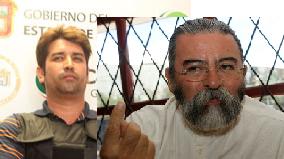
Poet and perp... can you spot the difference?
Well, sure, mistakes happen. The State of Mexico’s new Procurador General, Alfredo Castillo seems to be trying his best to overcome the state’s abysmal record in law enforcement (remember Niña Paulette for starters?) and has been all hot and bothered about his own local gangster band, La mano con ojos — and the alleged leader of the band, Óscar Osvaldo García Montoya (whom Castillo claims is responsible for a nice round number of executions… um… 600) — was indeed caught in Tlapan. Yeah, I can see the police mistaking the sexagenarian poet for the gangster. Uh-huh.
But… this was a little more than a case of mistaken identity (and theft by police, or even overstepping jurisdictional boundaries).
Efraín is good friends with Javier Sicilia.
YOU DO NOT PISS OFF THE INTELLECTUALS.
That is worse than a crime, it’s a blunder.
Quote of the week
Mexico’s economy is better than ours
Michael Bloomberg (Mayor of New York, founder and majority owner of Bloomberg Financial Reports, really rich guy, etc.)
The only stock market NOT to take a nose-dive Wednesday were in Latin America. The Bolsa de Valores Mexicana lost 0.5%.
You figure it out.


 mexfiles.net