Hombre Araña
My spidey-sense tells me that Miles Morales — Spiderman 2.0 — isn’t really the first spiderman to have some Hispanic roots:

Photo: © Eneas, Vagabondish
The power and the inglorious
Two of Mexico’s most prominent clerics — Cardinal Juan Sandoval of Guadalajara and Bishop Raúl Vera of Saltillo — have both come under fire this past month for their apparent forays into political matters.
Bishop Vera, whose support for Coahuila’s “Ley de convivencia” (“registered partnerships”, including those of same gender couples) and outreach to groups traditionally under-serviced or turned away by the Church I’ve mentioned before,
… is under investigation by the Vatican over his sponsorship of an organization that condones sodomy, according to Mexican press sources.
Saltillo area newspapers are reporting that Vera has received an inquiry from unnamed Vatican officials regarding the Gay and Lesbian Community of Saint Aelred (San Aelredo).
The “Mexican sources” are unnamed in Matthew Cullinan Hoffman’s article for “LifeSiteNews”, a Canadian website recently sued by a Quebec priest for defamation. Fr. Raymond Gravel claims that
LifeSite … has consistently called for … Gravel — briefly a separatist member of the Canadian parliament — to either renounce his views on abortion and homosexuality or give up the priesthood.
While Father Gravel, who resigned from Parliament in obedience to a Vatican ruling that priests could not hold elective office, claims to adhere to Church teachings on those two issues and blames Life Site for a campaign against him personally, based on his nuanced views on the two “hot button” issues:
Father Gravel opposed Bill C-484 [which would have made an assault on a pregnant woman an attack on a second person, i.e., the fetus] not because he was pro-abortion, he said, but because he was against “recriminalizing” abortion.
He also joined other priests in 2008 in addressing an open letter to Quebec’s bishops calling on them to support same-sex marriage and oppose new Vatican regulations regarding homosexual priests.
At the end of each of its reports on Father Gravel’s controversial public statements, LifeSiteNews put the name and address of the priest’s bishop, and when that produced no results, of the Congregation for the Doctrine of the Faith.
Similarly, articles on Bishop Vera and the San Aelredo community (which is less a parish, than a club for gay and lesbian Catholics, served by the same chaplain who oversees outreach to prisoners and migrants) also include the names and addresses of Bishop Vera’s superiors, and the Vatican offices to which one should address complaints.
I admit I don’t follow Mexican conservative religious publications, and wasn’t able to find mention in the Saltillo newspapers, but I have seen no mention of any scandal, or even controversy, surrounding the San Aelredo community in the national press, although there have been plenty of complaints from the right about Bishop Vera for other reasons. He has recently complained to Interior Minister Blake and Patricia Bugareli, the head of the Federal organized crime task force — to their faces [my translation]:
Citizens … continue to suffer the consequences of an irrational war, filled with Constitutional and human rights violations , in which the only strategy has been violence, and which has abandoned and denied at any cost the administration of justice.
Your war has not touched those who harbor the criminals, those public servants who aid and abet them, nor does it pursue or attempt to apprehend those who continue doing business and amassing wealth with blood money earned through multiple and various crimes, which have killed more than 50,000 Mexicans.
On Sunday, Bishop Vera described the high salaries paid to some local authorities as “insane” given that the wages paid to the average worker barely feed his or her family. If that. In other words, a typical work week for a Bishop who sees his job as “comforting the afflicted, and afflicting the comfortable.”
While it is plausible that Mexicans have complained to the Vatican authorities about Bishop Vera, given the rather low-key (and practically non-existent) complaints about the GLBT outreach in the Diocese of Saltillo, and the many complaints about the Bishop’s challenges to the status quo, and his seeming support for the political left in Mexico, I’m not at all surprised that Hoffman and Life Site News (read mostly in the United States and Canada) has had nothing but praise for Cardinal Sandoval (most recently for “protesting the recent passage of a homosexualist ‘human rights’ amendment to the nation’s constitution by the Mexican Senate”). And, has said not a word about a far more serious Church-state conflict in which the cleric is at fault, at fault, at most grievous fault.
As Duncan Tucker reported in the (subscription required) Guadalajara Reporter two weeks ago (21 July 2011), Cardinal Sandoval
…sought help from the U.S. government to prevent popular leftist candidate Andres Manuel Lopez Obrador from winning the 2006 presidential election, according to a WikiLeaks document * released last week.
Sourced from the U.S. embassy in the Vatican, the cable reveals that Cardinal Juan Sandoval Iñiguez asked Francis Rooney, then U.S. ambassador to the Vatican, if President George W. Bush could help prevent the possible election of Lopez Obrador, the candidate of the left-of-center Party of the Democratic Revolution (PRD).
The cardinal was worried by the rise of popular socialist governments throughout Latin America, the likes of Fidel Castro, Hugo Chavez, Evo Morales, and more moderate leftists Christina Kirchner and Michelle Bachelet.
Sandoval described this as a “dangerous trend,” fearing that AMLO, as he is commonly known, would lead Mexico in the same direction as the aforementioned governments. He also said that levels of “crime and violence had risen in Mexico City” under the government of AMLO, who was mayor at the time.
“The cardinals felt the poor in Latin America did not understand the potential benefits to them of free markets and urged U.S. government help, acknowledging that the Church, though necessarily cautious, can also play a greater role,” reads the leaked cable.
In a statement published on his website on Friday, AMLO said he had no doubts that Sandoval had solicited U.S. help against him, and reaffirmed that he had been robbed of the presidency.
Sandoval has since denied the allegations, declaring it “gravely irresponsible to publish this false information.”
To which, one must ask, whether the U.S. Ambassador (the cable mentions that he and the Cardinal were not the only ones at this meeting), or the Cardinal is the one who needs to confess to telling a lie. As it is to call a truth a falsehood, and a falsehood a truth.
Ironically (or maybe not so ironically), it’s that impunity that Bishop Vera spoke of that’s kept Sandoval out of the courts (and likely out of jail) for his irresponsible — or shall we say sinful? — behavior.

L: "He that followeth me shall not walk in darkness" R: "them that sit in darkness out of the prison house."
———
* 06Vatican61, released by Wikileaks on 11 July. A cable released 28 July, 05Vatican562 reveals Vatican distrust of Latin American leftists, including AMLO goes back a year before Sandoval’s discussions with the U.S. Ambassador.
Diana Cazadora
While long-time PEMEX office worker Helvia Martínez Verdayes never mentioned it until she retired, anyone who has spent any time in Mexico City (or Acapulco, or Villa Álvarez, Colima, or Ixmiquilpan, Hidalgo, or a few other places around the Republic) knows her: she is one of the iconic women of Mexico.

In 1942, even as President Manuel Ávila Camacho was distracted with a much broader war (against Germany, Japan, Italy, et. al.), than the one being fought against gangsters now, he took a keen interest in Mexico’s public image, working with then-regent (the appointed mayor of Mexico City, which didn’t elect its government until 1997) Javier Rojo Gómez on a plan to improve the capital’s aesthetic appeal, adding fountains and statuary to public corridors.
Architect Vicente Mendiola and sculptor Juan Olaguíbel presented a plan for a fountain to stand on Paseo de la Reforma at the entrance to Parque Chapultepc allegorically meant to symbolize the captial’s northward growth.
Then 16 years old, Helvia Martinez — or rather Helvia’s face and figure — gained instant popularity as “Diana Cazadora”… and instant notoriety from an unexpected source. Ávila Camacho wife, Soledad Orozco did not, like her predecessor as First Lady, the energetic Amalia Solórzano, automatically lend support her husband’s proposals. Orozco had her own eccentric interest, serving as chair of the “Legion of Decency”… which went around looking for things to complain about: like statues of naked girls shooting arrows.
Helvia’s statue was fitted with a decent skirt, and moved to a innocuous  neighborhood park for several years, while Helvia herself went to work as a secretary at PEMEX. The ridiculous skirt was eventually removed (or, more properly, just allowed to deteriorate and not replaced once Ávila Camacho left office), and Diana Cazador was given a more prominent location in the Zona Rosa — where nekked teenage girls weren’t quite so shocking to passers-by. While copies of the popular iconic image of Mexico City stand in other communities (like Acapulco), the original now stands where she belongs, on Reforma at the ends of Río Missisipi y Sevilla.
Helvia, in bronze and in the flesh, has aged well.
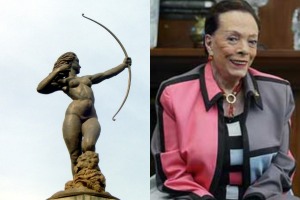
Photos and source material: De10.mx (El Universal)
General Santa Ana’s super-congress
From what I’m reading, the U.S. government is creating a fourth branch of government… a “super-congress”.
What’s so great about Super Congress? Well, they will be able to pass laws super-fast without having to be too accountable to the
public. “This ‘Super Congress’…isn’t mentioned anywhere in the Constitution, but would be granted extraordinary new powers.” Any new laws they approve will be fast-tracked through both chambers of “Little Congress” (our current House + Senate), where regular “little” lawmakers could not amend their laws, only give each an up or down vote. And those “little” votes are less powerful than today’s votes. The proposed Super Congress only ever needs 51% to pass any law, and they don’t need presidential approval (i.e. vetos have no effect on them).
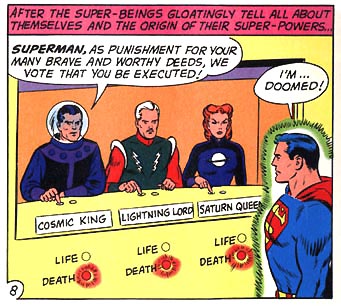
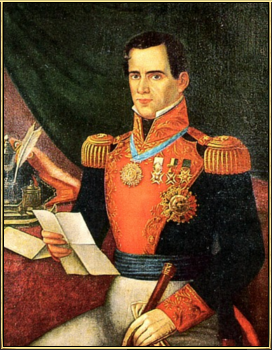
I knew I’d heard of something like this before, and I was right: the second of the Siete leyes (Seven laws) imposed on Mexico in 1835 by General Santa Ana.
At 1824, after a brief flirtation with monarchy, Mexico wrote a very good constitution. Unfortunately, not only was the country starting out broke after a twelve-year struggle for independence and the short-lived monarchy, it was also had to balance the social aspirations of the majority with a conservative monied class, that was unwilling to pay taxes. As the country slowly imploded, Antonio López de Santa Ana had become an accidental populist leader. Although elected as a “liberal” in 1833, he was unwilling to force through radical reforms and resigned (ostensibly for health reasons) which elevated the radical liberal vice-president, Valentín Gómez Farías, to the Presidency.
Gómez Farías, although he was a physician, wasn’t so radical that he’d introduce something even vaguely close to universal health care, but he did try curbing corporate power and raising corporate taxes (which in Mexico of the 1830s, the only corporation that mattered was the Catholic Church), which, together with some educational and social reforms led the social conservatives and the corporate interests to combine in seeking to undermine his presidency. Forced to resign under threat of a coup, Santa Ana returned to the presidency via “constitutional” means… Gómez Farías was forced to step down, and the interim president signed the congressionally approved Siete Leyes on 23 October 1835, then resigned. Opening the way for Congress (under that 1824 Constitution) to appoint Santa Ana to the Presidency… again.
The “Seven Laws” had a huge impact on United States history — they internally reorganized Mexico, effectively turning a federal republic into a centralized one. For those in the Texas part of the Coahuila y Tejas, who had been working for some way to remain part of Mexico while meeting the demand for more autonomy for their region (either as a separate state or as an autonomous region within Coahuila) — like Stephen Austin — it forced many into supporting the separatist cause.
A super guy for the super-congress
Under the Siete leyes, Mexico theoretically was still operating under the 1824 Constitution, and were not, in themselves innovations, as “clarifications”. These laws had much in common with recent laws proposed (and passed) in various U.S. states, in that they were designed to restrict voting rights (under the Siete Leys by imposing financial and literacy requirements on voters) and, while guaranteeing the same freedoms and rights of citizenship enumerated in the Constitution, codified a political system which would guarantee conservatives a permanent majority, and limit the right to change the political status quo.
The one innovation worth noting was the second of the seven laws, which created a body called the Supremo Poder Conservador… five individuals with “super-legislative powers”… and a bit more, since they could over-ride court decisions as well as legislative ones. They were — if I’m not mistaken (and I can’t find the answer at 3 AM, but will try tomorrow) — elected from the Congress — serving two-year terms, answerable only to “God, and the people”.
The war in Texas and the lesser known rebellion in the Yucatan (which very nearly became a British protectorate) aside, this did nothing to straighten out the financial mess the country was in. Where Gómez Farías had managed to get through some economic reform (forcing the church to sell off some properties, at least put them on the tax rolls, and taxes on property sales were also an important source of state revenue), including downsizing the military, the Supremo Poder Conservador and General Santa Ana — politically dependent on the Church and military establishment — reversed the policies and put Mexico ever more at the mercy of its creditors and bond-holders. Which, would, in a few years, mean the loss of a third of the nation’s territory.
Sources: Huffington Post; Daily Kos; Liberal Propaganda; Red Escolar, Efermides (Octubre); Siete Leyes Constitucionales de 1836 (Librería virtual de Tlahui); Gods, Gachupines and Gringos: A People’s History of Mexico (Grabman, Editorial Mazatlán, 2008); Lone Star Nation (Brands, Doubleday, 2004), The Eagle: The Autobiography of Santa Anna (Crawford, ed., State House Press, 1988)
Don’t just stand there… do nothing!
The most powerful woman in Mexico carries $5,000 Hermes purses and can make or break a presidency.
She’s head of the nation’s principal teachers union, the largest syndicate in Latin America, and once gave Hummers as gifts to loyal teachers.
…
Many in Mexico see her as a symbol of the corruption and monopolistic concentration of power that have long plagued the country and undermined its efforts to modernize and become more democratic. She is widely feared, and no administration has proved itself willing to take her on.
(Tracy Wilkerson, Los Angeles Times)
No administration may be willing to take her on, but it doesn’t mean others aren’t. Translated from Chihuahua Resiste:
Why a general labor and consumption strike to oust Elba Esther Gordillo, the leader of Mexico’s most corrupt union?
Because Mexico is supposed fighting a war on drugs, but the violence is affecting us as ordinary citizens. … Political repression is constant and has increased the number of missing and dead…
Because we are not a citizens’ movement, but citizens … exercising our rights and freedoms to express our deep outrage over the collapse of the country, spurred by Elba Esther Gordillo, the most corrupt politician in Mexico though her influence peddling, manipulation of elections, and her repression of both teachers and political opponents of the SNTE.
Because citizens are directly affected by the criminal actions of politicians. Their decisions are public, impacting everyone. As do those of Elba Esther Gordillo, affecting all Mexicans, not just teachers and students. Having confessed to dealings with Calderon outside the electoral law, she acknowledges her complicity in the electoral fraud that plunged Mexico into a genocidal war and unprecedented misery.
Any other collective action requires leadership, political pacts, negotiations and agreements. We do not want the ordinary citizens tobe dependent on a partnership with a government that is blind, inept and genocidal. Our action is anonymous but not secret. Our action has no leaders, but it requires organization. Our action is organized by social networks, but call for action in real life.
… our actions do not need the support of the press, nor require the blessings of the intellectuals. Our actions are those of a people conscious of the need to act in the interests of each and every Mexican: no press conferences, no fawning on Deputies, nor on the other political predators on our nation’s wealth.
The general labor and consumption strike from 2 to 9 October means not just not going to work, and not just keeping your children home from school, but also not buying from the supermarkets, and turning off the television at least an hour a day in concert with others. It is coordinated action by civil resistance. Not a simulated revolution on the Zocalo, or in front to the Secretariat of Public Instruction.
I don’t think this will work (though I could be wrong), but it raises an interesting question for those of us who are foreign residents and cannot take part in Mexican political activities. If I don’t shop at Soriana or Mega between the second and ninth of October, or decide to read a book (or work on one) that week and skip the telenovela, am I taking a political stand or not?
And, who is gonna check?
And, how?
Why the neglect?
Ana Maria Salazar, in El Universal (my translation):
Why in Mexico do we ignore the victims? In his presentation to lawmakers this week Javier Sicilia said violence is directly affecting millions of Mexican families. According to him, “the war waged by President Calderon, which has so far cost 50 000 killed, over 10 000 missing, more than 120 000 displaced people, and insecurity and fear of millions of Mexicans is an illegal war.” I do not agree with Javier Sicilia that Calderón’s “war”is illegal. But, I do believe that that there has been insufficient effort, and a lack of coordination and vision.
But beyond the effort to prosecute organized crime, is an underlying lack of government interest in supporting the victims of insecurity in this country. One would think that the government would give priority to the ordeal of the victims, partly for humanitarian reasons, but also its own political survival.
Why the neglect?
…
To recognize the victims is to recognize the failure of our security policy. It’s that simple.
…
Javier Sicilia is not alone in thinking this “war” is illegal, or that the prosecution of it has at least fallen short of legality. The administration itself seems to recognize this, proposing a “reformed” Ley de Seguridad Naciónal to legitimize the military prosecution of the “war” on common criminals… after the fact. That the “reform” has run into resistance in Congress, and — even if approved it will probably be only in conjunction with a series of victim’s rights and security oversight laws proposed by the Movimiento por la Paz con Justicia y Dignidad (Sicilia’s group).
The dubious legality is reason enough for the administration (and it’s supporters) to denigrate or ignore the victims. In Colombia, where a U.S. sponsored “drug war” was militarized under the Uribe administration, realization of the excesses of the military (and the inherent dangers of using military forces in civil police work) have not so much turned that country against prosecuting narcotics traffickers, as it has led to prosecution (and imprisonment) of the civilian leaders who allowed for those military excesses. With Uribe out of office, the people are recognizing that militarized security does not offer justice, and without justice there is no real security.
Uribe’s Chief-of-Staff and several cabinet ministers are now facing trial, and the Colombian Congress will be begin holding investigative hearings on the former President later this month. In the United States both the external wars, and the internal security laws were supported by both the Presidential party and the  opposition. Although even before George W. Bush left office, there were those calling for the former president’s men (and women) to be prosecuted for international war crimes it was unlikely to happen, even with an opposition party candidate being elected to the Presidency. In Colombia, where the military excesses were visible at home, even with a hand-picked successor from the same party, ex-President Uribe is likely to face criminal prosecution, or, at the very least, to be held up to odium by his countrymen and women. In Mexico, where there is little likelihood that the Calderón administration will be able to perpetuate itself, whether there would be criminal prosecutions is an open question.
Right now, the government propaganda run on television highlights the various gangster leaders captured (or killed without benefit of trial). Even if one accepts the premise that they were people who, as Texans say, “needed killin'”, the administration (and soon to be former administration) will need to account for the appalling butcher’s bill.
Prosecution of the “war” perhaps shows a failure of coordination and vision, but whether that will stand up as a rationale in a court of law, or of public opinion, is a rather desperate gamble at this juncture.
Celebrity endorsements you probably don’t want
Prosperity Technology is a small specialty manufacturer in Zapopan (Guadajara), Jalisco. They proudly advertise their products as having “C.I.A design”, their product being the Caltrop Tire Spike Deflator:
Caltop Tire Spike Deflator, no matter how they are thrown, dropped, slid, or direction they land in, they do the job. Take´em in the covert ops field, black sundown ops, transport jobs, vehicle defence strolls, and watch them take care of the tires.
 Of course, one would never use them for that. After all, as the company tells us in slightly larger print:
Treated and sold as Novelty Item: We are not reponsible [sic] for uses given, such as in the movie The Transporter. We are manufacturers.
And they do mail-order which has earned them, as Duncan Tucker writes in the Guadalajara Reporter, a glowing testimonial from one satisfied customer:
… On page 884 of “2083: A Declaration of European Independence,” [Anders] Breivik reveals that he purchased vehicle-disabling road blocks from Prosperity Technologies in Zapopan, a municipality of Guadalajara.
…
“The best caltrops available against vehicles are hollow spikes which puncture self-sealing rubber tires. The hole in the center allows air to escape even if the other end of the tube is sealed by soft ground,” says Breivik, noting that an effective roadblock requires “10-20 caltrops” which vary in price from 3-5 dollars per unit.
The Norwegian terrorist ordered 60 caltrops from the Jalisco-based firm, commenting that they are “very useful for certain missions where it is necessary to either escape (use on free-way to prevent pursuit), or to block of (sic) roads or to cause havoc in situations where you want to prevent protectors from pursuing you.”
I suppose it could have been worse.
(It tried to find out at least something about Prosperity Technologies, Inc.— the Mexican manufacturer, not the probably unrelated Ukranian software solutions firm of the same name. The on-line business directory listing I can find shows the manufacturing plant not in Jalisco, but at 3420 Lovett, Detroit Michigan. The business at the Detroit address is AK Solutions which makes breath-alizers. All I can figure is the two companies are niche players in the “security” industry, but whether they are related, or it’s simply that Prosperity moved at some point to Mexico from the United States, and another firm with more or less the same customer-base took over the facility in Detroit, I have no way of knowing. )
Arsenic and old caudillos
After an exhaustive post-mortem exam (like… post-post-post mortem) , it appears that Simón Bolívar probably died of the finest in medical treatment… or TB …or both.
Almost immediate following Bolívar’s death on 17 December 1830, in Santa Marta, Colombia, there have been rumors that the 47 year-old liberator’s end was not the result of tuberculosis —which he did suffer from (and was a fatal illness) — but was shuffled out of his mortal coil by political enemies.
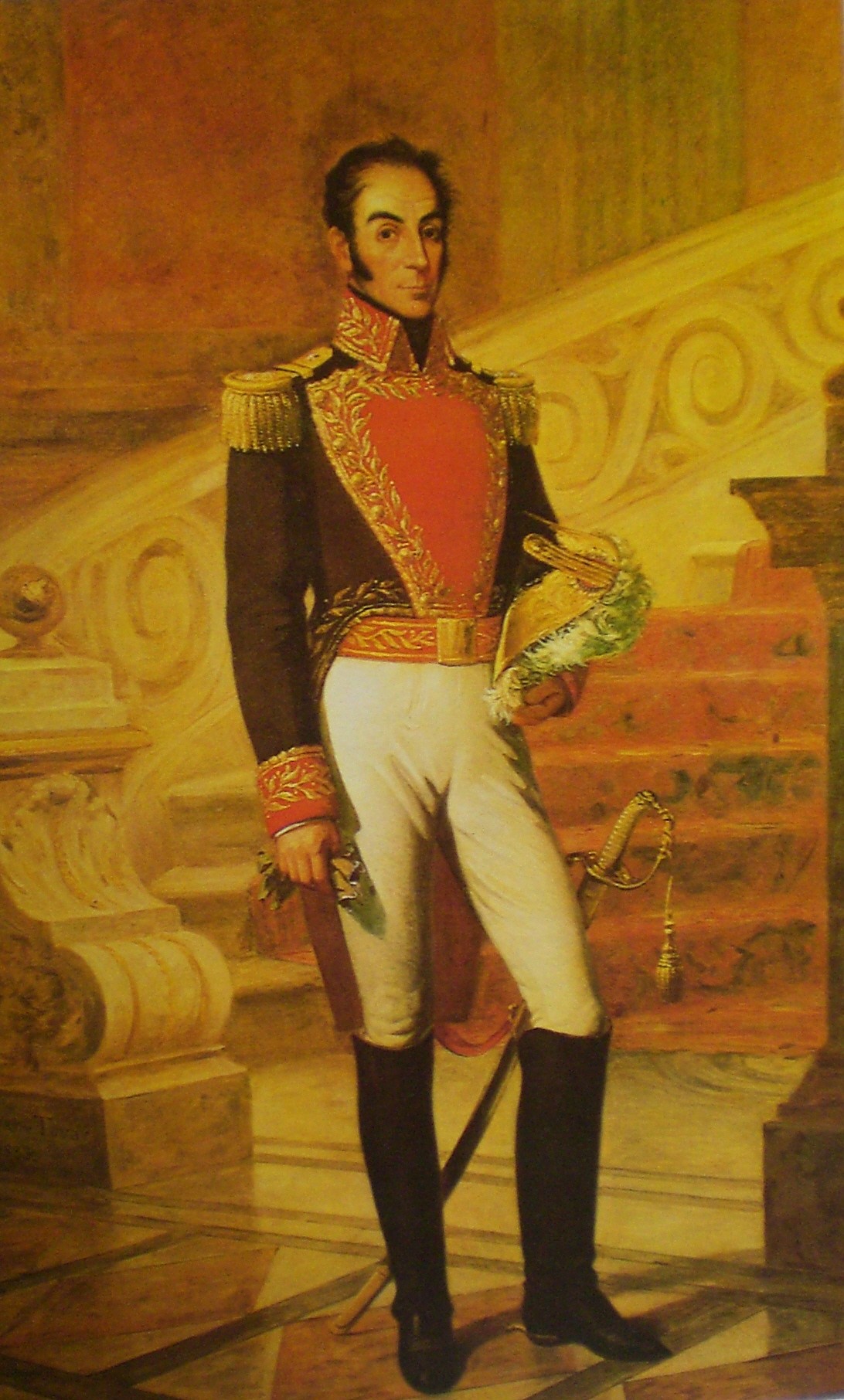 The rumors have persisted to this day, given new impetus by Venezuelan President Hugo Chavez and speculation among medical historians stemming from a 2006 presentation at a medical conference on the famous accidental poisonings. Specifically arsenic poisoning.
“President Chávez and I do share the belief that tuberculosis was not the cause of Bolívar’s death,” says the man who originally presented the arsenic hypothesis, Dr. Paul Auwaerter, an infectious-diseases expert at the Johns Hopkins School of Medicine in Baltimore. “However, our explanations for how he did die couldn’t be more different.” Auwaerter, reached in Switzerland on Friday, said Bolívar most likely ingested too much arsenic — either from the Andes rivers or from doses given by physicians who at the time considered the poison to be a tonic. (One of Bolívar’s contemporaries, the “mad” British King George III, may also have died from arsenicosis.)
Add Napoléon Bonaparte to the list of suspected arsenic poisoning victims. A 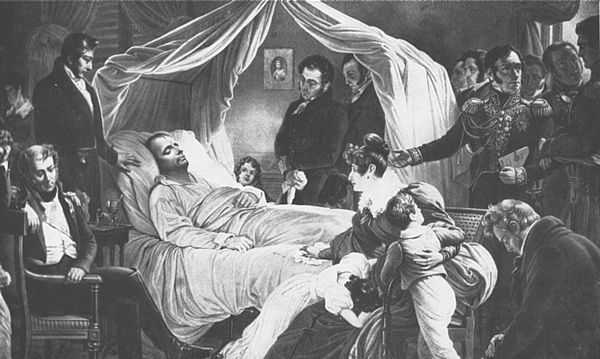 similar conspiracy theory surrounds the French Emperor’s death, supposedly of stomach cancer at the age of 51, was also said to have been hastened by intentional (or unintentional) arsenic poisoning.
While no one ever seriously considered digging up Napoléon, there are plenty of hair samples from from various periods in his life, as well as hair from Josephine and from his son (who definitely did die of TB at the age of 21). In 2008, the hair samples were tested for arsenic at the Italian National Institute of Nuclear Physics. New York Times science correspondent William Broad wrote:
The big surprise was that the old levels were roughly 100 times the readings that the scientists obtained for comparison from the hairs of living people.
“The concentrations of arsenic in the hair taken from Napoleon after his death were much higher,” the scientists wrote. But the levels were “quite comparable with that found not only in the hair of the emperor in other periods of his life, but also in those of his son and first wife.”
The results, they added, “undoubtedly reveal a chronic exposure that we believe can be simply attributed to environmental factors, unfortunately no longer easily identifiable, or habits involving food and therapeutics.”
One popular theory on Napoleón’s relatively early death — besides the always favored idea that his British captors got tired of him and spiked his drinks, was that his bedroom on Saint Helena had green wallpaper. The dyes used to tint wall-paper green were full of arsenic, and the bedroom was full of mold… so, if he was poisoned, the wall-paper done it.
Or, as the Italians suggested, he just had a lot of arsenic in his system anyway, but it was stomach cancer that did him in.

Bolívar exhumation, July 2010
Last 16 July, Bolívar’s remains were exhumed — both to confirm that the body was that of Simón Bolívar, and to test for poisoning. It appears there were signs of poisoning, but it may not have been intentional… arsenic was a common medication at the time, and apparently, it wasn’t that uncommon to be exposed to relatively high levels of arsenic at the time.
While the examination of Bolívar’s remains also uncovered arsenic, as well as other elements now considered poisonous, if they didn’t just get into his system through normal exposure, they may have been administered by Dr. Alexander Reverend. Reverend — called to attend the general in his labyrinth at Santa Marta (now in Colombia) wrote of his initial examination on 1 December 1830:
I found him in the following state: very skinny and debilitated body, the painful semblance and a restlessness of constant spirit. The hoarse voice, a deep cough with viscous sputum of greenish color. The compressed pulse. The laborious digestion. The frequent impressions of the patient indicated moral sufferings. Finally, the disease of its Excellence seemed to me to be of most serious, and my first impression was that he had damaged lungs … ”
Doctor Reverend autopsied Bolívar, and his description sounds to this lay-person like TB*… and it’s known that both of Bolívar’s parents (and one of his siblings) died of the same 19th century “white plague”. Paul Auwaerter, the John Hopkins lung specialist notes, however, that the lesions found could have been from any number of bacterial infections.
And, the arsenic could have come from environmental sources. Or maybe Napoléon done the deed. Bolívar, as a young man, lived in Paris, where he was something of a protege to Alexander von Humbolt (who among his many contributions to the Americas, told young Simón: “I believe that your country is ready for its independence. But I can not see the man who is to achieve it”). Though Humboldt, Bolívar was introduced to Napoléon and was present at the Emperor’s coronation on 2 December 1804. Where, perhaps the ceremony being rather long — and Simón properly appalled by the French caudillo’s willingness to be a crowned head of state, needed a pick-me-up… which, a few conquests and crossings of the Andes later, would prove fatal.
With the inconclusive results, the best we can say is that Bolívar had TB, and there was arsenic in his system, and he is still dead.
* My late brother, Dr. James Grabman, working for the Indian Health Services treated more TB patients than most U.S. physicians in the late 20th century. TB is still a killer, these days found especially among people with inadequate housing and diet… the basic conditions under which people live on Indian Reservations and in Alaska native communities. The Grabman TB Fund (c/o American Lung Association 1057 West Fireweed Suite 201. Anchorage, AK 99503) provides funding for TB and related disease research and education.
I love you to death
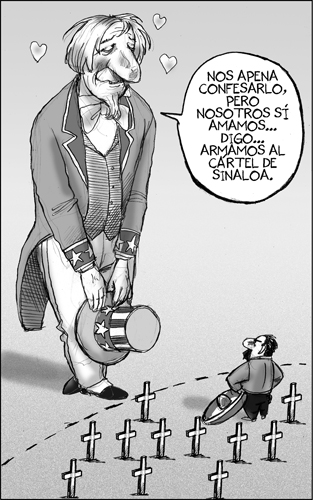
Fisgon’s cartoon in this Thursday’s Jornada depends on a pun (amamos — “we’re in love with” and armamos — “we have armed”), which perhaps doesn’t come through to English speakers — which is rather gentle, considering the outrage “Fast and Furious” has generated in this country, which feeds into the already common perception that the Calderón administration’s “war” on organized crime is not directed at organized criminals in general, but at those organized criminals who oppose the so-called Sinaloa cartel.
The botched investigation into gun-running is an extremely serious matter. With attempts in the United States to redefine Mexican gangsters as “terrorists,” it might even be argued that, if the Mexican government wasn’t informed of this action, then the United States was — intentionally or not — arming terrorists. If the Mexican government was informed, it might be charitably labeled “unintentional state-sponsored terrorism”.
As you see, even hedging my words, it’s impossible to speak of Fast and Furious without giving it a polemical framing. But whose frame should we use? Most of the commentary in the English-speaking media about Fast and Furious is from the extreme right. Like any issue involving Mexico. there is are those who would turn this into an immigration (or rather, anti-immigration) debate, but more commonly, I’ve seen discussions meant not just to denigrate the Obama Administration, but — perhaps more significantly — to discredit any form of firearms control.
This comment on a World Net Daily article (which mostly dealt with reaction by Larry Pratt, president of Gun Owner’s of America — a group which finds the better known National Rifle Association too “liberal” — to testimony before a congressional committee) is not uncommon among those taking an interest in this scandal:
Why was the BATFE [Bureau of Alcohol, Tobacco, Firearms and Explosives… generally known as “ATF”] allegedly working on trying to identify and prosecute drug criminals in Mexico? What authority or jurisdiction could we possibly have in such activities? Secure the border, enforce our own drug and firearms laws, and to h**l with Mexico. This was either one of the most incompetent Keystone Kop operations in history, or it in reality was an attempt by the administration to try to create false evidence of American firearms going to Mexican drug cartels as an excuse for creating even more worthless laws and regulations that infringe our Second Amendment rights.
Apparently quoting from another rightist source, a commentator on Free Republic writes:
This is the work of fascists, which is exactly what Obama is.Obama is organizing a 5th column army of revolutionistas on our borders and INSIDE our country. And he has acted to keep Arizona from interfering. We now can see the outlines of the Obama plan to destabilize the border states and several RED STATES with conservative governments.This is war against the people of the United States. This is an impeachable offence committed by Holder and the so called president of the United States.
It is hard to believe that .50 cal Barrett rifles were among the weapons sold to the Salino Drug cartel.HORRIBLE.
“Salino Drug cartel”? … probably the Sinaloa Cartel, said by Mexicans — and by some in the United States — to be the government’s preferred illegal agricultural exporter. INsight Crime (funded in part by the Open Society Foundations, which is George Soros’ charities, which, in the minds of the far right means they’re a bunch of commies) mentions that the ATF agent in Mexico City did say “We armed the [Sinaloa] cartel. It is disgusting.” Both statements (arming and disgusting) are perfectly true, but whether that rises to a conspiracy, rather than bone-headed stupidity, is another story.
HOWEVER…
Despite the best efforts of the Calderón Administration (and Malcolm Beith) to claim otherwise, the body count in the administration’s “war on drugs” has noticeably light on Sinaloans. Anibal Hernandez, in Los Señores del narco, claimed Chapo Guzmán’s ties to the government go back to at least the Fox Administration, giving weight to what had been a common assumption by the Mexican left. And, it’s a historical fact that in Sinaloa, the narcotics trade has always had a tacit, and sometimes open, relationship with political authorities on the state and/or national level.
My sense is that “Fast and Furious” was an equal-opportunity fuck-up: weapons ended up on the gangster “free market”, and the Sinaloans were as likely as buyers as anyone else. And, if one accepts the reasoning of the Mexican left, the Sinaloans were more likely buyers than any of their competitors, facing less hurdles in acquiring the “tools of the trade” than those more likely to be harassed by the government.
And, with the U.S. “loving” narcotics AND arming some of the more successful (and seemingly government approved) suppliers, one can understand how Uncle Sam’s rather bashful courtship of the Mexicans might be poorly received.
Readings for a dark and stormy night
It is a dark and stormy night: the rain falls in torrents — except at occasional intervals (for it is in Mazatlán where I post, and it is rainy season… and, being night, it is dark). A perfect time to peruse this year’s winners of the Edward Bulwer-Lytton Fiction Awards. Sponsored by the San  Jose State University English Department, the awards honor of the author of the 1830 novel, Paul Clifford, the opening sentence of which is a classic, of sorts:
It was a dark and stormy night; the rain fell in torrents–except at occasional intervals, when it was checked by a violent gust of wind which swept up the streets (for it is in London that our scene lies), rattling along the housetops, and fiercely agitating the scanty flame of the lamps that struggled against the darkness.
Since 1982, the Edward Bulwar-Lytton Fiction Award has sought to foster interest in great bad writing, sponsoring a “literary competition that challenges entrants to compose the opening sentence to the worst of all possible novels.”
Having somehow to work mention of this prestigious literary event into the Mex Files, meaning somehow finding something Mex to do with it, let me quote Chris Kemp of Annapolis, Maryland who earned a “Dishonorable Mention” (for Romance writing)… for an opening that not only is really great bad writing, but bad writing that manages to put a Mexican into a mangled metaphor of breath-taking atrociousness. To wit:
She gazed smolderingly at the mysterious rider, his body cloaked in enough shining black leather to outfit an Italian furniture store, wrapped so tightly each muscle stood out like a flamboyant Mexican hairdresser at an Alabamian monster truck rally; and he met her gaze with an intensity that couldn’t have been matched by even a starving junkyard dog in the meat aisle of a suburban supermarket.
¿Rudo y cursi… yo?
Dudley Althaus and Dane Schiller in the Houston Chronicle:
But for its problematic pedigree, Mexico’s marijuana might be hailed as a marketing miracle.
The much-maligned weed has suffered decades of punishment — burned, poisoned, ripped from the earth by its roots. Customers have been jailed, suppliers battered by literally cutthroat competition. Better products from Colombia, California and countless suburban back-rooms have somewhat eroded its popularity. Governments refuse to make it honest.
Yet, this pot has persevered. Production grows, quality improves and exports northward hum along.
…
“Marijuana remains the constant commodity of choice for the drug cartels because of end user demand and the ease of production,” said Tony Garcia, South Texas director of an intergovernmental police alliance that keeps tabs on the illicit drug trade.
“When cartels lose large quantities of other type drugs to law enforcement, their money coffers are replenished through the trafficking of marijuana,” he said.
Cheap to grow and relatively easy to bring to market, Mexico’s marijuana provides sustenance for entire mountain communities and wide profit margins for the gangsters.
…
Like your typical Mexican bourgeois, I tend to think of marijuana smokers as rather, cursi, but with “… surveys [that] suggest at least 11 percent of Americans over age 12 regularly puff from a joint, pipe or bong,” I suppose there’s a strong argument to be made in favor of the “war on drugs”… as long as it stays in the United States. It keeps down the competition from U.S. domestic growers and allows at least some of our traditional agricultural communities to thrive.
Linda Christian, D.E.P.
The first “first Bond girl” and the only woman other than Jane to tempt Tarzan, Linda Christian, died Sunday in Palm Springs, California.
 In the late 1940s and early 50s, Christian was marketed as the “Anatomic Bomb”, which was no reflection on her acting ability, but on … er… ah… screen presence.
Christian had an international childhood, growing up in Mexico, South Africa, Venezuela., France, Romania, Palestine… and points in-between. She was fluent in English, French, German and Italian, and said to speak passable Russian and Arabic.
Recruited into the film industry by Errol Flynn, her break-though role was in the 1949 Tarzan and the Mermaids, the last Johnnie Weissmuller Tarzan film, and the first Tarzan film made in Mexico. Her last English-language film role was in the 1964 Casino Royale, the first Bond movie.
Never a major star, she was best known as Mrs. Tyrone Power, whom she divorced in 1956. As she aged, the anatomical threat became less alarming or alluring, the polyglot actress continued to work in European and Mexican films into the 1980s.
Born Blanca Rosa Henrietta Stella Welter Vorhauer in 1923, to a Dutch father and Mexican mother, she is at least remembered with a plaque on the Plaza des Armes in her home town, Tampico, Tamaulipas.


 mexfiles.net