¡Ay, Jalisco!
Via Aguachile:
Fernando Guzmán Pérez Peláez, regarded as one of the most ultra-conservative members of the Jalisco government, where he is government secretary, declared that he is in favor of legalizing gay marriage.
The same man, less than a year ago, was an active supporter of the ridiculous “gay conversion” movement.
What happened?
Just a wild guess, but Puerto Vallarta tourism — heavily dependent on gay tourism — might have something to do with it… or recognition that approval of same-gender marriage in the Federal District last year didn’t cause any problems. On the contrary, with only about 850 same gender marriages over the last year, it has been a non-issue, although the Capital’s tourism department has been milking their new-found foreign image as a relative oasis of modernity and sanity for all it’s worth.
Or, maybe somebody just knocked some sense into Fernando Guzman.
Not Carstens, and probably just as well
In the end, Mexican Agustin Carstens did not get the support required to overturn the traditional and unchanging rule that has survived for six decades which virtually guarantees a European monopoly on the management of the IMF.
[Christine] Lagarde, 55, will thus become the first woman to head the IMF after the untimely departure of Strauss Kahn, who still must overcome a painful legal scandal.
I was surprised that SDPNoticias — a decidedly leftist, anti-Calderónist publication — was disappointed in Agustín Carsten’s failure to clinch the top job at the International Monetary Fund, but then, in any contest that comes down to something involving the French, everyone in Mexico is going to go for the Mexican. Even if it isn’t necessarily in our best interests.
Should Mexicans be disappointed that Agustín Carstens is not moving to the IMF? Perhaps not. Carstens is given much of the credit for Mexico’s stable economy, leading to some concern that his campaign for the IMF Managing Director’s slot was a distraction that could impact the Mexican economy. Seen as something of the “indispensable man” of Mexican monetary policy may have worked against his candidacy — one gets the sense that the Calderón Administration, on the defensive in nearly every policy decision, felt it could not afford to lose a key domestic ally, even if that ally was moving into an international post that greatly impacts Mexico.
 Whether Carsten’s and the administration’s economic policies are the right ones for the Mexican people is a political and economic proposition that is doubted by some. Not being in debt as a nation, doesn’t mean individual citizens and their families are doing ok. Food and fuel prices keep going up and salaries aren’t. It’s especially notable in a place like the one where I live, where too much of the economy depends on a cyclical (and fickle) industry like tourism and not on a stable one (like… oh… narcotics exports?).
Whether or not the foreign investments coming into Mexico (which seem to be going into things like tourism and mining and buying up Mexican assets) can be replicated in other countries isn’t a given, and Carsten’s successes here might not be applicable to other places.
And, let’s not forget. Carstens is one of the “Chicago Boys”… while less doctrinaire than many, he is a University of Chicago trained economist. While it would be unfair to assume that one is brain-washed by one’s academic background (Fidel Castro was educated by Jesuits, but somehow got over it), the “libertarian” and macro-economic theories associated with that institution have fallen into ill-repute even among lenders.
More seems to being made of the novelty of Christine Lagarde as the first female managing director of the International Monetary Fund, or of disappointment that the post, as usual, has gone to another European, rather than what is probably much more important, her background.
It didn’t seem to make a huge difference that Strauss-Kahn was a Socialist (and a former Communist) as far as IMF policies were concerned. He was another economist, and Ms. Lagard is a Gaulist (ideologically not all that different from Carsten’s PANismo), but she is not an economist, but an attorney specializing in labor and anti-trust issues. It seems that even “true believers” are starting to realize that economic health is a matter of more than money supplies and debt ratios, but depends on more intangible factors like social heath and a personal sense of well-being among producers and consumers.
And bankers. I was criticized for mentioning Carsten’s physical appearance, but I think it is a factor. It’s not unusual for even small companies to take out very large insurance policies on their key personnel. I would hate to think of the premiums on any policy written on the IMF’s Managing Director, but image that they are a lot lower when the Managing Director is a former Olympic athlete of abstentious personal habits.
And, as an added bonus, for those Mexican lefties who out of national pride would have preferred Carstens, maybe with another European (and with European economic issues likely to occupy the IMF’s agenda for the next few years), Mexicans can somewhat extricate itself from a concern for how it’s policies play on the world stage, and go back to focusing on the internal markets and the well-being of the ordinary Mexican, not the bankers and foreign investors.
Cold war: it’s not the heat, it’s the humanity
The United States spends $20.2 billion annually on air conditioning for troops stationed in Iraq and Afghanistan — more than NASA’s entire budget, NPR reported.
…
The necessary cooling costs so much because of the remote locations and danger involved in delivery equipment and fuel, Steven Anderson, a retired logistician who served under Gen. David Petraeus in Iraq.
When I lived in the Big Bend, the soldiers who were sent here (with no break) from Afghanistan to supposedly “secure the border” always mentioned how much the area looked like the place they’d just left. Of course, it wasn’t quite as cold in the winter, but summer temperatures in the desert (especially the further south you get in the Chihuahua desert) are just as brutal as they are “over there”. It’s the reason so many migrants die along the way.
Of course, the soldiers stationed along the Rio Grande were staying in motels (with air conditioning) but the soldiers running around on this side of the border, chasing those violence entrepreneurs are not. For which the United States gives Mexico about 20 million dollars… but no air conditioners.
I don’t blame the soldiers, or even their superiors for the outrageous expense. Being sent off on a war of choice by their government, I guess the soldiers are entitled to some level of comfort. But, when it comes to necessities in the United States (like food), it’s a different story. From Austin American-Statesman:
A knot of criminal offenders who spent seven hours in the sun harvesting buckets of vegetables by hand have decided they’re calling it quits exactly as crew leader Benito Mendez predicted in the morning.
…
Republican Gov. Nathan Deal started the experiment after farmers publicly complained they couldn’t find enough workers to harvest labor-intensive crops … Latino workers — including many illegal immigrants — refused to show up… One crew …wouldn’t come to Georgia for fear of risking deportation.
…
Mendez put the probationers to the test last Wednesday, assigning them to fill one truck and a Latino crew to fill a second truck. The Latinos picked six truckloads of cucumbers compared to one truckload and four bins for the probationers.
“It’s not going to work,” Mendez said. “No way. If I’m going to depend on the probation people, I’m never going to get the crops up.”
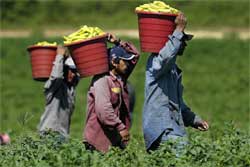
Conditions in the field are bruising, and the probationers didn’t seem to know what to expect. Cucumber plants hug the ground, forcing the workers to bend over, push aside the large leaves and pull them from the vine. Unlike the Mexican and Guatemalan workers, the probationers didn’t wear gloves to protect their hands from the thorns on the vines.
Temperatures hovered in the low 90s with heavy humidity, but taking off a shirt to relieve the heat invited a blistering sunburn. One Latino worker carried a machete that he used to dispatch a rattlesnake.
AMLO re-loaded
If you had told me in spring of 2007 that AMLO would still be such a relevant figure in the 2012 election, I don’t think I would have believed you.
Well, I won’t say “I told ya’ so”, but I have been writing on and off about AMLO as a relevant political figure since his presidential ambitions were thwarted in 2006. What surprises Patrick are two recent developments. In Nayarit, AMLO is backing the PT candidate, not the PRD candidate, and speculation being bandied about by El Universal’s political gossip column, Bajo Reserva, on a possible break between AMLO and his political protege, Marcelo Ebrard.
On the first point, Patrick quotes Aguachile , who huffs, “This is the true face of AMLO showing: A man who have absolutely no compunction about betraying his old party, as long as it benefits his own, highly personalistic project. ” Aguachile, who is a scholar of the PRD, soured on AMLO long ago, and I don’t think Patrick was ever a particular supporter (which is fine, him being a foreign correspondent and properly non-committal).
While I, of course, can’t vote in this country, not being a citizen, and barred from partisan activity, I was hoping for an AMLO victory in 2006, and admit I much preferred his economic and social programs to those of his opponents. And, I’ve been somewhat in awe of his staying power and political skill.
Being effectively frozen out of the national media after the initial novelty of his alternative presidency wore off (and after the media was co-opted into wall-to-wall coverage of the “drug war”), López Obrador in some ways was advantaged as a politician. Under the radar for the most part, he never stopped campaigning and organizing. While several of those organizations were centered around single-issue campaigns (PEMEX privatization, the LyFC takeover), there is a national organization in place that stands outside party politics.
How well-organized AMLO’s people are, and how disciplined his own organization is, is a question I can’t answer. Most of the propaganda I’ve seen appears to be produced by enthusiastic college kids or appears in relatively obscure “alternative” media, and it’s difficult to gauge “on the groud support” here in the northwest where I live and where AMLO, let alone the PRD and other leftist parties, have never enjoyed a sizable voter base. What can be said is that, unlike the U.S. media created “tea party” which was designed to channel support to one of the two U.S. national parties, the unsatisfied voters are rejecting all the mainstream parties (and conventional political party politics in general), and AMLO — never mind that he’s been a party pol his entire adult life — seems to be the only candidate poised to take advantage of these disparate groups.
Should AMLO be a presidential candidate for a minor party (breaking with PRD), he doesn’t need to win or even win a sizable percentage of the national vote to have influence over the national agenda after 2012. With proportional representation in the legislature, any single party for which he is the candidate that receives more than 2.5 percent of the national vote is guaranteed seats. If he is able to form a coalition between a couple of minor national parties (PT and Convergencia) he’d more than likely hold off the threats of a minor party losing its registration. It’s complicated, but parties which don’t receive a minimal number of votes in national elections lose their national registration — a death penalty in a country where elections are by party, and party funds are provided by the government based on their relative strength in national elections.
The second point — that AMLO “owes” the PRD his allegiance — doesn’t hold up. Politicians change parties all the time, usually on the excuse that they are consistent and the party is not. I saw Ronald Reagan’s 1962 statement, “I didn’t leave the Democratic Party, the Party left me”, recently quoted by a Guyanan politico, by the way. The late Gilberto Rincon was a Communist, several varieties of Socialist, a PRD founder, a Social Democrat, and served in the Fox Administration during his long career, the party being not so important to him as the opportunity it provided him to push his agenda (which was the rights of the physically disabled and other minorities).
The PRD after all, was cobbled together out of several political parties, and mostly run by dissident PRI operatives (including AMLO). In some sense, it has always been more a coalition than a unified party, and there really is nothing too odd in movement from one party within the broader leftist coalition to another.
Aguachile’s condemnation of AMLO comes from the politico’s backing of a PT-Convergencia candidate in the Nayarit governor’s race, over the PRD candidate. In a sense, this is trying to have it both ways — AMLO is a declared candidate for the PRD presidential nomination, but is looking at a run on a PT-Convergencia (or either one of those two parties) ticket as well. That AMLO, and his supporters, have basically taken over those two smaller parties was quite a coup, considering the PT, while ostensively a Maoist party, was said to have been organized by Carlos Salinas to create a weak leftist party under his control. Turning it into a more or less democratic socialist party, and pulling in support from the other social democrats (or working with them) isn’t necessarily a bad thing.
It’s somewhat unorthodox to seek two party’s nominations simultanously, but makes sense, given both the likelihood of fusion tickets, and the very real sense that the PRD compromises with PAN in state elections have not always benefited the left (as here in Sinaloa where a PAN-PRD coalition captured the governorship and the municipal presidency in Mazatlan, but you wouldn’t know PRD had anything to do with it from the way the PAN leaders are governing). There is some concern that some in the PRD, attributing their loss in 2006 to appearing “too leftist” might be tempted to present a more “moderate” candidate than they could in an attempt to pull in some PAN voters. And, as I said above, winning the presidency is not always necessary for a party (or a faction) to pursue its political agenda.
I was convinced last election that AMLO was going to win in a close election (and I think I was right, but…well… you know). This time, I tend to doubt it, but if there is a crowded field (of four or five main candidates), he might do well enough to remain a factor for another six year.
The eyes of Texas are upon you…
Nobody slices and dices stupid like Juanita Jean:
Let me tell you how dumb Rick Perry is. He moved from bean dip dumb to dog dump dumb this week when he went to speak to National Association of Latino Elected and Appointed Officials annual conference in San Antonio. You know, right after he pushed for voter ID and sanctuary city destruction.
News outlets statewide (and around the country) are weighing in on the response from the audience, using words like “subdued” and “tepid.”
The El Paso Times declared Perry “failed to woo” Latino leaders while “(t)he applause lines often fell flat and the clamoring of silverware hardly yielded.”
Politico picked up on the story Thursday evening, pointing out that while President Barack Obama got criticized for skipping the event, Perry got criticized for showing up.
And Perry did not mention his clearly anti-Hispanic legislation push. He thought they’d forget it because he’s so distractingly good looking.
“Rick Perry walking into a room is the same as eight good men leaving,” Juanita says.
She’s right, you know.
Juanita missed the best part of the story, as printed in (but surely not originating with) The Huffington Post:
… Hispanic politicians had earlier spoken passionately against his policies, deriding them as hurtful to Hispanics. Perry chose to ignore those topics and instead touted his appointments of the first Hispanic women to serve as secretary of state and to both of the state’s highest courts.
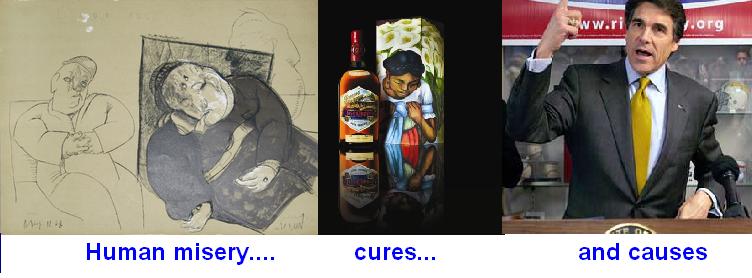
But a joke about how perfect it was to appoint Jose Cuevas* to the Texas Alcoholic Beverage Commission because his name sounds like Jose Cuervo — a brand of tequila — fell flat. Perry struggled to regain his confidence as he described Texas as a land of opportunity.
* Apparently, no relation to the Mexican artist José Luis Cuevas who sought to present the misery of the modern world, something José Cuervo helps you forget it for a while, and Rick Perry seems to want to spread to the rest of the United States.
Child labor
Creepy?
Welcome to KidZania, perhaps the only place in the world where child labour is actively encouraged. The idea was born in Mexico just over a decade ago when Xavier López Anconca was approached by a friend to co-invest in a day care centre where children would play at working and businesses.
…
… the model for Mr López’s edutainment empire has evolved into a well-honed strategy. First, identify a dense urban centre where relatively prosperous young parents will pay repeatedly for their children to play safely indoors.
…Second, ensure the city is home to a slew of corporate headquarters – especially companies with large social responsibility budgets that will pay KidZania to build its branded mini-cities: as much as 40 per cent of each centre’s construction costs are met by sponsors. That is also why entrance tickets to the Mexico City centre are boarding passes given at an American Airlines check-in counter, and why children build houses using Cemex-branded materials, call each other on mobile phones provided by Telcel and bottle fizzy drinks in a facsimile of a bottling plant…
,…To be sure, KidZania can be seen as a grim training ground for the next generation of consumers. But Mr López counters “we are only copying the real world”. Besides, he adds, children learn valuable social skills, including the value of money…
I notice they don’t have any kiddie-unions, though I wouldn’t be surprised if the tyke-transitos shake down the little darlings for their candy.
Remember the Alamo?
Oops, we did it again.
4-2 Mexico-U.S.A.

However, whether or not Mexico also kicked French butt (again) and set a new record for the most people in Smurf costumes in the world (and yesterday not only saw Copa de Oro finals in Morelia, but the 33rd annual Gay Pride march in Mexico City, and World Smurf Day celebrations at Estadio Azteca) I do not know.
¡Yo ♥ NY!
After a long battle followed by days of protracted deal-making, the New York State Senate narrowly approved same-sex marriage legislation Friday night…
A few more years, and the United States might almost be as civilized as Mexico, where just because same-gender marriages aren’t performed in all states, they are recognized in all states.
From Cuba Debate (my translation):
Ernest Hemingway, who died 50 years ago next July 2, was not one of those Americans who came to Cuba as a refuge, but one who came because he felt himself to be Cuban, according to one expert.
Ada Rosa Alfonso Rosales, director of the Museo Finca Vigia, the suburban Havana estate Hemingway made his home from the 1930s until he returned to the United States shortly before his death, said that research demonstrates that the author of “For Whom The Bells Tolls” and other novels “definitely felt Cuban”, although he never stopped being a “complete” American.
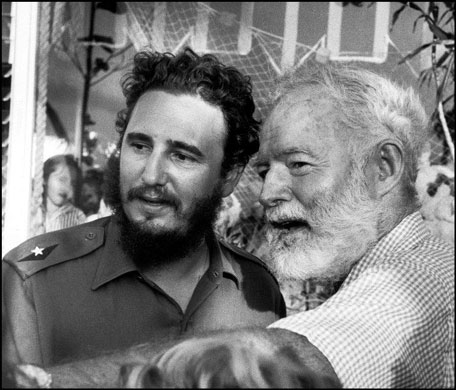
The controversial matter of Hemingway’s “Cubaness” has lingered since 1961. The author left the island, never to return, a few months after the well-publicized meeting with Fidel Castro at a marlin fishing tournament Hemingway had founded.
 Hemingway is probably the most beloved American in Cuba. He is well remembered in a country that dedicates seminars, conferences, fishing tournaments and public memorials to a foreigner born in 1899 and who committed suicide in his homeland.
Shortly before his departure from Cuba at age 62, Hemingway and Castro were photographed at a fishing tournament. They appear to be cordial with one another, and historians claim that this was hardly their only meeting, the two speaking privately on several occasions.
Alfonso Rosales said that the novelist “definitely felt Cuban and loved this country before and after the Revolution” of 1959. She indirectly rejected the U.S. contention that Hemingway fled the “specter of communism” when Castro began to implement a socialist system.
[I’m no Hemingway expert, but I tend to think he left because the Island didn’t have the facilities he needed to treat his deteriorating mental and physical health, and that the semi-forced departure as a result of U.S. pressure on American residents in Cuba (especially prominent ones like Hemingway) probably had a negative impact on his depression]
Although the writer’s direct links to Castro’s revolution are well known, less publicized (in Cuba) were the author’s activities during the Second World War, when Hemingway attempted to organize an anti-Nazi operation on the Island. Then U.S. ambassador in Havana Spruille Braden was apprised of a proposal by Hemingway to use diving expeditions in the Caribbean aboard his yacht, El Pilar as cover for hunting German submarines. Braden got Washington’s approval for Hemingway to equip his boat with machine guns, grenades and home-made bombs, as well as recruiting an anti-fascist network on the island.
Still, the eternal “antiyanquí” sensibility lingers, with an intellectual current that sees the writer as a would-be Robinson Crusoe, surrounding himself with Cuban Men Fridays.
The truth is that “Papa”, as the author was called, greatly enjoyed Cuba, devoting himself to his estate, to “kissing Martha (his wife at the time) and writing “The Old Man and the Sea,” a novel that [for Cubans] transcends the writer’s Nobel Prize.
Does it really matter?
A recent article on “Colombia’s ‘New’ Paramilitaries” was an exercise in deja vu. That color-coded map of the different territories controlled what in Colombian bureaucratese are called “Bacrims” — bandas criminales) looks an awful lot like the same kinds of maps we’ve been seeing over the course of the Calderón Administration of territories controlled by our “cartels”. Or, rather, of territories in which the various criminal organizations operate.
It’s impossible to find death tolls from the “war on drugs” (and how to separate out the victims of that “war” from the one on labor, on youth, on farmers, on dissidents), but try finding any figures on Colombia’s death tolls, which by percentage of the population are probably much higher than Mexico’s. But, perhaps the absence of complex ideology among Mexico’s violence entrepreneurs is what makes “our” drug war more news-worthy. It’s simply easier to write about when the English-language press only has to consider it in terms of domestic politics: the U.S.’s confusingly contradictory attitudes towards narcotics and firearms; and its ambivalence towards Mexicans as a people.
I realize Colombia’s Bacrims often have ideological aims far more sophisticated, but no less deadly, than the Ayn-Randian style capitalism of the Mexican “cartels”. La familia michoacána (and their alleged successors, Los caballeros templarios) are an exception. However, given that they represent a relatively familiar “American” ideology that mixes Evangelical Christianity and Capitalism, there is nothing likely to force your average media person to do any heavy intellectual lifting.
I appreciate those who send me links to news articles on Mexico, though I seldom acknowledge them. Nor do I often use them, since most are just about some specific incident in the on-going mayhem (which, in themselves, are probably meaningless) or seek to “explain” the situation purely in terms of the United States.
Little is said about the all-too-common, but much more important story. Narcotics themselves are not important. They’re just another commodity, that like sugar or coffee or minerals. And, like sugar growers, or copper mines, the pursuit of profits depends largely on exploiting rural communities, often leading to their expulsion (whether by narcotics traffickers clearing a path for access to the United States, as happens in parts of Coahuila and Tamaulipas, or by developers, seeking to build tourist resorts, or mining companies looking to expand in farming regions, there isn’t all that much to say), aided and abetted by local officials and/or local profiteers from the commodity.
Once in a while, something does sneak through about this. While highly, but I hope not fatally, flawed[1], Al Jazeera’s “Faultlines” program recently had a piece on a reaction to that type of exploitation we very, very seldom consider — resistance.
As you can see from the short clip (The entire program can be seen here), resistance to exploitation can be seen as resistance to the state. This brings us back to both the Colombian “war” and to Los caballeros templarios. Both on the left and right, the Colombian paramilitaries (or guerrillas or whatever you want to call them) often saw narcotics as a means to an end… a way of raising cash to finance their other operations (and, as a point of historical reference, Pancho Villa rejected the idea of selling opium in the United States to finance his operations, but other Mexican revolutionaries were less puritanical about it). A few, like the Mexican groups, and the guerrillas in the clip, are uninterested in the commodity itself, but are fighting the violence and oppression that comes with exploitation of the suppliers and workers.
And, it is why I say the “drug war” is ending faster than we realize. Focusing on what gang is in what state, or which gang boss had which police chief bumped off really doesn’t tell us anything beyond some bare — and relatively useless — factoids.
As with most things in Mexico, what matters is what always mattered: the tension between tradition and modernity, exploitation and resistance is at the heart of a struggle seen by outsiders in terms of only how it affects their own concerns. The foreign press sees a reluctance to fight the drug war, where here what is seen is a resistance movement against violence and exploitation. That the resistance is taking so many different forms and springs from so many different ideological bases — from traditional rural guerrillas to street protests led by metaphysical poets to perhaps those Evangelical Christian hit-men, suggests a mass movement … or rather movements … that the media is unable to comprehend.
[1] The presenter’s inability to pronounce common Mexican names (like Calderón) caught my attention, but it was his mention of somebody named “Arturo Sanchez Sanchez” when he meant Arturo Chavez Chavez (at the time, the Attorney General) that suggests that there are probably other factual errors in the story, and the presenter’s reliability should be questioned.
Nobody goes there … it’s too crowded
Water — or rather no water — is topic number one on the expat circuit right now. An expat book-buyer said today he couldn’t understand why the water was running out… “after all, there’s nobody in town.”
The rainy season hasn’t started yet (Tlaloc has been teasing us lately, a few drops falling last night, and some clouds moving in this evening) and despite a new reservoir (flooding out several ejidos, the residents of which believe — probably correctly — that they were under-compensated for their property), a new city administration that promised to make the chronic water problems their first priority (yeah… right!), our taps tend to run dry this time of year. And, with the Pacific Ocean (not suitable for drinking) on one side, and the Sinaloan subtropical dry forest (it’s called “dry” for a reason… like it’s semi-arid in the best of times) on the other, there just isn’t a lot of water in this part of the world.
The guy who couldn’t understand why, when the snowbirds are out of town, there are water shortages isn’t stupid, and I’m sure he is otherwise an asset to his fellow man. Nobody in town? Just 485,000 or so people who all use water (though certainly not as much as the foreigners, most of whom seem to hail from water-rich places like British Colombia), not to mention a couple of water-intensive industries like a brewery and a couple of canneries.
I’m afraid I have nothing profound to say about this… though I despair that simply getting across the idea that people in Mexico do a lot of the same needs and wants as my readers (basic things, like flushing the toilet) is too dry a topic for some.
Papal teaching
While it’s nice to see the pope is getting a more energy efficient set of wheels, a Mercedes hybrid engine Popemobile for tooling around the Vatican, maybe some older versions would have worked just as well.
I suppose if energy savings alone was the issue, he could have opted for something like the vehicle used for John Paul II’s visit to Mexico in 1999, if the Pope didn’t mind standing in line with the College of Cardinals at the bus stop in the mornings.

Or, if he’s got to travel around on his own, he could use the gas-miserly Piaggio Popemobile:

But, apparently gas consumption isn’t the prime consideration when it comes to designing a Popemobile: the new vehicle may be greener, but it’s still just an armored truck with a bomb-proof camper shell. A pretty basic idea, and a good one. I suppose there’s something to be said for imitation being the highest form of flattery, but when the design inspires a Ciudad Camargo mechanic and his client is the Gulf Cartel (though he overlooked the energy efficiency) maybe someone should have reminded them that “Thou shalt not steal… or steel plate”:



 mexfiles.net