¡Ya Basta!
15 April 2011 Guadalajara Reporter:
An attempt by President Felipe Calderon to deflect criticism from his handling of the drug war appeared to backfire this week.
In a speech to Coahuila business leaders on Tuesday, Calderon turned the tables on angry protesters of recent weeks who have repeatedly called for his head, often using the expression, “Ya Basta” (that’s enough) – implying everyone is sick to their teeth with the drug violence, and in particular the president’s perceived woeful management of a confrontation that he himself engineered.
“Let’s not be confused my friends,” Calderon said. “The ones who are doing the killing are the criminals … It’s the criminals that have ravaged large parts of our society and territory … they are the enemy, the ones who assault, steal and poison our young people.”
The president called for “a common front” against the “true enemy” rather than blaming the government or the armed forces for the lack of security.
“It’s toward the criminals that we should be directing a collective ‘Ya Basta,’” Calderon said.
His comments were greeted with disdain from several learned commentators, not least Jose Narro, rector of the UNAM, Mexico’s largest university. “Of course Mexicans have the right to say ‘that’s enough,’ but the cry shouldn’t only be directed at the criminals.”
Narro said the fact that the number of violent deaths is increasing, while the number of arrests and prosecutions remains static is clear evidence that “things are not being done in a proper manner.”
Narro urged Calderon to come up with a “comprehensive” solution to the security problem that focuses on investing more in the youth of the nation – i.e. in education.
Mexico City Mayor Marcelo Ebrard said the people’s “Ya Basta” call is directed at everybody but primarily those entrusted with public responsibility. He said politicians need to listen more carefully to what constituents are saying and would welcome the idea of a “national pact against violence and organized crime,” as has been suggested by Javier Sicilia, the poet whose son was murdered recently in Cuernavaca.
Humberto Moreira, president of the Institutional Revolutionary Party (PRI), said Calderon’s “Ya Basta” call needed to be accompanied by concrete proposals to promote jobs and education (only 13 percent of the population study high school, he noted).
Raul Plascencia, president of the National Commission for Human Rights, said it should not be forgotten that the government is ultimately responsible for public security and is duty-bound to respond to the public’s criticisms.
“The resources for public security in 2011 are the highest ever in our history, so it’s vital that we evaluate the results,” he said.
Although under the hammer at home, Calderon has found support from north of the border, where senior law enforcement officials say the increased violence is an indication that government policies to combat organized crime are paying off.
To most Mexicans, however, such an analysis is a very hard sell indeed.
North of the border, the same day the Guadalajara Reporter published this piece (credited only to “Staff”), Alex Pareene (Salon.com) picked up on “this astounding quote from” Drug Enforcement Agency Administrator Michelle Leonhart, as reported in the 9 April 2011 Washington Post:
U.S. and Mexican officials say the grotesque violence is a symptom the cartels have been wounded by police and soldiers. “It may seem contradictory, but the unfortunate level of violence is a sign of success in the fight against drugs,” said Michele Leonhart, head of the Drug Enforcement Administration. The cartels “are like caged animals, attacking one another,” she added.
It seems “contradictory” because that is absolutely appalling spin. For one thing, these “caged animals” are actually attacking civilians and children. And they are doing so because the drug war has made their chosen industry both profitable and dangerous enough to make murder and brutality effective means of winning competitive advantages. If this is a sign of success, maybe we should reconsider waging this war.
Of course, it needs to be added that Pareen is only calling for Ms. Leonhart’s resignation, not for — as Mexicans in increasing numbers are — an entire rethinking of the culture, economy and political framework of the country. However, Pareen — like Ms. Leonhart — has the luxury of indulging in the small gestures people in the exploiting countries can take to assuage their guilt over what they do to those they exploit . “WE” (Pareen and Leonhart) aren’t “waging the war” that needs reconsidered… the Mexicans are, and they are the ones who can reconsider it.
We’ll see it here first!
Traditions never die, they’re just up-graded.
Since the Puebla plant was the last to produce the Vocho… el niño gordo… el escarabajo… the bug… the beetle… the Volkswagen Sedan… it’s only logical that it’ll be the first to produce the new version for the market, and Mexican consumers will be the first buyers… in about a year. Wonder if we’ll get our clown-car taxis back.
I notice it has a front end engine, which really is a radical change. I can’t tell if the battery is still under the back seat (and if the seats are straw… though that’s one tradition I could do without)… or if you can pop it into gear and get going by rolling downhill. You know, the important things.
From Reuters:
The Inca Kosher News
Quinoa (pronounced ki-NO-uh or KEEN-wah) is a grainlike South American crop newly popular among health-conscious North Americans. In the last decade, observant Jews have welcomed it with something like the thrill of seeing a new face at the Passover table after several thousand years of conversation with matzo and potatoes.
…
There are two camps on quinoa: rabbis who say it is fine, and those who regard it as suspect. But both agree that its suitability for Passover depends on how the crop is harvested and shipped.
A definitive answer is not likely to be reached until a rabbi can be dispatched to a remote mountain region of Bolivia to inspect certain quinoa operations, said Rabbi Sholem Fishbane, director of the kosher supervision service of the Chicago Rabbinical Council. The council is one of several kashrut certification groups involved in the quinoa debate, which was brewing for years before it broke into the open in February with conflicting opinions issued by various rabbinical experts, he said.
“We’d like to get someone up there to inspect the operations, but it’s a four-day trek into the wilderness,” Rabbi Fishbane said. “Until we can get someone there, we’re going to have to make the best decisions we can with the information we have.”
Quinoa was unknown in the Middle East at the time of the Bible’s account of the Jews’ escape from Egypt, when their hurried flight left them no time to wait for their bread to rise. And since it was not part of their diet, it is not on the list of leavened grains forbidden to be eaten during Passover… At the time, the crop was grown mainly in Bolivia and was just beginning to gain popularity in the United States.
…
“They may be using the same equipment or bags to harvest a field of quinoa, and a field of something else,” he said. “Things easily get mixed up.”
Things certainly do. In 1603 a Portuguese trading ship was seized by a captain of a ship belonging to a subsidiary of the Dutch East India Company.  The Portuguese owners of the cargo sued the Dutch for damages, a sort of new concept at the time. The Dutch East Indies company, naturally, fought the suit on behalf of their shareholders, but Mennonite shareholders in the subsidiary company sought to file what amounted to a friend of the court brief to stop the East Indies Company from fighting the Portuguese claim. It seems Mennonites had a religious objection to piracy and figured the East Indies Company should just pay up.
The Dutch East Indies Company not only was one of the first modern corporations, it was one of the first to launch a massive legal spin campaign. They hired the best lawyer in Holland, Hugo Grotius to write a moral defense of their actions. Hugo’s treatise, De Indis sort of went above and beyond the case in point (which was moot anyway, the court ruling in favor of the Dutch East Indies Company before he had a chance to finish the thing).
Maybe he was padding his billable hours when working for the Dutch East Indies Company, but if he was going to mount a reasonable legal defense against the Mennonite’s claims of moral turpitude (back in those innocent days when people had the quaint belief that corporations had to act morally) against the Dutch East Indies Company, Hugo was going to go full-bore, all guns blazing (to coin a somewhat inappropriate metaphor), and set his chart for unknown territory, sailing far, far afield in his research for De Indis. Including consultations with anyone with any knowledge about the Americas, including a rabbi who’d somehow gotten to Peru and dropped on Hugo the interesting tidbit that the Incas were circumcised.
De Indis became the basis for Grotius’ mostly posthumously published works on the nature of war, international maritime law and rights of nations which form the basis of modern international legal conventions. And Hugo Grotius’ conviction that the Incas were the lost tribe of Israel.
Circumcised… AND persecuted by the Spaniards… and…
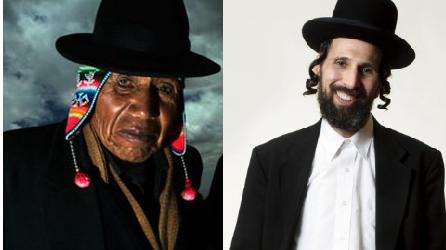
So… is this a question?
Short of imagination
A practical scheme, says Oscar Wilde, is either one already in existence, or a scheme that could be carried out under the existing conditions; but it is exactly the existing conditions that one objects to, and any scheme that could accept these conditions is wrong and foolish.
Emma Goldman

Photo: Marco Antonio Díaz, Milenio
Gee, that was easy.
The alleged killer of Juan Francisco Sicilia and his friends was detained after an “anonymous caller” told the Army 9th Battalion where they could pick him up., according to official reports.
… and here’s where it gets interesting. Rodrigo Elizalde Mora (or Morán), the alleged (er… “self-confessed” after … um… “persuasion”) perp supposedly belongs to one criminal gang, and a rival gang — undoubtedly motivated by good citizenship — kidnapped him, beat the crap out of him, hand-cuffed in a car, and dropped a dime on the alleged murderer who inadvertently set off a wave of protests against what many in Mexico see as incompetence in law enforcement and the Calderón Administration’s ham-handed response to criminality.
Apparently, those protests that some claimed were just “more of the same”, against the state’s inaction have had SOME effect: besides being forced to offer up a sacrificial victim in the person of the incompetent Attorney General Arturo Chavez Chavez; the state is, lo and behold, finally uncovering the people behind the mass murder of migrants and travelers in Tamaulipas and others whose bodies are suddenly showing up in supposedly just discovered “narco-fosas” (mass graves for victims of, one presumes, narcotics export related murder), and rounding up more than the usual quota of “usual supects”. And — remembering that Juan Francisco’s father, the poet Javier Sicilia, addressed his open letter not only to the state, but to the gangsters as well.
In a very narrow sense, this is not “more of the same”. In another, events following Juan Franciso’s murder confirms the very conditions that the elder Sicilia condemned:
We have had it up to here because you only have imagination for violence, for weapons, for insults and, with that, a profound scorn for education, culture, and opportunities for honorable work, which is what good nations do. We have had it up to here because your short imagination is permitting that our kids, our children, are not only assassinated, but, later, criminalized, made falsely guilty to satisfy that imagination. We have had it up to here because others of our children, due to the absence of a good government plan, do not have opportunities to educate themselves, to find dignified work and spit out onto the sidelines become possible recruits for organized crime and violence. We have had it up to here because the citizenry has lost confidence in its governors, its police, its Army, and is afraid and in pain. We have had it up to here because the only thing that matters to you, beyond an impotent power that only serves to administrate disgrace, is money, the fomentation of rivalry, of your damn “competition,” and of unmeasured consumption which are other names of the violence.
The state and the gangsters imagination seems only to stretch to more violence, to assigning blame, to “spin”. The response, so far, has been to overlook the heart of the problem — the absence of a good government plan, opportunities for youth to educate themselves and to find dignified work — in favor of the only things “that matters to you, beyond an impotent power that only serves to administrate disgrace, … money, the fomentation of rivalry, of your damn “competition,” and of unmeasured consumption which are other names of the violence.”
17 de abril de 1961
Boy, you think the U.S. media misunderstands events in Latin America now?
“Is this the first chink in Castro’s armor?” … uh… no.
As Cuban Journal puts it:
… On the 17th of April, 1961, the imperialists landed their Miami mercenaries, which they had not-so-secretly trained in Nicaragua and Guatemala, two nations that back then were governed by two pliant puppets of U.S. imperialism.
The Yankees thought that all it would take to overthrow the revolutionary government would be to land CIA-trained and directed mercenaries. They did not contend with the eternal vigilance of the Cuban people, who were determined to defend the conquests and achievements of their nascent Revolution.
A totally immoral man was at the White House back then; he was a known womanizer and a typical American politician. The previous president, Dwight D. Eisenhower, had approved Operation Pluto, the name given to this silly adventure created by the gooks at the C.I.A. JFK gave the go-ahead to continue the immoral, and ultimately disastrous operation.
In less than 72 hours, 66 to be exact, the people, the armed forces and the workers militias slapped the Miami mercenaries on the face and sent them to jail…
Among the 1200 or so captured invaders were 100 plantation owners, 67 apartment house landlords, 35 factory owners; 112 businessmen and 179 men who lived off investments and inheritances, as well as a smattering of C.I.A. agents, and “contractors”…
Most prisoners, excluding those who died during their captivity or of their wounds (or, like C.I.A. “contractors” Angus K. McNair and Howard F. Anderson were executed) were freed to the United States within 18 months…
Climate change change
I can’t say offhand how much energy is saved switching from brass bronze-aluminum alloy* to steel coinage, but it’s said to be substantial, and the reason for Mexico putting smaller coins into circulation.
Those are 25 cent and ten cent U.S. coins on the left, and a € 0.20 on the right for comparison. It’s a bit of a hassle with the old coins and the new both circulating right now, but I suppose we’ll adjust. Luckily, the 0.50 peso coin (slightly larger than the old 10 centavo) is ridged the whole way around, the 20 centavo partially ridged. The 10 centavo has a groove in the edge. I guess that means you can find them in your pocket… assuming you can find them at all:

* see the comments
Varieties of (religious?) experience
I have no idea where this video was taken, or what the occasion was, but it looks as if this performance by the Mariachi Juvil Oro de México was part of a religious celebration… which didn’t interfere with other worshipers following the dictates of their own conscience.
Or maybe the old lady is deaf. Either way, ¡disfrutelo!
Who you gonna call?
This month’s Telmex bill had a flier mostly designed to show us that our telephone connection rates aren’t all that outrageous compared to the United States. Objectively, they’re not: national long-distance calls average 0.79 pesos per minute, compared to 0.90 pesos for national long-distance in the United States, and connection charges are much lower in Mexico. However, the United States is a much larger country geographically, so long-distance calling may be a much longer distance, and— it’s almost not worth mentioning — people in the United States have a lot more money. And our tax on telephone use is about double that of the U.S. (19% compared to 10%).
Still, the Telmex flier is something of an eye-opener. In 1991, there were only 5.4 million telephone lines in Mexico, where today there are 15.6 million. Certainly more people have home service, but what’s somewhat eye-popping is that there are over ten times MORE public telephones in Mexico than there were in 1991: 69,000 in 1991, and 752,000 today.
And that’s not counting cellular phones. with cellular service available nearly everywhere and seemingly everyone in the country issued a cell phone at birth (even ten years ago, it was joked that you know you’re in Mexico when you go out to eat and the number of cell phones on the table is higher than the number of eating utensils), you would expect street phones to have gone the way of the buggy-whip. But no… and, come to think of it, there are people in this country who still need buggy-whips. And a cell phone.

Susanna Theissen was photographed by Sharenii Guzmán Roque (to accompany her article for El Universal) on the traditional Mennonites — recognized by the state as a “non-indigenous ethnic minority” — in Mexico City
According to “Vagabond Journey” 60 percent of the people in the world have cell phones, with those of us in the “undeveloped world” being even more connected than those in the high-tech countries:
To work almost anywhere in the world demands that you follow the communication conventions of the society where you seek employment, you need to play by the rules of  engagement. In this case the modus operandi of communication on planet earth is the cell phone. The working world no longer knows how to function without cellular communication, the personnel infrastructure of the planet is now 100% dependent on each member being easily contact each member at any time. I repeat, if you want to work on this planet –especially outside of the USA — you almost need to have a cellular telephone connected to you at all times.
Harp all you want
Today’s “The Guardian”, which doesn’t often turn its attention to things Paraguayan, but, in honor of Parguayan composer and musician Blas Flor’s upcoming London Concert, this morning there is an unsigned editorial, “In Praise of… the Paraguyan Harp“.
The harp was brought to Latin America by Spanish colonists, at a time when it was still an active part of everyday music-making in Europe, a common folk instrument rather as the guitar is today. Adopted and adapted by the indigenous population, who have cherished it ever since, the Paraguayan harp is portable, its strings close together, played with fingernails like a guitar. Much Paraguayan harp music accompanies songs in the local language Guarani, but new composers are changing traditions and expanding its use. For enthusiasts of the obscure there is now even such a thing as Paraguayan electro rock. Some folk traditions are a chore to listen to, simple and unmusical. The harp in South America is different: it is the sound of wide open plains, hot nights and cold beer.
It is very much a people’s instrument.
The “arpa paraguayano” is very much part of Mexican, as well as South American, culture. Unlike the European harp, found in concert halls (or, maybe in Marx Brothers’ movies), the Latin American harpa paraguayana is a portable instrument meant for street music. During the naked farmers’ protests in Mexico City, I once saw a guy walking down Cinco de Mayo in downtown Mexico City wearing nothing but sneakers, and toting a strategically placed arpa!
Harps were an integral part of a mariachi group, until the 1930s (the harps’ twang was hard to hear on the radio, and horns were substituted) , but there are still some mariachi standards that just don’t work without a harp. Here is Roberto Díaz and the Mariachi Internacional Guadalajara at the Festival de Marachi San Jose, California iperforming “Parajo campana”:
… and, showing the arpa’s versatility, this unnamed jaraneros in Veracruz — where not only are arpas heard and seen throughout the region, and part of any bar band, they sometimes work as double instruments. This was filmed outside the Presidencía Municipal in Veracruz and uploaded on youtube by “jolutv007” last September:
God, Sitting Bull and the free market
It was stated at one time that Sitting Bull, while hating the white Americans and disdaining to speak their language; was yet very fond of the French Canadians, that he talked French, and that he had been converted to Christianity by a French Jesuit, named Father De Smet. How true this may be is uncertain, but probably there is some foundation for it. The French Jesuits have always been noted for their wonderful success in winning the affections of the Indians, as well as for the transitory nature of their conversions, and it is very possible that Father De Smet may have not only baptized Sitting Bull at some time, but induced him and his braves to attend mass, as performed by himself in the wilderness.
Frederick A. Whittaker, A Complete Life Of General George A. Custer (1876)

Not exactly standard bling for a Sioux leader
I was looking for something completely unrelated when I ran across an article by North Dakota writer Mark Armstrong (Catholic Lane) on what appears to be a rather lively topic in some Catholic circles:
Was Chief Sitting Bull a Catholic convert? Did he convert William “Buffalo Bill” Cody? That was the scuttlebutt around Catholic circles this past week. From stories, to blogging, to Catholic radio shows, to postings from Facebook friends, I heard it multiple times.
Armstrong lays out the evidence (well worth reading on its own merits), coming to the conclusion that Sitting Bull — who was good friends with at least two Jesuit missionaries during his eventful life — probably was baptized by Father Pierre-Jean De Smet when the future Sioux leader was a teenager. As an adult, Sitting Bull was not known to have practiced Catholicism, nor — being polygamous — would he have been admitted to the community of the faithful:
This continued to be the major stumbling block to Sitting Bull’s entry into the Catholic Church. He would not give up his wives. That Sitting Bull liked family life, there can be no question. However, getting into the Church with two wives, that appeared to remain a “problem” throughout his life.
I stumbled across the Sitting Bull story while looking for something completely unrelated, but really shouldn’t be surprised. Taylor Marshall’s “The Canterbury Tales” (from which I got the photo of Sitting Bull wearing a crucifix), is more “pious” than historical in looking at the evidence of Sitting Bull’s Catholicism, but in the comments on his post, I noticed this:
The early Catholic missionaries were not there to ‘civilize’ them – that is, ‘Americanize’ or ‘Europeanize’ them. They were not there to change their culture, but to to bring them to Christ as much as possible within their cultural traditions….
This contrasted sharply with the efforts of the Protestant missionaries, who seemed to equate salvation with ‘Americanization.’ For example, Chief Moses (born Kwiltalahun – “The Sun Chief” -c. 1829–March 25, 1899) of the Sinkiuse-Columbia tribe in North Central Washington State was sent as a young boy by his father to Rev. Spaulding’s Lapawi Presbyterian school. At that school, he was beaten if he did not act ‘civilized’ enough. As a result, he turned totally against Christianity. He did have a good respect for the Catholic priests, but he could not overcome the bad taste in his life from Spaulding to accept Catholic baptism..
It’s a historical fact, whether it’s politically convenient or not, that the Roman Catholic missionaries were (and are) more tolerant of converts maintaining their cultural traditions than the Protestant missionaries have been. When researching Gods, Gachupines and Gringos, I ended up doing a pile of reading that ended up as a short footnote on the Council of Trent.
And, at least during the early conquest, before the Council of Trent standarized Roman Catholic practices in the 1570s, it was Church policy to “Catholicize” existing customs among newly Christian people. We don’t think of it in terms of European Christianity, but somehow have integrated Germanic customs like the decorated tree at mid-winter, and the Roman mid-winter festival of Saturnalia, into rituals meant to celebrate the birth of Jesus. In Mexico and Peru, with the conquest coming just before the Council of Trent (and the general independence of the Church in the Americas), the process of integrating those practices into the larger community of believers was never completed.
It goes against what one Amazon.com reviewer called my “evil white man/good indigenous people attitude,” but there was no way I could, even if I wanted to, ignore, the tremendous success early missionaries in Mexico had in conversions among the indigenous peoples, and — their willingness to tolerate the survival of indigenous culture… although that often meant dressing the culture in the guise of European-style Catholicism.
Of course, there were “back-sliders” and heretics among the Aztecs and Mixtecs. Zapotecs, Mayans… Bishop Landa of the Yucatan, was notorious not only for the holocaust of Mayan books, but for his persecution of Mayan shamans for whom adherence to the new faith would have been more difficult than for those owing less allegiance to Chac or the Bacab… or who failed to dress them in the panoply of recognized European saints.
This is what ties Sitting Bull to Mexico. His fame with us rests on his symbolism as one of the last great indigenous leaders to successfully (for a time) resist the destruction of his people. But, Sitting Bull’s leadership did not come from recognition among the Sioux of his military acumen, but from his prestige as a shaman… a “medicine man” to use the slightly perjorative (and wildly inaccurate) U.S. English term.
This is not to take anything from Fr. DeSmet, who was in the tradition of those like Bartolomé de las Casas, Vasco de Quiroga, Pedro de Gante and Toribio de Benavente Motolinia — none of them saints of the Church, but all remembered among the indigenous people of Mexico (and other Americans) as those super-humans who recognized our common humanity. He did, like the Mexican missionaries who saw baptism as the first step in guaranteeing the acceptance of the indigenous people as equal to the Europeans, probably baptize everyone he could… probably including the 17 year old shaman’s apprentice.
Nor is this to lay doubts as to the sincerity of Sitting Bull’s religious beliefs. It’s said he was a sincere enough Catholic to try to convert Buffalo Bill (who did convert to Catholicism on his deathbed). The 13 April 1883 New York Times included a two sentence report reading: “Milwaukee (April 12) — Bishop Marty, of Dakota, now in this city, says Sitting Bull will soon join the Roman Catholic Church. There are now 2000 Indians in Dakota belonging to the Catholic Church”. Fine, but if Sitting Bull was baptized when he was 17, he’d already been a Catholic for the last 35 years.
We know his murder was a result of his interest in the Ghost Dance movement, a syncretic pan-indigenous religious revival that swept the American west in 1890. Despite his reduced circumstances (partially brought on by his refusal to eschew his secondary wife) as a “reservation Indian”, Sitting Bull was still a recognized leader among the remaining Sioux. Attempting to arrest him (on no particular charges except maybe being a religious leader) he resisted, his family shot it out with the reservation police and he was sent… to the arms of Jesus? To the Great Spirit? … 15 December 1890.
Sitting Bull’s religion — whether traditional Sioux beliefs, Catholicism, the Ghost Dance, a combination of them all, or something of his own — is, of course, an academic issue, and perhaps a footnote in someone else’s history of the Americas. But, as I said, I’d run across this intriguing “footnote” while rummaging around another issue… specifically, Brother Steve DeWitt’s “God is not a capitalist” on his website, A Franciscan Abroad.
As the title indicates, DeWitt takes exception, as much on religious as economic grounds, with theologian Jay Richards’ attempts to find a theological justification for “free market” capitalism. De Witt’s “abroad”, Bolivia and Peru, like other Latin American nations, have been working out, arguing and sometimes fighting over their own syncretic versions of the varieties of economic “religions”, more and more finding that their own “indigenous” systems — even if in dressed in European style — work for them.
The “Mexican System”, which prevailed for most of the last century, owed a bit to Spanish anarchists, a bit to Karl Marx and a lot more to Emiliano Zapata, Pancho Villa and Alvaro Obregon, and the Aztecs… as synthesized by Lazaro Cardenas. In South America, the “bad lefties” (the “heretics” to “free-market capitalism” come indigenous (Evo Morales, most of the Zapatistas) or from Roman Catholic (Hugo Chavez, the son of catechists; Rafael Correa, a former lay brother; Fernando Lugo, Jean-Bertrand Aristide and Miguel D’Escobar, all laicized priests) belief systems. And, those Roman Catholics are form a syncretic American form of Catholicism, Liberation Theology.
Good luck to Jay Richards in his quest for to find the hand of God in the invisible hand of Capitalism… but, should he try spreading his faith abroad — unless like the Presbyterian preachers who beat Chief Moses, he plans to impose it by brute force … he’s unlikely to succeed and more likely to make us “savages”, like Chief Moses and the Christians, reject any variation of the one true faith. What might be accepted — in matters of faith (including economic faith) — is our right to work out our own version of what we’ll call “free market” capitalism, perhaps unrecognizable in the flesh, but one in the spirit.
Peru and that “sea-change” in Mexico
The thing about conventional wisdom is that it is often wrong. In February, regarding the Peruvian elections, I wrote:
It appears that former President Alejandro Toledo (Perú Posible) has a commanding lead, but not enough to avoid a run-off. The big fight is for second place, with Luis Casteñada (Solidaridad Nacional) and ex-dictator Alberto Fujimori’s daughter, Keiko Fujimori (Fuerza 2011) fighting it out between them, and both angling for undecided, other, and uncommitted voters.
At the time, I described Ollanta Humala as “far behind and losing support”. Oh well: the early returns show Humala leading by at least 12 percentage points over his nearest competitor, either Keiko Fujimori, or a candidate who didn’t even rate a mention in my February post, Pedro Pablo Kuczynski. Peru has multi-party elections, and a run-off if no candidate receives at least 50 percent of the vote (and voting is mandatory in Peru).
Toleda and Casteñeda basically evaporated as candidates since February, and “PPK”, being the last best hope for a conservative neo-liberal (or at least not rocking the boat) economic policy, received late support from the main party, APRO. The conventional wisdom is that IF “PPK” is the second place finisher, he’ll win the run-off. Of course, that may be wishful thinking on the part of foreign observers, Ollanta and Fujimori (the likely candidates for the run-off) — who are both popular with the have-nots (the Peruvian majority) scare the bejesus out of the establishment… having been famously described by Mario Vargas-Llosa as a choice between AIDS and cancer.
 I described Humala as a “conservative populist”, basically because I was discussing social policy and politics: Fujimori, Casteñeda and Toledo had all backed gay civil unions or gay marriage in their bid for what has been an overlooked voting bloc, while Humala had — in his previous bid for the presidency — used vehemently homophobic rhetoric.
Fujimori, seen as a stand-in (at least in the foreign press) for her father, the rightist (and now imprisoned) Alberto Fujimori, probably will be considered preferable to the foreign powers to Humala, who last time out was presented as a Hugo Chavez clone (like Chavez, he is an economic leftist from a military background), although part of his success has been in crafting a less radical image, appearing in business suits, rather than a red tee-shirt, and taking pains to avoid allowing his opponents to tag him as a tool of the Venezuelans.
Alberto Fijimori’s economic politics, “Fujishock“, did — in the short run — improve Peru’s economic condition, and the lot of many Peruvians. But, much like Ronald Reagan’s policies in the United States, the neo-liberal assumptions that wealth would trickle down proved untrue. Keiko’s economic policies seem to be pretty much the same as her father’s, although perhaps with a bit more promises of public assistance for those left behind.
And, while the conventional wisdom is that Keiko Fujimori holds the 20 percent or so of support any Fujimori backed candidate would receive (even after his imprisonment, the ex-president’s political machine remained powerful), and one can assume that the other neo-liberal candidates will reluctantly throw their support to Keiko.
But, Humala is very much in the “mainstream” (if that’s the right word) of Latin American — especially Andean — leftists. Peru is surrounded by left-wing populist governments, and its two closest neighbors, Bolivia and Ecuador, both have chosen leaders attuned to the indigenous majority, the “have-nots” and their customs and beliefs, who have been able to co-opt the intellectuals by packaging their programs in post-modern formats (think of the “rights of nature” in Ecuador, putting environmentalists and indigenous peoples on the same side of the Correa administration). Secondly, no one can seriously deny that these “leftist” countries are succeeding in the one way that the rich countries measure success… they’re showing economic growth.
Peru’s growth has been good, but — and this seems key — the “have-nots” have not benefited. Even the Miami Herald — known for clutching their collective pearls whenever the left appears anywhere in Latin America — can’t miss this salient fact:
From beyond its borders, Peru’s breakneck growth — it’s expected to surge 7 percent this year — is a matter of envy. But inside the country, many feel left out of the boom, said Manuel Torrado, president of the board of the Datum polling firm.
Only 5 percent of the population say they would keep the current economic model, and a full 51 percent say they want a dramatic change, according to Datum figures.
Which brings us back to Mexico, where the Presidential elections are still fifteen months in the future. The “sea-change” in attitudes towards the “drug war” has, perhaps, less to do with the gangsterism and security issues, than a sense that the security situation is a symptom of a sclerotic political system in need of radical change. Mexico’s growth rate is well below that of the “leftist” countries, and the excuses — the “war on drugs”, the flu, the U.S. banking melt-down — for the anemic performance are also being questioned.
As with the Peruvians, vast numbers of Mexicans feel left-out of the neo-liberal economic system favored by the two largest parties (PRI and PAN) and accepted, to some degree or another, by almost all of them. At the same time, what might be labeled “progressive” social issues (abortion and GLBT rights, justice system reforms, environmental protection) are pushed to the back burner by the focus on crime and punishment.
Humala received about a third of all Peruvian votes, about the same percentage AMLO and the “Benefit of All” coalition got in the 2006 election here. With a large abstention, at least a good part of which was due to the Zapatista calls to boycott the election precisely because the present system didn’t work, the percentage of Mexicans ready for a radical change may be even higher today.
Is there, as in Peru, a call for “dramatic change” by 51 percent of the populace? I have no idea if Humala can transform that call for dramatic change into success at the ballot box in the second round. Or is it clear that Peruvians see Humala as the agent of whatever change they want.
But, win or lose, the Peruvians will be demanding change. In Mexico, the attempts to change within the existing system having been thwarted in 2006, the movement towards radical change has been on hold, seemingly for the duration of the “drug war”.
The sea-change in Mexico is not calls by a poet for a separate peace in the “drug war.” Al Giordino (NarcoNews) gets a little carried away (ok, goes overboard) in his rhetoric, but hits on the important point:
… those who have long had and voiced their grievances with “the evil government” of Calderón have intelligently latched on to the anti-war-on-drugs cause as their own, too, because they smartly percieve it as a “wedge issue” that encompasses the whole of national discontent and which could very possibly result in the toppling of an authoritarian president, “elected” only via well documented electoral fraud, with absolutely not a shred of moral authority among his own people. In just one week, humble and dignified Javier Sicilia has collected the free-floating moral authority that nobody else could credibly assume in this Failed State named Mexico and supplanted the napoleanic Calderón as the moral leader of a nation.
It’s not the “napoleonic” Calderón that’s holding back the sea. As Charles DeGaulle (a Frenchman often compared to Napoleon — Calderón, being Mexican, has been better compared, unfavorable, with Santa Ana) observed “the cemeteries of the world are full of indespensible men.” Calderón is only one tiny part of a system of political and economic stagnation, likely to be washed away when that sea-change turns into a tsunami of protest.
Well-chosen words for Sunday
Scott Hensen (Grits For Breakfast) happened to be talking about the growing problem of corrupt (and corruptible) Border Patrol officers in the United States, but the same holds true for the security (or lack of security) situation here.
You could see this co
ming a mile away, but now those whose, ill-conceived, feel-good policies created this situation five years ago want credit for trying to clean up a preventable mess of their own making: Further evidence, if it were needed, of the results when demagoguery and policymaking collide.

Adrianne Pines (Quotha), follows up with a rather prescient statement probably not made with Plan Mérida in mind, but nonetheless, applicable:
The most absurd apology for authority and law is that they serve to diminish crime. Aside from the fact that the State is itself the greatest criminal, breaking every written and natural law, stealing in the form of taxes, killing in the form of war and capital punishment, it has come to an absolute standstill in coping with crime. It has failed utterly to destroy or even minimize the horrible scourge of its own creation.

(From “Anarchism and Other Essays”, Emma Goldman, 1910)

Photo of Real de Catorce: Mexico-a-holic.com
Darcy Tetreault (Upside Down World), in looking at another issue, mining — where foreign capital and a hankering for Latin American commodities also leads to violence, repression and corruption — writes:
Most Canadians would probably be surprised to hear that, in academic and civil society circles, Canadian mining has come to epitomize rapacious capitalism and imperialism. Canadian companies dominate the mining sector in Latin America, with interests in over 12,000 properties. In 2010 alone, at least five social activists were murdered for protesting against Canadian mining activities, including Abarca Roblero, who opposed Blackfire’s operations in the Mexican state of Chiapas.
First Majestic Silver is contributing to this notorious reputation. It is currently seeking local support and ways to convince government officials to grant permission for mineral extraction in Wirikuta. As part of this effort, company representatives have opened a museum in Real de Catorce and they have hired 15 locals to clean up the entrance to the old Santa Ana mine. Pay is between 70 and 240 dollars a week, a pittance compared to what the company is worth (1.58 billion dollars), but hard to refuse for people living in poverty. This strategy is not new: by offering jobs to some, mining companies can divide the local population and conquer. Another common strategy is to invent subsidiaries with Spanish names – in the case, Minera Real de Bonanza – in an effort to promote a Mexican public image.
Bob Mrotek (Mexico Bob), beginning with reminisces of his Catholic School readers (which featured David and Ann, rather than the public school’s Dick and Jane) looks at Mexican primers:

After the Mexican Revolution the Mexican Constitution was re-written in 1917 to include the provision that elementary education must be compulsory and that all education provided by the government must be free. Furthermore, the education should be designed to develop harmoniously all the faculties of the human being and should foster in each citizen a love of country and a consciousness of international solidarity, in regard to independence and justice. This was all well and good but the students were required to purchase their own books and many of these books were expensive beyond their reach and at the same time of dubious origin and quality. There were a number of important men who realized that access to good books would be a key ingredient in the education of the populace. One of these men was José Vasconcelos Calderón who was a Mexican writer, philosopher and politician. He was one of the most influential and controversial personalities in the development of modern Mexico and he was the driving force behind many efforts to make education accessible to everyone. He created the Secretariat of Public Education (SEP), in 1921 and later directed the National Library of Mexico in 1940. It is ironical that he died in June of 1959, just four months after Mexican President López Mateos created the National Commission of Free Textbooks. One year later in 1960 the free textbooks began flowing to the students. The first of these textbooks were reading primers.
…The difference between the David and Ann, Dick and Jane books of the United States and the Mexican book was that the former focused on white, middle class, and idyllic family settings while the later focused on simple things that all children could relate to no matter what their status. If you mention the phrase “Ese oso se asea así” to just about any Mexicano or Mexicana in their 40’s or 50’s I am sure that you will evoke a smile.


 mexfiles.net