¡COMO MEXICO NO HAY DOS! Mexico's hsitory and culture, the Real, and the surreal, Mexico. Politics, economic, news sometimes here, but regularly posted at mexfiles.substack.com. Copy and quote freely, but be respectful, and acknowlege the source. And, of course, monetary donations help keep the site going.
Elena Jackson Albarrán, a Miami University professor of Latin American Studies, in “The Conversation“:
Latin America’s ambivalence toward holidays to commemorate the colonizers has taken a turn since 1992. The 500-year anniversary of Columbus’ arrival corresponded with yet another form of colonialism, in many Latin Americans’ eyes, as a new wave of multinational corporations colluded with heads of state to tap the continent’s oil, lithium, water and avocados.
Activists used the commemoration to call attention to lingering economic, social, racial and cultural inequities. In particular, the anniversary inspired Indigenous rights movements – some of which commemorated an “anti-quincentenary” to celebrate “500 years of resistance.”
While no one really thinks Columbus discovered America… it was always here… there are plenty of contenders for who was “first” to travel from the eastern to western hemisphere, previous “discoveries” were either accidental (like those of Japanese fishing boats that washed up in the Baja Peninsula sometime in the 13th century), relatively unknown expeditions simply for the joy of exploring (such as the early 14th century voyage of Emperor Abubakari II of Mali), or small scale settlements, like Leif Erikson’s “Vinland” of around 1000 AD). Along with various legendary voyages, all… like Columbus 1492 expedition… based on the assumption that the Americas were just waiting to be discovered, and overlooking the very real possibility that people from the Western Hemisphere might have gone the other direction (by accident or design) … but, none of those previous voyages had the impact of the one in 1492.
That Columbus — Cristobel Colon, or whatever he real name might have been — was a particularly gifted late medieval skipper isn’t to be doubted. Nor that he was any better, or worse, a human being than any other sea captain of his time. Floggings, hanging or beheading disobedient sailors, taking hostages, rape and sodomy (“rum, sudomy and the lash”) were stanards of his time, and he was of an era when “conquest” had yet to be renamed “genocide”.
That Colomus was a dick, that he didn’t discover the Americas, is not what should be celebrated or bemoaned or even remembered today… rather that we can date a plantary change… in ecology, agriculture, human relations, economics. the whole of human existence… to one moment in October 1492.
It may be Friday the 13th, 2024, but the unluckiest day in Mexico was a Monday: 13 September 1847. Around 8 AM that day, Santa Anna — despite promises to fight the invading US street by street — withdrew his forces from Mexico City. Scott would later claim (and US historians usually accept it as gospel) that other than some rioting by prisoners who escaped from the local jails, there wasn’t all that much resistance, but Manuel Payno (a lieutenant-coronal in the Army at the time). and Vicente Riva Palacio (then a cadet, and survivor of the Battle of Chaputepec), as well as other Mexican historians, like Guillermo Prieto, paint a very different story.
While true that Riva Palacio, as a “man of letters” sometimes “embellished” the story (notably in a memorial address on the anniversary of the Battle of Chaputepec, raising four that he mentioned by name, to mythic status as the “Niños Heroes”) the carefully documented “El libro roja”written in collaboration with Payno and others notes that Scott had recruited ann “advance force” in Puebla.. from their own prisons and jails. Before entering the city, he sent in his mounted and equipped team of “muderers, rapists, and… some just very bad people” to run amok and “soften up” civilian resisters.
The regular army, however, despite the odds, did face fierce resistance, although kitchen knives, rocks, old muskets, and even flowerpots were no match for artillery and trained sharp-shooters. Buildings from which attacks on US soldiers were attacked were leveled with cannons, and the inhabitants — male, female, and child — were massacred. Still, it took two days before the Stars and Stripes were finally raised over the Palacio Nacional, although the first attempt failed… some unknown patriot having shot the unluckey trooper assigned by Quitman to hoist the banner.
Even during the occupation, while the elites and the US “diplomats” worked out a deal to take the land the US craved, there was continued low-key resistance in the city. US soldiers would be mugged (or worse) if on their own, and allegedly, patriotic street walkers joined in, those with syphilis finding a way to give their all, and — in an era when there was no effective treatment — to at the very least die for their country.
History, it’s said, is written by the victors, and the hstiory and myyths of the losing side in a conflict are often left to find rationales for their defeat. But, in putting the focus on the villains and traitors (like Santa Anna) we miss that history comes from below… not the oligarchs and traitorous generals, who rolled over in the face of what U.S. Grant would later call “the worst injustice one nation has ever done to another”, but in those anomalous nobodies that stood up to that injustice, and should be the mythic heroes we manage to cull from the flames of war.
Sources: Payno, et. a.. La libro roja (1905, A. Polo, Mexico).
Jay, William. The Causes and Consequences of the Mexican War (1849, Benjamin B. Mussey & Co., Philadelphia).
Grant, Ulysses S. “The Complete Personal Memoirs of Ulysses S. Grant” (reprint 2009, Create Space).
Lopez y Rivas, Gilberto, “Septiembre de 1847: resistencia popular a la ocupación estadunidense” (La Jornada, 13 September 2024).
Trying to write something on José Vasconcelos, but being bogged down in other matters, this site has been neglected for too long. While still wrestling with how to deal with the maddening Vasconcelos, on the one hand a progressive, on the other, a nazi supporter, making sense of his views on “race” is a challenge. Like so many early 20th century intellectuals, he was hung up on “”racial science”, but turned the usual (European and North American) assumptions on their head, arguing that the mixed ethnic heritage of Latin America made the “meztiso”, the standard issue mixed race peoples of Latin Ameica the “master race” in a sense..
While as nonsensical as any other “racial” theories, Jorge Durand — who has been publishing about migration and population changes for decades, looked at Mexico’s own recent election, and the upcoming one in the United States, to discuss the way “race” and identity are viewed differently … or more precisely, in this article translated from “El visor de la raza” in today’s Jornada… at how that affects, or doesn’t… politics. I left a paragraph or two out, mostly because it explicitly deals with Dr. Durand’s own biases in this election (hint, I agree with him that Trump is nuts), but this is my culture site, my politics one being at https://mexfiles.substack.com/.
A few weeks ago, while discussing with an American colleague the candidacy of Kamala Harris, she noted that if Harris wins the election, it would mean the President of the United States will be a black woman, and the President of Mexico a Jewish woman. Apparently Claudia Sheinbaum’s Jewish origin has been widely discussed in the United States. It’s my American friend’s way of seeing the world.and society.
It’s true that in Mexico there were comments in the press about the Ashkenazi origin of the surname Sheinbaum, and two or three gaffs, such as a racist “tweet” byVicente Fox, but we could say that 99 percent of Mexicans were interested in the matter.
However, in the United States (and for my colleague), race remains a vital issue, even more so when it comes to someone who aspires to the presidency. For Donald Trump, this issue is a kind of obsession. So much so that he questioned the nationality of Barack Obama, who was the son of an African father and an American mother. Even when Obama was president, Trump demanded that Obama show his his birth certificate.
Apparently, Trump sees the matter in black and white and considers intermediate types, such as Obama, who is technically “mulatto”: 50 percent white and 50 percent black, itself an inappropriate way of seeing others. According to the traditional, socially accepted criterion in the United States, what defines a black person is a drop of black blood. Strictly speaking, miscegenation is not accepted nor are there criteria or words to define ambiguous cases.
However, the official criteria of the US census accepts a series of nuances and tries, in some way, to sort out a multiracial mess that exists today. The census includes byone “black” or “white” categories for “non-Hispanic white” and “non-Hispanic black”. And in that we are to blame, because Hispanic-Latinos can be black, white, Asian or some multiple combinations.
But, to be clear, a “white Latino” is not “white” nor would mulattoes, sambos, prietos and other Latin variants1 that should properly be considered as Latinos, even if they are treated as blacks. Apparently, that census box assumes people are “pure” white or “pure” black, with no admixture.
Furthermore, the census has included a new category for those who consider themselves to have two or more races. And it is a box that grows day by day, in 2020, they constituted 10.2 percent.
Kamala Harris parents are immigrants from Jamaica and India, both educated at Berkeley, at a time when this institution was considered radical, and went on to distinguished careers.. Unlike the Obamas (Barack and Michelle), Kamala did not study at a “mainstream” university like Princeton, but to the historically black Howard University. Her blackness comes from having lived with her Indian mother in the black neighborhood of Oakland, and attending a (black) Baptist church. It was a way to integrate, within the racial strictures of the United States.
If Donald Trump was bothered by Barack Obama’s tanned skin and doubted his nationality, the matter has become more complicated with Kamala Harris, as he questions her blackness. He cannot criticize her for being black, so he says she is not authentically black and gets caught up in his mental juggling, saying that she identifies herself as Indian and not as black. Perhaps Trump thinks this will win over some black men.
The racial and demographic composition of the United States is rapidly changing… a decreasing percentage of “whites”, a stagnant percentage of “black” is stagnant and significantly growing percentages of “Latinos” and “Asians”, along with the percentage of those saying they are of two or more races. To ignore this is to not know the country.
Durand is referring to the retro terms (dating to Bourbon colonial attempts to define categories of colonial subjects by ancestry that still hang on among latin americans today. The terms he uses were “gradations” of “black” ancestry…
To great ballyhoo (pushed by, and paid for by Dr. Simi — that is Victor González Herrera of the Dr. Simi pharmaceutical chain), a relic — said to be the arm bone of Jesus’ replacement apostle, Judas Tadeus (called “Jude” in the English language bibles to distinguish him from the bad Judas) — made an appearance his week at the Metropolitan Cathedral.
One can be rather cynical and quite skeptical of the claim that the bone belonged to a person said to have been beheaded in Beirut in 65 AD, or that it in itself possesses any particular power or mystical value… but then again, whoever Jude was (the Acts of the Apostles suggest he was either Jesus’ cousin or little brother, and may have been the groom at the wedding where Jesus brought the booze… Judas — this one — being mentioned as married, and assisted by his wife in his work as one of Jesus’ first 12 followers (proving incidentally, you don’t need a lot of followers to be an influencer) is a major influencer in Mexico, especially in Mexico City.
For whatever reason (as the Wikipedia puts it); “According to tradition, after his martyrdom, pilgrims came to his grave to pray and many of them experienced the powerful intercessions of St. Jude. Thus the title, ‘The Saint for the Hopeless and the Despaired’.”
Hopelessness and despair can be the default when you are poor, especially in the bewildering and a denizen of (to use a cliché once standard with the Associated Press) the “teeming slums” of Mexico City… “el monstro”.
To get by, you need a friend, a patrón at your side. And Jude fits the bill. Whether or not the friend is imaginary is irrelevant. As a patrón, there is some expectation of a transaction for favors given, and his terms are easy… faith, and perhaps a visit. His regular hangout is the Church of San Hipolito, dating back to the 16th century, but since the 1920s, staffed by Claritian priests, an order particularly associated with Saint Jude.
The Claritians, the “Congregation of Missionary Sons of the Immaculate Heart of the Blessed Virgin Mary” were founded specifically to serve the underserved and forgotten. Their “mission statement” specifies
We are sent to evangelize by listening to the poor. One cannot be a Claretian if one acts as if the poor did not exist. Nor can one be a Claretian if one does not denounce unjust structures, fight against the system that subjugates the poor, and propose alternatives.”
They have worked in Mexico since the 1920s when, in the post-Revolutionary anti-clerical era they worked mostly underground… perhaps fitting them even better for serving and underserved community. As an order, one thing they’ve been noted for is their linguistic training… often serving in minority language communities. San Hipolito had, and may still have, an Anglo priest (whose name I forget) who preached in Caló … the “underworld” slang of Mexico City (comparable to cockney in London) and uses words that in that in “proper” Spanish would give a heart attack to a nun.
And, so… when asking for favors, and although the “official” feast of St. Jude is 28 October… the 28th of every month is one of the better days to call on Jude for help. Not that officials — ecclesiastic or otherwise — have a say in the matter. As the scholar of religion Bernado Barranca V. writes:
Saint Jude Thaddeus is one of the most venerated saints in Mexico, known for his closeness to the faithful. He is a giving saint, effective in the so-called exchange of spiritual goods. Many temples are consecrated in his honor. Many refer to him affectionately as “Saint Jude,” highlighting his popularity among young people only surpassed by the devotion to the Virgin of Guadalupe.
The adhesions to Jude Thaddeus are explained in the field of popular religiosity that so bothers the exquisite Mexican Catholic hierarchy. It is the faith of the poor and the simple. It is the religious expression of those believers who do not have access to medical insurance, do not have access to credit, do not have Internet and barely survive. This religiosity is lived, not thought, suffered and enjoyed. Fortunately, it is not at the mercy of dense ecclesiastical doctrines.
Popular religiosity is as dramatic as it is supportive. It is the faith of poor people who do not have access to vaccines or treatments, they do not have IMSS. They are the abandoned by the system, who clung to the protective mantle of the dark Virgin and to the detentes, shamanism and everything that symbolically protects them. Because they have no alternative! The devotion to Judas Thaddeus is the religiosity that can be subversive because it is beyond ecclesiastical canons and holds resentment against power for being abandoned. It is a thermometer of the life and moment of a people. The devotion to Guadalupe increases in times of crisis as occurred during 2015 and more recently in the pandemic. Thus, Saint Jude appears and reappears when conditions become more pressing.
That those with no alternative sometimes work outside the strictures of bourgeois convention, or… well… the strictly legal (or, definitely not legal), devotion to St. Jude is more “reputable” or acceptable to “dense ecclesiastical doctrines” than, say, Santa Muerte, or Jesús Malverde. As Barranco adds:
The majority of devotees of Jude Thaddeus, as it was said, are young people. The universe of crime, drugs and unemployment are united. The young, in “Juditas,” ask for opportunities and supports to achieve a better life. Saint Jude Thaddeus often walks, like Saint Death, between the line between what is forbidden and what is attainable. Many of his rituals are clandestine, and not all of the practices he performs are permitted by the Holy See.
Although, one wonders if Dr. Simi — whose fortune rests on selling cheap generics and cut rate medical services outside the system hasn’t glommed on to the saint of the poor and dispossessed more as a marketing ploy than out of any sense of piety. But then again, as a well-known Latin American cleric was heard to say about other “not quite ecclesiastically approved activities, “Who am I to judge'”.
A “typical” Mexican family in 1930. The Mexican population fell dramatically between 1910 and 20… not, as some suggest, entirely due to Revolutionary violence, but also given the worldwide flu pandemic of 1918-20 and massive emigration to the United States.
But, by the 1970s, it was beginning to become apparent that Mexico was rapidly acquiring more mouths than it could feed. Between that and the introduction of “the pill” (Mexico’s greatest gift to public health, a close second being the ball-cock… the devise that made indoor plumbing feasible for the masses). As a result, and quite “progressive” for a country dismissed for its alleged “machismo”, it was the first to include a constitutional right to birth control
Which Mexican women and men have taken to much more than one might expect. Where the “replacement rate” of live births is 2.27 per woman, in Mexico it is 1.6… and according to CONAPO (Consejo Nacional de Población), whereas as recently as 2018, a third of women said they had no plans to have children, fulling half say so now.
No chance any Mexican politician would dare insult “childless women”.
“No fear” may have been a popular clothing brand a few years back, but I doubt any of us could … in real life… show the sang froid of Fortino Sámano did on the 12th of June 1917. He finished his cigar with a smile on his face, waiting for the firing squad.
At most, the short presidency (1930-32) of Pascual Ortiz Rubio is relegated to a mere mention in surveys of Mexican history. Overlooked is that he was the last president to have been a victim of a serious assassination attempt, and that the botched assassination had major — and unexpected — consequences for the future of Mexico.
Although the Revolution had managed to overthrow the old oligarchy, there was no consensus of what would come next. Obregón, having come into office following an attempted coup by (or at least in the name of) the interim president Adolfo de la Huerta (serving following Carranza’s attempt to continue in the presidency following his term, and a brief civil war ending in Carranza’s death, possibly a suicide) in 1920 (fearing, among other irregularities, and attempted military uprising by one of the other candidates, who ended up before a firing squad) mused that with insurgentes of the 19th century overthrowing the Viceroyality, the Reformists overthrowing Santa Ana and the Church, and the Army overthrowing oligarchs, who would be overthrowing the war-lords. His own policy was to wherever possible subvert the other generals, famously saying “No Mexican general can withstand a barrage of gold pesos.” Those who refused to play along… well, Obregon had not become the winningest general of them all for nothing.
When his slightly abbreviated term ended, to no surprise, it was his close ally Plutaro Elias Calles who replaced him. Where Obregon was seeking to impose his vision of society on Mexico including weakening the Catholic Church’s power and influence, Calles went at it with a vengance, touching off a counter-revolution in the Bajio… the “heartland of Mexico” as well as a string of smaller military and civil revolts, including the Yaquí War…the last major “Indian war” in North America.
While Calles and Obregon both had their successes in reforming the Mexican state and in some manner, creating a more just society, stability eluded them. Obregon’s legislative supporters pushed through a constitutional amendement, which would — or so it was hoped — restore some stability and kick the problem of succession and continuity in administrations down the road. The presidential term would be lengthened to six, instead of four, years, and — although “no re-election” had been the battle cry in 1910 — re-election after being out of office a term was permitted. And so, with Calles’ overt support, Obregon was elected to a six year term in July 1928. Only to be gunned down by one of those Catholics (Juan Toral) who had taken to terrorism in response to Calles extreme anti-clerical policies.
Calles, to his credit, did not simply stay on, but followed the letter of the constitution, allowing the Interior Minister, Emilio Portes Gil, to serve as “interim president” until the next legislative election, when there would be a simultanous election to fill the rest of the six year term. For an “accidental president”, Portes Gil did a better job than expected, largely bringing the Cristero War (that religiously motivated counter-revolt in the Bajio) to a conclusion, while leaving the political future of the country to Calles.
Calles, to give the man some credit, or perhaps just recognizing the high mortality rate of the surviving war lords, and borrowing from Obregón’s policies of subverting, or coopting his opponents, built an “all sides” party … business and labor, neither left nor right, but giving something to each, but large enough a coalition to over-master any dissent: the PNR… somewhat modeled on the Communist Party of the Soviet Union, somewhat on the Fascista Party of Italy, something from “Tammany Hall” in the United States, all adjusted to the conditions of Mexico at the time.
Not that Calles was going to give up control, but through a party, with the consensus of his caregully chosen Central Committee, could extend his power. His eye fell on Pascual Ortiz Rubio, who’d been a military subordinate in the Revolution, but had been more or less “on ice”, serving various diplomatic posts largely out of the public eye. At the same time, the well-respected José Vasconcelos — philosopher and educational reformer, who had broken with Calles — decided also to mount a run for the “Eagle Throne”.
With the new party behind them (and, with a logo leaving no doubt they were THE party of the state… and, yes, their successor party uses the same logo), Portes Gil oversaw a smooth… if decjdedly corrupt… campaign to put the relatively unknown Ortiz Rubio into the Presidency.
Taking office, on the first of December 1929, the first president from the party, that would continue to hold power (even with two reformations and name changes along the way) until the end of the century, the crafted plan for creating a stable political system was very nearly undone the day he took office. What exactly happened, beyond “somebody” shooting the president (on his way to a party) two months into his term, 5 February 1930. For certain, Ortiz Rubio was shot in the jaw, and — while there is almost no doubt over who shot him or why — the whole affair seems to have been flushed down the memory hole. For… reasons?
As with Obregón’s (presumptive) assassin, Juan Toral, Ortiz Rubio’s (presumptive) assailant — Daniel Flores Gonzalés — was an active member of the pro-clerical underground. As he would confess (under tortune?) but later deny in an Supreme Court appeal two years later , Toral’s father, and Flores’ father certainly knew each other… Toral Sr. being Flores Sr’s lawyer and “man of business”. Toral admited, and Flores would first admit, then deny, being members of cells of the secretive “National League for the Defense of Religious Freedom”. Although Flores was a “country bumkin”, a small town boy, he had at least corresonded regularly with the Pro Suarez brothers and their allies (who’d attempted unsuccessfully to assassinate Obregon… twice). And, at any rate, Flores had been caught with the proverbial “smoking gun” in his hand, being tackled by unlookers as the President had emerged from his car.
While, for some unclear reason, there was an attempt to blame the attack on Basques, or on Vasconcellos (Flores admitted in court to having voted for Vascncellos, but denied a political motive), and his actions… travelling from San Luis Potosi to Mexico City (where he’d never been before) in the company of his priest, stopping along the way to visit another priest…. and, in the Supreme Court papers… .having visited the Basilica of the Virgin of Guadalupe to have his pistol blessed. All the indications that the assassination was religiously motivated.
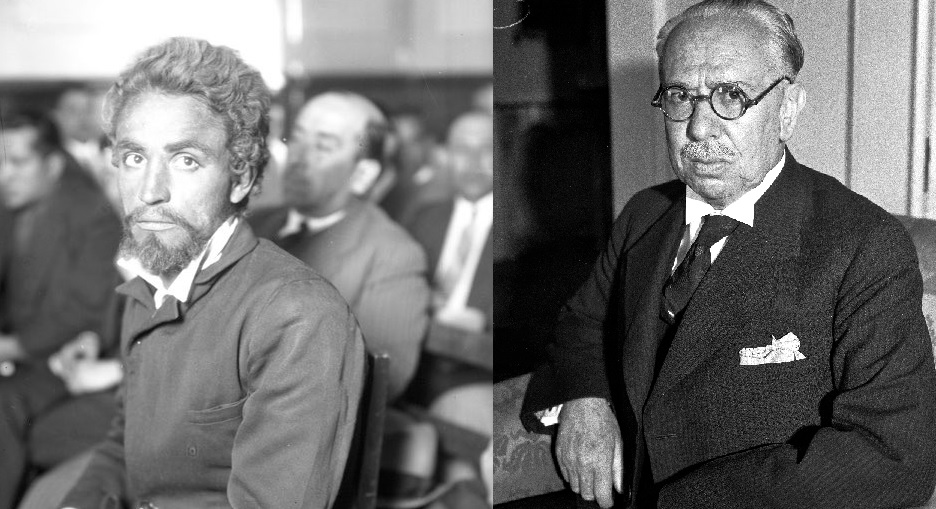
Flores at his trial, Ortiz Rubio 1932
However, Flores’ trial was a disaster. He was uncooperative, fired his lawyer half way through and continually contradicted himself. After hearing his appeal, he was sentenced to 19 years in prison, but died in 1932, under HIGHLY suspicious circumstances… he was only 25, and his death certificate attributes his dealth to a heart attack, although it was apparently discussed in the Cabinet, and among party leaders, how best to dispose themselves of the embarassing would be assassin. One popular theory is that an indigenous curandaro or rather wiitch-doctor (curanderos being presumably on the side of their patients) to prepare a poison, although it’s more likely Calles sent a hit man.
Which leave the question of why… why forget the event? If Flores was just a nut, why the high level discussions about how best to dispose of him? Vasconellos had gone into voluntary exile after his defeat, and showed no interest in mounting a counter revolution, and had not particular love for the Cristeros. And even the Church found Flores something of an embarrassment: having reached an understanding with the state, it had written off Flores as a “lone nut”, a fanatic… at most the pawn of his country priest, himself rather extreme in his views.
Still, the new party rule was not as secure as it might appear, and having lost the support of Calles, who regarded the president as a mere tool, there might have been suspicions raised that Calles himself had wanted to rid himself of a man largely seen as a mere puppet. Which is a bit unfair to Ortiz Rubio, who tried, even without the support of his supposed mentor,to fulfill the party’s promises of a better life for the people. Ortiz Rubio did push through a workers compensation bill… several months before Franklin Roosevelt was able to do so north of the border, and did what little he could to curb official corruption within the administration.
Seemingly forced from office (whether it was PTSD from the shooting, or just disguest) and said to have read he was resigning for health reasons (although he’d live a long life, dying in 1963 at the age of 86), he would resign om September 1932, not just clearing the way for the more Calles-friendly honest rogue Abelardo Luhan Rodriguez but leaving him the time and energy to act as an unofficial “mentor” to his fellow Michoacán native, Lazaro Cardenas del Rio.
The Party would survive Calles, going left, then right, then left,, then right well into the next century, although presently it’s future is in doubt.
While we remember the 1968 Summer Games in Mexico City mostly for the wrong reasons … the “off-stage” riots and massacres in part a response to protests against the frivolity of the games themselves in a country beset with more serious problems, and the howls of outrage in the United States when John Carlos and Tommie Smith staged a tiny protest against racism — but those games left an indelible mark on the City as well.
While it’s become standard, when hosting the games to plan for reuse or continued use, of the purpose built Olympic venues and facilities, Mexico City wins the gold and a world record in reusing Olympic facilities … with 21 of the 23 facilities erected for use for those few weeks in October 1968 still in use, many still for their original purpose.
The Olympic Stadium… the “giant sombrero” … is still here, the home of the UNAM Pumas. The Palacio des Esportes … while it still has various sporting events… is also a major concert venue, as well as used as a gym by both the Mexico City police, and the Normal Superior for training future Phys Ed teachers. The pools and bicycle velodrome in Balbuena are public recreation centers (the metro stop logo is a bicyclist) , and … of course… “Villa Olympia” — was built not as a temporary dormitory, but to be repurposed as social housing, and remains so today.
Other Olympic facilities have been folded into related facilities — the equestrian center at the military base, still used by the army, although they also use the facility for dog training. Canoing and rowing channels have been incorporated in the city parks,
The Comca’ca New Year was the beginning of this month… better know by the name given them by the Yaquís… “Seri” (“sand people) they reside on the Sonoran side of the Sea of Cortés.
Their “uselessness” to the Spanish conquistadors (being mostly fishers and desert hunters, they had no concept of agriculture, and possessed nothing of any particular use to the Colonial overlords) largely preserving their independence and cultural traditions much more so than other indigenous nations. The Comca’ca had contact with the Jesuits in the 16th and 17th centuries, which led to some of their holidays being marked by the religious calendar.. the start of the new year for them being the return of the rainy season, initially the Feast of John the Baptist (June 24) but celebrated a few days later … like the weekend (this is the 21st century, after all) .
And, this being the 21st Century… and Mexico… naturally their celebrations attract the attention of tourists looking for the “exotica” of indigenous culture. Maybe worth a trip… tourists from the US, Europe, South Africa descended on the Comca´ca community of Puenta Chueca to take part in the festivites… a few traditional dished (including loggerhead turtle — yes, an endangered species, but only a few, and merely a taste, is ladled out) and… well… take another kind of trip, courtesy of another desert resident, Incilius alvarius… aka the Colorado River Toad (aka Sonoran Desert Toad).
Described as “One of the largest [North American] toads… up to seven inches from snout to webbed foot, with a Jabba the Hutt-like countenance,” Incilius spend the dry season underground, emerging with the rains. to fatten up, breed, and… avoid predators.
How much the tourists come, then, out of an interest in sampling Comca’ca culture and tradition, and how much… as with some other pharms-tourists who visit Wikiriki, Yaqui and other indigenous communities to partake in what to those communities is a sacred act. one can’t say. For some, I’m sure it is out of a genuine serach for the sacred. Alas, for others, it’s about equivalent o walking into the Vatican, and asking the guy in the fancy robes for a taste of the little cracker and a sit of wine.
At any rat, while DMT has shown some promise in psychiatric treatment, it remains an illicit substance in most places (not Mexico), What the toads think it — though “milking them” leaves them stressed and devoid of protection against predators — which lately have been humans, adding to already threats to their survival like roadways, “commercial development” and herbicides throughout their range (from Central Arizona down through Sonora) — no one ever asks. Maybe they should before kissing them. You never know if you’ll get a prince… or a nightmare.
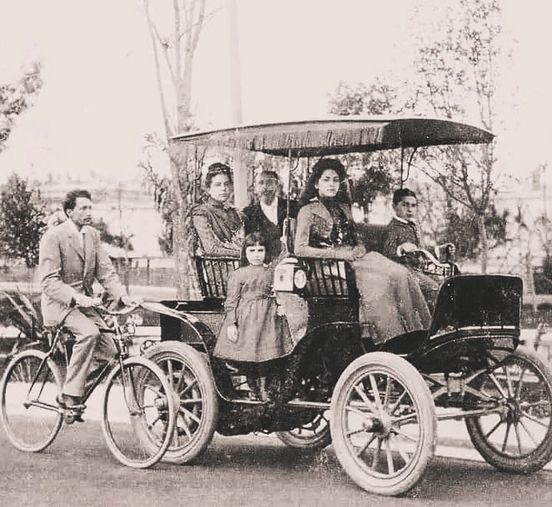
The first automobile in Mexico City was this 1895 Delaunay Belleville, owned by Don Fernando de Teresa Miranda (1864 -1918). I don’t that kid driving is old enough to have a license, but dad being a judge, probably meant he’d get away with it. Then again… i don’t think anybody’d thought of a drivers’ license back then (and I sometimes wonder — given the way people drive here — whether they really have ever given much thought to them), and besides… Don Fernando was a judge.
In 1916, President Woodrow Wilson mobilized the entire National Guard and sent it to preserve order along the Mexican border, and if possible, apprehend the Mexican revolutionary/bandit, Pancho Villa, who had been leading raids into United States territory.
The Iowa troops that accompanied this force never saw battle, but the many hours of training and experience they received would be beneficial in one very short year. (Iowa National Guard has proud history)
Iowa is pretty much your standard US state… with one exception. While the state was admitted to the Union in 1845, and had military units (precursors to today’s National Guard) serving in all US wars in some capacity since then. But, while that would be pretty much the same thing you could say about any state in the US, Iowa lacked one thing the other states didn’t. A state flag. And for that, perhaps they need to credit, not Mrs. Dixie Cornell Gebhadt, the flag’s designer, but Pancho Villa.
While Villa’s raid into Columbus, New Mexico in March 1916 was has been credited (or blamed) for the paranoia that led to Woodrow Wilson sending National Guard units to the border (and the National Guard as a formal part of the US Army had only existed for a few months at that time), the Zimmerman Note’s publication a week before Villa’s raid had more to do with it. Wilson had long before lost any trust in Villa (whose favor in the US was mostly due to his reputation as a teetotaler — something seen as making him the most “moral” among the Mexican Revolutionary leaders by Secretary of State, William Jennings Bryan — as well as Villa’s carefully crafted public relations, favoring the New York Times and other “establishment” media of the era). The Wilson Administration was more worried that Venustiano Carranza — said to be pro-German (or, at the very least, anti-gringo… which he was) — might just take Zimmerman up on his offer.
At any rate, Wilson called for “watchful waiting” — just in case — and dispatched National Guard units to the border. For the Iowa National Guard, this meant dispatching 65 youngsters (some only 17 at the time), mostly from Cedar Rapids, to guard Brownsville, Texas… about 900 miles away from New Mexico… but you never know.
Less said, Wilson had probably already decided to bring the US into the World War and the Iowans, like the other National Guard units mostly just went through training for that eventual fight. As it was, without all that much to do, the Iowans were visiting and meeting troopers from all over the United States, their encampments distinguished by their state flags.
No one had ever noticed it, but Iowa was the only state that had never had a state flag of their own. They might have seen 47 different state flags, but they also … looking across the border… would have seen one that maybe, with a bit of tweaking, might work if they were to have a state flag of their own:
Perhaps Mexico changed its flag in response to Iowa’s (or Mrs. Gebhart’s) “culture appropriation”?
The Mexfiles has never expected to turn a profit, but personal funds only go so far. Miscellaneous expenses (telephone, internet connection, subscriptions, spyware, hardware repair, etc.) run about 600 pesos (35 US$) a month, and donations are gratefully accepted. Please note that your donations are in Mexican Pesos (18 pesos to the US Dollar as of February 2019). A 25 US$ donation is 450 pesos.
The background of Mexican anti-clericalism and the "atheist" general who led the Catholic counter-revolution of the 1920s
128 pp., Editorial Mazatlán, 2012.
An oral history of the World War II experiences of Gilberto Bosques (1894 – 1997), Mexico 's Consul General in Marseilles, France, who saved tens of thousands from the Nazis.
36 pp. Editorial Mazatlán, 2007 $35 MXP (click the image)
While "The Mex Files" authorizes and encourages non-commercial use, such use must include a link including the words "Mex Files" hyperlinked to either "https://mexfiles.wordpress.com" or "http://mexfiles.net". Printed material must reference the original post.
Non-commercial re-publication is allowed for copyrighted material, provided it is "fair use" as defined in 17 USC § 107.
Commercial re-publication and all other use without the express written permission of the author is prohibited.
Information at richmx2 (at) live (dot) com