The worst of the last year… not COVID
in Mexico’s avocado-growing region told me that drug cartels had moved in, evicting – and in many cases killing – landowners to take control of production. It was horrifying. Every time I went to pick an avocado I would think of all of the innocent people who have died in the trade, driving an industry that is worth billions of dollars to drug traffickers.
Mexican Irish emigre Lily Ramirez-Foran, in the Irish Times last November:
The Russians are coming! The Russians are coming!
or… (apologies to the Beverly Hillbillies) “Californie is the place they wanna be… so they loaded up a Merc, to outrun the CPB”…
 While US media continues to report on various Central and South American would be migrants coming through Mexico, not much has been said about the (admittedly not that many) Russians suddely showing up at the Tecate/San Ysidrio crossing.
This previous week alone, seven Russians … who apparently were undocumented migrants in Mexico… attempted to run the border, four on Sunday, and another three on Monday. Both times led to nothing more than a short closure of the check-point while the Russians were being hustled off. However, the previous Sunday (12 December) 20 Russians, in a Mercedes and a pickup truck, attempted to run the border, leading to a short car chase, with shots fired at the Mercedes, but hitting the truck… all while a third vehicle… taking advantage of the chaos… also ran the border, but like the other two vehicles was stopped, carrying five more Russian wouldbe migrants.
No word on if they applied for asylum, either in Mexico or the United States… or, for that matter, how they got to Mexico (and why) in the first place. My own sense, having lived in Santa Maria de la Ribera, the adhoc Russian emigre neighborhood, that if Russians are immigrating to Mexico for a better life, the US obsession over possible economic and political rivalry from Russia is just stupid.
Source: “Rusos intentan cruzar a EU desde Baja California“, Proceso, 20 Dec 2021
A round-up of unusual sources
Breitbart, the far-far-far right-wing propaganda rag is not a source used by Mexfiles… until now. Like Hell, we’ll provide a link to that toxic waste site, but I have to admit Ildefonso Ortiz does a decent job with his “just the facts” coverage of US border region crime, though one suspect publication there is just rationale for comments mostly to do with the almost forgotten “Fast and Furious” scandal (in which the US Treasury Department’s Bureau of Alcohol, Firearms and Explosives knowingly allowed a cache of firearms to be smuggled to Mexican gangsters — a normal operation meant to track smuggling routes — that became a cause celebre for the US right, when at least one of those arms was used to kill a US agent working in Mexico) or the same old boring “Build the wall!!!” riffs.
Anyway, with the same information being published 16 December in the McAllen Progress Times (another not usual source), the story… interesting in iitself… could indicate a changing attitude in the US towards taking a more proactive role in their own smuggling problem.
From the two (and the indictment in the federal district court for south Texas, dated 14 December 2021) we learn that Daniel Gallegos, a part owner of Danny’s Pawn Shop and the Point Blank Shooting Range is accused of selling “thousands of rounds of ammunition to ‘an alien illegally and unlawfully in the United States’,” between March and May of last year: five different purchases to, what one assumes, was the same individual.
The comments on the story, both in Breitbart and the McAllen paper, generally are supportive of Gallegos, and question how, or why, he would have been expected to know the purchaser was in the country “illegally and unlawfully” in the country, and ineligible to purchase ammunition… and, for the Breitbart crowd, to take a break from their usual “deport em all!” attitude to defend the right to buy ammunition without any oversight or limit.
It might be that oversight and call for limitations that may be behind this all too rare prosecution.
Mr. Gallegos, having “retired” from the arms business, and … it seems… relatively cooperative with the prosecution, probably will get off with a fine or some other nominal punishment. But considering how rare it has been to see a US gun dealer even prosecuted, there may be more going on. Specifically, pressure from Mexico.
With Mexico presently suing several arms manufacturers in the United States… probably not expecting to either get to trial, but rather to harass the arms manufactures and tie them up in depositions and hearings and other time-and-money consuming activities long enough to wrangle consessions from them (discontinuing marketing campaigns and gun designs specifically for the Mexican market, and perhaps forcing them to requiring retails to more closely scrutinize customers before making a sale, and… at the outside… US law prohibiting its citizens from holding arms manufacturers civilly or criminally liable for the use of their products, but not foreign governments… just maybe driving the companies out of the arms business, or at least putting a sizable dent in their businesses.
Given that the “Merida Plan” … which was sold as “assistance” to Mexico to fight a “War on Drugs” and did nothing other than result in a few 100,000 needless deaths and disappearces, other than distract the public from the dubious “election” of the Calderón presidency… has become a dead letter, and the present Mexican government both less willing to just accept US “assistance” without looking at the fine print, and less concerned with narcotics flowing north than with its domestic economic and social issues, it has been willing to twist the arms (quietly) of the United States in return for allowing even a minimum of US involvement in dealing with cross-border illegal traffic. Narcotics going north… of course… but only if the US deals with firearms and money coming south.
Wisely, I think, when it comes to fighting organized crime, this government has been putting its efforts into fighting money laundering, rather than just catching so-called cartel leaders (not that they don’t, but unlike during the Calderón era, they are taking them alive, and seizing their assets). It’s indicative of the change in tactics that, with the US offering a “bounty” of five million dollars a head for “Chapo Guzmán’s five sons, the President made it clear that the five are Mexican citizens, and if they are charged with crimes in Mexico, it’s Mexico’s justice system that will deal with them… and that bounty hunting is not legal in this country, nor would Mexico allow foreign agents to join in some hunt for them.
IN short… it appears that, after years of cross-border crime prevention being seen as a purely Mexican problem, that narcotics smuggling requires both buyers and sellers, and that… given the unpalatable alternative of a war on its own people — especially when its become obvious that narcotics use is not just a minority issue, but one shared by middle-class “white” people. — the alternative is to accept that the “drug trade”, just like any other major business, requires give and take, that if the consumers cannot be controlled, then the goods and services provided to the suppliers has to be cut off. Now… if the US would just crack down on the bankers and “LLCs” and financial institutions that pay for those guns and “thousands of rounds of ammunition” coming from Texas, we might get somewhere.
Send in the envoy…
For Salazar, the ambassadorship represents a golden opportunity to further refine a shtick he’s spent his career perfecting: paying lip service to renewable energy while filling the coffers of the fossil fuel sector.
For Salazar, the ambassadorship represents a golden opportunity to further refine a shtick he’s spent his career perfectin
Kurt Hackworth in Jacobin, on the latest US Ambassador to stick his nose into Mexico domestic policy.
More later…
Diego Rivera, born 8 December 1886
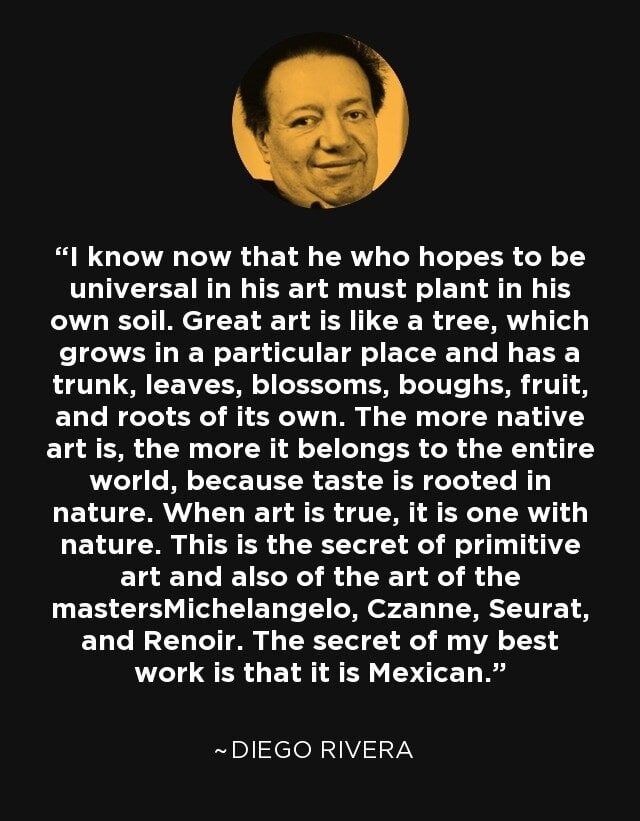
Tierra y Liberdad!… y… Marihuana!
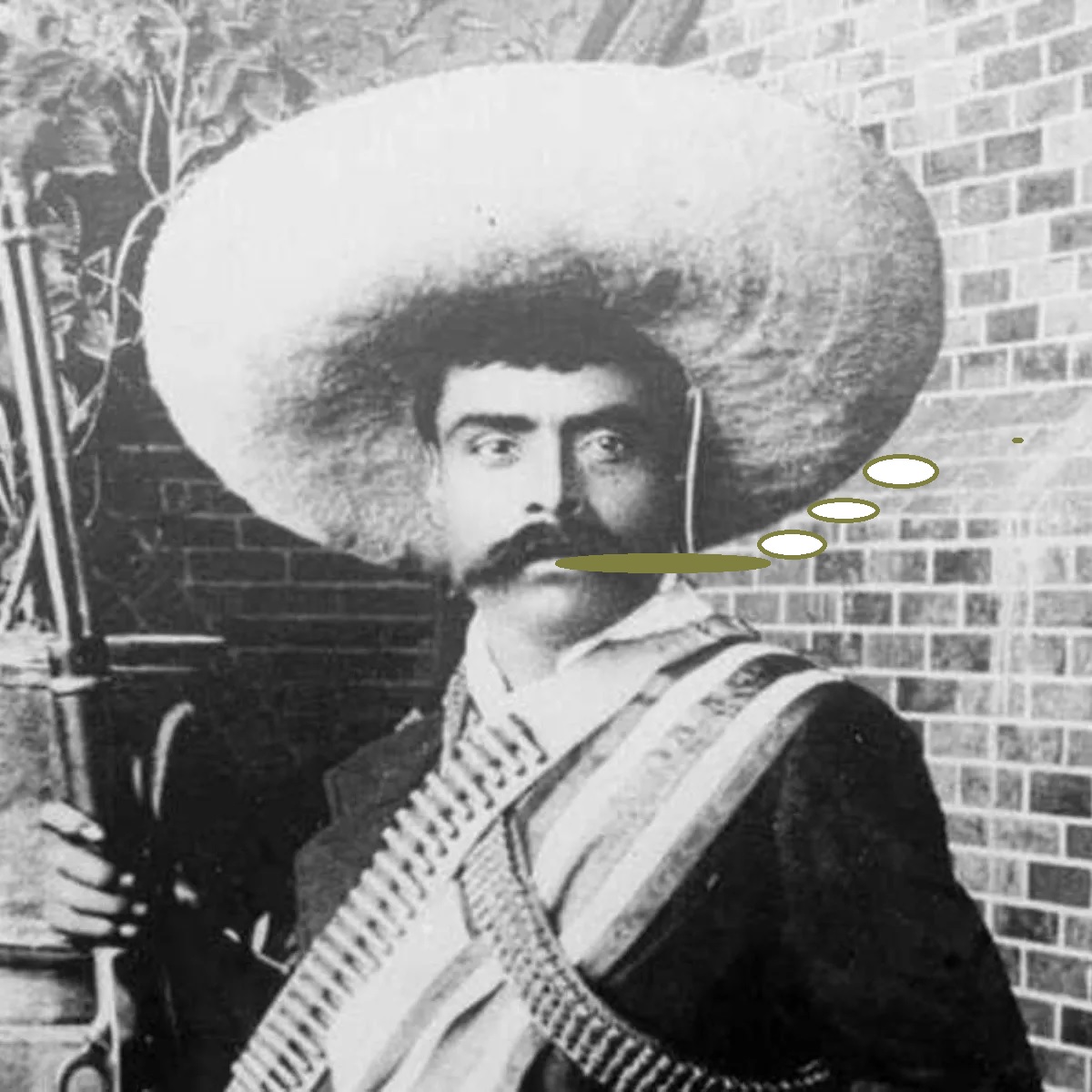
When Emiliano Zapata (and anarchist school-teacher Otilio Montaño) drafted the Plan of Ayula in 1911, with its then radical call for land reform in the state of Morelos, little did they realize not only that it would remain an inspirational and influential more than a century later… and not just in Mexico, but as an extention and distallation of revolutionary ideals and basic Marxist philosophy (IF workers should control of the means of production, then it follows that those that work the land — the peasants — should control the land… and take it by force, if necessary). After all, it’s the peasants that produce our most basic necessities.
Over the last 110 years, while Zapata did not “win”, not completely, the Morelos peasant farmers did largely gain control of their own land… only to find themselves at the mercy not so much of greedy overbearing landlords… as beholden to the more sinister, and much harder to fight, “market forces”. Certainly, we all need corn and beans… but what we’re willing to buy (or what the market has found a more profitable to sell us) has radically changes…
And the heirs to Zapata have too.
Enter the new Plan of Tetacala.
Drafted by the Asociación Civil de Pueblos Unidos del Sur de Morelos y Artistas Legales, and over 100 ejidatarios (the communal farmers, whose ancestors received title to the properties, in large part due to Zapata’s efforts in the Revolution, and the impact of the original Plan of Ayala) drew up their manifesto demanding they be given control over at least one seemingly essential unit of production. Marijuana.
With marijuana legalization simply a matter of drafting regulatory procedures, it’s difficult to say why the matter has not be settled. Assuming it’s not that the Senators are all stoned, it’s likely a matter of more pressing legislation, … and (left unsaid)… cue bono? The producers, or corporate interests?
One might include the so-called “cartels” as a corporate interest… the major market being exports, and the “cartels” having, for the last century at least, controlled the business. When it was figured out that marijuana was a good business and seen as a basic commodity by (white) people north of the border, it was no longer tenable that brown people in work clothes, squatting out in the countryside, not white men in suits sitting in air-conditioned offices in New York or Toronto, or London would be the ones to call the shots, make the decisions, bank the profits. Openly, anyway.
And… so… those white guys in suits, mostly out of Canada (which legalized marijuana several years ago, getting a jump start on the “respectable” white suburbanite market) have been lobbying the Senate to write regulations favoring them. The Plan of Tetacala seeks — in the best tradition of Zapata — to transfer control of the growing, processing, sales and marketing of marijuana to those who have been the last to profit from the crop.
At it’s most basic, the plan calls for communal farmers to be authorized to grow marijuana on their land without being criminalized by police corporations or authorities.
Their lawyer, Andrés Saavedra Avedaño, pointed out that with the Plan – whose motto is “Land to cultivate and freedom to smoke it” – it is intended to recover the value of land under cultivation and “celebrate a continuation of the Plan de Ayala (by Emiliano Zapata); the aim is for the peasants to be able to recover their lands ”.
“There is the same premise [in the Plan of Tetacala as in the Plan of Ayala*… Liberating the lands and the hands that work them for their benefit, in the face of the historical betrayal that persists against these sectors, and that has been evidenced in the attempts to regulate the plant carried out by the State ”
According to the signatories and their lawyer, the most important article of the Tetecala Plan is number 9, which says: “The cultivation, production, planting, transformation, transportation and distribution of marijuana are allowed for people in the agricultural sector whose objective is to relationship with production to improve their condition and social growth of their communities, facilitating their condition and access to free cultivation of their lands “
Source:
Morelos: ejidatarios firman plan para sembrar cannabis sin ser penalizados
¡Ai! ¡ai! ¡ai!… ¡Mariachi!
Today is international music day… also the Feast of Saint Cecelia, patron of musicians, and the annual Mariachi festival at Plaza Garibaldi in Mexico City… So…. two hours worth:
The daring young prez in his flying machine
From the 16th of November thru the end of the year in 1911, a airshow was held i Mexico City, sponsored by the Moisant Internation Aviators, to show off the latest in Bléirot and Deperdussin planes.
Geo Dyott, Richard Hamilton, and two women — Harriet Quimby and Matilde Moisant — demonstrated what was then the last word in transportation, Dyott brought along a passenger, President Francisco I Madero, making him the first head of state to ever go up in a plane (yes, Theodore Roosevelt had been in a plane earlier, but he was an ex-President at the time).
Mexico would have other aviation firsts… the first Air Force in the Americas (with two pilots, the Salinas Carranza brothers), the first aerial bombardment in the Americas (Mazatlan, 1914) and the first air-strike (Topolobampo, 1913).

Mine, or ours? Or… the fortunes of Fortuna
High. ho, High Ho… Fortuna stock is low.
Investors think it’s great, I know…
But, SEMANAT is on their tail
And they may have to go…

I know absolutely nothing about investing… in mining stocks, or anything else for that matter, but IKN does, and, from Lima, has been following the travails of Fortuna Silver’s stock dump following news that the Mexican Secretariat of Natural Resurces and the Environment (SEMARNAT) was not about to isue another 10 year waiver on its environmental permit.
The coverage in the mining and investment media has been swift, based on the assumption that something… anything… will change the Mexicans’ minds as to the operations of the San José Oaxaca site. As IKN writes, “… we got the inevitable pushback from the arrogant end of the mining commentariat, fuelled by the equally arrogant attitude of those at Fortuna Silver.” Among those “commentariati”, on “Seeking Alpha”, one “vozmozhno” wrote (13 November): “They knew about the Mexican permit issue before it became common knowledge. It was reported on a mining news website. Anyway it provided a juicy buying opportunity. I jumped in at 3.84 on the assumption that they will get it worked out and the price rebounds. We shall see.”
We shall, indeed, though I suspect vozozhno may be losing a chunk of change on the deal. “They” being Fortuna Silver, a Canadian corporation, which was a month late in applying for its environmental permit, despite strong opposition from local communities , where a growing movement, “Sí a la vida, no a la minería” (Yes to life, No to mining) has been organizing against foreign mining concessions since at least May of 2019. While the mining companies have always used the “job creation” argument in these communities (well known to any small town reporter or official, whether the job creator is a big box store, a prison, or an open pit mine), they have been known to resort to:
… provoking violent social conflict, displacing entire communities, threats, assassinations, forced disappearances, and persecuting activists and journalists. They promote, for their own benefit, tensions within communities, so that the state can later “resolve” in favor of the miners, by way of coopting the opposition, bribery, or police and military repression of dissidents.
Tryno Maldonado, in Guerrero Sur (9 November 2021) My translation.
What makes this more than just another “locals fight outside corporate interests” story is what it says about Mexico, andt the “new paradigm” in foreign relations. And, moving foreward in the era of climate change abatement. It’s been assumed for a very long time that Mexico wants foreign investments, and that it’s meant to be a resource exporting nation… something it’s been since Cortés first looted the Aztec capital. Ok… maybe… reluctantly… in the new paradigm it’s to be expected that the extractor actually pay for those resources, at least nominally, but… we’re seeing a rejection of the simplistic “job creator” market in favor of exploiting what the community sees as the gifts of their Creator: the forests, fields and clean water on which they have always depended. As a manifesto coming out of the May meeting of local Zapotec, Mixtec Chontal, Cuicateco, Ikoots and Mix communities states:
… various extractive projects … violate our community way of life, our bodies, our relationship: with the land, with our corn, with our water, with our spirituality and with our sacred territories.
… things they find more important than mere “jobs” (as if timbering, farming, fishing, livestock raising weren’t jobs enough). No different, really, than a small town in the United States or Canada turning down a new factory, or glitzy resort projcct on the grounds that it would bring in new and unwanted people and their strange “lifestyles”.
And, as it is, Fortuna dumped 1,516.000 liters of toxic waste in the Rio Coyote back in 2018, which is blamed, among other things for a hepititis outbreak in the region, so it’s not like the locals don’t have a point about wanting to protect their water. They can live without mining, they can’t live without water.
But what about Mexico? Since 1993, when a new mining law went into effect, over 200 million hectares of Mexican territory have been parceled out as mining concessions, about half (98,000,000) to foreign companies, mostly Canadian. In the last administration (Enrique Peña Nieto, 2012-2018) alone, more mining concessions were granted than during the 300 years of colonial rule. That despite a requirement (more honored in the breach than in the practice) that local communities be “consulted” before mining operations can commence. Which is what set off the “hoo-hah” in investment circles. Last Thursday (11 November):
The environment ministry… issued a statement saying it would work to organize the consultation of nearby indigenous Zapotec communities as part of the mine’s requested environmental authorization. That would let these communities decide “over their territory,” boosting environmental protection by involving all stakeholders, it added.
Reuters
That the state is likely… more than likely… to come down on the side of the “stakeholders” and not the shareholders (don’t you love how the foreign business press refers to local indigenous people’s land being in quote-marks, as if they actually were silly enough to think of the place they live as “their territory”?). Something Reuters seems to want to blame on “Lopez Obrador, a leftist resource nationalist who has repeatedly clashed with foreign mining companies, has said his government will not approve any new mining concessions, arguing past governments doled out too many.”
When you’re talking about nearly half the actual land in the country (those 200,000,000 plus hectares), yeah.. it probably is too many. The term, “resource nationalist” (let along “leftist resource nationalist”) is something Mexfiles hasn’t seen before, but how national resources are to be utilized, and who is to profit… shareholders, “stakeholders”, or just not worth the environmental cost, is going to be, if it isn’t already, one of the thornier international issues as we adjust to the new climate realities. Mexico is the world’s largest silver producer, and one of the “top ten” sources for several minerals essential to new energy efficient technology (like lithium). As of now, much (and a “leftist resource nationalist” might say too damn many) are controlled by outsiders in the already rich global north. Do they “belong” by divine right to the corporate interests, to the people of Mexico, or… are there other, more important things in life: our relations with our bodies, our corn, our water, our spirituality, our sacred territories.
That sounds less “leftist” than “traditionalist”.
SOURCES:
IKN “Fortuna Silver (FSM) (FVI.to) EIA permits, part deux (from IKN561)” 15 November 2021
Reuters, “Fortuna’s San Jose silver mine in Mexico faces closure due to expired permit” 11 November 2021
Seeking Alpha, “Fortuna Silver Mines misses on revenue” 11 November 2021
Consejo Civil Mexicano para la Silvicultura Sostenible: “Sí a la vida, no a la minería: comunidades oaxaqueñas” 21 May 2019
Maldonaldo, Tyno: “Oaxaca, Sí a la vida, no a la minería” Guerrero Sur, 9 November 2021
Towards a nation of readers?
Mexico’s “elder stateswoman” of letters, 89 year old Elena Pontiatowska, was out with her grandchildren last Sunday when someone broke into her house. A computer and a DVD player were stolen. Lamentedly, Pontiatowska noted, NOT A SINGLE BOOK. And, that, she says, is the real crime.

Insufficent Funds
The on-going Odebrecht/Agronitrogenados scandal… combining alleged bribes to PEMEX officials (including then CEO Emilio Lozoya are estimated to have cost the Mexican state somewhere (in round numbers) about 800 million dollars in losses. The biggest single loss was flipping the scapped Agronitrogenado fertilizer plant from Altos Hornos de México (which we are told, could have been re-opened) back to its orginal owner (i.e. PEMEX) at a 200 million dollar mark-up.
Lozoya, after a year as a “cooperating witness” which was granted on, among other grounds, a good faith offer to reimburse the federal treasury for its losses.
Lozoya’a original offer was to pay back 200 million dollars, at 50 million a year for four years (plus interest), but after one excuse and another, it became clear he had no intention (or, perhaps, no ability) to reimburse the treasury, and was subsequently taken to prison (bribery and fraud being non-bailable offenses, permitting pre-trial detention). And… lo and behold!… Lozoya has offered to finally pony up.
Well…. five million anyway.
if even that. What Lozoya offered is to hand over to Pemex the deeds of his residence in the Lomas de Bezares neighborhood in Mexico City. According to his preliminary appraisals, the value of that residence is between 3.4 and 3.8 million dollars, which assuming it can be sold for that value is still short more than a million of what he is alleged to have personally pocketed. The 1.6 million or so also promised is to settle any claims for the other 600 million in losses, although that 800 million is still just an estimate.
Lozoya’s offer, while paltry, includes a “payment committment”… turing over the deeds to the house to the victim of the fraud (i.e., PEMEX) and making payments over three years on an installment plan.
For some reason, the Federal Prosecutor is not buying it, nor is the Presidency, nor is PEMEX. And Lozoya will have to sit in the slammer a while longer.
Security … or is it Insecurity…Council?
Mexico’s first stint on the UN Security Council proved to be its last for almost 50 years.
In 1946, at the first meeting of the new United Nations, and it’s then 11 member states, Mexico’s representative, Rafael de la Colina Riquelme, was a leader in objections to the inordinate power given over to the five permanent member states (the neo-colonial United States and Soviet Union, along with declining colonial powers Great Britian and France, together with China… the “big five” of the allies in the just ended Second World War) to veto resolutions. Colina Riquelme argued (correctly, as it turns out) that the veto not only meant that the permanent member states had the power to make decisions about war and peace based on their own, and not international, interests, but that such an arrangement was bound to create blocs centered around the interests of one or the other of those five nations.
Being right… Mexico wasn’t given another seat until 1979, when a split between the two major camps in the Permanent Council (the Soviet Union and China, and the US-GB-France camps) split on whether to admit Cuba or Colombia as the Latin American representative nation, and settled on Mexico.
Which again, objected to the permanent members veto power. However, as a presumed member of the US-GB-France camp, although always (with the exception of the Fox Aministration) non-aligned, Mexico has, along with the members of an informal “Coffee Club” coaliton (formerly known as the “Uniting for Concensus” group), now including 120 of the 193 member states in calling for an end to the veto power granted to those nations (and their sucessor nations… Russia having replaced the Soviet Union, and the People’s Republic of China replacing what is now simply Taiwan).
An argument raised by Mexican president Andres Manuel Lopez Obrador in his recent address to the Security Council while Mexico holds the largely symbolic role as “presiding” over the Security Council for the month.
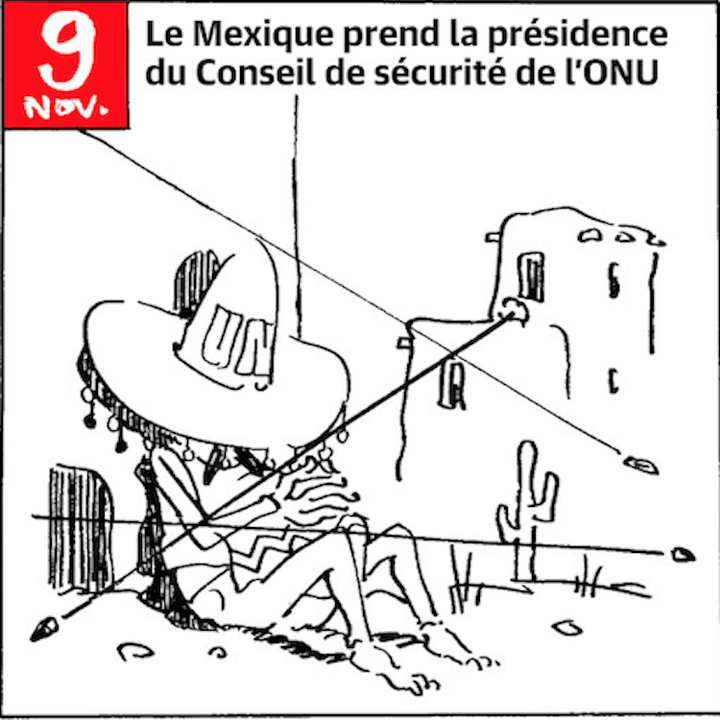
Although AMLO’s other call… for an international “minimum income” for the 750 million poorest of the poor (paid for by “voluntary” contibutions of 4% of the wealth of the world’s 100 richest individuals and 1000 richest corporations, with every UN member kicking in 0.02 percent of its national wealth) … is one of those, for lack of a better word, unworkable “Christian Idealist” ideas he is prone to throw out there. If covered at all by the foreign press (outside of those poorest of the poor countries, where it’s seen as something that is not only needed, but needed to be said), the reaction has been dismissed as hopelessly naive, or … as with France’s always snarky Charlie Hebdo… with downright racist hostility.
For the French, or at least the snarky racist ones, Mexico’s internal security problem isn’t an international one, with the demand from the wealthy nations for narcotics, and the uncontrolled arms trafficking and money laundering that result are not matters of international security.
That, if anything, shows the problem with the five member “veto”… that because those countries were the strongest and most able to impose their will on the rest of the planet eighty plus years ago, we should still let them control the agenda, and determne what is, and isn’t a global issue.


 mexfiles.net