Who needs guns?
Drug smugglers trying to get marijuana across the Arizona-Mexico border apparently are trying a new approach — a catapult.
National Guard troops operating a remote video surveillance system at the Naco Border Patrol Station say they observed several people preparing a catapult and launching packages over the International Border fence last Friday evening.
“It looks like a medieval catapult that was used back in the day,” Tucson sector Border Patrol spokesman David Jimarez told Reuters.
Tucson TV station KVOA said Border Patrol agents working with the National Guard contacted Mexican authorities, who went to the location and disrupted the catapult operation.
The 3-yard tall catapult was found about 20 yards from the U.S. border on a flatbed towed by a sports utility vehicle, according to a Mexican army officer with the 45th military zone in the border state of Sonora.
The catapult was capable of launching 4.4 pounds of marijuana at a time, the officer said Wednesday, speaking on condition of anonymity for security reasons.
“I have not seen anything like that in my time before as a Border Patrol agent … although we are trained to handle any kind of a threat that comes over that border,” Jimarez added.
Soldiers seized found 35 pounds of marijuana, the vehicle and the catapult device, the officer said.
The smugglers left the area before they could be captured.
Good thing they were only throwing marijuana…
Tata Sam…
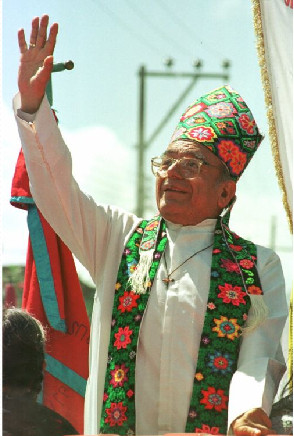
Photo: El Universal
John Donaghy, Hermano Juancito, quotes from an 2000 interview with a Des Moines Cathoic publication from Samuel Ruiz Garcia, who passed away earlier this week at the age of 86.
It’s a very well known saying that if someone offers you a fish, you don’t take it. You ask him to teach you how to fish.
So, Pedro learns how to fish. He goes to the store and he says, “I want to buy a net and I want to buy a hook,” And the owner of the store says, “Uh, what’s going on here, Pedro? You learned how to fish?”
He says, “Yeah, I learned how to fish.” Then the owner says to him, “OK, but what you didn’t know is you have to sell me a portion of your fish.” And Pedro says, “OK,” and he goes out and starts fishing.
He’s on the edge of the lake and soon he feels somebody tapping on his shoulder and somebody is standing there, telling him, “What’s going on here? You can’t be fishing here. This is private land.” And so they push him off.
Pedro has been given a skill, but that’s not enough. You can work on the “development” of the individual person, but the other half of that is working on the structural injustices.
In his forty years as Bishop of San Crisobal de Chiapas, and his tireless pursuit of justice since his retirement in 2000 (at age 75), Sam Ruiz spent far more than half of himself working to undo the structural injustices.
While relatively young when named Bishop (only 35), the Bajio native was hardly a naïf, the product of a solid Jesuit education, and graduate study at the Gregorian Institute in Rome, a sort of training school for future Bishops.
Still, when Ruiz was sent to Chiapas in 1959, he was unprepared. Although Mexico in the late 1950s had endemic poverty everywhere, the fruits of the 1910-20 Revolution had created a modern, seemingly progressive culture. Chiapas, then a little visited backwater, and still seen as something of an accidental appendage to Mexico (it was, after all, part of the Guatemala under the Viceroys), had been by-passed by the Revolution. As Carlos Marín wrote (Proceso, 1105, 4 January 1998):
… due to geographic isolation, social introversion, lack of political capability of the subsequent presidencies, Central American influence, and its great ethnic diversity, the Chiapans suffered from “national indifference” so they participated with little interest, or symbolically, in the historical development of present day Mexico. This “national indifference” or lack of national will, made it so that while the other federative entities developed themselves historically by means of their active and dynamic participation, like fusing their customs, political ideologies, economic and social procedures, and psychological situations, the Chiapans participated in nothing or in very little, for example, in the War of Independence, the battle between Centrists and Federalists, North American interventions, the War for Reform, French intervention, and the Mexican Revolution.
Perhaps, if I ever revise Gods, Gachupines and Gringos, I will need to add “except in Chiapas” to some of my more generic statements. Like this one: At the end of the Second Word War México was still poor and agriarian, but more prosperous than it had ever been. The Revolution had eliminated the worst abuses of Porfirismo: hacienda and peonage were horror stories told by aging relatives…”
Peonage may have gone, but — as in the much of the United States at the time— in Chiapas the forms of expressing racial and social inequality were unchallenged. Indigenous people were not permitted to use the sidewalks s in San Crisobal and — as the new Bishop began to visit his diocese (often by mule: then, as now, often the only reliable means of transit to remote communities), he uncovered even more startling evidence that the old order had not passed away — indigenous workers were still being whipped, and local landlords still practiced “droit de segnor”, the right to “test” the virginity of prospective brides among his dependent workers’ families.
Bishops of Chiapas have always preached against Heresy. The indigenous peoples pre-Conquest beliefs and practices might also be considered heretical. European pre-Christian beliefs and practices, having been washed of any hint of heresy by the 17th century Council of Trent, it was safer for Bishops of Chiapas to stick to futile sermons — in Spanish, the language of the conquers, not the conquered — against folk beliefs, and shamanistic practices, than to challenge the sins of the economic and political power elites.

Photo: El Universal
On the other hand, the elites have their own unorthodox practices. Thomas Gage, in the early 17th century, wrote of heretical trend among the Chiapan upper crust (albeit, a more harmless one — sipping hot chocolate during Mass) that ended with the Bishop’s assassination by a chocolate sipping cabal. But, Bishop Samuel’s See is named for its founding Bishop, Bartolomé de las Casas, who well into his 90s was crossing the Atlantic in small sailing ships to bring abuses against the indigenous Americans to the authory’s attention… and who, as an officer of the Inquisition, had slave-holders burned at the stake for their heretic ideas on human inequality.
Bishop Sam chose to hark back to the Dominican Las Casas. He dedicated himself to his indigenous congregants, learning their languages, building trust in their communities and — as it is said a good churchman should — “comforting the afflicted and afflicting the comfortable.” With the Second Vatican Council of the early 1960s. Laura Carlsen writes
Don Samuel Ruiz formed part of and led a movement within the Roman Catholic Church that based its theology on the Vatican II commitment to greater lay participation, the “option for the poor” that shifted attention to the need to serve the historically downtrodden, and the idea that the church cannot ignore injustice without being complicit.
These would become the principles he acted on. As mediator in the Zapatista indigenous uprising of 1994, Ruiz helped create the conditions for the new indigenous movement that marked not only Mexico but the world. His work as leader of the National Mediation Commission (CONAI) led to an unprecedented dialogue that resulted in the San Andrés Accords on Indigenous Rights and Culture, signed and later violated by the federal government. The Accords stand as a tribute to his work and the work of scores of indigenous leaders. They also stand as a tragic reminder that the word of the powerful cannot be trusted. But the spirit of emancipation and peaceful dialogue codified in the Accords survives in the individuals gathered at the mass for Don Samuel Ruiz, one of the principal architects of the peace process, and among the thousands of indigenous people who wait to receive his remains in his beloved state of Chiapas.
Don Samuel insisted that the church of the poor needed a human rights organization in Chiapas faced with the extreme human rights violations taking place. In 1989, he founded the Fray Bartolome de las Casas Center for Human Rights. The Center’s mission is to “walk alongside and at the service of the poor, excluded and organized people who seek to overcome their socioeconomic and political situation, by taking direction and the strength from them to contribute to their project of building a new society where people and communities fully exercise and enjoy their rights.” The mission embodies the strong belief that the church cannot be separated from the struggle for social justice and that it should play a supporting role rather than pronouncing from on high.
His work as a churchman and human rights mediator earned him honor after honor throughout

Ruiz at ELZN conference 1996, Photo: IF Archives (Sweden)
Latin America… and the hatred of many. Of course, in Mexico, a cleric cannot overtly take a political stance, but after constitutional changes in 1992, Bishops have been able to make their political views clear. Elsewhere in Mexico, the higher clergy have made their preference known for more conservative, anti-revolutionary movements, while Bishop Sam, having sided with the indigenous congregants, openly supported the Zapatista movement (where he was sometimes, half-jokingly referred to as “Subcomandante Obispo”) and the PRD. While the elites, in their rage against him, with odd (and sinister) groups like the Lyndon Larouche backed “IberoAmerican Solidarity Movement” making death threats against him, Don Samuel more than anyone else, became the visible symbol of Chiapas.
I’m still amazed that so many, especially Europeans think of Chiapas as the “real Mexico”. That is perhaps, yet another of Don Samuel’s legacies: Chiapas — the accidental Mexican backwater — became, to use theological terms, “an outward and visible sign” of Mexico’s on-going struggle to create a national consensus within a multi-cultural, multi-ethnic society and justice in an unjust world. The Church, let us remember, has been in the international public relations game a lot longer than the Zapatistas. Without the energy and resources of Bishop Sam behind them, the movement might have been written off as just another Latin American guerrilla movement, and quashed without much notice outside the region.
The Chiapas “situation” — and the meaning of it — has been uncomfortable for Mexico, and for Latin America in general. And for the Church. Bishop Sam, as a “liberation theologian” put him at odds with the Mexican hierarchy, and with the Vatican. As with other liberationists, the moral “preference for the poor” led to political preferences not favored by the elites here, or in Washington. As he said in an AFP interview in 2005 “Theology interests us less than liberation.” A man to be feared, and — if possible — marginalized much as Chiapas has been.
Forced out — ironically because his tolerance for local practices could be used to insist upon his retirement, his successor, Raul Vera, has carried Don Samuel’s legacy to the north, while Chiapas’ present Bishop, the very conservative Felipe Arizmendi, has had to uncomfortably accommodate himself to the new order of things in Chiapas.
Marginalized by the elites. Hermann Bellinghauen writes of the memorial services held in Bishop Sam’s former cathedral:
The indigenous people are coming from the far corners of Chiapas to pay their homage to Samuel Ruiz García, jTatik (father, in Tzeltal), converging by the thousands today in the cathedral dedicated to the Catholic saint of travelers, San Cristobal.
… Since early this morning, the faithful have arrived from Simojovel, Chenalho, Chilo, Ocosingo, Tila, Las Margaritas, Motozintla: the most obscure corners of what the Zapatistas called in 1994, the “forgotten corner of the country”.
Hourly masses, with High Masses at noon and dusk, are filled with representatives from political and social organizations, church groups, and the communities communities — Tzeltal, Tzotzil, Chol, Mam, Tojolabal…
Hermano Juancito, wrote “Monday morning, January 24, a saint in our midst went to his heavenly reward.” A saint, I don’t know. Mexico has produced it’s share of them. Samuel Ruiz Garcia who had many titles — Obsipo Ruiz… Su excelencia Don Samuel Ruiz Garcia… “Subcomandante Obispo”… Don Samuel — has earned a very rare title indeed. Only a few in our history, the 16th century priest and social reformer, Vasco de Quiroga and the 1930s President, Lazaro Cardenas, are elevated by the people themselves to the status of “Tata” … or, in Tzeltal, “jTatik” — “Our Father”…
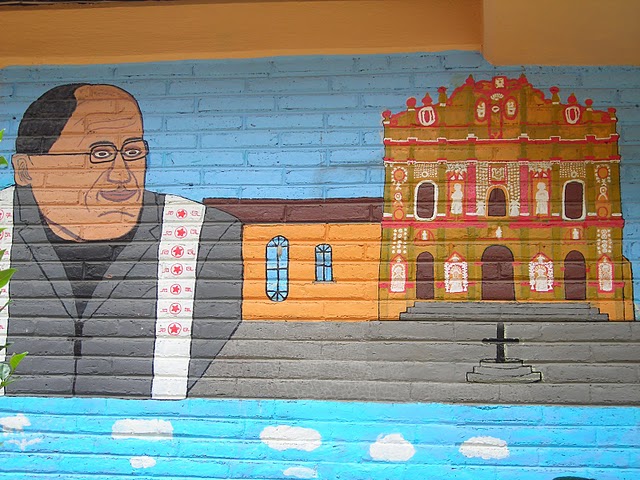
Mural "Samuel Ruiz and the Cathedral". Photo © 2009, Chelsea
Das Capital(ista): Carlos Slim
He didn’t quite say “From each according to his ability…” but Carlos Slim, during an interview by Michelle Caruso-Cabrera of the U.S. cable television network, CNBC, came dang close. With Bill Gates and Warren Buffet having each given half of their personal income (supposedly) to charity, Caruso-Cabrera wondered why Slim has not.
“As employers, we help resolve social problems. But by fighting poverty, not through charity.”
He explained that giving money to charity gives companies a huge tax deduction. Not paying taxes means less money for the government to promote development.
“It would be a huge mistake for a company like Microsoft, the world’s leading technology firm, to be sold by it’s founders to finance charities. They should not. It is more important to continue managing the company. “
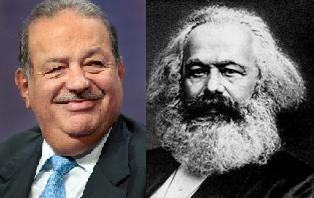 I suppose one could get into sterile arguments over whether or not Gates’ and Buffet’s (or Slim’s) actions are based in altruism or egoism. Coupled with what he said about investing in his own country (he thinks it’s foolish to let the temporary violence scare away investments, and he has no intention of leaving Mexico), what seems to come across is something else: Mexican.
The U.S. media became interested in Slim not just because of the northern obsession with rankings and nationalism which seem to create a problem for them when a Mexican outranks U.S. citizens on that probably inaccurate “Forbes” list, but also because Slim has been aggressively seeking investments in the United States.
Sure, Slim might be finishing Marx’s dictum “… and too each according to his greed,” but it strikes me that Slim, in his own way, is exploiting the exploiters. I wouldn’t play poker against Bill Gates, or Warren Buffet, or Carlos Slim. Gates and Buffet, the U.S. based billionaires, have — for whatever reason — decided to fold. Carlos Slim, the Mexican, is still in the game… and either he wants to up the ante here, or he’s bluffing. Either way, he’s looking to expatriate money into Mexico. Or, maybe repatriate.
There’s no getting around the fact that neither Bill Gates, nor Warren Buffet, would have become so rich had they not been citizens of a country whose own prosperity largely rests on exploiting the resources of other nations, especially Latin American ones… especially Mexico. There’s no way to put a dollar amount on the value of, say, Mexican metals to the computer industry, let alone the value of Mexican labor, low cost oil and agricultural products that freed up both capital resources (and gave people the leisure time to use computers) that were instrumental to Microsoft’s success. But, I will bet that whatever the Bill and Melinda Gates Foundation “donates” to Mexicans, it won’t make us even.
The world is not that simple. But, Slim — earning money through investments in the United States while continuing to reside in Mexico (and pay Mexican taxes) — is, in a very real way, “exploiting” the exploiter. And while it would be naïve to pretend that very rich people like Carlos Slim (and major companies like his Grupo Carso) don’t have a hand in setting the social and political agenda in this country, he admits (and accepts) the Mexican state’s right to allocate money he earns and others earn in Mexico as the State sees fit.
From Slim, according to his ability to make gobs of money. To the Mexican state, according to its tax laws.
Police station attacked in violent border town
… the U.S./Canadian border that is:
In a violence-weary city where every run can put police in danger, even this news was stunning: A gunman walked into a police precinct Sunday afternoon and opened fire with a shotgun, wounding four officers before return gunfire took his life.
…
That four were shot at once in Detroit wasn’t shocking; that they were all uniformed and armed was. And it capped another felonious weekend during which three bodies were found in an eastside home on Friday and five people were shot outside a strip club early Sunday.
Reading the fine print: Hillary Clinton
U.S. press reports (Reuters) only say Hillary Clinton is swooping down on Guanajuato next week for unspecified talks with President Calderón and Foreign Secretary Espinoza… to “to discuss competitive and border topics as well as better collaboration to jointly fight organized crime.”
What Reuters leaves out, I had to read in Agence France-Press. My “google-search” for this story brought up ChannelNewsAsia (Singapore) as the first choice. was tacked on to the end of the Singapore, and other English-language sources I checked. Tacked to the end of the Singaporean (and other English-language stories using AFP) — but the lead in La Jornada — was in regard to one issue on the agenda, organized crime activity along the United States border:
“I don’t think that the issue here is whether the stability of our of our society is at risk, but certainly, you know, this is a national security threat,” Clinton spokesman Philip Crowley told reporters.
“These international criminal organisations, they have assets and weapons and people that certainly can challenge any security force.”
The United States — the main market for Mexico-trafficked drugs and supplier of illegal weapons — has offered training and equipment to Mexico’s security forces under a three-year, 1.3-billion-dollar Merida Initiative to tackle organised crime, which is set to evolve this year.
“This visit is an opportunity to reinforce the close relations between the two nations and to identify common objectives and strategies to ensure greater security and well-being for the citizens of both countries,” Crowley said.
On her third official visit to Mexico, Clinton will be seeking to smooth over close ties upset last September, when she said Mexican cartels were starting to look like an insurgency.
I’m of a mind to presume the bold-faced comment was a bit of Gallic irony. Or, rather, galling. While AFP (at least some AFP stories) are mentioning, as an aside, that somewhere during the one-day meeting there will be some discussion of follow-up to the Cancún conference on climate change, the Spanish news service, EFE (via Latin American Herald-Tribune) goes into more detail on differences between the governments:
Mexico has repeatedly asked the United States to restrict the sale of automatic weapons because Mexican cartels take advantage of the ease of purchasing them to arm themselves and subsequently direct an immense amount of fire-power against the army and police.
In recent years, the United States – the world’s leading consumer of illegal drugs – has provided Mexico with $1.4 billion in arms, materiel and training for the war on drugs by virtue of the Merida Initiative. There has also been a constant exchange of intelligence.
United by trade and demographic ties, the two nations have also been in conflict for several years because Mexican truckers are barred from transporting cargo into the United States.
The Mexican ambassador to Washington, Arturo Sharukan, said this month that the No. 1 priority for his diplomatic mission in 2011 will be dealing with possible laws that limit the rights of undocumented immigrants in the United States, of the kind already enacted in Arizona.
Climate change is probably the most important issue, and those mentioned by EFE are a priority for the Mexican government, but — given Ms. Clinton’s (or, rather, her spokesman’s) intemperate and undiplomatic remarks which will, of course, simply lead to more discussion of the U.S. failure to do anything about its firearms and money smuggling operations, and its inability to decide how it wants to handle its massive consumer demand for narcotics.
I see real danger in that Ms. Clinton’s remarks seem to suggest a rationale for more direct intervention in Mexican national security matters, but if the U.S. administration does not mean to foster this interpretation, then Mr. Obama is ill-served by his Secretary of State and should consider replacing her if he expects his country to have friendly relations with its second largest foreign oil supplier and third largest trading partner in the future… or with any of his neighbors in the Western Hemisphere.

The offer stands
Arizona is a state riddled with anti-government white militias, radio stations pumping out racist hate speech and politicians who wave guns as they denounce the oppressive rule of Washington. But Arizona’s attorney general apparently believes the real threat to the stability of the US government is being fomented in a handful of high schools in a liberal corner of the desert state.
Tom Horne has declared classes in Mexican-American history and social studies in the city of Tucson illegal on the grounds that they are “propagandising and brainwashing” students into overthrowing the constitutional government and hating white people.
Horne has ordered schools to scrap the ethnic studies programmes under a law he wrote in his previous role as Arizona’s education superintendent. He has not banned similar classes dealing with black or Native American history on the grounds that no one has complained about them.
Chris McGreal, The Guardian (U.K), 21 January 2011
Editorial Mazatlán has offered to give two copies each of Gods, Gachupines and Gringos and Revolutionary Days — and provide at cost additional copies — to the Tucson Unified School District, or to the program’s teachers if they need to conduct Mexican-American studies courses in Tucson outside the official curriculum.
Not much else to say
Perhaps, though ignorance, I might have committed acts deserving of censure during my long career of public service. But I can assure you that I will give my word that my intentions have always been the most sincere, and I have directed my acts towards the glory and service of my country. Never have I deviated for even an instant from the paths that duty and honor have set before me. If my activities have been somewhat excessive, they have been prompted by my zeal and desire to serve my country in the fullest.
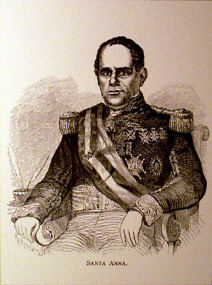 It’s a shame it was only published long after his death by his grandson (and not translated into English until 1967), but General Antonio Lopez de Santa Ana’s “The Eagle” should be required reading for any disgraced (or disgraceful) politico planning to write their memoirs (or excuses). In that one paragraph, written from his uncomfortable exile in the Bahamas in 1872, Santa Ana proved he still had the rhetorical flair of his prime, when it came to weasel-words.
… And, if you’re wondering why I’m not posting as much, no weasel-words here. I’m busy with other things.
Don’t cry for me, Alaska
“No force on Earth can stop Sarah Palin from becoming our very own “lite” version of Eva Perón — a glamorous and tragic legend, minus the tragedy.”
Eugene Robinson’s “Our Evita”, in the Washington Post opinion section (17-January-2010) garnered over 70 pages of negative comments (when I wrote this), mostly from Palin defenders. While there are a few superficial similarities between the two, the outrage over Robinson’s column should not be coming from from Palinistas, but from Peronistas.
Sarah Palin was a cheerleader before she joined the basketball team, and swung a pom-pom or two, and enjoyed a pampered upbringing. Eva Duarte was a poor girl from the Pampas who left home at age 15 to make her own way in the world.
Sarah Palin left several colleges while studying for a never successful career in broadcast journalism, ending up in Wasilla, Alaska. Eva Duarte went through several boyfriends while pursuing a moderately successful career as a radio actress in cosmopolitan Buenos Aires.
Sarah Palin, a little known political figure, caught the attention of an older, nationally known political figure (John McCain) who was desperate to find a gimmick for his electoral campaign. Eva Duarte, a moderately well-known apolitical figure, caught the attention of the older, nationally known Col. Juan Domingo Perón during a desperate time — at a charity event for victims of the devastating 1944 San Juan earthquake.
Palin’s speeches and rhetoric are largely credited with destroying McCain’s chances of becoming president. Eva Perón’s speeches and rhetoric are largely credited with saving Juan Perón’s life following the then-Vice President’s arrest during the October 1945 conservative coup.
Palin, as mayor of Wasilla, demanded the resignation of department heads who she felt were “disloyal.” During her aborted tenure as Governor of Alaska, she was accused of several ethical violations, but quit before they were investigated. Eva Peron, as Secretary of Labor, union leader, and President the Partido Peronista Femenino, demanded loyalty to the ideals of a working class movement.
The Fundacíon Eva Peron raised money for social and beneficial services to the poor. SarahPAC raises money for… Sarah Palin. And — although thoroughly investigated after her death — the Fundacíon was an extremely well-run charity funded mostly by union donations (in the form of paycheck deductions in return for Labor Secretary Eva Perón’s settlement of wage hikes, true enough…) and popular appeals. SarahPAC?… meh.
Although, it has to be added, that both Palin and Eva spent other people’s money for clothing, Eva Perón, as first lady, was using approved government funds for her wardrobe.
Eva Peron was the impetus for passage of women’s suffrage in Argentina, and for Argentina becoming the first nation to set aside seats in its legislature for female deputies and Senators.
…represented the aspirations of working.class people and appeared to women to be sincerely determined to improve their lives and working conditions and, most important, to have the real ability to make these improvements.
Sarah Palin claims to be a “hockey mom”… who wants to compare herself to a pit bull while simultaneously whining that she is a victim of the elites because of her gender.
The only real points of comparison is that both are nationalists and populists, whose parties blamed foreigners for much of their nation’s difficulties. In Argentina, an economic colony of Great Britain, those benefiting from the foreigners, and those opposed to populism were the conservative elites. In the United States, the conservative elites (who find working class foreigners a national threat) defend Palin. Eva died young, and — although vilified for a less than perfect personal life — the “glamorous and tragic” Eva is not easily ridiculed. Palin’s personal story, like Eva’s has some unexplained gaps too. But the tacky and pathetic Sarah is … well… well, let’s just say “poles apart” might refer to more than geography.

Of Marx and Quixote: John Ross, D.E.P.
Self-described “Investigative poet”, chronicler of the forgotten, and maker of myths, John Ross died early Monday in Tepizo, Michoacan. Ross spent the last twenty-five years living in Mexico City’s Hotel Isabela writing and publishing his interpretations of the changing Mexican political and social culture. If that is a quixotic task, perhaps it accounts for Ross’ growing resemblance to the ingenious hidalgo of La Mancha as he grew older.
John Ross was often described as irascible, or — more politely — “difficult”. He wrote brilliantly, angrily and wittily of our imperfect world, one he could not change, but only resist. In one of the small publications that he favored (The Rag Blog), Ross wrote of the U.S./Mexican border:
We went to visit the Wall where Hidalgo Texas fronts up Reynosa Tamaulipas across the bends of the Rio Grande (it’s called the Rio Bravo on the Other Side.) In Hidalgo, the Separation Wall is built around a restored pump house and bird sanctuary and resembles one of Richard Serra’s hideous installations. The aluminum cylinders that form the wall have enough room between them to allow a snake to squiggle through but the jabalis and other mid-sized mammals whose habitat this is are caged up north and south of this man-made North American monstrosity.
Down here where even dogs and their fleas are subject to deportation (the fleas were born here), everyone carries two sets of picture I.D. and flies multiple Stars & Stripes from their front porches.
At the time, Ross was already debilitated by the liver cancer that killed him Monday morning. Typically, he didn’t describe himself as a “cancer survivor” or “cancer patient” or “fighting cancer” but as a “cancer resister”. Resist he must (he was one of the first, if not the first, recognized Vietnam War resister, and “resistance” — and resistance to San Francisco police cost him an eye, resistance to a prison dentist several of his teeth, resistance to editors, most of his readership in all but the most obscure of publications. A shame… the man could write!
Ross, born 11 March 1938 was not only one of the last of the “beats”, but one of the last of the 1930s “red-diaper babies”. His friend Frank Bardacke nicely limns a remarkable (and quintessentially) American life story:
Born to show business Communists in New York City in 1938, he had minded Billie Holliday’s dog, sold dope to Dizzy Gillespie, and vigiled at the hour of the Rosenberg execution, all before he was sixteen years old. An aspiring beat poet, driven by D.H. Lawrence’s images of Mexico, he arrived at the Tarascan highlands of Michoacan at the age of twenty, returning to the U.S. six years later in 1964, there to be thrown in the Federal Penitentiary at San Pedro, for refusing induction into the army.
Back on the streets of San Francisco eighteen months later, he joined the Progressive Labor Movement, then a combination of old ex-CPers fleeing the debased party and young poets and artists looking for revolutionary action. For a few years he called the hip, crazy, Latino 24th and Mission his “bio-region,” as he ran from the San Francisco police and threw dead rats at slumlords during street rallies of the once powerful Mission Coalition.
When the not so ex-Stalinists drove him and others out of P.L. (“break the poets’ pencils” was the slogan of the purge) he moved up north to Arcata where he became an early defender of the forest and the self-described town clown and poet in residence. From there it was Tangier and the Maghreb, the Basque country, anti-nuke rallies in Ireland, and then back to San Francisco, where he finally found his calling as a journalist. “Investigative poet” was the title he preferred, and in 1984, he was dispatched by Pacific News Service to Latin America, where he walked with the Sendero Luminoso, broke bread with the Tupac Amaru, and hung out with cadres of the M-19.
In 1985, after the earthquake, he moved into the Hotel Isabela in the Centro Historico of Mexico City, where for the next 25 years he wrote the very best accounts in English (no one is even a close second) of the tumultuous adventures of Mexican politics.
There are many Mexicos — and many Mexico Cities. Anyone, especially a foreigner, who claims to have pinned down THE “real Mexico” is either deluding themselves, or their readers. John Ross was the best at describing HIS Mexico — that of the frustrated (and often doctrinaire) Marxists who quixotically (there’s no other word for it) try so valiantly to shoehorn in the Mexican experience into that particular 19th century economic theory. Not that Ross and his cronies at Café la Blanca were wrong in their analyses of contemporary events (not always anyway). The Marxists, in recognizing the strong communitarian sense that runs through Mexican history from the earliest cultures to the present, made more sense than others who rely on other theories (like liberalism or capitalism) which equally reduce the human experience to the merely economic.

Photo: Con Carlitos (concarlitos.wordpress.com)
Unlike in his native United States, in Mexico Marxism has not be relegated to the trash heap of history, but remains an essential implement in one’s intellectual tool-kit. Ross could, and did, elegantly dissect Mexico City’s complex politics and social milieu in avowedly Marxist terms, as in his 2006 essay (on the protests following the disputed presidential election), “Class War in Mexico City’s Gridlock“:
The car wars here are a codeword for class war. Poor people scrape by on public transportation: tens of thousands of effluvia-spewing tin can microbuses complimented by a clean, low-priced and over-saturated subway system, the Metro. But the first car is often the first step up the class ladder and lower middle class Mexicans spend a lot of time in their vehicles. In an effort to curb the killer smogs that such an egregious fetish for the internal combustion engine generates, the city has long enforced a one (sometimes two) day don’t drive ordinance but the middle class and the uppers just buy second and third cars to drive on the off days.
Indeed, when leftist presidential contender Andres Manuel Lopez Obrador who insists he has been cheated out of victory in the July 2 elections here, was mayor of Mexico City he catered to the motorist class by putting a second deck on the Periferico ring road freeway that encouraged even more citizens to congeal the capital’s thoroughfares.
But despite AMLO’s zeal for internal combustion, when on Sunday July 30, before 2.4 million followers, Lopez Obrador encouraged his disenchanted supporters to establish 47 camps, many of them strung along one of the city’s most elegant boulevards in a move to impress upon a seven-judge panel the historical importance of ruling in favor of a vote by vote recount, Mexico City’s motorist class and the media that panders to it, rose up as one fist in mass indignation.
The class struggle IS alive in well in Mexico (and throughout the world), but to see the world in those narrow terms can lead one astray. Witness Ross’ very wrong essay (from 2008, and also published by Counterpunch) on the outbreak of violence against the “emos”:
Underlying the hostilities between the Emos and rival urban tribes is the class divide which yawns wide in Mexico City. The Emos spring from the loins of affluent families and are often enrolled in private schools and the high school system of the National Autonomous University (UNAM) in a country where only 17 per cent of young people will have a chance to go to college. The UNAM rejects 100,000 would-be students a year.
As it developed, the attacks on the “emos” (not nearly as wide-spread as Ross reported — none occurred here in Sinaloa, for example) were only loosely ideological, and had little to do with “class struggle”, except that the attacks were fomented by neo-synarchists associated with the Opus Dei and Legionaries of Christ student movements. No particular social class is associated with the various “urban tribes” — the emos being picked on simply because they tend to be younger, and appear more vulnerable (including a perception of the emos as effeminate) made them an easy target for bullies. While some of the attackers were university students, so are many of the other “urban tribe” members, from punks to goths to emos (although, of course, “emos” tend to be younger teens). The violence had little or nothing to do with university admissions, and it’s hard to see what it had to do with emigration (especially with the Mexico City “underclass” which in Marxist analysis should be the source of urban tribalism, being largely immigrants from rural Mexico, not potential emigrants to the United States). Some of the attackers were urban tribesmen with political agendas — but were right-wing skinheads, not anarchist or apolitical punks. Ross, and the Café la Blanca critique on this issue, like several others, falls apart when non-class issues, religion, cultural norms or sexuality, are thrown into the equation… as they always are in Mexican social and political events.
Ross was of the theory that the 1910-20 Revolution “didn’t count” as a “real” revolution… apparently because it didn’t follow the scriptures laid down by German theorists in the 1840s. I rejected this interpretation, but it was important to me in understanding one “mainstream” critique. What John Ross’ reaction to being seen as a “mainstream” thinker on Mexico is anyone’s guess.
 Don Quixote — in his single-minded pursuit of justice based on his own faith — often looked foolish, or was neglected by the “mainstream” of his world. He was “mad”. John Ross was mad only in the sense of anger… or perhaps, “mad” in the sense that he was out of step with his times, with the “mainstream” that failed to see the underlying nobility of his struggle to resist the loss of faith in his own Marxist faith.
Marxism, like Chivalry, are easily mocked, when the values they espouse are no longer those of the elites. And so are those, who resist giving up these values. The very real, very human John Ross, like Miguel Cervantes’ fictional Don Quixote, holding on to their stubborn faith in the values of a by-gone era, and stubbornly refusing to acquiesce in the tarnished values of a duller, less-heroic present, force us to rethink our own values and conceptions, and lead us to a fuller understanding of the world and our place within it.
How do you make a Mexican beer gay?
What makes Guadalajara micro-brewery Cervecería Minerva’s two new products — “Purple Hand Beer” (yes, the name is in English) and “Salamandra Cerveza Artesinal” — so special is not that they are org anic brews with a “touch of honey” but that they’re gay beer. As in they have “a label design is based on the representative colors of the gay community, working to create a sense of community in that it speaks of the struggle for equal rights.”
Minerva’s Darío Rodríguez is definitely right when he points out that the gay/lesbian travel market is an overlooked niche market worth an estimated 8 billion US dollars a year, and may be right when he says that gays and lesbian consumers have great brand loyalty. But I have a sneaking suspicion that a six-pack of Tecate or Corona has the same effects on one’s …. um… post-consumption predilections … as a six of Purple Hand or Salamanda.
In deeper
When you’re in a hole, stop digging.
Molly Ivins
The butcher’s bill from the “war on (some) narcotics exporters” is coming in for 2010, showing roughly a 160 percent rise in casualties (from 9700 in 2009 to 15,300 in 2010.
Mexico has roughly 227,000 people in prison in 429 facilities, with an estimated prisoner population surplus of 54,000. In other words, close to 25 percent above capacity.
A new set of official, Mexican government drug war statistics released Wednesday say 34,612 people have been killed in drug war-related killings since President Felipe Calderon ratcheted up military efforts against cartels some four years ago. The new numbers highlight a significant spike in violence in 2010: the bloodiest year on record. According to security spokesman Alejandro Poire, 15,273 individuals were killed in 2010, a 60% increase from 2009 when the government says 9,616 murders were recorded. As the Wall Street Journal points out, the figures are significantly higher than numbers discussed by Attorney General Arturo Chavez in November 2010. At that time, Chavez said 12,456 killings had occurred over the previous 11 months.
(Hemispheric Brief, 13-January-2011)
Both of these alarming developments are often seen as the results of a mistaken policy, but it seems to “solutions” proposed to undo the damage (or, rather, to end the on-going disaster) are based on continue moving in the wrong direction.
The usually proposed solution to the overcrowding problem is to simply build more prisons. Seeing regularly in our media reports on prison escapes facilitated by prison officials (or, in Durango, prison officials sending out hitmen on a “work release program”), one wonders if simply building more prisons with the same management teams doesn’t seem all that brilliant an idea.
It should be noted that under the Mexican legal system people awaiting trial are also imprisoned and are not considered separately from persons in jail awaiting trial (as in the U.S.), but even so, the number of total prisoners is about equal to that of either Texas or California CONVICTED prisoners if you add in the number of convicted prisoners a small state or two (say North Dakota and Iowa) . Too damn many people in jail.
Speaking of Texas, where there are 2383 separate felonies on the books at last count — Scott Henson who brilliantly covers crime and punishment issues in that state on his blog, Grits for Breakfast. writes:
… there’s a pervasive, bipartisan mindset among the governing class which encourages the view that criminalizing undesirable behavior is the best or even only way for government to influence it. Outside of tax cuts aimed at job creation, there’s very little discussion of creating incentives instead of (or even in addition to) punishments – few carrots to go with the stick.
Of course, there is no such thing as a “felony” in Roman/Napoleonic Law, and even with a presumption of guilt, many of those in prison here don’t need to be there, even after sentencing. And, while we don’t arrest drug addicts just for being addicts, the biggest impediment to reducing the prison population has been the present court system. I was excited about proposed changes to our court procedures, believing “In theory, [new procedures] will speed up the system, and unclog the jails…”
 The changes never came, and it doesn’t look like the present administration has any interest in fomenting these changes. The latest of Calderón’s Secretarios de gobernacíon (number 4 in a series) was chosen for his experience with police, not with judges. And his support of the “drug war” in which the number of arrests, not the disposition of the prosecution, seems to be the benchmark for success or failure.
In other words, the state is still incarcerating people who don’t need incarceration, while adding to the numbers of those suspected of serious crimes, and making a bad problem worse.
And of course, the sheer number of murders is overwhelming the abilities of the courts to function. The Calderón Administration likes to mention (and so do I), the Mexican murder rate, even with the mayhem related to the present administration’s “drug war”, is much lower than many other Latin American nations, and the “drug warriors” statistics seem to suggest that most of the murders associated with this (bad) policy are outside state control:
…of the 34,612 murders since 2006, 30,913 are being registered by the government as “execution-style killings.” Just 3,153 deaths are considered the result of “shootouts between gangs” while 546 deaths involved “attacks on authorities.” (Hemispheric Briefs)
Dead is dead, and the State SHOULD be prosecuting those responsible for homicides. Certainly, “attacks on authorities” need investigation, and so do “shootouts between gangs” (although the knee-jerk reaction is just to say “good riddance to bad rubbish”) but the inability to even investigate “execution-style killings” is the most troublesome. Other than police (and I’m including the military here) sent to prevent (or foment) the shootouts, the resources, tools and personnel needed to bring the executioners to justice have been stinted.
The present administration seems unwilling, or unable, to consider alternatives that lessen the need for both incarceration and violent responses to violence. It continually proposes “top down” solutions (more federal prisons, more federal police) and those that remove responsibility for the conduct of the policy from local hands — more dependence on EPIC and similar U.S. controlled “assistance programs.
The U.S. “assistance” doesn’t have to be a problem, but it is. Unfortunately for Mexico (although a boon to the Calderón Administration), the U.S. government still thinks of Latin America in separate terms than it thinks of the rest of the world. Back in October 2007, I quoted Laura Carlsen on what was then called “Plan Mexico”:
… the real threat to Mexico lies in the fact that the plan proposes that the U.S. government be the funder and co-designer of a cornerstone of the nation’s national security strategy. Already it claims to be working with Mexico to build a central command to coordinate the work of internal agencies and facilitate binational coordination.
It’s no coincidence that the new plan concentrates on measures in Mexico, despite the obvious fact that the U.S. market drives the drug trade and illegal drugs couldn’t make it to the streets there unless organized crime and the complicity of government agents existed in the United States as well.
But it’s better business to attempt to remove the speck from your neighbor’s eye than the log from your own. Although Mexico’s drug problem is far more than a speck (the General Accounting Office recently reported that it accounts for as much as a $23 billion-dollar a year business), the new deal will offer up lucrative contracts to U.S. military and intelligence equipment firms, long-term maintenance and training contracts, and related services. In a recent Washington Post article, Misha Glenny cites a GAO report on Plan Colombia that finds that 70% of the money allotted never leaves the United States.
Carlsen (and many others) were concerned (rightly, it seems) that the U.S. assistance would be modeled on the U.S. “assistance” to Colombia (which has hardly been a success, both narcotics exports and murders remaining intolerably high). Perhaps, had the U.S. not been so tied into “saving Latin America (from Latin Americans) they might have thought of their own work in Italy.
Five documents from the U.S. Consulate in Naples were “wikileaked” on 7 January 2011. I haven’t read them in any detail but all deal with Italy’s actions against the Mafia… or, rather, the several Mafias. The various south Italian criminal “cartels” — like the Mexican gangsters — traditionally had their own territories, the Italians being only different in that their “cartels” had centuries of experience, where even most entrenched Mexican gangs go back only a few generations. The violence of the south Italian gangs make the Mexican gangsters look like Sunday School teachers at times… not only making “execution style killings” a wholesale activity (with the difference being the south Italians had no compunction about killing not just business rivals, but anyone who questioned their rights to exist. Journalists and anti-crime activists are killed in Mexico, but not nearly on the scale they were in Italy, nor is it usual for the Mexican gangsters to regularly rack up “collateral damage” like the Italians, who would blow up entire apartment buildings to kill one enemy).
The United States, by accident or design, played a role in both the Italian mafias’ and the Mexican cartels’ growth (see Peter Robb’s “Midnight in Sicily” [New York: Picador, 2007]). However, the U.S. also played an important role in their control and prosecution of the gangsters — not in the form of arms and controlling the “war”, but in providing more effective (and damaging) assistance — investigating and prosecuting U.S. connections, closing money laundering outlets and stopping up material assistance (including arms supplies) from their U.S. counterparts and cooperating with Italian prosecutors. However, assistance to Italy didn’t mean all that much assistance to U.S. companies, and perhaps that’s the difference. The U.S. is “dug in” now, for political and economic reasons, and finds it hard to climb out.
Mexicans are willing to stop digging. I will be posting on one of the more hopeful alternatives, one that runs completely counter to both the “more prisons” and “more police” model and seems to fill the holes in one community’s social fabric quite effectively.
The terrorist in Texas
“Border Explorer” Billie Greenwood posted yesterday on her interactions with accused terrorist Luis Posada Carriles, the only known suspected terrorist to have entered the United States from Mexico. Posada has bragged for years about his role in blowing up a civilian airliner and murdering 74 people, as well as a hotel (killing a foreign tourist) was a C.I.A. operative (Tracy Eaton at Along the Malecón — who has been following this story closely — links to CIA documents on Posada’s employment by the United States government), but has been living openly (and feted) in Miami since 2005.
The Cuban-born Posada was separated from the C.I.A. (by his own, or his employer’s volition isn’t clear) after his connections to gangsters became known. He moved to Venezuela (taking several office supplies, mostly of the firearms variety with him) where, as a naturalized Venezuelan citizen, he became a high ranking official of that country’s intelligence service. And — making a detour into a plot to assassinate U.S. Secretary of State Henry Kissinger (for suggesting the U.S. and Cuba might, as with China and the Soviet Union, have at least normal diplomatic relations) as well as several other terrorist plots throughout Central America and the Caribbean, eventually ended up in a Panamanian prison after he was caught with 2000 pounds of explosives with which he intended to blow the visiting Fidel Castro (and anyone in the vicinity, which would have included several leaders of several American nations) into orbit.
Cuba and Venezuela both requested his extradition, but instead, Panamanian President Miriam Moscone, on her last day in office, pardoned Posada and set him free. It might be mentioned that the President of Panama doesn’t have the power to pardon prisoners, but by the time anyone noticed the “technical problem” he had disappeared.
Resurfacing in Miami, Posada requested political asylum in May 2005. Something of an international embarrassment, given the United States’ stand on foreign terrorism, and a signatory (and originator) of several international agreement under which nations are obliged to try international terrorists in their own country if they will not or cannot be tried in the country where the crimes occurred. Posada’s attorney’s argued that Venezuela might torture him, and the Cubans execute him… something many in the U.S. believe is foolish when other countries refuse to extradite criminals who face capital crimes in the U.S.
If so, then he should be tried in the United States, but — that has proved impossible in the super-heated political climate of Miami. Perhaps luckily… Posada is said to have illegally entered the United States, supposedly at El Paso, and he can be tried out in the west Texas desert town. Although his attorney would like to make it a trial about Posada Carrile’s role as a “freedom fighter” against Cuban communism, he is only charged with illegal entry into the United States from Mexico — which he also apparently entered illegally— and lying on his asylum application.
There hasn’t been much mention of this in the Mexican media, although it is being covered throughout Latin America. While it is within the realm of possibility that having entered from Mexico, the U.S. would just throw him back, and “suggest” holding off on any extradition to one of the several countries where he is wanted for criminal offenses. I don’t see that happening, not with the conservatives already on the defensive over perceived bungling of security issues (and with the Calderón Administration having decided cleaning up corruption in the immigration service is the national priority de jour). Due to his advanced age (he’ll be 83 next month) Posada Carriles can’t be incarcerated here, but I don’t see Mexico taking in this toxic waste of a human being.
My predictions: he will be found guilty, but the U.S. will drag its feet deporting him (hoping for nature to take its course) or he’ll be sent to Panama. After all, after the ex-Shah of Iran showed up in Mexico for a couple of weeks, that’s where he went. He probably would have died there, but feared that the relatively enlightened Panamanian government under Omar Torrijos might have considered extradition requests from the new Islamic Republic and the ex-Shah ended up fleeing to Egypt. With the present government in Panama, there’s no worries about enlightenment. And the gangsters running that unhappy country, who make Mexican corruptos look like Des Moines Sunday School teachers, might find a use for the old man’s … eh… talents.


 mexfiles.net