Relación de las cosas de Wikileaks
In character, he was said to be rash, violent and impetuous, which in the long run led him to commit imprudent, inhuman and cruel acts against the Mayans.
Historians who have examined his life and this work say that he was a typical Western man…
“He” was Fray Diego de Landa (1524-1579), who arrived in the Yucatán in 1549, tasked with converting the Mayans to the One, True, Holy and Apostolic Church. Taking upon himself the role of Inquisitor — notably burning Mayan codices (and presiding over a violent punishment of Mayan non-believers that shocked the “official” inquisitor, Bishop Francisco de Toral, who was no slouch himself when it came to inquisiting). At the Bishop’s insistence, Landa was packed off to Spain to answer charges of abuse. The case dragged on for several years, while Landa took advantage of his access to the Spanish authorities to lobby for clerical preferments, ending up somewhat vindicated, being appointed Bishop of Yucatán himself, following Toral’s death. While cooling his heels back in Spain, he also wrote Relación de las cosas de Yucatán. The Relación , which remained unpublished until 1863, is recognized today as the essential document on Mayan culture and Yucateca history.
The quote is from the introduction to an English translation by David Casteldine (An Account of the Things of Yucatán, México: Monclem Ediciones, 2000) that I picked up while in Mérida over the weekend on business. A business trip that required putting aside my preoccupation with the Wikileaks Affair. Somewhat.
There was a comment on an earlier post about the Wikileaks by “El Chismoso” carping that
I’m beginning to see a trend on this blog. Every social problem in Mexico is caused by the U.S. It reminds me of this Flip Wilson comedy routine…
“El Chismoso” is presumably from the U.S. and must be around 60, Wilson having been a comedian best known for his routine in which he played a preacher continually claiming “the devil made me do it” whenever his less admirable traits were exposed. I suppose, Landa having blamed “the devil” for much of what he found less admirable about the Mayans there’s a tenuous connection I hadn’t considered, but that’s not what “El Chismoso” — and the U.S. government — has been trying to spin about the “relation of things of Mexico” contained in State Department cables.
Of course, not “every social problem in Mexico is caused by the U.S.,” but one expects U.S. government documents to deal with U.S. government actions, or reflect the view of U.S. government officials. That’s a no-brainer. And it’s a no-brainer that the Wikileaks, those related to Mexico, or originating from the U.S. Embassy in Mexico, deal with U.S. concerns, from U.S. perspectives, and are open to critical analysis. After all, that’s what all this Wikileaks hoo-haw is about. The U.S. government’s own statements about a “social problem” being open to inspection.
That scholars have relied on Landa’s Relación de las cosas for their understanding of the Mayans, doesn’t mean one can’t be critical of Landa’s aims or his methods. Or the long-term results of Landa’s actions. Fray Diego believed, and the Spanish courts that examined the evidence in his trial, and many of his fellow Spaniards believed, that forcing the Mayans to not just accept, but to unconditionally accept his and their belief system, was the right course of action. They saw nothing amiss with using violence and coercion to enforce hegemony.
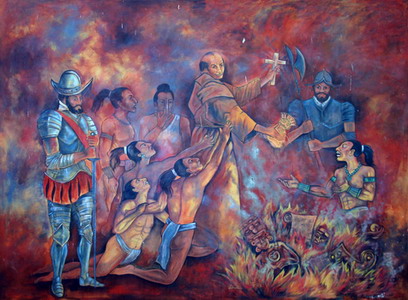
Maní, painting by Leonardo Paz
The infamous “auto de fé” of June 1562 in Maní was an action designed to punish “backsliders” against the imposition of the Spanish religious and economic system. Perhaps Rebecca West might coherently argue that Landa’s tactics were beneficial to the Mayans in the long run, under the presumption that the ways of the “typical Western man” are superior to all alternatives, and therefore the alternatives should be supressed, and it is a valid argument. But not one accepted by those forced to make the change. Converts from the old ways, and those still practicing the old ways fled, and turned “insurgent”. What Landa didn’t see, and wasn’t noticed at the time, was that his methods of persuasion probably did more to preserve the old Mayan religion and set off wave after wave of repression of the Mayans and violent resistance to outside intervention that has continued to this day. It was the inquisition at Maní where Landa oversaw the public destruction of Mayan records and documents on a large scale, leaving his version of the Mayan way of life. Landa — like today’s diplomatic cable authors — “obtained his material from native informants,” as the introduction to An Account of the Things of Yucatán has it. That Account, just to drive home the analogy, depended on “native informants” — people whose veracity we have no way of questioning at this late date, and who presumably (Landa’s research having been done as a missionary friar) were already tolerant of, or accepting of, the new faith. J
But, unlike the Wikileaks, the manuscript went unpublished for over 250 years, it was a bit late to consider the consequences of the policy then in place, and to consider alternatives to repression and violence.
The Wikileaks allow us to assess the value of the “native informants” and discern those who have accepted the “true faith” of neo-liberalism and those who accept U.S. hegemony and judge accordingly. By disseminating the Wikileaks one isn’t seeking to prove (or even argue) that “[e]very social problem in Mexico is caused by the U.S.”, but to to consider alternatives to the latest “theology” and presumptions that surround social issues (not necessarily a “problem”) while there is a chance of changing or modifying “rash, violent and impetuous” acts that are seen by many here as “imprudent, inhuman and cruel.” And may avert a tragedy like the history of the Yucatan Mayans.
The U.S. Dept. of State’s “Mex Files” here
I don’t expect to have time to more than glance at the wikileak cables over the next few days, but as I have access, am putting them up on their own page, labeled WIKILEAK MEXICO CABLES.
The batch I put up tonight (2-December-2010) were cut and pasted straight from El País. Others as I can, since Cable Viewer (cablegate.wikileaks.org) goes on and off line, and isn’t always easy to negotiate.
The one that jumped out at me right away was the summary to Cable 228419, dated 5 October 2009 (which is only “confidential” and neither secret nor marked “NOFORN” (meaning not for foreign distribution), which certainly sounds like the “drug war” is more about perception and image building (for PAN?) than about stopping the trafficking of narcotics to the world’s biggest consumer:
… National Security Coordinator Tello Peon and Undersecretary for Governance Gutierrez Fernandez told the delegation they would like to explore seriously focusing our joint efforts on two or three key cities to reverse the current wave of violence and instability and show success in the fight against the DTOs in the next 18 months. They suggested starting in Ciudad Juarez, Tijuana, and one other city with a joint planning cell to review what resources we could collectively bring to bear. They believe the symbolism of turning several of the most violent cities would be potent, sending a signal to the rest of the country that the fight against organized crime can be won, and combating the current sense of impotence felt by many Mexicans.
Please turn off the fun
There’s much I wanted to write about this week, bookmarked, but just didn’t get the time to develop … the dangers of militarization in Mexico (and the stupid proposals by stupid people for even stupider reasons for U.S. military involvement in Mexico) … the upcoming 2012 elections (and the perception that it’s in the bag, for one reason or another)… the “drug war” and the rumors of war. Nor have I had time to digest the yesterday’s truly historic change in Oaxaca
And there are other things I meant to write about, and perhaps will — the Cancún climate change conference, World AIDS Day, citrus fruit as germicides — but they’ll have to wait. Duty calls… off on a business trip for a few days.

Winkie, wacky and wiki leaks
Wikileaks CEO Julian Assange may be an imperfect human being, but — with governments simultaneously denying that his publications of U.S. State Department cables are important  beyond a glimpse of the petty gossip in which diplomats indulge and simultaneously trying to claim the guy committed “treason” or “espionage” (based on a U.S. law that hasn’t been used since about 1920) — there’s a lot of interest in finding the guy, and in painting him in the worst possible light. Whether he’s a good journalist, a gossip monger or just a cyber-punk, the only really bad thing you can say is that he’s a serial leaker. There is an arrest warrant out for him, stemming from an an unrelated unauthorized leak that I suppose presumably could be considered a criminal offense. NYTimes:
According to accounts the women gave to the police and friends, they each had consensual sexual encounters with Mr. Assange that became nonconsensual. One woman said that Mr. Assange had ignored her appeals to stop after a condom broke. The other woman said that she and Mr. Assange had begun a sexual encounter using a condom, but that Mr. Assange did not comply with her appeals to stop when it was no longer in use. Mr. Assange has questioned the veracity of those accounts.
Despite reports to the contrary (and they say Assange is a bad journalist?) there is no such thing as an “Interpol Most Wanted List”. There is, however, an Interpol “Red Notice” … something more along the lines of a request from one state’s police to other police agencies to find a “person of interest”. And Assange is certainly an interesting person. So interesting in fact, that Tracy Eaton (“Along the Malecon”), not satisfied with mundane reality like the Ecuadorian Foreign Minister’s off-the-cuff remarks to a reporter that Assange would be welcome in his country (nothing official, according to President Correa), comes up with some cock-and-bull scenario in which Assange is likely to flee to Cuba — not that anyone has said anything about his looking for political asylum, or having to consider it. And there’s no reason to suppose the guy has any interest in Cuba. Seriously, Cuba? Don’t think so: not for the reasons Eaton comes up with ( the leaked documents don’t put the present Cuban government in a very good light, and besides, Cuba might want good relations with the U.S. some day), but for the simple reason that Assange is a cyber geek, and Cuba is about the worst place on the planet a cyber-geek could work.
W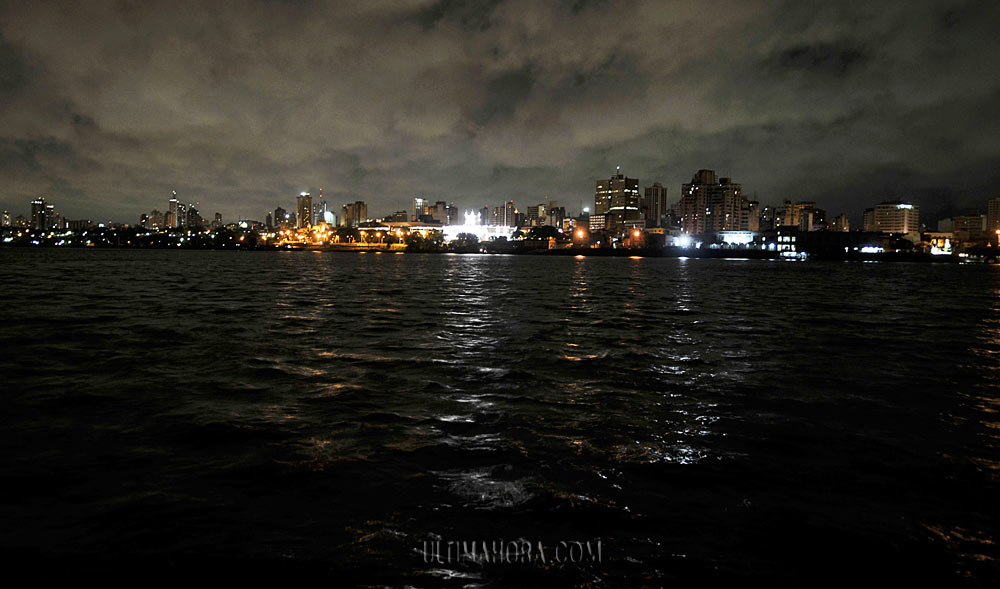 ith the possible exception of Paraguay. As someone mentioned in a comment the other day, even Paraguay’s largest city, Asuncíon, has maybe advanced socially into the 1970s. Oh, I know they have computers and telephones in Asuncíon now, but it’s not exactly the on the cutting edge of science and technology. Which makes the U.S. Embassy’s search for “biometric data, to include fingerprints, facial images, iris scans, and DNA, on [candidates for the Paraguayan presidency in 2008].” Uh, yeah… Paraguayan politicans are likely to leave their iris scans just sitting around the campaign office. This kind of James Bondish insanity seemed to affect the U.S. diplomats in Asuncíon quite a bit. When they weren’t running around looking for Hezbollah in the Chaco (something U.S. diplomats in Brazilia and Buenos Aires were also trying to find to no avail), they seem to have spent their time looking… for some excuse to keep spying just to justify a spy budget, or to justify a preconceived policy, or — most likely — because they can.
I have to give credit where credit is due. Adrianne Pines’ “Quotha.net” has managed to keep the snark factor down to a minimum not just on this particularly wacky leak, but also on several unfortunate publications from U.S. “strategic” thinkers. Pines has been publishing, without comment, some of the strange straight reports on not just this wacky leak, but wacky leaks from another embarrassment for the United States, the FIU-SOUTHCOM Academic Partnership.
Florida International University is a state of Florida public university, ot some “international” body. SOUTHCOM is the United States Southern Command, the “unified combattant command” of the Department of Defense, responsible for repressing Latin America since 1903. Together they produce papers on “strategic culture”, defined as:
“the combination of internal and external influences and experiences – geographic, historical, cultural, economic, political and military – that shape and influence the way a country understands its relationship to the rest of the world, and how a state will behave in the international community.” However, as Adrienne notes about their documents it is clear that a more accurate definition would be “strategic propaganda for the creation of hegemonic political ideology favorable to U.S. economic and military interests”.
One recent paper, calling out for snark, unapologetically speaks in terms that haven’t been seriously used … since about 1903.
…one of the most publicized elements contributing to the formation of the Chilean character” is the crossbreeding between wild and aboriginal warriors, who fought a long struggle, and a type of Spanish conquistador, who knowingly came to Chile to face a formidable enemy. Hence, it is the origin of the assertion that Chile is comprised of a people with an aptitude or predisposition for war.
The FIU-SOUTHCOM Chilean study goes beyond the old-fashioned “national characteristics” nonsense into apples and oranges territory in its attempts to justify economic control.
It is instructive to compare the growth of Chile’s economy with that of Mexico after the 1981 recession since both countries suffered from financial crisis and major recessions. Chile enacted the policy of letting the inefficient and unproductive firms, including banks and other financial institutions perish, leading to a more efficient transfer of capital to the more productive elements of the economy. Mexico, on the other hand, did not make the adjustments and only after the crisis of 1995 did it begin to privatize the banking system.
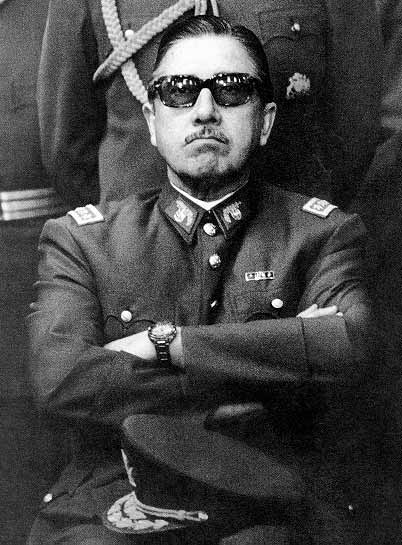 Leaving aside the minor factoid that Chile was a rather nasty military dictatorship at the time, the dictatorship having been fostered by the U.S. State Department specifically to undo the economic system in place before the 11 September 1973 coup, the statement only makes sense as an attempt to whitewash military intervention (in Mexico, too?) and justify imposing a particular economic policy on other countries… including Mexico.
Or, as Otto (Inca Kola News) suggest in a post on a rather hilarious leaked cable inquiring about the condition of Bolivian President Evo Morales’ nasal passages (I’m not making this up), there’s a simple explanation for the discomfort felt in Washington over the spillage of diplomatic ejaculations from around the world:
The USA really doesn’t have the first clue about Bolivia, even at a diplomatic level. Here’s a dude writing his letters home from the La Paz Embassy talking about Bolivia’s “quickly crumbling economy”. Jeeez! For one thing Bolivia’s “crumbling economy “just happened to be the number one best performing economy in the whole of The Americas in 2009 and for another, the economic policies have continued to this day, giving Bolivia a decent growth forecast for 2010. Currency reserves are at an all-time record, its trade surplus is excellent and the acid test of any country, its currency, shows strength all round, with the crawling peg recently ratcheted up a notch and Bolivians, for the first time ever, holding more savings in local currency than in the US Dollar. No wonder US policymakers get the country so wrong: they’re informed by utter dumbasses.
Dumbasses about covers it. Miguel Octavio, the anti-Chavista (and anti-Wikileakista) author of the always readable Venezuelan blog, “The Devil’s Excrement” finds himself “outed” in one cable and gives the impression that — being quoted saying something his said several times on his blog — that the wikileaked cables show more ineptitude and complete incomprehension of foreign countries and cultures than anything substantial. As to being the “victim” of the leak, Octavio writes, “About the main revelation from the wikileaked cable is that I have a Ph.D. in Physics, something that many readers may not know.”
Of course, we have only seen (as of my writing) only about 600 of the 2500+ cables, and none from Mexico (one is listed as coming from the U.S. Ambassador in Mexico City, but dealing with a Pakistani issue, it may be mislabeled. Of course, the U.S. Ambassador at the time was former Texas political hack Tony Garza, who sounded off on a lot of things not in his area of expertise, so who knows how it got here). Jorge Casteñeda, who is considered more a Mexico expert outside Mexico than within, thinks the leaks are a trove of “gossip” for historians and academics, but doesn’t expect much will be revealed by mining those 2500 promised Mexican cables.
Carmen Aristegui quotes El Financiero’s investigative reporter, Dolia Estévez — a Mexican makes it her business to talk to experts who Mexicans see as experts, and let them talk about  what they actually know — reports that sources who have been contacted by the U.S. State Department in anticipation of the damage that will result from disclosure. They cannot say for certain, but aside from some cables of probably only historic interest (going back to 1966 during the height of the Cold War, when Mexico City was vying with West Berlin for spy-v-spy capital of the world) that sources “hope” the Administration has prepared a good response to what should be “explosive” material.
… in 1994, the consulate in Hermosillo alleged that Manlio Fabio Beltrones, then governor of Sonora and currently a Senator, was allied with narco-gangs and, according to a consular source, was a cocaine user. Estévez adds that the story is unconfirmed, but is of the type of information to be expected [from the Mexican-based cables].
She said the material likely also includes information from U.S. intelligence reports on the UN representatives from Mexico in 2003 and 2004, t also could get information on U.S. intelligence made during 2003 and 2004, and the Fox administration but could include more recent information. (my translation)
Dumbasses in the consulates are nothing new in Mexico (or anywhere in Latin America, or on Planet Earth), but — with a presidential election in the offing, and growing discontent with the U.S. proxy war against narcotics traffickers, coupled with the always barely beneath the surface sense that the gringos are crazy, the results are unpredictable. Given historical trends, leaks from U.S. embassies have had negative impacts on U.S. policy, and U.S. Embassy initiatives, based on “dumbass” calculations and thinking in terms of “national characteristics” have led to tragedy bef ore and may again.
Maybe I’m just perversely interested in the “historical gossip”, but given my sense that Mexico has failed to thrive as it should compared to other Latin American countries because of too close ties to the United States, the leaks are going to be, as Aristegui said, “explosive”. Perhaps orgasmic.
Mexico may have entered into consensual relations with the United States, but something broke a long time ago. With that leak, there’s every chance of infecting the body politics, or in impregnating the citizenry with an even more cynical view of their government than they already have. Perhaps it’s too late to pull out, but Mexico will be within its rights to feel used, and to see that relationship as abusive.
Recommended reading

Daniel Ribot, “a writer of speculative fiction, lecturer, translator and comic book obsessive” (his doctorate was a study of Mexican political cartoons) has an excellent, clear and concise overview of the Mexican Revolution (and what it means) at his website Floppy Boots Stomp Compress (the name is a pop culture reference that didn’t mean anything to me, either). Part I is here, part II here.
As a Spanish-born British academic, Ribot’s interpretation of the events and meaning of it all will, of course, differ from a U.S. born Mexico-based writer less interested in the theories than in the results. And, while no one can ever hope to write a complete history of every event everywhere in Mexico during the Revolution, Ray Acosta’s “Revolutionary Days: A Chronology of the Mexican Revolution” is now required for any and all writers on the theme. Even those in the English Midlands.
Bike locally, think globally
AFP, 18-Movember-2010:
Authorities in Mexico City have taken on the uphill challenge of bringing more bicycles onto the streets of one of the world’s largest and most congested cities. Schemes to boost bike use are part of an ambitious 15-year Green Plan which aims to improve the environment of the sprawling metropolis. They’re also a pet project for leftist mayor Marcelo Ebrard, who hosts a world meeting of mayors on climate change on Sunday.
Sombrero tip to Erwin at The Latin Americanist
Sacrificial Victims
Ferdinand and Isabella wanted to enforce loyalty to their crown. Tlacaélel’s purposes were slightly different. He couldn’t eliminate the other gods or other people, but he could eliminate their ability to revolt. Sujects without warriors were no threat to Aztec control. Huizilopochtli, the sun god, had been a hummingbird — nothing particularly scary about him — but Tlacaélel wanted to scare people into submission, so Huitzilopochtli beame a god who lived on human hearts. Every town in the empire had to have it’s own Huitzilopochtli “church”. There was a huge demand for human sacrifices. Captured enemies were the obvious sacrifices. When captured enemies started to run out, the Aztecs had to refine the practice and took warriors as tax payment. Sacrificing the warriors to Huitzilopochtli kept the subject peoples from rebelling — they simply lacked the soldiers.
(Gods, Gachupines and Gringos)
As it is, I’ve pretty much stopped writing about the ins and outs of the “drug war”, leaving that to others. Frankly, too much of the writing is just plain sensationalist,self-absorbed, and ahistorical. Although it dominates THIS administration’s policies, and foreign reporting, honesty, I think it’s just a temporal event, more meaningful as a symptom of a problem, than a problem in itself. Patrick Corcoran’s review of Charles Bowden’s “Murder City” finds much wrong with the pop journalist’s Juarez book: besides Bowden’s obvious factual errors and his “conscious attempt to build a comic-book dreamworld… the dystopian land of death and disorder”, Corcoran disagrees that “The city’s descent into something like anarchy since 2008 isn’t the natural and inevitable byproduct of globalization writ large. ” In short — sensationalist and self-absorbed, but perhaps not totally ahistorical, just — as Americans tend to be — seeing history in terms of a few years, rather than a few centuries.
It is natural, in writing of a people who traditionally conceived of time as circular and has always had an obsession with its own history, to see contemporary events as variations on a theme. What has gone before exists now, although in an altered form, and — if are able to make the connection — will happen again. Several times, I have compared Don Felipe to Don Porfirio. Revolutionary propaganda often compared Don Porfirio to Huitzilopochtli. I might not compare our present administration to the Sun God, but I might to Tlacaélel.
As nephew, step-brother, uncle or great-uncle to tlatoque (roughly “emperors”) and later as cihuacoatl (literally “snake woman”, more like Prime Minister and chief priest combined), Tlacaélel was the “power behind the throne” during the entire period of Aztec hegonomy in Mexico. At the time of his death (in 1492, a rather important year in the history of the Americas) he had normalized the social-political system the Mexica (Aztecs) imposed on their neighbors, a good part of which rested on his unusual method of arms control.
While there aren’t the records to say for certain, it’s unlikely that Huizilopochtli worship was universal, or that its imposition was without dissent. Of course, we only have the “official” story, and any alternative media from the time seems to be lost. We do know of rebellions against Flower Wars — the ritual war-games introduced by Tlacaélel, in which the Mexica (Aztecs) faced off against a subject people’s army, the object being that subject captives were then “honorable” sacrificial victims: a form of indirect taxation through sports. But, based on Cortés’ success in using taxpayer protests to find allies among the Aztec subjects — only that there was widespread resentment and that, with Tlacaélel out of the picture, the Aztecs would probably have lost power eventually, even without the shock of the Spanish Conquest.
Huitzilopochtli, of course, came from the north (like the Aztecs themselves) much as the god of our secular age, neo-liberalism is also largely of northern origin. The Huizilopochtli cult brought immense benefits to the ruling Aztecs, and provided some benefits to the populace, even if the means of imposing those benefits was… er… “heart-rending”.
While there is no single figure we can identify as the Talcaélel of neo-liberalism (unless, perhaps, it’s NAFTA’s father, Carlos Salinas — who López Obrador for one identifies as the evil genius behind everything that’s rotten with today’s economic and political leadership) we have come to accept (if grudgingly) a system that enriches the elites, benefits the masses, but at the same time demands violence — especially against young men.
The phony “drug war” is neo-liberalism’s “Flower War” — an exercise in blood-letting that both reduces the number of possible opponents to the status quo, but also pays homage to the imposed, and artificial, belief system.
Statistically, the overwhelming number of victims in the “drug war” are young men. The “drug war” — something I really didn’t write about in my own Mexican history for the simple reason that I cut off at the start of the Calderón administration) — only took on the guise of “war” since 2006 . But that does not mean that the sacrificial victims to Huizilopochtli II weren’t already being sent to the altar of neo-liberalism before that.
++++++
As Esther (“From Xico”) put it back in March 2009:
… militarization — increasing militarization — solves nothing in a way we’d want things solved: it doesn’t solve underlying social problems, unequal distribution of wealth, increasing job losses due to the economic crisis, the terrible effects on local livelihoods of globalization, not just from NAFTA, but starting in the 1980s. Militarization also kills and maims people and destroys families and jobs. And creates anger among [the] civilians affected. Militarization does nothing for drug treatment. For civilian law enforcement. Militarization supports perhaps Calderón, but Calderón certainly isn’t Mexico.
Going back even further, to April 2006, was this overview of the effects on the devastation caused by NAFTA — NAFTA being, if I want to extend my metaphor a bit, the social framework imposed to enforce the new cult of neo-liberalism, much as the Aztecs imposed Talcaélel Huizipotchli cult on subject peoples.
While there has been some media coverage of NAFTA’s ruinous impact on US industrial communities, there has been even less media attention paid to its catastrophic effects in Mexico:
- NAFTA, by permitting heavily-subsidized US corn and other agri-business products to compete with small Mexican farmers, has driven the Mexican farmer off the land due to low-priced imports of US corn and other agricultural products. Some 2 million Mexicans have been forced out of agriculture, and many of those that remain are living in desperate poverty. These people are among those that cross the border to feed their families. (Meanwhile, corn-based tortilla prices climbed by 50%. No wonder many so Mexican peasants have called NAFTA their ‘death warrant.’
- NAFTA’s service-sector rules allowed big firms like Wal-Mart to enter the Mexican market and, selling low-priced goods made by ultra-cheap labor in China, to displace locally-based shoe, toy, and candy firms. An estimated 28,000 small and medium-sized Mexican businesses have been eliminated.
- Wages along the Mexican border have actually been driven down by about 25% since NAFTA, reported a Carnegie Endowment study. An over-supply of workers, combined with the crushing of union organizing drives as government policy, has resulted in sweatshop pay running sweatshops along the border where wages typically run 60 cents to $1 an hour.
So rather than improving living standards, Mexican wages have actually fallen since NAFTA. The initial growth in the number of jobs has leveled off, with China’s even more repressive labor system luring US firms to locate there instead.
But Mexicans must still contend with the results of the American-owned ‘maquiladora’ sweatshops: subsistence-level wages, pollution, congestion, horrible living conditions (cardboard shacks and open sewers), and a lack of resources (for streetlights and police) to deal with a wave of violence against vulnerable young women working in the factories. The survival (or less) level wages coupled with harsh working conditions have not been the great answer to Mexican poverty, while they have temporarily been the answer to Corporate America’s demand for low wages.
With US firms unwilling to pay even minimal taxes, NAFTA has hardly produced the promised uplift in the lives of Mexicans. Ciudad Juarez Mayor Gustavo Elizondo, whose city is crammed with US-owned low-wage plants, expressed it plainly: “We have no way to provide water, sewage, and sanitation workers. Every year, we get poorer and poorer even though we create more and more wealth.”
In other words, rural youth (and other young people) have been “sacrificed” to the neo-liberal economic system — creating wealth for the ruling classes, while destroying the future threat workers outside the system might represent. That the narcotics industry has taken on such an important role in the border communities, and in rural Mexico, seems almost natural. Narcotics production and smuggling stands outside the neo-liberal economic system. Certainly it is exploitative, but offers at least some of the young, a chance at economic survival. I suspect that the borderlands and the rural areas were already losing population, and collapsing as vibrant communities even before the “drug war”, and the stories we read of communities “overrun” by the narcos are more the result of being unable to resist (the best “warriors” — in our day, the educated, the skilled and the ambitious — have been drained off, sacrificed to neo-liberalism (either forced to migrate, or simply so beaten down that they’ve unable to fight for their own interests).
I don’t see the narcos as heroic in any sense, but they are symbolic of economic resistance. As with the Aztecs, resistance, even if only symbolic, would undermine the entire system. Thus, for the Aztecs, the “Flower Wars,” and — for neo-liberalism — the theatrical “drug war” with its slaughters done mostly out of sight of the masses, but the results displayed as evidence of the ruler’s power. Think about it. Most of the police/army/narco “battles” are secretive affairs, with after the fact major coverage of the carnage, or a parade of the prisoners about to be sacrificed.
++++++++++++++++
Tlacaélel died in 1492 (a rather important date in the history of the Americas for other reasons as well) at the height of Aztec power. He couldn’t know that the Huitzoptchli cult he so assiduously fostered would be doomed by a new faith, accepted only grudgingly in many cases, but overwhelmingly having the advantage of being NOT Huitzapotchli,and not overtly sacrificing the young. IN 2012, Calderón’s term expires. Right now, the betting is on another neo-liberal administration, but who knows… perhaps 2012 is not our 1524, but our 1492. Whether neo-liberalism is doomed, and whether there are conquistadors bearing a new economic faith, who — like Cortés — will find their allies among those not benefiting from the status quo, I can’t say.
Lazy, obese, and complacent is no way to go through life, son
Ganchoblog semi-praised the Washington Post for ALMOST managing to write an article with a Mexican by-line that was about something other than gangsters.
Los Pinos was presumably tickled to get some attention in the Washington Post that painted the president in a positive light and didn’t have to do with insecurity. And then they read the lede:
Mexico is battling billionaire drug mafias armed with bazookas, but when President Felipe Calderon ranks the threats his country faces, he worries more about methane gas, dwindling forests and dirty refineries.
… the article muses, “Who knew?”, which is a bit odd because Calderón has made quite a bit of noise on climate change for most of his term. In effect, the answer to that rhetorical question is, “People who follow Calderón’s public statements”, a group in which you’d expect the Washington Post correspondent to be included.
Meanwhile, in Washington itself, the television political chat-show, “Face the Nation” made some news when it’s “annual[…]attempt to bring together for an intellectual conversation four authors who wrote serious historical or political books,” went slightly awry. Edmund Morris, the Kenyan-born biographer (of Theodore Roosevelt and Ronald Reagan), managed to utter the word “bullshit” (in regard to a rather stupid question about what Roosevelt would do if he were alive — which he isn’t, and hasn’t been for a long time) and was bleeped out. That a well-educated person can get exasperated perhaps is news to some, but what annoyed Americans was that Morris
…launched a devastatingly serious critique about what he sees as unattractive about the American people today:
I see an insular people who are insensitive to foreign sensibilities, who are lazy, obese, complacent and increasingly perplexed as to why [Americans] are losing our place in the world to people who are more dynamic than us and more disciplined.
The Washington Post article seems to confirm Morris’ critique. i was struck that Crooks and Liars (a website that focuses on U.S. media and politics) finds it so unusual that a public affairs discussion would have “intellectuals”— the figures that dominate Mexican television discussion programs.
I’m not sure reporter from the Washington Post, like Bob Woodward, nor a media mogul and political commentator Ariana Huffington are exactly the same as people like Sergio Aguayo, or Lorenzo Meyer (academic researchers and historians, as well as journalists), let alone the late Carlos Monsivaís or Elena Pontiatowska — highly acclaimed belle-lettrists, cultural critics and journalists, or Gabriel García Marquez, who has appeared on Cristina Pacheco‘s afternoon chat show… which would be like having Gore Vidal on “Oprah”. In other words, in the U.S., media figures who write on politics are considered “intellectuals”, whereas here an “intellectual” better have something else in their tool-kit besides opinions and conversations with other media and political figures.
Leaving aside the absurdity of bleeping out a mild (and pertinent) obscenity,what seems to upset the critics in the United States is that Morris presented a well-thought out social critique. Perhaps an uncomfortable truth, but what makes it intriguing is that his attackers complained about his accent and his use of that single word (and he was quoting an American movie). Apparently, it wasn’t entertaining: from what I’m told, Comedy Central’s “The Daily Show” often has serious authors , but expects them to be funny. Some of our intellectuals are witty (the late lamented Monsivaís got chuckles from even the most poorly educated viewer), but aren’t expected to be entertainers, nor to temper their thoughts and language to the lowest common denominator. They are there to engage the viewer, to present a logical perspective, and — if one disagrees — one is expected to at least forced to admit that there is intellectual rigor behind the presentation.
Which leads back to the Washington Post (Woodward’s newspaper, by the way). The reporters, or editors, are too insular (or insensitive) to consider that Mexico and Mexican political leaders might have concerns beyond the narrow obsessions of the U.S. media, and are too lazy to do more than make complacent remarks about world issues. Obese? I don’t know, but perplexed they certainly are.
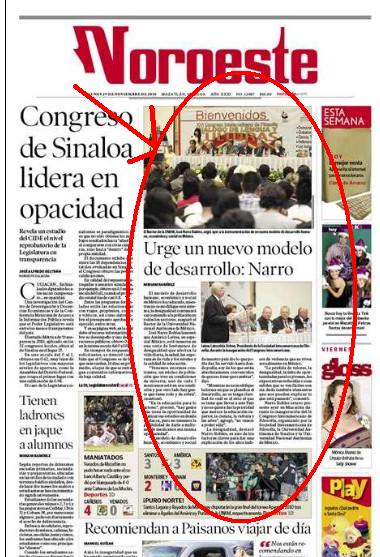 Mexican media isn’t all that great, but consider our provincial newspapers. In the United States, Sarah Palin (who seems to know nothing, and can’t even write the books put out under her name) is considered a serious contender for the Presidency. When she shows up in a local community, it’s likely to be at a shopping mall, and would merit coverage for that. And whatever bone-headed statements she might make.
Seriously considered as a Presidential candidate here is Dr. José Narro Robles, a MD, consultant to the World Health Organization, and Rector of the largest university in Latin America. He showed up in our local community, to present opening remarks to the Latin American Philosophical Congress, and his speech — calling for more state action to foster social and economic equality — was front page, above the fold, news in our local newspaper.
And, that is why intellectuals can tell newscasters in the United States they’re are full of bullshit.
Brazilian narcos scare me!
Mexican drug lords may lay on the bling a little heavy, but at least they have the bad fashion sense to stick to traditonal (naco) values. For real kinkiness among the criminal classes, you need to go to Brazil.
Rio police were taken aback when they raided gang-lord Pezão’s lair. Nothing so gross as decapitated bodies, or so over the top as a private zoo… nope… instead they found this:
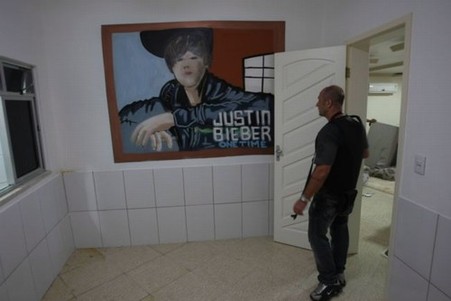
Pezão’s hideaway doubles as a shine to the Canadian teen idol. Which, as Cindy Cazares writes (Guanabee), “this would freak us out more than any evidence of torture we might find in a drug dealer’s house. In fact, maybe this is how he tortured his enemies.”
Excuse me while I soak my head in brain bleach and de-compress with a few hours of narco-corridos.
Drip, drip, drip…
Drips and drabs of updates in century font.
Speaking only of Latin America, the new batch of Wikileaks, and the discussions on them, have been mostly confirmations of what has been known, or suspected, about U.S. relations with the region.
 Inca Kola is, por supuesto, a site for people who invest in mining, which means moving tons of stuff you can’t use to find the stuff you can. That includes data mining, but so far, “apart from that and the usual US paranoia about hezbollah in Paraguay*, there doesn’t seem to be much about LatAm in the leaked documents…” with a few notable exceptions.
That “so far” needs to be emphasized. The Devil’s Excrement (an anti-Chavez Venezuelan site) takes glee in the fact that Venezuela merits less attention than Iran in the leaked documents. However, that’s about 4000 documents to look at. Mexico merits a mere 2000 or so mentions, but, unlike Jorge Casteñeda (noting that 85 percent of the Mexico related documents are not secret), the effect is likely to be more than of merely academic interest, especially with growing mistrust of U.S. intentions regarding “Plan Mérida” and lingering suspicions of interference in the last presidential election. Setty’s Notebook also wonders about what’s been seen so far, since access to Latin American mineral resources have been a overwhelming interest of the United States since the 1820s, but there seems to be little interest … which seems to reflect the Wikileaker’s own priorities rather than those of the Untied States.
A French diplomat thinks Venezuelan President Hugo Chavez is crazy**, and Hillary Clinton is “concerned” with the mental health of Argentine President Cristina Fernández de Kirchner, but that seems more in the realm of gossip (high-level gossip to be sure) than anything substantial.
There are several mentions of Mexico, in relation to the United Nations. Other than the fact that spying on the Mexican U.N. delegation seems to be on-going, no surprises as yet. Mexico had a seat on the security council during the build-up to the U.S.-British-Spanish intervention in Iraq, and Adolfo Aguilar Zinzer, the Mexican Ambassador to the United Nations at the time, had been talking about the spying at the time of his death in a car accident (that we have no reason to believe was anything but a car accident) in June 2005.
Otto, at Inca Kola News, reprints the cables regarding the Honduran coup. What is eye-opening is that the U.S. Ambassador, Hugo Llorens, concluded the coup was a coup… just adding to the sense that the Obama Administration’s spin on President Zeleya’s removal (and the subsequent strain on U.S.-Latin American relations) was for domestic political reasons.
El Duderino (Abiding in Bolivia) is anxious to read the cables from La Paz, in relation to the attempted coup in that country while I would like to see what was said in 2005-2006 about the Mexican presidential elections — the questionable activities of U.S. based political operatives aside, the “rush to judgement” in legitimizing the Calderón election and the blatant U.S. interest in the outcome would have been, at the very least, scrutinized from the corner of Danubo and Reforma … and what else they were up to not to speak of their present activities under the rubric of “Plan Mérida”.
I suppose if the leakers are the prospectors, then Cable Viewer and others are the miners, Inca and Abiding and others the smelters refining the stuff the scholars can turn into jewelry. Which I’m slogging up and down to offer to the gringos, as they say here, “for you, almost free.”

* As in an unclassified cable dated 2009-12-31 from the U.S Embassy in Brasilia:
The Brazilian government is achieving visible results from recent investment in border and law enforcement infrastructure that were executed with a view to gradually control the flow of goods-legal and illegal-through the Tri-Border Area (TBA) of Brazil, Argentina, and Paraguay, the proceeds of which could be diverted to support terror groups.
Or, to other smugglers? Geeze, it’s not like the Paraguayan borderlands haven’t been a smuggler’s paradise for some time now, has it?
** General Jorge Armando Felix, Brazil’s Minister for Institutional Security (i.e, head of the secret police and Presidential security advisor), is non-committal, as a good bureaucrat should be. (Secret cable from Ambassador John J. Danilovich, dated 2005-05-06):
… Ambassador raised Venezuela and its president Hugo Chavez and noted that Chavez was disrupting Brazil’s efforts to play a leading role politically and economically in South America. General Felix nodded his head and appeared to be very carefully measuring his response. He then said that he had his own personal opinions about Chavez (which he did not share) that were different from the Brazilian Government?s position. That being said, General Felix said that he preferred keeping in line with the official position (though he did not elaborate on it either). Felix noted that whether one was pro- or anti-Chavez, he had become very much a part of the “Latin American” reality.
The general comes out rather good here… at least trying to inject a bit of that “Latin American” reality into U.S. policy.
Another missing person report
SPDNoticias — which always refers to the resident of Los Pinos as “former presidential candidate Calderónn — notices that one of the other missing PAN leader‘s alleged associates is also missing.
A PAN party activist from the State of Mexico yelled out “you missed Chapo!” during a speech by former PAN presidential candidate, Felipe Calderón, while he was boasting of arrests in the “war on drugs” in a speech given to 10,000 civil servants and PAN supporters.
According to El Universal, the disruption occurred during what was presented as a “citizen dialog” to mark the fourth anniverasary of Calderón’s usurpation of the presidency.
Calderon called upon PAN to do more to prevent “the tragedy of returning to the old, authoritarian, and irresponsible” past — an allusion to PRI administrations, which, he said, “meant poverty, corruption, and denying or merely simulating freedom and legality.”
And, of course, SDPNoticias calls upon snark to say the same about PAN and Calderón.
8,841 but who’s counting?
This is one of those studies, that you really need to stick with. From Milenio (my translation):
As part of an on-going effort to eradicate bad habits, the Citizens Council for Public Security and the Prosecution of Justice in the Federal District (Consejo Ciudadano de Seguridad Pública y Procuración de Justicia del Distrito Federal) removed eight thousand, eight hundred and forty-one wads of chewing gum from walls and sidewalks on calle Madero.
According to the Council, over the course of the forty day project, citizen-agents reduced the average number of gum-wads on calle Madero from 100 to 24 per square meter, contributing to better sanitation and image for the important pedestrian street.
During the project’s duration, agents directly contacted 901 gum-chewers, 66 percent of whom left their wad in receptacles when “invited” to do so, 27 percent who threw their gum into other garbage piles and seven percent who requested more information. One person expressed shame over his conduct, 39 ignored the agents, two were verbally abusive and one pulled out his wad of gum and stuck it to a wall without saying a word.
The Citizens Council study found that on certain high-traffic days, more gum wads end up on the street. On 15 September (a “bridge day” to a holiday), Day of the Dead, and during the Revolution Centennial celebrations, observers noted 500, 100 and 5,000 wads of gum disposed of improperly.
One nice thing about Mexico. What we can’t blame on the gringos, we can usually blame on General Santa Ana. As far as chewing gum, it’s a two-fer:
In exile, Santa Ana did more for the Mexican economy than he ever did as president. Typical for him, it was a result of his personal vanity, and he was unable to understand its importance. For a time, he lived on Staten Island, New York, where he rented a room from a candy-maker. North Americans had poor dental hygiene and paid no attention to how their teeth looked. Mexicans, including Santa Ana, worried about their teeth, which they kept clean by chewing chicle, a rubbery plant sap. The candy-maker thought the ex-general’s chicle tasted awful but wasn’t bad if it was mixed with mint and dipped in sugar. He sold Santa Ana’s candy-coated tooth-cleanser as Chiclets. Mr. Adams, the landlord, became rich and famous as the inventor of chewing gum and created an entirely new agricultural export for Mexican farmers. Santa Ana never received the credit nor any profit from the idea.


 mexfiles.net