Passing gas
As usual, Canada’s joke of a national newspaper — The National Post — manages not only to toss in gratuitous anti-Mexican rhetoric, but to conflate an accident into some kind of conspiracy against Canadians.
The explosion at the Grand Princess Riviera Maya hotel in Playa del Carmen last Sunday was initially laid to a build-up of “swamp gas” — methane. Kelly McParland, with not even veiled contempt, rejects the initial finding out of hand:
… Mexican “authorities” (the word is in quotes because no one really seems to be in charge of anything in Mexico, except shrugging on camera) are suggesting the blast was triggered by a swamp.
See, they built this resort on a swampy area, and there’s still some swampland near-by, so maybe that’s the reason. Yeah, sounds good to me Manuel … nobody’s to blame, just one of those things. Thank God for that. We wouldn’t want to discover someone in Mexico was actually culpable — that might hurt the tourist business. So better to blame it on the swamp.
Who “Manuel” might be, Ms. McParland never explains… apparently it’s her “pet name” for all Mexicans (who, the rest of the article suggests, are all liars, and out to kill Canadians).
But, that’s the National Post. Not one to let facts get in the way. The Spanish owned hotel is not “nearby” some swampland… it’s IN a mangrove forest. After evacuating the 450 hotel’s guests, and its immediate closure, the Ministerio Público, the Secretaría de Desarrollo Urbano y Medio Ambiente and local Protección Civil authorities (those people Ms. McParland says aren’t in charge of anything) took charge of the investigation. And… as reported in slightly more reliable publications, it certainly seems methane gas buildup (possibly made worse by a sewage leak) was the likely culprit.
If there is a legal culprit — assuming bad environmental decisions from several years ago are any more actionable in Mexico than they are in Canada — the PERSON would be jailed, not having, like Canada, a convenient out the decision makers in an British based legal system “corporation” (a person without a body or soul… basically a vampire).
One has to ask if the Canadian media has editors who do more than “shrug” and evade their job of fact checking.
20 de Noviembre 1910

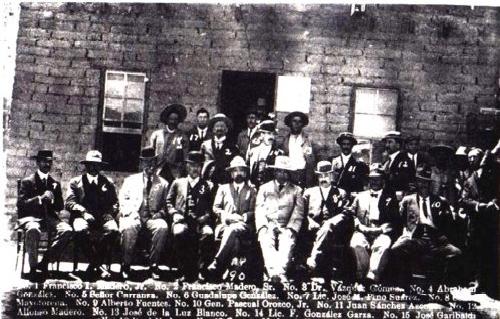
The Revolution — as scheduled (Madero even ran ads in border newspapers) — didn’t quite seem all that dramatic at the start. As Ray Acosta’s Revolutionary Days lists for 20 November 1910:
– Madero crosses in México at Piedras Negras, Coahuila but retreats back into Texas when no armed supporters meet him.
– In the mountains outside the city of Chihuahua, a local leader of Madero’s party garthers one hundred armed me. He reads them the Plan de Lan Luis Potosi and the men choose Cástulo Herrera as their leader. Pancho Villa is elected captain of twenty-eight men.
– Victorian Huerta requests a recall to active duty.
– In Cuartciéngas, Coahuila, Carranza’s hometown, there is a minor uprising in support of Madero. Carranza takes no part in it, and it is quickly put down.
We can’t predict the future importance of the most insignificant of actions, but without the action, there is no change. The students are taking to the streets today to protest the present “drug war” and more power to em…
And, while we’re waiting for the next big thing… here’s Lucha Reyes with Yo Me Muero Donde Quera to get us moving…
Obvious?
Wayne Slater (Dallas Morning News) catches what if it wasn’t a veiled threat — would be amusing in the twisted way that one enjoys the ravings of those “eccentric” relations yankees medicate when strangers come calling and southerners bring out as entertainment:
AUSTIN – Gov. Rick Perry said Thursday he would support sending U.S. troops into Mexico to fight the drug war.
The Republican has long urged beefed-up security on the American side of the violence-plagued border, but he said stronger tactics are needed to defeat the drug cartels.
“You have a situation on the border where American citizens are being killed, and you didn’t see that back when George Bush was the governor,” Perry said in an interview with MSNBC.
Asked whether the U.S. should consider deploying troops inside Mexico, Perry said the federal government should consider all options “including the military.”
“Obviously, Mexico has to approve any type of assistance that we can give them. But the fact of the matter is these [drug gangs] are people who are highly motivated for money, they are vicious, they are armed to the teeth. And I want to see them defeated,” he said.
“And any means we can to run these people off our border and to save Americans’ lives, we have to be engaged in.”
Covering the lunacy of Texas politicians is best left to the pros, but a few points to consider:
- Violence related to narcotics decreases the further one is from the U.S. population. The worst violence is across from El Paso, which suggests the closer one is to TEXAS, the more danger there is for Mexicans. I don’t think anyone in Mexico expects, as Perry seems to suggest, moving the good citizens of Brownsville to Corpus Cristi and everyone from El Paso pick up and flee to Amarillo… but thanks for the good wishes. Perhaps when Perry says “any means we can to run these people off our border and to save Americans’ lives, we have to be engaged in” could be taken to mean he’s going to finally “do something” about the gun runners, drug dealers and money launderers.
- Perry admits that violence to U.S. citizens has risen during his tenure as governor. Is this an admission that he is not up to the job. In Mexico, there is a legal procedure (destitucíon del oficio) for removing state governors who are unable to provide security for their own citizens. Governors have been accused of this kind of failure, but this is the first time I’ve ever seen one, anywhere, openly admit it. I realize the U.S. has a different legal system, and different political process, but it’s refreshing to see a U.S. politico admit he’s an incompetent boob.
- As everyone knows, “Insanity is doing the same thing over and over and expecting different results”. The United States has been throwing troops at the border in a small way to stop narcotics exports… and exports have risen.
They have — under the presumption that Mexico “has to approve any type of assistance” — intervened a couple of times in the past. The 1914 Veracruz intervention got a lot of U.S. marines and sailors killed (and several Mexicans, who are now national heroes), led to anti-United States riots throughout Latin America, permanent distrust of the United States Navy in this part of the hemisphere and a very serious threat of warring Mexican political factions uniting under the common banner of beating back an intervention (including from the very people who supposedly “approved” the “assistance”).
Pershing’s “Punitive Expedition” didn’t go exactly all that well either. The only overt U.S. military operation in Mexico since then was during the “War Against Nazis and Fascism” when the United States was permitted to maintain a few small air stations — off-shore and closely watched by Mexican security.
Well, I know Perry operates under the handicap of a Texas education, but perhaps he might “remember the Alamo” when a bunch of U.S. interventionists and insurgents got themselves needlessly slaughtered under the mistaken impression that Mexicans had to “accept” their “assistance”.
- The narcotics exporters may well be “highly motivated for money, they are vicious, they are armed to the teeth,” but then so are their buyers in the United States. Interventions, such as that “assistance” given to Iraq a few years back certainly showed a propensity for greed. While I wouldn’t say your average U.S. soldier is “vicious”, I would point out that U.S. intervention — as in Colombia (and Iraq) — most likely would include “vicious” people motivated by money and armed to the teeth.
What’s scary about all this is that we’ve been hearing interventionist statements not just from right-wing lunatics like Perry, but from supposedly “liberal” politicos like Hillary Clinton for the last year… basically ever since it dawned on them that Calderón is a “lame duck” and his political support has been evaporating since the 2009 congressional elections. Where his party has done well, it has been in coalition with the left, which is willing to try a different approach to the narcotics problem (one I see as a symptom of a larger problem with the dependence on U.S. markets, but that’s another post). And, while the PRD/leftist coalition is forming a circular firing squad, PAN is also deeply fractured. Among those who assume the status quo will be preserved, and crave “stability” above all else, the support seems to be for a PRI president.
Maybe all that is rhetorical, but consider that although polling shows continued support within Mexico for the “anti-narco war” there isn’t any indication of any wish to escalate the conflict, nor of any call for U.S. intervention. If anything, it’s precisely the opposite. The budget passed by the Chamber of Deputies cut out the spending meant to escalate a military “solution” to the export problem, for the simple reason it hasn’t worked… and has only created more violence. The only people who “obviously” feel they must accept U.S. “assistance” are on their way out, and — barring covert “assistance” (as in previous elections), don’t have the support to remain in office much longer.
Obviously.
Send me your not retired, your poor, your PhDs…
Immigration Clearinghouse looks at the BBVA-Bancomer immigration study which received some coverage north of the border. Usually wrong coverage, but some.
If it wasn’t for the boneheads at Fox News, there probably would have been no coverage at all… which is a shame, since what BBVA-Bancomer researchers unearth shows a very different picture of immigration (and “illegal” immigration) than the assumptions and stereotypes surrounding Mexican emigrants.
Migration from Mexico is driven 71% by the U.S. economy, 15% by Mexico’s, and 14% by higher U.S. wages…
…if all immigration to the United States ceased today, by 2050, a full 40 percent of the working-age population (over age 15) would be 65 and older…
While the average Mexican worker has slightly more than eight years of school, those who go north have almost 10… A Mexican with a doctorate degree is four times more likely to move to the States than one with elementary schooling, and three times as likely to head North as one with a high school education.
Obviously, just creating more jobs within Mexico does very little to stem migration. Jobs that pay well (and more jobs requiring higher education) will. I admit I’m surprised by this too… given that so many of the migrants are farm workers and/or displaced farmers. My sense is were Mexican wages to rise enough to meet the needs of rural and less-educated Mexican workers, many of these potential migrants would consider staying home as well.
Of course, “doing the jobs Americans won’t do” is going to still require migrants, and even in bad economic times, not many U.S. citizens are going to opt for the jobs we associate with migrants (farm labor, etc.). And, without migration, the U.S. population would be much, much older as a whole (requiring migrant nurses… and doctors… and PhDs).
I suppose — given that Mexico is going to depend on foreign remittances for some time and better-educated people generally earn more money — it might be cost effective to invest here in “over education”. That is, while right now Mexican doesn’t have jobs for every school graduate, at least we can send out graduates who can send back more money from higher paychecks.
Some serious rethinking is in order here.
Dome and dumber
Where else but Arizona?
Via ThinkProgress:
In an era saturated with absurd moments of anti-Muslim fear-mongering, mosques have become a touchstone for Islamophobia. Even unbuilt mosques have set off a wave of anti-Muslim sentiment in Tennessee, Texas, California, and most notably, New York. Not to be outdone, the people of Pheonix, AZ were quick to call foul over the appearance of a dome-like structure along an interstate. But in the clamor over the impending Muslim takeover, these Arizonans missed one small detail — the building is not a Mosque, it’s a church…
Specifically it’s a Luz del Mundo Church, described by Jason Dormady as
[An] evangelical christian group based in Guadalajara, Mexico […] essentially a neo-pentecostal movement (founded in 1926 they were neo-pentecostal before it was cool) that embraces biblical literalism, Jesus Christ as savior from sin through his grace and baptism in his name alone, and with a modern apostle on the earth today. In short, there is enough doctrinal similarity between Arizona’s evangelicals and Mormons to make them fit in quite nicely in that religiously conservative state.
Of course, once the Zonies catch on that the denomination is headquartered in Guadalajara, they might stop being complete idiots, and go back to their normal racist idiocy.

OH NO... the Muslims are taking over Italy!
Fox and hounds
Guillermo Faber (Crisol Plural, Aguascalientes), decidedly not one of the Amigos de Fox, finds something worth appreciated… Fox didn’t answer his phone when it counted:
I confirmed this with Vicente Fox himself: despite 50 phone calls from various lackeys of the Empire (Cheney, Rice, various Bushies) demanding Mexico sign off on the adventure in Iraq, the devious Bajio rancher managed to sidestep a mega-brawl over joining in the cime against humanity very neatly. He never took the calls. He was in the hospital. Hats off to Fox. To me, it shows that he has a lot of balls (or was completely unconscious) to dis a hysterical empire at its most hysterical.
For several reasons, I’ve always had my doubts about Fox’s character, ever since he was governor of Guanajuato. But this fact alone is enough to (almost) re-claim him in my view. It doesn’t matter what I think. I have to admit that by his single gesture (of supreme bravery or immeasurable unconscious) , Fox saved Mexico from countless misfortunes.
 I happened to see Fox in public soon after his public refusal to involve Mexico in the cock-up in the middle east. He certainly looked and moved like a guy who just had major back surgery, and tend to think his hospital stay during the build-up to the invasion was not simply a matter of evading responsibility, but was fortuitous, given Fox’s disastrous performance as a telephone solicitations. That would have been when Bush, sold Fox on disinviting Fidel Castro to the Monterrey Summit of the Americas. Fox was completely at a loss when it came to projecting any semblance of sincerity in trying to sell Fidel an unreasonable proposition. And, Fidel taped the call.
Mexico — having a lot of oil, a not very good military and a less than perfect government — certainly viewed Iraq differently than the United States did. And, even the most geographically challenged amongst us can tell Mexico is a lot closer to the United States than Iraq is. One of the few people I knew who supported Mexican assistance made his argument in the form of a metaphor: “If the neighborhood loan-shark asks you to help him kill a vicious dog that scares his mother on the other side of town, you are likely to help… especially if you think you might need a loan someday… and you know he’s carrying a gun”.
Which makes one wonder: are the gangsters Hillary Clinton likes to compare to “terror groups” the “vicious dogs” today, and is the Calderón Administration being handed a shotgun by the neighborhood loan shark and told to kill his dog that annoys the neighbor … never mind that it’s going to mean blasting out the front room, destroying the TV, and leaving a load of buckshot in his granny’s backside?
It takes a pillage to raze a village
I mean to write at greater length about the 13.3 Billion (13,300,000,000) peso jump in 2011 Mexican federal budget for military expenditures and what it might mean. I’ve got a long post about half done, but it keeps meandering off into tangents, and I need to make some serious cuts. Speaking of cuts…
SDPNoticias reports that PRI Deputy Hilaria Domínguez Arvizu has confirmed that the federal budget cuts a whopping 4.4 Billion (4,400,000,000) pesos for rural development and agricultural spending.
Ms. Domínguez — who is openly campaigning to lead the CNC (Farmers’ cadre within the PRI) — denies rumors that the party might face mass defections (possibly to PRD or one of the other parties of the left) if these cuts are not restored.
If this doesn’t mean both the PRI and the left have more reason than ever to change the course in this “drug war” — if only to guarantee their own survival (and, one would expect, heavy interference from the U.S. to try to prevent this change), I think this might mean that farmers are getting screwed over by the “drug war” not just by the narcos, but by the government response to the narcos as well… and rural Mexicans will be left with no choice but to work for the narcos as a result of ever declining opportunities … which will mean MORE money for military spending, and less for rural services, which will mean…
Spies ‘R U.S.
Jorge Carrasco A. and J. Jesús Esquivel, in Proceso (my translation):

MEXICO CITY, Nov. 14 (Process) .- Under Felipe Calderón’s administration, the United States has done what it always aspired to: embed espionage agents in Mexico City. It was the rise of drug trafficking in the country that opened the door for U.S. intelligence agencies, predominantly military, to operate from the Federal District without even the fig-leaf of diplomatic cover.
Establishment of the Office of Binational Intelligence (OBI) – which began with discussions under President Vicente Fox Quesada – was authorized by Calderon, after negotiations with Washington in meetings attended by the director of the Center for Investigation and National Security (CISEN), Guillermo Valdés Castellanos, without taking into account military objections.
Through the OBI, Calderón has ushered in U.S. intelligence agents to investigate without impediment organized crime syndicates and drug traffickers. They also keep tabs on Mexican government agencies, including the Secretariat of National Defense and the Navy, as well as diplomatic missions in Mexico.
From their headquarters at Paseo de la Reforma agents from the Pentagon, the Central Intelligence Agency (CIA), Federal Bureau of Investigation (FBI), and Departments of Justice, Homeland Security and Treasury, are working approximately 250 meters from the United States Embassy.
Within the OBI , the Pentagon has the largest presence, with agents from the Defense Intelligence Agency (DIA), National Reconnaissance Office (NRO) and the National Security Agency (NSA). There are also agents from three Department of Justice agencies: the FBI, the Drug Enforcement Agency (DEA) and the Bureau of Alcohol, Tobacco and Firearms (ATF). Two Homeland Security Agencies – Coast Guard Intelligence (CGI) and the Bureau of Immigration and Customs Enforcement (ICE) – and the Treasury Department’s Office of Terrorism and Financial Intelligence (TFI), round out the contingent.
In addition, the OBI opened two satellite offices: one in Ciudad Juarez and one in Tijuana, where U.S. agents command “task forces” against drug trafficking, supported by Mexican personnel.
Model City
Joshua Frens-String in Hemispheric Brief, on what may be a more important development in the proxy war on Mexican exports:
… recent student protests against the militarization of Ciudad Juarez are particularly noteworthy. The largest such protest came last week when over one thousand university students marched through the streets of Juarez (see an impressive video up at You Tube which documents the march) in response to the Oct. 29 shooting of student activist José Darío Alvarez Orrantia by the Federal Police. As independent journalist Kristin Bricker reported at the Huffington Post last week, that shooting occurred during the International Forum Against Militarization and Violence in Juarez, and just before Alvarez Orrantia was scheduled to speak on a panel about “Youthicide.”
Over the weekend, the nascent, and very vocal, student movement that is demanding social and economic improvements in Juarez, as well as the removal of the military, gained the renewed support of the Juarez human rights community. In a statement, rights groups, including the Centro de Derechos Humanos Paso del Norte, offered their full support to UACJ students while also demanding justice in the high profile shooting of Dario Alvarez.
As Frontera NorteSur puts it, the mass protests of last week represented “a university movement that hasn’t occurred in Ciudad Juarez since the beginning or middle of the 1980s.” “We are trying to find an exit,” one Juarez student activist tells the New Mexico State University-based news organization. “Nobody has a manual on how to survive a social war, on how to survive the war of a government that doesn’t want to listen, that doesn’t want to see what it is causing-especially in the young part of society.”
While killing a student at an anti-violence protest is ironic (and stupid and tragic and a lot of other things) and note-worthy, what is more interesting is that we are starting to see organized protests of “Calderón’s War” that can’t — as previous protests have been — be dismissed as “narco-influenced”. The article by Kristen Brickler that Frens-String mentions concludes:
Juarez has been a laboratory where government officials have experimented new tactics and strategies in Mexico’s increasingly violent drug war. The military occupied Juarez and relieved local police of their duties from March 2008 to April 2010, when Federal Police took over policing duties from the soldiers. Juarez’s mayor and the governor of Chihuahua, where Juarez is located, have sought advice and training from Colombian mayors and police. Furthermore, a new phase of the US drug war aid package the Merida Initiative will reportedly focus on “institution building” and “rule of law” in Ciudad Juarez.
Despite the drastic measures, violence has only increased in Ciudad Juarez. The city now has the distinction of being the deadliest city in the world.
Laboratory? Sending in the military to clamp down on civil activities not in the state’s interest is NOT experimental … it’s a tactic that’s been around for quelling civil unrest ever since states have had militaries to send. The people of Juarez are not rats… nor are the students, who — understanding universities are the proper place for initiating laboratory research — are proposing a different, and perhaps more promising, field of investigation.

Worth noting is that the Hemispheric Brief post was entitled “Juarez Youth in Revolt”… and the students (I assume this includes some good students of history) are scheduling the ¡Griten Paz! for the centennial of the start of the last Revolution in this country kicked off by a norteño intellectual.
Yesterday’s news… today
Gee, how did I miss this important anniversary?

Dear N.R.A.
From Blogging by Boz:
Arturo Sarukhan, Mexico’s ambassador to the United States, said it should be in the National Rifle Association’s interest to stop the illegal flow of guns going south. After all, the US second amendment was not intended to provide arms to unregulated militias in Mexico.
The NRA’s response via Reuters:
“It is wrong for him to blame the second amendment and the National Rifle Association for a problem that originates in his own country,” NRA spokesman Andrew Arulanandam said. “This is a very serious and sad situation but the solution has to come from within Mexico.”
It’s the sort of hardline response I’d expect from the NRA. But at second glance, it’s also interesting to compare his language to some of those who advocate for legalization of drugs. The NRA insists that they shouldn’t have to deal with the supply side of the problem because it’s Mexico’s demand for guns driving the illegal arms trade. Blame the country that creates the demand.
Perhaps, if Ambassador Sarukhan were to follow up on the NRA’s “interesting” supply-side defense of their interests, he might respond:
Dear National Rifle Association:
I have the honor of informing you that my government is in agreement with your suggestion that a “solution has to come from within Mexico.” Our problem being that with unrestricted firearms imports, we will, of course, as allowed by GATT and other international agreements, be raising tariffs on other U.S. imports to recoup the costs for losses to our economy from the firearms imports.
As nothing in Mexican law prevents individuals from filing lawsuits against the manufacturer of dangerous products, Federal Ministers will be assisting those citizens harmed by U.S. firearms in filing suits against the sellers and manufacturers. Because these suits will be brought in Mexican cours, and it will be impossible to collect such judgments as the courts may order, we will — as is done in the United States in similar situations — seize whatever U.S. assets are available in Mexico to satisfy the court’s rulings. This would include, for example, not just United States government funds in Mexican banks, but real property, automobiles and goods owned by U.S. citizens.
Much as your organization believes your Constitutional guarantees of the right to bear arms extends to sales for export, our Constitution guarantees the right of any citizen to engage in any honest enterprise he or she may desire. Perhaps we have been doing a disservice to our narcotics growers and exporters, similar to that your organization believes is done by those who object to the unrestricted sale of firearms.
Thank you for your enlightened attitude on this. We will be immediately opening our borders to the export and sale of methamphetamine, marijuana and heroin. We have asked the governments of Peru, Ecuador, Bolivia, Colombia and Venezuela to open their trade in coca and cocaine derivatives, which — in passing through Mexico — also would require a solution to come from within your country.
With all best wishes —
Arturo Sarukhan


 mexfiles.net