Hasta la huesos
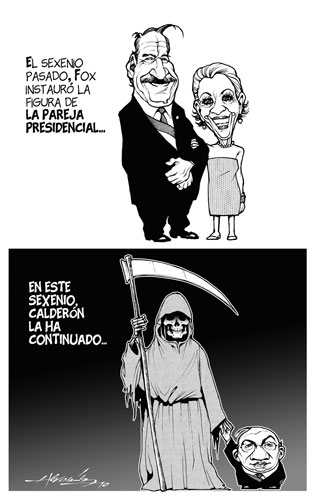
Pax Calderóna
José Darío Álvarez, a first semester sociology student at the Universidad Autónoma de Ciudad Juárez is in the hospital in serious but stable condition. died from his gunshot wounds. Álvaraz was marching in a demonstration against militarization when he was shot by a federal police officer.
I guess that means the demonstration was a success… students are being shot by the police, and not the army.
FARC? In the Baja?
Well, this is strange. One of the victims of the latest “rehab center massacres”, this one in Tijuana, was a guy named Wilson Ramírez Peña. Rámirez was a Colombian citizen and tentatively identified as a former (or active) FARC operative.
FARC, Fuerzas Armadas Revolucionarias de Colombia, according to the United States and the present administration in Colombia is a “terrorist” organization. According to its dwindling number of supporters and those who remember that the civil war that started in Colombia back in the 1950s has never ended, sometimes refer to the ostensively Marxist Leninist FARC as a “legitimate belligerent” in that unfinished war, or at the worst, a “violent non-state actor.” Whatever.
Like other “violent non-state actors” in Colombia (and sometimes the state ones, too), FARC has been financing its operations for a number of years through cocaine sales and kidnapping. The U.S. government’s “Plan Colombia” — supposedly targeting cocaine exporters generically — has been used mostly to wipe out FARC . The Colombian government was willing to make deals (i.e., bribe or be bribed) by FARC’s ideological opposite number, the Fascist AUC (Autodefensas Unidas de Colombia) and your ordinary apolitical capitalist drug dealers, like the kinds of guys we have here in Mexico.
While I suppose it is possible that there is more to this particular rehab massacre than meets the eye (several of these “rehabs” have been the scene of massacres before — most of them private facilities, seemingly connected to independent evangelists and suspected of acting as fronts for, or perhaps rest homes, for various Mexican criminal gangs). Of course, it could be that these rehabs are just easy targets for death squads, “cleaning” communities of minor annoyances like narcotics addicts. This doesn’t seem likely in Tijuana, although it may have been just a way of disposing of unwanted outsiders. The Baja California authorities have had to call in outside forensic evidence experts, in large part because the victims were not locals, their tattoos and gang colors not familiar to the locals.
Much as one might want to create an international conspiracy, it doesn’t seem likely, given that no one seems to be able to identify the late Wilson Ramírez Peña as a person of any particular importance within FARC, or within the larger world of narcotics trafficking. There’s a temptation to see this as somehow internationally significant however. “FARC” being classified as a “terrorist” organization by the United States feeds into the narrative of those like Hillary Clinton who throw around phrases like “terrorist tactics” when discussing criminal violence here — as if “terrorists” use tactics any differently than any other “violent non-state actor”, including totally apolitical ones like Mexican cartels. Honestly, I don’t know why anyone would be surprised that Colombian narcotics distributors are working in Mexico.
Which, in a way that is more troubling. “Plan Colombia” largely has succeeded in driving the narcotics traders out of Colombia (not the actual production of cocaine, nor it’s sale, but the control of distribution was taken out of Colombian hands), which just meant it moved to Mexico, and into the hands of the Mexican marijuana smugglers. Which, if they are wiped out by “Plan Merida” will not mean the end of the narcotics trade, but just another move northward.
We’re told this violence is a “normal” reaction to disruption of those gangs. Which sucks if you’re some low-level flunky in those organizations, or someone in the vicinity of the flunky. And, the more blood that flows and bullets (and hand-grenades) that fly, the more we’re told the plan is working. Presumably meaning that having been driven out of Colombia, and now being driven out of Mexico, control of the gangsters (and the mayhem) will move north.
Zombies unite!
Alas, Transparency International doesn’t measure stupidity. Panamá is supposedly less corrupt than Mexico (another indication that the parameters used are screwy), but in the stupid elected representative department, they have us beat hands down. From the un-dead Bananama Republic comes the latest in the dumber side of corruption… where elected officials abuse their power against the weakest among us… the dead.

Rob Rivera, “chief Instigator” for Panamanian cultural collective Porto Dia0 has, for the last several years, organized a Hallowe’en “Zombie Walk” .
This year, the event was planned for Casco Viejo. It would start Saturday night on Plaza Herrera and then the parade would meander through the old city center. Rivera had been busy arranging permits and coordinating everything with the local police and municipal authorities.
However…
Mario Kennedy, the local political boss… the indicted head honcho of the junta comunal… nixed a parade permit apparently because it might feature rock and roll music (which somehow leads to bombing Viet-nam — or Viek-man, as Kennedy refers to that country).
Rive ra called Kennedy to discuss issuing a parade permit. The “two hours of discussion” were more in the nature of a monologue by Kennedy on “the meaning of culture, religion, patriotic fervor and his opinion of tourists and resident foreigners”, ending with Kennedy’s refusal reconsider the issue, but offering the “helpful” hint that Rivera might be able to obtain a permit for a private party.
I didn’t know Panamá required permits for private parties, though maybe that’s some discriminatory practice and only requires zombies to have permits.
The police have instructions to stem the Rock-n-Roll Vietnamese Zombie menace and have been ordered to arrest anyone impersonating a zombie… at the Plaza Herrera where — in support of freedom of expression — the undead will gather this Saturday at 9 P.M.
So, what do you chant at pro-zombie demonstrations, anyway: “Death to bad government” or “long live idiots”?

Real tourists
There has been a 19.2% increase in foreign visitors to Mexico from January to August of this year compared to the same period in 2009 according to data released this month by Mexican tourism officials. The State Department may have issued travel advisories in March yet over 4.3 million of the 7.1 million foreign travelers in the first eight months this year came from the U.S.
As Erwin explains in his post, the bulk of the increase has been to our coastal resorts, and tourists are still shunning the bulk of the country — which is probably a welcome change to those who insist there’s a “real Mexico” if one gets “off the beaten track”. Not that there is an “off the beaten track” anywhere in Mexico and Mexicans living on the coasts are real Mexicans whose lives are really Mexican, in the real Mexico.
Really.
Corruptos
Every time Transparency International publishes their naughty-and-nice list those of us on the fringes of policy-wonkdom feel obligated to comment. Mexico is still about the middle of the pack, using parameters originally set up by Arthur Andersen Consulting (remember them?).
The only use I’ve ever found for the TI “Corruptions Perception Index” is when dealing with the uninformed people who tell me that Mexico is the most corrupt nation of earth (er, that would be Afghanistan), or at least in the Americas (nah… not even close).
Since the measurement is “perception”, it’s no surprise that the least corrupt (or perceived as corrupt) nations are the most homogeneous ones with the small discrepancy in wealth, and the most corrupt are those where there’s a sense that “thems that gots” didn’t get that way licitly, and where there are wide variations among people and their collective perceptions.
Secondly, given what is measured as “corruption”, practices that might be considered corrupt in one place (say, corporate financing of elections… or the existence of corporations as “persons” at all) are not considered corrupting in others, and aren’t even measured.
Third, there’s a perception that Transparency International is … shall we say… “influenced”… by outside factors (although you may think it, I would never use the word “corrupted” — so harsh a term) like political acceptance by the financial powers that be. As Otto notes, in connection with TI’s claims a few years back of wide-spread “corruption” in the Venezuelan state oil company:
… they repeatedly slammed Venezuela’s PDVSA for not publishing its annual earnings and financials when in fact the company did … It just showed TI for what it is; a biased, agenda-ridden organization that chooses its facts to fit the pre-conceived results and can’t be bothered to do the kind of investigation that’s needed for reliable stats work.
In other words, at most the “perceptions index” might be useful in bringing attention to specific issues (the need for timely financial reports at the Venezuelan state oil company, or — in Mexico — simplifying the procedures for release of public documents), but as a “my country’s better than yours” kind of thing, it’s meaningless.
And that’s all I’m going to say about it.
Nestor Kirchner
Nestor Kirchner, the former (and possibly future) President of Argentina, and spouse of Presidenta Cristina Fernández de Kirschner, died this morning at the age of 60.
Having come into office after a period of economic and political instability (the elected president and vice-president for the 1999-2003 term resigned in 2001. An interim president didn’t even serve out his three-month term, but resigned within a week, followed by another interim president), Kirscher faced the daunting task of reversing Argentina’s economic free-fall AND bringing credibility to his office. Taking on the International Monetary Fund (it was his government that simply refused to pay off on loans taken out by illegitimate military governments) and overseeing the creation of Mercosur were among the “radical” steps that enraged the great powers, but helped restore Argentina and Latin America’s credibility as self-governing peoples and reminded the world that our mutual interests were not to be subordinated to those of the major powers.
D.E.P.
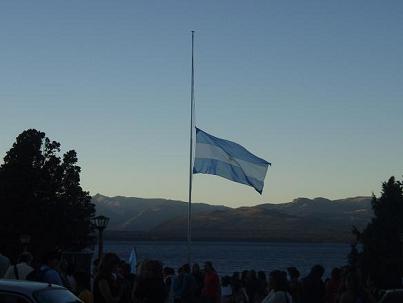
Photo: Inca Kola News
DOPEC?
The “Tuxla Group” (Colombia, Dominican Republic, Mexico, and the Central American Republics) are expected to have a “consistent and congruent” anti-narcotics policy as producers, when the consumer countries (er, the biggest single consumer country, anyway) dithers. From NPR:
“How can I tell a farmer in my country that if he grows marijuana, I’ll put him in jail, when in the richest state of the United States it’s legal to produce, traffic and consume the same product?… If we don’t act consistently in this matter, if all we’re doing is sending our citizens to prison while in other latitudes the market is legalized, then we should ask ourselves: Isn’t it time to revise the global strategy toward drugs?” [Colombian President Juan Manuel] Santos said in an interview broadcast Sunday by the Colombian radio station Caracol.
Maybe, since controlling the production and distribution is what justifies so much of our economic and military overlord’s command and control in Latin America, and props up several of the less, er “citizen-responsive” regimes, maybe a more proactive approach is in order. DOPEC, anyone?
Don’t worry, the U.S. economy’s heavy dependence on spending for police and firearms and prisons to control narcotics could still keep humming along, while the money made on the sale and distribution might be invested locally, rather than being siphoned off through money laundering elsewhere.
As military music is to music, military justice is…
One of the most significant reforms to come out of Mexico’s participation in the Second World War (or, as it is known in Mexico, the “The Anti-Fascist War”) was the formal removal of the military from a political role. As I wrote in Gods, Gachupines and Gringos:
President Ávila Camacho used the war as an excuse to professionalize the military. The old cowboys, miners, farmers and factory workers with the rank of colonel or general or still enlisted in the armed forces couldn’t meet the new requirements and found other jobs. Officer’s pensions had often been based on how much of a threat the old officer had been. Wartime, and the need to watch the military budget, was the excuse for reorganizing these pensions… The Mexican military budget actually dropped during the war and has continued to decline ever since.
In 1948, formation of the PRI, as successor to the PRM, completed the process, removing military cadres from the then-ruling party hierarchy. While 1950s President Adolfo Ruiz Cortines had been an Army officer (in the Quartermaster Corps), since the War, presidents have been civilians, and — although as Commander-in-Chief — actually do hold military rank, were reluctant to admit to using the military in civilian operations. This is not to say that the military was not used as enforcers in civil controversies (they were… again and again: in the 1958 railroad strike, in 1968, in the “dirty war” of the 1970s, against the Zapatistas in 1994, and on other, less “celebrated” occasions), but that it was always done under civilian authority and often only with the reluctant participation of the generals and admirals.
As a Revolutionary (or “Institutional Revolutionary”) state, militarism continued to have an important place as a symbol of the increasingly abstract people’s government. Vicente Fox, the first non-Revolutionary Party President, made important — if subtle — changes that sought to project the civilian nature of state authority: trying to turn the always impressive Mexico City Revolution Day parade into a celebration of sports and health rather than a show of military hardware (the military still marched, but the army cooks, Servicio Militar marching tree planters — armed with shovels and seedlings — and the disaster recovery teams all were turned out smartly), commuting the few remaining convicts under a death sentence in military prisons to life imprisonment, and allowing an important courts-martial case to be televised.
The last — often forgotten — may have been more important than we thought. I honestly forget what the case was about, and the exact date, but remember I had students (I was giving English conversation classes to executives at the time) fascinated with the show. It perhaps didn’t have the addictive quality the Watergate Hearings held in the United States, but did bring national attention, if only briefly, to what was then completely forgotten in the seeming de-militarization of the State: that the military justice system was separate from civilian control and — by extension — that the military itself was a thing apart from the civil government.
While calls for reforming the military justice system continue (none going as far as Argentina, which simply folded the military code into the civilian legal code) are under discussion, but have so far stalled, a more troubling trend is that — under the rubric of the “drug war”, or the more generic term of “insecurity” — Felipe Calderón has reversed the trend towards demilitarization and civilian control. Some is symbolic: he is, as far as I can tell, the first President since the War Against Fascism to be photographed in a military uniform. Much more worrisome, it seems Calderón is encouraging the military itself to seek a larger role in the affairs of state.
John Ackerman recently wrote in Proceso of a document distributed to PAN Delegates and Senators that (in my translation) “asserts that the mission of the Armed Forces is ‘perverted’ when they are ‘subordinate’ to civil authorities and are ‘overwhelmed by an assignment to internal security’. He quotes General Luis Crescencio Sandoval, who makes the public argument that “the Armed Forces cannot come to the aid of a civilian administration when that administration is, itself, incapable of confronting the problems of national security and lacks the capacity to safeguard against threats, foreign and domestic” (again, my translation).
In other words, since civilian control cannot contain “insecurity”, then civilians should have no say in what is done to regain control. Which, of course, begs the question — when control is regained, who is the controller?
While military abuses do receive some airing (usually in small circulation “alternative” media), not much is said about creeping militarism in Mexico. Ackerman points out that Articlo 129 of the Constitution is explicit: “In peace time, no military authority shall exercise any power other than those related to military discipline”, and some outsiders (such as Philip Caputo) have suggested that a creeping coup is underway, more attention is civil authorities inability to deal with “insecurity” — as Lourdes Cardenas writes in her El Paso Times column “Mexico in Focus” (which perhaps is better titled “Juarez in Focus”, but is always worth reading, and worth bookmarking):
It is evident that the federal government’s strategy to fight organized crime has failed. It is evident that the government is incapable of bringing security to the city and to the country. What is most obvious is that fact that people cannot be safe, even in their homes—teenagers cannot celebrate and party, people cannot walk outside their homes without the fear of being shot…
Alejandro Marti, a powerful business man whose 14-year-old son was kidnapped and murdered in 2008, coined a famous phrase that made waves in the political and social arena. After his son was killed, he went on television and said, “¡Si no pueden, que renuncien!”, which means if the authorities cannot control the criminals, they should resign.
I can’t say whether Sr. Marti’s position is correct, and can take no position on what the elected officials should do about insecurity. The use of the military (even if unconstitutional) seems to restore the semblance of security (and least temporarily), but I question whether simply abrogating authority to the military resolves the problem, or whether it simply replaces one problem (the temporary — and largely artificial — problem posed by the narcotics trade and the failure of the elected officials to craft a workable solution) with something more serious.
Paul (January 2008 – 26 October 2010)
The great World Cup prognosticator, Paul the Octopus, has passed away… apparently of natural causes… at the advanced age (for an octopus) of two and a half years.
He will be remembered… as delicious.

“Here in Colorado”
“Here in Colorado, Mexican authorities can’t have access to ME”
Porter Corn (Immigration Clearinghouse) on the lastest twist in the politicized saga surrounding the disappearance of David Hartley, last seen in Zapata County, Texas.
Tiffany Hartley, “widow” of David Hartley, the American allegedly slain on Falcon Lake on September 30, says she plans to remain in Colorado at her family’s 20-acre ranch, but she intends to use the media and the upcoming elections to help keep her husband’s murder in the spotlight.
She said: ‘Being here in Colorado, the media is going to be my way to get my voice out.’
Ms. Young-Hartley claims her husband was shot by Mexican “pirates” while jet-skiing in Mexican waters on Falcon Lake (on the Rio Grande River/Rio Bravo del Norte). With no body (which, had Mr. Hartley been on a jet ski, presumably was wearing a life-preserver and would have been floating), no jet ski and inconclusive eye-witness accounts that the Hartleys were, as they said, illegally entering Mexico, the mystery has become a political circus and is being milked for all its worth by self-interested “security experts” and amateur detectives.
Even if one assumes Hartley was murdered in Mexican waters, Ms.Young-Hartley’s odd behavior (making calm, deliberate political statements on national television talk-shows the day after the supposed murder) and her reluctance to cooperate with Mexican investigators suggest the story is either more complex… or, more likely, simpler, than it appears. Corn has suggested an “elaborate hoax”, but in his latest post on Tiffany Young-Hartley, quotes a “blog radio” personality, Peter Hyatt, as writing:
Previously, she said she was afraid of going to Mexico because she might be arrested there. Does Tiffany Hartley believe that she cannot be arrested on Mexican soil? If Mexican investigators are able to bring forth evidence showing that she was involved in the slaying of her husband, they could ask for extradition.
I can’t vouch for Hyatt (here’s the show, you can draw your own conclusions on his reliability), but I’m not immune to playing amateur detective myself. My betting (like Corn’s) is that Ms. Young-Hartley and/or her (presumably) late husband were involved in criminal activities of their own.
Synergy gone wild!
WOW!
Kumbia!
Tropi-punk-Kumbia!
Lesbian tropic-punk Kumbia!
Lesbian tropi-punk-Kumbia… from Argentina!
Lesbian tropi-punk-Kumbia from Argentina with Nancy Sinatra’s “These Boots Were Made For Walking” done as a punk version of Mexican ranchero, with a cameo appearance by Willie Nelson and we’re into the stratosphere of awesomeness.
Kumbia Queers — “Mís botas”
Narcoprende has a review of Kumbia Queer’s new album, La grande estafa del tropipunk” at Guanabee.com.


 mexfiles.net