Baaaaaaaddddd!
Decapitations — not just for Arizona any more!
Over 300 goats decapitated.
Shepherds from various communities in Puebla State are frightened by the attacks to their herds. They suspect the presence of natural predator, a nahual (shapeshifter) or the Chupacabras. Authorities have combed the area.
Shepherds from Colonia San Martín, Los Reyes Metzontla and Cañada Ancha in Puebla State are frightened by the attacks on their flocks by either the Chupacabras, wild dogs or some other wild creature that they’ve been unable to hunt down, and which has caused the deaths of over 300 goats for some 50 days now.
Felix Martinez Hernández, president of Colonia San Martin, said that on August 14th at around 7:00 a.m., over 36 goats were found butchered in the Colonia San Martin strip, located 18 km south of the municipality. The presence of a predator, nahual or the Chupacabras is suspected.
People who live in the community explained that the phenomenon increased after the rains, and this led them to seek support from the authorities in dispelling the mystery, which has people frightened due to the cruel way in which the goats were dispatched…
Court etiquette
To a modern republican sensibility, one of the most ridiculous things about Maximilian’s short-lived Imperial Court was its elaborate etiquette, and to many historians, a sure sign of Maximilian’s superficiality his concern with such trivia as whose bench should be cushioned in velvet, what color stockings the lackeys should wear for a third-class dinner, & etc. Read the Reglamento y ceremonial de la Corte and I can guarantee some eye rolling and chuckles. But in context, the 1860s, when rigorous court etiquette was widely, from Austria to Spain to France and England, considered a crucial instrument to maintain the stability of the State– and this when the upheavals of 1848 were a fresh memory for so many— the Reglamento begins to look more sad than nonsensical.
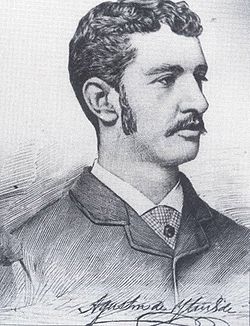
Sad… perhaps if one has immersed ones’ self in the life of the Hapsburg puppet rulers of Mexico during the French intervention of the 1860s, and takes Maximiliano and Carlota as sympathetic figures. Mexico City writer C.M Mayo does. Her latest book “The Last Prince of the Mexican Empire” is deservedly praised for bringing attention to the forgotten, and tragic story, of Augustín Iturbide y Green.
 The grandson of the Napoleón wannabe, Augustín Iturbide — who had made himself Emperor of Mexico for several months after independence, but was forced to abdicate (and later shot) — Iturbide y Green’s mother was a U.S. citizen, making the boy’s “adoption” (more like a kidnapping) by Maximilano and Carlota in a desperate attempt to present a “Mexican heir” to their phantom throne more pathetic than anything. “Prince Iturbide”, as an adult served in the Mexican army, later becoming a professor of foreign languages at Georgetown University in Washington, DC, where he lived in a monastery until his marriage (at the age of 59) .
Mayo deserves high praise for her dedication to this minor footnote in Mexican history, but the very existence of “The Last Prince” is one reason I don’t take the Mexican Emperor and his courtiers seriously, and find them not so much nonsensical figures, but repellent ones.
 I’ve mentioned before that it was the Maximiliano and Carlota story that first piqued my interest in Mexico (blame it on Bette Davis), and — considering how short a time they actually were in Mexico (they arrived in Veracruz on 21 May 1864. Carlota left for Europe in early 1866. Maximilano was overthrown on 15 May 1867, and was shot on 19 June 1867, meaning he was only in the country for a little less than three years… not even long enough to apply for a permanent residency today) — their story has fascinated scholars and moralists for the last 150 years.
I’ve certainly read my share of various studies of the royal couple. Most frankly annoyed me, with their willingness to forgive the royals their active support for, and participation in, mass murder, plunder, pillage and economic rape (Carlota, as their French military controller Achille Bazine later remarked, was the cold-blooded one, Max being something of an amiable fool — sort of the Dick Cheney and George W. Bush of Mexican historical pairs) with bland references to their “good intentions” (and isn’t that what the road to Hell is paved with). One reads endlessly of Max’s interest in the welfare of “the Indians”, and uses his friendship with Tómas Mejía as proof. Or, makes mention of “la India Bonita” (Max’s supposed indigenous mistress). Interestingly though, “la India’s” name is left out of most narriatives — she being “just an Indian”, not a human being. Nor, in most of the studies, are “the Mexicans” — with the exception of a few criollo courtiers and absolutely necessary people like General Mejía — considered more than a colorful native backdrop to a romantic tale in an exotic land.
When I read the late Jasper Ridley’s “Maximilan and Juarez” — considered one of the standards of Max-ology — I was incredulous that it was written in 1992, not 1892. Or even 1932 when Bertita Lorenz Harding’s “Phantom Crown” could, without self-conscious irony, write of “Indians” in terms of stereotypes like “stoic” and “humble”. Ridley spent his long career writing royal biographies, and perhaps he was a royalist. And he was a European. None of which means that his thesis that Benito Juarez was simply an “Indian” and therefore stubborn and unable to comprehend the subtle ways of the white man’s hereditary rulers, was somehow “racial”… not a political stance of a radical 19th century republican liberal.
For all that, I depended on Ridley (along with Joan Haslip’s 1971 “Crown of Mexico”) for much of what I wrote about the Second Empire in my own book. But, in the end, I didn’t find them “sad” so much as diabolical:
Foreigners often see the Imperial couple as a tragic, romantic pair. Mexicans see them as well-intentioned fools, or worse. By modern standards, they were white supremacists. Like the gachupines of the colonial era, they believed that Europeans were obviously superior to the Mexicans, and the warfare and destruction carried out in their name was justified. Unfortunately, this attitude pervades most foreign writing about the Hapsburgs. The legal concept of “crimes against humanity” did not exist in their day, but in the 21st century they could be tried and convicted of genocide and terrorism under Mexican, French, Belgian or Austrian laws for the atrocities committed by the soldiers serving in their name.
They were foolish and greedy people, not idealistic, misguided ones…
… The French occupation of México happened at the same time as the American Civil War. In both, white supremacy was one of the justifications for massive bloodshed and destruction. There is no more reason to defend the selfish, stupid, vain and cold-blooded Hapsburgs any more than there is to defend slaveholders.
Although I suspect that in a modern court of law, the royal pair could have been found not guilty by reason of mental defect or disease, the enormity of their crimes and the havoc they wreaked upon Mexico are mind-boggling. There is no way, except by looking at the individual victims of their short rampage through Mexico, of contemplating that. C.M. Mayo is to be commended for writing the story of perhaps the most innocent, and therefore, most tragic of their victims.
Ethel Stockton, D.E.P.
I had a customer in the bookshop here one time, who — looking for “local” books about Mazatlán — was thumbing though Ethel Stockton’s “Old” novels. The customer thought it was “cool” that a “little old lady” was writing novels. I had to correct her. Ethel Stockton was a lady. And she was old. But until a recent illness forced her to return to her native Seattle, nobody in Mazatlán would have thought of her as a “little old lady” — that sounds like Tweety Bird’s Gwanny!. Ethel Stockton was something much finer… a tough old broad living abroad.
Having written a couple of “how to” books prior to moving to Mexico in 2002, Stockton was, in some ways, following in the great tradition of Vasco de Quiroga. The 16th century Spanish jurist — like Stockton — came to Mexico mostly to live on a retirement income, but, living to an advanced age, built a new career based not only on his previous training and skills, but on his openness to what was new in the world, and in what the “New World” had to teach him. Quiroga would become Bishop of Michoacán in his late sixties, and spend the next thirty years working to re-invigorate Purépecha culture.
Stockton was a bit older than Quiroga when she came to Mexico, and her goals were more modest, but there was a re-invention and rejuvination:
Wow! I discovered there was Life after 80. I found a ME I had not known existed. It was the happy me, the laughing me, the loving me I had always wanted to be. When I arrived in Mexico, at age 86, to live alone, far from family and friends, with only myself to rely on, Life was there, waiting. It showed me the wonder of myself and my world. It taught me to be ME.
And, at the age of 92, to publish her first novel… “Old is a Four-Letter Word”. Followed by “Older Is Better”, “Not Too Old” and “Old Fashioned”, the novels follow the ups and downs of the life of Analiz Victoria Fallon, a “mature heroine” who could not have been imagined by a younger writer. Analiz, having fled a bad marriage for an independent life in Mazatlán in 1965 is in her 80s when we first meet her in “Old is a 4-Letter Word.” Like Quiroga, Analiz has opted not to be an outside neutral observer of the “other,” but to embrace her new home, and to embrace her aging self.
While full of humor, the Analiz novels do not shy away from the reality of aging or of Mexico. Analiz has a stroke in the course of the series, and — in the last (and as yet unpublished) book in the series — has a run-in with the local narcos.
As reviewer Norm Goldman wrote of “Old is a 4-Letter Word” —
“Old is like one of those nasty 4-letter words. It should be banned from the dictionary.” When she is scolded by her son-in-law for encouraging her seven- year old grandchild to follow his dreams of one day becoming a pilot or astronaut, she retorts that we seem to never get away from the term ‘old’ for when we are young we’re told that we are not old enough to do things and when we become old, we are warned not to do them as we are too old. Annaliz believes that most people’s lives are dull and flat without any fun. She underscores the idea that it is within everyone’s grasp to have some fun out of life- a message she endeavors to spread by presenting her book of options. It is up to the readers of this book to decide if they want to take the risks necessary to enjoy life to its fullest.
And she did.
Again, like Quiroga, Stockton was not one to eschew the new and modern (for Quiroga, not just opening himself to the new and daring ideas of Thomas More, but taking full advantage of the latest in communications technology of his time, the printing press). Having self-published her first two books, she took full advantage of both on-line and “print-on-demand” publishers (who were rather annoyed to find Stockton was quite willing to fight them to have her books printed for her peer group … in large print), as well as maintaining a website, communicating by e-mail and facebook.
Per her instructions, the following was posted on her facebook page:
“To my family and friends at my death:
Have no guilt feelings. My love will always be with you. I lived my life as I wanted to. You gave me everything you had to give while I was here. Let me go with loving thoughts.”
Just one look
Gary Denness was not the only one bothered by the big blue “Mex Files” in the middle of the header, but he was more bothered about it than I was. So, that mad dog of an Englishman stayed out of the midday sun of Santa María de la Ribera this afternoon, and redesigned it.
Good show! or as we say here, ¡Que buena onda!
Everybody dance now…
Idema redux — a “no comment” comment
A week ago, I posted on Jack Idema, a phony “counter-terrorism consultant” who, in addition to serving time after being convicted on 58 counts of wire fraud involving military supplies and later making the news for being sentenced to an Afghan prison for running his own private prison, and is wanted now in Mexico for spousal abuse at the very least. There were hints in the Mexican press of what the U.S. press called “lascivious details” involving forced participation in orgies, and spreading HIV virus to unsuspecting people.
I didn’t find the fact that there was a crazy con-man living in Mexico nearly as intriguing as the possibility that a self-proclaimed “counter-terrorism expert” was possibly a source of weapons for Zetas, or a U.S. “consultant” feeding at the trough of Plan Mérida funding.
Last night, I received a very long, detailed comment that — because of the extensive number of links — sent directly to my “spam” folder. Headed “DISTRIBUTION: ALL LAW ENFORCEMENT AND MEDIA” it alleges to detail Idema’s present activities in Bacalar, Quitano Roo, and provides email addresses (and often telephone numbers) of everyone from Idema himself to the state prosecutor to supposed co-conspirators in various shady enterprises. I decided not to print any of the information because the supposed sender used not their own website as a return “ISP”, but some gay porn site… and the person tried to claim the post was from one of Idema’s alleged victims. The author did include her “real” on-line name… “Cao” of Cao’s Blog — an extreme reactionary site given over to “soldier of fortune” type postings, and a lot of pro-Idema posts over the last couple of years.
Cao — who claims to be a “midwestern housewife” — seems to have a thing about gays being part of a communist plot (for real — “Homosexuality, in fact, is one of the things communists are pushing,” write Cao, apparently missing that real commies like Fidel Castro went out of their way to label gays “counterrevolutionary” and were hardly known for their sympathies to sexual minorities) AND Jack Idema (“to say that I’m a paid blogger for Jack Idema is stretching things considerably,” she writes).
Which makes it so weird that “Cao” — claiming to be a female victim of Jack Idema — details in her missive “TO ALL LAW ENFORCEMENT AND MEDIA” so many salacious details about Idema’s sexual activities (including dead links to supposed gay orgy houses for rent). In other words, the post doesn’t pass the smell test.
With that warning in mind, Cao also posted another Mexico story — one that feeds into my interest in the possible misuse of Plan Mérida funds (or, rather, perhaps the intended use being to prop up U.S. war industries and “consultants”) and/or organized gun runners from the United States.
With her purpose being to “clear Idema’s name” (which makes the comment I’m not posting even stranger) Cao writes:
Mexican police just admitted that American Jeffery Shippey, a former DYNCORP employee… was arrested fifteen days ago for impersonating a special agent of both the U.S. Justice Department and U.S. FBI.
I have no information on Shippey being arrested in Mexico, but I did find reference to him recruiting mercenaries for work in Iraq in Manta Ecuador, when the U.S. maintained an airbase there as part of “Plan Colombia” part of its overall “war on drugs” in an 26 April 2007 post by Cyril Mychalejko in Upsidedownworld:
Jeffrey Shippey, a former DynCorp International employee at Manta created a ghost company, Epi Security and Investigations, and recruited more than 1,000 Colombians and Ecuadorians to work in Iraq. The report noted that the company wasn’t registered in Quito nor with local provisional authorities. NGO’s told the Working Group that the company allegedly was using Chilean instructors and former Colombian military personnel.
Shippey wrote in an advertisement promoting his company at the Iraq Job Center Web Site … that, “These forces have been fighting terrorists for 41 years and have been trained by the U.S. Navy Seals and the U.S. DEA to conduct counter-drug/counter-terror ops in the jungles and rivers of Colombia.”
Whether Shippey was arrested in Mexico or not — and whether Idema is hanging with a “21 year old local transvestite prostitute who can be found working the highway,” doesn’t much interest me. As it is, the criminal investigation of Idema was for violence against a woman and there was no mention of transvestites or gays in any of the news articles regarding the denunciation.
What bothers me is that two known shady arms contractors are showing up in Mexico — and I’m sure there are many more. Who they are supplying, or who they are ripping off, and what they are doing here… THAT I’d want to learn about.
Analyze this — or don’t
(via Latin Americanist)
… Mexico’s tourism industry…officials are eyeing a new tourist block: same-sex honeymooners.
Mexico’s highlighting the honeymoon of the first couple married under Argentina’s new law allowing gay marriage, who are treated to an all-expenses-paid vacation in Mexico City.
Mexico City has an office specifically for recruiting gay tourists.
“We are a very tolerant, liberal, avant-garde city,” tourism secretary Alejandro Rojas told CNN.
Officials hope to train hotels and restaurants on sensitivity and create maps with gay-friendly attractions. An international gay tourism conference is also on the table.
… Earlier this week, the Council of Catholic Analysts of Mexico encouraged a boycott of Mexico City.
The “Council of Catholic Analyists?” — I never heard of ’em either. I didn’t know Freudians were Catholics, or maybe they’re just neurotic but really want to change… but not in Mexico City. Or something. I’m confused.

1° de Septiembre and “La Barbie”

Hernandez (la Jornada) probably drew this cartoon before the capture of La Barbie, — Edgar Valdez Villarreal (or plain old Eddie Valdez as he was known back in Laredo), but he acidly captures the mood of a good portion of the country on the eve of the First of September Presidential Report (“El Informe”).
But the criticism isn’t only from the left-intellectural press. Also coming before news of Valdez’ capture was José Luis Ruiz’ article in Monday’s El Universal on dissatisfaction within PAN over Calderón’s prosecution of the anti-narcotics crusade. The translation comes from Reed Brundage (Americas MexiBlog):
The war launched by President Felipe Calderon against organized crime has found some of his main critics within the ranks of his own party, National Action. … From the former president Vicente Fox and former PAN leader Manuel Espino, to PAN legislators such as Manuel J. Clouthier, Javier Corral, and Santiago Creel, they have joined the voices calling for Calderon to change the way of dealing with the underworld, including promoting social factors over the armed forces.
These questions have been motivated by the President’s reaffirming his position to use the armed forces in the onslaught of criminal groups which, for all intents and purposes, have regions under their control. And the Army has not succeeded in weakening the operational structure of these organizations.
Valdez’ capture, coming as it does just as criticism of the “war on drugs” is reaching a critical point, it too well timed to pass without questions being raised about it.
From Metáfora Política:
The capture of Edgar “La Barbie” Valdez Villarreal, is a political coup for Mexican President Felipe Calderon, coming as it does just hours before the fourth State of the Union address …
… [T]he capture of Valdez Villarreal, the alleged leader of the Beltran Leyva cartel, has been promoted by the federal government as proof that their military strategy is working…
… Security experts are skeptical that this arrest will seriously impact organized crime: they believe that the apprehension of a drug high command does not destroy the structure of the organization.
… Meanwhile, Mexican public opinion continues to reject the violence generated by the fight against drugs, which has killed 28,000 since Calderon took office nearly four years ago.
A couple of points of my own…
El Barbie was primarily in the cocaine business, not in the Mexican agricultural export trade. Following his arrest, Colombian police arrested 11 associates… following an 18 month investigation. That calls into question the spin that Valdez’ arrest was a Calderón administrative operation right there.
Valdez was taken alive… unlike other recent “drug lords”. The Christian Science Monitor quotes Jorge Chabat (one of those guys always quoted by the U.S. press about these matters) as calling it a “‘clean operation,’ unlike the previous two high-level captures, in which suspects were killed. Valdez, who was indicted in the US for cocaine smuggling, could be extradited, and that could ultimately mean more intelligence-gathering for officials on both sides of the border.” Again, the suggestion is that foreign operatives were involved… and makes one wonder if killing other drug lords wasn’t also part of the operational plan.
Malcolm Beith points out that “La Barbie” was leading the Beltran-Leyva gang, which USED to be allied with Chapo, but then, Trotsky and Stalin were once on the same side too… as were Pancho Villa and Álvaro Obregón. If anything, it bolsters the belief in the impunidad of Chapo here. I don’t think his other recent post (on the capture of some cousin … a distant cousin I believe) of Chapo disproves the theory that the Sinaloa Cartel is purposely left alone by the Calderón Administration, but Barbie’s arrest doesn’t prove it either. It does underscore that Chapo’s enemies are still the ones getting captured (or killed) with much more regularity than the Sinaloans.
But, in Beith’s article, there is the interesting, overlooked tidbit that the capture was at the hands of the Federal Police, not the military… and was taken alive. The military operations end in bloodshed, and dead gangsters (in a country without a death penalty), which tends to confirm the beliefs of those of us who think soldiers should not be doing police work.
¿Informe o deforme?
On Wednesday, Felipe Calderón will present his “State of the Union” (informe) to Congress and the Nation. Up until the Fox Administration this was done live and in person. Beginning with Carlos Salinas, Congress began expressing the will of the people — a bit of rudeness towards el presidente being an important step towards democratization. By the time Fox came to office (and Vicente Fox had his own history of creative disruption when he was a Senator from Guanajuato — famously parading around the chamber with ballots on his ears to protest what he was hearing about stuffed ballot boxes ), the disruptions had become an art form … something sadly missed when Calderón — who wasn’t even sworn into office in front of the Congress, as Presidents always have been, for fear of disruption (and a reminder that his “election” may not have been as cut and dried as he liked to pretend) has managed to turn the Informe into “Informercials” … a written report with some videos and exciting theme music.
Which may outline the President’s goals and meet the legal requirements of his report… but doesn’t tell us much of anything about the State of the Union. While TV and radio are always full of government propaganda, the Presidency has lately spent their propaganda budget on a series of advertisements for the Presidential info-mercial… Ana Lourdes Cardenas of the El Paso Times, looks at the message, and the reality.
… here is a summary (in italics) of some of Calderon’s messages in those ads:
–After facing the worse economic crisis last year, Mexico’s economy is in the process of recovery. In a period of six months this year, the government created half a million jobs.
What the commercial doesn’t address is that the unemployment rate in Mexico is still very high (5.7%) and just in July; 2.6 million people lost their jobs. The commercial also doesn’t discuss the existence of seven million young people who are called “ni-nis,” a Spanish nickname for those who don’t study, don’t work (ni estudia, ni trabaja) because there are not enough job opportunities for them. Many of those young people have become potential recruiters of organized crime.
–As never before, the government is weakening the strength and structure of organized crime through historical seizures of drugs, money and weapons. Besides that, Mexico has a professional well-equipped and trained federal police force.

"The deliquents have neither morals nor scruples ... but we can top that!"
–Violence has spiked up because the cartels have been affected by the government’s war on drugs.
Really? Is that the explanation for the recent assassination of two mayors and a candidate for governor in the state of Tamaulipas, the execution of 72 migrants and the increasing violence in Monterrey, Cuernavaca, Veracruz, Acapulco, Sinaloa, Nayarit, Torreón and many other cities and states in Mexico?
–The construction of infrastructure –especially highways and roads–has opened opportunities for education and health to rural and indigenous communities, reducing levels of poverty.
There are no numbers to measure how the new infrastructure is impacting levels of health and education. A highway does not necessarily open the doors of a university of high school.
Ms. Cardenas, writing for a U.S. newspaper, has to play that “on the one hand, on the other hand” game called “editorial balance.” She credits Calderón with being honest enough to say that “we’ll have more violence before we can see a light at the end of the tunnel.” but makes the assumption that everyone sees the same “common enemy” and that — with Presidential elections in 2012 — Calderón “only has one more year to change the fate of the country and to convince us that the country is not screwed up yet.”
I don’t think the country is “screwed up”… the administration may have “screwed up” along the way. But twisting the message to fit the hole the administration is digging itself into is no way to straighten things out. It may be messy and dirty, but digging out of that hole is going to require an honest discussion of alternatives and national priorities. Democracy deserves more than carefully crafted info-mercials and informes that don’t inform.
U.S. citizen arrested — GOOD!
Stratfor leaves out the minor detail that “la Barbie” is an American citizen, a native of Laredo Texas (along with Tom DeLay) and that most American of all things, a former high school football star. Fred Burton was quoted by ABC News as saying “”He’s a kid you would not expect, coming from a nice family, upper-middle class, living the American dream,”…And the next thing you know, he’s swallowed up in this narco business and has become highly successful.”
Swallowed up? C’mon, that’s what you say about some poor slug who ends up a victim, not a capo. Anyway… here’s Fred’s piece from Stratfor:
The Mexican Federal Attorney General’s Office (PGR) confirmed that members of the Federal Police detained former Beltran Leyva Organization top enforcer, Edgar “La Barbie” Valdez Villarreal. Several Mexican media outlets have reported that the operation that netted Valdez Villarreal took place outside of Toluca, Mexico state, while others have reported that the operation actually took place near the Morelos and Guerrero state borders. Federal Police had reportedly launched an operation to capture Valdez Villarreal on Aug. 9 at a luxury condominium complex in the Bosque de Las Lomas neighborhood of Mexico City but missed him by a few hours, indicating that the Mexican government was close to capturing him for some time before his arrest. The arrest of such high-profile and public figure in the Mexican drug-trafficking scene is a huge success for the Mexican government on both a tactical and public relations level.
…The arrest of Valdez Villarreal is a tremendous blow to the leadership of his faction of the [Beltran Leyva crime family… and it is unclear at this point who if anyone will take the place of Valdez Villarreal. …
The arrest of Valdez Villarreal also comes at a time when President Felipe Calderon’s war against the cartels has been drawing some negative attention due to the high levels of violence and a recent, ominous escalation in tactics over the past week with increased use of improvised explosive devices. Valdez Villarreal was well known for his ruthlessness and brutality in dealing with his rivals, and his arrest will be a public relations coup for the Mexican government even though it will do little to quell the violence in places like Juarez and Monterrey.
I may have more to say on this later, but today’s been one of those “nibbled to death by ducks” days… a lot of minor annoyances that meant a lot of standing in line and other distractions. By the way Edgar Valdes Villarreal (spelled “Villareal” in some news reports) got his nickname from a supposed resemblance to “Ken”… and here I thought it was his interrogation tactics, which more resembled those of Klaus Barbie.

I would not feel so all alone…
The Agonist asks this weekend “What will the impact be if California votes to legalize marijuana?” Despite the Agonist’s self-description as “Thoughtful. Global. Timely”, and the discussion that follows is thoughtful and timely, they only look at legalization in the largest U.S. state as having an impact on their own country. No mention is made of the probable impacts here.
I’ve heard, again and again, the “just legalize it” argument — from people in the United States — as an answer to Mexico’s narcotics-export violence. I think that’s hopelessly simplistic. If anything, legalization in California may create more problems than it resolves here.
Although there has been a lot of discussion lately of “laundered money” coming back into Mexico from the narcotics export trade, I’ve noticed that the assumption is that the only “corrupting” being done with the cash is on this side of the border*. Considering we’re only talking about — at most — ten billion U.S. dollars coming back into Mexico annually, and Mexican marijuana an allegedly 40 billion dollar a year business, obviously we’re not earning our fair share of the take. Given that Wachovia Bank, all by itself, laundered $378.4 billion . If the money earned in this particular business is “corrupting”, it isn’t here that people should be worried about.
Of the relative pittance coming back into Mexico some certainly is going into various officials’ pockets … although they have to buy cars, and computers and pay school fees or throw parties (and pay the caterers and the cooks and the mariachis) or hire guards, or use it somehow to other people’s benefits. And, although the income is supposedly “dirty” (and unreported on taxes), I don’t know how many degrees of separation it needs to go through before it becomes “clean”… if a gangster invests in a hotel project, is the realtor who sold the land, or the construction company that erects the building, or the architect, also “corrupted”? Maybe they are… and is the construction worker who is paid by the builder who was financed by the gangsters also corrupt? How about the teacher, whose salary is paid by the construction worker who sends his daughter to a private school? Or the waitress who gets a tip from the teacher who eats his lunch at the local comida economica?
Or, is it more corrupt that Wachovia Bank hires “lobbyists” and finances politicians who will revise tax codes to benefit their officers?
One first needs to define “corruption” and — even using the standards of Transparency International (which was originally funded by Arther Andersen — for real!) — Mexico is not particularly “corrupt”, so I¿m not sure that cutting off a cash flow to Mexico would be necessarily good for us… or, for that matter, to the United States.
Secondly, I’m not convinced that California’s legalization will do anything positive for our own agricultural sector. A commentator on the Agonist article, Lex, writes:
The big growers [in Califronia] who are against it have a few reasons. One is that the current situation is pretty wide open… The big problem of too much cash disappears. It really couldn’t get any better for them than it is right now. Second, the new law actually limits the amount of space that can be used for cultivation in a residential zoning. That’s a problem for the big growers. The standard in California is to buy a house and fill it with weed. The big growers own multiple houses and employ people to “live” in them. If the new law is enforced, the big growers of today will have to switch to commercial property.
There will be no precipitous drop in prices. They haven’t dropped (so far as i know) in the 13 years that marijuana has been all but legal in California. At first, prices will go up because of the taxation regime. How the market responds is hard to tell. Theoretically, it will force the cartels out; if it does that’s slack that can be picked up by others. But there will not be a glut that drives prices down. Excess will simply be shipped out of state, where the risks are higher but the monetary rewards are much greater too.
Of course, in California, much of the marijuana is being grown indoors, in residential areas… which does give the Mexican growers some edge at least as far as cost competition. But, CalPotNews.com mentions another grower issue, one that would impact our market share much more.
… the blog for Stoners Against the Proposition 19 Tax Cannabis Initiative features Dragonfly de la Luz, the pen name for a roving marijuana correspondent and pot reviewer also known as “Ganja Girl” and the “Weedly World Traveler.”
Dragonfly writes that passage of Prop. 19 “reverses many of the freedoms marijuana consumers currently enjoy, pushes growers out of the commercial market, paves the way for the corporatization of cannabis, and creates new prohibitions where there are none now.”
As with any other agricultural product in the United States, corporate growers are likely to drive out independent producers and control the market. For Mexican farmers, this is likely to mean either the U.S. government will be “lobbied” (or, in the weird way the U.S. legalizes bribery, through “political contributions”) to limit foreign production and sale. As with tomatoes and avocados, the import regulations would be written to limit sales of Mexican produce to corporate vendors which would not only control market prices — which is the proper definition of a cartel (which isn’t a bunch of competing gangsters, but a cooperative agreement among vendors to control a market).
It’s not like the marijuana growers are independent producers now, being at the mercy of their distributors (who are likely to kill them if they screw up), but it isn’t any economic benefit to the farmers themselves. Quite the opposite.
Admittedly, there may be alternative uses for marijuana (as bio-diesel or cheap fiber) but I sense that it would either require even more concentration in the agricultural sector (driving still more rural residents off the land) or would be, at most, a niche market not returning nearly the same profits that marijuana grown for narcotics does.
Finally, while the “drug war” is a proxy war to meet the U.S. demand for controlling the marijuana trade (among other narcotics, for which there is still a huge U.S. demand), and an excuse to militarize Mexico, legal consumption in California isn’t going to magically make it disappear. The claim by supporters of the California initiative is that consumption won’t increase. Perhaps that’s true (and, my sense is that regulatory pressures will push for “milder” marijuana being the most widely available… the same way commercially sold alcoholic beverages have a lower proof than moonshine, and packaged cigarettes less nicotine than “roll your own” tobacco products). But, given (or so I’m told) that Mexican grown marijuana isn’t nearly as rich in THC as that grown in California or British Colombia, and isn’t the first choice of consumers, what market it has is going to be for consumers without commercial options… the other 49 states. In other words, a “drug on the market” that will lead to even more cut-throat competition in an already cut-throat business.
And, while the California law eliminates a part of the rationale for the militarization of Mexico, the gangsters are not just going to become solid citizens. With even less economically viable agriculture, there will be MORE incentive to turn to “alternative financial opportunities” in the campo… and among the displaced in the cities. The gangsters are likely to turn to migrant smuggling or kidnapping or other forms of mayhem.
* Sidney Weintrab and Duncan Wood, in a Center for Strategic and International Studies report (“Cooperative Mexican-U.S. Antinarcotics Efforts“, August 2010) that has been making the rounds lately, spends three pages on “Corruption” when talking about profits returning to Mexico, but only three sentences on “Shortcomings” when the issue is money in the United States… and two of them dismissing a single case of a bribed customs inspector.
Here’s some old hippie who seems to have mixed feeling about all this:


 mexfiles.net