Right to life … or at least 30 years
In April 2007, Mexico City decriminalized first-trimester abortion within city limits. Pro-choice groups rejoiced, but the Catholic Church, which has a dominant presence in this secular country, sounded the alarm. Conservative leaders asked the Supreme Court to overturn the law. The nation watched the case closely, and in a rare act of transparency, the Supreme Court televised six public hearings in the spring of 2008. Opponents of the law, who hailed largely from the church and President Felipe Calderón’s National Action Party (PAN), argued vehemently against first-trimester abortion, and Ingrid Tapia, a lawyer for a conservative women’s group, stole the show when she addressed the court in a low-slung black dress. “Is it legitimate,” she rasped, her violet eye shadow and matching fake nails glinting, “for a mother’s liberty to supersede a child’s right to life?”
Despite such pleas, the court voted 8-3 that the city’s law did not violate the Mexican constitution. At the time, everyone assumed the states would follow the capital’s lead and legalize early-term abortions, counting on the high court to back the new laws if they were challenged.
(Mary Cuddehe, The Atlantic, 29 October 2009)
In Guanajuato, where the “insurgent” PAN political machine built by Vicente Fox had became Guanajuato’s ruling party, the state legislature barely failed in an attempt to outlaw even abortions in cases of rape and incest (as in most Mexican states, the only permissible reasons for a legal abortion at the time) in 2000 . While the exception remained on the books, there was every indication that the law was being thwarted with public ministers either refusing to take rape complaints, or failing to inform victims of their rights. With the passage of Mexico City’s less restrictive abortion law (which permits abortions in the first trimester regardless of the circumstances of the pregnancy), there was a backlash in several state legislatures (not only from PAN, but also from PRI). At the time, in what looked like a campaign modeled on similar campaigns in the various U.S. states, several Mexican state legislatures inserted “life begins at conception” clauses into their state constitutions, or created even stiffer criminal penalties for abortions.
Guanajuato — once better known for revolution than reaction — did both. With predictable results. The state has the highest percentage of teen births in Mexico, and a rising rate of maternal deaths. And a criminal justice nightmare:
Six women are serving long prison terms in the central Mexican state of Guanajuato after being convicted of homicide for terminating their pregnancies, activists said Wednesday.
The women, all poor and with little education, have served between three and eight years of the 25- to 30-year sentences handed down by state courts…
A woman who had received a similar sentence to those that are being served by the six women for murder was released …
Of these seven cases, one was a spontaneous abortion, two others were undertaken because of rape and the rest were for accidental pregnancies…
(EFE, via Latin American Herald Tribune, 6 August 2010)
Mexican justice is often better in theory than in U.S. justice, but when Mexico is unjust, it tends towards injustice in appallingly obvious ways. This is an imperfect society (show me one that isn’t). Mexican women’s groups, which already have had their fill of craziness in Guanajuato, have seized on these seven women as a symbol, and through their lawyers, may be able to challenge the state’s restrictive laws in the Supreme Court on grounds that it violates constitutional guarantees of equal protection regardless of gender or social condition.
Politically, with Mexicans having consistently polled in favor of less restrictive abortion laws, and growing anger against the status quo and seeming lack of interest by the ruling party in social reform, there could be major consequences for PAN in the state elections as a result. While Guanajuanto Governor Juan Manuel Oliva Ramírez is defending the women’s imprisonment (claiming they are guilty of infanticide), Josefina Vázquez Mota — PAN party coordinator in the Chamber of Deputies — is trying to distance the national party from the state government, issuing a tepid statement calling for the state to allow other government institutions (like the Human Rights Commission and the Supreme Court) to do their job.
And, one hopes, there will be a reconsideration of this ill-conceived attempt to politicize public health.
Thou shalt not steal… especially from Carlos Slim
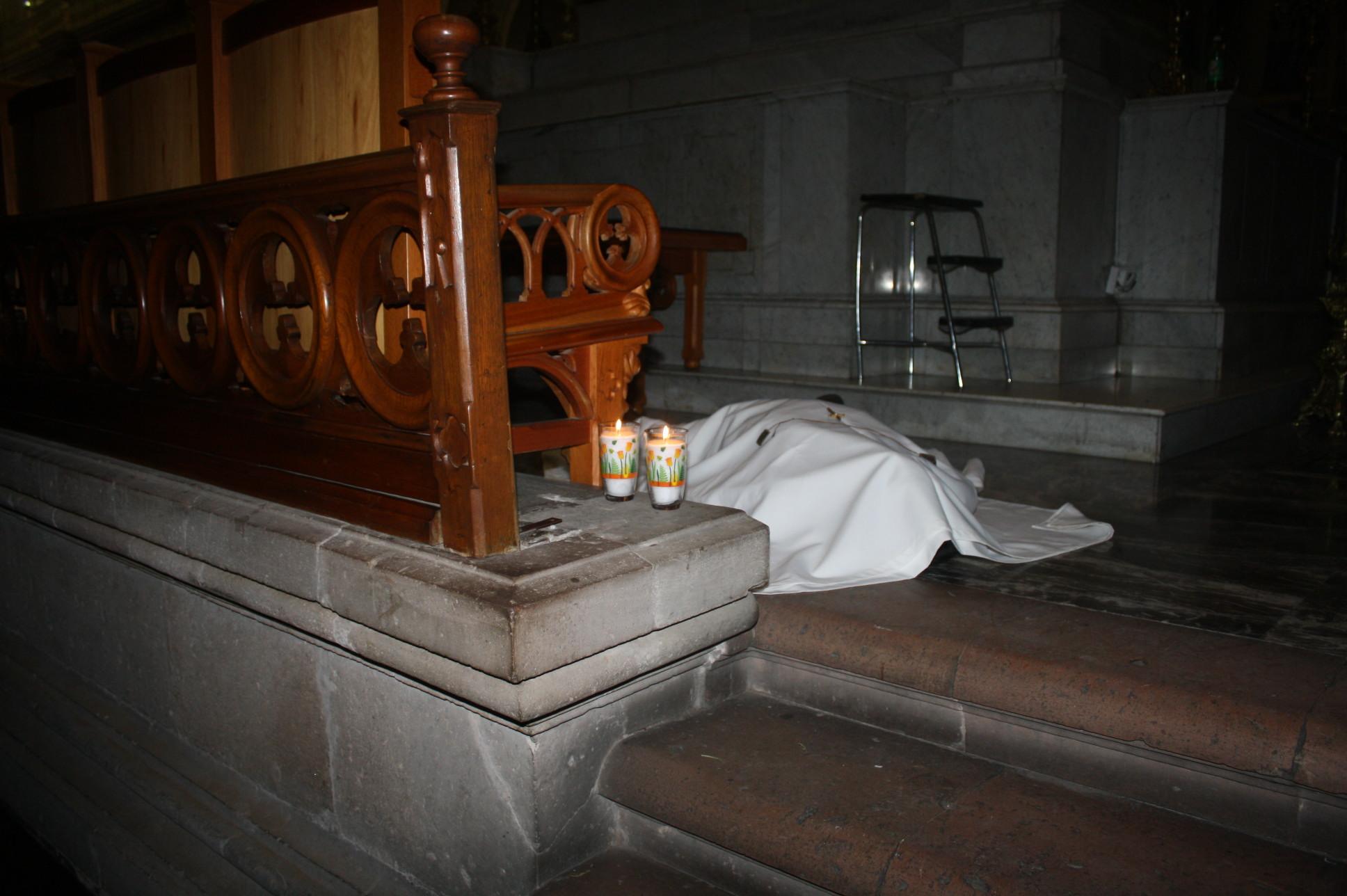
Photo: Crisol Plural
Having stolen a panama hat (estimated value, 600 pesos) at Sanborns, a shoplifter was chased by security guards into the Aguascalientes Cathedral, where he eluded capture by dropping dead. Of course, the Church is said to have a lot more power in Aguascalientes than most places in Mexico, but Carlos Slim is richer than God.
The gay marriage court case (not that one, this one)
By a vote of 8-2, the SCJN (the MEXICAN Supreme Court) recognized the validity of the Federal District’s same-gender marriage law. As a result, unlike in the United States, a same gender marriage in one jurisdiction (the Federal District) is a valid marriage in the entire Republic.
Mexico’s constitution forbids discrimination based on, among many other factors, what it calls “preferencias” (Art. 4) — all that the Supremes needed to consider when upholding the Federal District marriage code. The right of adoption by same-gender couples, which is included in a separate article in the Federal District code is also being challenged by the Federal Government, and will be ruled on next Monday.
Someday, for many in Mexico, is today…
28,000 reasons (more or less) there is no war in Mexico
I really saw no point in commenting the state rubbed out eliminatination neutralization of Ignacio Coronel –the most recent of an endless stream of “indespensible men” in the Mexican narcotics trade to fill a cemetery plot… and, as easily replaced as any other indepensible man.
As usual, “Nacho’s” execution without trial (in a state without a death penalty)was followed by the obligatory nonsense about how this was a huge victory for the “drug war”… even though — “in the short term” it would mean more violence and murder by the non-state actors. The assumption that disrupting the leadership of the cartels will weaken the cartels as lower-echelon figures fight among themselves for control of their organizations — and the state stays out of it — may have some validity. That is not a “war”, but a state policy of targeted executions, which we are told is not really “war”, coupled with omitting to provide basic state services (like not getting bumped off) to a certain segment of the population.
The policy — or the results of the policy — account for somewhere around 28,000 deaths since the start of the Calderón Administration’s actions… whatever name we give it. The exact number seems to be in contention, although — as über-number-cruncher Diego Valle discovers — the trends are more important than the exact numbers. As military action increases, so do the deaths, which cannot be attributed to any “war” in which the Mexican state is an actor, but to fighting among gangsters, or to gangsterism in general.
Or, rather, gangsterism in specific locales. Chris Hawley, at USA Today, in one of the few U.S. based even-handed mass media reports on the situation, writes:
… a closer look at the latest official statistics indicates that much of Mexico has modest murder rates. The horrific violence that is jacking up the national death toll is largely in nine of Mexico’s 31 states.
Despite a wave of killings in these states, the murder rate in 2009 was still lower than it was a decade before, long before the Mexican government began a crackdown against the cartels.
“If you look at history, today we have fewer murders, both in raw numbers and rates,” said Mario Arroyo, a researcher with the Citizens’ Institute for Crime Studies, a Mexico City think tank.
The statistics show that the most deadly violence is happening in northern Mexico close to the U.S. border where smuggling occurs, and in the states where marijuana and heroin are produced. Also:
• The state with the lowest murder rate is Yucatán, the Gulf of Mexico state known for its beaches and Mayan ruins. Its murder rate of 2 per 100,000 was comparable to Wyoming and Montana.
• Washington, D.C.’s murder rate is nearly quadruple that of the Mexican capital, Mexico City. Washington’s murder rate was 31.4 per 100,000 people in 2008; Mexico City’s rate in 2009 was 8.
In other words, hardly an all-out “war”, but rather rampaging violence along the frontier, coupled with feuds among producers in other regions. About these murders, Ganchoblog says:
Much of these murders were basically street gangs fighting over turf rather than multi-national gangs with the power to threaten the state, a distinction that organized crime obfuscates. That’s not to lessen the significance of the 28,000; indeed, it is in some ways more worrying, because reducing the drivers of violence isn’t merely a matter of taking down two or five gangs, but rather hundreds, as well as addressing the broader social climate that gives rise to them.
For a variety of reasons — historical and otherwise — the Mexican state has always had trouble projecting its legitimacy along the U.S. border. In the sense that the state has opted for a military occupation (which has been relatively harmful) in place of the more traditional means of creating a sense of security, has meant that people in the borderlands have been largely left to their own devises. Edgardo Buscaglia is not the only one to have compared the borderlands to Sicily — where the absence of a legitimate state left citizens to be preyed on (or join in preying on their fellow citizens) for centuries.
In Sicily, it took centuries for the Mafias to evolve. In the borderlands, unintentionally, a hothouse atmosphere allowed their growth in a matter of decades.
Of course, the borderlands have a history of lawlessness, exacerbated by U.S. demands for the benefits of criminal — or other less desirable enterprises, without having to absorb the costs of production.
To a large extent, the Mexican state tolerated the border’s use by criminals and undesirables since the 18th century, but at the same time was able to project its legitimacy — that is, the local police chief might be crooked, and the state legislature a joke, but the borderlands were seen by the Federal Government as an integral part of Mexico. And, even if it required bribery, allegience to the state was maintained.
Under NAFTA, the border became a “free trade zone” — economically in, but not of, Mexico. Coupled with the State’s neo-liberal policies, which lessened dependence on a central authority for survival, and left people more or less at the mercy of the “market” (which, in the borderlands, meant the United States market), while at the same time, it was in the U.S. interest NOT to “off-shore” its own institutional controls south of the border — for example, moving unionized U.S. plants to Mexico without moving the union and discouraging Mexican unions from operating in those plants.
Throw into the mix that the borderlands — again for economic reasons — went through a massive demographic shift because of NAFTA. Cities like Juarez and Tijuana and Nuevo Laredo have more than their share of “displaced persons” and a relatively rootless, younger population than other Mexican communities: an industrial age frontier society, the frontier being a post-industrial United States.
The people on the frontier should have been (and were) the great beneficiary of NAFTA, but also its victims. Although the economic and social short-comings of NAFTA and “free trade” were clear to some, the signs were ignored by the Federal Administration, and gave the mafias an opening.
While military control has been one method of providing state institutions in difficult regions (again, something not unheard of on the Mexican frontier), in itself, militarization does not imply a state of war.
We have smugglers, we have gun runners, we have mafiosi, we have — perhaps — death squads, we have feuds up in the hills, and we have militarization on the borders. What we do not have is a war.
La Casteñada a century later
Along with the Revolution itself, this is the centennial of the opening of La Casteñeda… inaugurated with great fanfare by Porfirio Díaz in 1910 as part of a series of institutions designed to show off Mexico City as a “modern” capital.

It was the type of government facility every respectable metropolis had at the time… an insane asylum.
It’s not that mental health facilities didn’t exist. The great 16th century progressive and all-round good guy among the early Spanish rulers —
Vasco de Quiroga, who arrived as Audiencia judge in 1530… past sixty (an old man for his time) was something of a pioneer—the first foreigner who came to México to retire but found a new and meaningful second career in his adopted country. Among many other things in the 16th century, monasteries were assisted living centers. Even peasants often invested a small sum with their local monastery over their lifetime to pay for their care when they got too old to work. Quiroga, who had a good pension as a senior bureaucrat, planned to invest in a new Mexican monastery that would take care of him the rest of his life when he finished up this last assignment.
Quiroga found two things in his Audiencia that bothered him deeply. Pedro de Guzmán’s abuse of the local indigenous peoples, especially the Tarascans, and the huge number of minor criminal cases where the defendant was drunk. Quiroga was one of the first people to recognize alcoholism as a disease. His money for the monastery went to open the world’s first alcoholism rehab … in Mexico City.
(Gods, Gachupines and Gringos)
What makes this notable was that La Casteñada — in Mixcoac, then a far suburb of Mexico City — was not so much a new facility as a rehab and expansion of an existing facility… a pulque distillery, and La Casteñada’s first patients included the alcoholics transferred from that still-functioning 16th century rehab. Along with the inmates of el Divino Salvador, a church run facilities for mentally ill women, few private madhouses, and epileptics (then considered a mental illness) who had been warehoused in the Hospital para Epilépticos de Texcoco.
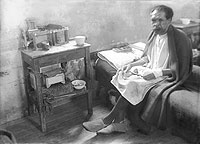 When it opened in 1910, with Porfirio’s son cutting the ribbon before a distinguished audience including the diplomatic corps, wealthy benefactors, and the medical establishment, it was considered a genuine breakthrough in the treatment of mental illness. It provided the training for generations of Mexican psychiatrists and its centennial is celebrated as a milestone in medical care in Mexico.
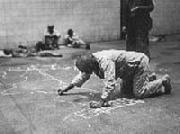 As with similar institutions of its sort, La Casteñada developed a sinister reputation as a snake-pit . A facility designed to humanely care for 1200 patients at any time, had 3500 people under its roof in the early 1940s, some of whom languished in forgotten cells meant for violent patients and the criminally insane. Reports of mistreatment, abuse, neglect and the high death rate from communicable disease — problems found in similar institutions around the world — spelled the end of La Casteñada, which was finally demolished in 1968.
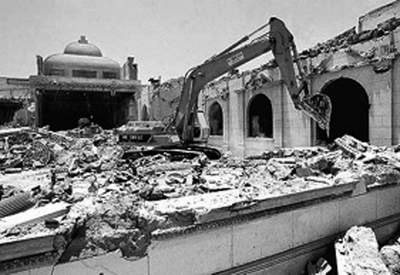
Writer and clinical psychologist Ivan Arellano Covarrubias, on his blog, Diario Psicoanalítico, wrote an “obituary” for la Casteñeda ïn October 2009, on the 41st anniversary of its demolition.
Definitely, the Manicomio General de México, better known as la Casteñeda was a watershed in Mexican for psychiatry and the medical profession. As we know, the mental hospital tried to be an excellent institution to patients dismissed as ‘crazy’, but following the Revolution it became difficult to maintain its altruistic intentions, and began to deteriorate in such a way that could no longer not fulfill its mission. For all that, it should be emphasized that the ‘madhouse’ set the stage for the formation of psychiatrists and paved the way for hospitals like the renowned Hospital Fray Bernardino Álvarez and other psychiatric specialty hospitals of today. And while there is no doubt that the asylum was for some years nothing more than a shelter for the needy, opening la Casteñeda was also global watershed in the clinical treatment of the mentally ill.
(By the way, this is the 3000th post on the Mex Files. An obsessive-compulsive disorder?)
One way or another…
Nogales, Arizona – United States federal officials in Arizona stated today that “illegals” who try to cross into Mexico from the USA are subject to arrest.
(Diario de Juarez, translation by M3 Report)
Gotta keep those private prisons in business, I suppose.
Double feature
The first commercial motion picture ever made showed employees of the factory owned by Auguste and Louis Lumière — who invented cinematography — leaving work the afternoon of 19 March 1895. The brothers made a series of short films, demonstrating their new invention, with which they toured the world the next year. Mexico City was not one of their stops, but amazingly, by mid 1896, Gabriel Veyre was also producing motion pictures. Two of Veyre’s films were not only the first Mexican movies (making him, arguably, the first filmmaker in the Americas), but set two important precedents for the future, and not just of the film industry.
I’ve said before that Porfirio Díaz was, in many ways, ahead of his time. He was the first politician to appear in a moving picture… actually, one of the first people to appear in a motion picture, starring in what was something of a world-wide commercial success at the time… just for the novelty of the thing: El presidente Porfirio Díaz paseando en el Bosque de Chapultepec. Thanks or no thanks to Don Porfirio — showing he was still fit enough to go for a morning ride at the age of 66 — and Gabriel Veyre, politicians and politics have been defined by the media image ever since.
Of course, then as now, images of violence sell. Possibly filmed the same day as El presidente…, Veyre’s Un duelo a pisolas en el Bosque de Chapultepec was the first movie shoot-out, the first screen violence of any sort (and also set the precedence for foreigners who want to confuse fictional Mexican violence with every day life) . I suppose if you’re one of those people who wants to blame Hollywood for a violent culture, and Mexicans for everything else you disapprove of, you can simplify your life and just blame Gabriel Veyre.
Island of the Damned
My recent foray into the weird and wacky world of right-wing extremism introduced me to a forgotten, and tragic, bit of the Mexican Revolution that I never knew about, and certainly didn’t expect to learn about from some Falagist website. The few “Reconquistadores” you run across in Mexico are connected with the extreme right-wing (despite what the extreme right wing in the United States seems to think). At any rate, the Falangists, besides demanding the return of Arizona and Texas and California to “The Catholic Empire” want to reclaim Clipperton Island. It seems a big deal to them… though I’d never heard of Clipperton Island, and had no idea Mexico ever lost it.
First of all, it’s not exactly an easy place to find… 9 square Km. of atoll roughly 1300 Km. west-south-west of Acapulco. Clipperton himself was an English pirate, working more or less for the Spanish (but, being a pirate, more for Clipperton than anyone else) who noticed the nine square Km. atoll while sailing by about 1700. A couple of French sea captains, Martin de Chassiron and Michel Du Bocage, landed in 1711, drew a map and left it for a French scientific expedition to claim the place in 1725. And then, more or less forget about it.

Humbolt: he studied shit
The only thing Clipperton really had was shit… lots and lots and lots of shit. Bird shit, aka guano.. became a valuable commodity in the early 19th century, thanks to Alexander von Humboldt, who wrote on the beneficial uses made by Peruvians of the piles of seabird shit that had piled up on desert coasts over the milenia. He used the Quicha word “guano” in his reports, which sounded better — and much more like a valuable exotic commodity — than the German translation, “vogelscheiße” … easier to spell, too). Humboldt noted it was rich in both nitrogen and phosphorus. Which — with interest in scientific agriculture just seeping into public consciousness — meant a lot of people started getting interested in guano, especially since nitrogen and phosphorus aren’t just for enriching soil. This was also the Napoleonic Era, when Europeans were busy slaughtering each other as never before… and nitrogen and phosphorus are also essential ingredients for gunpowder. It’s not exactly “swords and ploughshares,” but guano had commercial possibilities both in war and peace. Every country wanted to get their hands on the stuff, and they weren’t interested in… ah… getting their shit together… which led to at least two wars.
Clipperton’s nearest landfall being the the Revelligigio Archipeligo (about 950 Km. north), Mexico made a vague claim to the place in the 1840s. So did the United States, which, in a rather far-fetched claim of Manifest Destiny, passed the Guano Act of 1856, claiming all unclaimed islands with bird shit on them for the United States. In response, France officially annexed Clipperton, making it part of Tahiti, in 1858. The French didn’t actually get around to doing anything about the place until 1897, when they stumbled upon a couple of Americans busily mining guano… and ran them off. And left.
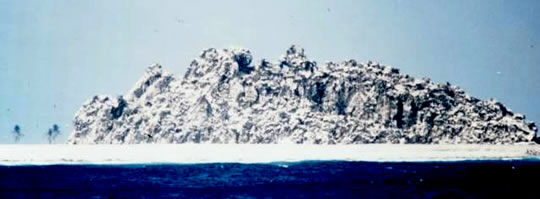
Clipperton Rock, aka, a pile of ...er... guano
At which point, Porfirio Diaz dispatched the Mexican gunboat Democratía to Clipperton and installed a governor. The French weren’t exactly thrilled to find out there were a bunch of Mexicans illegally crossing into Tahitian territory, but — maybe having learned that messing with Porfirio Diaz wasn’t such a hot idea, they weren’t in any hurry to settle the dispute. Instead of fighting over a pile of shit, they turned the who shitpile over to King Victor Emmanuel III of Italy who didn’t get around to flipping a coin and giving the place to France until 1931. In the meantime…
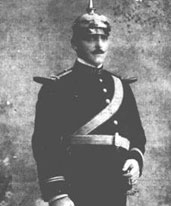 … To keep from upsetting the French too much, in 1906 — when Porfirio decided to complicate matters by awarding the guano concessions to a British company, he sent a English-speaking Franco-Mexican officer, Ramón Arnaud Vignon, as military governor. Arnaud, after spent several months trying to figure out what he’d done so horribly wrong to merit such a promotion to governor, arrived with a handful of Mexican settlers. For the next several years, as the King of Italy more or less forgot about the whole thing, the British exported their guano and the Mexicans worked in the mines, built a light house, a couple of homes, shops and went about their otherwise uneventful lives. Every two months a ship from Acapulco arrived with food and supplies …
Until… in 1914, with the Revolution in full swing, the supply ships stopped coming. In 1915, a U.S. warship bringing the news of the Revolution (and the First World War) and offered to evacuate the 100 or so people living on Clipperton. The mine manager, a German who had gotten a bit funny in the head from the isolation, was taken away, but Arnaud — a stickler for duty — turned down the offer. By 1917, every adult male — including Arnaud — were dead except for light-house keeper Victoriano Álvarez. Launching his own revolution, Álvarez declared himself King of the Island, and decided to repopulate the place. Never mind there wasn’t any food coming in.
Alicia Rovira — Arnald’s widow — launched the counter-revolution — at any rate, when Álvarez attempted to rape her, she bashed his brains in. Leaving no adult men on the island. The last surviving four women and seven children were rescued by the U.S. gunship Yorktown.
While the island remained largely uninhabited it was visited — twice — by Franklin Delano Roosevelt, in the late 1930s, who probably only heard of the place when the King of Italy finally decided it was French and it showed up in the newspaper one day, considered buying it for the United States as a naval refueling station. During the Second World War it was briefly occupied by the United States, but returned to France in 1945, by which time chemical fertilizers and bigger better nukier bombs had pretty much killed the demand for guano.
Other than sports fishermen and a few French scientific and naval personnel, and Jacques Cousteau (who thankfully didn’t complicate things by claiming it for his sovereign, the Prince of Monaco) , there were no permanent residents after the Mexican colonists were evacuated. A biologist studying seabirds in 1958 stayed long enough to slaughter the feral pigs that were killing off the guano-makers, and in 1962, the crew of a shipwrecked tuna boat spent a couple of weeks living on the island. The French considered using Clipperton either as a nuclear test site or a tourist resort (but not both…at least not at the same time), but nothing came of either proposal. A California con-man tried using Clipperton as one of his supposed headquarters for an off-off-off-shore investment scheme got him tossed into the slammer first in Mexico, then in the United States. Somebody or the other in Paris finally figured out it’s just too far from Tahiti to be part of French Polynesia and it’s left as an French Overseas Territory (with no people). And leave it to the Mexicans to check up on the place once in a while.
Occasionally visited by scuba-diving expeditions out of the Revelligigios or Cabo San Lucas, there is a sort of Mexican claim. At least one Mexican environmental group (Conservacíon del territorio insular Mexicano, A.C.) considers the island’s future a Mexican one. But, despite what the Falangists or the environmentalists think, Clipperton — as it was, and as it is — is for the birds.

Who said what
“Is it a misfortune that magnificent California was seized from the lazy Mexicans who did not know what to do with it?”
I’ve run across this quote a couple of times lately — attributed to the wrong person… (which is a clue: think Laurel and Hardy, Simon and Garfunkel, Batman and Robin)… on extreme rightist sites, both in Mexico and in the United States, although the author is neither connected to the far right, nor lived in the Americas.
It’s attributed to Karl Marx, and it’s no secret that Marx favored the United States in the 1846-48 “War of Northamerican Intervention” (and I even footnoted that in my own book). As the paragraph in question goes on to say, “All impotent nations must in the last analysis, owe a debt to those who, under the laws of historic necessity, incorporate them into a great empire” and Karl — being a stickler for “historical necessity” (capitalism — a la the United States — by “historical necessity” replacing agrarianism– as in the Mexico of the 1840s) — was a step towards the eventual withering away of the state and dictatorship of the proletariat) — the quote makes perfect sense in terms of his theories.
What’s weird about the quote isn’t that a 19th century German felt comfortable using stereotypes, but that it’s quoted both by Mexican “reconquistadores” and by U.S. xenophobes.
On the xenophobic sites, the enthusiasm for the quote is based on that great logical argument, “MOMMY… he did it too!” — somehow Karl Marx, being a leftist (although a long dead one) once said something rather rude about Mexicans, ergo, if such statements are considered rude in the 21st century, it indicates “leftist hypocrisy” and any arguments against xenophobia are invalid. Or something like that. Damned if I can figure out the xenophobes.
The reconquistadors in question (and, no, I’m not going to link to them) is a rather exclusive group (their national convention almost filled up a small meeting room in the San Miguel de Allede public library) of generic Falangists — going on about the Jews and the Masons and the Protestants and the decadent Anglo-Saxons and the glories of Francisco Franco… and how much better everyone was back in the days of the Spanish Inquisition… (and — in a rather charming touch — pussyfooting around the fact that they’re not only fascists, they’re fashionists: denying membership to “those who … wear urban styles which denigrate the human person and the nation” — meaning, I suppose, punkers… punkers, emos, skateros, girls in miniskirts (and boys in miniskirts).
But, at least — Marx being a Jew and saying something kinda rude about Mexicans, and a Marxist, of course — I guess the Falangists are more logical in their use of the quote.
A shame it wasn’t Karl Marx who wrote it. OK, Marx could have said it, and wrote and thought a lot of thing very similar, but the quote was from an article in the 15 February 1849 Neue Rheinische Zeitung, written by Fredrick Engels.
I donno… maybe Marx’s beard was too much of an urban style and Engels’ beard didn’t degrade the human person. Or all commies look alike. Or getting it right is just too hard for the hard right.

People easily confused by people easily confused
This machine kills fascists…
Woody Guthrie famously had a sign on his guitar that said “This machine kills fascists”… add concertinas to the weaponry, along with lyrics by Manuel A. Fernandez and we have the machinery in place to ridicule them to death.
Video from Los ciclones del norte via Laura Martinez (Mí blog es tu blog)
The new word of the day…
Whenever I hear someone talk about making English the “official” language of the United States (or some subdivision thereof), my first question is always what authority will decide which words are, and aren’t English? There’s nothing comparable to the Academia Real, which since 1714 has been, for better or worse, setting the rules for the Spanish language.
In 1951, under the sponsorship of the Mexican government, a separate Asociación de Academias de la Lengua Española was created to unify the separate national academies of the Spanish-speaking world — including the United States. For a few years in the 1950s, the Royal Academy and the Association were separate, but since 1956, the Association and the Academy have collaborated in producing the Diccionario de la lengua española — which, while not perfect and sometimes slow to adopt neologisms — at least gives a reference to what is, and what is not, Spanish.
Spanish had good verbs for being taken by gangsters or pirates (sequestrar or plagiar), and the tragedies of the 1960s and 70s introduced the word for being taken against one’s will by the government (disaparacer) … but nothing in Spanish to talk about being whisked off to Alpha Centari. How Inexplicata, the Journal of Hispanic Ufology, was able to function without such a word is a mystery. Perhaps an even bigger mystery than those seemingly common enough in Latin America events which Inexplicata has to write about … without, until now, a word to describe them.
So, they have more reason to cheer the introduction of “abducir” than anyone.
…One can be abducted by an “alleged extraterrestrial creature” or an excellent writer may “abduct readers with his/her novels.”
Last decade, controversy swept across Spanish ufological circles when the DRAE included the word “ufología” (ufology) into its hallowed pages, defining it as “Simulacro de investigación científica basado en la creencia de que ciertos objetos voladores no identificados son naves espaciales de procedencia extraterrestre” that is to say, “A pretense of scientific investigation based on the belief that certain unidentified flying objects are spaceships of extraterrestrial origin.”
So we welcome “abducir” to the pages of the Royal Academy’s dictionary with a glass of the finest intoxicant from Zeta Reticuli. ¡Salud!


 mexfiles.net