Chido video de viernes
I guess I’m showing my age:
Suave (soo • AH • veh) literally means soft. It’s an old school expression that means cool. Suave is used almost exclusively by Mexicans born before 1966. Its equivalent for younger cohorts are chido (utterly recommendable) and padre (if you want to sound as a 8 year old).
For foreigners, “suave” can be used by fogies old enough to remember all the Elvi… Presley, Costello and the sometimes really, really un-chido Elvis Crespo:
And it’s one, two three… what are we fighting for?
Don’t ask me, I don’t give a damn,
Next stop is Culiacán…
I haven’t weighed in on the GAO report “MÉRIDA INITIATIVE: The United States Has Provided Counternarcotics and Anticrime Support but Needs Better Performance Measures” (pdf), nor on the numerous media analyses and various spins put on the report because what it says isn’t all that enlightening and should have been obvious a long time ago: the exercise was ill-conceived as an anti-narcotics measure, and is spending a lot of money attacking a symptom and not the disease — which is a problem for the United States.
What is not talked about is that “Merida” is part of a trend towards financing the militarization of other countries (not just Mexico) — something mentioned obliquely by Joshua Kurlanzic and Shelby Leighton (Council on Foreign Relations), in the Boston Globe, who used Mexico as a springboard to discuss this disturbing world-wide trend:
Mexico’s political system has also gone backwards in one key area: the role of its military. As the Latin American drug trade has blossomed and its neighbors have become less stable, the military has stepped in, and used its leverage to control an ever-widening sphere of the civilian political system.
In several Mexican states, in fact, the military essentially commands the area, dominating law enforcement and other civilian institutions. The Mexican armed forces now contain nearly 260,000 troops, an enormous leap from just 150,000 men in uniform in 1990. Military personnel now occupy hundreds of positions traditionally held by civilian personnel, especially those in law enforcement. “The military is becoming the supreme authority — in some cases the only authority — in parts of some states,” Mexican political analyst Denise Dresser told the Senate Judiciary Committee last year.
The Mexican military’s quiet power grab is emblematic of a new and disturbing trend throughout the developing world…
The authors’ area of expertise is Asia, and I question some of their interpretations of Mexican history, but that’s not my focus here (nor what I’m quoting from a worthwhile article). I also have a problem with the idea that Mexico is a “developing” country (its been an industrial nation for the last century, and has a several millenia old urban culture, hardly “undeveloped), but I’m more concerned with the presumption that militarization is only a problem in the “developing” world.
And it’s five, six, seven… open up the pearly gates…
Well, it ain’t no time to wonder why…
It’s not Mexico that spends half its national budget on “security”, although the present administration is stinting in necessary spending in other areas. It is, however, Mexico — and countries like Mexico that receive “stimulus packages” from the United States to buy arms, and “security advisers” from the United States, where the military presence is most noticeable, and where the problems are the most visible.
Today, the president-elect (or select?) of Colombia — which, despite (or thanks to) massive U.S. “drug war” funding is exporting MORE cocaine and has a murder rate that makes Juarez look like Mayberry, offered to “share Colombia’s experiences” with Mexico in fighting the drug war. Presumably, that includes how not to get caught killing innocent people for fun and profit, how to threaten judges and journalists, and generically justify human rights violations.

Even civilian policing takes on military overtones: photo of Oaxaca police from Chihuahua Resiste
The supposed “developing nations” militarization — in this quarter of the planet, at any rate — is largely in response to those “drug war” purchases. Brazil and Venezuela beefed up their forces in response not just to the Colombian build-up, but to the placement of “undeveloping” United States military installations in Colombia and the Netherlands Antilles. The Central American Republics, which have striven mightily, but often unsuccessfully, to throw off militarism, are now being asked to turn back the clock as well. Costa Rica’s red-carpet treatment for the U.S. Navy is only the latest manifestation of a trend that can hardly be laid to the “developing nations”.
At the same time, that United States keeps harping on the “rule of law”, here in Mexico, the “rule of law” is being conveniently short-circuited. No one seems to care (or care to comment) on the ironic fact that Article 129 of the Mexican Constitution forbids the military from involvement in civil affairs, that even gangsters are entitled to a trial (and they aren’t eligible for the death penalty, which isn’t imposed in this country anyway), and “ley de fuego” supposedly went out with Porfirio Díaz. At that same time that Mexico is urged to reform its judicial system, those reforms are being delayed… again with the excuse that the “drug war” takes priority. Sort of like the U.S. argument that there can be no immigration reform until immigration stops (which is like saying you can’t reform drug laws until people stop using drugs, or implementing prison reform until there are no prisoners).
Rule of law? The new Secretarío de Gobernacíon was chosen — not for his experience in governance and the nuances of the law (as a whole), but for his expertise in integrating the military into the police forces in his own state is evidence enough that militarism is taking precedence over other fields of law and governmental functioning.
Whoopie, oh boy… beaners are gonna die!*
So who dies in this “war”? Not a lot of Mexican soldiers, but a lot of Mexican civilians.
A recent poll by Angus Reed found that “half of Americans (49%) believe Mexico deserves most of the blame for being a major supplier of illegal drugs to the U.S. because it has allowed the drug cartels to grow and flourish. ” Only a third (34%) think the United States “deserves most of the blame for this situation, for having a population that demands illegal drugs.” I don’t do blame… that’s just the reality of it.
What set off this rambling post was the news that Oakland California has decided to “grow its own” … fine by me, and none of my concern, but — if government units in the United States are going into the narcotics trade for themselves, while other government units are militarizing large sections of the country supposedly in response to the “threat” of the narcotics trade (why not send the National Guard into Oakland?) it’s not exactly the right time for them to complain about our militarization, while complaining not enough is being spent, (so the Senate is sending us more!) AND yet anther government agency carps that no one seems to know what the rationale of the whole exercise is about… is more than galling. It’s asking people to die here, to give up their rights, to submit to militarization … for an undeveloped unknown reason.
* Apologies to the one and only Country Joe Mc Donald and the Fish:
I know this post was more link-heavy than usual, but I was only able to “cherry pick” some of the data available. For those that like to accuse me of being picking my data to fit preconceived notions … this is just what’s recent on the internet (which is not everything on the subject by any means), here’s their assigned reading for the weekend:
Militarizing the Mexican customs service
Glenn Greenwald on “The Secret Washington”
Council on Hemispheric Affairs on the narcotics trade in the Caribbean
More — and more lethal — weapons for Mexico City police
Militarizing politics, police and society: Honduras today
Details on delivered and pending Merida Initiative equipment and training
Narcos killing politicos in Peru (just for a change from Mexico)
Colombia’s secret police and Uribe’s legacy
Soldiers cover up murder of civilians (Baja California)
“Plan Colombia. Ten Years Later”
Adam Isacson (Senior Associate for Regional Security Policy, Washington Office on Latin America), testimony befor the Domestic Policy Subcommittee, Oversight and Government Reform Committee: “International Counternarcotics Policies — Do They Reduce Domestic Consumption or Advance other Foreign Policy Goals?”
Problems with the Merida Initiative Says GAO
Mexico’s Military Malpractice (Council on Hemispheric Affairs)
Human rights defenders under threat in Mexico
Is Calderón preparing for “total war” on all protests?
¡Mujeres con moral de vencedor!
 ¡Infantes de Marina! Infantes de Marina, hombres con moral de vencedor!
¡Nuestro lema es la victoria por mi patria y por mi honor,siempre en culquier misíon!
Perhaps the Mexican marines will need to tweak their traditional shout.
Although there is a long history of Mexican women serving with the military, or as soldiers and officers, going back to Aztec times. The Aztecs weren’t prone to celebrating their defeats, but this was one they couldn’t overlook, and which poet, playwright, wit and historian Salvador Novo would later retell in one of his most famous, and outrageous radio plays:
In The War of the Fatties, a campy, tongue-in-cheek retelling of an episode from the Mexican Trojan War, naked fat women from Tlatelolco discombobulate Tenochtitlan’s invading army by squirting them with breast milk. Told with satiric allusions to the policies and tactics used by Mexico’s current ruling party, PRI, to consolidate its power, the play unfolds a history of vain rivalry and decadence, intricate political maneuvers, corruption, and unchecked ambition that determined the course of Mexican history for two centuries before the Spanish conquest.
María de Estrada was one of the best fighters in Cortés army (she was a deadly lancer), surviving el noche triste, a battle in which the women of Tenochtitlán joined in driving the invaders from the city, not only raining down rocks, flowerpots and arrows on the fleeing conquistadors and their allies, but joining the the street fights and firing arrows from canoes.
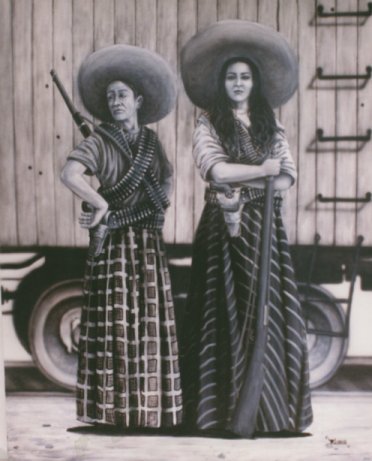 During the war of Independence, women served mostly indirectly, as they did throughout Mexican history, as cooks, nurses, foragers, and spies… although — especially in the Revolution — Las Adalitas were not simply a romanticized version of camp followers, but fighters and sometimes officers in their own right. Lyn, when she wrote here, said of these Revolutionary soldaderas:
The women were hungry, filthy, tired, overworked, neglected, generally unappreciated, and often suffering from illnesses. That doesn’t take away from the fact that they were devoted, supportive, and played a very valuable role in the fighting forces they “served” in.There hasn’t been a lot of detail written about the role of women in the Mexican Revolution, but among the lower class, many women became soldaderas, fighting soldiers, or victims.
With the “professionalization” of the military during the Second World War (or, as it is known in Mexico, “La guerra contra nazifascismo”) the Mexican military took on the bland, “usual” characteristics of any modern military force. Female military personnel were relegated to administrative and medical duties, and — at this time — only three percent of active duty military personnel are female.
But, either catching up with the 21st century, or — in the circular way time works in Mexico — returning to where we should be, women are again serving. In 1998, Lt. Elsa Karmina Cortés Vorrath became the first female naval pilot. But it was only this year that combat positions in the Marines were open to women. “Drug warriors” Clara and Inés are two of the first fifteen “few good women” assigned to marine combat duty.

Photos by Arturo Bermúdez, from “Mujeres combatientes”, by Jorge Alejando Medellín in M Semanal.
Amen to that!

I’m sure He would agree, but maybe The News ought to watch their accent marks. They mean Jesús Ortega, the PRD Party President.

Compare and contrast...
Oh… well… NEVER MIND!
Catching a buzz in Sinaloa
Looks like yet another danger for the expats of Mazatlán to freak out over… dangerous elements moving in during the still of the night, taking up residence in OUR neighborhoods, followed by demands that the local government retaliate in force. Which they do… sending out the fire department to blast the wasp nests … which happens every rainy season. Some of my neighbors consider the WASP hives an annoyance too, but I have no comment on that.

El Debate
SB 1070 — and friends
“Friends of the Court” briefs in the lawsuits to stop Arizona’s “papers please” law from taking effect have been filed at the last minute by the governments of Bolivia, Colombia, El Salvador, Guatemala, Nicaragua, Paraguay and Peru, as did the government of Mexico earlier. Also, as a Friend of the Court, the American Bar Association, which normally only files such briefs during appeals to higher federal courts, in an unusual move, filed their brief before the federal court begins considering the Arizona law later this month.
Though the bar association’s briefs concentrate on the constitutional issues raised by the law, they also contend that the measure could be burdensome for both legal citizens and local law enforcement, who will be required to detain an individual if a “reasonable suspicion exists that the person is an alien who is unlawfully present in the United States,” according to the statute’s language.
Though citizens are not required by law to carry identification, they will be held until their immigration status can be verified, though “federal databases are poorly integrated and often incomplete or inaccurate,” the ABA brief argues.
While the bar association’s membership, which includes nearly 400,000 attorneys, judges and other legal professionals, is not uniformly opposed to the intent of the Arizona statute, … after visits to bar associations in the state, including those in Maricopa, Scottsdale and Phoenix, a consensus emerged that the courts were the best venue to handle opposition to the law’s implementation.
On the other side the State of Arizona can at least count on the support of some California Nazis.
Femmes fatales
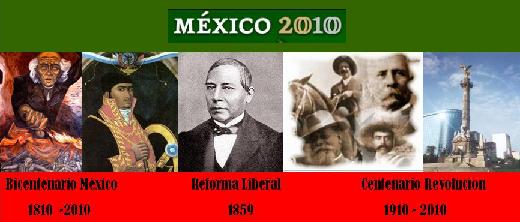
Josefa Ortiz de Dominguez and Leona Vicario weren’t the only heroines of the War of Independence… Doña Josefa and Senorita Leona were proper ladies of their times , if engaged in  rather improper activities: Doña Josefa was busy plotting the overthrow of her husband’s employer — the Viceroyal government — and Leona was working both as a spy and propagandist.
There’s a place in a struggle for proper ladies… and improper ones as well.
Julian Rodriguez Marin, EFE (via Latin American Herald Tribune):
Spanish colonial governments in Mexico persecuted and repressed, even with death, female rebels they accused of using their charms to seduce their officers and convince them to switch sides, historian Maria Jose Garrido told Efe.
“The crime of seduction was one of the most frequent accusations against women who joined the insurgency,” Garrido, who has studied the role of women in Mexico’s War of Independence that broke out in 1810, said.
…
“In 1812, one of the rebel newspapers published two articles inviting women  living in New Spain (as Mexico was then known) to take part in the War of Independence in different ways,” the historian said.
… the authors asked women not to marry Spaniards, while those already married to them were urged to get their spouses to become spies to aid the Mexican cause.
In case of an imminent marriage with a Spaniard, women were asked to make the wedding contingent on the husband switching to the insurgent ranks and educating any children they might have on the side of independence.
And, it wasn’t just the “proper” ladies that contributed to Independence:
Iturbide [then on the Royalist side]… ordered Maria Tomasa Estevez de Salas shot to death after she was convicted of seducing royalist troops in the Salamanca region, and who he said had a great deal of success in her rebel activities because of “her beautiful figure.”
… Carmen Camacho… seduced a garrison of soldiers into deserting.
In 1815 a judge described these women as one of the worst evils because, due to their sex, they were an instrument for seducing all kinds of people and were capable of carrying messages, spying and trafficking arms under their skirts.
Torreon massacre — gay bashing?
Patrick Cocoran, in Torreon (Ganchoblog) picked up from El Universal a detail in the Torreon massacre that seems to be overlooked in the U.S. and foreign media coverage:
Having surveyed Facebook pages from area residents, El Universal reports that the quinta where the massacre took place appeared to have been rented out earlier that day by a homosexual and lesbian group, but that the virtual invitations indicate that the party was to be finished by the time the massacre occurred.
My link to the “Torreon massacre” in the first paragraph is to Elizabeth Malkin’s article in the New York TImes, which avoids the false impression given by earlier reports in the foreign press, which made a big deal out of the prime victim’s not-uncommon family name — “Mota” — assuming that because mota is also slang for marijuana, that the killing was narcotics related.
Which, of course, it is… if only in a round-about way. There’s no reason a gay or lesbian person couldn’t be in the narcotics trade, nor that people with the apellido paterno of Mota might not be in that business. And, the massacre was in a Salon de Fiestas — an institution here in Mexico, where parties tend to be large and homes small. Reportedly, the gay/lesbian get-together was supposed to be over by the time of the massacre, and it’s still unclear whether the salon had booked back-to-back events.
And, while gangsters lately have engaged in indiscriminate slaughter, over-kill and excessive violence is usually the sign of a hate crime. And this was, no way to spin it, excessive.
If I am even partially right (and gangsters are infamous for their homophobia) this shows what I’ve thought is the main problem with the “drug war”. By making it the priority, and assessing national security solely in terms of the narcotics trade, normal national security issues have been slighted. Bloggings by Boz referenced another article in the New York Times over the weekend, which tied environmental degradation in Guatemala to the narcotics trade. True enough, as Boz wrote,
… this could lead to two conclusions:
- Fighting organized crime and promoting security is a pro-environment policy
- Protecting the environment and enforcing environmental regulations is a pro-security policy
One important point is that neither of these can come “first.” They need to be done in parallel and they need strong governmental institutions to pull it off.
Those with a long memory will recall that the Mex Files praised the Calderòn Administration back when it was still new and shiny for promoting tree planting, and pro-environmental policies… which were seen as national security issues (and the Army here has environmental protection as one of its tasks) that fell by the wayside as the present administration tied its legitimacy to a violent, militaristic response to the narcotics trade.
The conclusions I draw, from the Torreon massacre isn’t so much that a “strong governmental institutions” are required, as much as ones capable of multi-tasking and dealing with causes and not just treating the symptoms. No one says gangsters aren’t bad people (and their homophobic on top of everything else), who need to be tried, arrested and sent for social readaption.
We have the institutions to deal with environmental protection, agricultural production, controlling guns and money that pours in from north of the border, educational reform and social services for unemployed youth… and of guarding human rights. But, we have an administration unwilling or unable to respond to what has been a chronic (but not particularly threatening) problem — narcotics exports — except by escalating the violence.
I always had great respect for the Fox Administration Secretary of Health, Juliio Frenk Mora. Dr. Mora during his tenure associated homophobia with violence, and — under the rubric of protecting the citizens against a public health problem (violence) — spent government funds to fight the cause of the disease. The present Secretary of Health, José Cordova Villalobos might be a hero to some for the aggressive response to the over-blown flu epidemic last year, but all it demonstrated is the administration’s reflective need to throw firepower and overwhelming (military) force at a problem in order to control the effects, and not deal with the cause.
Playing musical chairs with the Cabinet, finding someone better at directing violence for the state does not stop violence from the non-state actors. Creating opportunities for rural people to earn a legitimate and respectable living, to receive an education, to have something to do with their lives (other than joining the cops or the robbers), inculcating respect for others (as Dr. Frenk tried to do), might have prevented this latest tragedy. Which, I very much fear, given the state’s response, will just escalate the violence, not reduce it.
Update:
Patrick commented below that he thinks the gay party guests were gone by the time of the massacre, and Rolly Brooks comments elsewhere that the owner of the salon was probably the target of this peculiarly cold-blooded form of a business shakedown. While the title to this post might be misleading, I don’t think I need to change anything in my original post… my point being that state violence against one class of criminals does nothing to prevent crime, nor to create a just and equitable society.
Never say never again
Nothing happens in Mexico… until it happens.
(Porfirio Díaz)
I guess the mainstream guys weren’t listening to me, when I said it’s much, much too early to make predictions about the 2012 presidential elections, let alone the candidates. Two assumptions made by the mainstream guys (and they know who they are) have been that Enrique Peña Nieto would be head the PRI ticket in 2012 (and, as a corollary, would be the next President) and that Lopéz Obradór was washed up, history, a goner. Neither is holding up.
Who won and who lost the recent by-elections is largely a matter of spin, but one thing is certain … Peña Nieto — and his supporters — are having to change their assumptions. As David Agren wrote this week:
How much does State of Mexico Gov. Enrique Peña Nieto fear the formation of anti-PRI electoral alliance for the July 2011 gubernatorial race in his home state? Apparently enough to postpone the election date to July 2012, when the country chooses a new president – and he expects to romp to victory as the Institutional Revolutionary Party candidate.
Assuming there is a governor’s election in the State of Mexico there’s no guarantee that the PRI would win… or that a coalition like the quasi-successful left-right one that captured the governorship in Sinaloa, Oaxaca and Puebla would be successful. If — as proposed — the State Constitution is changed to delay the elections, it could also expose Peña Nieto as a weak candidate and the PRI as a party too insecure to submit itself to the voters.
The left-right alliance may not hold (and probably won’t) but it looks as if the “left-left” alliance is going to survive.
Not completely unexpected, Andrés Manuel López Obradór — AMLO — has announced his intention to seek the Presidency … de facto as well as legitimo … in 2012. Supposedly, there was a pact with Marcelo Ebrard, the sitting Jefe de Gobierno in the Federal District (AMLO’s old job) to step aside and allow Ebrard to become the standard-bearing of a leftist coalition, Ebrard denies this:
He (López Obradór] said “Let’s take a survey on this and see where we are headed. He’s the head of a popular movement, and the agreements we have — not just between individuals, but among the entire left — are still in place .
Commentators, of course, never take politicians at their word, and most have seen this as a fracture of the left-wing coalition, the lopezobradoristas would argue that the willingness of the leftist parties to run as junior partners in coalition with PAN opens the door to a “true leftist”.
They may be right (er… correct). Magli Marlene Juárez writes in the 16 July The [Mexico City] News:
The Democratic Revolutionary Party (PRD), the Labor Party (PT) and the Convergence Party (Convergencia) all affirmed that they wouldn’t allow the nation’s left-wing to be split in the next presidential elections, and said they would fully support either Andrés Manuel Lopez Obrador or Marcelo Ebrard as the candidate, depending on who is chosen.
A pact was signed by members of the Dialogue for Mexico’s Reconstruction (DIA), promising unity during the next election.
Ebrard is no more acceptable to the right than Lopez Obradór, probably less so, since the “social reforms” bitterly opposed by the right — like legalized abortion and same-gender marriage — had to wait in the Federal District until Lopez Obradór no longer dominated the political agenda.
 I don’t think Lopez Obradór, under any circumstances, would be supported by the right (though I’ve been wrong before), but Marcelo Ebrard might be open to criticism from social conservatives within the left, like Evangelical Protestant and traditional indigenous leaders.
And, Lopez Obradór is the candidate who draws the crowds. One problem with making assumptions about 2012 is that voter turnout was low… not surprising, really. It was higher in states like Sinaloa where there were more interesting candidates. In places where the candidates were uninspiring (like Baja California) or prevented from campaigning (like Quintana Roo), the turnout was low. Whatever the merits of the case against Greg Sanchez in Quintana Roo, and whatever his defects as a candidate (or an office-holder) he did appeal to the lower-class voters, and turnout would have been much higher (and he might have won) had he been a candidate. That certainly looked like voter surpression to me, and it was a factor in several state elections. Jenaro Villamil, in last week’s Proceso wrote of voter turnout:
In analysing the recent elections, historian Lorenzo Meyer starts with a stab at political realism: the elites are not willing to allow the “lower classes” to make decisions that would change the state of affairs in the country, and has blocked the transition to real democracy, no matter the parties, whatever their initials, in partnerships or by themselves. The alternation in power is irrelevant. All seek the same thing: the money and power means electoral triumph. In that sense, the Independence movement and the Revolution can be considered failures.
Lopez Obradór faced down his own attempts to use criminal charges to prevent his running in 2006, and it doesn’t look as if that trick would work again, and — if it were tried — would likely increase his support.
As a candidate, Lopez Obradór would bring in the voters who have been turned off — largely because they believed his election was stolen, or because, even with their vote, they saw nothing changing. With the Calderón Administration losing more support every day, and the “drug war” getting more, not less, violent as a result of the Administration’s fixation on the issue, and it’s apparent inability to designate a successor to Calderón that — barring a surprise candidate from PAN running as an anti-administration figure (as Calderón did during the PAN primaries) — any PAN candidate will be damaged goods at best.
PRI only managed to get seventeen percent vote in the 2006 election. Admitted, they had the crappiest candidate of all times, and the party was split by Esther Elba Gordilla’s defection and internal dissention, but for the country’s largest party (and the world’s most successful political machine) this was pathetic. I’ve always been of the mind that Calderón only eked out his victory (if he indeed did, which I will always doubt) it was because of Esther Elba’s “Nueva Aliaza” managing to split PRI vote in Oaxaca at the state level, while giving Calderón a margin of votes  for President that he wouldn’t have had otherwise. While Peña Nieto remains PRI’s best hope for 2012, he is likely to be a weak candidate, especially compared to a neighbor from the Federal District. And, despite attempts by PRI party chair, Beatriz Parades to move the party back to its socialist roots, it is still the “neo-liberal” party of Carlos Salinas in the minds of most political chatterers and the cartoonists. The image is going to hurt… especially if, as it is doing now, it becomes tarred with the perception that either it cannot push a viable alternative to Calderón’s economic policies or his “drug war” fixation. Or, as happens in some places (like Sinaloa), it’s seen as an ally of the narcos.
And both PAN and PRI are stuck with being “insiders” in the drug war. While PRD is also an insider, less so than the two bigger parties, and Lopez Obradór has been an outsider during the “Plan Merida” era. Calderón loses more and more popularity in Juarez every day, and — as the news of the “drug war” gets worse and worse (and there is more and more U.S. pressure for a quick fix) the more unpopular PAN and PRI become.
PAN has no real up and coming candidate, and is likely to be even more split by internal dissention — and this is the irony of Mexican politics — after taking 10 percent of the nation back from PRI in the governor’s elections. Notice that the winning coalition candidates were all ex-PRI figures and it only did so by allying with all anti-PRI forces while not trying to expand voter turnout.
Calderón loses more and more popularity in Juarez every day, and — as the news of the “drug war” gets worse and worse (and there is more and more U.S. pressure for a quick fix) the more unpopular PAN and PRI become.
PRD, and Lopez Obradór, has always been open to defector candidates from other parties and — for all his personal faults — Lopez Obradór has been a master at building coalitions. As a candidate, he brings out voters who otherwise would stay home — especially youth voters (a la Barack Obama. He’s been pushing an alternative agenda which is likely to appeal to those who haven’t bothered to vote until now.
Giving speeches in the campo and writing books has kept him under the radar (Sanborns supposedly wasn’t going to carry La mafia que se adueño de México … y el 2012, but does have it. I had to ask for it at my local Sanborns, which sort of surprised the clerks, though they’re used to this weird foreigner with a taste for lefy Mexican publications now).
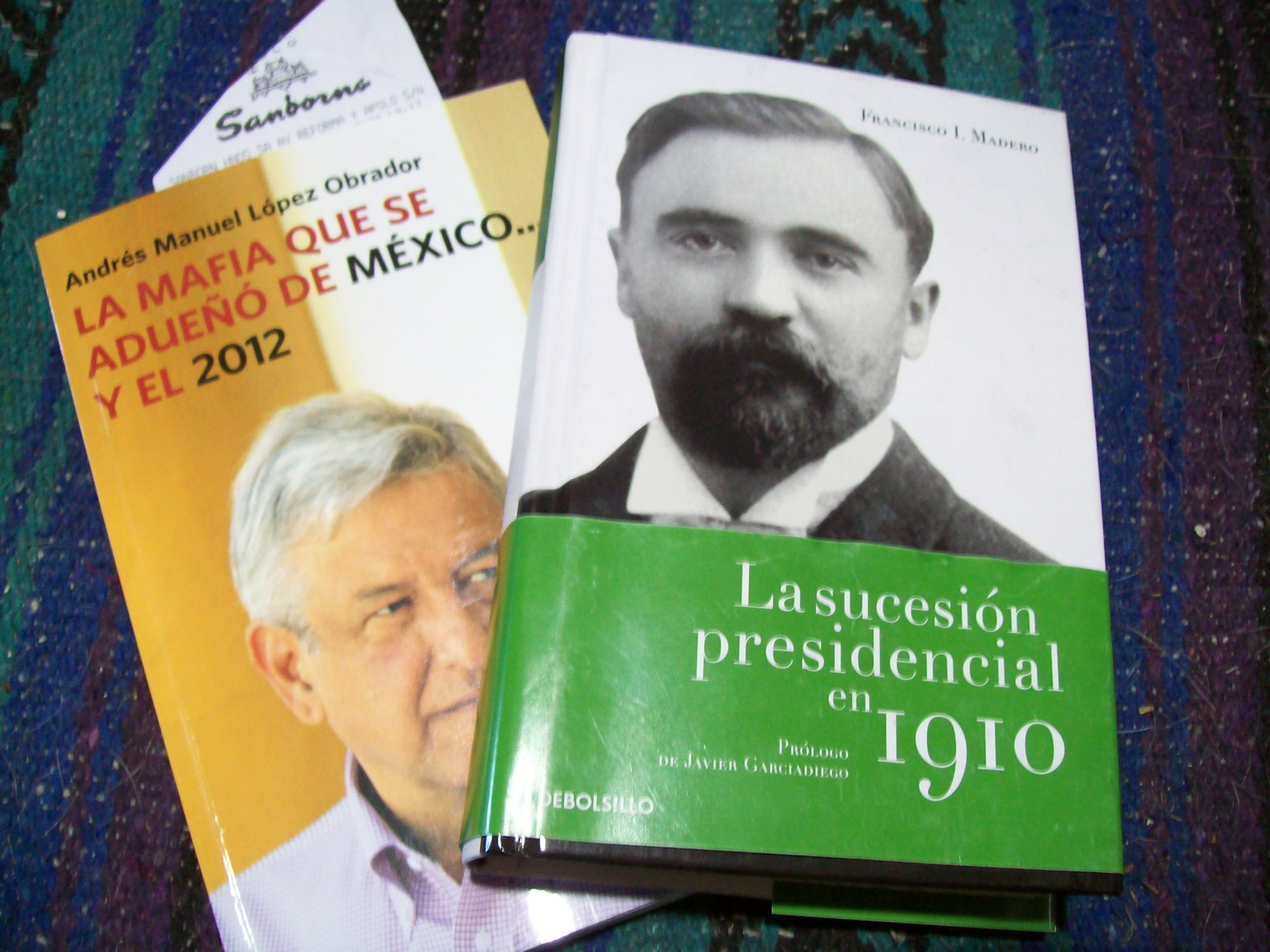 Books and speeches were Madero’s weapons in 1910… and, like Madero, Lopez Obradór is no prose stylist. Of course, when Madero’s La sucesión presidential en 1910 came out, it was criticized for having no literary or academic content. Which, as Francisco Bulnes, one of the more astute of Don Porfirio’s cientificos pointed out, was exactly what made it so dangerous… it had mass appeal and was readable. By the way, it’s been reprinted — and available at Sanborn’s too.
In Don Porfirio’s day, it wasn’t all that hard to freeze Madero out of the media (who turned to alternative media strategists like Pancho Villa to get the message across). Harder in the days of mass media and corporate domination of the airwaves. Unfortunately (or fortunately, depending on one’s political persuasion, and/or investment in political theater) Lopez Obradór’s alternative media presence (Regeneracion for example) seems amateurish.
Of course, all this depends on what happens through the rest of 2010, and into the first half of 2011… stay tuned. Nothing is going to happen… until it happens.
Boom!
I haven’t been able to run down Malcolm Beith’s references (and I’ll leave that to others), but I believe he’s correct when he posted yesterday:
Everyone is reporting on the car bomb in Ciudad Juarez, and how it adds a new dimension to the war on drugs. Actually, car bombs (i believe multiple) were detonated in Sinaloa in 2008. So it’s not really a new dimension, more of an ugly new twist.
And, although the would be bomber managed to managed to blow himself up, it’s not the first time gangsters have used bombs against law enforcement people by any means. On 16 Feburary 2008, a gang with colorful names like “El Nazi” and “El Gordo” tried to blow up the local prosecutor’s office in the Federal District, instead blowing up some flunkie. That bomb was a primitive “mother of Satan” concoction. Most of the ingredients being available at your local hairdressers (and the widow of the wannabe bomber was a hairdresser), the Mothers of Satan have been a favorite bomb for all kinds of baddies, including “terrorists” — which led to the usual crazy reactions in the U.S. about possible Middle-Eastern involvement. Count on the always reliable Fred “Paranoia R Us” Burton to try detonating a whole new level of paranoia:
Although Mexican authorities say the attack was the result of a car bomb, a counterterrorism expert said there is “some confusion” about exactly what caused the car to explode.
“For this to be an improvised grenade attack, in some capacity, it doesn’t surprise me,” said Fred Burton, vice president of intelligence at Stratfor, a privately owned global Intelligence service.
But if this particular car bomb was manufactured to the level of sophistication similar to those used by terrorist groups like Hezbollah, then this is a significant event, Burton said.
Other than a more sophisticated bomb design — n this case, set off by a cell phone, and designed to injure or kill rescue workers (one of the victims was a doctor who stopped to render medical assistance) after police officers were wounded in a shoot-out with gangsters, all that means is gangsters are reading the same “bombing for dummies” books every other bad guy reads.
Gangsters have been using bombs and car bombs to kill their enemies for a very long time. And all over the world, even in Arizona (where car bombs are also used for such mundane purposes as disposing of unwanted — and well insuranced — spouses).
And it’s certainly not as if this is a new idea. Car bombing in relation to the border narcotics trade has been considered before, as in the 1958 film “A Touch of Evil”:
Towards a more colorful vocabulary in 30 days
There are plenty of those “word of the day” and “build your vocabulary” sites for non-native Spanish speakers, but most are frankly boring. And either give you words you already know, or ones you’ll really have to stretch to find any use for in any given day. Not so with the website posted semi-regularly by Chicago economics consultant Pablo. Modestly billed as working “towards a manual of communication for the English speaker visiting Mexico City” it is a lot more than that… entertaining and instructing in equal measure … and teaching us the words we really do need, and are are not going to have too much trouble building into a conversation on any given day.
“Effective Swearing in D.F.” isn’t so much about learning the swear words — and most entries are not groserías but modismos — Pablo is careful to give us the proper (and sometimes improper) usages, mostly understood throughout Mexico.
As for example in this post from 28 June on jefe and jefa:
Jefe and jefa are masculine and feminine for chief or boss. They are typically used to refer to parents. This might be a source of confusion. That’s why we suggest the use of patrón in opposition to jefe. Patrón (like the tequila brand) literally means boss in a work related context.
Example:
Marlon: ¿Y esa camionetota tan chingona?
Brando: Es de mi jefe.
Marlon: ¿De tu patrón o de tu progenitor?
Brando: No la cagues. Mi patrón tiene un zapatito bien jodido.
Marlon: Where did you get that bad ass SUV?
Brando: It’s my chief’s.
Marlon: Your boss or your father?
Brando: C’mon, my boss drives a beaten up Renault 5.
Zapatito (little shoe) is the affectionate nickname for Renault 5
And, what better way to discuss the differences between “ser” and “estar” than considering pacheco, with its Cheech and Chong meets Abbot and Costello possibilities?
The term pacheco (pah-CZECH-awe) allows Spanish non-native speakers to grasp the difference between ser and estar. On one hand, estar pacheco means to be stoned. On the other, ser pacheco means to be a stoner, a pothead. Caution: Pacheco is also a common family name.
Also helpful to know:
La pacheca: the act of consuming cannabis.
Pachecada: something a stoner would say or do.
Mensajero: Buenas tardes, ¿es usted Pacheco?
Gutiérrez: No, yo nomás ando pacheco.
Pacheco: Déjate de pachecadas, Gutiérrez. Disculpe joven, yo soy Pacheco. Este cabrón es un pacheco.
Messenger: Good afternoon. Are you Pacheco?
Gutierrez: Nope. I’m just a little stoned.
Pacheco: Stop the stoner non-sense. Sorry, I am Pacheco. This dude is a pothead.
Liberté, égalité … perfidité
Two A fine examples on this year’s Bastille Day:
- In Argentina, the Senate argued all night, finally at four in the morning passing by a vote of 33 to 27 the lower house bill that legalizes same-gender marriage. President Fernandez de Kirschner has already said she will not veto the bill, which was supported by about 70 percent of Argentines.
The best the opponents were able to muster was a slogan “Every child deserves a mother and father,” which may be true, but rather misses the point. Argentina joins Netherlands, Sweden, Spain, Iceland, Belgium, South Africa, Portugal and Canada in permitting same-gender marriages nationwide. Chile, Paraguay and Uruguay may join Argentina in updating their marriage laws later this year.
In the Americas, besides Canada (and Argentina as soon as the new law is printed in the Gazette), in countries where marriage is a state matter, same gender marriage is permitted in San Pedro Sul in Brazil and the U.S. states of Connecticut, Iowa, Massachusetts, New Hampshire and Vermont as well as the District of Colombia (Washington).
And, of course, the Federal District (Mexico City). Having discovered in Mexico that the sky does not fall when people of the same gender marry, reforms may be on the agenda for state legislatures in Michoacán, Morelos, Puebla, Sonora, Tabasco, and Tamaulipas.
Several European countries, and a handful of places in the Americas (like Montevideo, Uruguay and the state of Coahuila) give legal protection to same-gender couples under free union (domestic partnership) agreements.
- And a hoax: in France… probably the best Bastille Day gesture ever… the government decided to correct one of the great injustices of European colonialism, paying back (with INTEREST) the 90 million gold francs extorted from Haiti in return for its independence. A fake email allegedly from the French Foreign Ministry announced plans to return the 90 million gold francs Haiti was forced to pony up for it’s independence. Having begun life hopelessly in debt, Haiti never recovered, and there is no way to undo the past, but €17 billion goes a long way to at least overcoming some of the most pressing needs of that most unfortunate nation. Structually Maladjusted was pulled in by this hoax too… which he seems to think was useful in highlighting the Haitian debt issue. I do’t. That seems a rationalization for what is, at bottom, a cruel trick… not so much on people like myself (who picked up the tale), but on the very people meant to be “assisted” by this hoax.
From what I can tell, the hoaxers are a U.S. group, preaching to the French about a historic injustice, which — I suppose could be (and should have been) the basis for some unrestricted aid now. But, U.S. groups should, if they do need to preach (which seems to be the style of U.S. political discourse) might do better to stick to their own country’s sorry history of intervention and expropriation in Haiti and elsewhere in the Americas. This seems typical of U.S. “progressives”… not to really have any concern with their fellow Americans as people, but only to use them as “lessons” for domestic consumption.
While that may pique a few consciences in France, the effect is only to use Haiti as a foil for their own social and political games. And a cruel trick upon any Haitian who might have read the original report.


 mexfiles.net