Olga Guillot, Reina del Bolero, D.E.P.
Olga Guillot, born in Havana in 1922, began her singing career in the mid 1930s, part of a sister act, then as something as a Edith Piaf knock-off, before coming into her own in the late 1940s. Appearing throughout Latin America and in European and Latin films in the 1950s, she was a major Cuban star by 1961, when — unable to reconcile herself to the 1959 Revolution — she moved first to Venezuela, and later to Mexico. In 1964 she was the first Spanish-language singer to appear in New York’s Carnegie Hall. A star throughout the Caribbean and Latin America, she spent the last several decades in Miami, where she died Monday at the age of eighty-eight.
With over sixty recordings to her credit, her signature piece is “Voy”, written especially for her by Mexican composer Luis Demetrio. Here is Olga singing “Voy” from a 1999 Televisa broadcast.
José Francisco who?
(A couple minor updates, in italics)
Felipe Calderón has gone through four Secretaríos de Gobernacíon in as many years. The first — who lasted just over a year — was the former Governor of Jalisco, Francisco Ramírez Acuña. Among other things, the Secretarío de Gobernacíon is charged with overseeing national security.
While privately, many whispered about his possible connection to narcotics traffickers, he was more condemned for his well-documented contempt for human rights (like having 1500 kids rounded up at gun point during a rave to confiscate a whopping 65 grams of marijuana… and earn himself sixty never-to-be-investigated denunciations before the Jalisco Human Rights Commission, not to mention the condemnation by Amnesty International for allowing, if not encouraging, torture and abuse of protesters during the 2004 Summit of Caribbean, Latin American and European leaders in Guadalajara). None of which probably disqualifies him for the security chief part of the job — not really, anyway — although he was widely seen by everyone except his own party as an incompetent boob.
What really did him in was that the Secretarío de Gobernacíon is also the de facto Presidential Chief of Staff, and the guy was not a good negotiator. It’s not like he could torture opposition deputies into backing administration initiatives.
No one was sorry to see Ramirez Acuna go in January 2008, but Juan Camillo Mouriño Terrazo brought his own baggage to the office. First off, he was born in Spain, which led to open speculation about his Mexican nationality. Mexico does not have a Vice-President, and the Secretarío de Gobernacíon is — along with everything else — the #2 guy in the Executive Branch. While it’s not clear that he automatically assumes the Presidency if anything were to happen, it is assumed that the Secretarío de Gobernacíon would — as he does when the President is out of the country — become acting President.
While Mouriño was a much better negotiator than Ramírez, evidence presented by the PRD that Mouriño had used a previous job with PEMEX to steer contracts to his (Spanish) family businesses suggested he was not exactly Sr. Limpio, those nagging constitutional questions hung on… never to be answered, as Mouriño, along with José Vasconcellos (son of THE José Vasconcellos), the top Federal Narcotics prosecutor, were both killed in an airplane accident that many still believe was no accident after only 10 months on the job.
The replacement, something of a surprise at the time, was Fernando Gómez-Mont Urueta, best known as a defense attorney specializing in fraud and white-collar crime. Of course, being a conservative pro-business administration, the left had a field day looking for dirt on Gómez-Mont. As a national security guy, he’s a typical right-wing hard-ass, and he’s a social conservative, but then again, he’s a PAN appointee, and that’s to be expected. Nothing particularly scandalous in his background ever emerged although he was closely tied both through legal business and politically to the missing (and controversial) “Jefe Diego”.
There were no major political reforms (meaning changes, not necessarily for the better) coming from the Executive Branch during Goméz-Mont’s tenure, so it’s hard to assess his skills in negotiating with the Legislature. However, digging into the past, David Agren (one of the few foreign reporters… probably the only foreign reporter… ever assigned to cover the Mexican legislature) writes:
No one ever questioned Gómez-Mont’s negotiating talents. He formed a formidable PAN negotiating tag-team with his legal and political mentor, the currently missing former presidential candidate Diego Fernández de Cevallos – who is eroneously mentioned in many press reports as being a close friend of Calderón. They negotiated many of the early electoral reforms that led to an independent IFE and, it’s believed, in exchange for recognizing the scandalous 1988 election of Carlos Salinas, they brokered a deal so the PAN victory in Baja California would be permitted – the first time a state government slipped away from the PRI.
Still, he’s somewhat inflexible, having expressed extreme unhappiness over a deal between PAN and PRI not to challenge each other in next year’s State of Mexico Governor’s race, in exchange for PRI support for the PAN proposed national budget. He went so far as to resign from the party earlier this year in protest of PAN’s alliance with the PRD in several state elections . And, lately, he has been raising questions about his administration’s prosecution of the “drug war”. Rumors that he was about to be sacked, or planned to quit have been circulating for a while now, and his resignation, just after the elections, really isn’t all that unexpected.
What is unexpected is his replacement. José Francisco Blake Mora is very much an unknown outside of his home state of Baja California. Baja may loom large in “expat” and tourism circles, but it’s the other side of the moon in Mexican politics. He served in the state governor’s cabinet, was in the state legislature and was once an also-mentioned candidate for the Procurador General (Attorney General) slot. Let’s put it this way: his three paragraph entry in the Wikipedia (Spanish edition only) was only updated today, based on wire service reports from one of the Tijuana papers. The guy’s apparently a PAN loyalist (the opposition is already sneering that he’s a Calder’on “yes man”), a competent enough (as these things go) official from a minor state and… that’s about all anyone can say. My guess is that having been in the Gobernacíon office in the Baja, perhaps he’s made connections with U.S. drug officials, who have put some pressure on the Mexican administration to appoint him to this sensitive position. But, like I said, the guy’s basically a cypher at this point.
(I received a couple of emails, a comment and noticed in the press that Blake’s reputation in Baja California is as a police organizer, bringing down the death toll in the “drug war” — which makes me think it’s ONLY the drug war that is in Calderón’s thinking… that and Blake is a personal acquaintance from their law school days).
It’s as if the Calderón Administration has given up on everything BUT pursuit of the drug war, and is just going with party faithful and true believers, as it runs out the clock until the 2012 elections. It also, PERHAPS, opens the way for Goméz-Mont to mount a challenge for the PAN presidential nomination… something he said he doesn’t want, but then, when politicians lips move…
“Hernandez” on the “evolution” of the Secretaries during Don Felipe’s tenure appeared in this morning’s Jornada:

You can learn a lot from Lydia
Tattooed and pierced women “clearly demonstrate a loss of values in our society” according to Luz María Ramírez Villalpando, addressing 250 PAN faithful in León. Which normally wouldn’t matter, but Ms. Ramírez is the director of the Instituto de la Mujer Guanajuatense (Imug), the state organ charged with protecting and fostering women’s rights.
She complained that “There is no standard or sense of values in these things. A young person may say it’s original or like it, but there’s another value — health — and these things are prejudicial to that.”
Ángeles López García, of the Centro de Derechos Victoria Diez — who Ramírez tried to have charged with “terrorism” back in August 2009 for helping a client bring sexual assault charges against a state police officer — responded that Ms. Ramírez’ attitude towards tattooed women is a human rights violation all on its own, suggesting as she does that women have no rights over their own bodies.
OK, I’m the first to admit I’m not fond of tattoos: on men or women (why ruin a work of art with graffitti?). So I don’t have any. But I respect the Marxist stance on this issue:
14 July 1789, Paris… 14 July 2010, Panama
I’ve been following, with growing alarm, the deteriorating situation in Panama — another Latin American nation that attracts more than its share of riff-raff scattered through the expat community. Alas, the riff-raff seem to dominate the on-line information coming out of that country, with the exception of Okke Ornstein’s “Bananama Republic”.
What Okke is calling the “sausage law” is basically a combination of a Panamanian version of the U.S. PATRIOT Act (basically criminalizing whatever the state decides is criminal) with anti-labor provisions designed to attract the riffier and raffier of foreign investors (we don’t need no stinkin’ unions). Heavy-handed enforcement by the riff-raff that run the country is being strongly resisted and violence has already broken out.
It’s much harder to whisk away dissidents to the Bastille in the dead of night in the days of video cameras and the Internet than it was in 1789, but the Panamanians may be having their own Bastille Day… today, or very, very soon.
I’ve been wondering if Panama (a U.S. ally and arguably a legitimate strategic interest of the United States) isn’t the real target of the “humanitarian” concern of the U.S. Marines being sent to Costa Rica. It wouldn’t be “humane” for the Panamanians to throw out their government “of the gangsters, by the gangsters, for the gangsters” and practice a little “liberty, equality, fraternity”.

What’s going to make this interesting is that the best-case scenario is going to be a “constitutional coup” (President Martinelli will be forced to resign, by any means necessary and someone possibly the slightly less crooked who will be sold as a plausible replacement). The U.S. government (and their right-wing cheerleaders at home and abroad) are going to have a hard time changing the twisted logic they used to defend the Honduran coup to fit what’s going to happen in Panama. Today, or…?
Unreasonable suspicion
The usual suspects’ favorite rationale for NOT reforming immigration laws in the U.S. is that the reforms have to wait “until the border is secure” — which is like saying they can’t reform narcotics possession laws until all narcotics dealers are in prison, or prison reforms have to wait until there are no criminals at large. Perhaps now, they’ll start saying immigration reform has to wait until there is data security.
In Utah, an anonymous letter was mailed to law enforcement and media outlets accusing 1300 people by name of being undocumented immigrants.
The list included not just names but birth dates, addresses, telephone numbers, and in some cases, even Social Security numbers and employers. The letter was signed by a group calling itself “Concerned Citizens of the United States.”
The group said they “strongly believe” people on the list are undocumented immigrants who should be deported. The names were compiled, according to the letter, by observing the individuals.
“We then spend the time and effort needed to gather information along with legal Mexican nationals who infiltrate their social networks and help us obtain the necessary information we need to add them to our list,” the letter explains.
Media did track down some of the names on the list and found that the people were either in the country legally or had recently become legal residents. The amount of detail given alongside some names was scary.
One woman had beside her name her due date. When contacted, she confirmed she had given birth but that she was a legal resident.
In an understatement, Marisa writes “this is scary”. Hell yeah! Bad enough that stupid laws like the Arizona SB 1070 allows outsiders to file lawsuits against police officers and departments for NOT using “reasonable suspicion” in checking immigration status, can you see what will happen when busy-bodies start deciding for themselves what is, and isn’t, suspicious. That, or some mob showing up at your door demanding YOUR papers.
A wise-guy, huh?
A little learning can be a dangerous thing.
MexConnect had one of those “people should post in English, because I read English” threads you find on ex-pat message boards all over the planet. This wasn’t a variant on the legitimate complaint of minority-language speakers that they are denied access to information by the majority, but based on the idea that “we foreigners” who can’t read Spanish are being slighted. Or somehow insulted by persons who post in Spanish.
Working for a English-language publisher in Mexico, I’m aware that many of us don’t speak the majority language here (and it’s what keeps me employed). I write in English (of a sort). It’s the language in which I’m most comfortable thinking and the language I write.
I have never heard any of my non-English speaking readers think I’m “rude” to do so (although I have received comments from appreciative readers who though it was a shame my site was in English… and said so in Spanish). Really, the only negative comment I ever received about the language in which I write was verbal… someone complaining that a Polish writer’s comment (merely mentioning that my site was linked to his site) was in Polish and I didn’t translate it. I took it as a compliment, that someone not speaking English found something I wrote useful enough to bring to the attention of his own Polish readers. Besides, I don’t read Polish. Or Hebrew or Russian, which are also languages that shown up in my comments now and again (along with Spanish and Portuguese and Italian… which I can usually figure out).
I have no problem with people thinking, and writing, in their own language. If the ideas are at all useful, those of us not handicapped by U.S. language education are usually better able than I am to at least figure out what is going on. They don’t do so out of rudeness, but because it’s the best way for the writer to say something. Or — and this is probably more the case on an “ex-pat” website, because there are bureaucratic rules and regulations under discussion and those rules and regulations are in Spanish. And need to be followed exactly.
Anyway, being a “minority language” speaker, I certainly do support the right to receive information in my own language… as do other minority language speakers. And, being a wise-guy, I posted my response, from Article 27 of the Universal Charter of Human Rights — the Nahuatl version:
¡Nochi tojuantij tijpiaj manoj ma tiyejyektlalikaj tochinanko o topilaltepej ika kuali tlamachtilistli!
(Everyone has the right freely to participate in the cultural life of the community…)
Of course, that was a cut-n-paste job, but elicited the following personal response
Nochi tlajtoli kipia kampa peua uan kipia kampa tlami, axueli se akajya san tlauel mokajkalakis ika se tleueli tlamantli, yeka onkaj tekiuaj para ya ma tlakualtlali. Ijkinoj nesis para melauak titlatepanitaj uan melauak nojkia titetlasojtlaj.
A rather witty rejoiner … at least I think it was. I’m stuck trying to figure out is how to say “hoisted on my own petard” — quiminaznequitli doesn’t look right to me.
Cognitive disconnect?
Ken Ellingwood, writing in the Los Angeles Times, is one of the first “mainstream media” reporters I’ve seen who notices that the situation in Juarez is NOT necessarily viewed the same by Mexicans as by those north of the Rio Bravo:
“It’s not enough to analyze it only in terms of public safety. You have serious gaps in the social and economic [areas] that have to be closed,” said Antonio Vivanco, a Calderon advisor overseeing the development effort.
In the first months, the program has paid to have more than 750 police cruisers outfitted with GPS technology so commanders can track them, a check against official corruption. Authorities have assigned extra police to key thoroughfares to create nine “safe corridors,” envisioned as crime-free zones.
Sarah Hill, in Boston Review (sombrero tip to Ganchoblog) — although she’s focused on the “drug war” manages to hit on a reality most overlook:
The escalating war over the Juárez plaza coincided with a particularly unpleasant moment in the global market system—in the midst of massive factory layoffs prompted by the economic downtown beginning in 2007. Locals easily grasp that little of the current day-to-day violence in Juárez has much, directly, to do with any cartel. Look at who dies with grim regularity: a gang of teenage car thieves, a group of former cholos who opened a funeral home, a guy pilfering doors from an abandoned neighboring house. Not all victims are entirely innocent—the city is filled with scrappy, hard-working men and women, some of whom have turned to Juárez-by-night for survival now that Juárez-by-day has so little to offer them—but they are not drug dealers or corrupt police, either.
Juarez is something of a demographic anomaly: a desert town grown out of all proportion because of its access to U.S. markets, dependent in normal times on smuggling for a good part of its business and populated by the young and desperate. The “boom years” created a situation I once called Detroit meets Deadwood — a manufacturing city coupled with a frontier town. With the collapse of legitimate trade (or rather, having sold itself as a cheap labor site, it’s inevitable collapse when still cheaper labor became available elsewhere), it was already in an economic free-fall when the Calderón Administration ratcheted up a “drug war” to boost its legitimacy.
Back in November, based on something Maggie Drake had written about her area of the Baja (also infested with drug warriors of various factions) I asked whether or not “death squads” might also be at work. While Hill doesn’t directly say that, she is suggesting that the victims listed as casualties in the “war” are not really “combatants” but at most “camp followers” … and, as Gancho also mentions in another post, on San Pedro Garza García, Nuevo Leon’s controversial presidente municipal, Mauricio Fernández (whose “innovative” anti-crime tactics implicitly suggested using death squads), is back in the news — several of his “security team” being tied to organized crime figures.
Ellingwood and Hill both hit on something that people here have been saying, but hasn’t been much heard outside Mexico except in small circulation websites and academic publications. Throwing more police (with or without GPS-outfitted cruisers) has nothing to do with resolving an economic situation. And, a “drug war” isn’t the simple “black hats v. white hats” people want to make it out to be. About time the U.S. media noticed that.
At least it’s in Mexican hands
 Grupo Frisco, a wholly owned subsidiary of Grupo Carso, a wholly owned subsidiary of Carlos Slim, plunked down 25 million U.S. dollars to buy the El Porvenir gold mine in Aguascalientes from the Canadian firm, Goldgroup.
Goldgroup is applying the proceeds to “fund development of Goldgroup’s advanced stage properties” in Sinaloa and Veracruz states.
One interesting tidbit from Goldgroup’s press release. Francisco Escandon Valle, whose career was in Mexican government service as a mining regulator, has gone over to the dark side, being appointed to the board of directors of Goldgroup.
And every cop is a criminal (fiction reader)
This has been a bad few months for Mexican letters. Juan Hernández Luna was only 47 years old when he had a fatal heart attack over the weekend.
A one-time el Universal nota roja correspondent in Puebla — a job he took on to supplement his 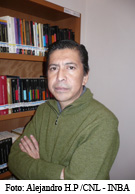 meager income as a theater performer (and thankless, economically suicidal career as a poet) — Hernández Luna turned to crime fiction… one of the few Mexican writers in the genre. Naturally, Latin American crime fiction is not your Patricia Cornwall cut em ups, or your Agatha Christie nice cup of poisoned tea. Hernández received the Dashell Hammett Prize for crime fiction in 1997 for his Cadáver de ciudad, which might be best described as a Janet Evanovich novel on peyote: the shaministic protagonist — having killed a cartel boss in the middle of Puebla Cathedral goes into hiding in Baja California… where he is recruited to solve the mysterious castration of a reclusive millionaire… AND… for good measure, the disappearance of Mexico City’s Angel of Independence. With a lot of gratuitious kinky sex and off-beat religious sects hovering around the background. And all tongue firmly in cheek.
But Hernández Luna was not a simple entertainer, but like so many Mexican men (and women) of letters, an intellectual seriously involved in national affairs. He was the genius behind “Programa Literatura Siempre Alerta” — an idea that seemed so bizarre it actually made sense. Beginning in 2006, and continuing until a new PRI local administration discontinued funding, Programa Literatura Siempre Alerta introduced the Nezahuacoatl municipal police department to their fictional brethren.
By the generally low standards of Mexican municipal police departments, Nezahuacoatl (one of Mexico City’s largest, and poorest, suburbs) stood out for sheer incompetence, low morale and low standards when the program was introduced in 2005 by Hernández Luna, who had grown up in the community. It was never intended to turn municipal coppers into Sherlock Holmes or even Paco Ignacio Taibo II’s Hector Belascoarán Shayne (and how many leftist Basque-Irish private eyes can Mexico support anyway?) although Taibo was an enthusiastic supporter, and occasional “facilitator” in the program, which was a nice bit of “Life Itself“ (My favorite Taibo novel — in which a leftist intellectual crime fiction author finds himself — albeit reluctantly — the chief of police of a vastly underfunded municipal department).
No, the idea — and this is what I found so brilliant about it — was not only to improve the reading skills of the generally undereducated local police officer — but to find a way to allow police officers to discuss their own lives and their interaction with the public… and, perhaps more importantly, to introduce them to the police officer as a person of respect within society.
It worked. Expanded to include not just classic Spanish language literature like Don Quixote and 100 Years of Solitude, but everything from art appreciation to dance classes, police morale increased and … perhaps more importantly… with police officers who began to see themselves as persons of respect who, in turn, should (as Latin American do), show respect to others, citizen trust in the police improved, and crime rates dropped. It has received recognition not only from Mexican academic institutions, but from the inventors of the respectable policeman… Scotland Yard.
 The Federal District adopted a similar program, Letras en Guarda, in 2007, with which Hernández Luna was intimately connected until last year when his health began to deteriorate. The Nezahuacoatl program was canceled in 2009, when a PRI administration took over the municipal government (and the officers went on strike demanding an end to bribery!). That the Federal District continued it is not surprising — the Jefe de Goberierno, Marcelo Ebrard — with a background in social services administration — had been the unusual choice for chief of police under the Lopez Obrador administration, and improving the quality of the Federal District police has been a priority for years.
Police reform is not something that comes overnight. It is not a matter of hiring more officers, or changing the organizational chart. Nor is it a matter of focusing on the priorities of the United States, nor of public relations. What Hernández Luna recognized, and what he should be remembered for — is understanding that fiction is, as Andre Gide once said in his own crime novel, “a mirror held up to reality”. The reality of crime and punishment in Mexico (and everywhere else, both in fiction and reality) depend on how we reflect our cops and robbers… until we see our cops as men and women of respect, and they see the citizens as equals deserving respect, throwing money and manpower and new and more lethal weapons (paid for by the United States or not) is likely to be wasted.
Ramón Eduardo Ruiz, D.E.P.
One of the great Mexican historians in English (an admittedly small group), Ramón Eduardo Ruiz, died yesterday in Rancho Santa Fe, California. He was 88 years old.
The son of a emigre Mexican naval officer turned California farmer, Ruiz was raised on stories of the Mexican past, something he sought to share with his students since the 196os. A long time professor at the University of Calfornia at La Jolla, his emphasis was the cultural richness of Mexican life and of Mexican literature.
Ruiz’ Triumphs and Tragedies: A History of the Mexican People perhaps paid more attention to the tragedies than the triumphs, and seems to gloss over the massive changes in Mexico post-1968 but is particularly useful in looking at the “dusty figures of the past” and illuminating many of the events I was unable to touch upon in my own book .
Of course, AFTER reading Gods, Gachupines and Gringos: A People’s History of Mexico … and been lured into an addiction to Mexican history… Triumphs and Tragedies is a necessary fix for your Mexican history jones.
Paul el Pulpo — right again!

The guachupines have every right to BASQUE in their EXTREMADA-ly deserved glory, as long as they don’t have ANDULUSIAN of ARAGONce about Brazil in 2014.
Brazil 2014.
Dancing on your grave…
Nothing to do with Mexico really, but 89 year old Australian Adolk Korman revisited the scenes of his youth with his daughter Jane and her three children, and brought back a video not to be missed.


 mexfiles.net