The Fourth of July…
While today is election day, north of the border this is the 138th birthday of Calvin Coolidge. We remember Coolidge here for having sent not only the stupidest U.S. Ambassador we ever had, but also the best.
Ambassador to Mexico, Frank Sheffield
… tried his best to work in the tradition of Joel Poinsett and Henry Lane Wilson. Poinsett had masterminded Masonic plots; Wilson had sponsored a bloody coup d’etat; Sheffield organized football games.
Convinced “Soviet México” (as he called it, especially after México and the Soviet Union exchanged ambassadors in 1927) was doomed to Catholicism, Socialism and what was worse, actually demanding ownership of the oil revenues; a radical remedy was in order. To Sheffield, it was a question of education. Mexicans played European sports like fútbol – soccer – not American sports like football. Only people who played an American style game could produce people who supported American style (or rather, pro-American) governments. So, with great secrecy, the ambassador contacted universities throughout the United States. College students were recruited as secret agents—their mission (paid for by the United States government): infiltrate Mexican schools and recreation programs and teach the Mexicans the “American Way of Life” and the lateral pass.
More seriously, the ambassador listened to oilmen like William Buckley, who were still pushing for United States military intervention to protect their investments. When the United States intervened in a Nicaraguan civil war in 1927 (to protect American investments in that country), Mexican soldiers were sent to assist the Nicaraguan government under the Juárez Doctrine, which called for mutual assistance when asked by a neighbor in need. The two armies spent most of their time avoiding each other while their governments issued inflammatory warnings. President Coolidge… said that México was on “probation” and could be attacked if it didn’t withdraw its troops; President Calles responded that he would order the oil fields torched if American soldiers entered the country. More practically, Calles suggested both countries leave Nicaragua, and that the matter be turned over to the International Court in The Hague. Meanwhile, the luckless Ambassador Sheffield, who had to publicly deny there was any plan to invade, unwisely left papers outlining his suggestions for intervention. The Mexican cleaning staff “expropriated” the ambassador’s papers.
President Coolidge had no choice but to cancel the invasion and the football program. Anyone was bound to be an improvement, but Coolidge surprised the Mexicans, and himself, when he chose Wall Street banker Dwight Morrow to replace the disgraced and discredited Sheffield. Morrow’s immediate task was to avoid a complete breakdown in relations. Oilmen and other American businessmen would listen to a professional business advisor. Unlike his predecessors, Morrow—who had made his fortune listening to the experts who disagreed with him and then advising wealthy investors on how to handle their money—did not arrive with preconceived notions of how México should react. …
Morrow’s advice was simple— in México, play México’s game by México’s rules…
(Gods, Gachupines and Gringos)
Although the spirit of Sheffield lives on, perhaps it’s only proper and fitting that the United States remembers Calvin Coolidge — not so much for sending the only U.S. Ambassador to Mexico to ever have a street named for him (calle Dwight Morrow, in colonia centro, Cuernavaca) — but for presiding over a United States of the 1920s, which so much resembles the Mexico of Felipe Calderón: viewed internationally as a nation of violent crime, rampant gangsterism, political scandal and a growing gulf between the haves and have-nots.
So, north of the border, enjoy the day of excess and explosions … and let nothing come between you and your Calvins:

Deutschland, Deutschland über Argies
Unlike games in which the Mexican national team played, which had the Zocalo overflowing with fans [watching the World Cup on giant screen TVs], the national square was only half-filled yesterday. Most, with Aztec blood in their veins, wildly cheered the “white boys” — the few Germans in attendance standing out because of their different physique and language.
(Sarah Pantoja, El Universal)
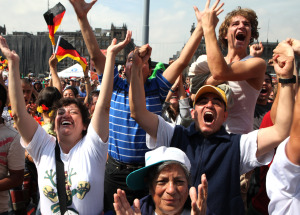
It’s one of those weird Mexican things. Mexicans think of Argentines the way Texans think of New Yorkers (and vice-versa) — dorks with big egos and weird accents. Ironically, Argentina has more Germans than Mexico, but maybe Mexicans like the Germans because we got the nicer bunch of them in the 1940s: Mexico got Jews and Communists and Social Democrats and respectable types and the Argies got the Nazis. Or, other than a couple of U-boat attacks, the Germans never invaded Mexico and even offered to help us invade the United States. Or, the Germans just played better futbol.
Off her head
Gov. Jan Brewer recently signed a new law that allows Arizona police officers to demand immigrants to produce documentation proving their legality.
In an interview with Fox News, Brewer said, “We cannot afford all this illegal immigration and everything that comes with it, everything from the crime and to the drugs and the kidnappings and the extortion and the beheadings.”
“Our law enforcement agencies have found bodies in the desert, either buried or just lying out there, that have been beheaded,” she added.
Slight problem… no one has told any law enforcement officials or county coroners about it. The Arizona Guardian (which doesn’t make it easy to directly quote a paragraph or two… or half dozen) could find no records of any beheadings, although they did find a few instances of unattached skulls being found in the desert.
Better yet, the Guardian asked Brewer’s spokesman Paul Senseman about her comments both on nationally televised and local programs making the beheading claim. Senseman does the only thing he can, and denies she ever said people were getting beheaded in Arizona.
Maybe not… but they do seem to misplace their brains quite regularly.
Early campaigning — for the NEXT election
We’re in the “days of reflection” — the three day blackout on political propaganda and polling (ain’t it wonderful!!), but there’s no let-up in discussion of the 2012 election:
Ganchoblog on Calderón’s surprise announcement that he plans to phase out the federal tenencia (the valuation tax on automobiles, also assessed in some states), which was:
… reportedly sparked by a similar plan in the works in the State of Mexico. Not to be out-shined weeks before an election day by his likely successor, Calderón’s cabinet raced to preempt Peña Nieto’s announcement with own of their own. This may not be entirely true, but if it is and you have a presidency making such a decision based entirely on a governor’s possible course of action, you have to wonder about the quality of his advisors.
Given that Gov. Peña Nieto is still the presumed PRI candidate for Prez. in 2012, it just sounds like standard “middle-class tax break” kind of campaign promise — one of the candidates for Governor here is also promising to end the tenencia… but we don’t talk about the 2010 election today … and looks like one to Jornada cartoonist Helguera:

Deja vu… cell phones
I’m STILL in the process of moving. My phone line (and computer connections) won’t be in until next week, so am going back and forth between the old and new place, which means posting will still be irregular for a few days. But speaking of phones, I ran across TWO of my old, unregistered cell phones, which reminded me that Mexico is sometimes still a trend-setter in Latin America, for good or ill.
Julio Rank Wright in Americas Quarterly:
… there´s been an unforeseen consequence of cell phone penetration in El Salvador and presumably other developing nations: the use of cell phones to commit criminal acts, specifically extortions.
El Salvador’s security and defense authorities claim that 85 percent of extortions are committed using cell phones from penitentiaries across the nation. Given the fact that access to a cell phone number is easy through pay-as-you-go schemes, phones can be used within jails for any range of criminal purposes, including extortion.
In response, the Attorney General is calling for a legal reform that would allow for verification of the location of the owners of some 300,000 cell phone lines and request pre-registration with personal information. Those that don’t register will have their line blocked permanently. This solution is used in many countries including South Africa and most recently Mexico.
There was a lot of whining here about registering phones. The ONE I did use (and could find two-thirds of the time) was registered easily enough… but, with the number of unregistered phones still something like 15 to 20 percent, TelCel got a court injunction to hold off on cutting service to unregistered phones… most of which, I suspect, are probably lost, stolen or strayed anyway.
Love in the time of deportations
Esther writes on “A Broken Heart”:
“She just left me. Just today. So all of a sudden I am going home to Guatemala.” Silence for a bit. “She was legal in the US. Is. When she goes. She has more money than I do. She wants me to go back.”
“But you can’t.”
“No. It’s different these days. The police, you know, they come after us. I can’t get a driver’s license. So many police now.” Another pause. “When you get sent home, you can’t go back. If you get caught, you go to jail.” He shrugged his shoulders, smiled a bit. “She’s really beautiful.”
“How long were you , you know, together?”
“A year.” Another shrug. “But she doesn’t really love me. It was for fun, for her, going with me. Now it’s not fun anymore. She tried to be nice. She got me a permit to work here. in Mexico. In Xalapa. But I don’t want to stay here. It all looks ugly here now. I want to go back to Guatemala. She’s going back to Minneapolis. She wasn’t even going to stay here with me.”
Native wisdom
Oil spills are not one time disasters, but generational. Via Abiding in Bolivia, how Ecuadorians coming to Louisiana to share their own experience with the fifty year struggle against oil contamination:
Making census of us (and U.S.)
“We should do away with the picturesque jargon of black, mulatto, mestizo… and etc., and instead view ourselves geographically, calling ourselves Americans for where we are from, as do the English, and the French and that other European country that is oppressing us, and the Asian in Asia and the African in his part of the world.”
José Maria Morelos y Pavon (1814)
Erwin, at The Latin Americanist, writes on the problems the United States — which might have saved itself some grief had it listened to what Morelos was saying — is having with their decennial national body-count:
An interesting conundrum appeared for numerous Latinos who tried to fill the census papers: how to accurately answer the questions pertaining to race and ethnicity. If one is of a mixed racial background such as mestizo, for instance, then how should one classify his/her race for the Census? What about the person … who claimed that “I would consider myself Hispanic or Mexican-American, but definitely not White”?
A report from the U.S. Commerce Department Office of the Inspector General found that some Census workers have ignored similar troubles during their door-to-door visits. Rather than clarify concerns some of the workers in the study made things worse:
Upon their visits, census workers are supposed to read aloud the 10 census questions, including those on race and ethnicity. Yet, according to the report, 71 workers incorrectly communicated the race and Hispanic-origin question to respondents. Some census workers made assumptions about individuals’ race and filled in boxes without asking the respondent the ethnic background questions, while others failed to ask their respondents if they wanted the questions read aloud.
The “picturesque jargon” of the United States is even more complicated than Morelos’ world’s “Peninsulare, Criollo, Mestizo, Mulatto, Negro, Indio, Zambo, etc”. The U.S. census form specifies that one defines oneself as:
Hispanic, Latino or Spanish Origin — divided into sub-categories of:
- Mexican, Mexican-American or Chicano
- Puerto Rican
- Cuban
- Another Hispanic, Latino or Spanish origin
AND/OR…
White
Black, African-American or Negro
American Indian or Alaskan Native (with the form asking for the specific “tribe”)
Asian Indian
Chinese
Filipino
Japanese
Korean
Vietnamese
Native Hawaiian
Guamanian or Chamorro
Samoan
Other Asian (with the form asking to “print race, for example Hmong, Laotian, Pakistani, Thai and so on”)
Other Pacific Islander (with the form asking to “print race, for example Fijian, Tongan and so on”)
Mexico also has their census in years ending in “0”, and it took about three minutes to answer the census workers´questions. I was asked how many people lived in my house (one). My name and age. Whether either of my parents spoke an indigenous language (which they didn’t, so I wasn’t asked which languages), whether I had running water and electricity (yes), whether I had an indoor toilet, refrigerator, stove, blender, or washing machine (yes to all), if I knew the roofing material on my house (concrete, I think), my level of education (maestería), my trade (if any) — and — being a resident alien, the country where I was born.
The controversial question here asked my religion. The Roman Catholic Church hierarchy worried that quasi-Catholics, like those who follow the Santa Muerte religion would be counted among the faithful. Cardinal Norberto Rivera briefly considered calling on the faithful to boycott the census.
I think the real concern was that the long-time estimate that 85 percent of Mexicans are Roman Catholics is probably way over-stated… with ninguna preferencia probably being the true majority religion, even among those (like myself) that are “technically” Catholics. Of course, I was tempted to indulge in a bit of picturesque jargon and answer “Iglesia de San Cuah“, but came to my … er… census before I spoke.
Sherlock Holmes and the secret of the Baja
Nigel Bruce, the quintessential bumbling Englishman of the movies, may have been a better actor than we give him credit for. One might expect the second son of Sir Michael William Selby Bruce, 11th Baronet of Stenhouse and Airt (and Lady Bruce, naturally) to have easily slid into the character of a slightly befuddled vaguely upper-crust Englishman, but Nigel Bruce was born in Mexico… Ensenada, Baja California to be exact: 4 February 1895.
So, how did Dr. Watson end up being born in Mexico? Elementary… his parents were on vacation. A-HA! The game’s afoot… a doctor, you say? And a Mexican? Perhaps we can use our deductive reasoning to determine how exactly Holmes acquired his cocaine connections.
A tip of the deerstalker to Maggie Drake, who in the spirit of the great consulting detective… caught something on PBS and checked the Wikipedia.

I say, this isn’t the normal typeface, but I was hounded into using Baskerville.
Mexico really should have joined Mercosur, not NAFTA
What the hell was Carlos Salinas thinking? Canada and the United States may have some geographic ties (and, yeah, there is that trade thingy), but NAFTA is the wrong group for Mexico to have joined. It had a chance to join Mercosur, under the Fox Administration but passed, becoming only a “observer nation” in the Pan-Latin Common Market. Which was a huge mistake.
After all, it’s Mercosur that really shares the penultimate goal of all Latin Americans — winning the World Cup. The founding members of Mercosur — Argentina, Brazil, Uruguay and Paraguay (my fave, just because*) prove in union, there is strength:
As an economic grouping, MERCOSUR has underperformed. But as nations on the soccer pitch, watch out. MERCOSUR nations are outperforming those from NAFTA, APEC, and even the EU in the tournament this year. Perhaps the next generation of trade agreements should begin to include the free movement of labor, especially for those who play soccer. No doubt that’s one of MERCOSUR’s comparative advantages.
* Nothing to do with futbol, but any country whose history included mandatory polygamy (after a 19th century war killed off nearly every Paraguayan male) and an Mennonite Nazi movement (for real… they were mostly immigrants from German-speaking parts of the Soviet Union and feared Stalin more than Hitler — and I guess were ready to kill anyone who interfered with their rights to be pacifists — oh, and thanks, Jason, for the correction) is too bizarro not to take some interest in.
That the country was a setting for parts of two great novels — by Voltaire (Candide) and Graham Greene (Travels With My Aunt) — is not enough.
I can’t tell my right-wing crazy gringos without a scorecard, so who anarchist movement known as the “tea-baggers”considers their leader today I haven’t a clue. But thanks to Bloggings by Boz, I realized if the tea-baggers were able to overcome a tendency among its faithful to holding xenophobic and racist attitudes towards Mexicans, they might actually be a politically and economically relevant organization and achieve genuine clout in the United States.
The “tea-baggers” are all for less governance, more free enterprise and less restrictions on firearms. Continually, they have been let down by incendiary calls by their leaders to “target” opposition politicos — those who do would thwart the “tea-baggers” in their quest to downsize governance to the point where it can be “drowned in a bathtub” — when the leaders wimp out, and abjectly claim to be speaking merely of metaphors. They could learn a lot, and have more in common than they realize with a well-known, and much more successful, Mexican political pressure group. Perhaps — in the spirit of NAFTA — they could join forces:
Mexico’s organized crime has a political agenda linked to their financial aims […] Their agenda is that they want less governance and law enforcement that prevent them from doing their business. They will get there by corrupting public officials, threatening them or killing them. Some of the killings target politicians or law enforcement specifically for their actions while others simply serve to create fear among all government officials.
[…]
Their goal is […] to degrade governance to a point at which they can operate freely.
As an extra bonus, joining the cartels would give the “tea-baggers” (who all seem to be getting by on social security payments) real paying job, too. The retirement plan sucks, but — then again — they claim to be great believers in self-reliance. And for the gold bugs among them, narco-bling could easily be offered as salary and benefits.
And — while “tea” is supposedly a synonym for Sinaloa’s most famous export (though I don’t think I ever heard it used outside of really bad late 1960s movies) — I suppose such a merger would allow that term to be resurrected which might also serve to purge “tea bagging” of it’s somewhat indelicate connotation (link probably NSFW).
The murder of Dr. Rodolfo Torre Cantú and four others outside Ciudad Victoria, has thrown the entire electoral process into chaos, not only in Tamaulipas, where Torre was the PRI candidate, and odds-on favorite for the next Governor of the U.S. border state, but throughout the country… and raises questions about the democratic credentials of the present administration.
While presumed to be the handiwork of one or another of the narcotics export “cartels”, David Agren notes the growing number of political deaths during the Calderón Administration:
The death of a gubernatorial candidate just seven days prior to statewide elections marks the most notable political assassination in Mexico since the 1994 murder of PRI presidential candidate Luis Donaldo Colosio in Tijuana. The details and motives for Colosio’s death still remain firmly in the domain of conspiracies more than 16 years later.
Torre’s death also marks perhaps the most significant political murder since President Felipe Calderón launched his crackdown on the drug cartels in December 2006 – or, according to Patrick Corcorcan of the Gancho Blog, at least the most significant murder since Edgar Millán, acting director of the Federal Preventive Police, was gunned down in May 2008 by the Sinaloa Cartel.
Interior Minister Juan Camilo Mouriño and anti-drug prosecutor José Luis Santiago Vasconcelos died in a November 2008 plane crash mere miles from Los Pinos (the president’s residence) but the incident was ruled an accident and foul play ruled out.
As Vasconcelos — as the head of narcotics prosecution — was said to be the intended target of what many refuse to believe was an air accident when the better-known Mouriño was killed, Torre may not have been the target of this attack, but rather Enrique Blackmore Smer, a popular Deputy, Executive Secretary of the State Security Council and — incidentally — Torre’s campaign manager.
Felipe Calderón, however, already assuming Torre was the intended victim (which he could have been) of narcotics traffickers (who could have been the killers), said :
“Today has proven that organized crime is a permanent threat and that we should close ranks to confront it and avoid more actions like the cowardly assassination that today has shaken the country…”
Neither political violence, nor allegations that narcotics traffickers have an interest in political campaigns are anything new. Neither in Mexico nor anywhere else for that matter. State sanctioned violence — under the rubric of fighting organized crime of one sort or another (think of Porfiro Díaz’ “Rurales” — supposedly anti-bandit rural police more often used to evict or kill troublesome peons) — isn’t new either.
While I don’t think there has been wide-spread “disappearances” of political opponents carried out under the guise of anti-narcotics criminal prosecutions, there have been Michoacanazos (arresting potential political opponents on shaky narcotics charges before elections, then dropping them later), and un-investigated murders and disappearances of environmentalists, labor activists and journalists, chalked up to organized crime. And, the deaths of innocent by-standers dismissed as “collateral damage.” And, it might be noted, Torre may have been the “innocent bystander” in this latest hit. But this is what is new — people are less likely to accept the state’s rationales, nor are they as likely to be cowed into silence as they once were.
Via The Woodrow Wilson Center’s Mexico Portal, comes an editorial from Jorge Fernández Menéndez in Excélsior, on Fernando Gomez-Mont’s summary dismissal of human rights organizations as “useful idiots” for the gangsters. As Fernández rightly points out, so-called “drug lords” have raised human rights complaints from prison. What he neglects to mention is that human rights campaigns here in Sinaloa and elsewhere have been dismissed by authorities as financed by narcos, which could be true, but doesn’t mean the issues weren’t legitimate.
And, what is new is that people notice that present Administration’s single-minded focus on one particular problem (organized crime) can be flexible when it is useful to put down dissent, or when it wants to distract attention from other issues. Raul Vera, the Bishop of Saltillo, noticed. He is one of those Gomez-Mont would dismiss as a “useful idiot”, but took the risky move of mentioning politics in the pulpit last Sunday:
The bishop of Saltillo, Raul Vera Lopez, called President Felipe Calderón Hinojosa a dictator and Interior Secretary, Fernando Gomez Mont, a fascist during a Sunday afternoon homily.
During the sermon, Vera also warned that organized crime been fused with the Mexican state and there are no clear boundaries between them.
He noted that the unconstitutionality of presidential action is not limited to security issue, but is also exhibited by Calderón’s hard-line attacks on the working class, “as in the illegal action undertaken against Luz y Fuerza.
Known for his unending campaign for human rights, Vera Lopez dismissed Fernando Gómez Mont, who in recent days urged the National Human Rights Commission (CNDH, for its initials in Spanish) to make a distinction between torture and “enhanced interrogation*”.
“The language is dictatorial, fascist and dangerous,” he said.
During the homily, Bishop Vera López began by repudiating attacks against media outlets — Zocalo (Piedras Negras), Noticias del Sol (Laguna region) and Televisa, which in recent days have been the target of organized crime.
Bad (and possibly illegitimate) governments, focused on their own survival and thwarting the legitimate concerns of the masses aren’t anything new either. Oh, perhaps the exploiting class is Mexican now, our religion is democracy and human rights, and the imperial power has moved from Paris to Washington, but in the bicentennial year, bad government is nothing new… and not all clerics are beholden to the government line:
* “enhanced interrogation” is my translation of “sometimiento” — literally “submission”, but in the sense of submission under duress… as in “giving the old third degree.”


 mexfiles.net