Strange fruit of the poisonous tree
“Fruit of the poisonous tree” is one of those great legal phases everybody learned from Law and Order: meaning basically that evidence obtained by tainted means can’t be used to convict a person at trial. However, it can be used to ridicule them. Or, as election fodder.
In Puebla, apparently illegally obtained wiretaps of Governor Mario Marín Torres have led to calls for him to step down from office. Marín is no stranger to the world of leaked wiretaps. He was already famous as “gobernador precioso” from leaked conversations of his discussions with now incarcerated child prostitution ringleader Kamal Nacif Borges who congratulated Marín for illegally kidnapping journalist Lydia Cacho (who had exposed Nacif’s kiddy-porn and prostitution ring) . Having creepy, rich friends and abusing power and attacking journalists may not be democratic, or even admirable, but the governor survived that particular scandal. However,
The age of consent in Mexico is 18, and having weathered a scandal involving his ties to pedophiles, which makes the tapes of torrid phone conversations from 1999 between Marín, then the 45 year old Presidente Municipal of Puebla and a 17-year old girl a particularly difficult problem. He may get out of that, but it’s going to be a challenge to maintain his gravitas when “Jessica Z.” is heard cooing “You have a fat ass just like a baby. It’s sooo cute! ” [ok, not a literal translation, but you get the point]. Not trafficking in such material doesn’t mean I don’t know where to find the leaked tapes.
Having a fat ass is a politician’s right (although we can make fun of it) and sex scandals don’t carry the same weight they do elsewhere, but other wiretapping scandals -may have a long term effect. Excelsior published transcripts of phone intercepts of Felix Herrera, the Governor of Veracruz, who is heard offering to use state funds and distribute poverty relief packages through PRI candidates in his state –which is, of course, as illegal as boinking a 17 year old (even if she does think you have a cute ass). Probably more so.
Herrera has filed criminal complaints against rival political parties PAN and PRD, as well as Excelsior. complaining about violation of personal privacy and abuse of state power (the wiretaps were supposedly done by CISEN, the Mexican intelligence agency). I suppose that last statement should end with an exclamation point.. or two.
Of course, PRD and PAN are making the most of the accusations. In a rush to the courthouse door, PAN is planning to file counter-charges against Herrera and PRI for abuse of authority and bribery. Ganchoblog has more on the possible fallout for the 2012 Presidential elections.
Keep the faith

Subversion 101
It’s no secret that U.S. government tries to clandestinely infiltrate Mexican political affairs. But I didn’t realize that they advertised on Craig’s List … and that they can’t spell:
This is from Craig’s List for Mexico City:
Program Officer and Intren (DF)Fecha: 2010-06-19, 11:03AM CDT Contestar a: jhenao@iri.org [Errors when replying to ads?] US NGO looking for a Program Officer and Intern for its Mexico City office. Program Officer must hold Bachelors degree or above and have experience in NGO/International Affairs field. This person will administer programs with Governors, Mayors and State Legislatures. Intern must have interest in working in NGO/International Affairs field. Please send CV in English. |
Iri.org is, if you’re interested, highlights their work with “civil society organizations” — although the two mentioned on their site — “Movimiento por Oaxaca” and “Inculca Valore” — either don’t have websites of their own, or are misidentified. There is a “Moviemiento Ciudadano Por Oaxaca”that does voter registration, and seems to be the group IRI is supporting. Any number of Mexican organizations work to “Inculca Valore” one way or another. Most are religious groups or — in one instance — a motivational speaker, but perhaps they are referring to the workshops sponsored by Nelson Vargas — who runs a chain of fitness centers and who came to prominence after his son was kidnapped and murdered. Vargas — with State of Mexico Governor Enrique Peña Nieto — was involved in a ‘ “Talla Politica Incaulcar Valores” in Huixquilucan, State of Mexico. Huixquilucan is prominently mentioned in IRI literature as a “model community” and it appears the local administration receives considerable attention from IRI.
None of this is sinister, and information exchanges on ways of registering voters or “instilling values” are — on the face of it — benign activities. HOWEVER… the IRI — “International Republican Institute” — is a one-hand off agent of the United States government. It is part of the “National Endowment for Democracy” set up by the Reagan Administration as a political and propaganda arm of the Agency for International Development. According to the Institute for Policy Study’s “Right Web” (Tracking militarists’ efforts to influence U.S.foreign policy):
The private, congressionally funded NED has been a controversial tool in U.S. foreign policy because of its support for groups that push an agenda closely in line with U.S. objectives and because of its association with efforts to overthrow foreign governments. As the writers Jonah Gindin and Kirsten Weld remarked in the January/February 2007 NACLA Report on the Americas: “Since [1983], the NED and other democracy-promoting governmental and nongovernmental institutions have intervened successfully on behalf of ‘democracy’—actually a very particular form of low-intensity democracy chained to pro-market economics—in countries from Nicaragua to the Philippines, Ukraine to Haiti, overturning unfriendly ‘authoritarian’ governments (many of which the United States had previously supported) and replacing them with handpicked pro-market allies.”
…
NED works through four core institutes: the National Democratic Institute for International Affairs (NDIIA), the International Republican Institute (IRI), the American Center for International Labor Solidarity (ACILS), and the Center for International Private Enterprise—representing, respectively, the country’s two major political parties, organized labor, and the business community.
IRI, in other words, is run by the Republican Party as a subcontractor to the United States government to “Inculca neo-liberal valores”. It is a major supporter of the “Global Center for Democracy and Development” — a “club” for neo-liberal and right-wing ex-presidents (Vicente Fox, Alejandro Toledo of Peru, Jose Maria Aznar of Spain, Carlos Mesa of Bolivia and others) and is widely suspected of clandestine political activity on behalf of similarly minded candidates within Latin America and elsewhere. IRI is to the State Department as Blackwater is to the military.
The IRI’s board, chaired by John McCain, is composed of old Republican Party leaders, mostly from the first Bush era, or left-overs from the occupation government of Iraq, and a few, like Liz Cheney (daughter of Dick Cheney) from the extreme right of that party.
NED is said to have played a behind the scenes role in Felipe Calderón’s election, and there is no secret that Republican Party operatives were active in both the Fox and Calderón presidential campaigns — whether funded through the IRI or not, I don’t know.
Although IRI claims to have worked with the three major Mexican parties (PAN, PRI and PRD), I find no evidence on the IRI website of any connection to PRD, and to PAN only in the State of Mexico… where, coincidentally, the Governor — from the neo-liberal wing of PRI — is being pushed as the most likely successor to the presidency in 2012 — with the assistance of Nelson Vargas, whose anti-crime citizen’s organization has been cynically used by the present administration in an attempt to delegitimize the PRD and left-wing alternative solutions to political and economic problems.
There’s probably nothing very derring-do, or overtly illegal about IRI’s program director job. There may be a labor law problem with hiring an “intern”: in this country workers are workers, even if they are students and also receiving academic credit from some institution. “Interns” are usually unpaid, or paid only a stipend and are outside the normal labor market.
Then again, maybe an “intren” is something entirely different, or — being in the business of subverting foreign governments — the IRI don’t need no stinkin’ labor regulations.
Lost in transit?
I tend to bookmark too many items, and once in a while just have to toss them out. But this is intriguing. From the 16 June 2010 Houston Chronicle:
Want to know where the Unabomber is doing time? Not a problem.
How about the American Taliban, the Olympic Park bomber, or the only man convicted of conspiring in the Sept. 11 attacks?
All of that information is in the public record and readily available on the Federal Bureau of Prisons’ website.
But when it comes to the former king of Mexico’s Gulf Cartel drug trafficking syndicate — a man who pointed an AK-47 at the head of two U.S. federal agents and for whom the government once offered a $2 million reward — his whereabouts remain a secret.
There is no record anywhere for convicted drug capo Osiel Cardenas Guillen.
In fact, not the U.S. Marshals Service, the Federal Bureau of Prisons, Justice Department nor anyone else seems willing — or able — to say what’s happened to Cardenas.
Nearly four months ago, he was secretly sentenced behind guarded doors at the federal courthouse in Houston to 25 years in prison.
But according to prison records, Cardenas hasn’t shown up yet.
Inmate number 62604-079 is simply listed as “in transit,” release date unknown.
Not that the complete disappearance of Inmate #62604-079 from the face of the earth, for all time, would be a bad thing, necessarily, or if his head and body were found in different locations (although, happening in the United States, we’d hear all kinds of blathering about drug violence seeping across the border). Still, between the dubious benefits from the “drug war” here, the embedded U.S. agents in the country, and the sense that the Calderón Administration not so secretly backs a rival gang (the Sinaloa Cartel) it might be reassuring to know exactly what happened to Osiel, so we wouldn’t have to indulge in the favorite Mexican sport of conspiracy-spinning.
What will we do without you, Monsi?
Monsi would have loved his funeral at the Palacio de Bellas Artes. Where Frida Kahlo, Cantinflas and Maria Felix — a nice trinity of Mexico City’s cultural figures, and Mexican culture, with its foibles and passions was the one side of the multi-faceted Monsivias’ witty and ironic reflections — all previously laid in state, Monsivais’ funeral was disrupted for a moment when the Secretary of Public Instruction — Alonso Lujambio — entered and a mourner yelled out “Get out of here, show some respect!” Jousting with politicians, and showing his contempt for the inept and self-aggrandizing, as well as demanding they “show respect” to the people: that was Carlos Monsivaís always.
Sonia Sierra’s coverage of the funeral service for El Universal captures the intense grief of the Mexican artistic and intellectual community, while Tracy Wilkerson’s obituary at the Los Angeles Times (and shame on the New York Times for not putting one up over the weekend) is worth reading for those who don’t read Spanish.
Jornada prints Elena Poniatowska’s funeral oration on the front page today. It leads off:
What will we do without you, Monsi? You, the most lucid antidote to presidential authoritarianism; the most lucid antidote to the absurd, if not corrupt, attitudes of the two chambers; the most lucid antidote to abuse of power; the most ingenious and persuasive reporter on the attitudes and language of politicians whose “Por mí madre, Bohemios!” provided you and us with so much amusement for so many years? You fight our political class and our business class; voice your and our outrage with your decisions and declarations as you confront the trickery and unreality in these times of impunity.
An immediately recognizable figure (said to be the only writer all Mexicans knew by sight), there was no need for a formal portrait at the service. A caricature by Fisgón rested at the foot of the coffin, while the photograph was focused on one of Monsivais many — and well beloved — cats, with the writer disappearing behind a mound of papers in the background as he works in his cluttered office.
Always a public figure — from the time he was 15 years old and was front and center at a 1954 demonstration (pushing Frida Kahlo’s wheelchair) — but with a private life he seldom discussed — the essential figure in making sense of Mexican culture, popular, academic and intellectual was laid out in a casket draped not only with the Bandera Nacional, and the UNAM flag, but with the gay rights flag as well. 
Not the English way
My theory of British imperialism is that it wasn’t so much about grabbing control of everybody else’s commodities like oil and minerals, or even looking for a captive market for their finished goods, as it was a desperate search for something decently prepared and tasty to eat.
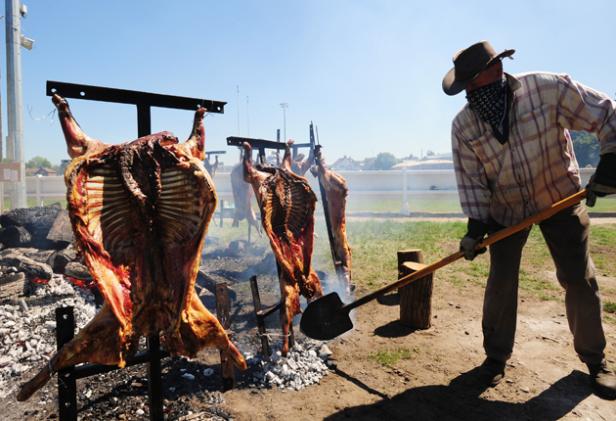
Tasty Argentine asado is being cooked the way it should be, not on the savage pampas, but on the playing fields of the Esher Rugby and Football Club in Hersham, Surrey. Ian Burrell of The Independent (with photos by Facundo Arrizabalga) report on the Anglo-Latin (and Latin-Anglo) communities:
“I remember the day when a friend’s father in the North of England told me I was the first Mexican he ‘had ever seen not riding a horse’ – meaning in John Wayne films and The High Chaparral,” says Libertad West, a Mexican-born recruitment specialist who arrived in Britain 20 years ago. “The perception of Mexico and Latin America was very different to today’s sophisticated knowledge of the younger generation as a result of free movement across continents. People are very familiar with Frida Kahlo and Diego Rivera. When the British Museum organised an event to celebrate Mexico’s the Day of the Dead last year, it had to shut the entrance gates for the fifth time ever in its history.”
Oh well, one expects some cultural distortions from primitive people… one might forgive their incomprehensible need to drag the ghost of Frida Kahlo into any discussion of Mexican (and Latin American) culture, if — with proper tutelage — the British can be civilized enough to learn at least how to prepare a decent meal.
Do as we say, not as we do: part 3
Matt Yglesis, whom I’ve presented before as “Exhibit A” of ingrained U.S. imperialism, even from (or especially from) the “progressives”. His latest attempts to paint a smiley face on good old fashioned paternalism comes from the view of a person in a country with an over-dependence on resources, trying to solve our “problem” with having those resources.
Chana Joffe-Walt has a worthwhile podcast about one solution for countries facing the resource curse: “Take all money that comes in from foreign companies — for lithium in Afghanistan, oil in Nigeria, natural gas in Bolivia — and give it to the citizens. Literally have a government official sit down with piles of cash, maybe with some international oversight, and divvy it up.”
…
… you can’t [create a giant slush fund] in high-corruption countries. So maybe this whole post is pointless. Or maybe this is a service the World Bank could provide—insured deposits at some modest rate of return for resource rich poor countries.
What counts as a “high-corruption country”? One like the United States that can’t control money laundering, and where extractive industries buy politicians … legally? And where extractive industry royalties have always been a political football (think of the Texas Land Commissioner scandals over the last 100 years)? And where even the concept of making an extractive industry put up an escrow to pay for environmental damage is somehow a controversial issue?
And… why — corrupt or not — would a nation trust a foreign banking organization to “invest” it’s own money in “insured deposits”: which means the money is invested in financial instruments (like mortgages and developments) in the rich countries, not in their own nation?
And, why are profits considered a “slush fund” when a nation administers them, but somehow honorable when managed by the World Bank or, as in the United States, by such upstanding organizations as British Petroleum?
Do as we say, not as we do: part 2
Some new currency restrictions on exchanging U.S. dollars had the “expat community” it a tizzy over the last few weeks. I can’t see that anyone is actually exchanging 4,000 US dollars in greenbacks for pesos a month (the restrictions don’t affect wire transfers or ATM card withdrawals) and I’m hard-pressed to imagine a scenario in which a large amount of foreign currency would change hands in any legitimate business deal. Usually people pay by check, or at least in the currency of the country. Maybe someone recently entering the country and buying a late model used car from someone leaving the country… but that’s about it.

Fisgon: Lavado de dinero
While I don’t see these currency restrictions as a big deal (and am amused by the expats who have nothing better to do that carp that everything the Mexican government does is meant to make their lives harder) what makes those restrictions onerous isn’t the perceived affect on rentistas, but what it says about U.S. and Mexican foreign policy. Friday’s El Universal (06-18-2010) commented on the release of a study, “The Globalization of Crime: A Transnational Organized Crime Threat Assessment” (a pdf I’m having trouble loading) that led to comments both by Ganchoblog and by the Woodrow Wilson Center’s Mexico Portal:
The Wilson Center zeros in on the “money laundering”:
The majority of global drug-profits remain in the U.S., Canada and Europe, which in the case of cociane, represents 70% of the 72 billion dollars worth of product trafficked each year, according to yesterday’s statement from the United Nations Office on Drugs and Crime.
While “dirty money” may be a problem, I’ve said before the real problem is that it isn’t getting back to the workers and producers. You see some honking big pickup trucks (and the occasional armored Humvee) out in rural Sinaloa, but those are work trucks of a sort… the farmers and workers are as poor as ever, and certainly aren’t making out like… er… bandits. Gancho focuses on the chronic complaint of Mexico that the United States does nothing to control the illicit gun trade, while expecting Mexico to control the narcotics trade:
For decades Europe and the US have signaled corruption in developing countries as the principal cause of transnational crime, which exonerates them of guilt.
In the case of Mexico and its combat of drug traffic this unequal relationship is clearer. The northern neighbor refuses to control the free sale of assault weapons that wind up in the hands of the cartels, it doesn’t stop the activity of the cartels in their border towns, and it has done almost nothing to reduce the consumption of drugs by its citizens. Why should we then do the dirty work of the US?
Why indeed?
Do as we say, not as we do: part 1
This is interesting. The State of New Jersey recently legalized marijuana as medication. Rather than buy marijuana on the open market, however, the state is going to grow it’s own. I’m sure the fine agronomists at Rutgers University will be able to grow marijuana, but it’s not exactly what one would call a traditional crop. To make it more interesting, the #1 pusher (sorry, couldn’t resist) of this proposal is the state’s governor, Chris Christie. Of Christie (a conservative Republican), Susie Madrick (Crooks and Liars) writes:
I thought Republicans were for the small businessmen and against more government regulation? (Not to mention that most business experts recommend concentrating on “core competencies.” Think growing marijuana is Rutgers’ area of expertise?)
And, while Republicans (and Democrats) have been loathe to admit they support crop subsidies, they usually try to do it indirectly. And, of course, state enterprises smack of…. horror of horrors.. socialism.
If I read this correctly, it means the taxpayers of the State of New Jersey will on the one hand, be subsidizing a crop grown by a state enterprise while on the other hand, through their federal taxes, subsidizing the Calderón Administration’s attempts to destroy the marijuana growing business.
It would be cheaper, and more sensible, to buy Sinaloan. We can provide the State of New Jersey all it want. And have much more expertise in that particular agricultural niche product.
Come to think of it, the only crops we in Sinaloa and New Jersey probably compete in is the planting dead gangsters.
Carlos Monsiváis

4 de mayo de 1938 – 19 de junio de 2010. D.E.P.
Don’t do the crime, if you can’t…
… at least look somewhat menacing in your perp-photo:

The dastardly duo stiffed a bartender in Aguascalientes. But keep it under your hat. (Crisol Plural, Aguascalientes)
Dutch treat: Friday Night Video
Do you have to have a Mexican name to appreciate Conjunto? After all, as the name suggests, it’s a musical melange of the Texas borderlands… where the Tejanos hung with the Cajuns and worked for the Czechs and Germans — having to use English (of a sort) as a common language, and somehow figure out how to get everybody to boogie. It worked for them pretty well… and works for the TexMexplosion — Dwayne Verheyden, Lynyrd van Riet, Geert Verheijden, and Wout van Koot … the Netherland’s best Conjunto banda, bar none:


 mexfiles.net