Not to rub it in or anything…
At the not-so-O.K. Corral
Pass the popcorn… this is gonna be fun.
From the East Valley Tribune (Mesa, Arizona):
Gov. Jan Brewer lashed out at the president and his administration Thursday, saying they effectively announced — in Ecuador — that the federal government will sue Arizona over the state’s new immigration law.
 “That is just totally outrageous,” the governor said after being told of a televised interview Secretary of State Hillary Clinton did while traveling. She said there is no reason Arizonans should have to learn through a blog post of an interview she did with NTN-24.
…
Five lawsuits already have been filed in federal court contending various provisions of the law are unconstitutional. Challengers want a federal judge to block the measure from taking effect as scheduled on July 29 while the bill’s legality is litigated.
“That’s not how you do business,” Brewer said of Clinton’s statement. “That’s not how you treat other elected officials.”
Ms. Clinton, as Secretary of State has to deal with foreign affairs, and the Arizona law is negatively impacting international relations (not to mention probably breaking a number of international treaties) which probably gives the State Department standing in a lawsuit. However, Mrs. Clinton is not an “other elected official” … cabinet officers being appointed by the President (after approval by the Senate). For that matter, Mrs. Brewer was not elected to her post either. She was State Secretary of State (which has nothing to do with international affairs, but is the chief elections officer of Arizona) and appointed to complete the elected governor’s term when that governor (Janet Napolitano) was appointed (with the approval of the Senate) as Secretary of Homeland Security.
Besides, whose fault is it if Mrs. Brewer doesn’t read the blogs from Ecuador, huh? She might be wise to read ones from Mexico, too.
A rare sight
Lesley Téllez (The Mija Chronicles) was out with her camera on the streets of Mexico City after THE game. Whether this contingent was part of the force sent to clear the estimated 30,000 revelers out from around the Angel of Independence last night I can’t say, but when Ms. Téllez took the photo, it was a rare sighting indeed… granaderos (a Mexican term meaning “Imperial Storm Troopers”) ALMOST smiling.

Show us the money
Two possibly related stories. First, from EFE, via Latin American Herald-Tribune (Caracas):
MEXICO CITY – The Mexican government has launched a plan to monitor the oil spill in the Gulf of Mexico and plans to ask BP to contribute an initial sum of $20 million, Environment Secretary Juan Rafael Elvira Quesada told Efe on Wednesday.
The funds will be used to equip 26 centers for environmental studies and train personnel for the plan, which was launched at the start of the week, he said.
In addition to Elvira’s department, the Profepa environmental enforcement agency and several other entities will take part in the initiative.
The funds to be requested of BP will enable initial monitoring “before there is an impact on Mexican waters,” he said, adding that “we are also considering having samples of the type of oil washing up on the Louisiana coasts” for purposes of comparison.
The money will help Mexico gauge the impact of the spill over a span of one to five years through “permanent (surface and underwater) sampling.”
“This doesn’t mean that (that amount will suffice) to cover the damage to biodiversity. It’s just the additional amount of resources we hadn’t set aside in the budget for transporting biologists, personnel, cameras, equipment, vehicles,” training staff and launching scientific activity, Elvira said.
“Mexico’s not going to sit there with its arms crossed, waiting to see if the oil arrives or doesn’t,” he said.
Secondly, from Associated Press, via Mexico City News:
WASHINGTON, D.C. – The State Department has requested an extension of a plan that promised $1.1 billion to help fight drug cartel violence in Mexico, which is undergoing one of the bloodiest months in recent history.
In a report submitted to Congress this week, department officials asked that the Mérida Initiative be extended past 2012. The report calls for the strengthening of public institutions, support for local and state governments and a renewed effort to fight drug, weapon and money trafficking in the U.S., according to a copy of the document obtained Wednesday by The Associated Press.
The report says that the U.S currently spends more than $420 million on financing equipment, training programs and providing technical assistance.
It also says that of the $628 million destined to buy equipment, almost $113 million was delivered between 2009 and 2010. There is $190 million left to deliver in 2010 while $325 million will be delivered in 2011.
In both the B.P. Blob and the “drug war” we are talking about U.S.-centric disasters, which directly impact Mexico. In both, the U.S. government has been loathe to interfere with private commerce where it directly impacts their own interests. Nothing has been done, nor will be done, about gun running and as to money laundering, Mexico is expected to regulate its U.S. currencya — but without the U.S. doing a thing about it’s own bank secrecy laws or putting any controls foreign currency exchanges.
While the B.P. Blob is directly, and immediately, impacting the United States, and the U.S. is right to demand that B.P. put up a sizable escrow account (20 billion [thousand million] U.S. dollars) to cover claims and immediate damage relief, the most Mexico can muster is a “plan to ask” for a modest amount of monies, earmarked for “studies”, and merely proposed by a minor cabinet official.
The “violence seeping across the border” of the narcotics trade — like the oil hitting the Tamaulipas and Veracruz coasts as well as those in the states of the northern country — is, perhaps, the result of bad political decisions that have led to dependence on destructive economic activities. It’s common in the U.S. to hear talk of “oil addiction” and — in a real sense — with both the U.S. using a quarter of both the world’s narcotics and oil, such a comparison makes sense.
But the narcotics industry, which involves relatively poor people like farmers and small time dealers, and a couple of rich guys, has money thrust at at by the United States, and is expected to put up with murder and mayhem and damage to its tourism industry and disruption of agriculture and transportation and banking. And when it seizes some assets from the supposed criminals, the U.S. expects a cut.
When B.P. — one of the largest single enterprises on the planet — damages tourism and fisheries and transportation and … just about everything… the nation that didn’t hesitate to take over oil fields in the past is now expected to beg the wrong-doer to “contribute” to a study of the problems they’ve unleashed. With U.S. permission, no doubt.
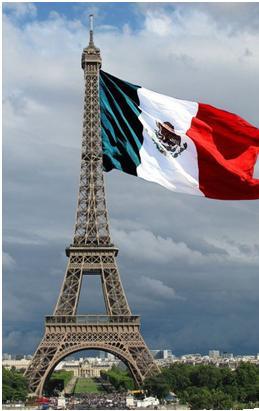
2-0! Over the French… por supuesto
Cartesian logic failed to take into account the Aztecs, who recognized that what happened before will happen again… and again… and again. Just with a different set of players under different conditions.
1838 — Veracruz: Antonio Lopez de Santa Ana and Mariano Arista
1863 — Puebla: Ignacio Zaragosa and Porfirio Diaz
2010 – Chicarito and Cuautemoc.

… retiemble en sus centros la tierra.
Al sonoro rugir del cañón vuvuzela.
Futbol v Football
For the fifty percent of Mex Files readers who are in the United States, a little explanation of how the other 96 percent of the planet thinks:
A secret plan to end the war?
Bloggings by Boz, which often reflects the thinking of one of the few groups that still think Felipe Calderón’s “war on drugs” is productive (i.e., the Obama Administration) posted yesterday on the “lengthy defense of his security strategy.
Boz is more attuned to security and strategy than I am, but the strategy seems to be a lot like Dick Nixon’s “secret plan” to end the war in Vietnam… escalate the violence and demand domestic opponents trust the President. Not that the Mexican opposition is any more likely to trust Calderón in 2010 than the U.S. opposition was willing to trust Tricky Dick in 1968.
Several commentators in Mexico (both Mexicans and foreign residents) have commented on the seeming lack of anything new or “strategic” in the latest statements on narcotics fighting. Rather than go with the nuanced, and somewhat apologetic attempts to spin the same-old, same-old as somehow significant, I’ll go with SDPNoticias.
It isn’t a publication that attempts to be fair and balanced (editorially, they support “legitimate president” Lopez Obradór over “ex-presidential candidate Felipe Calderón”), but nicely cuts the crap when it comes to discussing Calderón’s “strategy” (my translation):
Ex-presidential candidate Felipe Calderón, saying that organized criminal violence already existed when he came to power has only worsened because of the sale of weapons from the United States.
On national television and repeating the same speech he has been saying for years, Calderón insisted that the alleged war on drugs “is not just the president’s responsibility, but of all Mexicans”, although it was he, after all, who declared war in 2006 trying to justify the electoral fraud perpetrated Andrés Manuel Lopez Obrador.
After insisting that the country was already beset with violence when he came to power, Calderón listed the actions he has taken to supposedly combat organized crime, which obviously have not diminished violence, but to the contrary have increased violence.
He said he has a “long-term anti-crime strategy” and claims to have inflicted heavy blows to the cartels.
He also said that the cartels been killing each other, by which he sought to justify the number of violent deaths in the country.
In the end, while insisting that the war on drugs cost money and the lives of soldiers and sailors, he failed to mention that hundreds of innocent civilians have also lost their lives. Nonetheless, he will continue its war on drugs and which, he said, “worth it.”
When Nixon was president of the United States, his veracity and trust-worthiness was dubious even to many of his own supporters. While Mexicans are more likely to trust their presidents, even “de facto” presidents (as the Lopezobradoristas would say), there are limits. Excuses for increased violence and the lack of progress on other social issues in a single minded — and so far counter-productive — attempt to resolve this one problem, are costing the administration what credibility it has with the “silent majorty”: those who were never sold on either the Lopezobradorista or Calderonista vision, but who accepted the legitimacy of Calderón’s presidency, and who had hoped for at least some reform and progress in areas not related to this one issue. Or at least social stability.
While Calderón did run on a “law and order” platform (as did Richard Nixon in 1968), it wasn’t to the exclusion of all other social and political programs. While I thought the Lopez Obradór program was better economically and socially and have been critical of some of the proposals the Calderón administration advanced (such as the “reforms” at PEMEX and labor law changes), I praised others (the now-forgotten billion tree project, the overhaul of federal court procedures, changes in the tax code).
But whether I favor a proposal or not, they have all been shunted aside in favor of a single minded continuation of the same thing which is giving the same (negative) results. The only “strategy” seems to be to continue doing what doesn’t work. And isn’t wanted.

Send in the clowns
Sombrero tip to Tim’s El Salvador Blog.
El Salvador, even with a murder rate about four times that of Mexico, has its limits. When robbers, disguised as clowns murdered a bus passenger, Salvadorians became wary of street clowns. The clowns’ union is demanding the police find the killer clown clones.
That “Indian attack”
A government media tour to promote tourism in southwestern Mexico went awry when machete-wielding Indians briefly kidnapped 13 reporters on the trip, officials said Sunday. Fifteen people trying to film a beer commercial were also abducted.
Nobody was harmed during the abductions…
Gustavo Ruiz, A.P.
When a group of travel writers and their film crew were detained by Nahua residents of Santa María Ostula, Municipio de Aguila, Michoacán earlier this week, it appeared the whole thing was a mistake… the Nahuas eventually releasing the travel reporters after determining that they weren’t the people the community meant to detain… a team filming beer commercials on Nahua land without permission.
This sounds like the plot for a sit-com, but the touchiness of those Nahuas is understandable and there is a tense situation.
In June 2009, the Nahua commune of Santa María Ostula won a forty-year old lawsuit against private land-owners over use of a thousand hectare plot within the commune, whose economic base is agriculture. The day the court order was handed down, 200 armed men attacked the Nahua community. In February of this year, the regidor (municipal council representative) for the community was kidnapped; in May, there was another incursion by masked gunmen; and in April the commune’s administrative headquarters were attacked .
Of course, the foreign news reports start talking about things in Michoacán having little or nothing to do with this community (A.P mentioning that the state also includes the Monarch Butterfly preserve — which is sort of like mentioning something on Long Island, New York and mentioning Niagara Falls is in the same state), and including the obligatory references to narcotics growers… when the issue may be something much simpler.
 Look at where the land in question is… It includes extensive “undeveloped” beach-frontage (which may be the reason the communal residents were so adamant about Modelo not using their properties without permission) and control of that particular resource is something corporate interests (like Modelo) are more likely to want to control than some narcotics dealer (although I imagine narcos would be interested in investing some money into new projects of the right kind).
If I lived there, I’d be wary of passing tourism reporters, too.
U.S.A! U.S.A!
Filmed to coincide with the U.S.A.-England game, this commercial at first confused me, til I realized what it was all about. The United States, like its cars… and Team U.S.A. wouldn’t exist without their immigrants.
Here’s to the sons of immigrants — Carlos Bocanegra, Jonathan Bornstein,Jose Francisco Torres; Ricardo Clark and Stuart Holden — and the immigrants — Haitian Jozy Altidore; Mexican Hercules Gomez; ; Oguchi Onyewu and Maurice Edu (Nigerians), Robbie Findley(Trinidadian), Edson Buddle(Jamaican) and Benny Feilhaber(Brazilian) who fended off the onslaught of those those tea-partying red-coats once again!
Well, I suppose it’s legal
Sure, there’s been talk of using unmanned aerial drones to monitor the border, but Republican congressional candidate Tom Mullins has found himself in a bit of hot water over offering a proposal to put land mines on the United States – Mexico border.
As the Associated Press on Monday:
In the May 18 interview with KNMX radio in Las Vegas, N.M., Mullins says the U.S. could mine the border, install barbed wire and post signs directing would-be border jumpers to cross legally at designated checkpoints.
He explained Monday it was a suggestion he’d heard while campaigning.
There are two American nations that haven’t signed the “Convention on the Prohibition of the Use, Stockpiling, Production and Transfer of Anti-Personnel Mines and on their Destruction“… one is an an island that’s had a fend off a few amphibious landings and terrorist incursions from the other one, which I suppose COULD mine it’s border with either of two of the treaty’s signatories. Which might make cross-border rock tossing kind of exciting… too bad about the livestock, though:
Cleaning day?
A morbid thought… or two. Last weekend, 19 people were murdered in a drug rehab in Chihuahua, and yesterday, at least thirty convicts were massacred in the federal prison in Mazatlán. The targeted victims are said to be tied to the Zetas.
There have been a couple of drug rehab massacres before — like last weekend’s they were at “faith based” group facilities, and were said by authorities to be prompted by the tendency of drug dealers to “hide out” in these facilities, or to enter them, hoping to go straight. I wonder.
I’ve never having heard of any attacks on Narcotics Anonymous, or on the few state facilities for addictions, but don’t think it’s an attack on religion (the rehabs hit have all been connected with evangelical churches) but the connection is intriguing. Sill, with low level street dealers being popped off right and left, I wonder sometimes if the attacks are orchestrated not by the various gangster organizations, rather than by death squads taking advantage of the “drug wars” to eliminate what are seen by most people in this country as a social nuisance.
On the other hand, the alleged targets of these massacres, as in the prison massacre, are said to be connected to the Zetas. If you remember, this gang was supposed to be the super-gangster terrorist squad, half “A-team” and half Al-Qaida. The Zetas may never have been the bad-asses we thought, and are sitting ducks for the Sinaloa Cartel, or the Zetas have turned on their own in one of those interminable inter-gang feuds, or — somebody doesn’t want the Zetas left alive (a lot of them never make it to trial here in Sinaloa, especially those, who like our inept hitmen who tried to rob a construction site and got caught, don’t live more than a week or two while awaiting trial). I saw a local post suggesting the prisoners in the federal facility (which includes both non-violent and violent offenders without much in the way of segregation) were doing some “social cleansing”.
And, there’s another very scary possibility — not necessarily likely, but nothing I’d rule out:
A special operations task force under the command of the Pentagon is currently in place south of the border providing advice and training to the Mexican Army in gathering intelligence, infiltrating and, as needed, taking direct action against narco-trafficking organizations, claims a former CIA asset who has a long history in the covert operations theater.
… a former U.S. government official who has experience dealing with covert operations and who also asked not to be named, says the presence of special operations forces in Mexico “is really nothing new in terms of how we have dealt with Mexico in the past.”
“Black operations have been going on forever,” the official says. “The recent [mainstream] media reports about those operations under the Obama administration make it sound like it’s a big scoop, but it’s nothing new for those who understand how things really work.”
“How things really work” to a lot of people here means the government favors the Sinaloa Cartel in their way against the Zetas. Given the history of similar “black operations” in Colombia (read about the PePes some time), U.S. special operations groups have worked with foreign gangsters in Latin America to eliminate what the U.S. decided were worse gangsters — and turned out to be an even worse plague for their own countrymen.


 mexfiles.net