Richer than God?
Ciro Gómez Leyva is making his second appearance in the Mex Files this morning. David Agren, in a recent Catholic News Service piece on the Legionnaires of Christ, mentions the respected journalist in passing while writing on the fallout of the Legionnaires of Christ scandal. Gomez Leyva, then at Canal 40, was one of the first in the Mexican media to report on the financial misdeeds of Marcial Maciel Degollado and the Legionnaires. The upshot was, between pressure from the Zedillo administration, and pro-Legionnaire advertisers, Canal 40 lost about a half a million U.S. dollars in advertising revenue.
Agren followed up his CNS story on his own website, mentioning possible legal action against the Legionnaires for, among other things, “pedophilia, the corruption of minors, money laundering and organized crime.”
The money laundering and organized crime ties of the Legionnaires were the subject of an article by Alexandra Gutiérrez in last week’s Proceso (2005-05-23), which, coupled with the statements by Fauzi Hamdam, a law school rector close to the missing Diego Fernández de Cevallos that Jefe Diego was nabbed by a “very powerful group with extensive resources.” Seeing FeCal has denied that Jefe Diego was snatched by the narcos, and the theory that he was grabbed by the Army or one of the political parties doesn’t seem particularly plausible, one wonders if the Jefe’s ties to the discredited religious money laundering operation might be ripe for speculation.
First do no harm
Maggie’s Madness is covering the Anastacio Hernandez Rojas saga, and there is no way I can write on everything (nor do I want to), but the medical questions surrounding his death come at the same time medical questions are being raised about other immigration law procedures.
The American Academy of Family Physicians; Asian Health Services Community Health Center ; Association of Clinicians for the Underserved; National Physicians Alliance; Committee of Interns and Residents/SEIU Healthcare; Doctors for Global Health, Board of Directors; Physicians for Human Rights; and the United States Chapter of the International Society for the Psychological Treatments of the Schizophrenias and other Psychoses (ISPS-US) were co-signatories to a statement condemning Arizona’s “papers please” law, which will, in these groups’ opinion, interfere with their ability to practice medicine.
Dr. Valerie Arkoosh, President of the National Physicians Alliance, asks “Why would undocumented immigrants, or legal immigrants without their papers handy, go to the emergency room or a healthcare center that can be policed?”.
Being an accident victim, or injured in a serious crime, is a matter of legitimate police inquiry, and that “lawful contact” under which police officers, if they don’t want to be sued by private parties, would have to inquire about one’s immigration status if they had a reasonable suspicion that one might be not legally in the country.
Is life better with less criminals?
Via the Woodrow Wilson Center’s Mexico Institute:
Ciro Gómez Leyva, Milenio, 6/2/2010
The majority of the dead are criminals, President Calderon repeats again and again. And judging by the cold, hard facts, it is true. But? Do you have to keep killing them, Mr. President? Is life better with less criminals? How has the daily life of 110 million Mexicans improved from the butchering of 21,915 in these three and a half years?…
The perception of the people, in survey after survey, has been moving from caution to disappointment, from disappointment to hopelessness.
But President Calderon keeps repeating that they had to continue killing. That Mexicans could not continue to live at the mercy of the criminals. (original editorial here)
Questioned about “non-combatant” deaths in the so-called “drug war”, Felipe Calderón used the unfortunate phrase “collateral damage.” While this might be of some comfort to people in the United States when talking about civilian deaths of people alien to themselves (like Iraqi farmers or Afghan wedding guests), this kind of bloodless bureaucratic bullshit does not go over well with people talking about their own countrymen, let alone their friends, relatives and neighbors.
As Gómez Leyva writes, the slaughter is nothing like what one would expect in a “war” with relatively matched forces. There are 18 deaths on the “druggie” side to every one on the government side. Of course, on the “druggie” side, you have inter-mural slaughters, with their own “collateral damage”, but there is no proof that all those killed by the government were serious criminals. And, not having a death penalty in this country*, the “collateral damage” numbers are much closer to the estimated 22,000 “drug war casualties” during the Calderón Administration than we like to think.
* Although in practice, Mexico hadn’t had a state execution since 1961, the few remaining laws on the books permitting executions (mostly under the military code) were done away with in 2005.
Ode to Joy???
Meant to honor the 100th anniversary of the 9th symphony, Theodor von Gosen’s Mexico City Beethoven monument, according to the Beethoven Haus (Bonn, Germany), is allegorical:
“A winged Genius is placed on a high pedestal. A figure – the suffering human soul – kneels in front of him and pleads for redemption. Beethoven’s mask, which is attached to the pedestal, clearly suggests the message that redemption can be found in his music.”
I guess it’s best approached from the Bellas Artes side. Coming through Parque Alameda, after passing by the hookers, one might be tempted interpret the allegory slightly differently.
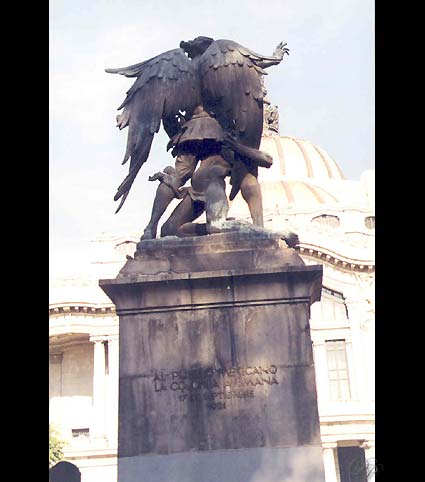
lvbeethoven.com
Am I being detained, Agent Soto?
I don’t recommend doing what checkpointUSA does without a lawyer and a video-camera in your car (and a car), but I wonder what is going to happen when local police (in places, like, oh… Carefree, Arizona) decide to check out “suspicious” pedestrians.
Sombrero tip to Bender’s Immigration Bulletin.
Update on San Diego Beating/Tasing…
From Maggie’s Madness:
Just a few moments ago, Frontera announced that Anastasio Hernandez Rojas died due to complications as a result of the beating he received from US Border Patrol Agents Friday night.
…Anastasio had lived in the United States although not legally, for twenty six years and was the father of five children. He had been deported following a traffic violation which occurred a week ago.
… homicide detectives from San Diego Police are investigating the beating and the Mexican Consulate has issued a statement condemning the beating. … people in Tijuana and the northern areas are angry.
As I predicted, I did get a comment trying to justify the action by the Border Patrol. And we know why the late Mr. Hernandez was so distraught about his deportation. He had a family to support.
Condolences to the family, of course, but one hopes for justice.
¡No tasermé, cuate!
SAN YSIDRO — A 32-year-old Mexican man was in critical condition Saturday and not expected to live after an altercation with federal border officers at the San Ysidro Port of Entry Friday.
The man was in the process of being deported, San Diego police said Saturday.
Homicide detectives are investigating the incident involving U.S. Border Patrol and U.S. Customs and Border Patrol agents. Police said the man stopped breathing after a CBP officer used a Taser to subdue him.
(Lionel Sanchez, San Diego Union-Tribune)
Maggie Drake (“Maggie’s Madness”) picked up on this Saturday, quoting Mexican newspapers which had more details than the Sunday article in the San Diego paper. From what Maggie found in El Mexicano and AFN-Tijuana, it appears that 35-year old Anastasio Hernández Rojas was in the process of being deported and was severely beaten before being tasered. And the “critical condition” mentioned in the San Diego paper is “brain death”… which is pretty damned critical.
The Union-Tribune report mentions an “unnamed witness”, but the Mexican reports suggest that there are several witnesses, and possibly a video of this incident, which means … of course… the Mexican consulate is going to insist be investigated, and the Border Patrol is going to try to minimize and… I’ll be getting comments from the people who bring up illegal attacks on Guatemalan migrants in Mexico as if it’s relevant to a death in legal custody for a regulatory offense in the United States.
Watch your language!
Joanna van der Gracht de Rosado (her website is here), writes in Yucatan Living on the basic courtesies (and lack thereof) of life in her corner of Latin America. Had I published this, I might — respectfully — have suggested the following editorial change :
For traditional Yucatecans Latin Americans, it is so important to not publicly offend, criticize, or be scornful of another person’s choices or lifestyle.
I was at a party once and there was a group of foreign men loudly discussing the merits of the local supermarket…
“Why don’t ‘they’ have a properly equipped hardware section?” one fellow asked the others.
“I know what you mean, I was looking for 1¼ inch screws the other day, and do you think I could find them?” answered his buddy.
They continued to criticize the way the store was stocked, how poorly it was run, and then went on to complain how “hardly anyone speaks English”. My Yucatecan husband was not amused, and when we got into the car, he exploded,
“Who do those guys think they are? To start with most people who shop at that store don’t ever have need for 1¼ inch screws; they have workmen who buy them… at a hardware store! Secondly, we are on the metric system here, and thirdly, we speak Spanish in “this” country!”
Please be so kind as to read the entire article, and take it to heart before you … er… screw up in your daily interactions anywhere south of I-10.
A modest suggestion for Señor Obama…
As desperate efforts continue to stop the oil spewing from beneath the ocean floor into the Gulf of Mexico, 17 countries have offered to help in some way or another, but for now BP and officials coordinating the clean-up effort have accepted assistance from only two of those countries, Mexico and Norway.
… Though the State Department receives the offers, it is BP and the Unified Area Command, led by the Coast Guard, that are the entities that decide which offers to accept. So far, the UAC has accepted skimmers and booms offered by Mexico and Norway.
Sure, Mexico is glad to help out, and it is the Gulf of… that’s under attack by the criminal negligence of B.P. and Halliburton and Transocean (who under their old name, Sedco, blew out the blow-out preventers that were the culprit in the 1979 Istoc I disaster — up to now the second worst oil spill of all times).
It’s rather generous of PEMEX, considering the only reason B.P. is drilling in U.S. waters is that they were trying to get into the new field before PEMEX (which is drilling slowly and SAFELY with the assistance of the Norwegian state oil company, Statoil, which has experience in deepwater drilling — and why the Norwegians are already in the neighborhood) started pumping.
But, there’s something else Mexico can offer the United States, and something that might be of long-term mitigation. Given that B.P. did so badly screw up, and is dragging their feet, and is — in the words of U.S.C. 33, Chapter 26, Subchapter III, § 1321 (Oil and hazardous substance liability), creating:
… a discharge, of oil or a hazardous substance from a vessel, offshore facility, or onshore facility is of such a size or character as to be a substantial threat to the public health or welfare of the United States (including but not limited to fish, shellfish, wildlife, other natural resources, and the public and private beaches and shorelines of the United States), the President…
… may, without regard to any other provision of law governing contracting procedures or employment of personnel by the Federal Government—
A good model for Presidents who have to deal with oil companies that drag their feet in adhering to the law — although Aguila Oil’s foot-dragging was over labor laws — was set by Lazaro Cardenas back in 1938:
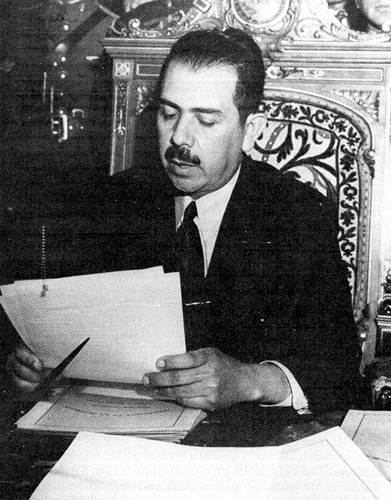
No matter what he does, the right wingers call Obama a “socialist” anyway. I don’t say he needs to just take over ALL the oil companies, but — whatever means are necessary — could mean just taking everything B.P. has in the United States to “prevent the substantial threat of a discharge” and a warning to the others.
They love him, yeah, yeah, yeah…
The Beatles, who never appeared in Mexico, had a tremendous influence on literature and culture (one Mexican radio station played nothing but the Beatles, twenty-four hours a day, three hundred sixty-five days a year for over twenty years)…
Gods, Gachupines and Gringos, page 387
The TV news coverage of Paul McCartney’s arrival in Mexico City was deja-vu all over again — the big cars moving through mobs of ecstatic female fans looked straight out of the sixties… until you realize that Paul, and the screaming fans are IN their sixties, too. Most of them.
McCartney’s appearance lat night at Foro Sol in Mexico City was attended by what La Jornada called “los 55 mil religiosos de su música congregados“. Ticket prices ranging from the several hundred to several thousand pesos — Paul, you’re a rich man, but maybe most Chilangos are not rich men, too — those commies who run Mexico City (heirs to the student movement of the 60s, who all were subverted by listening to the Beatles) have some piety.
The Federal District set up a free giant screen transmission at the Altar a la Patria — an alter being the appropriate venue for one of those guys said to be more popular than Jesus Christ (though running a poor second in Mexico to the Virgin of Guadalupe).

Carlos Cisneros, La Jornada
In my time in Mexico, I have only seen one Elvis impersonator (on the #2 Ruta headed for UNAM, singing a perfect version of Heartbreak Hotel — and not knowing a word of English) , a couple of Doors cover bands (scary, that one of them was at a senior citizens’ dance) and protests outside Chapultepec Castle when Elton John did a concert for Marta Sahagún’s Vamos Mexico phony charity , but Beatles impersonators and tribute bands still fill Mexico City theaters every weekend.
Here’s El Morsa (The Walrus):
Failure to communicate
Steve Benson, Arizona Republic:

¡Tierra y Liberdad!… y cerveza?
 “What good is a revolution, if you can’t have beer?” as Rosa Luxemburg never said. Cervecería Revolución — a “100% national brewery” — is already marketing Zapata Beer, and plans to introduce Pancho Villa beer later this year.

I don’t think it’s going to be “alcohol-free”, though Villa himself was. His first official act whenever he took over a territory was closing the breweries, smash up the distilleries and close the cantinas. And had more than one officer shot for drinking.
This would be like introducing Cary Nation Whiskey in the United States. Ah well, even though Mexicans know their history well, it’s not the first time Pancho Villa has been used to advertise… well… just about anything. He liked food… and women… not beer.


 mexfiles.net