It’s beginning to look like Christmas…
The Christmas tree, like Santa Claus and … well, gifts at Christmas instead of Tres Reyes… has been taking over the traditional festivities — or integrating with them — for years now. Although, being Mexico, where one can’t decorate enough, there’s a place for the world’s biggest Christmas tree… 110.35 meters high, 1.2 million lightbulbs and 80 kilometers of cable… right in the middle of the Reforma at Rio Oslo in Mexico City.
For myself… I’m trying to maintain SOME semblance of Mexicanismo — I figure, like most Mexican workers, Christmas actually runs from Virgin of Guadalupe Day (tomorrow) through Tres Reyes (6 January) and the point is to do as little work as humanly possible. So, my Christmas Tree is a Guadalupe-Reyes Tree — a mere 1.60 meters, with only 100 lightbulbs and about 2 meters of cable goes up tomorrow.
I was really amazed, and ooohhhed and aaaahed along with everyone else when I saw the Reforma tree earlier this week. My pictures aren’t nearly as impressive as Gary Denness’ video from last Saturday’s lighting ceremony.
And the OTHER gangsters…
This has been mostly a lefty blog kinda story for a long time, but with a state visit by the Governor-General of Canada (basically, their version of our colonial era Viceroy, though in Canada’s case, the Viceroy is a French-Canadian woman) the issue of exploitation of indiginous communities by Canadian mining firms has seeped into the “mainstream press” (at least in Canada), including this from the Globe and Mail:
Three men with links to a Canadian mining company have been charged in the killing of a Mexican activist, threatening already strained relations between the countries on the eve of a visit to the same region by Governor-General Michaëlle Jean.
A spokesman for Calgary-based Blackfire Exploration Ltd. confirmed that an employee, a former employee and a one-time company contractor were arrested in the Nov. 27 murder of Mariano Abarca Robledo, who had led local opposition against Blackfire’s barite mine in Chicomuselo, Chiapas.
Ms. Jean is preparing to travel to Chiapas Tuesday for a dinner with the state’s governor. Tensions are already high between the two countries over visa restrictions placed on Mexican visitors by the Canadian government in July.
The arrests come at a critical time for Canada’s relations with a key trading partner, as well as the reputation of Canada’s mining industry abroad…
Uh… killing local people and destroying the environment IS what the Canadian mining industry is mostly known for “abroad” (and in parts of Canada, too).
Are you surprised?
The Mexican army is responsible for a long list of disappearances and murders, along with the torture of 25 Tijuana police officers accused of corruption, according to a new report by London-based human rights group Amnesty International.
“The report, which meshes with earlier examinations by Human Rights Watch and Mexican human rights groups, accuses soldiers of torturing 25 police officers in Tijuana in March to coerce them to confess to links to organized crime,” The New York Times reported. “It says a man arrested by soldiers in October 2008 in Ciudad Juárez was found dead of a cerebral hemorrhage. It says two brothers from Ciudad Juárez were led away from soldiers the next month and never seen again.”
The Secretaria de Gobernacion issued a statement, acknowledging the AI report (the Tijuana tortures are only a small part of it, but given my U.S. source, are the most likely to lead a news report, being a border community), but saying that the excesses were “temporary” and motivated by civil authorities”… in other words, we didn’t do it and promise never to do it again.
The security of the people is a necessary condition for development and effective protection of human rights. With the objective of recuperating peace and tranquility for all our people, the Executive decided to resort to the legitimate use of force, to rescue public spaces which have been taken by delinquents,” the statement said.
In other words, we’re destroying human rights to save them.
Coming to our census
I’m still on the road, sans laptop, so have to fall back on gathering the news the old fashioned way (dead tree versions, TV and gossiping with taxi drivers).
Three or four themes seem to be dominating the national news, but — for right now — no links or translations — til I can sit down and go through the internet for a couple of hours at a time.
In the on-going “drug war”, Universal (I caught the story in last Sunday’s Guadalajara Informador) is looking more like smoke than fire. National police recruits are complaining (and Universal has been looking into allegations) that the new national police, with their snazzy uniforms, new and improved hardware and decent salaries are a hollow force. Specifically, the recuits are claiming the new uniforms and weapons are only trotted out for public relations events, while they’re still using the older, and obsolete equipment. Worse, the recruits are claiming they aren’t receiving the salaries they were promised — which would allow police officers to support a family on just that one job, but have to take outside employment to make ends meet.
Low salaries are probably the greatest factor in so-called “police corruption” … the honest coppers have to take outside jobs as taxi drivers or laborers or delivery men or security guards to make ends meet… or work for narcos, who pay regularly.
The El Universal investigation relied on anonomous informants, who claim that superiors are cheating them, or forcing them to work overtime for no pay, or on outside work… and — if there are complaints, demoting the officer or filing an “administrative report” which will prevent the officer from taking the higher paying “operative” work (the officers are supposed to get a bonus for taking part in arrests, etc.)
Related to this are the headlines this morning (at least in the Mexico City dailies) — that I haven’t had time to look at in any depth — that the focus on the police and military budget is negatively affecting educational spending. Which isn’t really news.
The “slavery story” was the scandal of the week…. in Mexico City, several police officials were padding their own salaries with a rather nice scam of shipping mostly indigenous men, mostly working as porters in the Merced, off to a local “drug and alchohol rehab” that was forcing the guys to work for no pay and for really, really crappy food (one man described “black chicken soup with rotten carrots”) … and shaking down their families for the cost of their so-called “rehabilitation”.
Most of these guys were not drug addicts, nor alcholics, and the phrase “social cleansing” has been floated in regard to this story. There are more details — including allegations that the slaves were also forced to have sex with some very creepy (and, by all accounts, ugly) guy at the “rehab”… which was raided, and the slaves (who were making Christmas baskets for department stores!!!) rescued. Several returned to their families, a few have been put up at Federal District expense in hotels or shelters, and a few simply decided to leave under their own footpower after the raid. Televisa is, of course, trying to hang this on the Federal District’s left-leaning government, the left trying to pin it on Calderon’s rightist federal administration.
How many people are working in involuntary servitude, or underpaid, or in other less than adequate situations may remain a mystery. The Federal Government — having tried a few different ways to cheese-pare the budget without success (the plan to eliminate three cabinet posts is effectively dead), has decided they’ll drop fifteen questions from next years Federal Census. Lefties are suggesting that the rationale is not saving money, but access to information. If the feds don’t ask, they don’t have to tell the true sitution of the Mexican people, and can continue policies based on assumptions long outdated.
More later.
Judith who?
Judith Miller, who — once upon a time — was a journalist, has called upon her extensive background in covering Middle Eastern affairs (she still claims “I was fucking right” to publicize false claims that Iraq had “weapons of mass destruction” — giving creedence to the Bush Administration’s war against Iraq, and against the world economy) to write about Mexico. As with her writing about Iraq, she’s not about to let facts get in the way of a good story, as Ganchoblog notes:
Ms. Miller won a Pulitzer Prize at one time, but it wasn’t for fiction. But, when it comes to Mexico, it seems foreign reporters (especially those that aren’t anywhere near the country) take their facts not from any knowledge of the country just south of their own, but from parts of the world having nothing much to do with the region.
Miller’s supposed expertise is middle eastern politics. She is not the first middle east correspondent to try to make analogies between Mexico’s “drug war” and the U.S. interventions in central Asia. The A.P.s Mark Stevenson — who I admit has improved after a couple of years in Mexico — came here from a career as a war correspondent in the middle east, but had some Latin American experience, cheerleading for the conservatives and reaçctionaries in Haiti and Guatemala. His early reporting in Mexico suffered from a sense that he was writing about a desert war in a far away country, not a anti-crime (and possibly anti-dissident) police operation next door to the United States. Not to say there aren’t some very good reporters for the foreign press. Just not many from the so-called “mainstream press.” And not from disgraced Times reporters getting a stipend from some right-wing “think tank”.
Just because… it’s Friday
Nobody knows my name?

I’ve been haunted by this photo, and am honesty not sure where I found it… or who the lad is. If he is alive, he’d be pushing 100 today, and the photographer is also a mystery to me. 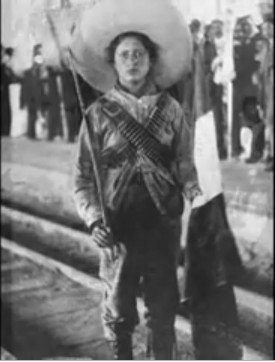
I’m guessing the photo was taken in northern Mexico by one of the several Texas based photographers who worked in El Paso during the Revolution, and made a comfortable living from postcards and photos of the “troubles south of the border.”
Jimmy Hare and Felix Sommerfeld were both pioneering wire service photographers (Hare had combat photography experience, having followed the United States Army into Cuba in 1898 for Colliers‘, who also paid him the then princely sum of $200 a month to stroll across the bridge from El Paso into Juarez for his photos. Of course, Hare insisted on combat pay). Sommerfeld — working for Associated Press — was less well paid, but did a nice sideline selling intelligence on U.S. military operations to both the Maderos and the Kaiser.
Homer Scott — who moved to El Paso for his health — had the lens blown out of his camera while photographing one battle, and wasn’t above shouting orders to whatever unit he was trying to capture on film… hoping for more interesting action shots.
Otis Aultman, who ended up in El Paso to live out his childhood dream of being a cowboy (and figured news photographer was about the same thing) was “the only photographer Pancho Villa trusted”. However, when Villa started to realize how much his photograph was worth in the news market, he began insisting on being photographed by Mexican lensmen — returning at least a small sum to the Mexican economy.
Walter Horne was the guy who really made a killing out of the killing. A pool hustler by trade, Horne realized that the bizarre Victorian attitudes about memento mori hadn’t — uh — completed died out. And, to most people at the time, El Paso and the Mexican frontier was still the “wild west.” Horne´s series of firing squad executions were quite popular souvenirs, and — for a price — he’d pose soldiers from Fort Bliss with a couple dead Mexicans and print up postcards to send back to moms and pops.
None of these gentlemen will be making money off this photo, if we use it, as intended, as cover art for Ray Acosta’s Revolutionary Days: A Chronology of the Mexican Revolution (coming Spring 2010)… but I’d expect those talented scoundrels would still want their cut and I’d be happy to give them credit anyway.
On the road until at least 8 December
I’m not taking a laptop with me to Guadalajara and Mexico City, so posting will be light to non-existent.
Honduras — OPPOS WIN… sorta
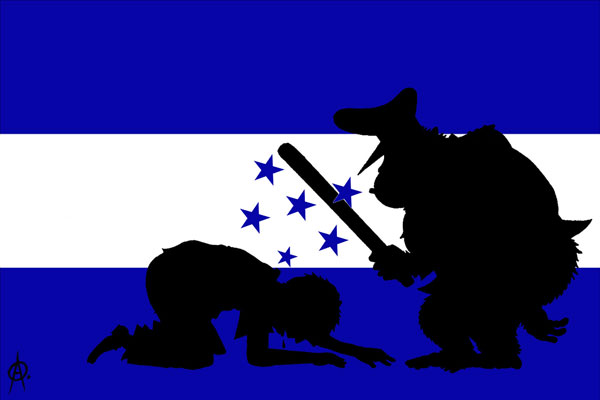 To no-one’s surprise, National Party candidate Porfirio Lobo — who was a real candidate for a real party (the more conservative of the two main conservative parties in Honduras) back when the real government scheduled the real elections — won the not-so-real election.
Bloomberg’s Eric Sabo and Helen Murphy claim it was a peaceful election, but Julie Webb-Pullman (via Scoop, New Zealand) begs to differ:
Contrary to coup-sponsored electoral observer reports of a peaceful election, the days leading up to, and of, the ‘electoral farce’ were characterised by repression and violence in many places, particularly resistance strongholds such as San Pedro Sula where resistance members were beaten, injured, and detained, and one is reported to be disappeared. Among the injured is a Reuters reporter, and two religious workers from the Latin American Council of Churches working as human rights observers were detained.
There have also been reports of rapes, beatings and detentions from other districts, which human rights groups will be following up in the days to come.
“They have put civilian clowns in office to put a clean face on the military coup,” commented Bertha Oliva, Director of the Centre for Families of the Disappeared and Detained of Honduras (COFADEH).
Despite protestations to the contrary by the international corporate media, there is a wealth of photographic and first hand accounts from the polls – including documents shown to international observers by polling booth staff – that the turnout was considerably less than 50%, and in the northern part of the country, less than 20%.
My guide to “inside the beltway” thinking, Boz (Bloggingsbyboz.blogspot.com) was looking for buyers for an improbable set of numbers. Ignoring the fact that Hondurans already distrust the political system (and the bizarre constitution forced on the country in 1982 (and re-interpreted by Congress regularly since), Boz assumes that turnout will be extremely low to begin with.
Out of an estimated 4.6 million eligible voters, Boz, based on unprovable calculations comes up with 2.5 million voters… then 2.25 probable voters, and THEN… suggests that there has to be less than 1.5 votes cast (including, one presumes, “null votes”) to invalidate the election. That smells of desperation… either on Boz’s part (who may be an establishment type, but isn’t known for being either dishonest or stupid… just trapped within the Beltway mindset) or on the part of those who need somehow to create a rationale for claiming this phony election somehow reflects the will of… a couple of Hondurans.
I don’t know if the abstention rate will hold up, and how many “null votes” there are, so we’ll see… Boz’s ridiculously high “fail bar” might just be reached, in spite of the best number crunching I’ve seen since my (extremely — a matter of days) short stint with Enron.
Less than zero
While the Obama Administration north of the border has probably done more in one year to decelerate the domestic disasters in the United States that resulted from policies implemented by the Reagan Administration and accelerated under Bush I, Clinton and Bush II, he can no more “start at ground zero” with the United States domestic and foreign policy than he can by claiming an illegitimate election in Honduras will reset some clock in that unhappy country.
Laura Carlsen, writing 26 November:
The security forces charged with overseeing the electoral process are the same ones who broke the constitutional chain of command by kidnapping and exiling the president on June 28. they are also the same ones accused of multiple assassinations of demonstrators and resistance leaders, arbitrary detentions, torture and beatings.
Tyler Shipley, writing from Tegacigalpa for Toronto Media Cooperative, filed this report about an hour before my post:
…A cocktail party was held this evening [presumably Friday or Saturday night] at the Mayan Hotel for the representatives of NDI and IRI (elections-observation organizations linked to the Democratic and Republican parties in the US, respectively) and other observers cobbled together from the far-reaches of the Latin American Right (including Armando Calderon Sol, former president of El Salvador.) As they toasted to the great strides that Honduras was making towards a stronger democratic republic, they were entertained by 14- and 15-year old Mayan girls, dancing in sexualized traditional dresses, much to the delight of the overwhelmingly male ‘champions of democracy.’
I suppose it is possible that the American elections observers believe that this farce is a legitimate election. If the individual I spoke to two days ago was any indication, they clearly have very little knowledge of Honduran history; normally, at this point in an election campaign, there truly would be a ‘fiesta.’ Supporters of the two primary parties would be waving red or blue flags, encouraging people to support their candidate, and arguing in taxis over who was best suited to run the country. This year, the flag vendors walking from car-to-car are ignored. This afternoon, Pepe Lobo, the election frontrunner, held a rally in the Colonia Kennedy and paid people 200 lempiras each to attend. Even with the financial incentive, it was a feeble rally. Perhaps it is because, as a taxi driver explained to me this morning, “in July, they were paying people 500 lempiras to attend the white marches. Then they dropped it to 300 and now it is 200. I can make more driving my taxi.”
Hermano Juancito isn’t likely to be invited to cocktail parties with Mayan hoochie-coochie girls (and I do mean girls), but, then again, his social circle is more of the “lead us not into temptation” set… that includes the temptation to pretend that all is normal:
Padre Fausto spoke of a village where authorities are going around, from house to house and threatening the people with ten years of prison if they don’t vote.
He mentioned a case of the town of San Nicolas, Santa Barbara, where the military did a 4:00 am raid and forced the people out onto the streets.
But one story is almost comical. Padre Esteban in Lepaera, Lempira, has been very outspoken against the coup. Yesterday the military surrounded the parish center, where he also lives and thus would prevent him from coming out. However, their intelligence was really poor. He was out in one of the rural villages and so their encirclement of the parish house was in vain.
“Hope” and hype in Honduras
The electoral farce in Honduras is this Sunday (a few hours from when I wrote this). Honduras Coup 2009 has the rundown on the spin machine already coming out of Washington, Tegacigalpa and other places.
We are left with the spectacle of a US that declared a multilateral foreign policy in Trinidad and Tobago openly leading a tiny minority of countries of the Americas committed to recognizing the elections, alienating governments that see it putting the “stamp of approval” on the coup.
Which, remember, is taking place under the supervision of the armed forces, who have stockpiled plenty of tear gas for the election…
President Obama — curiously ahistorical for a lawyer and supposed scholar — suggests the military run “election” will let Honduras “start from zero”. If this is based on advice he is receiving from his State Department, he needs to replace that political hack he put into the job before she costs the United States its last shreds of good will and respect it has in the Americas.
Ginger Thompson, the Times’ woman in Mexico City, has an allusive, non-committal review of the reasons for the declining respect for the United States in the region.
Hermano Juancito (… stay safe, John)… snapped a photo of this home-made poster which expresses the sentiments expressed not just within Honduras, but throughout the hemisphere, about this exercise in futility:
![They all lie. Nobody fulfills [their promises]. Vote for nobody.](https://mexfiles.net/wp-content/uploads/2009/11/voto-inutil.jpg "voto-inutil") “They all lie. They don’t fulfill their promises. Vote for no one.”
“They all lie. They don’t fulfill their promises. Vote for no one.”


 mexfiles.net