Of Jehovahs’ Witnesses and drag queens
I’m still moving into my new house and already the Jehovah’s Witnesses have been by… with a message in almost perfect English.
I realize the Witnesses have some deeply held convictions that may put them into conflict with the state (pacifism and a refusal to acknowledge the symbols of the State) which has, at times, subjected them to murderous rage.
But, the Witnesses have thrived in Mexico. For whatever reason, per capita there are more JWs in this country than in any other and … in some trades… are actually at an advantage. Los Testigos have a reputation for taking extra care of other people’s money. Although religious discrimination is technically illegal — Witnesses are openly solicited for jobs as cashiers — amusingly in the kinds of places you don’t think a sect known for their puritanical lifestyle would be employed — like “meet markets” and dance clubs.
Of course, like everywhere else, these rather harmless people make one “lifestyle choice” that exposes them to mainstream prejudice on occasion. Otherwise rational, tolerant people are proud of their harassment of JWs who — shall we say — flaunt their lifestyle. The same people who will say they don’t care what other people believe, and speak of other religious conscientious objectors like Quakers or the Amish with nothing but admiration, will often gleefully relate the stratagems and cruelties inflicted on people whose practices are not their own, but to whom a simple “no, thank you” or, at most, cold indifference, is all that is required.
I thought of that today, not just because the Witnesses left me a “welcome to the neighborhood” message (not realizing I’d lived two door away, but up a flight of stairs inside a gated porch), but because I watched another minority not my own, and one whose members don’t affect my daily life, subject to “accepted” cruelty. Teenage boys are usually relatively respectful in Mexico, but one of the neighborhood drag queens came in from a more than a few rude taunts from the guys hanging on the corner while she was walking down the street, minding her own business and, like I was, doing nothing more provacative than carrying home some groceries.
Jehovahs’ Witnesses… drag queens… both perfectly harmless minorities that ordinary, otherwise decent people, find it permissible to attack. But, and this always surprises me, there is an incredible tolerance for drag queens (and Jehovah’s Witnesses) within Mexico — and in Latin America as a whole. This holds true not just for “mestizo” Mexico, where a tolerance for the differences in humanity as a whole influence the thinking, but in “white” Argentina and “black” nations like the Dominican Republic and Cuba as well.
Cuban homophobia, lingered much longer than elsewhere in Latin America, but I’ve always maintained, it’s got more to do with the Cuban government’s adherence to a 19th century Victorian ideology than anything else. Karl Marx may have hoped the workers of the world would throw off their chains, but he expected them to adopt the same prudish middle-class values he practiced.*
Mexico is somewhat behind the curve when it comes to gay rights… only one state and the Federal District recognizing same sex unions (something Argentina, Brazil, Colombia, Cuba, Nicaragua, Uruguay and Venezuela, etc. have considered in one way or another) although the Mexican constitution was ahead of the curve in recognizing sexual preference as a protected civil right.
But elsewhere in the Americas… Canada and the United States (especially Canada) have — like the other wealthy nations — been relatively good on protecting the civil and legal rights of sexual and religious minorities. The rest of the English-speaking Americas. No.
I mentioned the “races” of Latin America for a reason. In another forum, on another topic, I mentioned something about homophobia in Jamaica, and one comment was incredibly racist. While in the United States, African-Americas tend to be socially conservative for complex reasons, the rampant homophobia in the former British colonial empire (Africa and the Caribbean) seems to have more to do with who was the colonial overlord: the ENGLISH, after all, who included sodomy in their colonial criminal code, and who settled the Americas with their puritans.
Which makes me wonder if just learning Spanish is enough to bring Jamaica into the Latin American community. Or the community of civilized nations, for that matter:
* Reynaldo Arenas, drag queen and political dissident, pointedly observed in his 1990 memoir, Antes que anochezca, that as a sexual minority, one is by definition a dissident, no matter the political system: one’s identity as a human being demands you say “NO!” to the majority.
We’re still the one…
Commodity On-line, via capitalist tool (I mean that in a good way) Inca Kola News:
When it comes to global manufacturing, Mexico is quickly emerging as the “new” China. According to corporate consultant AlixPartners, Mexico has leapfrogged China to be ranked as the cheapest country in the world for companies looking to manufacture products for the U.S. market. India is now No. 2, followed by China and then Brazil.
In fact, Mexico’s cost advantages and has become so cheap that even Chinese companies are moving there to capitalize on the trade advantages that come from geographic proximity.
…
Mexico’s allure as a production site that can serve the U.S. market isn’t limited to China-based suitors. U.S. companies are increasingly realizing that Mexico is a better option than China. Analysts are calling it “nearshoring” or “reverse globalization.” But the reality is this: With wages on the rise in China, ongoing worries about whipsaw energy and commodity prices, and a dollar-yuan relationship that’s destined to get much uglier before it has a chance of improving, manufacturers with an eye on the American market are increasingly realizing that Mexico trumps China in virtually every equation the producers run.
While the trade advantages of working within NAFTA and the much lower transportation costs associated with geographic proximity to the United States consumer market are what interests the readers of Commodities On-line, there are less cost-driven advantages Mexican has over China as well.
Although the Calderón administration has been trying to undo the Revolution’s accomplishments in establishing labor rights, the rules under with labor and management operate are well-established and — for the most part — relatively stable. Putting aside ethical considerations like forced labor, workers who are not coerced are more productive than those that are… and less likely to engage in sabotage or unannounced slowdowns or force the manufacturer to turn to state authorities to enforce minimal production standards (not to mention the staffing problems if your shop stewards are executed).
Secondly, and one often overlooked, is that Mexico is not a “developing country” where the whole concept of manufacturing and shift work and payment by check and processes and procedures are something that has to be learned by the work force. There has been a working class in Mexico forever (there are strong indications that most of Teotihuacan’s residents at its heights were working on assembly lines making obsidian tools for export). Even for rural indigenous immigrants to manufacturing areas there isn’t much need to “develop” the work habits suitable to these kinds of enterprises, since there is already a peer structure to assimilate these workers.
Where foreign investors run into problems is where they either try to “game the system” — making the assumption that Mexico, being poorer than the United States — doesn’t have a manufacturing and employment culture of its own, or that the rules don’t apply to them — or — when they don’t do their own due diligence and try to compete with a successful Mexican enterprise making the same product and would be better off investing in expanding their market.
The latter is self-evident. Every day (or nearly every day) one reads on the expat message boards inquiries from a wannabe Mexpat about setting up a dress shop or a hair salon or ESL school or designing websites for Mexicans… as if there are not already a lot of Mexican businesses doing exactly that. The best these kind of investors can do is offer services to other gringos that aren’t going to compete with existing businesses… of which there are very few, and none of which are going to make you rich. Like selling English-language paperbacks or publishing English-language books for the English-language minority.
On the former, I’ve seen companies run into problems when they either try to cheat (and cheaters never prosper), or — more commonly — assume that hiring a Mexican-American or a Mexican trained in U.S. schools (and usually with a U.S. MBA) to handle the human side of things. Not that some of these guys aren’t bright, but they may not be tuned in to the nuances of how things work. Reading Ned Crouch’s Mexicans and Americans: Cracking the Cultural Code is a good start (as well as Crouch’s webcast from the Library of Congress on this topic). Putting into practice his admonition that one doesn’t say “they don’t understand,” but “I don’t understand” is harder.
Working within the culture — and hiring management from within the culture — is essential. Consider Crouch’s discussion of time. Mexicans will get the job done, and done well and within the parameters of the job, but finding even a Mexican-American who can works within that Mexican concept of time is a challenge. The problem for the investor is accepting that their way (and their money) is in the hands of people who may not think the same way. That requires trust.
Friday night video: Johnny Cash, Richard Nixon and indigenous rights
In July 1972, musician Johnny Cash sat opposite President Richard Nixon in the White House’s Blue Room. As a horde of media huddled a few feet away, the country music superstar had come to discuss prison reform with the self-anointed leader of America’s “silent majority.” “Johnny, would you be willing to play a few songs for us,” Nixon asked Cash. “I like Merle Haggard’s ‘Okie From Muskogee’ and Guy Drake’s ‘Welfare Cadillac.'” The architect of the GOP’s Southern strategy was asking for two famous expressions of white working-class resentment.
“I don’t know those songs,” replied Cash, “but I got a few of my own I can play for you.” Dressed in his trademark black suit, his jet-black hair a little longer than usual, Cash draped the strap of his Martin guitar over his right shoulder and played three songs, all of them decidedly to the left of “Okie From Muskogee.” With the nation still mired in Vietnam, Cash had far more than prison reform on his mind. Nixon listened with a frozen smile to the singer’s rendition of the explicitly antiwar “What Is Truth?” and “Man in Black” (“Each week we lose a hundred fine young men”) and to a folk protest song about the plight of Native Americans called “The Ballad of Ira Hayes.”
(Antonio D’Ambrosio, “The Bitter Tears of Johnny Cash“, Salon.com 8-Nov-2009)
I won’t have Lou Dobbs to kick around anymore
Oh well.
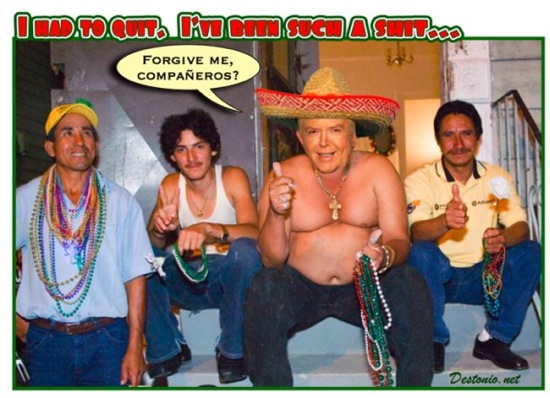
I’ve mentioned the guy a total of 23 times (24 counting this one) over the lifespan of The Mex Files. I guess his resignation (a thinly disguised firing) at CNN IS a victory for everyone who had sane views on immigration and human rights, but — as I got more than a little snarky about with a guy who acted like even a bigger dickhead than Dobbs (if that’s possible) back in November 2007— it’s not really relevant to the Mex Files. At least at the time, I was living in the United States, so had some interest in U.S. newscasters, and sometimes watched Lou Dobbs’ ridiculous television program, and did comment on it — much as I have commented on other badly researched, or misleading news regarding Mexico.
And, what’s the point anyway? Dobbs is only a symptom of what’s wrong with U.S. media coverage of Latin America, not the cause of the crappy, misguided and hostile coverage the region receives.
The only time one hears about Latin America — other than in a travel section or a scholarly publication — in the U.S. media is when the issues involve narcotics, political upheaval or threaten the financial interests of the corporate owners of the U.S. media.
While lip service is sometimes paid to the United States’ drug addictions as a reason for the cartels, one would think from listening to news from the United States that the cartels are the ONLY social and political issue in Mexico. Not hardly. Things like genetically modified corn — courtesy of U.S. conglomerates like Monsanto, agricultural policies in the United States that have destroyed the Mexican family farm, the maquiladoras, etc… have a lot more to do with the distortions in Mexican rural employment opportunity than the U.S. drug culture.
So, Mexicans — and Central Americans — have to go to work in the United States. Dobbs was not the only one pushing the idea that this was somehow a threat (or even a challenge) to U.S. hegemony in the Hemisphere.
And Latin Americans sometimes come up with new ways of meeting their social and political needs that aren’t those of the Untied States, and which might, conceivably threaten U.S. business interests. You only hear that Chavez is a dictator or Correa cancelled Ecuador’s debt, or Evo Morales is a former coca farmer… and not anything about the successes their governments have had in redefining the role of the governed and the government.
When you hear anything “positive” about Latin America, its not in terms of these nations doing anything particularly right, but in terms of their adhering to Wasthington’s wishes… Mexico’s present administration continuing its fratricidal anti-narco campagin, Colombia waging war on its own people but giving Washington special rights to maintain military operations in their nation, Honduras and Haiti accepting their humiliation and quasi-occupation.
You can’t blame Lou Dobbs for that… but he was fun to kick around. Yeah, I suppose it’s a big deal that CNN got rid of the guy, but so what? Does that affect the way the Wall Street Journal is covering Venezuela or Honduras? I don’t think Mary Anasasia O’Grady is going to lose her job any time soon, and her toxic reportage affects not the no nothings who watched Dobbs, but the policymakers and executives who make the decisions that actually affect Latin America.
I’m sure a lot of news writers and commentators are saying that Dobbs was an exception, but even “progressive” writers have begun with the assumption that there is something “wrong” with the way things are done in Latin America, and need “fixed” by the United States. While Lou Dobbs’ use of neo-nazi source material in one broadcast was shocking, it was no more a manifestation of American Exceptionalism than was John Arivosis´contention in “Americablog” that the Honduran coup was justified to prevent “another Chavez”. As opposed, to say, another Pinochet? Or, rather, another Alvaro Uribe?
As it is, Dobbs was just the most visibly bad of U.S. reporters on Latin American and Latino issues. What he said wasn’t all that relevant to Latin American politics and culture and the dialog will continue without him, but with the same misinterpretations, misreportings, misreadings and conscious distortions by the U.S. media as before.
OOPS!
I wonder if the driver had to take a drug test.
I’ve said it before and I’ll say it again. Mexican police operations sometimes look as if they were planned by Norman Schwartzkoff (“Attack with overwhelming force”), and executed by the Keystone Kops.
Neighborhood watch
“Pepe”, José Merino, El DeFe statistician, researcher and Chilanogolist (or, should that be “Chilangologico”?) puts together a color coded map of market services available from one segment of what the District Assembly is calling in their regulatory codes, “unsalaried workers”. As with other markets in Mexico City, specialties within the sex worker’s trade are generally found in the same marketplace.
Pepe’s map works best in Firefox, but the color coding may or may not be perfect, but you can check it out here.
It’s not quite a perfect market system. While there are points of sale for:
- Women 24/7
- Women: evening and nights
- Women: nights only
- Drag queens
- Gay youths
- “Mayates” (gay men, presumably passive partners)*
… a large segment of the population is underserved (or underserviced). Pepe notes that women seeking men are denied equal access, and have to rely on Craig’s List. Sounds like sex discrimination to me.
The Puente d’Alvardo “mercado” (women evenings and nights) has been the object of some complaints from the neighbors (which includes PRI’s Federal District headquarters). Augustín Torres, the PRD Assemblyman representing the area, has responded to constituent complaints and has proposed moving the “zona de tolerencia” a few blocks north … to calle Luis Donaldo Colosio. Torres mentions the safety and convenience factors — calle Luis Donaldo Colosio has a wide median strip (keeping the working women out of traffic and off the very heavily trafficked corner of Insurgentes and Puente d’Alvardo) and — with regular traffic crossings, allows customers to sample the wares easily from the convenience of their car. Not mentioned, but certainly a factor in relocation is that calle Luis Donaldo Colosio is right in front of the National PRI headquarters.
* Use “mayate” with caution. A Natuatl word meaning a scarab (specificially the green figeater beetle, Cotinis mutabilis), mayate has a few different meanings in Mexican Spanish – mostly pejorative. These were discussed (in Spanish) back in June 2006 on the Word Reference Language Forum. In the north, especially in Baja California, it can mean a person of African or African-American descent, and is as offensive as “coon”. In most of Mexico, it’s a crude word for a homosexual, allegedly referencing entomology (not etymology)… beetles laying their eggs in “organic matter”… i.e. shit, and somehow related to anal sex. However, since “mayates” are presumably on the receiving end, that doesn’t make much sense. But, then, fok etymology seldom does.
Delivery girl
A lot of people, myself included, had our first job as teenagers making deliveries. Bertha Martinez Sebastian is one of them… but her deliveries are a little more complicated than the morning newspaper:
(Ricardo Ibara, EFE, via Latin American Herald Tribune [Caracas])
Bertha Martinez Sebastian, 16, combines going to school with her work as a traditional midwife in an isolated village in the southeastern Mexican state of Oaxaca, where she has assisted at more than 40 births.
A Mixe Indian, Bertha Martinez told Efe in an interview that her career as a midwife began at the age of 14 in her native town of Santa Maria Alotepec, which is four hours by road from the nearest public hospital.
… [S]he acquired the necessary skills through organizations that promote natural methods such as Nueve Lunas, which has a training program for midwives called “Luna Llena” (Full Moon).
Bertha is a member of Mexico’s Sexual and Reproductive Rights Network, and since becoming a midwife has also attended international conferences and training courses in the neighboring states of Morelos and Chiapas.
…
Bertha combines her work as a midwife with high school studies and plans to continue until she becomes a professional doctor, though her immediate goal is to study natural medicine and the complete functions of the human body.
Up to now, one of her priorities has been to use and promote medicinal plants as a means of healing the sick.
“I like to say that it’s always better with medicinal plants because they don’t contain all those chemical compounds, they’re something natural that our ancestors knew about and they’re an inheritance we ought to make use of,” she said.
Bertha’s house is also her office. There she gives advice and administers treatments to those who come because they are pregnant or for some ailment.
She also makes house calls for her patients, since a pregnant woman in an Indian settlement prefers to give birth at home surrounded by her family.
I wonder if she also does baby-sitting? Probably not on school nights.
Return of the king…
Esther (From Xico) has become enamoured with Netzahuacóatl… to the point where she is contemplating creating English translations of the poet-tlaotani:
It’s not perhaps that well known al otro lado – north of the Mexico-US border that in fact the Aztecs were not simply the Aztecs, but were part of The Triple Alliance, three different states in which the Aztecs, or Mexicas of Tenochtitlan (which is today Mexico City) were dominant. Netzahualcóyotl became the head of Texcoco, the next most influential member of the alliance. The weakest member was Tlacopan The triple alliance dominated the central section of Mexico pretty much from coast to coast during much of the 15th and early 16th centuries with the exception of what was the Kingdom of the Tlaxcalteca which is today Mexico’s smallest state, Tlaxcala. It was Tlaxcala that gave Cortés essential assistance in his conquest.
But there is a great deal more to Netzahualcóyotl than his political alliances. He was an engineer, a naturalist, a philosopher and a poet. Leaders like him in our own experience who come to mind are Theodore Roosevelt, Thomas Jefferson, John Adams and Abraham Lincoln, though none of them were poets that I know of.
I have a charming little book called Poesías de Nezahualcóyotl con semblanza biográfica –(Poetry of Nezahualcóyotl with a few words on his life) The semblanza biográfica is by Abraham Camacho López as are the translations of the poems attributed to Netzahuacóyotl from Nahuatl to Spanish. (I will continue spelling it Netzahualcóyotl out of respect for our local bus company.) There is some scholarly questioning of whether the poems were actually written by Netzahualcóyotl. I think this doubt is not quite warranted. As Camacho López indicates at the end of this piece, there are reasons to think he did. In addition to Camacho’s reasons, I would add that oral societies managed to transmit without alphabets as we know them a great deal of their learning, history (as they wanted it remembered) and culturally important beliefs, knowledge and mythology. To decide whether or not it is worthwhile to track down exact authorship of actual words is also a cultural judgment.
Posting this week
While there are always things to be said about Mexico, this week posting will be mostly references to other sites. I’m busy with an editing project, and spend too much time in front of the computer as it is…

Mudslides in El Salvador — 7000 homeless
From Tim’s El Salvador Blog:
The death toll from yesterday’s floods and mudslides rose to more than 130 as more bodies were found and more inaccessible areas were reached by authorities, and more than 90 are still missing. At least 1500 houses were destroyed and some 10,000 forced from their homes. President Funes has declared a national state of emergency and declared that the damages in El Salvador are incalculable. He has called for help from neighboring countries and is seeking to use some funds designated for dealing with the economic crisis to be used for the present crisis.
Tim suggests any of the following international aid organizations to those in a position to offer monetary assistance:
Organizations gearing up to provide humanitarian relief include:
Honduras: “the situation is worse than ever”
So says Human Rights monitor Bertha Oliva, about the so called agreement in Honduras, that does nothing more than put the usurpers in the position of overseeing elections later this month. The same electoral tribunal that was lobbying Washington to recognize elections run by the coup regime under the absurd argument that elections should be “separate from the political fray” will be in charge of the military, which doesn’t exactly give peace — or any meaningful democratic alternative — a chance.
The Real News Network, in posting this clip, notes that at 08:39, “the subtitle quotes Shannon as saying “Honduran democracy is NOT in the hands of Hondurans. It should read is NOW in the hands of Hondurans.”
Not so much a mistake, as a freudian slip, perhaps. Although I don’t see much difference between the Obama Administration’s Latin American policy and that of any other Democratic Party administration going back to Woodrow Wilson’s “we will teach them to elect good men,” Shannon was a hold over from the Bush Administration. Sending him to Honduras as Deputy Secretary of State for Hemispheric Affairs was a sop to Senator Jim DeMint of South Carolina (and representative of the far right Hondurans, or so he would make himself), who held up the appointment of Dr. Arturo Valenzuela for the position until after these phoney negotiations were completed.
While the agreement gives the United States a plausible excuse to recognize a regime that is likely to only begrudingly and cosmetically reform the system, the opposition is likely to grow, especially given the large scale repudiation of the elections within Honduran society itself.


 mexfiles.net