Not so great moments in newspapering

By the way, that’s 42 deaths — nation-wide, over several days — some multiple, some singular. Unlike the United States, however, nobody in Mexico is hiding their heads in the sand, and pretending that north of the border drug habits are creating havoc…
Well, maybe except for this unfortunate fellow earlier this month in Guerrero …

(One update at end)
… or so said Don Felipe, justifying the dissolution of Luz y Fuero de Centro, the Mexico City metropolitan electric company (the rest of the country is served by CFE, Comisión Federal de Electricidad.
While I’m waiting for the snarky responses from those that are going to list other government entities that “don’t work in the country”, I was struck by Calderón’s calling attention to the amount of money lost by LyFC compared to other government programs… which would indicate a management, not a labor problem.

If I heard right, the workers — whom, if we take Calderón at his word, are losing their jobs because of poor management — are going to receive assistance finding jobs with “small enterprises”. How that jives with his statement that there were no plans to privatize the national power company makes me wonder if he doesn’t, as the union claim, simply want to break contracts, and destroy the union movement… something his party has always stood for (and, until recently, the other parties wouldn’t).

Electrical workers' protest (photo: David Jamarillo, El Universal)
While privatization may be technically off the table, I wouldn’t be surprised to see introduction of a PEMEX type “reform” that allows for outside contractors to bid on subsidiary services, and which will pit the laid off 15,000 union workers who took to the streets in protest Sunday.
At the same time, there are legal questions. For starters, a union contract with one employer is still valid when another owner takes over the business… in this case, when CFE takes over LyFC. Sindicato Mexicano de Electricistas (SME) is not going down without a fight, with other unions and several political leaders (notably AMLO) arguing the Calderón Administration’s end game is the destruction of the independent union movement… something well in line with both PAN’s more recent “neo-liberal” policies that assume a public utility should turn a profit (something alien to political traditions that hold the utilities to be a public service, not a business) and its historic roots in anti-labor movements (including fascism).
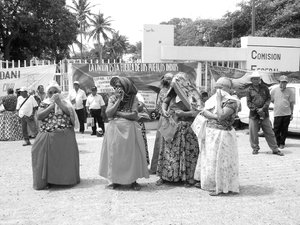
Photo: Alberto Lopez, El Universal
Ironically, CFE is raising its electrical rates, which have led to protests by business groups, manufacturers, consumers and tourist operations throughout the country. Protests, like this one by Tehuana women, are becoming more common.
Laura Carlsen, as usual, provides excellent background and overview:
The decree follows a union conflict that the government fueled and then took advantage of to eliminate the company and its union. The union elections last June were contested by the losing group amid rumors that the federal government was actively fomenting division. In a warning sign, on Oct. 5 the Secretary of Labor, Javier Lozano, rejected registration of the new union leadership without waiting for a decision from the Labor Tribunal…
…The Mexican Electrical Workers Union (SME, by its Spanish initials) is among the most active and independent unions in a country that has been dominated by government-affiliated unions. Its membership has led the many battles for defense of labor rights and standard of living in the country. SME leader, Martin Esparza, declared the Calderon takeover “unconstitutional” and has vowed to fight against the liquidation of the company and of the union contract. In a joint interview on MSVRadio, he spoke alongside the defeated union candidate, Alejandro Munoz, in which both declared common cause to fight against the administration’s union-busting move.
In a daze cause I’ve found… lithium
I though lithium was supposed to help control manic episodes.
A couple of interns at The Center for New American Security must have downed their own happy pills when they wrote this superficial review of lithium production — neglecting the rather minor one that’s of most concern to their employer — as fuel for nuclear bombs, and as rocket fuel for missiles):
Lithium is the lightest metal in nature and an excellent conductor of electricity, and these two properties make it especially useful for batteries. In the past, lithium was used most commonly in glass, ceramics, and pharmaceuticals, but its use in batteries has taken a huge jump in recent years. Currently, 25% of mined lithium is used to produce batteries commonly found in portable electronics and hybrid cars. In fact, The New York Times reports that the hybrid automobile market is likely to generate most of the demand for lithium in the near- to mid-term. The high oil prices in 2008 raised the profile of hybrid cars, which in turn raised lithium’s profile in the automotive industry.
But the defense industry is paying attention to lithium as well. One 2007 report by the Defense Logistics Agency referred to lithium batteries as a “critical go-to-war item” (pdf) and recommended expanding the number of vendors to avoid supply disruptions.
Lithium seems to have bright prospects in automotive manufacturing, along with its use in tech and communication devices that are a major part of modern life as well as modern warfare. Therefore, DoD is probably not the only organization worried about supply chain security. This prompts several important questions about lithium. First, where does the United States get its lithium? The answer to this question is not entirely clear. The United States does have domestic lithium deposits, mainly in two areas of Nevada. But only one U.S. company currently mines lithium, and the United States Geological Survey (USGS) refuses to release U.S. production numbers so that it can protect the company’s proprietary information. (And, interestingly, one of the Nevada sites is being developed by a Canadian company.) But most sources indicate that the United States is one of the top five producers of lithium in the world, even if the exact numbers are unclear.
The USGS does note the countries that export to the United States. Between 2004 and 2007, 61% of U.S. lithium imports came from Chile, while 36% came from Argentina and only 3% from other countries. Chile is politically stable, and Argentina’s long-term outlook is relatively healthy despite economic problems earlier in this decade, so it seems that this wouldn’t present tremendous concerns. But going forward, the center of lithium influence is likely to shift to Bolivia, since vast reserves lie beneath its Salar de Uyuni salt flats. For the United States, this could be a problem: the Morales government remains hostile to U.S. concerns, and there is potential for instability given serious rifts in Bolivian politics.
I suspect the lack of figures on U.S. lithium production (the only major lithium mining nation not to post estimates) has more to do with its use in the United States for military applications than any desire to “protect the company’s proprietary information”, but let it pass.
It’s not that Bolivia is unstable that worries the Department of Defense, either… it’s that Bolivians have this funny idea that their minerals belong to them, and don’t feel any obligation so start mining the stuff until they can cut a deal that they’re comfortable with.
Matt Yglesias (who I guess is a lefty… never really read the guy’s stuff before, but he’s quoted by a lot of the “usual suspects”) gets a little giddy himself, falling into the same assumption that the U.S. MUST have the lithium, and that the Bolivians will have to sell to “us”:
What happens is that at the margin Americans have lots of money and want more oil whereas Venezuela has lots of oil and wants more money so in exchange for money we get oil from Venezuela. It’ll be just the same with Evo Morales and his lithium. If US firms and consumers want lithium, they’ll have to pay money to the people who own it. But if the world’s largest lithium reserves were in Italy or Iceland or Ireland or Illinois it would still be the same—people who want access to lithium ore will need to pay money to the people who control it. Ownership of natural resources is useful insofar as it helps you get money. But developing countries whose economies depend on exporting natural resources need their customers more than we need them (if Iran stopped exporting oil it’d be a disaster for the US but a much bigger disaster for Iran) and it’s in everyone’s interests to keep the commerce flowing.
Yglesias is just one of those people who doesn’t “get it”… there’s no rule that says a “developing country” has to sell to anyone. All this lithi-mania started when the Bolivians started making noises that they would develop their fields, for internal use (or for making car batteries in Bolivia).
Besides which, as the Lunatic Llama (a great Bolivian-focused site, that I added to my “blog feed” thingy) points out in his critique of Yglesias (and what got me to read the guy in the first place):
He argues, essentially, we shouldn’t worry because we have money, and since we have money, it’s a done-deal we’ll get a slice of the lithium. On the world commodity markets, I think that’s true. But if we want to get in on the extraction of lithium, and view that as a national security prerogative, I don’t think Bolivia will magically open the gates for us.
Nor will the Bolivians simply start mining if its not in their best environmental interests. Evo Morales, wasn’t just flapping his gums in a manic phase, when he said:
We must change the capitalist lifestyle, since the capitalist system favored obtaining the maximum profit possible, without taking into due consideration the lives of others or the environment.
…we must consider in detail the “well-being” of human individuals while also guaranteeing the well-being of Mother Nature, he said, adding: “Mother Earth can exist without human life, but not the other way around.”
Now I know why I wasn’t missing anything by not reading Yglesias — he’s predictable and reaslly doesn’t present anything new or stimulating. He’s just a typical gringo, assuming the world has some economic duty to maintain his standard of living. And that the rest of the world “buys” the same cynical value system on which people in the United States make their assumptions.
The assumptions made by the establishment and its critics in the United States are like those who — noting the falling oil reserves here in Mexico — and the declining revenues to the state from oil sales — suggest everything but simply using the oil domestically and not selling it at all. That proposal was beaten back… for now… but isn’t dead.
But, given that Mexico is still selling off natural resources, and does, to a large extent, still “buy” the U.S. mode of thinking… the whole kerfluffle over Bolivian lithium reserves might be slightly moot anyway. Mexican owned mining company, Pierro Sutti announced last week it found a mind-boggling 36,000 hectare of lithium and potassium, stretching through Zacatecas and San Luis Potosí states. Company president, Martín Sutti, told the press that potentially the field will produce 80 tons of lithium for every 10 feet of excavation.
Since Mexico presently doesn’t mine either lithium or potassium, even a small find would be news-worthy. But this find — if it is exploitable in anywhere near the quantities Sutti claims — will yield between ten and twelve tons of lithium carbonate yearly. This equals the annual production of the world’s present main lithium producer, Chile.
And, no doubt, the gringos will be able to buy it. At a fair price, to be determined at a later date. Or not.
(A snarky postscript for one critical reader: I’m no spring chicken, but just about anyone under the age of 30 40 50 60 gets the reference in the title).
Sunday readings
Travel for fun and profit…
The country of the future is…. Uruguay? From MercoPress:
… recent Argentine government decisions have virtually “expelled” some of the most advanced farmers who have settled in Uruguay helping to promote a truly technological “revolutionary” transformation of Uruguay’s agriculture, which historically has been more traditional and adverse to risk.
In Spain an official Uruguayan trade delegation, headed by Finance minister Alvaro García, met with Basque entrepreneurs who expressed a firm interest in Uruguay’s foreign investors’ legal framework and opportunities to invest in different sectors. A delegation of Basque businessmen is scheduled to visit Uruguay in the near future.
Last September a delegation of Uruguayan entrepreneurs visited the International Investment and Trade Fair in China and also returned with good news. “Chinese businessmen expressed interest in knowing more and in depth about what is considered one of the most stable economies of the region and a reliable access to the South American trade area, Mercosur (Argentina, Brazil, Paraguay, Uruguay plus associate members, Chile and Bolivia).
Retirement living
Saul Landau (Counterpunch) visits retired polito, Fidel Castro:
“I immerse myself in reading,” he reported, “and I write as well.” (He has published one or more essays each week for more than a year in Granma.) He selected a volume from the neat piles of books, newspapers and magazines. “I’ve read Obama’s books very carefully.” He slowly flipped through the pages of “Dreams From My Father” showing underlining and hand-written margin notes on almost every page.
“A man who shows deep intelligence, with a gift for writing, and obviously good values,” he concluded. “But he is limited in what he can do. He is tied down by vested interests.” I imagined Gulliver thinking his noble thoughts as the Lilliputians chained his arms and legs.
“I used to be a politician,” Fidel said, the understatement of the year. “I can put myself in his shoes. I understand how hard it is to make basic changes.”
Rest in Peace…
Francisco Franco is still dead, and what remains isn’t long for this world. The Guardian, U.K.:
Apart from a single statue of Franco that overlooks the port in the Spanish north African enclave of Melilla, military installations have become the last hiding place of the old dictator. He still presides over a patio in the regional military headquarters in Valencia, for example, and peeks over the walls of a barracks in Melilla which has become home to one of the equestrian statues that have been removed from Spain’s streets.
“In the last few years the military has become the final guardian of his memory,” said Jesús de Andrés, a political science lecturer at Madrid’s UNED university. “A good number of statues have ended up in military installations.”
Old Francoists have all but given up the fight to conserve the symbols that the caudillo left behind, especially since the Socialist government of José Luis Rodríguez Zapatero passed a 2007 law calling for them to be removed. The final decision on what needed removing was left in the hands of town and city halls, however, with some rightwing mayors still refusing to change streets named after Franco or remove plaques.
Now campaigners want Franco himself moved…
And, the fashion report from La Paz
(Thanks to El Gaviero for first posting this):
Lights are on, nobody home
HOLY SHIT!
At approximately 10:30 pm Saturday evening more then 1000 federal police took over diferent installations of the Compañia de Luz y Fuerza del Centro which provided electricity for the central region of Mexico. At midnight the government issued a presidential decree announcing the disspearance of this company and its functions will be taken over by the CFE, the Federal Electric Company
(via Ana María Salazar, posted at 2:11 Mexico City time this morning)
There has been a barrage of news items over the last few weeks, suggesting the union representing Luz y Fuerza workers was hopelessly corrupt. Less reported in the national press has been that union’s continued intransigence toward what they still regard as a “de facto” presidency (as opposed to the “legitimate presidency” of AMLO), and their opposition to Administration noises about deregulating and/or denationalizing the electric companies. As of Friday, there were still discussions about recognizing the union elections.
Cronica de Hoy says this was a cost-savings move. LyFC has been losing money, and one major overhead has been retiree pensions. Paying employee liquidations (a cash payment based on salary and years of service to which Mexican employees are entitled) might also mean canceling future retiree benefits: presently pensions run the company pays about twice its yearly payroll .
Jornada’s first posts note that there was no immediate violence during the “requisa”, but Milenio, which had fuller coverage, indicates that violence is expected, and notes that the Union has scheduled an emergency meeting for today.
El Universal’s 0307 AM posting quotes Sindicato Mexicano de Electricistas official Martín Esparza as calling the action an “offense against all Mexican workers” and also reports that an informational strike will begin at 9 AM tomorrow. U.S. and Canadian electrical workers’ unions have expressed solidarity, but it remains to be seen what happens next.
Stay tuned… assuming I have electricity (my electric company here always was CFE (also state owned), but there’s no guarantee their workers won’t walk off the job.
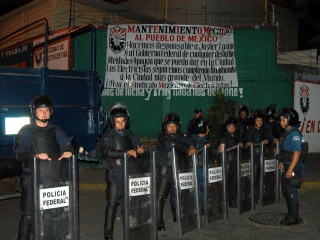
Notimex photo
The timing (late on Saturday night, after beating El Salvador in the World Cup hexogonal elimination round— putting the whole country into a party mood) with a Monday holiday) was obviously planned to minimize media attention and mute reaction by the union (and anti-administration sympathizers). Ironically, I only caught the story because I had gone clubbing, and — unrelated I think — the power went out!
This is what they mean by foreign aid…
I was always somewhat amused by the gardener and her friends, buying the story that Honduras was awash in paramilitaries and mercenaries, ready to swash and buckle their way through the countryside in support of the ousted legitimate government.
Well, I take it back… there are mercenaries running around Honduras… just not on the side the gardener thought.
Honduran landowners have reportedly hired former Colombian paramilitaries as mercenaries to protect them against possible violence stemming from government tensions, a UN panel said today.
The UN working group on mercenaries said that it has received reports that some 40 former members of United Self-Defence Forces of Colombia, or AUC*. The US government classifies the AUC as a terrorist organisation.
They will protect properties and individuals “from further violence between supporters of the de facto government and those of the deposed President Manuel Zelaya,” it said.
Separately, a 120-person group of paramilitaries from several countries in that region was reportedly created to support the coup in Honduras, the panel said.
Honduras is a party to the international convention against the recruitment, use, financing and training of mercenaries, the group said.
(AP, via The Guardian)
Of course, the present regime doesn’t feel particularly obliged to follow international conventions… or even it’s own laws, particularly.
* For those with trouble telling the Colombian gangsters-slash-paramilitary-groups apart without a scorecard, AUC is the RIGHT-WING group, best known in the United States for having been hired by the United Fruit Company to kill union organizers (and by the Italian Mafia to smuggle cocaine). Several member of Colombian President Alvaro Uribe’s political party, his family (and some same himself) have connections to this gang.
Disassociated Press
I guess Associated Press is going into the propaganda business.
TEGUCIGALPA, Honduras — Honduras’ interim leaders put in place new rules Saturday that threaten broadcasters with closure for airing reports that “attack national security,” further restricting media freedom following the closure of two opposition stations.
The latest decree is sure to anger supporters of ousted President Manuel Zelaya and appears to be a challenge to the Organization of American States and a team of regional diplomats who were in the country Thursday to push for a resolution of the crisis.
…
Under the decree imposed by the government of interim President Roberto Micheletti, “the frequencies of radio or television stations may be canceled if they transmit messages that incite national hate and the destruction of public property.”
Officials can monitor and control broadcast messages that “attack national security,” according to the decree…
I guess what the AP is saying it isn’t a supporter of Manuel Zelaya (which is fine), but not seeing this as a challenge to freedom of the press in general (including the part that considers itself “Associated” ). Already, the Micheletti regime has made a mockery of the alleged restoration of civil rights (they carted away an entire television station and destroyed the equipment… then said, “oh, never mind.. you can APPLY to reopen if you want) and closed down Radio Globo. There was international outrage when, after the bloody attempted coup in Venezuela in 2002, the network that had encouraged the coup (to the point of urging the assassination of the president) had its station transmitter permit denied when it came up for renewal (and it is still broadcasting as a cable station), which is an entirely different set of circumstances.
What constitutes attacks on national security is, of course, up to the guys with the guns, whichAssociated Press sees as only a problem for the Organization of American States and “supporters of Manuel Zelaya”, and not anyone who expects news reports…. like, oh… readers of AP wire reports.
Friday Night Rio Summer Games video
 Two of the greatest American athletes of all times, after Flyin’ down to Rio…
Not looking for Mexico
In an 1979 essay, Octavio Paz wrote:
In general, Americans have not looked for Mexico in Mexico; they have looked for their obsessions, enthusiasms, phobias, hopes, interests — and these are what they have found. In short, the history of our relationship is the history of a mutual and stubborn deceit.
I remembered that quote when I wrote my comment to the excellent article “The Most Misreported Country” by Michael Massing posted in the Colombia Journalism Review, brought to my attention by Burro Hall (who knows something about mainstream journalism, having actually made a living in it).
When it comes to Mexico, U.S. journalists seem interested in only four things: drugs, traffickers, violence, and corruption (with an occasional nod toward immigration). Journalists peddle a sort of drug-war pornography, salaciously and insatiably dwelling on the most lurid aspects of the trade: narcos, gangs, smugglers, pipelines, cells, mass graves, severed heads, torture chambers, dirty cops. Journalists promiscuously quote DEA agents, eagerly accompany undercover cops on ride-alongs, descend daringly into drug-infested neighborhoods, and intrepidly interview members of the drug trade.
…
This genre of reporting is actually quite old, dating back to the days of Pablo Escobar and the Medellín Cartel. Journalists loved writing about the Wild-West-like operations and lifestyle of those criminals, and of the valiant efforts of drug enforcers to take them down. They finally were toppled, of course. But you know what? The drug trade has continued. The same is true of the Mexican cartels. … And the reason is clear: Americans continue to crave the stuff. We are the ones who sustain the drug trade; we are the ones who in the end are mostly responsible for the drug violence that periodically erupts in Mexico. You’ll almost never see a journalist explore this, however. It isn’t sexy. What is sexy are the cartels, and so the pretense about their lethal impact on the United States must be maintained.
Go read the whole thing, and the commentaries. Massing hit a nerve among some of the “usual suspects” in the drug-war correspondent biz.
A little foreign politics…
The United States is still #1 in some things. No one is better than a native New Yorker when it comes to a classic insult.

“He is taller than he is well-mannered”
New York born (1962) Italian Member of Parliament Giovanna Melandri, on Silvio Berlusconi.
Honduras Redux, reloaded, again, part 2
1) De facto government of Roberto Micheletti shows signs that it may be willing to loosen its grip on power. 2) The OAS arrives in Central America for highly publicized meetings with Mr. Micheletti and ousted President Mel Zelaya. 3) Disappointment follows as Mr. Micheletti refuses to budge in the face of international pressure. And…repeat. Was Wednesday yet another showing of the same old tragedy? The AP’s coverage of Wednesday’s “Guaymuros Talks” would make it appear so. “Honduras’ coup-installed leader resisted calls by diplomats from across the hemisphere to reinstate ousted President Manuel Zelaya, at one point angrily telling the visitors they “‘don’t know the truth or don’t want to know it,’” the wire service writes today.
NY Times starts to catch up with what’s been known for some time about the Honduran coup leader’s media machinations… a cast of characters out of some of the greatest scandals of the past (like Iran-Contra).


 mexfiles.net