Spillover violence
Foreign Secretary Patricia Espinosa is trying to spin the appalling body count in the “War on Drugs [the United States and Canada insist can only be controlled over Mexican’s dead bodies]” as evidence the “policy is working”. Asked about that body count, Espinosa is quoted in her “exclusive interview” with the Associated Press as saying:
… the “great, majority, immense majority” of victims are drug pushers or gangsters and foot soldiers linked to cartels.
“This is a very ugly statistic,” she said, “but a good percentage of those killed never have their bodies claimed, their families never go and get them … That is a very clear indicator that these people were involved in drug trafficking.”
I’m not sure I follow the logic of that. It may be a clear indicator that poor rural people don’t always read the crime pages of out of town newspapers, or gangsters need to call their mothers more often, or any number of things. I just hope that a high body count isn’t going to be used as a measure of success for police actions (as it was — or is — in Colombia, leading to some … er… interesting ways to supplement income). But, it is likely to go higher.
In Tijuana, Maggie Drake has been writing about the local police chief’s “shoot to kill” order… and the fortieth police shooting THIS YEAR in that municipio. Tijuana is in the unhappy situation of sitting next to the user emporium (and gun supplier) of southern California, but the spillover in violence from the user community is coming from either further afield.
In Canada, increasing violence in their own drug trade is being blamed on Mexican “success”. As a result of the military/police actions against the various gangster organizations that handle distribution, British Colombian cocaine dealers are feeling the pinch:
Supply lines were drying up, recalled B.C.-based RCMP Superintendent Pat Fogarty, because the cartels were too busy fighting the Mexican military.
It was translating into rip offs, or people who could not pay back what they owed — a dicey situation among gangsters that often results in bloodshed.
“This is where the tentacles of the disruption in Mexico bled over into Canada, in terms of violence,” said Supt. Fogarty, in charge of the Combined Forces Special Enforcement Unit in B.C. He has more than 20 years’ experience battling organized crime.
Police in British Columbia say the Lower Mainland has seen a spike in gang-related violence this year over last, and most of it is gun warfare.
If the violence was kept in British Colombia, it wouldn’t be a problem, but Canadian gangsters have been showing up here lately. This week, two Canadians were killed in a shootout that had some Canadians more upset with the local paper publishing photos of the corpses than with the fact that two more of their guys are down here in the Puerto Vallarta morgue. Hope their familes reclaim their bodies.
Honduras: impending miseries and resistance
With the suspension of civil liberties and constitutional rights by the coup that justified itself after the fact on the grounds that it had to protect the constitution from a theoretical threat, there doesn’t seem to be much concern for dealing with the country’s real and chronic problems.
It was only when the salario minimo was raised that there was even a hint that Manuel Zelaya was somehow more corrupt or demogogic than any other Honduran leader, and — with the coup leaders (aka the “de facto government”) apparently willing to let the country’s economic life come to a screeching halt while it turns its compete attention to its own survival, the basics of life in the hemisphere’s second poorest country are ignored.
A priest in the Diocese of Copán’s Sunday sermon was taken from the Epistle of James:
Come now, you rich, weep and wail over your impending miseries.
Your wealth has rotted away, your clothes have become moth-eaten,
your gold and silver have corroded, and that corrosion will be a testimony against you; it will devour your flesh like a fire. You have stored up treasure for the last days.
Behold, the wages you withheld from the workers who harvested your fields are crying aloud, and the cries of the harvesters have reached the ears of the Lord of hosts.
You have lived on earth in luxury and pleasure; you have fattened your hearts for the day of slaughter.
You have condemned; you have murdered the righteous one; he offers you no resistance.
With the press censored, it is getting difficult for ordinary people to find independent sources of news. I notice that “Gente Blog” — which is still up this morning — is set up under a Honduran investment and travel site, but is running a mirrored version of a server in Tokelau — a “non-self governing territory” of New Zealand, at genteblog.tk. Honduras, aside from being one of the poorest nations in the Americas, also has the lowest home computer usage rates in the Hemisphere*. 12 percent of Cubans, who we think of as information isolated, and 11 percent of Haitians (the poorest of the Americans) are reached by the internet, but only 8.4 percent of Hondurans.
Still, unless the “de facto government” is willing to shut off electricity and seize computers (I wouldn’t put it past them), the internet is going to be the best way to get independent information in and out of the country, since Honduras — unlike China — doesn’t have the capacity to block access in any meaningful way. And that 8.4 percent includes a lot of people like school teachers and church workers, who can pass along what is known.
That said, I received an email from Caritas (the Catholic social service agency in Honduras) that their weekly bulletin will be putting out updated information on the “situation” in their country, and I’ll be happy to pass along whatever is sent this way (email address: richmx2 [at] live.com).
* I changed this sentence to read “home computer” because “Boz” (comment #1) is correct that in Latin America, most computer users go to internet cafes… which still limits both availability of access and makes it relatively easy for the government to limit access, either by shutting down cafes, or monitoring what users view.
I guess she’s not a fan
Guadalupe Rivera Marín, Director of the Fundación Diego Rivera, is not particularly fond of the works of Frida Kahlo, for some reason…
(Partial article translated from EFE wire story, via El Universal)
Diego Rivera had to “finish up canvases” for Frida Kahlo because “she was so very lazy,” said Guadalupe Rivera, one of the daughters of Mexican artist in an interview published today by the Buenos Aires newspaper Clarin.
“When she needed money, he finished them so he could sell them,” she said, adding it bothered her “a lot” that her father’s memory is linked to that of Kahlo, his third wife.
Guadalupe Rivera, the daughter a previous marriage between the artist and Guadalupe Marin, said Kahlo, “was totally different from what they say now she was.”
“First off, she was extremely mannish, foul-mouthed and “loved fooling around with the mariachis” on the Plaza Garibaldi in Mexico City. “
Rivera’s daughter adds that athough Kahlo was said to be a woman full of life, “she was a degenerate,” and, she adds, “a bad painter.”
If my arithmetic is right, Guadalupe Rivera Marín, was born in 1924, and Diego Rivera and Frida Kahlo married (for the first time) in 1929, then Guadalupe was five when her family was broken up by the other woman. Much as I discount Kahlo as a major artist (and if Diego had finished her canvases, his ego was too huge to not have made them anything but Riveras.. not to mention they would have been better art), why do I suspect there may be some unresolved childhood issues lurking about this revisionist view of art history?
Ah well, as Tolstoi said, “Happy families are all alike; every unhappy family is unhappy in its own way.”
I got bogged down last week, trying to translate a short poem by Salvador Novo. I starting looking at some background material and…then the Burro kicks up a fuss, and …. geeze, look what happens!
Burro Hall has every right to kick up a fuss about the break with tradition (and good taste) contemplated by Spanish matador, Joselito Ortega.
A little-known Spanish matador is breaking with a sacred tradition, agreeing to advertise on his cape while slaying bulls and endorse a soft drink that caters to gays.
It is, of course, its the disrespect to ceremonial aspects of the traje de luces and the desecration of the capote de brega any aficionado should rightly condemn –and is worthy of a news item — but the Associated Press, with their usual editorial clumsiness (or perhaps with their cultural blinkers on, and under the assumption that tauromachia is a form of rodeo, to be profaned with crass commercialism) writes the rest of the story about the last word in that quote. As the AP writer (or editor) words it:
In Spain, matadors are seen by many as the pinnacle of macho, and Ortega’s agreement to endorse a product geared toward gay men is raising eyebrows.
Never mind that I have yet to see any eyebrows raised except in the English-language press about the gay angle… or about gay matadors which has never been an issue in a sport that integrated racially and sexually (as well as gender-preferentially, if that’s a word) long before any other.
I’m more stymied by the AP use of “macho”. “Macho” seems to be in the eye of the beholder, much like United States Supreme Court Justice Potter Stewart’s famous definition of pornography (Jacobellis v Ohio, 378 U.S. 184 [1964]): “I know it when I see it.”
“Macho”, in English, means “stereotypically masculine”, something early 20th century writers associated with Mexico, and by extension, with all Spanish-speaking males:
Our fascination with Mexico endured in the twentieth century. A particular fascination for the gringo male was the notion of extreme masculinity embodied in macho. Spanish macho seemed to offer opportunities for manliness and toughness unavailable in English. Macho was apparently known in the West by 1927; it made its way back to the New York weekly The Nation early in 1928, when a correspondent wrote, “Here I was in their midst, a Macho Yankee Gringo, yet treated with consideration.” More recently, author Norman Mailer was one who took machismo seriously. In his 1961 Advertisements for Myself he wrote, “Every American writer who takes himself to be both major and macho must sooner or later give a faena [a ritual performance like a bullfighter’s] which borrows from the self-love of a Hemingway style.”
Norman Mailer and Ernest Hemingway aside (and I’m not so sure about Papa — or is it Papí?), “macho” has developed a slightly different set of connotations than when they wrote. Oh, sure, it still means a “man’s man”… just not in the way they intended it to:
In the sense that some gay men are turned on by athletes, maybe “macho” might fit. But, as the not pornographic, but probably not completely safe for work Turkish gay site, “Casual in Istanbul” regularly featured semi-nude (and often identified as gay) madadors, soccer players and swimmers… it doesn’t appear the body builder “macho man” is exactly what the AP meant either.
At most — or at worst — all Machismo means in Spanish is what we call “male chauvinism”. That has nothing to do with gay guys, or bullfighting particularly, although — in an odd way — it does have to do with one of the most unlikely of Mexican public figures of the mid-twentieth century, Salvador Novo.
Novo (1904-1974), one of the most complex and contradictory writers of the twentieth century in the Hispanic world… poet, historian, short-story writer, food critic, theater director, playwright, is sometimes compared to Oscar Wilde, not just because of his brilliant literary production, nor even because of his epigrammatic wit and use of irony, but because of his overt refusal to conform to the gender stereotypes of his times. Unlike Wilde, though, Novo was never in the closet and, unlike Wilde, he was not punished … in fact, he was rewarded, becoming an important figure with the PRI and the government.
An “obvio” from his earliest days (he quipped later the two biggest girls in Torreón were his mother… and himself), and his first published writings celebrated his same sex romances. At 17 he was a published author, and arriving in Mexico City discovered both a “bohemian” culture that accepted and celebrated the unconventional and talented, and — more importantly — generous state funding for the arts.
The Mexican government in the 1920s was more than receptive to modernism in the arts — the Revolution demanded not just a change in politics, but a change in thinking as well. And the State was willing to invest in artists. The young Novo was writing for several new cultural magazines which may not have reached provincia, but were read by the nation’s new leadership.
Not that the literary and political establishment was completely tolerant of this strange new talent [my translation]:
Novo, like other Contemporáneos [the literary coterie associated with the magazine of the same name, founded in 1927] as civil servants, were often under attack for being “morally dubious”. Those were the days of Gide and Proust and Salvador Novo, building on that French dramatic tradition, went a step further, writing a gay stage drama: El tercer fausto.
Making no secret of his relationships with taxi drivers, professional wrestlers and what are now called “rough trade”, Novo was “out of the closet” publically in a way that would not be common until the late 1970s. In his work and personal life he reinvented the hate-filled and invectives hurled at him into witty repartee. Emmanuel Carballo says the star of the Mexican literature was a cynic, “A being who calls those things we are forbidden to talk about by their right name.” From his youth Novo learned to be what some of his contemporaries refused to accept: a different human being. “This honesty with himself,” continues Carballo, “earned incomprehension, rejection and hostility.”
…
Novo … was openly and belligerently gay in times of ruthless assertion of literary machismo. With deadly satire and the repeated demonstrations of his talent, Novo resisted harassment…
Talent is a natural resource not to be wasted, and satire is a deadly weapon in the hands of an enemy, and the establishment had no intention of alienating the modernists while they waged war against the old guard, and what they saw as the reactionary mind-set that had kept Mexico from assuming its rightful place in the world. And, following Lazaro Cardenás, the Revolution became the “Institutional Revolution”… in part a recognition that the “Revolutionary Family” included not just the proletariat and peasant, but the urban bourgeois as well. What hadn’t changed was the sense that the arts had a vital national purpose — as propaganda for state programs and as a means of developing a modern culture within a traditionalist society.
While Marxists — like Diego Rivera — echoing old Karl’s Victorian propriety, continued to snipe at Novo, the political class could overlook the obvious, and use the talent. Novo, with Carlos Chavéz, was co-director of the new Instituto Nacional de Bellas Artes y Literatura, overseeing literary and dramatic productions throughout the country. In this role, among other things, he wrote and directed (and sometimes starred) in weekly historical radio dramas many considered it their patriotic duty to listen to. Not that something as witty as “The War of the Fat Ladies” (from an Aztec legend about fat ladies who defeated enemies by slapping them with their tits) had to be a chore.
Later, he served as director of public relations for various Cabinet Departments, among them the Secretariats of Education, Foreign Affairs and National Economy.
 Appointment to the prestigious Academia Mexicana de la Lengua (the Mexican affiliate of the Real Academia Española) in 1952, confirmed Novo’s place in the establishment. In 1965, Gustavo Díaz Ordaz — not known for his tolerance of deviance of any kind — appointed Novo Cronista de la Ciudad de Mexico… city historian, a sinecure that paid a nice salary and seemed mainly meant to honor the writer, but was (as the devious Díaz Ordaz also knew) a way of keeping the talented, dangerously witty writer within the establishment at a time when the pressure was building for political and social change within the system.
By 1974, when Novo died, he was — with an irony he appreciated — seen as something of a reactionary, and — with an irony he should have appreciated — even a “macho man.”
The short version of the song that destroyed the Maileresque definition of “macho” (linked above) didn’t include this verse:
Every man ought to be a macho macho man,
To live a life of freedom, machos make a stand,
Have their own life style and ideals,
Possess the strength and confidence, life’s a steal,
You can best believe that he’s a macho man
He’s a special person in anybody’s land.Hey! Hey! Hey, hey, hey!
Macho, macho man (macho man)
I’ve got to be, a macho man…(Jacques Morali, Macho Man)
… and still working on translating the poem.
Want to stop “illegal immigration”?
The hyper-observant Laura Martinez found a way to make the truism that Mexicans doing the job Americans can’t may pay off:

We burned democracy (in order to save our butts)
TEGUCIGALPA (Reuters) – The de facto Honduran government has issued a decree allowing it to suspend freedom of speech, ban protests and suspend media groups because of “disturbances of the peace” since a June coup that toppled President Manuel Zelaya, government officials said on Sunday.
De facto Honduran interior minister Oscar Matute said media that incite violence should be regulated under the decree, a copy of which was obtained by Reuters.
A senior government official said the decree, dated September 26, has been printed in the official gazette.
Hermano Juancito offers more details on the decree:
Here are parts of what the executive decree says:
There is a restriction for 45 days of certain rights which are guaranteed in the Honduran constitution in these articles:
69: “Personal freedom is inviolable and only under a legal agreement can it be restricted or temporarily suspended.”
72: “The emission of thinking [expression of thought] by whatever means of dissemination is free without prior censorship. Those who abuse this right or by direct or indirect means restrict or prevent the communication and circulation of ideas and opinions are responsible before the law.”
78: “The freedoms of association and assembly [meeting] are guaranteed as long as they are not opposed to public order and decency [good morals].
81: “Every person has the right to move freely [freedom of movement], to leave, enter, or remain in the national territory.
“No one can be obliged to move their domicile or residence, except in special cases and in accord with the requirements set down by the Law.”
84: “No one can be arrested or detained unless there is a written order from the competent authority, issued in accord with the legal formalities and for a reason previously established by law.
“Nevertheless, the offender in flagrante [caught in the act]may be apprehended by an person for the sole purpose of handing that person over to the authorities.
He asks a basic question:
Is this a democracy?
The answer is… it could be, much to the chagrin of the tourist-resort community of La Ceiba’s ex-gardening columnist turned pundit:
At 9:15 she posted:
Honduran President Micheletti has responded with a national cadena (radio and television announcement) prohibiting any public demonstrations without prior permission. It is a wise move to prevent violence and protect life and property, but mark my words: he will be damned by the human rights groups for doing this.
Not that anyone particularly cares about Mel Zelaya per se, but even the United States can’t swallow the nonsense that the golpistas are anything but thugs stealing democracy:
At 11:23 PM, she starts … with due respect to my readers among the clergy… shitting bricks:
It was just announced on the news that US Ambassador Hugo Llorens is assisting ex-president Mel Zelaya to set up a parallel government led by Zelaya within Honduras. They showed Llorens big toothy grinning face over and over again.
(Actually, la Gringa, as far as I can tell, it’s not setting up a “parallel government” as assisting the legitimate one.)
Have the United States of America led by President Barack Obama and Secretary of State Hillary Clinton lost their minds?
Nope… sounds like they grew a pair.
Hurrah!!!
Another slow weekend in the Hemisphere
Honduras:
(Update in bold italic)
Another overnight curfew in Honduras last night. I’m writing this Saturday PM so have no idea if it will be extended into Sunday.
AFP reports today (Sunday, at 4:32 PM) that “five members of the Organization of American States were detained for six hours at the international airport in Honduras Sunday and four were expelled as they were attempting to enter the country, John Biehl, the only OAS official to enter the country.”
The French news agency also quotes Fr. Andres Tamayo (the priest and environmental activist threatened with deportation by the Micheletti regime, now holed up in the Brazilian compound) to the effect that there are farm workers and farmers descending on the capital for what Mel Zelaya calls a ““final offensive against the de facto government.”
An interesting development. Monseñor Luis Alfonso Santos, the Bishop of Santa Rosa de Copán, has called for a constituent assembly [which may be wishful thinking on my source’s part, per the comment by John Donahhy, who knows the Bishop personally]. Given that the justification for the coup was the claim that President Mel Zelaya MIGHT be able to call for such an assembly, had the non-binding referendum he was pushing been included with the November balloting… and passed… and been accepted by Congress as a persuasive argument to vote for such an assembly… and in turn was the rationale for rousting him from his bed at gun point and exiling him — it’ll be interesting how the “de facto” government deals with this meddlesome priest.
(source: Honduras Oye!)
Venezuela:
Al Jazeera obtained tape of a police investigation in Colombia, in which a “paramiliary operative” from one of the rightist groups now in prison, claims that Manuel Rosales — an opposition candidate in the 2006 Venezuelan Presidential elections, and former mayor of Maricibo — who fled to Peru when he was charged with misuse of public funds and embezzlement — offered the paramilitaries $25 million to assassinate President Chávez by any means. According to Al Jazeera, the conversation with Rosales took place at a secret meeting in 1999. Rosales said that he personally would be in charge of the plan to assassinate President Chávez, though the money would come from several sources.
It’s those “several sources” that open a whole can of worms. Rosales’ business interests and bank holdings in Panama and the United States (Florida, in particular) received much attention from the Venezuelan press shortly before he fled the country.
(sources: Al Jazeera, Venezuela Analysis, Inca Kola News)
United States:
You wonder whether this “politics by other means” initiative from Venezuela might have anything to do with one of the suspected financial backers of the … ah… Colombian unregulated agricultural market… like, oh, Allen Stanford.
Allen … er “Sir” Allen, as he likes to be called, made his money the old fashioned way. He stole it, mostly from Latin American investors seeking to hide assets from taxing authorities, and used his Antigua bank. It’s suspected that many of those investors had good reason to avoid tax authorities — having no way to account for the source of the assets (sort of like the money that Rosales invested in Florida). There’s the usual way to make lots of untaxed money in Colombia, and it ain’t cocoa.
Anyway, Sir Allen is in the custody of the GEO Group… part of the Wackenhut family of fine private prisons… where he had, shall we say, an accident.
CONROE, Texas — A U.S. Marshals Service spokesman says jailed Texas billionaire R. Allen Stanford is being treated at a hospital after being injured during a fight with another inmate.
Deputy U.S. Marshal Alfredo Perez said Stanford was being treated Friday after a Thursday altercation at the private Joe Corley Detention Facility in Conroe about 40 miles north of Houston.
(Source: Huffington Post, Corp Watch, Detention Watch Network)
Health care for foreigners
John H. Richardson, in Esquire Magazine, interviews Rudy Rupac of Planet Hospital, a U.S. travel company specializing in making travel arrangements for U.S. citizens that can’t afford medical care at home.
“If you are purposely going abroad for medical care, and paying to do so, obviously they’re going to treat you like royalty,” [Rudy] Rupak told me. “If, on the other hand, you’re in an emergency situation, some countries will do a wallet biopsy.”
…
There’s another reason why Americans go to Mexico for the health care they’re so eager to deny to Mexicans who come to America: Mexico has a national health plan. “Actually, they have two of them,” Rupak told me. “One for everybody, and another for government and military and some corporate. And also private insurance for the wealthy.” So Mexican health care is cheaper in general, since the public plan gives so much economic competition to the private plans — and also because the public system siphons off so many poor people and leaves the fancy plans as lean and mean as they want to be. Most private hospitals in Mexico don’t even have an emergency room, for example, because that’s where hospitals lose the most money. They can do this because there are always public hospitals that are required to take in everyone. That wouldn’t work in the U.S. because there are so few public hospitals — and still millions more people without insurance. And no matter how passionate every good American claims to be when it comes to laissez faire and the free market, it’s just not cool to have too many people bleeding to death on the sidewalks. Even illegal Mexicans. It’s lousy for property values, at the very least.
And as Pancho Villa…
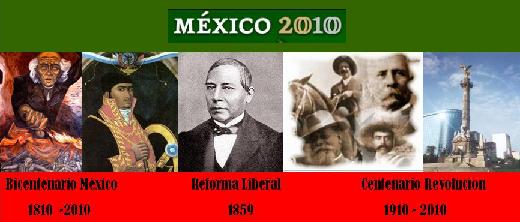
Geeze, I really ought to do a series on Mexico and Hollywood… or just on Pancho Villa and Hollywood.
In no particular order Hollywood’s idea of Pancho Villa has been
- Antonio Bandaras — the Spaniard who is first choice for any Hollywood movie involving anyone, any time, who spoke Spanish.
- Edward James Olmos — #2 for “Hollywood Hispanics”.
- Pedro Amendáriz, Jr. — aka Pedro Amendáriz Bohr… his dad played Villa numerous times in Mexican films.
- Freddy Fender — yup, THAT Freddy Fender.
- Hector Elizondo — a New York born and bred guy with at least a Spanish name.
- Leo Carillo — who played another Pancho… the Cisco Kid’s sidekick on the 1950s television series.
- Wallace Beery — often considered the definitive Hollywood Pancho-
- and… of course — Pancho Villa.
Or … weirdest of all, Yul Brynner in the 1968 Villa Rides!.
I guess it’s your typical Hollywood version of the Mexican Revolution, which apparently wouldn’t have happened without OUR support (in this film, Robert Mitchum as a rogue airplane pilot).
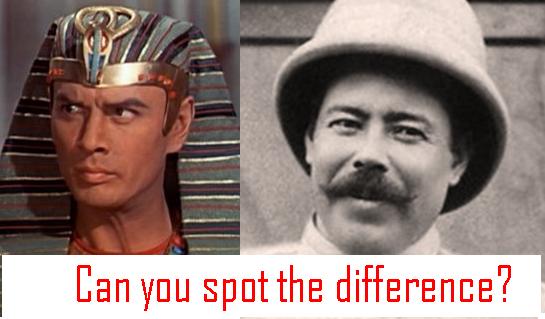
I don’t know if it was the rather loose interpretation of Mexican history, the weird idea of scripting witty repartee between Pancho Villa and Rodolfo Fierro or a bald Pancho Villa that was the problem, but — despite some success in Germany and Scandinavia, and moderate sales in the United States, it was never distributed in Mexico.
The Maurice Jarre theme music is somewhat memorable however:
Honduras — Zelaya is not paranoid, he has real enemies
Those who would defend the coup in Honduras are getting more creative. Because a Miami reporter apparently doesn’t understand Spanish, when Zelaya said he was being bombarded with “radiacíon”, the Herald made it sound as if the guy was spinning fantasies. Maybe reporter Frances Robles doesn’t hear well, or maybe her Spanish is bad, or maybe her editors need to invest in a good dictionary.
According to the DRAE (Diccionario de la Lengua Española of the Real Academia Española) — which is a hell of a lot more reliable than the Miami Herald — “radiacíon” is “Energía ondulatoria o partícularas materiales que se propagan a través del espacio“… energy waves.
Which is exactly what the Honduran Army is doing — bombarding the Brazilian Embassy with “radiacíon”.
Here’s what was aimed (and may still be aimed) at the Brazilian Embassy. Notice that the soldiers are wearing noise protectors.

The device, according to Wired.com is:
… the LRAD or Long Range Acoustic Device, a super loud-hailer deployed by U.S. forces and famously used to fight off pirates. According to the Guardian, LRAD is being used in two ways: as a megaphone to order protesters to disperse, and, when they disobey, as an “ear-splitting siren” to drive them away.
…
According to Reuters, a truck-mounted speaker was used “to blast the embassy with harsh sounds.” The Guardian describes the speakers as being used to generate “high-pitched noise.” The Miami Herald cites witness reports that “soldiers used a device that looked like a large satellite dish to emit a loud shrill noise.”
The device seems to have spooked Zelaya; in the Herald report, he claims that he is under attack by some sort of radiation weapon. This reminds me of someone I talked to who once told some protesters that the LRAD sonic blaster emitted radiation that would shrivel their testicles. He was impressed at how fast they got out of the way.
If you’re willing to risk the family jewels, LRADs are being used in Pittsburgh against demonstrators as well. Here’s what it’s like:
As to reports of poisonous gas, at least one group is claiming to have had gases analyzed, and found traces of Hydrogen cynanide.
An interesting report (posted by Hondruas Oye!) from Chinese wire service Xinhua, datelined 24 September from Panama City, quotes the Honduran Ambassador to Panama as saying Honduran soldiers assisted Zelaya’s return to the country.
Friday nite videos: Mr. Teddy, Joseph Goebbels and La India Maria

Teddy Stauffer, 1936
Under the leadership of Swiss saxophonist Ernst Heinrich Stauffer, better know as Teddy, the Original-Teddies were the top swing and jazz orchestra in Germany in the late 1920s and throughout the 1930s.
Having one’s music labeled “degenerate” by some anal-retentive politician today might boost record sales (and the Original-Teddies sold very well throughout their career), but when the bureaucrat in question was Josef Goebbels, there was, indeed, a problem. Interviewed by Bob Alvardo for “El AntiQuario” in his old age, Stauffer said the problem wasn’t just that Jazz was Afro-American music, but something even worse according to the Nazis:
Swing music was my problem in Europe. When the Nazis put on the blacklist all the Jewish composers, the songs, I was already on the list one year and a half. With the revolution in Europe, Swing music was forbidden, Swing dancing forbidden. Nobody know what Swing is, they forbid something that is only bad imitation. They didn’t have it, we had it. That made us number one. I came to America in 1941. I came on the refugee ship. I am not Jewish, but I was on the blacklist for the music that we made.
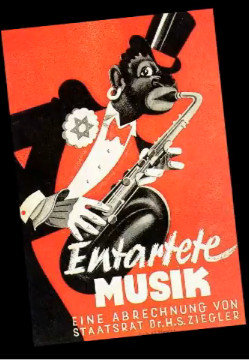
"Degenerate Music"
Perhaps Stauffer was prescient when the Original-Teddies recorded Chica-Chica-Boom-Chic in 1941. It would be a more tropical locale than Hollywood — where he hoped to get work as a studio musician — where Stauffer found refuge in 1942. Lou Christine (who also writes for Atención San Miguel) picks up the next chapter in Stauffer’s checkered career in a fine article written for The (Mexico City) News last week:
The U.S. seemed like a safe haven and a place to continue his musical career but because his passport was stamped with a swastika, he was barred from residing north of the border. Stauffer was soon on a bus to Mexico City. To his delight on his first day in this nation’s capital, while passing a record store, he spotted his band’s album featured in the store’s window. As fast as you can say, “que padre,” Mexico absorbed the vivacious Stauffer the way a tortilla sucks up anything tasty. In no time he was operating his own jazz club, “The Casanova” in Mexico City. Yet upon his first visit to Acapulco, Stauffer realized his calling and vast potential.
With deep-pocketed backers he opened “The Casa Blanca Hotel” at the seaside, soon-to-be resort, town. Before long, Acpulco’s first nightclub “La Perla,” was opened. The post-WWII crowd was ready to party. With Stateside contacts and Mexican amigos, he imported other music stars, along with the famous, whose appetite for good times matched their stardom. Stauffer’s good looks and irresistible charm mesmerized most comers. The Guerrero Governor appointed Stauffer as the town’s good-will ambassador while naming him Mr. Acapulco as the seaside portion of the town went from rags to riches.
Stauffer became famous for being the first hotel operator to install a swimming pool at a seaside hotel. Many scoffed, said he was crazy, and asked, who wanted a pool when there was an ocean a stone’s throw away? Mr. Teddy wouldn’t permit detractors to sway him. He was hell-bent on making éapulco a place that would be a spectacular gem second to none. His poolside parties outdid any beach party bingo.
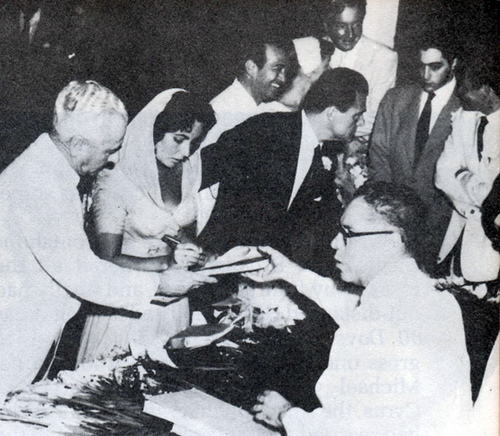
Taylor-Todd Wedding, 1957
“The Casanova”, might not have lasted as a club, but as a name, it presaged Teddy’s career in Acapulco. Stauffer put a different meaning on “swing”, and — with his good buddy Errol Flynn — gave Acapulco it’s head start on the “swinging sixties”. Always one to mix business with pleasure, the compulsive womanizer had a soft spot for weddings. Elizabeth Taylor and Mike Todd’s 1957 wedding was not the only one Mr. Teddy arranged. He liked Acapulco weddings so much, he married five times between arriving in Acapulco and his death at the age of 81 in 1991.
Although also remembered for opening the port’s first shopping mall, organizing tennis tournaments and turning the la Quebrada cliff divers into a lucrative tourist attraction, Mr. Teddy is remembered most for his clubs. His greatest creation (or, perhaps, most “degenerate” act) was Tequila A Go-Go — the first discotheque in Latin America.
 María Elena Velasco directed as well as starred in a series of satirical farces centered around Maria, a traditional indigenous woman who prevails over the villains and villainy of modern Mexico, her native wit and grit put to the test by gangsters, crooked cops, greedy criollos and others. El Coyote Emplumado — a farce involving a stolen Aztec statue, and a satirical look at foreign tourism, the story makes room for an affectionate travelogue of Mr. Teddy’s Acapulco.
This isn’t the best copy of the film, but there’s something hopeful in Maria’s reliance on tradition when she evades the gangsters by slipping into one of those discos. Goebbels was wrong… the swinging Swiss swing saxophonist didn’t cause degeneration in Mexico. Even a old-fashioned girl like Maria could incorporate Mr. Teddy — and Mr. Teddy’s world — into Mexico’s always regenerating culture.
Look familiar?
This video, posted yesterday afternoon is of an “arrest” of a demonstrator at the Pittsburgh G-20 Summit. The posters (“g20media”) say it’s “some scary shit, man” and the demonstrators did not have a parade permit…
The guy hustling a demonstrator into an unmarked car are, we are told, members of a “multi-agency tactical response team assigned to the security operations for the G20”.
They look more like kidnapping to me. The irony is that the winner of my trivia contest wants me to make my donation to Rosario Ibarra’s Comité !Eureka! founded to uncover the fate of victims of “multi-agency tactical response teams assigned to security operations” here in Mexico, and bring the organizers of those “multi-agency tactical response teams assigned to security operation” to justice. Although in Latin America, there is a pithier name for such operations — “forced disappearances”. And for the “multi-agency tactical response teams assigned to security operation. We usually just refer to them as death squads. And the people who think up these kinds of police operations as “criminals”.


 mexfiles.net