2020… in the bag
As of today, within Mexico City, stores and other points of sale can no longer provide plastic bags. The Ley de Residuos Sólidos (“Solid Waste Law”) will only permit “compostible” packaging at points of sale except where there is no alternative for hygienic reasons, or there is no alternative available to prevent food waste. Considering there is a stiff fine for providing such bags, I doubt there will be much of a black market (and, Mexicans are adaptable, with plastic bags only having been around for the last 20 or so years, and plenty of alternatives…. ask your abuela).
While I expect biodegradable bags and food cartons will be on the market shortly, the unsaid major effect of this is that, given Mexico City’s percentage of the country’s population… coupled with the obvious fact that outlets in Mexico City generally have franchises outside the city, or that packaging distributors are unlikely to want to have to sort out sales within Mexico City from those in, say, State of Mexico, or Morelos… or for that matter Chihuahua, Oaxaca, or Chiapas) one can expect what happens in Mexico City won’t stay in Mexico City.
Latin America 2019….
No room at the border…

Word of the day: agredado
He’s got diplomatic immunity.
He’s got special powers no one can see.
Send in the envoy…(Warren Zevon)
I never heard, or saw, the word “agredado” until today… when it showed up not just on the front page of the morning newspaper, but in the first four stories in the paper, and a couple of times in national news reports on radio and TV. Basically saying Mexico don’t need so stinking agregados.
Which are “attaches”… diplomatic representatives, or, specifically in today’s news, “agredados laborales”, “labor attaches”, a never heard of before this weekend diplomatic post, seemingly invented by the Democratic Party members of the US House of Representatives, or by the Trump Administration, or … well… somebody in the US, in a last minute addition to the revised NAFTA treaty (USMECA in English, T-MEC, in Spanish and French).
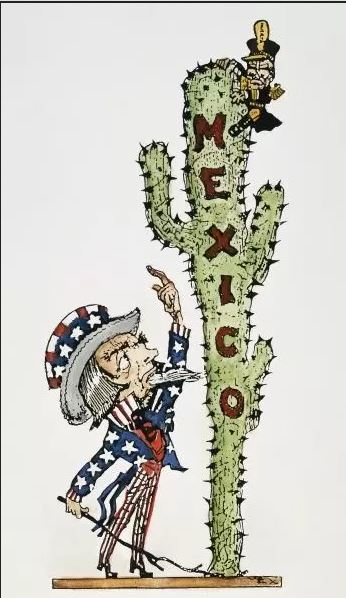 What it comes down to is that the Mexican legislature approved the treaty early, but the US congress refused to ratify it, without some sop to their own base. Unfortunately, in the spirit of Woodrow Wilson, they turned paternalistic and “demanded” that US “labor monitors” oversee compliance with certain provisions related to labor standards in Mexico. You know, the country that was the first to mandate paid weekends, put the basic labor code into its constitution in 1916 and is now governed (and holds a majority in both houses of Congress) by a pro-labor, socialist, party.
The US has proposed these “monitors” be diplomatic personnel… agredados laborales”… which, naturally, the Mexican foreign ministry will not, under any circumstance, permit. It’s not that there aren’t labor violations from time to time (a lot of times to times to be honest about it), but that Mexico traditionally has, as have most nations, rejected foreign control oer their internal affairs. Mexico, with better reasons than most (remember the Drug War?), certainly would not allow some foreign diplomat (who is likely to side with who do you think in a dispute between workers and management in a US owned business?) to dictate dispute resolutions… especially when the treaty Mexico approved called for a regular arbitration process involving two representatives from each of the T-MEC states involved in a dispute, and one mutally accepted arbitrator from a disinterested third country. That is, in a dispute between Canadian labor and a US management, there would be two Canadians, two people from the US, and one from… say, Argentina or France or Gabon, or wherever… a total outsider.
The arrogance of the US Democrats, and frankly racist assumption that Mexicans will somehow “cheat” unless stalwart American are watching is bad enough, but the proposal also stinks of absolute ignorance of what is happening in this country, and what labor protections already exist.
Let’s put it this way.. can Mexico now insist they won’t go along until the US includes domestics in the Social Security/National Health system (oh, that’s right… the US doesn’t have National Health), that all workers are entitled to two weeks of vacation, maternity leave, sick days, and an end of the year extra paycheck? Are the bills in the US House (as there are in the Mexican Chanmber of Deputies, waiting on a vote) to cover “outsourced workers” (Kelly Girls and the like) as employees, entitled to the same benefits (including the right to unionize and/or strike) as any other worker?
Can Mexico insist its diplomatic corps can order US companies to comply with Mexican labor law?
One grace note. A foreign ministry official pointed out that the ministry has the right to declare any foreign diplomat “persona non grata” and doesn’t have to give a reason. Should the US try to send us those new “agregados laborales” they may not need more than an overnight bag when then enter the country.
The fire this time: Genaro García Luna in the dock
Lo importante de que Estados Unidos haya capturado a García Luna no es García Luna, siquiera, sino los baldes de lumbre que caerán hacia arriba, hacia los lados y hasta abajo de García Luna.
(The important thing is that the United States captured García Luna, not García Luna himself. However, the fire that is going to flare up up, down, and all around García Luna.)
Alejandro Páez Varela, in SinEmbargo
That Genaro García Luna, a top cop from the Fox Administration, then Secretary of Public Security, and, arguably, the most powerful figure in the Calderón Administration as chief architect, cheerleader, and commander in the “war on drugs” (or, as it turns out, war on some (inconvenient) drug (exporters) was arrested in the United States for trafficking in “more than five kilograms” of cocaine (as a matter of law, how many more that five doesn’t really matter, but multiply by a number with several zeros to the right might not be excessive) is going to, indeed, “flare up, down, and all around” not just the disgraced General, but scorch not just any number of former (and possibly still active) political and business leaders, but the media, the political parties and, yeah, probably, some of the traditional “cartel” figures as well
 How far back García Luna’s “secondary career” of working for (or, at least not against) certain criminal organizations goes isn’t yet clear. His official career in counter-intelligence stretches back to Carlos Salinas’ Administration, when the General worked for CISEN, the now disbanded Mexican intelligence agency. IN 1998, during the Zedillo Administration, he moved to the Preventative Police, and during Fox’s tenure moved to the Judicial Police, then headed the also since disbanded (for being too corrupted) AFI. During Calderón’s tenure, he was, of course, Secretary of Public Security, the face of the “war on drugs”, endlessly featured on television and in the print media, despite well-documented reports of his inexplicable wealth, and the painfully obvious rising body count indicating the so-called war was anything but a success… or even sane.
It’s no wonder he was a media star… the government paid out 231,000,000 pesos to media firms to publicize his, and his “drug warriors” activities. That included financing a television serial centering on the derring-do and exciting lives of fictional anti-narcotics officers (by the way, the show earned some of the lowest ratings in Mexican television history). And… in a particularly bizarre attempt to improve his brand, re-enacted (with the orignal cast of “perps”) the capture of a kidnapper and his French moll. Both were probably guilty as sin, but the re-enactment threw the entire legal case into limbo, the French media had a field day, and a ruckus in France, leading the the lowest point in Franco-Mexican relations since… oh… the attempt to install Maximilian as Emperor.
That so many in the media either ignored the warning signs that García Luna was openly corrupt, or just unblinkingly accepted payments for positive coverage has left them exposed as incompetent as best, corrupt and untrustworthy at worst. Expect several retirements, or retreats to less and less prestige posts… heck, even a tiny little website like this one isn’t going to take them at their word now.
As to the politicians and the parties.
The Lopez Obrador Administration (which has wanted to both end the drug war, and reform the security apparatus, has been taking full advantage of the situation to order a thorough purge of the police… firing anyone connected with García Luna. It’s understandable that his administration would not want to go after the upper echelons of former administrations, or the opposition parties, lest he be accused of seeking vengeance on his enemies and seen as a dictator. HOWEVER, with the new administration, there has been an important change in the justice system. Where before, the “Attorney General” was the Procurador General, a cabinet officer serving at the pleasure of the President, the nation’s chief prosecutor is now the Fiscal General, appointed by the President and the Senate, with a term overlapping that of the presidency, and not dependent on the Executive branch.
My sense is that the Fiscal leaked information, or made it available to US prosecutors… both to protect the Executive branch from the inevitable backlash of instigating a witch hunt… and to justify likely investigations and probable indictments of very high level former officials. Calderón has been unconvincingly claiming he knew nothing, Fox for once is keeping a low profile, Zedillo is safely (for now) buried in academia, and Carlos Salinas is probably holed up in his lair, boning up on the extradition treaties of various other sunny climes for shady people, As to Peña Neito, it should be noted that Chapo Guzman’s extradition to the United States was during his tenure, but he’s not off the hook, with allegations that holdovers from the previous administrations, as well as those within Peña Neito’s own circle, were also beneficiaries of the largess of various cartels.
And, they’ll burn, burn, burn… in a ring of fire.
Sources:
Asmann, Parker, “Mexico’s Former Top Security Official Indicted on US Drug Charges” InSight Crime, 11 December 2019
“Corruption allegations long dogged ex-Mexico security chief“, Associated Press, 10 December 2019
“De Vicente Fox a Felipe Calderón: ¿quiénes ‘tiemblan’ con la detención de Genaro García Luna?” Vanguardia, 10 December 2019
Flores, Linaloe R. “El policía patriota: Genaro García Luna gastó 300 millones en construirse una imagen de héroe“, Eme Equis, 11 December 2019
Medellín, Jorge Alejandro. “La negra espalda de García Luna y el final de una era en el narco,” Eme Equis, 10 December 2019
Páez Varela, Alejandro. “El encargo” SinEmbargo, 16 December 2019
Santiago, Cuauhtécatl. “Calderón dice desconocer las causas de la detención de García Luna“, La Hoguera, 10 Decembger 2019
Narco-industrial policy
When we talk about the history of Mexico’s traditional exports (oil, minerals) we often divide the story into one of free-lancer eventually consoldated into state run operations, although run mostly for the personal profit of the politically favored, and… in the neo-liberal era, privatized for the benefit of those favored few though with the government always ready and willing to step in to help those who help… themselves. Diego Enrique Osorno, in an extract from his revised version of his 2010 El Cartel de Sinaloa. Una historia del uso político del narco, published as “La cuna de la narcocultura” in Gatapardo, suggests the same he same holds true with another important export… narcotics.
It’s easy to see a parallel between the gangsters who sell drugs, and the crooks running PEMEX. If nothing else, the former probably never declared their incomes properly nor paid anywhere near the income taxes they owe. I used to speculate that the state could take over the narcotics trade as a paraestal [state managed business] leaving the crooks running it now in charge, and no worse a company than PEMEX. That was then, this is now: the 4th Transformation, the era of a “Moral Economy”. I’m not sure how narcotics exports fit into a “moral” economy (but then, it’s hard to put the fossil fuel business in a moral framework either), but I suppose… given that there are legitimate, and “moral” uses for both marijuana and opium poppies, and that crop substitution and better economic and cultural opportunities in the rural backwaters of the country will only go so far, maybe an openly state run narcotics “cartel” … freed from crooks in and out of the government,… would be a logical next step in the on-going “Narco” saga.
From “La cuna de la narcocultura” (my translation)
Following Félix Gallardo’s arrest in 1989, the government claimed the now-imprisoned Culiacán-born “godfather” had organized a meeting with his principal associates among the Sinoloan drug trafficking families, to assign them specific territories. For several years this was considered the “genesis” from which the Sinaloa Cartel was divided into cells organized in different places called “plazas” in the drug lingo. However, when I interviewed Felix Gallardo himself for this book, the capo told me that while there had been such a meeting, the plazas were assigned by the chief of the anti-narcotics police in the government Carlos Salinas de Gortari, Guillermo González Calderoni.
“It was González Calderoni who distributed the plazas. He answered to his superiors, but after my arrest, he never arrested anyone of any importance. They were all friends of his.” In 1989 there were no “cartels”, the capo told me, who still remains locked in a maximum security prison.
“Cartel” is the word that the DEA began using during the eighties in Latin America, later picked up by Mexican authorities, then by the press and eventually by ordinary citizens. It is not a precise term, designating a group of traffickers, but referring to an economic organization that dominates all phases of a business and is in a position to control the market and prices of a product or service. This does not always apply with Mexican “narcos”, however, beyond the mythology surrounding the term — which in recent years has been claimed by the traffickers themselves to name their organizations — the word “cartel” has transcended its dictionary definition and in the popular imagination it has become a simple way to refer to an intricate conglomerate of gangs , generally made up of family members, in a specific region.
Although it is not clear whether it was Felix Gallardo or the government which created the cartel system, the idea that these various groups all work in a coordinated way with the government still prevails. As Felix Gallardo told me: “The drug traffickers were not against the government, we were part of the government.” Thus, until the end of the eighties, drug trafficking functioned as a kind of parastatal enterprise [state corporation, like PEMEX] controlled by mostly Sinaloan families.
But in the nineties, Mexico was simultaneously experiencing the consolidation of neoliberal economic policies and a trend towards alternation in power between various political parties. So, the new competitiveness, as well as a turn to the free market, eventually prevailed in the narco world as well. In this context, the first independent cell to separate from the others was the Tijuana cartel (coincidentally or not, centered in the first state to be ruled by a party other than the PRI). At the time, the Arellano Felix family decreed the autonomy of their territory and began charging special rates to other traffickers who wanted to use the coveted border with California, in the United States.
Who “owns” Emiliano Zapata?
 This year, being the centennial of Emiliano Zapata’s assassination, has seen a number of exhibits, new biographies, conferences, and the like. Considered the most “authentic” of the Mexican revolutionary caudillos by more than a few historians and political theorists, or at the very least, the one with the most consistent agenda (which, I admit, I see as limited to agrarian reform), he has been interpreted and reinterpreted to fit whatever modern sensibility we want to put on him.
Like Pancho Villa, Zapata’s romantic appeal comes in part from NOT emerging from the Revolution as a “winner”… the winners — Carranza, Obregón, et. al. — never reaching consciousness outside Mexico and Latin Americanists… although, unlike Villa, Zapata never has become a joke, or a cartoonish figure. One can’t imagine a comedy about Zapata, whereas at least one comedy has been premised on Villa’s best-known action. Instead, when it comes to films (at least those in English), for foreigners, Zapata is the saintly revolutionary of “Viva Zapata!”, as scripted by John Steinbeck.

Belfast, ca. 1980
Steinbeck’s Zapata was not that of John Womack, the scholar, nor of the Irish Republicans who appropriated Zapata’s rural uprising to the urban “troubles” of their own country, nor that of the EZLN, the “Zapatistas” who draw their inspiration for their own anti-neoliberal uprising to the the Caudillo del Sur… nor that of Mexican communists (never mind the original Zapatistas were “good Catholics”), nor the one promoted by the State of Morelos whose politicians shout their Vivas! to the home-state hero every 16th of September, only to sell out their farmers and see the campesinos as “useful idiots” in their various political campaigns…

Anencuilco, Morelos. Roberto Rodriguez, Photo by Patricia Morales, Cuartoscuro.com
And… Zapata the gay icon. Although it had been suggested, generally to discredit him, that Zapata was gay or at least bisexual (I wrote on this at some length 10 years ago), appropriating him as a gay icon has not been widely accepted. Jorge Zapata, the caudillo’s grandson led a contingent of Morelos campesinos into the Bellas Artes Zapata exhibit yesterday, demanding the removal of Fabian Chairez’s “offending” work.
Honestly, I can understand Jorge Zapata’s objections. It’s not… as some have suggested… brutish, machismo peasants v. the LGBT community, bisexuality having been quietly tolerated in Mexico (I can show you records going back to the earliest days of the Conquest on this), nor that it’s unknown that Emiliano Zapata enjoyed a close relationship with one of the most “notorious” and flamboyant gay men of his time (although, as a horse trainer, and by no means as a social equal to his employer, Ignacio de la Torre). Nor, is it so much that a gay man felt the need to present a supposedly gay man in the retro images of female stereotypes, but rather that a true “working class hero” and revolutionary leader … the image of everyone from the romantic musings of Steinbeck to the gritty street of Belfast… into a ridiculous and decadent bourgeois cartoon.
That, and it’s kitsch.
Anything not nailed down
Cactus thieves in the news.
Ana Luisa Casas “Saquean extranjeros desierto coahuilense” (Zocalo, 2 December 2019):
Other plant species have been seized after being illegally extracted from the Coahuila desert, by people from Japan, Germany and the United States, as well as people searching for alternative medicines, and curanderos.

BOLO: Agave victoriae-reginae
Rubén Rojas, director of the Plant Curatorship at the Museo de Desierto (Mude), that such looting fractures the desert ecosystem, since each plant is a link in the environment..
According to the biologist, the majority of those robbing plants do so for reproduction in foreign countries and for medical use, although MUDE laboratories make tissues or seeds available for conservation or transfer and there is no need to extract plants from the field.
“If we lose that species in Coahuila, the intricate function of the ecosystem loses one more link. Although there are plants with medicinal properties such as peyote, their looting is an unreported issue that needs to be regulated by the authorities, while the collection of some cacti needs to be eradicated, “Rojas Meléndez said.
Arturo González, director of the MUDE also lamented the “unfortunate looting.”
“Mexico has 70% of all the world’s cacti, incredible plants that have healing benefits, which generate very interesting chemistry that could mean important cures,” he said.
“It is not necessary to depopulate the deserts, but to go with an expert who says how you can get it, as we become the main predators of our own deserts,” he added.
Believe it… or not?
The story of Alfredo N. … a 17 year old student, claiming he was abducted, taken to a secret camp in the mountains of Guerrero to “recruited” as a cartel hit-man... sounds like something out of a bad movie, although…

lanation.com.ar
… gangsters have been known to kidnap people for a disposable labor force before, and forced levies are not unknown in Mexican history, although normally, it has been the government or political insurgents who resort to it. Comparing gangsters to a FARC (the photo accompanying the story is from a story published in the Argentinian newpaper La Nacion back in September 2018, about FARC), just gives support to those who would prefer the Mexican gangsters be seen as “terrorists”, and not… as they should be… just as another mafia. I expect Alfredo’s story will be appearing soon in the less reputable reaches of the English language media… The Daily Mail, Breitbart, etc. Stay tuned.
However, if the story is true, in a way it gives hope that some missing and disappeared young people may yet be found alive (Alfredo claims to have seen groups like his, of 10 to 30 young adults in several camps, or rather, abandoned villages), And, if true, it might mean that the new government strategy of going after the gangsters’ financial resources is working, and the gangsters are unable to provide the incentives they once did to willing recruits, and have to rely on untrained, reluctant “draftees”.
Cartels, Lithium, and the Devil in the details
“Never let a disaster go to waste” is the mantra of neo-liberal politicians. That the murder of nine dual national US-Mexican citizens, never mind that they have always been considered “shady” and outsiders in both cultures, has been both an admitted disaster (by the Mexican authorities and by the presumed assailants) but given the location, and the timing, it would be impossible not to note the “advantages” some see in not letting this disaster go to waste.
Translated from Zosíma Camacho, “¿Cuál es el interés de los gringos en Sonora: el narco o el litio?, Contralinea, 27 November 2019.
Will the United States soon remain on the sidelines when the world’s largest lithium deposit in the world is just a few kilometers from its southern border, coincidentally close to where the LeBaron clan women and children were recently slaughtered?
The indescribable crime of November 4 generated a worldwide notic and opened a rift between the Mexican government of Andrés Manuel López Obrador and the US government of Donald Trump.

Photo: Mining Technology
The latter precipitously proposed a war of extermination against the Mexican cartels. The Mexican government did not accept such a proposal, although it had to, while careful to reiterate its national sovereignty, accept United States participation in the investigation. It is necessary to remember that the members of the Mormon community to which the LeBarón belong have dual nationality: Mexican and American.
Thus, on Monday, November 11, a caravan of 50 Federal Bureau of Investigation (FBI) SUVs, with an undetermined number of agents, arrived in Sonora to investigate the bloody attack. The Mexican government has stated that all procedures are carried out in the presence of, and with the consent of, the Mexican authorities. They also indicated that the FBI agents cannot carry weapons in Mexico.
Meanwhile, LeBarón family members went to Washington to speak with the US president. In an open letter, they have asked the United States to designate the Mexican drug cartels as “terrorists”. There are already proposals by Republicans in Congress to approve such a measure, and Trump himself announced that he is also cosidering such a move.
It should be noted that US legislation justifies the action of troops and agents, open and undercover, wherever there are terrorist organizations. And it does not consider it necessary to have the agreement of the governments of those countries.
On the other hand, lithium has become one of the most coveted minerals in the world. It is already the cause of one of the biggest disputes between the various economic (and military) powers. As is known, lithium is the main element for the manufacture of batteries and other cell phone accessories, computers, electric cars, airplanes, spacecraft, submarines … needed for a variety of scientific, technological, and military developments.
Whoever ensures the supply of this mineral will also ensure the victory of an arms, economic, scientific, and technological race between five main competitors: the United States and China at the top and in a second block near Russia, Israel and the United Kingdom.
The coup in Bolivia, where the world’s largest untapped reserves are likely to be, may be the result of this dispute, as the deposed president, Evo Morales has said.
On August 30, the powerful Mining Technology group revealed which are the 10 largest lithium mines in the world . In first place is the Sonora lithium project, a joint venture between of Bacanora Minerals (30%) and Cadence Minerals (70%) .
The mine is estimated to hold proven and probable reserves of 243.8Mt, containing 4.5Mt of lithium carbonate equivalent (LCE). The bankable feasibility study for the project has been completed, which estimates a mine life of 19 years.
Sonora is proposed to be an open-pit operation being developed in two stages with the first stage having a production capacity of 17,500 tonnes per annum (tpa) of lithium carbonate. Stage two will double the production capacity to 35,000tpa.
The other nine lithium deposits in operation are in Thacker Pass (Humboldt, Nevada, United States), with proven and probable reserves of 179.4 million tons; Wodgina (Port Hedland, Western Australia), with 151.94; Pilgangoora (Pilbara, Western Australia), with 108.2; Earl Gray (Greenstone, Forestania, Holland, Western Australia), with 94.5; Greenbushes (Western Australia), with 86.4; Whabouchi (James Bay, Quebec, Canada), with 36.6 tons; Pilgangoora (Pilbara, Western Australia), with 34.2; Goulamina (Bougouni, Mali), with 31.2, and Arcadia (Harare, Zimbabwe), with 29.8 million tons.
The Mexican project is already well underway, having received concessions during the Peña Neito administration. Exploitation set to begin in 2020. But who will exploit it? As we said, the Sonora Lithium is located in the municipality of Bacadéhuachi, in the high mountains of Sonora, in the same region where the LeBarón were attacked and where drug traffickers have operated for decades. The region is largely controlled by the armed “Gente Nueva” gang’s “Los Salazar” faction, tied to the Sinaloa Cartel.
Bacanora Minerals, which will operate the mine is based in Canada, listed on the London Stock Exchange, its capital coming from the governments of Oman and China. This company has no other business or presence in any other part of the world.
On October 15, the Chinese company Ganfeng Lithium bought 29.99 percent of Bacanora Minerals’ shares and Wang Xiaoshen, vice president of Ganfeng, was immediately appointed director of the company.
It is estimated that the Sonora Lithium project, with 100,000 hectares, has a value of 1.253 bullion US dollars.
On the QT, and right under Uncle Sam’s nose, the Chinese are preparing to exploit the most important open-pit lithium deposit in the world. The massacre gives a pretext to Donald Trump to set foot in Sonoran territory. By declaring the cartels “terrorists” he can do both.
Maybe it’s not “poisonous oil” with which we receive messages from the devil, as the poet Ramón López Velarde* had it. Lithium may be attracting attracting a host of new demons.
*
El Niño Dios te escrituró un establo
y los veneros del petróleo el diablo.
The Son of God wrote from a stable,
with the devil’s poisonous oil.
From “La suave patria”At the time of its publication, 1921, the Mexican Revolution was just consolidating although the United States and Great Britain, both having major corporate investments in Mexican oil (Mexico being the second largest producer in the world at the time), were threatening interventions, and demanding special economic rights in the county. The oil fields until the 1930s, were being protected FROM the Mexican government by a mercenary army.
Terrorists? Sound and fury, signifying nothing
Donald Trump’s “plan” to designate Mexican “cartels” as terrorists seems to have more to do with his own country’s domestic politics than with any imminent drone attacks on wedding parties back in the hills of Sinaloa. Although, you can’t blame people here for starting to keep one eye on the sky… just in case.
First of all, Mr. Trump’s statement (on Bill O’Reilly’s “No Spin News”… a radio podcast program) suggested he’d been working with Mexico “for the last 90 days” on a plan to send drones. But somehow no one heard of these discussions, including the Mexican government, until a few members of the extended LeBaron community, made a statement calling the gangsters who apparently killed some members of their family, mistaking them for rival gangsters, in a widely disseminated (and endlessly facebook posted) letter, referred to the killers as “terrorists”… about a week ago, not three months ago. Somehow… while I wouldn’t be surprised that the United States Army has some plans on a back shelf to invading Mexico (and probably has since the botched “Punitive Expedition of 1916”) … I doubt this was much on the mind (does he even have a mind) of Mr. Trump 90 days ago, let 90 minutes before the LeBaron massacre made the Mormon separatists into all American victims.
 But as to the “terrorist” designation. It seems like Manifest Destiny that the United States can decide what other countries should or shouldn’t do about groups in their own country that the United States “designates” as a threat, but let that pass. That the terrorist label allows the United States to forbid contact with the so designated group, and can prosecute those doing business with them is the same thing it does when it comes to criminal organizations now. The only difference is that “terrorists” are pursued by the Department of Defense, whereas the Department of Justice goes after “criminals”. What this suggests is less that the Trump Administration is looking to stop drug dealers than it is looking to continue militarizing law enforcement, perhaps beefing up paramilitary units like the Border Patrol and using Defense Department funds for “hardening the border”… popular to his domestic supporters, but not of much use when it comes to either stopping the flow of narcotics to willing US consumers, or, for that matter, the slaughter of Mexicans who get crosswise with the gangsters.
And, it’s not like the US doesn’t already find legally plausible excuses when it invades Mexico (as in 1876, 1892, 1914, 1916), or that the US hasn’t had “embedded” agents here before… notably during Calderón’s “war on kingpins” that accomplished nothing except drove the homicide rate sky high. But rather, those incursions have gone spectacularly wrong. The incursions of 1876 and 1892 were small affairs, supposedly to hunt “bandits” (although really to pursue would-be rebels against Porfirio Diaz) or to “help” Mexico (as in the 1914 invasion of Veracruz to stop the shipment of arms to the Huerta dictatorship). And, given the last two military incursions, in 1914 and 1916, the US could expect resistance… not from those it sought to destroy so much as from, well, everyone.
In 1914, the German ship carrying weapons to supply Huerta’s federal army simply unloaded down the coast, while in Veracruz ordinary citizens, the Federal Army, the Naval cadets, armed convicts released from prison fought the invaders, and once the US Marines had captured the port, they found their presumed beneficiaries, the Constitutionalists led by Venustiano Carranza, were hardly grateful, publicly announcing they would ally themselves with Huerta to drive out the invaders. In 1916, again under the claim of hunting bandits (Pancho Villa, having fallen from the grace of the Wilson Administration, being conveniently re-dubbed a “bandit”). the US Army did little other than split the Mormon community, beat and torture some campesinos, and rather embarrassingly lose the only battle they ended up fighting… not with the “bandits” but with the Mexican Army, their putative ally, in the small town of Carrizal, Chihuahua.
We’re already seeing a hint of what might be coming should the US even make noises about an incursion with hugely popular demands floating around the internet to strip the LeBaron colony of their citizenship and expel them from the country for their “treason” in appealing to the United States President for assistance, and serious questions being asked about the loyalties of those PAN governors in the border states who remain friendly with US law enforcement officials.
Of course, the United States has tanks, and drones, and.. hell,… NUKES… at its disposal, but if they were serious about “fighting the cartels” they’d release their said to be incorruptible police forces… the FBI; the DEA, the IRS, the ATF… on their allies of the cartels in the United States. Sure, they can lock up all the drug dealers they want, but until they go after the money and the weapons, more incidents like those that befell the LeBarons are going to happen, with or without US drone attacks.
Food fight… sorta
The Museo de Arte Moderno indeed does forbid bringing in food or drink to their exhibit halls, but what’s a baby to do? What’s a mother to do?
When security removed a patron the other day for feeding her baby in the exhibit hall, it sent some titters through the mom-and-baby community, leading to civil disobedience by forty babies and their mothers.
Just keeping you abreast of the latest demonstration here in Mexico City.

Photo: Carlos Paul for La Jornada


 mexfiles.net