Gabo and Oscar: Friday Night Video
If you can’t beat ’em, join ’em.
El Universal, and other Mexican newspapers… recognizing that newspaper readership is falling everywhere, includes video clips on their on-line edition that are always informative and well-produced.
A new biography of a well-known novelist might get buried (if reviewed at all) in the back pages of a U.S. paper. But, then… would Danielle Steel or John Grisham or even Saul Bellow get a reception like this?
Music, by Oscar Chavez to round out what Mexicans consider newsworthy…
“Osama, Osama…” the twice-told tale
With U.S. President Barack Obama taking what should have been the unremarkable step of actually speaking to people the country wants as allies, the typical right-wing crazies are going ape-shit.
For some reason, as justification of why Obama should NOT have talking to countries that the U.S. would prefer be on “with us” and not “with the terrorists”, anchor-baby Michelle Malkin threw a terrible twos (Muslims and Latin Americans) hissy-fit:
Among our great friends south of the border, Mexico boasted “the second-largest number citing the US government as the perpetrator of 9/11 (30%, after Turkey at 36%). Only 33 percent name al Qaeda.” Which, of course, is no shock to those who remember when the U.S. soccer team was taunted with chants of “Osama! Osama! Osama!” after a match in Guadalajara four years ago; or when the team was booed again in 2005 and plastic bags filled with urine were reportedly tossed on American players.
They hate us. They still really, really hate us.
Uh, no… as the NBC Sports website Ms. Malkin references about this event …
“…a few dozen fans chanted “Osama! Osama!” as the United States was eliminated by Mexico in Olympic men’s soccer qualifying.”
In Mexico, people are very polite, even at soccer games. Still, in any crowd at a major game you’d be hard pressed not to find a few dozen guys getting drunk and obnoxious. It’s not “they hate us” but they hate having to remember their manners when they’re shitfaced.
Ms. Malkin is not very polite and she does hate us (“us” being sane people AND Mexicans). Was she drunk, too?

McPrison — the newest NAFTA import
I’ve heard the claim that Mexican pop culture reflects U.S. pop culture … but lags a couple of years behind. When it comes to things like pop music, or movies, the results may be odd (a children’s party down the street over the weekend featured a disc-jockey playing Village People hits and Gloria Gaynor… all that was missing was the mirrored ball to turn colonia Sanchez Celis into West Des Moines Iowa, ca. 1978.
Post NAFTA (or maybe, more accurately, Post Napster) pop cultural incursions have been more rapid. It’s probably a harmless trend (and Mexicans have their own way of absorbing foreign influences), though there are those who would (and will) continue to harp on the coarsening of culture, courtesy of the colossus of the North, and blah, blah, blah.
It looks though, as if a less benign trend is making its way here.
The federal government announced plans to build 12 new prisons that will be franchised to the private sector… This with the intention of reducing overcrowding in Mexican prisons (Mexico Today).
Many cheered when the Obama Administration claimed the “war on drugs” was over, and there was a new paradigm at work. All well and good, but I thought (and I’m not the only one) that the “prison-industrial complex” was too big, and too economically important to be shut down. The “war on drugs” was too good for businesses — or certain business — to just disappear.
Using the argument that there are too many criminals being arrested (even with periodic mass jailbreaks, Mexican prisons are overcrowded) and — since Felipe Calderon has put off signing a narcotics decriminization bill — we can probably expect the “war on (certain) drug dealers (but apparently not on others)” to lead to more prisoners. Miguel Angel Guiterrez of Reuters lays out the problem, and the Calderon Administration’s solution… one that — given the track record of these “private prisons” — doesn’t bode well:
Dozens of violent clashes have rocked jails this year and a stream of inmates have escaped. Last month drug hitmen dressed as police screeched up to a northern Mexico prison in a convoy of vans and freed 53 prisoners who were seen on security cameras pouring into the street.
…
Mexican media count 22 jailbreaks this year and some 40 prison feuds, fueled by guns smuggled in by visitors and lax or corrupt guards who let prostitution and drug peddling go on within prison complexes.
April alone saw 19 riots in jails in Mexico City, where wealthy inmates bribe guards for spacious cells with televisions, while others sleep on bare floors in crowded conditions, Mexico’s Human Rights Commission says.
…
Public Security Minister Genaro Garcia Luna said on Tuesday that a dozen additional prisons, built and run by private companies, would be ready to hold Mexico’s top criminals by 2011.
Genero Garcia Luna is the guy whose house is much too big (and too highly assessed) to be built on a civil servant’s salary, but he claims it was investments… in GEO Group, perhaps?
There is no question that an increasing tendency to send people to jail, even for minor social offenses, has led to both overcrowding, and is a step back from the generally benign intentions of Mexican penology… where prisons are called “Centers for Social Readaption” — the theory being that jail is not a punishment for a individuals’ wrongful act, but a controlled environment for learning to live in a less-controlled one.
One thing that really bothers me is that Islas Marias will be turned into a private prison for serious criminals, instead of the refuge for social misfits it is now. The hopes of turning the Americas’ last prison colony into a wildlife refuge are again thwarted.
Yeah, right
The paranoid “AY-rabs are gonna get you” crowd just doesn’t give up… especially when they can get a two-fer and throw scary Latin Americans into the brew.
Exhibit A is the newest “threat” making the rounds… courtesy of the otherwise reputable Federation of American Scientists (which has a strong pecunary interest in weapons research and development) … from “Open Source Center” (which is a propanda organ for the U.S. intelligence community) on the HUMONGOUS threat of … get this… Bolivian Muslims. All 1000 or so of them (including minor children), which, as El Duderino calculates, words out to about 0.001 percent of the Bolivian population. The Bolivian muslims, according to the report might be “susceptibility to foreign Islamist influence”… yeah, there’s an Imam from Argentina, and a La Paz doctor who was born in Pakistan.
Exhibit B, courtesy of the never-reputable Washington Times, is an EXCLUSIVE: Al Qaeda eyes bio attack from Mexico” (insert several exclamation points here). While the Washingon Times has enough journalistic integrity to note that
[United States] officials, who spoke only on the condition they not be named because of the sensitive nature of their work, stressed that there is no credible information that al Qaeda has acquired the capabilities to carry out a mass biological attack although its members have clearly sought the expertise.
Yeah… some guy in Whothefuckknowsistan made a “recruiting video” for the wannabes saying “we’re looking for a few really stupid guys” who are gonna carry an as yet undeveloped instantly lethal anthrax produced at non-existent laboratories in a suitcase — without somehow kiling himself (and everyone around him) half-way around the world, sneak into Mexico by some yet to be determined means, cross the U.S. border (somehow), meet up with crazy right-wing militia men who hate Jews more than Arabs (or that’s the plan) and … still not managing to kill everyone as they cart around this battered suitcase of death… then spread “anthax confetti” somewhere or another. Pretty convincing plot, no?
Every once in a while, you run across paranoids talking about arabs crossing the U.S. Mexican border, usually with the breathless very scary additional information that the Arabs spoke Spanish. Like, oh… Carlos Slim, an Arab-Mexican, who crosses the border quite regularly for nefarious doings like board meetings of the New York Times Corporation.
There are a lot of Latin Americans of Arab descent, and — given the near impossibility for even political refugees from Arab nations to receive residency in the United States, recent Arab immigrants in Mexico and other Latin American countries sometimes are planning (and sometimes do) irregularly immigrate into the United States.
Ay-rab terrorists are a perennial favorite of the paranoid right wing in the United States., but you have to wonder whether the “officials” were not named because they were the same guys who tipped off Bill Gertz of the Washington Times back in October 2004 that Chechen terrorists had entered the United States. Of course back then, Chechens were in the news, and still had cachet.
“The cold war ended today”
Though one of its more useless organs is still functioning… barely.
The Cold War ended today. Fidel Castro said more than 40 years ago that history would absolve him, and history absolved him.
Manuel Zeleya, President of Honduras on the end of the 47-year old ban on Cuban membership in the Organization of American States.
In a concession to the United States, language specifiying that Cuba had to honor the “democratic principles” of the OAS… presumably referring to Article I of the OAS Charter, which calls on member states to “preserve and defend” democracy… like those other bastions of freedom — Chile during the Pinochet Dictatorship, Guatemala during the reign of the genocidal religious fanatic Efraín Ríos Montt, Haiti during the Papa (and Baby) Doc era, Argentina during the “state of exception”, etc.
Cuba, which takes the Organization of American States no more seriously than anyone else outside of a few Washington inside-the-beltway types (and maybe Andres Oppenheimer of the Miami Herald ) essentially, “thanks, but no thanks.”
(Everybody who writes on Latin America sooner or later has to deal with Oppenheimer. He is worth reading for a simple reason. He’s an excellent guide to the more reactionary thinking within U.S. political circles (and opposition research usually repays itself) and — with a batting average somewhere below the Mendoza Line for his prognostications, you can usually take what he says, bet the opposite and come out ahead. — end of snark).
Although there were organizations — set up to foster U.S. trade with Latin America — prior to 1948, the OAS Charter was founded on a “a pledge by members to fight communism in America.” But, as Cuban Ambassador to Paraguay, Hector Igarza, was quoted in the Miami Herald as saying:
A truly authentic organization would be one where Latin Americans and Caribbeans could discuss, debate and look for solutions to their problems without intrusion from external actors…
Which sounds slightly more diplomatic than the Diaz-Bartlett brothers:
The OAS is a putrid embarrassment,” declared U.S. Reps. Mario and Lincoln Diaz-Balart, both Miami Republicans, in a joint statement.
Which means… batshit crazy right-wing exiles and Commies alike agree on one thing… Oppenheimer doesn’t know shit, and the OAS, like Francisco Franco, is still dead.
Not every cop is a criminal…
What you read about in the foreign press (and the Mexican press) right now is about police officers being arrested en masse… but what you aren’t hearing about are replacements.
I caught this small item in the Caracas English-language Latin American Herald Tribune (rapidly becoming one of my favorite newspapers):
The Mexican government has launched a program to train 1,500 university graduates as federal police investigators and intelligence officers as part of an effort to upgrade law enforcement by introducing scientific methods.
“It gives me great pleasure to know that there are men and women trained at the country’s best universities who are willing to be investigative and intelligence police officers for the Federal Police,” President Felipe Calderon told the trainees in a videotaped message on Monday.
…
The 12-week program will be held at four universities and police academies, with Mexican university professors and foreign instructors teaching the courses.
Trainees will acquire knowledge and skills in a number of areas, such as anthropology, psychology and criminal sociology, learning about criminal behavior.
They will also learn, among other subjects, about police theory and ethics, police techniques, and basic principles of police analysis and investigation, while observing human rights and complying with the law.
While I wonder if a 12-week training course is sufficient, this is a step in the right direction. The biggest problem (two problems, actually) with police in Mexico is that they are poorly trained and poorly paid… which either results in — or is a reflection of — the perception of police officers as a low-status occupation.
I’ve been accused (and plead no-contest) to not accepting the common (journalistic) formula that Lopez Obrador is or was a dangerous radical. I lived in the Federal District during his tenue as Jefe de Gobierno, and thought the district ran relatively well… and that improvements in the quality of life were noticeable. It wasn’t the big splashy programs that I thought made him more than “presidentiable” but the bureaucratic and policy changes that really affected day-to-day life: street lights and garbage collection issues.
 I was particularly impressed (and mentioned it in passing in my Mexican history, seeing it as a major historical change) with the police reforms instituted when now Jefe, Marcelo Ebrard was Secretary of Public Safety (“police commissioner”). Higher educational requirements for police candidates might not mean less muggings today, but it meant smarter cops on the streets over the next several years. Better salaries and more benefits didn’t eliminate bribery, but it makes the job more attractive to people with a “respectable” lifestyle, and didn’t need to risk their jobs for a few pesos to get through the day.
Both Lopez Obrador and Ebrard came to their political careers from the social services field. It seems laughable when the administration began fiddling with police uniforms, and that seems like a small thing, but image is important.
Ned Crouch’s well-written (and MexFiles recommended) book for U.S. employers doing business in Mexico, “Mexicans & Americans: Cracking the Culture Code” recommends exploiting the Mexican sense of group identity in the workplace. While the job itself may not be glamourous, or even particularly high status, giving the workers a sense of themselves as part of a group and showing respect for them as members of that group, pays off.
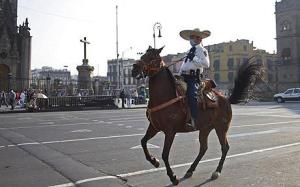
Still there are budget problems. Officer Dobbin didn't get a cubraboca.
One example Crouch uses is giving “gimme-hats” to the employees, including the grounds keepers. It wasn’t the hats that were important to the guys mowing the lawns around the office… it was being seen as having a place within the group’s overall solidarity. Similary with police uniforms — it wasn’t so much that a cop now had something that looked sharp and flattered his or her build (though, there’s the side effect that when you look good, you are a lot less likely to hang around with taco grease down the front of your jacket… or indulge in enough tacos to ruin the good silhouette. “Cos every girl crazy bout a sharp dressed man“, new uniforms may have been a factor in being able to recuit younger, healthier, cadets.
 And, a part of that esprit de corps (and another improvement in overall police work) was also a simple change unlikely to make a splash at election time… calisthenics at the start of the shift, and more physical education (even for the Segway patrols) and weight training for the cops.
Uniforms and equipment only go so far… Delegacion Miguel Hidalgo a few years ago spent a fortune on outfitting “robo-cops”… who, with no training, were sent out to squelch unlicensed vendors and got the crap beat out of them by a bunch of irate grannies. Training takes time, and doesn’t fit election cycles, but is absolutely necessary. Ebrard’s biggest single reform was instituting on-going training sessions for the police, and I’ve written before on the amazing training program in Nezahuacoatl that radically altered citizen perceptions of the police. It’s not just using weapons, but just basic citizenship that makes for better policemen. It may not get votes this cycle, but it pays off in the long run.
Of course, there are still problems with policing in Mexico City — and the police are far from ideal. you are always going to have your share of bullies and perverts and uniform fetishists in a job like this, but I’d say the Federal District police are — overall — much better than those you find in most places throughout the country or anywhere in Latin America. When you read about corrupt officers in Mexico City, you usually find that the persons involved were Delegacion or Auxillary officers, not members of one of the Federal District units, or were members of the same unit (in which case, it’s usually their commander who is at fault).
I question the timing of the newest wave of police and bureaucratic arrests (and wonder whether they’ll even come to court, or the cases will be quietly dropped after the July elections), but firing a bunch of ill-paid, uneducated, bribable cops doesn’t resolve the problem. It might sway a few voters (or.. perhaps, PAN often following the U.S. Republican Party’s tactics, discouraging poorer voters — who tend to vote for the other parties — from going to the polls). Nor, is it just a matter of equipment. The only thing worse than a sleazy cop, is a well-armed sleazy cop.
Not glamorous, and not likely to make much money for U.S. “advisors and consultants”, but the real way to get a handle on Mexican police problems (if they are, indeed, problems) is uniforms, pay and training. Not highly politicized short-term headline making “house-cleanings”.
What’s good for G.M. is good for Mexico…
or, so argues Edgar Amador in The [Mexico City] News.
Company managers are appointed to maximize profits for its shareholders, but in this case it’s a little bit different. GM’s largest shareholder [is the United States government]…
… if GM really wants to become a contender again, it has what it takes south of the Rio Grande: a partner with 105 million people, with lower labor costs, ample infrastructure to ship exports abroad and flexible labor regulation.
Cities such as Silao, Ramos Arizpe, Saltillo, Toluca and San Luis Potosí already host some of GM’s vanguard facilities in the world.
Mexican GM plants assemble mostly four-cylinder vehicles and may be set up to manufacture hybrid and ecology friendly cars, such as the one required by the new U.S. government blueprint. Mexican plants, for GM, are among the lowest cost and most efficient plants in the conglomerates.
The easiest way out for GM is to move as much of its production capacity as it can down to Mexico. But that’s easier said than done. What would U.S. taxpayers say the moment they find out that their taxes used to bail out GM are being used to ship jobs, not cars, south, that they are paying taxes so that their precious few jobs are GM … G(one) to M(exico)?
I think the point is that the United States is locked into its consumerist economy. In which case, saving the jobs related to the sales and service of a good s a more pressing goal than creating the goods themselves.
At least in the short term, while the U.S. plants (and entire management and labor situation is reformulated) Mexican workers may be what’s good for G.M. and the U.S. taxpayers.
(By the way — I notice that this was the only Mexico-related article on the “New” News’ editorial page — the lead editorial dealt with Burma and the United Nations Security Council (although Mexico is a member of the Security Council this year, there was no mention of the fact, nor any suggestion that Mexican diplomats take a lead on this issue), and the others with internal politics in the United States. The only “News” produced story I could find was an overview of the back and forth over projected debates between the chairs of PAN, PRI and PRD).
Malcolm… hire David Agren back, and give him a raise!. And, maybe you can drag Kelly Arthur Garrett out of retirement.)
A tale of two (border) cities
Monday was D-Day (as in Documentation Day) when the “Western Hemisphere Travel Initiative” (i.e., “Show us ze papers” act) went into effect: United States citizens entering their own country have to show a passport. The Associated Press tried to spin the narrative that there were only minor problems… and — obviously — those nice friendly Federal officials treat everyone the same, whether in Buffalo or El Paso… right?
Jessica Whitaker of London, Ontario, didn’t have a passport and was reminded of the new requirement before officials allowed her in to the U.S. at the busiest passenger northern crossing, the Peace Bridge between Buffalo N.Y., and Fort Erie, Ontario.
“They were very nice, very polite,” said Whitaker, who had a birth certificate and driver’s license.
And there were some hiccups.
In El Paso, U.S. citizen Rosario Aragon said she got into a heated, 30-minute discussion with a border agent demanding a passport for her 9-year-old girl, even though U.S. and Canadian children under the age of 16 only have to present a birth certificate. He finally let her through after taking her daughter’s name and warning her to get an official ID from local police.
¿No pasaran?
As a cynical Mexican once noted, the way to increase trade with the United States is simple — suppress the unions, go back to the one-party state and kill the students.
June 1989…

The rise in the United States’ trade deficit with China between 1989 and 2003 caused the displacement of production that supported 1.5 million US jobs. Some of those jobs were related to production or services that ceased or moved elsewhere; others were jobs in supplying industries. These jobs reflect the effect on labor demand – in lost job opportunities – in an economy with a worsening balance between exports and imports. Most of those lost opportunities were in the high-wage and job-hemorrhaging manufacturing sector. The number of job opportunities lost each year grew rapidly during the 1990s and accelerated after China entered the World Trade Organization (WTO) in 2001. The loss of these potential jobs is just the most visible tip of China’s impact on the US economy (Asia Times).
Afraid to visit Mexico?
I hear Guatemala is lovely this time of year:
GUATEMALA CITY – Guatemala’s national ombudsman says the number of murders between January and April exceeds by 15 percent the number during the same period in 2008 and that this year is on track to become the most violent in the history of the Central American country, which already suffers an average of 17 slayings per day.
…
The 2008 murder total in Guatemala – a nation of approximately 13 million – was nearly equal to that in neighboring Mexico, which has more than 100 million inhabitants and is the scene of open war among rival drug cartels.
According to Interior Ministry figures, in the first four months of 2009 there were about 1,996 homicides…
The News in the news
Once again, there’s a “new” The [Mexico City] News. The “old” News — founded in 1950 by Romulo O’Farrill — achieved something of legendary status given the later career of some of its former ink stained wretches like Pete Hammil and Joan Didion. And, provided a nice cover for a passel of spies back in the day.
Though widely suspected of being a mouthpiece for Washington (and supported by the C.I.A. — which is probably true for more than a few of its underpaid reporters and editors) — in the mid-1950s Fidel and Raul Castro (who were living around the corner from Novadades, the parent company) would come in to check the foreign wire service reports (then-editor James Plenn recalled them as “nice boys”).
Given both the CIA influence (which supplemented reporters’ incomes, while also providing “loans” to the paper, and even copy through a front organization, “Daniel James and Associates” a supposed public relations business), the O’Farrill family’s ties to the conservative wing of the PRI and the paper’s utter dependence on the Party for advertising revenue, it was — ironically enough — a victim of press liberalization in the 1990s.
The News hung on for a few years, Novades didn’t seem to know how to function in the new era, with papers (and all media) having to scramble for advertising revenue after access to government-sponsored advertising became competitive.
By 2002, when Novades itself folded, the News was a joke. It still had some good writers (I ran into Michael O’Boyle one night who said that the News was the only place a guy could be the business editor of the country’s largest English-language daily fresh out of journalism school) but there wasn’t much news in The News that I couldn’t get elsewhere. And I wasn’t the only one.
And, although there was an explosion in the English-speaking population of Mexico beginning in the late 1990s, the news-reading community changed. Those interested in “news from home” could access U.S., Canadian, British and other papers over the internet, or watch cable television. Most of the growth in monolingual English speakers was among retirees who had no interest in Mexican affairs, and the paper — if read at all — seemed to depend on ESL teachers: not exactly the best market for advertising new cars or sales at the local supermarket.
With English probably the second-most widely spoken language in Mexico, there is still a need for an English-language daily, and for a few years, the Miami Herald, in cooperation with El Universal, did publish “The Mexico City Herald” which just never really got off the ground and folded in 2005.
When the “new” The News was launched in October 2007 (I had a little warning from my own journalistic “deep throat” source), I was a little dubious about the O’Farrill family coming back into the news-biz, but the paper seemed to have decent funding — from somewhere. Never attracting any real ad revenue to speak of, its raison d’etre seems to have been a forum for attacks on the PRD-led Federal District Administration. Still, it had some good reporters: Jonathan Clark, who’d been one of the few “real” reporters at the end of the old News era was lured back from Arizona, David Agren, who’d been hanging on as a stringer for Canadian papers was brought on board, and Nacha Cattan did good local news stories. Otherwise, it was a mixed bag (one reporter used to post messages on one of the tourist message boards looking for sources. Jonathan Clark once wrote a good story he caught on to by reading the tourist websites — and that’s how I met him — but it was about a foreigner who preyed on tourists, and tourist message boards were a legitimate reseach tool).
As a national daily, it had a huge problem — Agren was expected to cover the Chamber of Deputies, the Senate and Los Pinos all on his own; what spotty coverage there was from outside the capital depended on free lancers (like myself on one occasion), or was re-hashes of foreign coverage … and filtered through the editorial presumptions of the foreign press. When I visited The News in February, the staffers all mentioned the same problem — the paper depended on coverage from foreign (U.S.) news sources with their foreign biases or they were publishing news two or three days behind the Spanish-language papers.
I should have had a clue something was up when David Agren was forced out (ostensively because he wasn’t writing enough — though how one guy was supposed to do the job normally covered by at least a dozen writers is beyond me) I should have sensed something was up. I wasn’t the only one to notice that last Friday’s on-line edition, and Saturday’s …. and Sunday’s were the same. Looking at the print edition, there was an explanation that the paper was moving offices. News, apparently, to the News.
And — the paper went out with a lie. There was no move. For that, we need to look at Planeta Mexico (a tourist website!) and Editor and Publisher (a U.S. publication for the news trade);
Mexico City News, the city’s only English-language daily, began operating under a new owner Monday — and with a new publishing schedule and with a staff shrunken by two-thirds.
Grupo Mac, whose Mexican papers include Cambio and Estadio, bought the paper from Victor Hugo O’Farill of the well-known Mexican publishing family.
In unsigned editorial in Monday’s paper [reprinted by Deborah Bonilla in the Los Angeles Times’ “La Plaza”] Mexico City News said it is reducing its page count to 24 pages Monday through Thursday and will publish a 32-page weekend edition on Fridays. It is eliminating its Saturday and Sunday editions.
Planeta Mexico reported the paper’s staff had been trimmed by two-thirds. The editorial alluded to the layoffs, saying the “fault” for that lies with the previous owner.
“When you lay off dozens of employees by surprise — as happened at The News on Friday, and as is to be expected in any merger, anywhere, particularly during an economic crisis — make a personal appearance to break the news,” the editorial said. “Have the ‘cojones’ to fire people yourself, thank them for their hard work and effort and face any possible backlash, rather than leaving the dirty work to the lackeys and muscle-for-hire.”
The firings were — at least in the letter of the law — probably (but not definitely) legal, but the “new” News doesn’t look any different from the old news… except that it doesn’t even have what news the other one did, relying instead (one hopes temporarily) on reprints from U.S. media sources. And, still using the really crappy on-line service that not only replaces accent marks with gobbledy-gook — as commentator Charles Dews noted in the La Plaza story, “Can you imagine how frustrating it has been to try to read something like JosACe FernACandez from MichoacACan played fACutbol today in PACatzcuaro, and suchlike?”
They’ve got to do more… as it is, the Mex Files can screw up accent marks and run the news a few days late at a lot less money (which it can always use… more money, not less of it)… and at least you can access the archives.

Dia De La Marina
Felipe Calderon will be in Mazatlan today for Dia de la marina events. Dia de la marina commemorates the the date in 1917 when article 32 of the Constitution of the United Mexican States went into effect. The article states that any vessel flying the Mexican flag must be crewed by seamen who are Mexican by birth, which if it sounds like it’s discriminatory towards immigrants, it is.
The first Mexican admiral was an out of work former United States Admiral (David G. Porter), and naval officers up to the time of the Revolution tended to be either Spaniards or U.S. citizens… who had an annoying habit of changing sides during coups and counter-coups.
Several even went over to the enemy in 1846, when Commodore Shubrick sailed into Mazatlan, setting up the United States’ Navy’s first overseas base… and it’s first and last Mexican base. Since this WAS for a short time the U.S. Pacific Fleet headquarters, I guess its appropriate to celebrate Felipe Calderon’s visit to the Mazatlan navy yard with an American sea chanty, filmed aboard the U.S.S. Reasoner in San Diego in 1978. Ahoy!


