Sunday readings
Clearing out my bookmarks on a Sunday afternoon:
Leftist governments are anti-business?
Otto the Inca’s latest “chart-o-the-day” should give pause to those who think conservative governments are, by definition, more investor friendly than the lefty ones. At least it appears investors don’t follow the same line of reasoning:

Here we go again
Abortion is likely to be before the Supreme Court again. Here in Mexico that is.
In the last 13 months, 12 of Mexico’s 32 states have approved amendments to their state constitutions defining a fertilised human egg as a person with a right to legal protection, and seven other state parliaments are taking steps in the same direction.
Non-governmental organisations (NGOs) say it is a massive conservative reaction to a law decriminalising abortion up to 12 weeks’ gestation that went into force in the Mexican capital in April 2007.
The law was upheld in August 2008 by the Supreme Court, which ruled that it did not violate the Mexican constitution.
Behind the wave of reforms of state constitutions, according to critics, is a pact between the hierarchy of the Mexican Catholic Church and the leadership of the most traditional political parties to curb social movements advocating the legalisation of abortion.
Tag an alien, win five bucks:
This is just kind of neat. From the Mansfield (Ohio) News-Journal:
Allie Crall was happy and speechless when she learned a butterfly she tagged in September migrated nearly 2,000 miles to central Mexico.
“The most fascinating thing is how (monarch butterflies) get from here to Mexico and their travel distance,” said Allie, a Wynford Elementary School sixth-grader.
It was the butterfly enthusiast’s first time tagging a monarch for the Crawford Park District’s annual tagging event at Unger Park on Sept. 13. The tag was found in El Rosario this spring. Monarch Watch uses the tags to help with migration research. Monarch Watch pays $5 for each tag recovered.
“The glory that was Greece…”:
I wrote in my own book about the origin of the word “gringo” (from “greigo” — Greek). Its been a slow week, and I happened to look at where people were coming to my site from. I didn’t recognize “Saratakos.wordpress.com” but then… without a translator, I wouldn’t have been able to read it anyway. It’s a scholarly study of the origins of the word, Γκρίνγκο… which is, of course, Gringo in the original Gringo-lingo.
Off to the beach…
Thanks to the right-wing lunacy emanating from the nomination of Sonia Sotomayor for a seat on the United States Supreme Court, I finally figured out how Watergate happened. It was a failure to communicate.
A bunch of Cuban burglars were sent out to bug the Democratic Party headquarters… led by all-round lunatic G. Gordon Liddy, who proved his ineptitude when it comes to languages (and to acting like a human being) when he said of Sotomayor, “‘She’s a member of La raza’, which is illegal alien for ‘the race’.”
Unfortunately for all of us, Liddy’s criminal sentence was commuted by President Jimmy Carter and what should have been the incoherent ravings of a cracked ex-con on the back wards of some hospital for the criminally insane (and basically useless) has instead led to a career in broadcasting his potty messages over the airwaves and broadband.
While Liddy’s cohorts were definitely up to something illegal (and were aliens) Spanish is not, of course, “illegal alien” and Spanish words are not simply clandestine disguises for English terms.
Stace Medellín, over at the Houston area political site, “Dos Centavos” once again has to take up the dreary task of explaining a Spanish “false cognate” (or “falso amigo”) of trying to talk some sense into the congenitally bone-headed one more time:
This issue comes up every time a Spanish-speaking person is recommended for any position in the United States, or Spanish-speakers are in the news… as now, with the nomination of Bronx-born appellate court judge Sonia Sotomayor for a position on the U.S. Supreme Court. One of the sillier attacks on Sotomayor’s nomination is that she is a member of a civil rights group for Spanish-speakers, called “la Raza.”
The group’s name is enough to give monolingual Anglophonic bigots all the (false) rationale they need to twist the arguement to a claim they are countering bigotry (by fostering it… sort of like burning down a village to save it). According to the people who “buy” this line of reasoning, the U.S. group, la Raza uses as its motto a quote from Mexican academic, politician and philosopher, José Vasconcelos — “todos para la raza” — “all for the people”.
I did once run across someone with enough sophistication to confuse himself even more. Vasconcelos, having turned against the Calles Administration, ran for President in the special election of 1929. Following his defeat, he drifted further and further into right-wing circles, ending as an apologist for Hitler.
Ironically enough though, when Vasconcelos spoke of “raza” in the sense of ethnicity, he was talking about mestije (what in English is called by the negative word, “miscegenation”) as a positive thing. He wasn’t so much pro-Nazi as in awe of Hitler as an author whose book led him to political power. And — no getting around it — Vasconcelos was an anti-Semite.
That may make quoting Vasconcelos problematic — though it is like assuming whatever Henry Ford said about automobiles was suspect because Ford also praised the Nazis, and was a notorious anti-Semite — but doesn’t make “raza” mean “race”.
This isn’t just a “chicano” thing, or even a Latino thing, by any means. It’s not even a Vasconcelos thing.
One doesn’t need to go to the Diccionario de la Lengua Española of the Real Academia Española (though I did… page 1731 of the 21st edition to be precise) to know how stupid this is. “Raza” is used everywhere in the Spanish-speaking world … from Argentina to Andulusia … to mean breed, nationality or other group which hold something in common. Only the ancillary uses after the seven definitions does it mention “raza humana” … “human race” and subdivisions thereof .
Drugs: Change the paradigm?
I had a job in Mexico City for a while where I’d be leaving the office just about 7 P.M., when the Federal Gazette was published. I knew a couple of guys who made a pretty decent living as runners — picking up the copies as soon as they came out the door and heading for the major law firms (Judges would read at their leisure). Until the Federal Gazette is published, a law is not in effect. Several recent laws, mostly those pushed through Congress by the opposition, have yet to be published, including the new narcotics decriminazation bill. Opposition deputies and senators are tired of waiting … and openly speculating that President Calderón is putting off sending the bills to the Gazette to avoid having the “war on drugs” seen in this election campaign as any more of a political failure for his party– and a human rights disaster — that it already is. What effect the continued war will have on the 2012 Presidential elections is already becoming something to consider.
Jose Antonio Crespo is sometimes cited in the foreign press as a “political analyst” — which he is, as well as a historian of note, a professor, a TV talking head and newspaper columnist. My translation is from Friday’s nationally published column, which appeared in my local newspaper, El Debate de Sinaloa.
The odds are about a hundred to one against PAN making the “war on drugs” the focus of their campaign in 2012 – not because we will have won the war, but just the opposite: it will be clear that the Felipe Calderón’s war is a monumental strategic failure. How can we claim to be winning a war when criminals escape with the assistance of their guards? When authorities announce the capture of small time dealers, hitmen, various “capos or even mayors –our first question is ‘how soon will they escape?’. At the same time that the Federal Government showed no confidence in Michoacán Governor Leonel Godoy I in its recent operation in that state, it also requests Godoy’s cooperation. But, how to demand cooperation and coordination from those whom have been told they don’t inspire your confidence? Every day the administration and its party come up with more and more justifications for violating the constitution, civil liberties and human rights for the sake of a war already lost. The consumption of drugs, but the rights has not been reduced and democratic practices. It’s not drug consumption that has declined: it is the security of not only soldiers and police, but of citizens (including more than one hundred minors) and journalists. If PAN continues bragging about its bankrupt strategy for fighting the cartels, it’s because the majority of the public still supports it, or because in Mexico good intentions are rewards more than results… or because so many of us have [drunk the Kool-aid*] which sees the increase in violence and mounting death tool as evidence “we are winning”. And in all probability, the opposition parties will make security and the fight against narcotics a campaign issue, which PAN will seek to avoid, as they now avoid speaking of the economic crisis.
While here we are trying to withdraw from a “war we cannot lose” but cannot win, contrary winds are blowing in from the United States, where officials are beginning to rethink the strategy that for years has driven that country’s war against drugs (and the social cost of which has been borne essentially by its neighbor to the south. The new White House “anti-drug czar”, Gil Kerilkowske, has said that the concept of a “war on drugs” is inadequate, because it’s not seen as a “war on a product” but on people: “We are not in war against people in this country” (Wall Street Journal). For that reason he proposes changing the direction of anti-narcotics policy, prioritizing addiction treatment and intensifying efforts to prevent consumption. In part, this is due to the political strategy which now causes the saturation of the justice system and over-crowds the North American prisons. That country has one of the highest rates of imprisonment in the world, if not the highest (they have yet to learn our effective technique of handling the problem – allowing for periodic mass jail breaks to relieve the system and make room for new criminals). According to the Time magazine, the United States spends 68 billions dollars on their prison system in which a third of the prisoners are being held for non-violent crimes related to drugs. And the country spends another 150 billion dollars for police and court costs – almost 50 percent of the arrests tied to the production, sale or consumption of marijuana. “. One third of all prisoners are in their prison system, and one third part of the prisoners is briefed by nonviolent crimes related to the drug. And other 150 billions destine to police and courts, being who almost 50% of the arrests are tie with the production, sale or consumption of marijuana: “That is a very large amount of money, the majority federal funds that could be better spent on schools or infrastructure, or simply returned to the public”, the publication states.
Even before the economic crisis, several specialists had raised the issue that the financial costs of this war were untenable. It is reported that support for legalizing the consumption of marijuana continues to grow. Today, it is 40 percent, double what it was two decades ago. In one form or another, thirteen separate federal agencies have given permission for marijuana use for therapeutic reasons (migraine, appetite loss, or depression among other serious ailments). Even the Republican Governor Arnold Schwarzenegger, has declared: “I believe that it is not hour of (to legalize), but is hour of a debate… I believe that we would have to very carefully study what other countries are doing, those that have legalized marijuana and other drugs, what effect had in those countries” (8/V/09). He recognized the economic advantages seen in legalizing the consumption and sale of that single narcotic in California (the fifth largest economy in the world). 56 percent of Californians are in favor of the option of liberalizing the law, and collecting taxes, according to a Field Poll. The Sacramento Bee, a major daily newspaper in that state, wrote in an editorial: “Two decades of the “war against drugs” have failed in its attempt to reduce the American illicit drug market. Instead, that effort has filled the prisons of the nation, while the constant drug market has nourished violence as much in this country as in Mexico. This is the context in which Americans… have to debate questions such as the marijuana legalization.” (7/V/09) And The Economist magazine, in its April issue, maintained that “the war against drugs has been a disaster, has created failed states in the developing world, while the addiction blooms in rich countries. Any way one looks at it… this fight has been anti-liberal, death-causing and without sense”. And it compares the present cartels with the alcohol gangsters of the twenties, only with more strength and a global reach. And so it is. There is agreement to advance the legalization of marijuana. As consensus grows there to legalize marijuana, we will have fewer arguments here over continuing the irrational prohibitionist policy towards cannabis.
* I substituted the better known U.S. idiom for Crespo’s idiomatic phrase “porque muchos se han tragado la rueda de molino” — “because so many have swallowed a mill-stone”
We don’t need no stinkin’ rule of law
There could be a huge problem coming out of the Michoacan arrests. Except on the grounds that the accused have rights to a fair trial, no one is going to defend corrupt officials… BUT…
Miguel Angel Rivera of La Jornada translated by Kenneth Edmunds in The [Mexico City] News):
“… there’s the question of whether it’s required by the Constitution of Michoacán to proceed first with the desafuero of the mayors.”
… And there’s the inevitable political angle: What if some or all of the accused are freed on technicalities, but not until after the July 5 elections?
Desafuero may be an odd concept to those familiar with Ango-American jurisprudence, but it is meant to protect the elected official from the whimsy of the ruler. While it hasn’t historically been a problem in the United States, Latin America, especially, is full of examples of popularly elected local leaders being “punished” for political inconvenience, by leaders using the excuse of minor (or major) criminal behavior. The most notorious was the attempt in 2004-05 to unseat Andres Manuel Lopez Obrador as Jefe de Goberierno based on his allegations that he improperly violated a land-owners’ rights in the District’s acquisition of an access road for an emergency room for the ABC Hospital.
A criminal indictment disqualifies one from seeking public office, and it’s not clear that the Federal officials checked whether or not Michaocan’s own laws require disafuero for municipal officials.
This issue is coming up just as Amnesty International’s Annual Report on Human Rights (via “Gancho Blog“) highlights these specific problems with the Mexican federal legal system:
Serious human rights violations committed by members of the military and police included unlawful killings, excessive use of force, torture and arbitrary detention. Several journalists were killed. Human rights defenders faced threats, fabricated criminal charges and unfair judicial proceedings.
Patrick Corcoran, at Gancho Blog (who seems to be a bigger fan of the Calderon Administration than I am) writes:
But, knowing what we know now, the suggestion that the government should have waited until after the elections to execute the arrests is silly. In six weeks time, the offending politicions might have destroyed evidence and covered their tracks. They also almost certainly would have continued supporting murderous criminal organizations for another a month and a half. That could well have meant several tons of cocaine safely smuggled through the state, and several dozen dead bodies thanks to the gangs that these officials were protecting. Six days would have been one thing, but six weeks is quite another.
That sounds to me like the U.S. defenses of torture based on the “ticking time bomb” scenario… the bad guys (first accepting that the accused ARE the bad guys) COULD continue their nefarious plans while the niceties of the law are observed. And, the elected officials arrested may have been crime victims, rather than active participants — forced to pick their security secretaries by the narcos under threat of violence — according to a story in today’s Latin American Herald Tribune.
Given the track record of Federal prosections in Michoacan in arresting people, making the news and then later saying “oops, we nabbed the wrong guys” (as followed the bombings in Morelia last Independence Day), the suggestion is not at all silly. Nor unreasonable.
Associated Press Exclusive!
Never say the AP isn’t on the cutting edge, or likely to uncover startling new facts…

They should get a Pulizer for this… er, make that a Putz-lizer.
(Newspaper not mentioned to protect the innocent)
Anglo-Dutch-Hispanic?
Forced somehow — by any means necessary — to come up with some rational explanation of his party’s attempts to denigrate the nomination of Appeals Court Justice Sonia Sotomayor to a position on the Supreme Court of the United States, Karl Rove sniped that Sotomayor — despite reports to the contrary — would not be the first “Hispanic” to be nominated for this position. According to Rove, that would have been Benjamin N. Cardozo, appointed to the Supreme Court in 1932 by outgoing president Herbert Hoover.
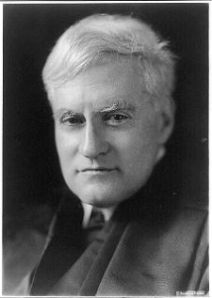
Funny, he doesn't look Mexican
Rove (who also claims Judge Sotomayor is intellectually challenged) never bothered to look up the meaning of “Hispanic” — defined in 1978 by the United States Office of Management and Budget as:
A person of Mexican, Puerto Rican, Cuban, Central or South American, or other Spanish Culture.
Cardozo, was highly cultured, but his culture was not that of Mexico, Puerto Rico, Cuba, Central or South America or Spain. His family were Sephardic Jews. Even if, given the common assumption that Sephardic Jews with Portuguese names at one point had ancestors living on the Iberian Peninsula, Portuguese descent (especially when it was about 500 years ago) doesn’t count. As the Associated Press Style Book specifically cautions, “Refer to people of Brazilian and Portuguese origin as such, not as Hispanic. ”
As it is, it’s not always clear that Sephardim with Portuguese names were necessarily Portuguese anyway. Given that a number of Sephardim fled Portugal during the early 16th century Inquisition, it could simply mean that someone somewhere acquired the common surname of a prominent local family. Benjamin Disraeli, also of Sephardic heritage, claimed the family name was Italian, though what his family had been called in Italy is anyone’s guess. And no one ever claimed Disraeli was England’s first Italian Prime Minister.
Even if — as Cardozo himself believed — the family was resident at some point in Portugal, it’s hard to get around the second fact. The family spent about two hundred years in ENGLAND and HOLLAND before they showed up in New York, before the United States even existed. Anglo-Dutch — you, know, like Cardozo’s neighbor Teddy Roosevelt (who at least had SOME connection to Cuba). Ok, Cardozo wasn’t quite “WASP”, but he was WAS (White, Anglo, Sephardim — though claiming “agnostic” as his religion) … and that ain’t Hispanic.

Not Cuban, not Hispanic... and -- despite the pose -- not gay
Judge Sotomayor, another New Yorker, is… her parents having been United States citizens (by birth) from the Commonwealth of Puerto Rico. That does make her “Hispanic” by all the definitions. Don’t worry, Karl. Benjamin N. Cardozo MAY have been a “minority” that Republicans would have had better luck selling as “controversial” … as his “Wikipedia” entry notes:
The fact that Cardozo was unmarried and was personally tutored by the writer Horatio Alger (who had been accused of inappropriate sexual relations with young boys) has led some of Cardozo’s biographers to insinuate that Cardozo was gay, but no real evidence exists to corroborate this possibility.
¿Bueno?
The front page of today’s Jornada reports (article by Miriam Posada and Roberto Gonzaléz. My translation):
A couple of points. While people like to complain about TelMEx, it isn’t nearly as bad as some claim. Consumer telephones weren’t seen as a necessity until relatively recently, and most complaints have been about the delay in obtaining service, not in the service itself. Competition would not necessarily resolve this challenge, though — in theory – it would lower the consumer rates (which are some of the highest in the world, and are the second area in which there are legitimate complaints). The justification for the high rates — “homologizing” the entire system (which had an ad hoc mix of European and North American standard switching stations, as well as obsolete, “good enough” equipment throughout the country — have largely been resolved, and other companies seek to benefit from the huge expeniture Slim undertook to create the new TelMex.
Note that the competitors only want to service the high-traffic areas. When I was living in rural west Texas, we paid a much higher fee for our telephone service than in “high volume” areas, while we were more dependent on the telephone than other parts of the country. In rural Mexico (even worse off than rural areas in the United States), this sort of competition could cause even more hardships in the campo than there are now.
People forget what a huge change decent phone service has been, and how much that has improved rural life. Even in the most backwards ejital you’ll find an internet cafe (I went to one in Tabasco where you had to step over the very, very large pig sleeping in the doorway. Still, it means rural farmers have access to market prices, taxes can be paid electronically and rural kids have access to the same educational resources as the kids in Mexico City.
I just read a crime novel, written about 10 years ago, where the plot revolves around a murder in a Mexican town with only one telephone. Try finding a place in Mexico now without phones, and without a couple internet cafes — you won’t find places where the murderer can get away with it (almost) because nobody is able to make a telephone call. Crime writers are, perhaps, the only people who have a legitimate reason to complain about TelMex infrastructure development.
 I don’t have any problem with Slim getting even richer than he was as a result of Telmex expansion. He didn’t invent the internet, nor did he create the consumer demand. Much as I would like lower rates, I can see his point, that making TelMex simply the service provider (and, given that foreign companies are unlikely to want to do anything more than make a profit and extract it from the country) are not going to be willing to make the investments that TelMex has, and continuing to make, in providing adequate service throughout the country.
As to television, I have mixed feelings. Basic cable isn’t available everywhere now, and isn’t affordable. There are a few independent stations, but still Televisa (and it’s pseudo-competitor, in reality simply a second network with much the same ownership, Galaxia) control the market. A new network would be welcome, but creating a Televisa network — would just concentrate ownership of the airwaves within the same small group that now controls the broadcast media. It would not improve Mexican access to information all that much, and probably doesn’t make much sense.
I depend for my information mostly on the print media, which is suprisingly strong for a country that supposedly doesn’t read. And the newspapers are doing well economically. But that’s a post for another day.
It still stinks!
Downwind from the 15,000 hogs of Granitas Carroll (the Smithfield Farms hog lot that FINALLY came to attention during the “swine flu” scare) are the 3000 inhabitants of La Gloria, Veracruz, where four-year old Edgar Hernandez Hernandez received the dubious honor of being the first know victim of the latest flu epidemic to survive the disease.
Even if, as the Governor, Fidel Herrera claims, the outbreak of flu in that small community and proximity to the hog lot were purely co-incidental (as was his winning the lottery — TWICE!), the residents would like to see their concerns with water and air quality and the loss of agricultural productivity as a result of the hog lot’s …. uh… hogging the water supply…. addressed.

Creepy art and creepy artist (photo stolen from Burro Hall)
Well, the Governor has heard the people, and given them… not relief, not an investigation into Smithfield Farms, not even a blue ribbon commission to study the issue to death. Instead, being a direct action kind of guy, he’s commissioned a statue of young Edgar. While hogs might be the proper iconography for such a statue, sculptor Bernardo Luis Artasánchez has his bronze Edgar holding a frog.
Why a frog and not a pig? San Antonio Abad might have made a more logical choice than some poor kid whose going to be teased unmercifully as a result of all this.

San Antonio with San Porky
After all, San Antonio is the patron saint of fighting infectious diseases… AND swine farms. In Latin American iconogray, he’s always shown with “Babe” at his side.
San Antonio was an Egyptian, so there is SOME weird connection here to the frog… Artasánchez claims its a reference to the seven plagues of Egypt, but you got me on why the Old Testament reference is ok, but not the more obvious one to a place also known for serious water problems and pigs. .
I’ve wondered if Artasánchez is related to the Governor. He’s sort of favored for this type of public art in Veracruz, and his work has been received by the public with enthuasm… for tearing it down.

Art critics in Boca del Rio review Artesanchez' statue of Vincente Fox
Why Michoacan?
As usual, when Mexico makes the international papers, it’s all narcos all the time (ok, flu once in a while).
“Ten Mayors Arrested, etc:” (this quote happens to be from Tracy Wilkerson of the LA Times… one of the few newspapers that still have foreign correspondents):
Mexican security forces swept into President Felipe Calderon’s home state of Michoacan on Tuesday and arrested a total of 27 mayors and other government officials, the largest operation to target politicians in Mexico’s bloody drug war.
The officials, including 10 mayors, are being investigated for alleged ties to drug traffickers and other organized crime syndicates that in effect control large sections of Michoacan, the federal attorney general’s office said.
Mexican commentators are wondering about both the timing of the arrests (this is the campaign season, with elections the first weekend in July) and why Michoacan has been singled out, when the nexis of narco activity has been in the northern tier of states.
Michoacan, despite being the birthplace of Felipe Calderon, is better known for its leftist politics (Lazaro Cardenas — a combination of Franklin Roosevelt and Hugo Chavez in Mexican history — began his political career here, as did his son, Cuauhtemoc) and — being Puripechan, not Nahuatl — has been out of the mainstream since the days of Tenotitchtlan. Even its gangsters have not been “normal” ones — having a decidedly “moral” mission statement for their core business of meth-making, marijuana selling and head chopping.
The same might also be said of Zacatecas — a left-leaning state that suddenly is the focus of Federal criminal investigation, though its crime syndicates are more traditional business organziations than Michoacan’s “la Familia”.
This is not Chapo Guzman territory, which is why the questions are being asked. La Familia has been in a turf war with the Gulf Cartel, both organizations also rivals of the Sinaloa group run by Guzman. Since Chapo is the “most wanted” of the various gangster leaders, the questions being asked are why the Federal Government is making splashy arrests in connection with the less important organizations {which benefits Chapo) while not making much headway in bringing down the Sinaloans. Even the Roman Catholic Church recently complained about Chapo’s relative freedom in the north, which was poo-pooed by the Federal authorities.
Add the recently news-worthy attacks on Santa Muerte shrines (while ignorning the Sinaloans’ favorite santone, Jesus Malverde), PAN’s claims of PRI corruption in this election campaign, growing resistence to the “war on (some) drug (exporters)”, the need for the Calderon Administration to recover the support its been losing as the death toll mounts in that drug war — and more and more voters question whether its being used to cover attacks on dissenters … AND it becomes very easy to see why so many Mexicans believe the Michoacan raids were not coincidental.
Bolivian nukes? Puu-leeeeze!
Buried down in the (dis)Associated Press reports on the latest in the “Axis of Evo” scare story (Israeli document: Venezuela sends uranium to Iran) there are a few details that I’ll bet will be overlooked.
 First of all, where does Venezeula get the uranium it’s supposedly shipping? The Israeli document probably didn’t go into too much detail, but the fact that Venezuela has uranium deposits is somewhat beside the point, when you read that they aren’t mining it. Bolivia mines a bit… and the Bolivian government is anti-US and pro-Venezuelan, therefore… Bolivia = Venezuela in AP-landia. So does Paraguay.
Note to AP: a country in the same continent is not the same country. Even having diplomatic ties, and even having presidents with somewhat similar political theories doesn’t make them the same country.
Otto (who knows more about mining than just about everyone, and more about Latin America than most people) lives Peru, not AP-landia. Peru is a country in South America, just like Paraguay is (and they both start with the letter “P”). He noticed that the AP confuses Paraguay (where there probably are some Hezbollah members among the Palestinian immigrants in that country) with Venezuela.
I’d question whether immigrants who might have belonged (or still belong) to a political party in their homeland qualify as a “cell”… but it sounds scarier, andwhich doesn’t make them a “cell”… since they come from a country where Hezbollah is a political party.
And… has anyone mentioned that the “Israeli document” detailing this supersecret international plot is THREE PAGES? I’ve seen more plausible screenplay concepts that are longer.
I’m guessing it’s in Hebrew. Which might be the reason nobody at the AP appears to have read it. Why bother, there’s enough there to cook up a good AP exclusive. Take one cup of “Venezuela is EEEVIL” and a cup of “Bolivians call fascists “Fascists” and that’s not nice”, add a dash of “scary AY-rabs are gonna kill us”, a sprinking of “Iranians are crazy people” and a dash of “Israel is always right” and send it out half-baked.
God and Man at the United Nations
I hadn’t really thought about it, but one factor in more attention being paid to Latin American resource issues might be that the President of the United Nations General Assembly is a Nicaraguan, Miguel d’Escoto Brockmann. The largely ceremonial post of General Assembly President is rotated among various regional groups, and D’Escoto was the choice of the Latin American-Carribean nations for their turn at the job for the September 2008 to September 2009 term. The President is using his post as a “bully pulpit” to push issues like sustainable development and the rights of rural and indigenous people.
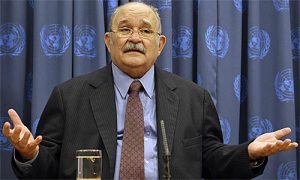
Go ye therefore and teach all the nations (Mark 16:15)
A “pulpit” seems like a natural place for a guy like D’Escoto. He is a Catholic priest. The route to the United Nations is not the usual career path for a Nicaraguan priest, but Latin clerics have been called to take on tasks outside their usual duties before. In the colonial era, it wasn’t unheard of for clerics to take on state administrative tasks (indeed, in Hapsburg Spain, joining the clergy was often the pathway to a bureaucratic career, and more than a few colonial bishops did double-duty as regional administrators or, very early in the history of Nueva Espagna, as even Viceroys. The Mexican War of Independence was touched off by a priest’s sermon, and several priests were military leaders.
D’Escoso’s path to the United Nations is, in some ways, a reflection of both the tradition of educated clerics taking on bureaucratic positions and revolutionary politics. A World Council of Churches official, he was one of the few Nicaraguans with foreign policy experience after the success of the Sandinista Revolution, not part of the discredited (and quite nasty) Somoza regime. He served as his nation’s foreign minister, despite official Vatican admonishment (priests are not supposed to take political positions) from 1979 until 1990.
Following the 1990 Nicaraguan elections (won by the U.S. backed conservative “Liberal Alliance”… “liberal” meaning more or less “secular and capitalist” in Latin American political terms), d’Escoto remained active in the Sandinista movement, and turned his energies to regional groups working on issues like rural agricultural, sustainable development and indigenous rights in Latin America.
While priests are not supposed to run for, or hold, political office, at the same time the Second Vatican Council of the early 1960s reinterpreted the Church’s role and welcomed an engagement with the secular world. Within Latin America, where the Church had often been on the side of the status quo, there was a rebirth of the traditional sense of the clergy as the protector of the powerless against the state under the rubric of “Liberation Theology”.
The Liberationist’s philosophy has found its way into political discourse. While the most obvious Liberationist in politics is Paraguay’s president, Fernando Lugo, who was a bishop before leaving the priesthood to run for President, there are several others. Ecuadorian President Rafael Correa — who refers to himself as a “Christian of the left” — served in a mission community for a time; Hugo Chavez often peppers his discourse with religious rhetoric and came by it naturally. His parents were Catholic Church teachers in rural Venezuela and he grew up in a Liberationist family (as did many Venezuelan military officers). Famously, Andres Manuel Lopez Obrador (who was a social worker in an indigenous community, but whose organization had ties to the Presbyterian Church) ran for President of Mexico as a coaltion candidate of a party whose name — “For the benefit of all, first the poor” — nicely sums up the Liberationist position.
Given that — as Madonna Louise Ciccone put it — “we all live in a material world” — any “engagement” with the world meant mixing in the materialist philosophies by which we all live. For Latin Americans the “material world” was based in Capitalism. The only alternative available was Marxist movements, which at least in Latin American political discourse, offered more benefits and a more equitable treatment of the poor. But in 1978, with the election of John-Paul II, there was a Pope from a country where countering the establishment meant taking an anti-Marxist stance. John-Paul II (and the current Pope, Benedict XIV) both see Capitalism and Socialism as equally inadequate –based as they are in materialst and not spiritual ideals — but at the same time accept the uneven distribution of resources in the world, and tend to overlook the failures of capitalism to address these problems. There was going to be trouble. And there was.
One early victim of the anti-liberationist purge was Brazilian theologian Leonardo Boff, a Franciscan priest whose writing criticised hierarchal organizations that work against the interests of the people. Among those heirachies Boff attacked are the Chuch itself… which led then Cardinal Joseph Ratzinger (now Pope Benedict XIV) to “silence” Boff for a year in 1985. Boff left the priesthood in 1992, but as a well-known philosopher, writer and educator, continues to voice crititism of what he calls “fundamentism” — including both capitialist theories like neo-liberalism (the basis of U.S. trade policy) and the Church hierachy.
D’Escoto managed to hold on to his priestly status, as did a few others. With his election to the United Nations post, he appointed several “senior advisors” that includes some suprising, and controversial (at least in the United States) figures like Noam Chomsky and Joseph Stiglitz, he also selected Brother David Andrews, (an monk who is Executive Director of the National Catholic Rural Life Conference which provides support for fair trade and sustainable agricultural policies) and Boff.
Perhaps the old Pope was right, that the material and spiritual don’t mix. The United States representative has called D’Escoto’s statements and concerns “increasingly bizarre”, to which Boff responds:
… there are representatives of rich countries that find the behavior of Padre Miguel very strange. Not long ago an article appeared in the Washington Post echoing this sentiment. The writer said that Miguel d’Escoto talks of very strange things that are never heard in the UNO, such as solidarity, cooperation and love. He greets everyone in his speeches as “Brothers and Sisters all.” Even more strange, says the writer, is the fact that many representatives and even heads of state, such as Sarkozy, are using the same strange language.
Good Lord! In which level of Dante’s hell are we? How can a society be built without solidarity, cooperation and love, deprived of the profound feelings expressed in the UN Human Rights Charter, that we are all equal, and because of that we are brothers and sisters?
For a society that has opted to transform everything into merchandise: the Earth, nature, water and life itself, and which puts making money and consumption as the supreme ideals above any other values, above human rights, democracy and respect for the environment, the attitudes of the President of the General Assembly of the United Nations must seem strange indeed. They are not found in the capitalist dictionary.
We must ask ourselves about the human and ethical qualities of such a society. It is simply an insult to everything that humanity has preached and attempted to live throughout the centuries. No wonder it is in crisis, and more than an economic and financial one, it is a crisis of humanity. It represents the worst that exists within us, our demonic side. It has proven to be unsustainable even financially, which is exactly its central point.
(Boff’s quotation is taken from a longer discourse, Does This Society Deserve to Survive?, translated into English by Refugio del Rio Grande, Texas, USA and published in Tlaxcala)
“As an American”…
I’ve received several comments on a recent post of mine in which I questioned the motives behind a bill in the United States Senate that included a demand on the Mexican Federal government that it investigate Brad Will’s death as a condition of receiving financial assistance with narcotics interdiction.
While I think Will was over his head in Oaxaca, and of course I don’t think the state’s investigation into the death was anything other than a whitewash, I objected to including this demand for several reasons — not the least of which was the assumption that the Mexican Federal government should intervene in a state matter (Mexico, like it’s neighbor to the north, is a federal republic.
There is no particular reason for the Federal courts to step in to a murder investigation, either in the United States or in Mexico, but the assumption was that the Federal government SHOULD, in return for an unrelated benefit. Describing Will as an “unaccredited journalist who was illegally intruding in Mexican political affairs” resulted in some negative feed-back, as well as this comment by Leslie Beyerstein:
Just to play devil’s advocate here… As an American, I want non-citizen residents of the U.S. to participate in our domestic politics. If they live here, they’re part of our community, and their opinions on internal issues are important. So, I have a hard time buying the argument that a non-Mexican, ipso facto, has nothing to say about Mexico’s domestic politics.
Ms. Beyerstein is not just “an American” — she is a well-known respected on-line journalist and photographer, whose “Majikthise” site “provides daily coverage of local, national, and international politics from a left liberal perspective.” I usually don’t receive comments from writers of Beyerstein’s reputation: our cordial exchange of e-mails probably doesn’t explain my whole response to her comment.
As an American
Were I a citizen of Canada, Cuba, Chile, Chile, Colombia or for that matter, Mexico, I’d register the usual complaint about estadounidenses who assume the name for anyone in the hemisphere for residents of one country… and leave the impression that citizens of one of the 47 nationalities speak for all of us. But, I’m anestadounidense, and accept what for my neighbors grates on their sensibilities.
That was not Ms. Beyerstein’s intention, but the suggestion is that “we do things thus in the United States, therefore it is good.”
…their opinions on internal issues are important.
Of course, not everyone in the United States is as enlightened as Ms. Beyerstein. U.S. courts and legislatures that have ignored the Mexican government when it presses for legally mandated rights (such as consular consultation for criminal defendants) for its own citizens. And, the number of yahoos who claimed immigrant protests in the United States SHOULD be illegal is legion. I’m afraid Ms. Beyerstein’s opinion is a minority one.
Be that as it may, the United States — for whatever reason — chooses to allow political participation by foreign residents. Mexico does not. Ms. Beyerstein — “as an American” — is making the assumption her country’s way is “right” and Mexico’s “wrong.”
I have a hard time buying the argument that a non-Mexican… has nothing to say…
It’s a cliche of Latin critiques of the United States that it’s people use commercial metaphors for everything. As Oscar Wilde said of cynics, “they know the price of everything, but not the value.” No one was making that “argument” anyway. And nothing to buy or sell… I did not write Capitulo III, articlo 33 of the Constitución Política De Los Estados Unidos Mexicanos — but I understand the reasoning behind it.
As a practical matter, and this is what Ms. Beyerstein and I discussed, given Mexican historical thinking, and the touchiness about foreign criticism (especially from estadounidenses), foreign involvement in political matters is counterproductive. It is not viewed as an offer to “sell” even the finest of products, but an unwarranted intrusion. If not by the persons supporting any given movement, then by their opponents… who will “sell” the foreign presence as such.
Certainly, a foreign blogger can comment obliquely (and maybe directly — though I chose not to do so) on day to day issues. He or she cannot, however, state that Mexican voters MUST vote for this or that candidate or party, or that the legislature MUST pass a given bill… or that the Federal Government MUST intervene in a state police matter.
I don’t want to “sell” an argument… but I do want to sell books (either through my publisher), or in the United States through Amazon.com or Jackson Street Books.
“As an American” you’re free to buy or not buy any conclusions, but understanding the Mexican way of thinking about foreign intervention is vital to writing and thinking about their culture and their politics, you need to buy the book.


