One of the most interesting places in all the continent* and a must visit for anyone connected to mining, the town of Potosí in Bolivia has a history like no other. A new book is out on the story and kind reader GB put this link to the NY Review of Books critique of author…
via ” Potosí: The Silver City That Changed the World”, by Kris Lane — IKN
A government for, of, and by, morality?
Rebecca West, writing of the Conquest, famously said, “This is not a moral universe”, which has never stopped anyone from dreaming of the possibility of … if not universal morality, a moral society at least.
Alfonso Reyes, the son of the general originally tapped to replace Don Porfirio (and killed in the opening salvo of the “Ten Tragic Days”… the street battle that raged in 1913 when Huerta staged a coup against the democratically elected president Franciso Madero) who, despite his anti-revolutionary antecedents, went on to a distinguished career serving the Revolutionary republic as a diplomat, although he was primarily a philosopher.
Having witnessed, and as a survivor, of the fratricidal Revolution, and the violence that swept the country during and after, as well as, from his diplomatic posts, the horrors of the Second World War, he turned his attention to the problem of creating a just, equitable, and peaceful society, able to live with itself, and with humanity.
He presented his thoughts in a short (about 7500 words) document of 14 chapters, in the “Moral Primer”… Cartilla Moral… published in 1944. Although clearly influenced by his own devotion to Roman Catholicism, he attempted in the first 12 chapters to outline a universal code for all peoples, at all times, everywhere. The last two are a summary… the bullet points of his presentation (my translation below).
Next week López Obrador’s plan to work towards, if not a moral universe, or even a moral society, is being released next week.
Already a “best seller” (I already ordered my copy), Hacia una Economía Moral, looks to trying to work towards Reyes’ “The good” by way of, among others Marx and Engels. Echoing Engels’ eulogy at Marx’s funeral, AMLO notes that until one’s need for food, clothing, shelter, and transportation are met, one cannot aspire to more cultural, ethical, educational development. How then, to meet the economic needs that will allow for creating a moral society, one that, as Reyes hoped, led to a peaceful, just, and happy society?
Reyes was a theorist, not a policy maker. That the president, elected on a promise to change government and radically redirect the state, is presenting an economic plan in the form of a moral text is, in itself, possibly unique. Certainly, policy makers present their plans as being more ethical, or.. if you will… moral, than other plans, but usually just as an additional rationale to pursue policy X as opposed to policy Y. Not as the most basic reason for the electorate to back what looks to be a much deeper and long-reaching change to a post neo-liberal economic and social system.
One expects the book will be endlessly reviewed in the Mexican media and parsed by both economists and the intellectuals. I assume also, there will be discussion among both the foreigners here, and those with an interest in alternatives to the present political/economic systems. AMLO’s several books have all been relatively short works, usually under 150 pages, but there is no way I can translate it myself. If there is interest in “crowd-sourcing” a translation, we could have a PDF or e-book translation out within about two weeks of original publication.
Cartilla Moral (Resumen)
SUMMARY: PART ONE (Chapter 13)
Man is superior to the animals because he has a conscience.
Good should not be confused with what suits our taste or is to our benefit. To the good we must sacrifice everything.
If men were not capable of the good there would be no human person, no family, no country, no society.
The good is the set of our moral duties. These duties are the obligation of all men and all peoples. Disregard for these duties is evil.
Evil carries its its own punishment in shame itself and in the dismissal of our fellow men. When the evil is serious, it is additionally punishable by laws with penalties ranging from compensation to death, through fines and imprisonment.
The satisfaction of doing well is the most firm and true happiness. That is why we speak of the “dream of the righteous.” He who has a clear conscience sleeps well.
In addition, he lives happy with himself who asks little of others.
Society is founded on the good. It is easier to live according to the laws than outside the laws. It is better business to be good than to be bad.
But society to function well, there is a sacrifice which we cannot avoid. For personal happiness, one must consider the common happiness of humanity in achieving the good.
The good forces us to act righteously, to tell the truth, to conduct ourselves with right intention. But it also forces us to be neat and decent, courteous and benevolent, industrious and accomplished at work, respectful of others, solicitous in the help we can give. The good also obliges us to be discreet, well mannered and educated as much as possible.
The best guide for the good is natural goodness. We all have the instinct for goodness. But this instinct must be completed with moral education and with the culture and acquisition of knowledge. Good intentions are not enough.
SUMMARY: PART TWO (Chapter 14)
Human morality is the code of the good. Morality forces us to a series of respects. These respects are contained within others. They range from respect to those closest to those furthest from us.
First, respect for our person, body and soul. Respect for our body teaches us to be clean and moderate in natural appetites. Respect for our soul summarizes all the virtues of spiritual order.
Second, respect for the family. This respect goes from the son to the father and from youngest to eldest. The child needs help and advice from the father and the elder. But also the father must respect the son, giving him only worthy examples. And the same must be done by the eldest with the youngest.
Third, respect for human society in general, and the particular society in which we live. This implies, of course, obedience to customs considered necessary. Do not be extravagant. You don’t have to do everything the other way around just because you want to annoy people.
Fourth, respect for the country. This does not need explanations. Patriotic love is not contrary to the feeling of solidarity among all peoples. It is the field of action in which our love for all humanity works. The ideal is to reach peace and harmony among all peoples. For this, we must fight against the imperialist and conquering peoples until they are defeated forever.
Fifth, respect for the humanity. Each person is like us. Let’s not do to others what we don’t want them to do to us. The highest manifestation of man is his work. We must respect the products of work. Breaking glass, dirtying walls, destroying gardens, throwing away things that are still usable are acts of savagery or evil. These acts also indicate stupidity and lack of imagination. Every object produced by man implies a series of respectable efforts.
Sixth, respect for the nature that surrounds us. Inanimate things, plants and animals deserve our intelligent attention. The earth and everything in it form the house of man. The sky, its clouds and its stars form our roof. We must observe all these things. We must try to understand them, and study for that purpose. We must take care of things, plants, pets. All this is the natural heritage of the human species. Learning to love and study it, we learn in passing to be happier and wiser.
Smell the fascism?
Put it in perspective
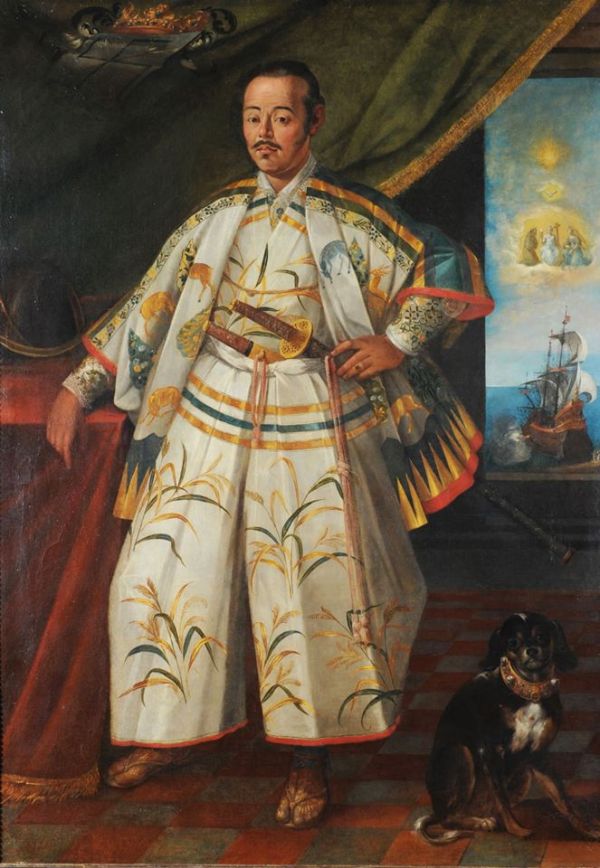 Hasekura Tsunenaga, Japanese Ambassador to the Spanish Empire. He toured Mexico at a time when Shakespeare was still alive, and the English colonists in Virginia were reduced to cannibalism to survive.
Populism v Doña Florinda
 Doña Florinda, a recurring character in the Mexican sit-com “El chavo de ocho” had married above her class, a widow (her sea-captain husband having been eaten by a shark) with one son… whom she zealously watches over for any “contamination” by her lower class neighbors.
Although “El sindrome de Doña Florinda” (people have written academic papers on this) is one explanation of the whipsawing between progressive and conservative governments in Latin America, it id not the full story. The Doña Florinda syndrome suggests that progressive governments seek to open the economy, growing the middle class. Middle class interests and values — stability, “getting ahead”, maintaining social standards — are promoted by the right, and create the climate for a return to a conservative government.
Which returns to the economic theories that prevent the middle class from growing, and… like Doña Florinda’s lamentable encounter with the shark… leave the middle class in reduced circumstances, resentful, and more open to the progressive policies shared by the “lesser” neighbors.
But, as Ilán Serno wrote in today’s Jornada, it’s more complicated than that. Whether progressive or reactionary, Latin American nations still operate under a few economic assumptions, going back in some cases to the colonial era. Whether the left is nationalist (as with the Morena government in Mexico)or populist (in in-coming Peronists in Argentina), and whether the right is fascist (as in Brazil, and… so it seems… Bolivia) or neo-liberal (Chile and Ecuador), the economy is based largely on extractive industry (oil, lithium, coffee, etc,) and can only open up the middle class through expanded exploitation.
More to the point, to foster growth takes money… and more money spent on the have-nots during a progressive phase… leads either to debts or to more exploitation…. and a turn to conservativism.
Unspoken, though certainly a Doña Florinda-ismo, is the assumption that the “deserving middle class” are the victims of the undeserving beneficiaries of the growth period. Doña Florinda certainly feels entitled to her (self-ordained) social status. “Those people”…. the indigenous in Bolivia, or Brazil, the rural poor in Mexico, just about everybody in Guatemala (poor, rural,. and indigenous) are expendable.
Semo bemoans the fact that we haven’t found a way out… yet. A new, and different economic system, something beyond the simple “capitalist v socialist” model. So far, it appears the Morena government in Mexico is doing something different… cutting government spending while increasing benefits… but it is probably only a reprieve from the need for a new social and economic model. There is only so much “waste, fraud, and abuse” of previous administrations that can be cut to free up spending for expanded benefits programs. Presumably,or one hopes, the money extracted from corruptos is limited, and eventually, like the oil wells, the source will dry up.
Ivanka Trump behind the Bolivian coup?
Mexfiles can’t vouch for this, but Ciudadanoweb.com (Santa Fé, Argentina) had a long article on Ivanka Trump’s visit to Jujuy province (bordering Chile and Bolivia) last September to announced a 400 million US government investment in a “lithium route” to exploit (presumably, for U.S. corporate interests) growing demand for the metal.

Coup-mistress?
Coincidentally, Bolivia was, at the time, considering changing its original plans for a joint venture with a German company to provide lithium (Bolivia having the world’s largest known reserve) for a better deal with the Chinese. Under the new deal, the Bolivians would maintain control of their reserve, with the Chinese investing in manufacturing lithium batteries and other products within Bolivia itself.
Ms. Trump was accompanied by Undersecretary of State John J. Sullivan, Deputy Chief Management officer for the Pentagon, Lisa Hirschman, and Mark Green, Director of USAID: draw your own conclusions.
El trasfondo de la tensión entre Bolivia y Estados Unidos por el litio, 13 November 2019.
Is democracy a religion?
Maybe because I’ve been watching the American soap opera “Greenleaf” … the trials and travails of a family of evangelical preachers and their megachurch… as well as following events in Bolivia… where it appears Evangelical Christians played a major role in planning and executing the coup… the question comes up.
Is it more or less democratic to simply follow the literal Word (of one’s constitution, or the BIble), or is it open to interpretation… and by whom? Is the goal of a democratic society the “salvation” of everyone, or of the elect? And what is “salvation”? Traditionally, we’ve fallen back on either Bentham’s “most good for the most people”, but … like those who say “we are all God’s children”, there are those who say we say “all men (and women…. and intersex) are created equal and…. entitled to the life, liberty, and the pursuit of happiness”. Whatever salvation or happiness is? And again… is it something we decide, or do we turn it over to our preachers, or to some sort of holy writ?
In the story, the Bishop is ailing, but the undisputed leader of his congregation and his family. There is no clear line of succession, and while the Bishop and the pastors do more than their share of “unchristian” acts, they see themselves (and are seen) as justified.
While, in theory, there was a succession plan for the Bolivian head of state, he, like the fictional Calvary Church, had a long time leader who had created a thriving community that was identified with that leader. Is it wrong that the rules (or strict Biblical interpretations) were sometimes stretched to meet the needs of the flock, or the citizens?
It seems that in discussing what happened (and is happening) in Bolivia is a matter of belief. I wonder if those who defend the … “transition in power”… avoid using the word “coup” the way religious people avoid the word “sin” for acts they accept, though others see as anathema. In the story, the gay choir director is fired, not for anything particular, but because for some, he’s a sinner. Something not said, and certainly not a legal reason (the fictional church is trying to avoid a lawsuit for termination without cause). A coup is not something we politely call a transition we support either.
Gimme Shelter: from Garibaldi to Evo
Translated from Elías Camhaji and Georgina Zerega. “La vieja tradición de asilo que abre las puertas de México a Evo Morales“, El País (Madrid), 11 November 2019

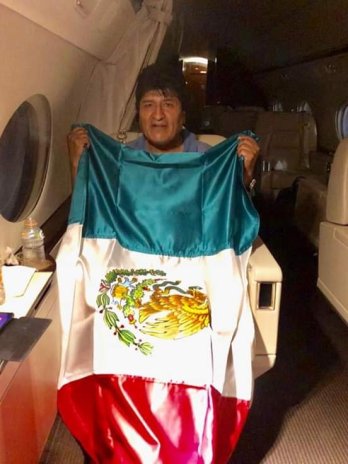
Mexico has granted asylum to Evo Morales. The former Bolivian president has requested protection from the Mexican government, Foreign Minister Marcelo Ebrard announced Monday. The Latin American country has a long tradition of asylum and refuge: a list that includes the Spanish Republican exiles, citizens who fled the South American dictatorships in the second half of the twentieth century and victims of the civil war in Central America during the eighties and nineties . Morales, who was forced to resign from the presidency last Sunday, is the latest to join a group of notables harbored in Mexico that has included Italian revolutionary Giuseppe Garibaldi, Cuban writer and politician José Martí, Soviet ideologue Leon Trotsky, Spanish film director Luis Buñuel, and the Guatemalan Nobel laureate Rigoberta Menchú.
The Mexican Government, restrained by being a neighbor of the United States and its own limited military power, has been characterized by legalistic diplomacy, that is, a reliance and adherance to international law, to the principles of non-intervention and to solidarity with the victims of authoritarian regimes and war . Asylum differs from the refuge in which applicants must demonstrate that their lives are threatened by political issues, such as government repression or attacks on their defense of political ideas by groups in power. “It is above all a humanitarian act, which should not be understood as a sign of approval or disapproval, much less hostility to any foreign government,” says Natalia Saltalamacchia, internationalist and professor at the Autonomous Technological Institute of Mexico.
“Mexico has had an open door policy, although with some restrictions,” explains Jorge Schiavon, an internationalist at the Center for Economic Research and Teaching. In the case of giving protection to Latin American leaders, Mexican asylum policy has generally been conditioned to receive few people and has focused on ideological profiles close to the governments, Schiavon points out. That tradition was especially reflected during the Governments of the Institutional Revolutionary Party and has been recovered by the Government of Andrés Manuel López Obrador, adds the researcher.
Along the same lines, former Mexican Foreign Minister Jorge Castañeda (2000-2003) points out that the offer of asylum by the López Obrador Government could be related to the “his sympathy” for Morales. However, he argues that the offer runs hand in hand with the humanitarian tradition that Mexico has. “The only reason to deny it is that they have committed very harmful acts, human rights violations or crimes against humanity and that is not the case with Morales,” he says. In spite of that, the former foreign chief warns that the double play of condemning “the coup d’etat” on the one hand and not “electoral fraud or violations of the Constitution” on the other, could bring problems from the Organization of American States for the Mexican chief executive.
“Mexico is doing well to grant asylum to Evo Morales, but the focus of the discussion should not be there, but on the steps that follow to have a stable situation in Bolivia,” says Saltalamacchia. The Government has faced criticism after not weighing in on the political crisis in Venezuela and months later offering asylum to Morales, and the consequences of these foreign policy decisions can have.
“I do not see that contradiction, rather that López Obrador follows the doctrine of nonintervention to avoid getting into trouble and appealing to his humanitarian tradition, in the case of Morales,” says Schiavon.
Ebrard noted on Monday that his country’s great tradition of political asylum began in 1853, when the country jointly signed a non-extradition treaty for political crimes with Colombia. “Granting asylum is a sovereign right of the Mexican State that is consistent with its normative principles in foreign policy,” he said. Since then, Mexico has become one of the most important bastions in the continent for those fleeing their country. The dictatorships that ravaged Latin America, from the second half of the twentieth century, produced a large number of asylees in Mexico, in the seventies mainly from Argentina, Chile, Brazil and Uruguay, and later, in the eighties, from El Salvador and Guatemala.
One of the great gestures in foreign policy at the time of the Latin American dictatorships, Castañeda recalls, was the attitude taken by the Government of Luis Echeverría in 1973, when following Augusto Pinochet’s coup, he sent a plane to search for the widow of ousted president Salvador Allende. The last case of high-profile asylum in Mexico was last October, granted to Ricardo Patiño, Ecuadorian Foreign Minister during the Rafael Correa Government, who accused the president, Lenín Moreno, of persecution.
Mexico has faced a growing number of asylum and refuge applications in recent months in the wake of the Venezuelan political crisis and migrant caravans. Requests went from 2,137 in 2014 to 29,631 in 2018, according to official data. Between January and October of this year, 62,299 people have requested permission to settle in Mexico.
Bolivia: A coup or not a coup? That’s not a question.
Whether the “irregular change” in government in Bolivia was justified by a dubious rationale for a fourth term for Evo Morales seems a legitimate question, and whether or not Morales’ government was “good” or “bad” in any sense, whether it met the needs of various factions (including those of foreign multinationals) are more questions for historians to answer later. Was the run for a fourth term at all legitimate? Were trade deals with China in the best interests of the people? Were their corruptos in the party? In other words, answering the immediate questions, “Was this a coup?” with rhetorical questions in an attempt to avoid the obvious.
Feel free to disagree.
He’s back!
Helguera, in La Jornada,

Cannabis… the Canadian model the wrong one
Although marijuana is not legal in Mexico… yet… I’ve been noticing for the last several months people advertising in the foreigners sites for sales and marketing people in what they expect to be some sort of boom market. While I don’t expect the domestic market to be all that large (except maybe for foreigners and hipsters who can afford those less traditional forms of ingestion, like “artisanal” candies and whatnot, I did notice the advertisers, when questioned, all say the regulations that are going to favor them are coming, and the advertiser is a “respectable” Canadian company.
Although my concerns about marijuana legalization centered around probable US agro-business running roughshod over the intended beneficiaries of legalization (farmers, indigenous people, victims of the “unregulated exporters”) and have drawn my parallels to the history of other luxury crop exports (sugar, with it’s history of slavery; coffee and bananas, an on-going saga of labor exploitation, land theft, and murder), Canadian journalist, and long time observer of her country’s “investments” in Latin America, Dawn Marie Paley, in addition to long reporting on the narcotics trade and its impact on our part of the world, has seen another “development model”. I don’t know if her article in today’s Jornada was also written, or might be published, in her native English, so I went ahead and translated it.
It has just been a year since Canada legalized the production, consumption and sale of marijuana, becoming the second country in the world to do so, after Uruguay.
But unlike Uruguay, Canada has a long history as the headquarters for multinational companies, many working on an extractivist model to return profits to managers and shareholders in Toronto and New York. Apparently, the cannabis sector is looking to follow in the footsteps of Canadian mining companies.
Canadian miners established a business model attractive to cannabis companies, based on extractivism and cheap labor. The miners try to influence legislative changes in their favor, just as cannabis companies do. Today we are facing an attempt to build a colonial and punitive international cannabis industry.
The largest marijuana company is Canopy Growth, based in Ontario. Canopy has 8 billion dollars in shares and operations in 14 countries. Its largest shareholder is Constellation Brands, owner of Grupo Modelo, Corona, and Pacífico in the United States. In recent years, Constellation has been the target of protests and boycotts against the construction of a new [export] brewery in Mexicali.
There are also other Canadian cannabis companies valued at billions of dollars, with operations in Asia, Africa and Europe. These companies have two interests when investing in other nations. They want to establish their own farms for marijuana production for eventual export to Canada (and the United States, when marijuana is legalized nationally), But they also want to monopolize national markets. Utopia for them, perhaps, would be consumers having access only their proprietary marijuana products.
Cannabis companies are already lobbying in Mexico. “Representatives of international and national firms, laboratories, pharmaceutical companies, production companies” have been pressuring senators on regulation, according to the Morenista senator Ricardo Monreal. He added that the Senate wants to “cool the impetus a bit” and not move forward with regulating marijuana under pressure from business lobbyists.
The Mexican Senate should have issued its regulations on cannabis for adult use by October 31, but requested an extension, that was granted by the Supreme Court of Justice of the Nation (SCJN). Now, the Senate and Chamber of Deputies now have until April 30 of next year to pass legislation on recreational cannabis use in Mexico.
Regulation is a minefield, in which corporate interests threaten to overlook those of the traditional cultivators and victims of prohibition-related violence. Experiences in other nations of Latin America teach us that it is necessary that regulation be robust and inclusive.
In Colombia, for example, activists worked hard to achieve regulation that would contribute to peace-building, including the [rights and expectations of] traditional cultivators, war victims and indigenous peoples. However, despite the efforts, almost all traditional growers have been left out of an integral participation in the legal business, because the market has been monopolized by a group of Canadian companies.
The National Development Plan presented by President Andrés Manuel López Obrador promised an “end of the‘ war on drugs ’”. But far from being decriminalized, state continues to work against those who produce, distribute and consume marijuana in the country. There are still people imprisoned for the simple fact of having few grams of grass for their personal consumption.
It is vitally urgent to regulate cannabis in Mexico.
But it is also important that in the Senate take their time and that there is transparency in Mexican marijuana regulatioons. But it is even more important that Mexico does not adopt a law that allows unlimited participation for foreign companies.
As the #RegulationForLaPaz coalition has always insisted, marijuana regulation should be focused on social justice, protecting small producers and contributing to reparations for the hundreds of thousands of victims of violence resulting from the so-called fight against drug trafficking.
Clothes make the man?
 UNIDEP, Universidad del Desarrollo Profesional, with campuses throughout Mexico, offers degrees mostly in business administration, as well as in health sciences. The serious looking fellow on their latest poster perhaps is meant to be a specialist in physical therapy.
Although he is not a student, nor a graduate of UNIDEP, he is… in a way… in the physical therapy trade. The model, Spaniard Angel Muñoz is better known under his stage name, Jordi El Niño Pollo (politest translation being Jordi, the dick-boy), the star of a string of films in which the youthful Jordi… ahem… relieves the physical tensions of (uhhh) older, but attractive and lonely, women.
Maybe you just didn’t recognize him with his clothes on.


 mexfiles.net