Friday Night Video: Damn Mexicans
One step foreward, three steps back
David Agren (The [Mexico City] News) reports that
Lawmakers on Thursday voted to approve the creation of a new federal police force that they say will eventually take the place of the military in the war on organized crime.
The bill passed by the Chamber of Deputies aims to convert the Federal Preventive Police, or PFP, into a new force simply known as the Federal Police, which would remain under the management of the Public Security Secretariat, or SSP. It will have expanded investigative and intelligence-gathering powers.
Proponents say that the new force resolves a major challenge facing the PFP, which lacks the ability to carry out investigations and gather intelligence and is unable to employ surveillance techniques such as placing wire taps and having undercover agents infiltrate organized crime groups.
“In Mexico, police don’t have the powers of investigation to anticipate crimes,” Deputy David Mendoza of the Democratic Revolution Party, or PRD, said. “We’re now giving them the ability to investigate, under judicial controls.”
The latter is something Rudolf Giuliani and company never cottoned on to when there were here a few years ago making their high-priced recommendations (and misrepresenting themselves to people in the U.S. as “cleaning up Mexico City’s Police Department”). In Mexico City, it’s more complicated, with each Delegacion having it’s own police (analogous to a county sheriff’s department), as well as different types of police at both Federal District and Federal level — Judicial Police, Security Police, Preventative Police (and traffic police, as well as a few special departments like the Embassy Security police, the Banking and Industrial Protection Police and the Waterway Police — the latter patrolling the canals in Xochimilco).
The Federal Government, the states, as well as most larger municipios, also have divided police departments, divided among different agencies, and different branches of government. As it is, investigators don’t do preventative work, Protective Police don’t gather evidence. It would have taken a bureaucratic miracle to combine jealously guarded agencies (the Judicial police are — not suprisingly — part of the judicial branch of government, the Security Police an executive agency) and the first attempt to create a coordinated agency (Unipol) became a political liability after what should have been a simple operation (a crackdown on underage drinking) went horribly wrong at the News Divine Club.
I’ve said before that a single police agency is probably necessary, and the federal bill is a good step. There are some civil rights concerns (the proposed new agency would be premitted to do undercover operations, to tap suspects’ communications, and –– as it’s worded in Jornada, use “simulados para la prevención de delitos” — there’s no good Spanish phrase for “run sting operations’).
It’s not like police don’t do this now, though it’s usually a scandal, and at least — in theory — this would put the police under civilian legal control. It’s much less scary that an Administration proposal to create “States of Exception”, that would basically leave the military in the streets as policemen. And, give the military access to the courts, as well as civilian legal records. In other words, making what’s now a dubiously legal enterprise (putting the military in the streets) in some jurisdictions (like Juarez) legally permissible… and probably long-lasting.
There have been several reports recently on military abuse, (Reuters here) but — as it stands now — at least in theory, the civilian authorities have ultimate control. There’s no guarantee a “State of Exception” would be solely for narcotics trafficking control, nor would there be any way to stop the executive branch from using the miltiary for other activities. AND… as it is, the executive branch is in no hurry to send the troops back to their barracks:
Technical director of Calderon’s National Security Council, Monte Alejandro Rubido, said the troops have until 2013…
2013, please note, is after Calderon’s term expires. “No Re-election” was a rallying cry for the 1910 Revolution, and strict term limits has been the final defense against single strong-man rule. Most Latin American nations adopted the single presidential term as a democratic measure, though after Alvaro Uribe (with U.S. assistance) used Colombia’s “drug war” to justify a second (and now a third) term, multiple terms have been pushed through in several nations. You’ll note that only in those countries unfriendly to the United States (Venezuela in particular) is this considered undemocratic. My bet is that the Obama Administration, and Hillary Clinton in particular, will back Calderon when he starts making noises about doing away with what’s the final defense against the “indespensible man”… and he can be not elected again.
You can’t hide your lying eyes
[W]e’re going to turn ourselves into the moral equivalent of a Latin American country run by colonels in mirrored sunglasses and what we’re gonna do is prosecute systematically the previous administration, or threaten prosecutions against the previous administration, based on policy differences. Is that what we’ve come to in this country?”
Karl Rove, on why Bush Administration officials should not be prosecuted for international war crimes.
Uh… you mean like the guys who disappeared people ... or, I suppose, as the Bushistas will call it, “enhanced misplacement”? Wasn’t it was prosecuting torturers and international war criminals that ended the era of “colonels in mirrored sunglasses”?
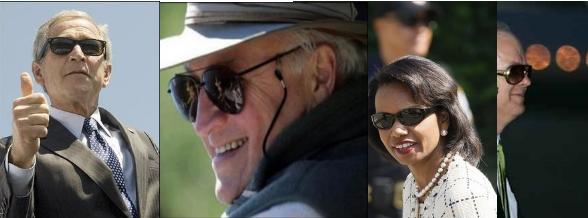
The General Pinochet look is soooo cool
Maybe, once these jokers come before a court of law (not some bogus “Truth Commission”) the United States can restore it’s prestige in the world to the equal of Chile. Or Uruguay.
Two schools of thought?
Cast a cold eye on life, on death…
Whether man die in his bed
Or the rifle knocks him dead,
A brief parting from those dear
Is the worst man has to fear.
Though grave-digger’s toil is long,
Sharp their spades, their muscles strong,
They but thrust their buried men
Back in the human mind again.
(W.B. Yeats, Under Ben Bulben)
While I’m fascinated by the Bolivian terrorism story, it’s a little off my beat — there’s more than enough weirdness and kinky violence right here in Mexico. Otto and Bina are doing a better job (and sometimes scooping the big boys) of keeping up with the Bolivian-Croatian-Hungarian-Argentine-Colombian conundrum, and the best I can do is take a look now and again at the Irish Times.. or pass those interested on to them.
Conor Lally, the Times crime correspondent, has been doing an excellent job of following up on Michael Dwyer, the Irish “tourrorist” that seems to be a side issue in all this. There are some eyebrow raising suggestions in Lally’s story (the Irish security company where the dead man worked has an unsavory reputation, but no website; who were the other 17 Irish travelers, and what was this “training course” he told his parents he was taking in Bolivia are questions I have, but are left unanswered).
But, what really caught my attention in Lally’s article was this from Martin Dwyer, the dead man’s father:
Mr Dwyer said he was disgusted that pictures of his son’s body appeared in newspapers after his death.
While perhaps, out of shame, or grief, the Dwyers wish to retreat into privacy, privacy is not extended to the dead in Latin America. The dead have no shame, nor is it any assault on dignidad — dignity being the ultimate right of personhood in this part of the world — to be exposed in death.
It seems grusome to outsiders — and there’s no getting around the fact that it takes an adjustment — that death, even violent death, is an accepted fact of life. Whether traffic accident victims, headless gangsters (or their victims), suicides or foreign terrorists gunned down in a hotel room, the photos are going to be published. The same as those who die a “natural” death are not prettified, nor is there any indignity.
Visitors get a ghoulish thrill from Latin America’s acceptance of the “not pretty.” The spate of media reports on Mexico’s Santa Muerte focus on the sect as a “Death Cult”. It’s not. It’s a religion that accepts death, but so does Christianity. In our churches, the image of Jesus is not some nice, cleaned up corpse ready for the “viewing”. Jesus’ limbs are distended from the crucifixion, the lance wound in the side, and the crown of thorns are bloody. The mystery at the heart of Christianity is resurrection, but to have resurrection, one must accept that Jesus died under torture, and to turn one’s gaze from the torture is to deny the significance of the resurrection.
It is not that one likes the images, nor that one accepts gangsterism, or terrorism… or auto accidents for that matter. But they are not abstractions, something alien to one’s life. This does not make Latin Americans fatalistic… the survivors of those whose bloody demise is splashed across the morning papers mourn their loved ones just as an Irish family does. But they — and we — understand quite well that this is part of being human.
There are those who say images of violence make one tolerant of violence. No, it’s the abstraction of violence. Real violence is not shown: the same country that would not publish even photographs of coffins of dead soldiers from an extremely violent invasion is the same country where an entire industy is built on violence as entertainment. Hollywood movies are extremely violent, and popular television series in the United States, “CSI” , is premised on the idea that violent death is an interesting intellectual puzzle.
Northerners, with a few exceptions, have never cottoned on to the Latin American sense that death is a fact of life. One of the few was the naturalized Mexican writer, Bruno Traven. Traven’s 1929 novel, Die Brücke im Dschungel (The Bridge in the Jungle in English, El puente en la selva in Spanish) is essential to understanding the Mexican way of death… and, in some ways, the Latin American (and human) way. A little boy is killed, ironically, by the “gifts of civilization” (unaccustomed to wearing shoes, he falls off a bridge and drowns) and the unnamed narrator becomes a partipant in the lengthy funeral rites. There is nothing pretty about the dissolution of a corpse in the jungle heat, but there is nothing unnatural about it, nor any attempt by Traven or his characters to deny it. It is in the nature of thing… and humans… to die and to rot.
It is in the nature of foreigners with guns to be shot and to leave a bloody corpse. In Mexico, one admits to mortality. Tourists come for the oddity of Dia de los Muertos, but there is nothing ghoulish about celebrating life and death. Levity is part of being human too, and the irreverence shown to death itself is in no way showing irreverence to the dead. It’s death that is not to be feared, but mocked. Not the dead themselves. They, no matter the cause — gunshot or a noose — maintain their dignidad.
Twelve heads in a bag (The Krayolas)
I’m not sure what to say about this. I’m always glad to see artistic fusion in the borderlands(the classic corrida, or I guess “narcocorrida” taking on Texas folk/Bob Dylan style “American” coloration). I just wish the Krayolas had picked some other noteworthy event.
Too big to prosecute?
We are shocked at what we have heard, and have no doubts on the evidence given that the Colombian government of Alvaro Uribe, and the security forces, are complicit in human rights crimes. We are convinced also that the murderous activities of the paramilitary forces are condoned and actively supported by the government and army. These crimes are aggravated by the impunity enjoyed by the perpetrators and the failure of the legal system to prosecute the criminals and those who issue the orders.
It’s no wonder that the Bush Administration was so hep on Colombia. Having just celebrated the life of a genuine hero who was willing to put torturers and human rights abusers on trial, and in an era when even PERU is willing to put corrupt presidents in the dock, what is the problem with the Obama Administration?
Deliver us from evil, but not the Sinaola Cartel?
I honestly don’t know what to make of this situation.
Even in the “reliably leftist” (and in Mexico, that means anti-clerical) media has been all over the story of threats against rural priests who preach on the sinfulness of narcotics trafficking, or — in the course of their pastoral duties — take a more proactive approach, helping farmers and others counter threats from local gangsters, much as the best of Colonial rural clerics protected their flock from brutal Spanish authorities. The PRD — given the severity of the threat — has suggested that priests receive federal protection.
Last week, the Archbishop of Durango, Héctor González Martínez, publically said that “Everyone knows where [#1 on the narco hit parade] Chapo Guzman is… except for the authorities.” His Eminence then specified the town.
However, when asked by the Federal Prosecutor to come in for an interview, González said, “I am deaf and dumb.” He further denied that he, or priests in his diocese, are under any threat.
The Mexican Bishops Conference, this week in Mexico City, issued a statement rejecting the idea of special protection, arguing that “all citizens must be protected, and priests are citizens, too. It is the Federal Government’s responsibility to protect everyone.”
While Renato Ascencio, Bishop of Ciudad Juarez, confessed (if that’s the right word) that one of his priests had to flee to Canada because of death threats, and Salvador Rangel, the new bishop of Huejuetla, Michoacán said a few priests have received threatening telephone calls, others were only willing to admit that preists — like other citizens — sometimes receive threats.
Most of the hierarchy seems to be taking the same line as Emilio Berlié, Archbishop of Yucatan, who claims narcotics traffickers “respect religious men and women, because we represent God.”
***
A couple of thoughts.
1. The bishops are, of course, correct, in stating that all citizens should expect their government to protect them, but there’s more to this than that. Priests (and nuns… and ministers and rabbis and imams and gurus and lamas… all clergy) are not “normal” citizens. There may be something unfair about clerical restrictions (mostly having to do with inheritance laws) these restrictions are mostly on the churches as organizations. Clerics — as representatives of their denomination — cannot take a political stance, and religious facilities cannot be used for political purposes. Given the overwhelming power of the Roman Catholic Church compared to other denominations, when the Bishops speak of clerical rights for citizens, they are usually demanding the right to use their power to shape public opinion. If this is true, it’s a smart (but … forgive me… devious) move to demand equal citizenship rights for the clergy.
2. PAN is, and always has been, the “Catholic Party”. The “piety wing” of the party can, in many ways, be compared to “Christian Conservative” movements within the U.S. Republican Party, but Mexico and the U.S. are very different countries. Anti-clericialism (or, rather, limiting the power of the Roman Catholic Church) is what made Benito Juarez a hero — and almost a saint — to Protestants, Jehovah’s Witnesses, Mormons and other religious minorities. Non-Catholic religious voters tend to back the left. PRD is, and always will be, the anti-PAN, which, by extension, means it receives support from the non-Catholic minority voters. The Bishops are not willing to turn the other cheek to the PRD. Whatever PRD proposes, the Bishops reject. And vice-versa.
3. There is a growing rumor in Mexico — mostly limited so far to chismosos and comments on internet sites — that the Sinaloa Cartel is in bed with PAN. What’s pointed to as evidence is that Chapo Guzman managed, very easily, to escape prison soon after Vicente Fox was elected President, and that the “war on drugs” has been a war on “some narcos”… the Beltran-Leyas, the Gulf Cartel and la Familia… not much on the Sinaloa Cartel. Conspiracy buffs also point out that Chapo Guzman’s alleged fortune is somewhere, but there seems to be almost no interest in the Federal Government into finding those assets — which have to be invested somewhere. The conspiracy theorists also notice that PAN claims of “naroc influence” in the other parties revolve around every gang BUT Chapo’s.
Adding to the PAN-Sinaola rumors is something interesting that Jason Dormady at “Secret Reflections” noticed. Jason, who teaches Latin American and Mexican history at Stephen F. Austin State University in Texas keeps a sharp eye on Mexican religious trends. He noticed that the recent anti-Santa Muerte “pogram” ignores another much better known alleged “narco-santo:
Santa Muerte appears to have upset a few folks in the Calderon admin…and I have to wonder if it doesn’t have to do with more than narcotics.
1) PAN Catholicism at the leadership level is NOT the folk Catholicism and syncretic Baroque worship of the Santa Muerte followers. Do we have some lingering Sinarquista influence among the PANistas? I’d say that is not a hard stretch.
2) Drug cartels also have leaders that give deep devotion to border saint Jesus Malverde… is the PAN going after him? I haven’t heard that they are…if they are, write in and let me know. If they aren’t, it seems to me that they may not be because Malverde is a Northern santo and to go after him would REALLY unsettle some northern PANistas. Then again, Malverde is also more popular amongst those crossing the border, unlike Santa Muerte who has deep followers in DF.
In other words, Santa Muerte followers tend to NOT be PAN supporters, but the Sinaloa Cartel (and PAN-controlled area voters) are likely devotees of Jesus Malverde.
And, when it comes to Chapo, the Archbishop — like Sergeant Schultz — sees nothink.
For what it’s worth, I know that conspiracy theories and talks of cabals are commonplace in Mexico, and only sometimes true. And I recognize that politics in Latin America is a contact sport. With Congressional elections coming up you expect politicos to spread the muck pretty thick. But, some conspiracies turn out to be true, and sometimes the mud sticks.
Random numbers
It’s not Mexican “real Americans” despise… it’s Republicans
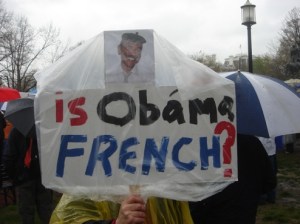
This would account for Obama-mania
Recent polling by CNN reveals Mexico, as a country, is viewed favorably by 52 percent of Americans (ok, “USAnians”). The most popular of the countries asked about was France (viewed favorably by 68 percent). Even Venezuela (viewed favorably by 42 percent) gets a higher favorability than the Republican Party (39 percent). (OpenLeft)
Texans (which includes a whole lotta crazies) might be the exception here. At least, according to a Houston Chronicle survey (sombrero tip to Stace Medellin’s “Dos Centavos”)
The numbers of area residents who believe that the new immigration “mostly strengthens American culture” increased from 39 percent in 1997 to 57 percent in 2005, and then dropped to 44 percent in 2007, before recovering to 49 percent in this year’s survey.
…In the 2009 survey, 64 percent agreed that, “The children of illegal immigrants should have the right to attend the public schools,” down from 71 percent in 2007.
…
In 2007, 44 percent were in favor of “a law that would deny health and welfare services to illegal immigrants in Texas.” In 2009, 50 percent were in support of that proposal.
They must have been surveying the suburbs…. that’s where the Republican live.
Mexican lemons… safe at any speed
Otto (Inca Kola News) found this safety/trucking issue related statistical graph:

It’s a plot of the US highway fatality rate versus the tonnage of fresh lemons imported from Mexico… I’m forced to conclude that Mexican lemons have improved highway safety a great deal. The vitamin C, maybe? The fragrance? Bioflavanoids?..”
Be PRI-pared, no PANicy PRDictions — yet
David Agren (The [Mexico City] News) (link very likely to disappear within 24 hours)
The Consulta Mitofsky poll gave the PRI 32.3 percent support, a 2 percentage point drop from a similar poll taken last month. The National Action Party, or PAN, climbed by 1.3 percentage points to 26.8 percent.
The Democratic Revolution Party, or PRD, came in a distant third at 14.7 percent, but the result continued an upward trend for the left-wing party, which bottomed out at 10.4 percent during the midst of a messy internal election in November.
The nation’s remaining five registered political parties garnered support from a total 5.3 percent of the respondents, while 20.9 percent of those surveyed said that they were undecided.
While PAN surprised me last presidential election, resorting to enough dirty tricks and negative campaigning to pull out a victory (helped by the ineptitude of PAN’s presidential candidate), I expect PRI will do very well in the June Congressional elections. PRD is about where it always is, despite rumors of its imminent demise. The smaller parties, especially Convergencia and the Workers’ Party (PT) may do better than the polls suggest.
Mitofky polls are relatively reliable, if you take the margin of error to lean towards the left. Home telephone ownership rates are very low in Mexico, which means undercounting the working class and rural voters, as well as the urban poor. AMLO, while not widely covered by the media, has been building grass-roots support among those undercounted voters thoughout the country. PAN and PRI sniping may not benefit the PRD, but may shift a percentage or two to the smaller parties which will probably be PRD allies in the next Congress.
Familia values
Latin American Herald Tribune (Caracas):
MEXICO CITY – The Mexican Federal Police announced on Sunday that they had captured after a six-month investigation 44 alleged drug traffickers from the La Familia Michoacana cartel, arresting them all at a baptism without a shot being fired.
Among the people arrested in the Saturday operation launched in Morelia, the capital of the western state of Michoacan, was Rafael Cedeño Hernandez, the cartel’s second-in-command and the man responsible for shipments of drugs coming from Central America…
Besides providing better-dressed perps for their group mug-shot, La Familia was different from most cartels in a few other ways …
Cedeño, “el Cede”, the taskmaster, reported to Nazario Moreno González, “el Chayo” who was second in command of “la Familia” and presumed heir apparent to leader Alberto Espinoza who has been in detention since last New Years’ Eve.
“The taskmaster” coordinated the cocaine transfers and the distribution of efedrinin and pseudoefedrin to la Familia’s chain of clandestine laboratories, oversaw operations at bars and speakeasies owned by la Familia (or shaken down by them), as well as being in charge of promoting prostitution, and day to day hit man and kidnapper activity… and well as coordinating training and indoctrination into la Famila.
Cedeño’s indoctrination consisted of courses in ethics (!), personal development, avoiding narcotics use, overcoming alcoholism, and building a strong family bond; all “in order to obtain a greater motivational and emotional control of the members”, a police official said.
Sounds like kind of an uptight organization… sort of like Amway. I bet they didn’t have casual Fridays.
(Abridged and translated from “ Cae ‘El Cede’, un jefe de ‘La Familia’ michoacana“,
María de la Luz González, El Universal, 20-March-2009)
The more things Che-nge
The U.S. media and politics website, “Crooks and Liars” an audio recording of an interview between ABC News correspondent Lisa Howard and then Cuban Minister of Industry, Che Guevara, from the 24 March 1964 edition of “Issues and Answers”.
The “issue” that made this newsworthy 45 years ago was an agreement between the Cuban government and British Leyland Company to buy buses for Havana. Though Crooks and Liars presents it simply as a “blast from the past,” triggered by renewed interest in Cuban-U.S. relations, Guevara was making statements that — absent the Marxist jargon — are still being made today.
At about 01:35 on the 24 minute recording, Guevara speaks of the problem caused by “foreign aid” to Latin America (and specifically to Cuba), pointing out that the U.S. is not the only market in the world. Throughout the interview, Che returns again and again to the point that if there was a “free market” and Latin American (and Asian and African) nations were equal partners, revolutions like the Cuban one would probably be based on local issues.
Howard asks specifically about the Alliance for Progress, which Guevara notes, ironically I think, that if the Alliance really did create equality in Latin America, the United States would be faced with the problem of dealing with its own inequalities. Rather pointedly, he says that the “American Way of Life”, the high living standard of the west, depends on exploitation of Latin (and African and Asian) people.
Interestingly enough, at 21:20 on the recording, Che speculates that Raul Castro would be the logical successor to Fidel. I’ve thought for a long time that Cuban political development was locked into place by the U.S. blockade/embargo. Had the U.S. and Cuba had normal relations, and not interfered with Cuba’s search for alternative markets, the political system would have been very different. As it is, my prediction is that post-Raul, Cuba will adopt a “Institutional Revolutionary” system, like that which prevailed in Mexico… with the party and state services overlapping, and a relatively stable system in which — although the Revolutionary achievements are preserved — there is a slow erosion as the system ossifies.
I think the money line is at 22:50 when Che, asked about what the United States should do in Cuba (and, by extention, in Latin America):
Nothing, just leave us alone.
Bullshit by the numbers: the “drug war” again (sorry)
Some 10,560 people have been killed since 2006, the year Mexican President Felipe Calderon took office and launched his campaign against the organized crime gangs that move cocaine, methamphetamine, marijuana and heroin to a vast U.S. market. Consider that fewer than 4,300 American service members have died in the six-year war in Iraq.
While there are a few similiarities between the U.S. War in (or on) Iraq — in that many feel it was started to legitimize a dubiously elected president, and serves as a distraction from more pressing social issues — the constant repetition of that “More Mexicans killed than U.S. soldiers” just doesn’t stand up.
Even if we accept the idea that an action against gangsters is a “war”, there are a few glaringly obvious problems with the numbers. First, if we consider the police and soldiers and the gangsters as “combatants” the number of civilian deaths is about zezo. The number of civilian deaths in Iraq is estimated at between 90 and 100 thousand people. That’s out of a population of 30 million, compared to a handful in a country of 120 million.
Those 10,000 Mexican deaths are gangsters, soldiers and policemen… “legitimate targets” if one is willing to swallow the “war” jargon.
Secondly, the number of U.S. casualties is just that… those from one force. That number ignores British, Spanish, Police, Salvadorian, Fijian and other “coalition casualties, let alone the Iraqi Defense Force, which is doing most of the dying on one side of the conflict. Coalition Force casualties alone are over 10,000.
And I didn’t even look at the numbers for Afghanistan, nor at the number of “terrorists” and “insurgents” killed.
(Figures: Iraq Coalition Casualty Count, Iraq Body Count)


