Bolivia: Follow the (Masonic? U.S.?) money
The coup attempt (or thwarted terrorist attack) in Bolivia is veering from something scripted by Robert Ludlam into something by Dan Brown.
Unexplored at this point are any ties between former U.S. Ambassador Philip Goldberg, who was Chief of Mission in Kosovo prior to his appointment as Ambassador to Bolivia in August 2006. In August 2007, Goldberg was expelled from Bolivia, following media reports of his ties to the separatists, and the comical incident in which the United States miliary attache, Lt. Col. Greg Michael of the Mississippi National Guard, was arrested shooting up a whorehouse in Santa Cruz (the largest city in the separatist region) which led to exposure of a gun running racket.
Also unexplored… and this is where it seems to go into Dan Brown territory, are the intriguing hints of a Masonic plot. Far from the kind of guy to go off rails into rants about the International Zionist-Bildenburger-Templar conspiracy, Otto writes in Inka Kola News about an odd connection between the terrorists, and the “Media Luna” separatists which includes ties to the Croatian Army and Masonic lodges.
I’d look into the Ambassador and the Masonic Lodges as well. This would not be the first time in Latin American history coups were organized this way, by U.S. Ambassadors. Back in December 2006, I wrote about Joel Roberts Poinsett and the York Rite Masonic plot that set the pattern for U.S. covert operations in Latin America, back in 1828. Masonic conspiracies aren’t the stuff of paranoia in Latin America. The Italian based Propaganda Due Masons (or, as the Masons now clain, “pseudo-Masons”) had a hand in the “dirty wars” of Argentina and the southern cone in the 1970s.
Logically, the Bolivian investigators are going to follow the money trail. The first, and most obvious question to answer is “who paid for the luxury hotel where these guys were staying”. And, perhaps just as intriguing, how did an Irish tourist, who’d been staying in youth hostels throughout Latin America (from the now-closed Bebo site) end up with these Croatian-Bolivian-Masonic terrorists, and shot in his underware in a luxury hotel room in Santa Cruz?
Follow the leaders…
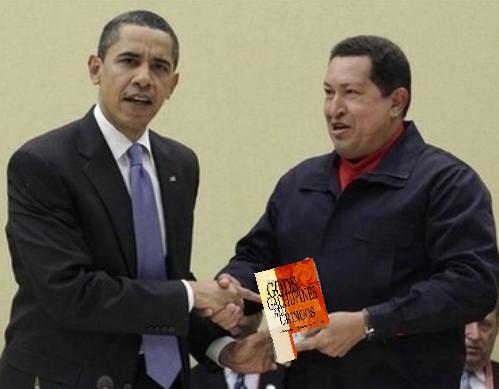
(Oh, Eduardo Galeano’s Open Veins of Latin America is pretty good, too, for a book published 35 years ago). I don’t know about Open Veins, but if you’re boycotting Amazon, I know my book is available though alternative sources: read here.
Mazahuacholoskatopunks …usos y costumbres
Every writer on Mexico, especially Octavio Paz, has seen the survival of the indigenous cultures as a remarkable achievement — and it is. Mexican culture is unique, but then, all cultures are… all take in the new and “modern” on their own terms. One of my motives in writing Gods, Gachupines and Gringos was to correct some common myths about Mexico — the first being that Mexican culture is a single thing, a specific blend of indigenous and “Spanish” influences in some specific formula. You get the sense sometimes that people read that the DNA of the Mexican population, as a whole, is somewhere between 40 and 60% indigenous, and then leap to the conclusion that 40 to 60 percent of Mexican culture is indigenous. And, that indigenous culture is static. And, that there is a monolithic indigenous culture in Meso-America.
While a good number of those myths are based on plain, old-fashioned reactionary thinking, there were a few resulting from “progressive” beliefs, which are equally false, and equally fatal to people expecting to deal honestly with the Mexicans.
It’s not a matter of political thinking, but just not thinking to assume that indigenous peoples were part of a static culture (and that there was a single indigenous culture in the Americas). Of course, it is racist to assume that the indigenous peoples were “backwards” and sitting in darkness waiting to welcome their European overlords (and smallpox) to drag them kicking and screaming into the 16th century, but it is equally racist to assume that individuals and groups didn’t see advantages in the changes (dislocating as they were), nor that the indigenous people did not consciously adapt and adopt these changes to meet their own needs. Or that what was 16th century indigenous culture would have stayed the same over the next five hundred years.
Very few of us expect people not to change, though many have a sentimental (or stereotyping) attachment to some outdated image of a people. Look at how these men are dressed in the late 1920s in this photograph by Tina Modotti.
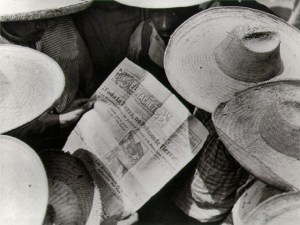
The big sombrero is what we usually think of when we think “Mexican”, but outside a football game (or a barroom for tourists) would you expect to see men dressed like that in Mexico City. This Mexico City street scene, by Carl Campbell, could be almost anywhere in the world:
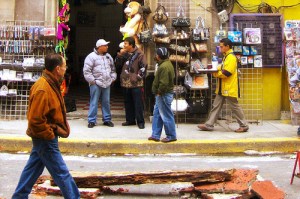
People don’t dress like they did in the 1920s, and there’s no reason to assume they would. Tourists are sometimes disappointed they don’t see more “indigenous costumes” on the streets when they come to visit. Maybe they do, and just don’t know it.
The Mahuaza people , indigenous to the State of Mexico and Morelia, like other people, adopting the outside cutlure to their own needs, and incorporating them into their “usos y costumbres.”
 Young Mazahua men work in Mexico City as construction workers. The white pijamas of their elders would make them stand out in the city, and — they sense — open them to ridicule. In a surprising way, the “uso y costumbre” of the Mazahua has not been to cover up their “tribal” affiliation, but to borrow from their new neighbors, the “urban tribes” of Mexico City. Depending on their community within the larger Mazahua world, there are skater Mazahua, there are cholo Mazahua, there are punk Mazahua.
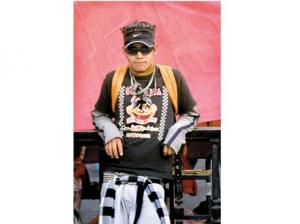 Federico Gama, who has written Mazahuacholoskatopunks (photos from the book) notes that while the Mazahua in the city disguise their indigenous origin to outsiders, they can tell at a glance who is, and who isn’t, one of them.
As with any traditional community (whether indigenous or otherwise, anywhere in the world), one learns the rules at an early age. Because its the young construction workers who are earning money, and — in the modern age — money makes the world go ’round — the cholos and punks and skaters and emos are  taking over community leadership from the elders. Part of tradition is learning the code… so, children preparing for the rite of passage (literally… taking the bus to Mexico City) are taught not just how to dress cholo, or darkeo or punk, but the walk, the attitude and how (and when) to throw up a gang sign… Mazahua gang signs.
The “mainstream” culture has also made its adaptions… By custom, indigenous communities in Mexico City have always had their Sunday gathering spots. Certain parks, and even certain park benches, are the village center where the scattered diaspora congregate to speak their own language and catch up on home business. The Mazahu homies do that too, but with their own new tribal affiliations, savvy constuction company managers, recognizing that their cholo and punk and darkeo workers have differing tastes (hard to imaging an emo construction worker), already were setting up clubs for those workers. A Mazua club with the same music and amenenities wasn’t that difficult for them.
I have my doubts about “usos y costumbres” as a legal right that overrides personal autonomy. I’m wondering what will happen in a couple of years when a cholo’s kid decides he wants to go punk. Or emo.
We should have seen it coming
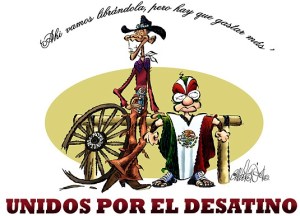
“Calderon”, the political cartoonist at Reforma, couldn’t resist using the controversial Spanish Burger King Texican Whopper ad to comment on the Obama visit. As Laura Martinez kindly explains to those who can’t read Spanish, it says “United by bullshit”.
The Obama-Calderon talks resulted in a couple of carefully worded statements full of loopholes, like “Should Congress fully fund these requests, we anticipate requesting the remaining funding,” and an agreement to “launch a Bilateral Framework.”
I won’t hold the pickle, I won’t hold the lettuce… and I won’t hold my breath waiting for a substantive change in U.S. – Mexican relations either.
The Czar can do no wrong
I suppose using the term “Czar” for the bureaucrat whose job is to coordinate between all the other bureaucrats on a specific goal is unavoidable. THE Czar was the autocratic head of a fractious empire of uncontrollable petty aristocrats who ran roughshod over their local people. And, the guy who could bring down the wrath of the whole state on anyone who questioned the value of any particular whimsical decision he made, without facing consequences.
One hopes, in a democratic state, picking a “Czar” is done with some care, and concern for the decisions made in the past. Although Mexico welcomes the Obama Administration’s acceptance of U.S. responsibility for the gun and money smuggling operations that are undermining security on this side of the border, there is concern about treating a separate border issue, migration (emigration from here, immigration there) — seen as rooted in economic problems and agricultural policy — as a security and law enforcement issue as well.
The [Mexico City] News, in today’s editorial, wonders if “border Czar” Alan Bersin’s background in mishandling migration enforcement isn’t a bad sign for the future.
Perhaps people have been blinded by all the recent gestures of bilateral cooperation, but hardly a note of protest was raised this week when the White House made a very questionable choice in naming its new border czar.
New czar Alan Bersin essentially held the position before when he served as the U.S. Department of Justice’s special representative for the southwest border from 1995 to 1998 during the Clinton administration. During that period, he oversaw the implementation of Clinton’s new Operation Gatekeeper, an effort that sealed off the border at San Diego and El Paso and pushed migrant flow into the southwestern desert.
According to the University of California at San Diego, migrant deaths at the border rose from 87 in 1995 to 499 in 2000, an increase of 474 percent. Nearly 3,000 deaths were reported during the first 10 years of the program.
In an interview this week with the San Diego Union-Tribune, Bersin said the deaths “were largely a function of the migrants being taken [to the desert] by smugglers.” But that’s a cop-out. The government’s intention was to push the migrant flow into less-populated areas so that they’d be easier to spot and catch.
In a story by the Arizona Daily Star, Andres R ozental, Mexico’s deputy foreign relations secretary from 1988 to 1994, defended Bersin’s role in Operation Gatekeeper, saying: “I think he was acting under instructions of his government.”
Sorry, but we’re not buying the “just following orders” excuse. We’d like to see Bersin own up to the failures of Operation Gatekeeper, and we’d like to hear someone, especially on this side of the border, make a bigger stink about his appointment.
Back to basics
Hey, there foreign policy wonks… economic downturn cutting into your interventionist plans for global dominance? Tired of the pontificating on the same old dreary “-stans” that no one seems to be able to find on a map, let alone find interesting enough to support your think tank? Has Andrés Martinez got a deal for you!
Mexico is so refreshingly 9/10. The fact that the bad guys there — and they are truly nasty — are not driven by religion or ideology, but are just in it for the money, is reassuringly retro. Still next door and still a mess, though not quite Pakistan, Mexico is a place Americans can always go back to, the way one goes back to basics, or the girl next door. Mexicans may not feel the same way about U.S. intentions, but ever since the James K. Polk administration a century and a half ago, whenever the United States preoccupies itself with Mexico, it takes a breather from more adventuresome empire-building. It was no accident that the pre-9/11 George W. Bush talked about adopting a more “humble” foreign policy almost in the same breath in which he talked about prioritizing the U.S. relationship with Mexico. The two would seem to go hand in hand.
Mexico is a fitting foreign-policy “crisis” for an overstretched superpower suffering recessionary times, eager to turn inward. This isn’t about wanting to extend a Pax Americana halfway around the world, but about domestic anxieties once Americans’ hubris has been depleted. U.S. jobs are disappearing along with Americans’ retirement savings, and now, well, the neighborhood is going to hell.
The cool kids donate to the Mex Files:

Resistence is futile: Homeland Security
In a twisted way, this is a good thing. Those of us who worked or lived on the U.S. side of the border and have been talking about the lack of basic civil rights that follow the paranoia about border security have been dismissed as leftists or told our concerns are overblown. And, besides, the argument goes (but is seldom verbalized) it only happens to “those” people… not white, middle class people.
Well, the Rev. Stephen Anderson would like to set the record straight on what happens to U.S. citizens who object to being subjected to police state searches in their own country.
By the way, this was not a border crossing, but a “check point” along a Federal interstate highway.
UPDATE (21 March 2009): Jesus’ General posts a video that makes the pastor look like a loon (which he is, as the audio the General also posts brings home), but that’s not really the point is it. He’s an arrogant asshole, but last time I checked, even arrogant assholes who preach on the virture of standing up to piss don’t deserve to be tazed, beaten and arrested by the border patrol.
The foreign terrorists in Latin America are… Irish?
Updates in boldface. I’ve been linked as a source plagiarized by the highly unreliable, and factually challenged Marc Chamot Report [see note at end].
Although right-wing terrorism, and the denial that it exists, are semi-hot topics in the United States, it’s a much more serious reality in Latin America than theoretical MOOSLEM TERRORISTS.
Via Inca Kola News comes a report of an attempted assassination attempt on Bolivian President Evo Morales. Bina, at News of the Restless translated several reports from Bolivia’s ABI which fill in more information. From what is known, it appears there was a terrorist cell — including Europeans (some reports say Hungarians, others Romanians, and still others Croatians)– operating in Santa Cruz, where the U.S. Embassy was unwisely supporting what appeared to be a fascist group seeking to foment an secessionist movement in the region. Whether these were hired guns or an organized terrorist group isn’t clear yet. Santa Cruz secession was largely funded and led by Bolivians of Croatian and East European extraction, who may still have ties to the “old country”.*
To add confusion to what we know, a few days ago, someone tried to blow up the Cardinal of Santa Cruz’ home (His Eminence was unharmed, but the poor guy is recovering from heart surgery and didn’t need the excitement). The Cardinal is not a supporter of Evo Morales, but of his opponents. This group was supposedly responsible for the attack on the Cardinal’s home.
Predictably — the far-right in Santa Cruz is trying to suggest that the terrorist reports were phony, though Bolivian officials showed the explosives, weapons and dead Irishman, another foreigner and a Bolivian. Others of various nationalities are said to be in custody.
The Irishman, now ready to be planed under the old sod is named Michael Dwyer. I thought right-wing militias were a U.S. thing, but apparently not. The Irish Times is reporting that Ireland’s Foreign Ministry is investigating, but does not identify Dwyer. Dwyer’s website (on a Bebo page — the AOL version of Facebook) which includes several photos on him in Bolivia, lists friends and associates in various Irish paramilitary “clubs” that may be of interest to the Foreign Ministry and international law enforcement people.
Conor Lally, Tom Hennigan and Michael Parsons, who are covering this for the Irish Times, in an article detailing the predictable response of Dwyer’s friends (basically, claiming he’s a nice guy, and couldn’t have been involved with a terrorist organization, and that “A member of the family of Michael Dwyer (25), from Ballinderry, near Borrisokane, Co Tipperary, confirmed last night that he had died in unexplained circumstances while travelling in Bolivia”, drops in this possible bombshell:
It is understood some of the group had been working in private security in the US.
I sent the reporters an e-mail, asking if they had any more information on the “security company” connection, but don’t expect to hear anything until Monday at the earliest.
* A weird post-script. The Miami Herald, which only claims there was an “Alleged Plot” , had a comment on the story by someone calling himself exelero”. Exelero makes some oddball claims — that the dead Irish guy was a boytoy for the Bolivian leader (from the Irish guy’s site, it’s pretty clear he was straight… but who can say? — which don’t make sense. “Exelero” linked to a Bolivian website, that referenced a Hungarian-language website about the Bolivian killed in the police attack, Eduardo Rozsa Flores. Rozsa Flores was a journalist (of a sort) who joined the Croatian Army during the Croatian-Serbian War, and had a blog, variously in Hungarian, English and Spanish. It appears Rozsa was a Muslim convert, though it’s hard to tell whether he was pro-Muslim, or just anti-Israeli. The side links seem to be for far right-wing sites, though the English-language articles are from “leftist” and progressive organizations.
Sabina, at News of the Restless, with better access to Hungarian and Croatian speakers, dug up more reliable information on Rozsa than I could, and I’d suggest checking her post on his background shady background and activities in Bolivia and Europe.
The Muslim ties don’t seem that strong, but it’s worth noting that the Bolivian leader also had east European ties to extreme rightist organizations.
Mark Chamot Report readers:
Chamot seems to be under the impression that suggesting that law enforcement people contact Dwyer’s friends listed on his Bebo page (especially those from the Galway war games club he belonged to) during the investigation Chamot took to mean there was confirmation of an internet terrorism cell. The Bebo page has since been taken private, but apparently there is also a Facebook page, which included photos of Dwyer in combat fatigues, from his “combat adventure sports” activities.
Chamot — like most far right wing “fair and balanced” types, is an blithering idiot and a self-aggrandizing fool. He claims connections with a number of reputable “mainstream media” organizations, and claims to have been praised by “Daily Kos” (and a number of obscure, unknown far right commentary sites), but what seems to be implied is some comment on one of those mainstream sites (or on Kos) mentioned him. This is worse than unethical, it’s a blunder.
The real tip-off is that Chamot uses the sad case of Pedro Guzman (the mentally retarded U.S. citizen — by birth, I might add — who was “deported” to Mexico and was finally tracked down by his mother (with no help from the United States government) living on the streets of Tijuana to illustrate his contention that IMMIGRANTS need to learn English. Guzman, once again, was born in the United States, is mentally retarded and from a part of the U.S. where a minority language is spoken.
Texas — just say “oui”
Stace Medellín (Dos Centavos) quotes his historically challenged (and seditious) Governor as saying:
“Texas is a unique place. When we came into the union in 1845, one of the issues was that we would be able to leave if we decided to do that,”
Now, Rick Perry is amongst the anti-American voices supporting secession.…

Texas secessionists at "Tea-bagger" event, screenshot from Rachel Maddow Show, MSNBC
Just FYI, on Perry’s 1845 statement, Texas came into the union with the ability to divide into five states, not withdraw. After seceding during the Civil War, Texas was allowed to re-enter the union after ratifying the 13th Amendment. The 13th Amendment banned slavery in the United States and any territory subject to its jurisdiction.
UPDATED: Texas v White, a U.S. Supreme Court case decided in 1869, said Texas cannot secede.
What these neo-Texians seem to forget is that Mexico allowed a few of the illegal aliens from Tennessee to stay if they became Catholic and gave up their slaves. They broke both rules, thus, they were bombed out of the Alamo–only after careful thought by Mexican soldiers who didn’t really feel like shooting at a Church, which the Alamo was. Again, all Mexico was doing was enforcing its immigration laws once the Texians failed to live by the rule of law.
While I agree that “Gov. Good-Hair” is a moron (or, moran, as the right-wingers like to say), maybe the United States should allow Texas to secede…. though, of course, that would leave the Texans — who pay no income tax now — having to figure out how to pay for their own defense and security, not to mention making up the budget deficit they’ll face when the Johnson Space Center moves to Mississippi. Maybe they can borrow money from Mexico. And, of course, it would be much easier for the United States to build a fence across Oklahoma, where the wind comes sweepin’ down the plain, than along the existing Texas international border, the Rio Grande River/Rio Bravo.
It would certainly give the United States and Mexico less reason to complain about each other. The United States could stop fretting over “violence spilling over from Mexico” and start worrying about it spilling over from Texas, and the Mexican gangsters, whose murder and mayhem is bottled up on the United States frontier would hae somewhere to expand without annoying the two major trading partners overmuch.
And getting Mexico to accept an independent Texas might not be all that difficult. General Santa Ana’s foreign minister, Lucas Alamán, who saw — correctly as it turned out — that U.S. annexation would be problematic for Mexico, suggested in 1845 that his government recognize the Texas Republic on one simple condition… that Texas NOT support annexation by the United States, but become a French dependency.
Actually, that makes sense. The Texans and the French both think their cuisine is the best in the world… both belive their own version of their native language is the only proper form of the language… that the rest of the world is interested in whatever it is they do… and they both think it’s perfectly normal to proudly celebrate their military defeat by the Mexican Army — le Bataille de Camerone and its dead heroes, Danjo, Milan, Morzski and the rest are quite the equals of the Battle of the Alamo‘s Travis, Bowie, Crockett, et. al.
Its not who you know, it’s who’s your daddy
Proof, if any was needed, that having the right parents makes all the difference:
Paraguayan President Fernando Lugo acknowleded his paternity of Guillermo Armindo Carrillo Cañete. Lugo was a Roman Catholic Bishop when he began his relationship with Guillermo’s mother, Viviana Carrillo. Though a Catholic priest involved with WOMEN would be newsworthy in the United States, Catholic priests in rural Latin America have always been assumed to have girls on the side. And, occassionally, kids. And he’s certainly not the first Latin American president to have a taste for young girlfriends (Juan Peron had a thing for teenagers). As a scandal, this will probably pass.

“… once fell from the third floor of a building and survived without a scratch. “He is the son of a bishop, no doubt,” [Ms. Carillo’s cousin, and her lawyer] said. “It was a miracle.”
God protects fools, babies and Latin American presidents.
Sex, drugs and other news o’ the day…
The Secretary of Health, Jose Angel Cordova said that if marijuana were legalized in Mexico, it would strengthen the cocaine cartels because the use of marijuana would lead to the use of cocaine. He said that studies proved that users of marijuana are 13 times more likely to use harder drugs.
Of course, Jose Angel Cordova also tried to sell the idea that condoms lead to sex. Cordova’s comments on cocaine came during Congressional hearings on decriminalizing marijuana.
Speaking of mood-altering substances, At the Red Fly, in Mexico City’s Condessa, serious research is being conducted, Ejutla, Oaxaca native son, Cornelio Lopez:
Led by the erudite López, the mezcólatras embarked on their quest in late 2005, taking the Red Fly as their base. Defined as those “who know the history, rites, manufacturing procedures, properties, tastes and ways of tasting mezcal,” the mezcólatras see it as their mission to defend the mezcal making tradition while making others aware of its value.
And, in the world of dangerous substances:
“BKC (Burger King Corp.) has made the decision to revise the Texican Whopper advertising creative out of respect for the Mexican culture and its people,” the company said in a statement sent to The Associated Press.
…”It was our intention to promote a product whose culinary origin lies in both the American and Mexican cultures, and was meant to appeal to those who enjoy the flavors and ingredients that each country offers,” the company said.
Burger King does not address the more serious issue of referring to something described as “taco coated chilli con carne” as Mexican food… or even food.


