If you can read this… you must be a commie
Those pesky lefties... why can’t they follow the prescriptions of the IMF and World Bank and privatize education?
The “Yes I can” campaign, designed by Cuba and paid for by Venezuela, has helped more than 800,000 Bolivians.
Under Unesco standards, a country can be declared free of illiteracy if 96% of its population over the age of 15 can read and write.
In 2001, a census found nearly 14% of Bolivians were illiterate.
Cuba was declared illiteracy-free in 1961 and Venezuela, under Hugo Chavez, reached the standard in 2005.
Mexico, which has some unique challenges (50+ languages) was well on its way to eliminating illiteracy, but the process has somewhat stalled in the last few years (about the time “neo-liberalism” came back into fashion). The rate isn’t bad — about eight percent — with most illiterates concentrated among older rural women who speak a language other than Spanish. Despite a huge increase in the military spending, and a need to change the budget in light of the U.S. economic meltdown, education and public service spending is higher than last year. As usual, education accounts for about 10 times the military expenditures.
Illegal alien cows!!!!
Apparently, in the U.S. “free flow of goods and services” under NAFTA doesn’t include cattle.
EFE (sory, lost the link!)
Live cattle exports to the United States will end the year down more than 50 percent due to U.S. food labelling law, Oswaldo Cházaro, president of the National Farmers Federation, or CNG, said on Thursday.
 The labeling system has created discrimination against Mexican-produced meat products, he said.
The Country of Origin Labeling, or COOL, system means that a product is only deemed a product of the United States if every production phase takes place in the United States.
That means that U.S. slaughterhouses now have to divide animals in their facilities by country of origin, and create separate labeling methods within each factory.
The legislation, which entered into force in September, covers beef, chicken, pork, fish, seafood, fruit, nuts and fresh vegetables.
Chárazo said most of these products are exported to the United States once they have passed the final stage of production with a “Made in Mexico” label.
However, the vast majority of Mexican beef exports are live calves, sold to U.S. farmers for rearing at around six months old. These calves are raised and fattened in the United States for 10 months before being slaughtered.
Under previous rules these calves had been sold with the label “Made in the United States.”
U.S. meat producers have begun deducting the cost of the new structure from prices paid to Mexican farmers, Chárazo said. Six-month-old calves raised on the Mexican side of the border now sell at 85 cents a pound, while U.S. raised calves earn ranchers $1.2 per pound.
Chárazo called the 35-cent price difference “aberrant,” adding that it had never before been more than 10 cents.
From 2005 to 2007, Mexican farmers exported on average 1.32 million live cattle a year to the United States.
During the first 10 months of this year however, Mexico exported just over 500,000 head of calves, and the CNG estimates that Mexican farmers will export no more than 626,000 for the year as a whole, a decline of around 47.3 percent.
“We will have around 700,000 extra calves which will remain in Mexico, creating an overstock which will create an alarming price drop,” said Chárazo.
Meanwhile, U.S. meat exports to Mexico continue to soar, he said. He estimated full-year 2008 exports at around 416,300 tons, up from around 318,000 in 2007.
The Economy Secretariat had separately filed a complaint with the World Trade Organization on behalf of Mexican farmers, Chárazo said.
The Washington Post reports that Canada has joined the suit filed with the World Trade Organization.
That “five dollars a day” is now… $3.98
I buy my eggs at the neighborhood grocery by the half-kilo. Some of my neighbors — who are earning the salario minimo, or a bit more — buy theirs by the peso. They have to watch every centavo, and figure the family food budget based on what cash is on hand that day. It’s not usual to hear someone ask for four pesos of eggs, four of tomatoes and ten pesos of beans rather than a quarter kilo of eggs, three tomatoes and a bag of beans.
For them, the below-inflation raise in the salario minimo is going to create new challenges. From The (Mexico City) News (links tend to disappear after a day or two):
The below-inflation hike to Mexico’s national minimum wage will help preserve jobs, although workers will be unhappy, experts said on Friday.
“The main reason the wage hike was below inflation levels reflects the worsening [economic] situation … a lot of companies are trying not to fire people but to implement cost cutting measures,” said Gabriel Casillas, an economist at UBS Bank México.
The National Commission on Minimum Wage, or Consami, said Friday that it would raise the top rate minimum wage by 4.6 percent to 54.80 pesos ($4.18) a day on Thursday. Lower minimum wage rates of 53.26 pesos and 51.95 pesos apply in some areas.
However, the Association of Mexican Human Resource Professionals, or Amedirh, said it was stunned that the wage increase had come in so far below inflation, which was 6.23 percent in the 12 months ending on Nov. 30, according to statistics published by the Banco de México.
Approximately 5 percent of Mexican workers receive minimum wage, and they are seeing their purchasing power weakened every day, she said.
What I see in U.S. and foreign presses all the time is a confusion between this figure (or these figures) and “average wage”. Mexican workers are not paid an hourly figure, but a daily one. The person receiving the “salario minimo” may only work that particular job a few hours a day. And, if they are a regular employee, their paycheck also includes one day of rest per week, vacation and year end bonus pay.
In theory, it’s based on the cost of basic goods and services, needed to support a family of four. The calculations include such things as the price of milk, mangos and beans, as well as cooking gas, transportation expenses and electricity. It doesn’t really meet a family’s needs (and doesn’t include — but should — things like school supplies and union dues), but with a state-run medical system and assuming the family receives assistance for school uniforms and supplies, it is possible to get by, if the family owns their own home. That five percent who live on the salario minimo are sometimes “not in conformity” with the Mexican constitution’s stated human right to a decent home, though they are usually people having SOME kind of home.
The other thing that needs to be understood is that the figures reported ONLY apply to unskilled general labor. Everything from janitors to carpenters to editors to financial analysts have a set “salario minimo”. Salaries are low here (and some of us, like I do, fall into anomalous categories that don’t have a set wage, or are — like commissioned sales persons — not covered by these rules.
However, the lower than inflation raise in the salario minimo cuts into everyone’s purchasing power, not just the low wage worker. Job contracts are usually written as so many times the salario minimo — what’s a few centavos difference to the fruit picker in Chiapas is a few hundred pesos to the Mexico City executive whose salary is expressed as 1250 salarios.
And, things like legal fees and fines are not a given amount in the law, but a number of salarios minimos (a parking ticket in Mexico City, for example, is 2.5 salarios. It saves the trouble of revising the traffic code every time there’s a change in the currency value).
Still, while controlling wages may be a time-honored way of controlling inflation, its the housewife who buys her beans not by the kilo, but by the peso who is going to be cutting back, not the bankers and economists.
Los Tres Caballaros contra los Nazis (Friday Nite Video)
Here’s a clip of one of the greatest propaganda films ever made . Concerned with the appeal of Fascist movements in Latin America during the 1930s, the Roosevelt Administration, at the start of the Second World War convinced at least a few Hollywood moguls to lend their talents — and their talent — to the war effort.
One studio’s efforts outdid anything Leni Reifenstahl ever did — Leni only convinced Nazis in Germany to be Nazis, and did it in German. This film, in English, Spanish and Portuguese, not only helped convince the Brazilians and Mexicans to join the allied cause (Brazilian troops fought in Italy, and Mexican airmen in the Pacific, as well as providing needed raw materials, industrial capacity and Mexican workers to keep the farms, factories and railroads functioning in the United States) but managed to find two hitherto unknown Brazilian and Mexican stars… who in this scene manage to overpower one of the best, and most popular, American film personalities of all time:
“The Three Caballeros (English version) — starring Panchito Gallo, Zé Carioca Papagaio and Pato Donald — is available in its entirety in eight Youtube videos, beginning with this one..
I wrote about the Disney Studio and the Mexican contributions to the war effort in my book. A slightly early version of the story was posted here on the Mex Files in August 2007.
Cut to the chase
Burro Hall on your (North of the Border) tax dollars at work here in Mexico:
Six months after we (America, not Burro Hall) promised Mexico a billion and a half dollars to exacerbate the war on drugs, the first few sackfuls of cash have started to shake loose. Like most foreign aid, the vast majority of these dollars will be spent in the US, not Mexico. But one thing that is being built in Mexico, we note with interest, is several dozen “laboratorios” for detecting false immigration documents. How excellent – more money and power for La Migra!
Of course, on the list of antisocial activities committed by the cartels, sneaking into the country on false papers is pretty far down the list. But then this whole Initiative is more about furthering US goals in the region than fighting the scourge of drugs, as the people in charge of it all but admit.
Checking for false IDs — paid for by “Plan Merida” — has more to do with finding contracts for software vendors than with finding narcos. Funny that none of the press releases or news stories mention who got the contract to develop the software… and whether or not we Mexican taxpayers will be stuck for the maintence and service contracts on this.
Besides, what difference does it make to Mexico if gangsters use phoney ID cards? Aside from a few Miami Mafiosi and the occasional rogue wannabe crime-buster, foreign criminals don’t have much to do with our “War on (some non-pharaceutical) drug (exporter)s”.
Dumb criminals
This little story from El Diario de Coahuila (Saltillo, Coahuila) 12/17/08 (translation by “M3 Report“) is being carried in the U.S. press as evidence of the pervasiveness of crime in northern Mexico, and the alleged power of the gangsters. It seems to me more that if the supposedly master criminal “Zetas” are reduced to attempts to shake down schoolma’arms, they’re not as powerful as we are led to think. Resourceful, but pathetic:
In “at least” 17 educational institutions in the city of Monterrey, Nuevo Leon, teachers have received threats from presumed members of the criminal gang Los Zetas demanding their Christmas bonuses. According to several reports from professors, members of the criminal group appear in schools dressed in suits and threaten teachers for their bonuses, in some cases as much as 20,000 pesos [about $1,500]. In other cases, the demands are made by telephone. Teachers are reluctant to show up for their final classes for fear of being attacked by Los Zetas.
The teachers’ union (and dissident unions) are a pretty powerful group in themselves, and teachers generally enjoy a level of respect not accorded to policemen or politicians. Screwing with teachers is much more likely to bring down the Zetas than attacking the cops.
Great Leap Backwards
 Leave it to the Bushistas to get one teeny-tiny thing right (lifting the cap on the number of foreign seasonal farm workers) and screw up everything else. Royally. Farmworker Justice, via The Sanctuary:
The Bush Administration today finalized midnight regulation changes to slash wages, make it easier to hire foreign workers, and reduce worker protections for the nation’s farmworkers. The changes apply to the H-2A agricultural guestworker program and were published today in the Federal Register. They will take effect January 17.
The DOL’s many harmful revisions to the H-2A visa program include reducing obligations for growers to effectively recruit U.S. workers before applying to bring in guestworkers, lowering the wage rates by changing the program’s wage formula and eliminating government oversight of the program.
I don’t recall either proposed Obama Administration Secretary of Homeland Security Janet Napalitano, nor Secretary of Agriculture designate Tom Vilsak having ever showed much interest in protecting farm workers, so don’t expect immediate relief from this neo-bracero non-program.
“Foolish Forbes”
I overlooked this, but “maesana” at the Lonely Planet Thorn Tree Mexico Message Board caught it. This article appeared in The (Mexico City) News, 17 December 2008. The archiving system for The News is sometimes hit or miss, so I’m posting the entire thing — for “educational use only” — © 2008, Editorial Quertyiop S.A. de C.V.).
Foolish Forbes magazine
Augustin Barrios Gomez
In its latest edition, Forbes Magazine published a cover story called “Mexican Meltdown: The Next Disaster.” The front page sports an especially dark and menacing Mexican looking over a Mexican-flag bandanna, guerrillístyle, into the camera.
Forbes could have done a review of the problems of our huge, diverse and vitally important country. The cover could have been “The Mexican Challenge.” But Forbes decided to go the simple “everything’s going to pot” route. Perhaps they believe this will sell more magazines. But what they did is irresponsible and wrong, as Ambassador Arturo Sarukhan himself points out in an interview included within.
The truth is that all the U.S. public gets is bad news about Mexico. Even relatively responsible NBC News only talks about violence … over and over again. Its parent company, GE, has been lobbying the Mexican government to allow its Spanish-language Telemundo to operate here. Nevertheless, we never hear about the Mexico that represents an attractive market for GE. We only hear about drugs, violence and poverty, with an occasional shot of a Cancún beach during Spring Break.
This does not serve the interest of the U.S. public, which has a larger stake than it knows in the success or failure of its North American neighbor. And it certainly makes the job of those of us who are here working in favor of promoting the rule of law, economic growth, etc., more difficult.
The media has pigeonholed Mexico as (1) a place of violence and poverty, or (2) a place with bucolic, or fun, beach destinations. If your story is in any way nuanced, or truly analytical, it finds no place in the mainstream media. The upshot is that we get gems such as this line published in the Forbes article: “Drug-related violence pervades all segments of life in Mexico.” No, it doesn’t. The 107 million Mexicans and 1 million plus Americans who live here are surely worried about narco-violence. But it certainly does not “pervade” our lives here. To say it does is to misinform the public, at best, and to generate fear and loathing toward Mexico and Mexicans, at worst.
To pretend that Mexico (and perhaps even the 27 million Mexicans and Mexican-Americans in the United States), will just bid “adiós” and fall off the edge of the entire U.S. Southwest is ridiculous. Nevertheless, that is the leitmotif behind many of the reactions to what people are seeing in the news. Airing our problems could provide a wake-up call to people in power, but expectations are often so low that dissing Mexico fuels despair, not action.
In February, this column pleaded: “President Calderón needs to get interested parties with more local legitimacy to argue Mexico’s case.” At the time, it asked for a coordinated, multi-disciplinary public education campaign in the United States to confront the myths, explain the challenges and invite the public to be part of the solution, not part of the problem. It said: “Non-governmental Mexican and U.S. organizations should be disseminating information about Mexico and its cooperation with the United States. In addition, North American companies with interests on both sides of the border could launch a campaign to educate people regarding NAFTA.”
Unfortunately, Mexico keeps its PR budget tied to the Tourism Secretariat, which is obsessed with variations on the anachronistic “Amigo Country” campaign of the 1970s. The Forbes article is an example not only of lazy journalism, but of Mexico’s failure to explain and sell itself to its most important audience.
Instead of smearing Mexico with facile alarmism, Forbes, supposedly a magazine for investors, should have been paying more attention to what became the real “next disaster,” just down the street from their offices. Bernie Madoff allegedly created, under the auspices of the U.S. Securities and Exchange Commission, or SEC, a Ponzi scheme to the tune of $50 billion. He was regulated as a “broker dealer,” certified by the authorities, operating with impunity for more than 30 years. The SEC has been extremely effective at making the lives of ordinary investors more difficult by limiting third-party wire transfers for the sake of combating “money laundering,” for example. But when it came to actually doing their job, which is “to protect investors,” they have been criminally negligent. Not even in the darkest depths of Mexico’s multiple financial crises did we see this level of brazen swindling as a result of astonishing government ineptitude.
To wit, when Alfonso Romo went personally bankrupt, his brokerage, Vector, was deftly isolated from the mess and investors never lost even a minute’s sleep. Who would have ever thought that Mexican authorities could teach their U.S. counterparts a thing, or two, about oversight?
This post brought to you by the letter “Z”

Zapata
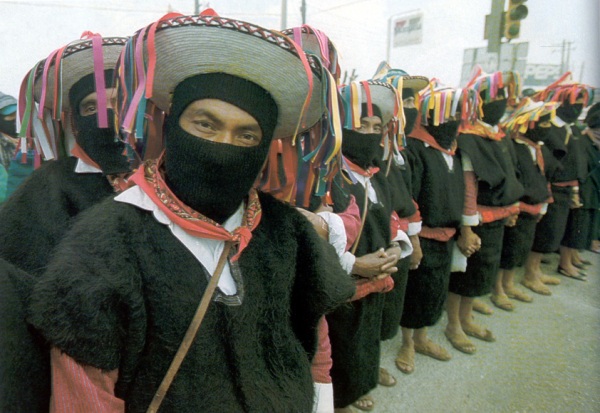
Zapatistas

Zapatos

Zapatazo
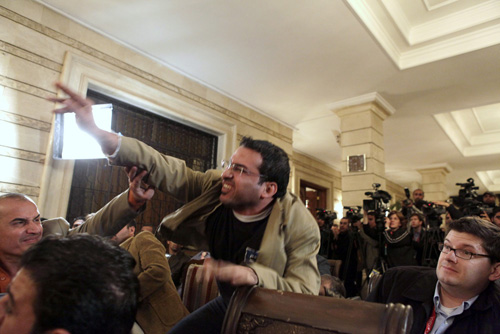
Zapatazoista
Za-pa-ta-zo-is-ta 1) Of, or related to the actions of one Muntazer al-Zaidi, a journalist who told George W. Bush on 14 December 2008 what everybody in the world thought, but hadn’t said… that Bush deserved the boot!
2) One who appropriately responds to bullshit.
The summit… DOH!
While Otto has the best report on the fun and games at this non-major major event, we can look forward to a report from the U.S. delegate who met with Evo Morales (Bolivia), Rafael Correa (Ecuador), Hugo Chavez (Venezuela), Juanes, Alvaro Uribe (Colombia), Alan Garcia (Peru) and Lula de Silva (Brazil):
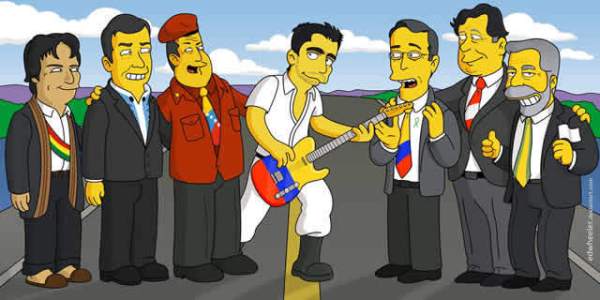
Sombrero tip to Eddie (“Barrio Flores“, Cochibamba, Bolivia)
Nobody’s like a Virgin anymore
Not quite credibly, Raul Sayrols, publisher of Playboy Mexico, claimed that “The image [of un-covered girl Maria Florencia Onori] is not and never was intended to portray the Virgin of Guadalupe or any other religious figure. The intent was to reflect a Renaissance-like mood on the cover.” Nobody believes him, of course. It “just happened” that the semi-nekked Onori appeared dressed in quasi-biblical garb in the December issue… just in time for the only religious holiday everybody in Mexico actually pays attention to… 12 December, the feast of the Virgen de Guadelupe. By the way, Burro Hall found a link that THOU SHALT NOT CLICK.
Now that you’re back … and have said three Hail Mary’s and made an Act of Contrition….
Sure, people were offended, but at least it was over something with a long history, and the offense was contemporary. In Santiago Chile, Cardinal Jorge Medina is stuck in a time warp. It was so 80s… not just the Mass in honor of that 80s guy, Augustin Pinochet, but the Cardinal’s sermon… dedicated to attacking the ” offense to God and a dirty stain on our heart,” who was not — as one might think — the day’s honoree, but a 50-year old mother of four who used to be famous. Just like the dirty stain formerly known as General Pinochet.