Gringo to the last drop…

Photo: Tom Tziros (http://www.flickr.com/photos/argos_t/)
This photo happens to be from Thessaloniki Greece, where there have been riots lately over a domestic issue (police brutality), but almost anywhere in the world where the Seattle coffee-seller has set up shop, you will find the same thing after people with a grievance pick up a few rocks.
Or, want decent coffee at an affordable price.
Even though my introduction to Latin American business was in the early 1990s, when I worked for a short time for a coffee importer and distributor in Kansas City, MO (there was even a “Richard’s Blend” which didn’t do too badly at a few selected cafes in western Missouri and east Kansas), and I could look at beans and tell you with some certainty where they were grown (and, in a pinch, whether they came from the Atlantic or Pacific side of some Latin American countries), I’m not a big coffee snob. Nor think it’s worth paying some company in Washington State a sizable chunk of change for what I can get from a local seller for much, much less. Coffee is coffee.
The Greek riots started with protests over a police shooting, but as the unrest has grown, so have the causes for complaints, foreigners being one. The Greeks are upset with poor immigrants, but down this way, it’s the wealthy semi-immigrants that are undermining the local economy…. shopping for Colombian coffee. OK, Colombian coffee probably is better than Mexican coffee, and — thanks to Juan Valdez — assume Colombian coffee is what one must buy. At least that’s the message I’m reading on the local on-line message board for ex-pats here in Mazatlan. Where there is a well known MEXICAN coffee roaster and distributor.
Mexico is a NAFTA member state, and the U.S. and Canada are supposed to be favoring Mexican agricultural products over non-NAFTA products. But, as with toys, textiles, electronics, etc. the U.S. was also keeping prices for consumer goods artificially low by buying from the cheapest supplier, whether that supplier was a piratical state like the People’ s Republic of China or not. So, the U.S. is buying coffee from Colombia (with its absolutely horrifying labor and human rights record) over Mexico, where very good labor rights are often ignored, but where out of work farmers lose what few rights they do have when they are forced to become “illegal immigrants” in the United States because of … among many things… gringo’s insistence on Colombian coffee.
I hate to tell the local gringos this, but Mexican and Colombian soil conditions and climate in the coffee growing regions is the same. Mexican are not traditional coffee drinkers, but there’s nothing unique either in the genetics or soil conditions of Colombian coffee… it’s all hype. And Starbucks — like any other coffee roaster and distributor — looks first at where they can buy the cheapest beans, than only secondarily at the genetic variants: Arabica beans are pretty much all the same, and the only advantage Colombian growers have over Mexican growers is that coffee has been a favored export crop for much longer than it has in Mexico.
It rubs me the wrong way then to see Colombian coffee sold in Mexico… after being exported to the United States, roasted, ground and returned as a “U.S. product”… bought eagerly by those ex-pats who want Mexico to remain low priced, but somehow provide the same goods and services these gringos received at home by exploiting Mexico (and Colombia).
So, if Greeks… or Mexicans sometimes don’t appreciate the joys of Starbuck’s, it’s understandable. And, perhaps, admirable, that the citizens of coffee-growing countries sometimes realize that exporting their own products to be sold for the benefit of a foreign corporation isn’t a good deal.
Rock on, dudes! … I didn’t say that, and you didn’t read it.
Those who would trade liberty for security…
… you know the rest. There is a legislative battle right now between PAN and the Calderon Administration on one side, and PRI, PRD and the legislative left on the other over police reforms. The Calderonistas are pushing for a single national police force under the control of the Federal Executive and the opposition parties, for varying reasons, agrees that better police coordination is needed, but rejects a consolidated police.
In this case, it’s the leftist parties that are fighting the consolidation, and — if you read the rightist, or pro-PAN publications — is to maintain local government control (read “patronage”) where opposition parties have the upper hand. For the lefties, it’s also a matter of civil liberties. Police answerable only to the Federal Executive could be used to quash legitimate dissent. Of course, local coppers are used to put down dissenting movements now… but when they do, they risk their own electorial advantage if the movement is indeed popular with the locals, and — if they are unable to control the movement — then they need to compromise with the dissenters or open themselves to federal control (and risk removal from office for “inability to govern”). I tend to prefer a few pockets of anarchy and the risk of some violence to a police-state, but that’s a personal thing.
A more conservative argument against federalizing the police is also a basic capitalist one. If I were in the gangster biz, I’d rather only have to bribe one or two key officials, than handle the bribes for local police chiefs, state police inspector generals, federal police commanders — any one of whom might, in a fit of honest pique, undo my dirty work. A unitary police force would make bribery and corruption a much simpler task.
For the honest coppers, and those of us who support them, the less unified the police, the better. If there are corrupt forces, it’s easier to replace, say, the transitos of Fulanatitlan, than to pick out the bad apples buried omewhere in a huge police apparatus “controlling” a country of 120,000,000
I don’t like to just post full articles, but unfortunately The (Mexico City) News doesn’t seem to have an on-line archival system that works. Michel Marizco’s “The more things change …?” in today’s The (Mexico City) News (09-December 2008 ) is copyright ©2008, Editorial Qwertyuiop S.A. de C.V. and used with… trepidation.
Crusty old Border Patrol agents have a saying up here, “The only difference between the U.S. and Mexico is that in Mexico, the money’s on the table.”
I’ve been thinking about that a lot this past week, watching the United States carry on with its modus operandi of throwing enough money at a problem to make it go away.
I worry about the gringos, I really do. Until I start thinking that maybe they really do know what they’re doing. And when I start thinking like that, I get worried because whatever they see, I am not seeing it yet.
Last week, the United States forked over the first payment of a $400 million pledge to Mexico’s security. It’s replete in helicopters, scanners, training and something disturbingly vague called an Anti-Gang Strategy. U.S. Ambassador Tony Garza called it “the most significant effort ever undertaken” by the Americans and the Mexicans.
What do they see? What am I not seeing?
From my vantage point on the Sonora border, Arturo Beltrán Leyva’s boys in the federal government are going to be getting some shiny new helicopters and semi-truck scanners to make sure their loads are going through.
What else can we expect? What else does anybody expect?
The case against high-ranking officials in the Special Investigations of Organized Crime unit, SIEDO, was just beginning to be get interesting in late October. You may remember the case, two high ranking officials within the SIEDO had been arrested and accused of taking $400,000 salaries dropped off in a suitcase every month by Beltrán’s people.
The news was clouded, it nearly disappeared, and in the media it seemed to completely disappear when that plane carrying Juan Mouriño and José Luis Santiago Vasconcelos went down. The case against Santiago Vasconcelos’ former subordinates had just barely begun when the man died.
For years, I’d been hearing what a remarkable man he was; how the SIEDO was going to function like an island of law enforcement, isolated from the silken strands of Sinaloan narco-dollars. How under the Fox administration, the SIEDO was going to be a new type of law enforcement. It wasn’t and that fact is not changed by the demise of the agency’s former director.
Two weeks ago, another top official went down; Rodolfo Gutiérrez, AFI’s top voice in Interpol, also working for the Beltrán family.
Now, the answer we’ll hear – and I hear it from the gringos every time a renegade Border Patrol agent gets arrested – is that their arrests are indicative of a fabulously working system. That they’ve fallen into the leaching fields of a perfect biosphere and were surfaced on the outside; the system is clean.
Sure.
And War is Peace and Ignorance is Strength, yadda yadda.
I was astonished, I don’t know why, last year, when the U.S. State Department sold a bid to a U.S. technology company on behalf of the Mexicans. They wanted a system that would monitor every cell, landline, fax, chat message, e-mail and Internet posting coming in and out of the country.
For whom? Who was going to be listening on those calls?
The Americans seem to think, just about every time, that this time is going to be different.
Now I’ve had the same hope in Las Vegas and it usually ended with trouble and an emergency call to the bank in the middle of the night.
Is this what we’re seeing? The gringos hitting and hitting, when they should be staying? Topping 21 every time and cursing their luck then throwing down another stack of chips?
Or do they understand something I’m not seeing in Mexico’s narco-woes?
A growth area in the Mexican economy
GUADALAJARA – The 22nd Guadalajara International Book Fair ended over the weekend after having received 600,000 visitors and registered a general increase in sales, organizers said.
“The number of visitors is 12 percent higher than last year, and the number of professionals is similar, around 17,000,” book fair director Nubia Macías told Efe.
The fair, which ran from Nov. 29 to Dec. 7, is the biggest in the world of Hispanic publishing, with the presence of more than 1,600 publishing houses and close to 500 writers.
For its 22nd edition, the book fair grew from last year’s 26,000 square meters (6 1/2 acres) to 35,000 square meters (8 1/2 acres) this year.
“The big publishing houses reported much higher sales than last year, between 30 and 80 percent more, although some say their sales stayed about the same,” Macías said.
He added that sales at the 2007 fair totaled about $50 million.
So, even if you can’t afford a vacation this year, you CAN afford a book. And, have I got a deal for you!
A dog’s best friend…
Amazing video from a roadside security camera in Santiago de Chile…
Barraging them with pesos
Grits for Breakfast reviews the War on (some non-pharaceutal company controlled) Drugs from North of the Border:
… the so-called “Merida Initiative” seems more political and symbolic than practical. Mexico doesn’t need our money, they need to clean up their own law enforcement agencies while America needs to focus on reducing both demand and corruption north of the border.
… the United States shouldn’t be spending so much on helicopters and equipment when many in Mexican (and increasingly US) law enforcement are working as much as agents of drug cartels as police.
Given that the “war” is mostly symbolic (though it’s killing real people, and more money just puts more weapons of individual destruction into more hands) there are two things that might be done.
One is to stop treating this as a “war” — which perversely legitimized the gangsters, creating mostly mythical “armies” of alien invaders. They’re not, they’re just ordinary crooks. Treating them as crooks, and not some special kind of super-gangster might not be so bad. People beat the crap out of car thieves and shoplifters when they catch them in the act (sometimes the police have to rescue the criminals from angry shopkeepers as a result). If we started seeing narcotics dealers as just another gang of crooks, maybe people would stop fearing them, and start treating them with the contempt they deserve. Instead, the state is throwing money at the problem — which, in the case of the Merida Initiative is only making some U.S. manufacturers richer, and putting more money in the hands of people who can buy narcotics.
A second tactic which doesn’t seem to be considered is the Canonizago… Alvaro Obregon, during the Revolution, observed that no Mexican general could withstand a barrage of gold pesos. Criminal proceeds have always been legitimized over time. HSBC started out laundering opium money, Las Vegas was built on mafia investments, etc. Why not let the gangsters “clean” their money, or pay them enough to retire?
Obregon, of course, had a stick as well as a carrot. Those who couldn’t be incorporated into the Revolutionary family were destroyed (like Pancho Villa). The gangsters aren’t stupid, they’ve invested their funds in all kinds of things outside narcotics. Forget the source of the money, and let them maintain their “ill-got gains.” But destroy them if they don’t “get with the program” and put that money into things like dam construction, telecommunications, banking, etc….. WITHIN MEXICO. Given that asset forfeiture laws exist in the United States and elsewhere, then start working with those countries to identify those gangsters with assets abroad. Some will try to keep their funds outside the country, but they can be extradited.
Of course, there are gangsters with a taste for criminality, but I suspect most just want to get rich. Let ’em. As long as the money comes back to Mexico (and money has no morals), Gangsters are already heavily involved in investments here… and the problem isn’t the money source so much, as the fact that criminals (especially those perceived as “super criminals”) can’t be held accountable for their actions like ordinary investors: try getting an environmental impact statement for a new hotel out of Chapo Guzman.
However, if Chapo is a legitimate investor, and is willing to file an environmental impact statement, what difference does it make where he originally earned the cash? He’s always claimed he was creating jobs anyway. Tell him to put up, shut up or die.
Certainly, a better form of “economic stimulus” than tossing more money at the police.
Bloody twits!
Nezua got a bit bent out of shape about the The Times (of England) On-line 7 December “Confessions of a Tourist: everything goes down Mexico way“, and suggested we respond. The biggest problem with the article — besides being patent fiction — is that it’s written, not in English, but in British… a dialect which uses the word “humour” for what normal English-speakers call “racist bullshit.” I don’t pretend to be fluent in British, but there are ways to respond that might be sensible to the inhabitants of the sceptered isle. As the Scots (not English)woman (Lady McBeth) recommended: Be bloody, bold and resolute.
To the Editor, The Times
Sirs:

The British are coming! The British are coming!
I realize that the benighted inhabitants of your unhappy, cramped, damp island only traveled the world under the influence of rum, sodomy and the lash; that historically it was your criminal classes sent to the Americas; and that your nation resents the fact that your people lost their Empire as a result of Mexico’s decision to prevent your companies from stealing our oil for the benefit of your Navy until 1938; but I would have hoped that a newspaper like “The Times” might have had a civilizing effect on a people best known for poor dental hygiene, unattractive, pasty bodies, inedible food, alarming levels of heroin addiction, illegitimacy and hooliganism.

The enticing smile of a typical British lass
Given the undeveloped state of your culture, perhaps the fictive nature of the 7 December 2007 “Confessions of a Tourist: everything goes down Mexico way” was based in some primitive folkloric tradition by-passed by the modern world. However, even in a nation so benighted as to maintain a hereditary monarchy, one would expect newspapers to print something that at least approached the suburbs of veracity.
Where, one asks, did “Cael Weedon” find a hotel in Ensenada on a “dirt road”? And, though the area seemed crowded with foreigners (presumably downtown Encinada, which keeps its cobbled streets out of a sense of tradition, and a cost effective way of controlling traffic), where was “Weedon” that there were no automatic teller machines, nor telephones, if indeed his wallet was stolen. And, given the large number of foreigners — all presumably engaged in unethical behavior (as was Weedon) — must one presume the wallet was stolen by nationals?

Brits abroad -- thankfully only half-naked
“Weedon” ends his tale with a claim that a hotel manager spied on him whilst passed out naked. Unlike Britain, Mexico is a modern nation, with a written constitution (unlike your vague “unwritten” constitution depending on the abject acceptance of custom and traditional values, allows all persons equal rights before the law). If a Mexican is so perverse as to find the pale, pasty, flabby, drunken, sexually repulsive Brits (and I have yet to see any other kind in Mexico) an object of desire, that is his right, and “Cael Weedon” has nothing to complain about.
Sincerely,
Richard Grabman
Mazatlan, Sinaloa, Mexico
Sunday reading: 07 December 2008
Where to go?
Jessica Terrell of the Orange County (CA) Register writes on the challenges of the well-educated and undocumented …
Carried into the United States in her mother’s arms, Maria became a [sic] criminal when she was just over 2-weeks-old.
Of course, she did not know that at the time. Maria found out that she was an illegal immigrant when she began applying to colleges at 17, and told herself that if she was unable to gain U.S. citizenship by the time she was 30, she would leave the country forever.
Now 22-years-old and a graduate student at Cal State Fullerton, Maria, who is still undocumented, said that she tries not to think about her lack of citizenship and the obstacles it could create for her future…
Going to Washington
“Chilangabacha” (Chilango + Gabacho: “One of the biggest challenges of speaking Spanish in Mexico is not being able to express yourself as clearly as you would in English. You might be a regular Dave Barry spouting off one liners and clever anecdotes in your native tongue, but when it comes to Spanish, by the time you think of some hilarious pithy remark and remember what the past perfect form of “chinga” is, the conversation train has already left the station.”), with tongue firmly in cheek, profiles Secretary of Commerce designate “Guillermo Hijo de Ricardo”:
Bill Richardson may have been born in Pasadena and gone to school on the East Coast, but the fact he went to public school in Mexico City until he was 13 years old qualifies him as straight up Chilangabacho, güey.
Going to (the) Mass(es):
>Inca Kola News, the essential capitalist tool for Latin American investors, explains the difference between the mindset of running a state-owned business and a private one:
… Chile’s Codelco, the world’s largest copper producer, will match 2008 capex next year to the tune of U$2Bn. In the words of big cheese José Pablo Arellano;
“The investment plan is comparable to the one last year…..We expect to go ahead with a vigorous investment plan next year in spite of this difficult situation”
Or in other words, while the rest of the sector tucks, trims, cuts and slashes spending, Codelco rolls on as usual. Y’see, the whole mindset of a country-controlled company is different. Bottom line profits come down the list of priorities (as long as the company adds to GDP and pays its tax and royalty bills the State won’t moan so very much).
Ian Welsh (Firedoglake.com) wonders about the economic sense in keeping some U.S. industries private, when public ownership would be cheaper… and a financially sounder investment:
… in exchange for 7 billion and some warrants that may never pay back, the government put itself on the hook for 250 billion dollars. For 20 billion dollars or maybe a bit more, the government could have simply bought out Citigroup.
Now, it would make no sense for a private investor to buy Citi, but if the government has decided that it will never let Citi fail, and it’s hard to read the Citi bailout any other way, then it’s already on the hook for all of Citi’s debts anyway. And if it is, then there is no downside to owning Citi: it gets all the upside if it turns Citigroup around, after all—not just a few warrants, but the ability to issue stock and pay dividends when it chooses, to itself. There’s no taxpayer protection like that.
Add that to the fact that the current management of Citigroup is clearly incompetent, and there’s no reason not to take over Citi. And with Citi under control, one of the world’s largest banks, the government could have used it as a policy instrument, having it lend in the overnight market at the rates the government determines, having it give out credit directly to consumers and businesses at government rates and so on.
Going, going… gone
Canada… CANADA!!!… apparently had a coup d’etat (or, as they call it in Quebec, a “coup d’etat“), with the ROYAL GOVERNOR seizing power. Or something strange like that. Wonkette can make about as much sense of it as anyone outside a monarchy can:
… well-to-do white nerd countries had supposedly given up on such uncouth measures as overthrowing the state. Slate’s posted a thorough summary of the whole thing; and if you’d like an “authentic” Canadian newspaper article about it… well crap, what’s the name of any Canadian newspaper… Toronto must have one…
Not going for the gold
Bananama Republic writes on the phony press releases being put out by the non-existent gold mining operation, Petaquilla:
Richard Fifer’s mining scheme in Panama, published a press release recently saying that they now had ANAM approval and would go in production in December. Then Don Winner of the Panama Guide, a relentless pumper of Petaquilla stock who at least on one occasion indicated he was a shareholder himself, declared that the Petaquilla share might very well make a comeback. It didn’t, the price tanked even after the optimistic press release and not even Fifer’s insider trades are keeping it afloat. Undaunted, Winner continued later that those who declared Petaquilla “dead in the water” were “morons“.
Inca Kola News has more on Petequilla and Richard Fifer:
Fifer is under charges of embezzlement in Panama. Y´know, minor details like that. Fifer is also pally pals with Panama’s President Torrijos, whose mandate finishes once the March 2009 elections are done. A surefire issue in this election campaign will be environmental issues, and Petaquilla is certain to be held up as an example of how not to build a mine. Any new admin is likely to ride the overwhelming local opposition to the PTQ operation in order to get into office. Politically, time is running out for the scam artist Fifer.How bad is the PTQ enviro record? Very bad. Just last month the same ANAM environment office that partially approved the PTQ impact study slapped a fine on the company to the tune of U$1,934,694…….. and thirty-four cents. The reasons for this fine include the non-submission of an EIA before starting site construction, damage to the ecosystem, soil erosion , loss of biodiversity and contamination of local water supply.
Plan Merida = Victory?

Victory attained by violence is tantamount to defeat, for it is momentary.
Mexican murders associated with organized crime and drug trafficking passed the 5,000 mark for the year, almost twice the number killed in all of 2007.
A total of 5,031 people have died this year in violence stemming from organized crime, including 35 in the past 24 hours, newspaper El Universal said, based on data it compiles. The pace of the violence has escalated over the year; the first thousand deaths occurred in 113 days, the last thousand in 42 days, the newspaper said.
Now that the United States is underwriting 197 million dollars — out of 4.5 billion dollars promised — in U.S. equipment and consulting purchases (NOT, as some media reports have it, “delivering 197 million dollars to Mexico”), we can expect still more “momentary victories” in the “war on drugs.” And more deaths in what should properly be called the “war on the unregulated export commodities market”.
Clothes make the man?
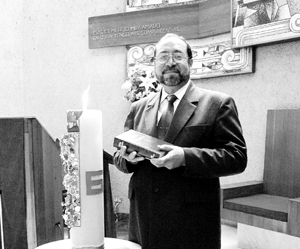
Can you guess what this guy does for a living?
The photo is full of clues, but you’ll have to read on for the answer…
Tis the season Friday video
Barbarians apparently celebrate Christmas stomping over each other in WalMart Stores. Civilized people maintain orderly lines.
Not clear on the concept
Jonathan Saltzman and Andrew Ryan, Boston Globe:

The regional director of Homeland Security, Customs, and Border Protection was charged today with repeatedly hiring illegal immigrants to clean her Salem home after one cleaner wore a wire during an undercover investigation.
Lorraine Henderson is the director of the Port of Boston, overseeing 190 armed federal officers who patrol major airports and shipping terminals in Massachusetts, Connecticut, and Rhode Island. She is expected to appear today in US District Court in Boston on a charge of encouraging an illegal immigrant to remain in the country.
“She’s supposed to be deporting aliens, not hiring them,” said Assistant US Attorney Brian T. Kelly, chief of the public corruption unit…
I just hope Ms. Henderson paid the cleaning women the prevailing wage.
Death: a bad career move
I have to admit I’m a bit stumped by Coahuila politics. On one hand, it’s often the most progressive state in Mexico (legalizing same sex marriage, for starters), and on the other, sometimes trying to act like their former territorial dependents, the Texans.
Coahuila Governor Humberto Moreira, depending on a state law, wants to institute the death penalty for some crimes. Federal Senate leader Gustavo Madero has warned the Governor that should he attempt to institute a death penalty law in his state, the Senate will have him stripped of his office. Senator Madero is from the conservative PAN party, but unlike the United States, Christian conservatives in Mexico really follow their religion. They also tend to believe in following the Mexican Constitution and international treaties (Mexico being a signatory to the Inter-American Human Rights Agreement (the “San Jose Pact”), both of which forbid the barbaric practice of state-sanctioned murder. It should be added that the euphemistic bureaucratic name for Mexican prisons is “Social Readaption Center” — suggesting that the point of locking people up is to eventually return them to society (alive), not — as in Texas and the United States — to punish them and prop up local economies.


