Restless in Rosarito
I don’t always agree with Maggie Drake (“Maggie’s Madness”)’s support for using military troops as police in Baja California, but as she wrote last Sunday, the residents in Rosarito see the Army as their only defense against a situation not of their making:
After Mass this morning, we were invited by friends in Rosarito who were participating in the March for Peace to accompany them. Of course, we had to sort of stand on the sidelines since we are not allowed to become involved in anything political. There had to have been over 500 people marching. After the march, the organizers met up with Mayor Torres, everyone else dispersed, but we were taken on a tour of the other side of the Highway and got a first hand glimpse of the the Mexican Army and Federal police patrolling the area.
These people want more Army troops on a permanent basis, and the truth is, they really do blame the Americans for providing the market for the drugs. They openly spoke of everything from extortion, the “Gentlemen’s Clubs”, kidnapping fears and corruption – and they are fed up. Organized crime here has become such a hydra-headed monster, it is so far beyond even what the United States experienced with prohibition.
Many of them were bitter that the tourists had stopped coming. These people felt that for a long period of time while the tourists were coming, they were being abused by the criminal element, yet they had to keep smiling and living in danger when Americans were sucking down the cervezas on the beach not even slightly aware of what they were going through. Many of these people were very angry.
.
Assume the position
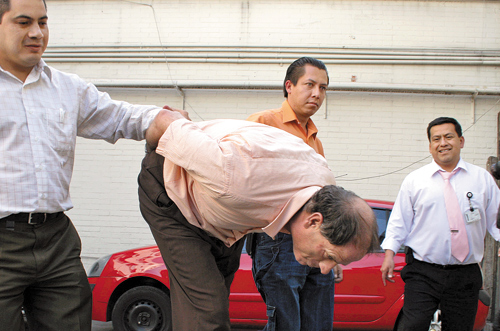
Photo: Cuartoscuro/Ricardo Castelan, reprinted from The (Mexico City) News
The “Mexico City Scammer” — who told countless tourists a tale of woe about stolen credit cards and the need to fly back to New York for his son’s birthday — has finally been arrested. Jonathan Clark wrote about the infamous gringo conman back in March 2005 (I’m quoted in the article).
The scammer, who used a variety of names and stories (usually claiming he worked for PriceWaterhouseCooper) is facing a plethoria of charges in Mexico, the United States and several European countries. His arrest came after pushing a would-be victim, who pressed assault charges. As seen in the photograph, the Scammer is in practice for the new role he will be playing at Reclusio Norte at least until his “real” identity and nationality is determined.
Top Gun
Where’s General Santa Ana when we need him?
From “A Global CIty on the Rise” (a Houston blog):
Houston has quietly become one of the top weapon sources for Mexican drug cartels according to federal law enforcement officials. Houston has numerous gun shops and is a good location, close to the border, for bring firearms into Mexico. An estimated 90 percent of some 27,000 weapons taken from stash houses or recovered on crime scenes from the past two years are said to have come from the U.S.
These are the issues that cause Houston much grief and concern and also give them a bad name. They are the types of problems that all global cities face but the global cities that stand alone on top are the cities that take these problems head on. Houston has to find solutions to stop so many weapons from going into Mexico and causing many problems and unnecessary deaths.
Plan Merida

No need for comment. Robert-ito (Noroeste)
We won’t get fooled again? HAH!
You know how to tell George W. Bush is lying? His lips move.
You would have thought that the U.S. press learned its lesson. Don’t believe what governments say, when common sense tells you its bullshit.
What’s frustrating… especially for those of us who comment on, and pay attention to, Latin America is the willingness of both corporate media and otherwise intelligent commentators and Latin-watchers… is that despite knowing the Bushistas fed everyone a line of bullshit about Iraq and “weapons of mass destruction” and the “axis of evil” that otherwise sensible people were completely willing to buy a story about the Colombian Army attacking a FARC encampment over the border in Ecuador (which killed several Mexican students) — and discovering laptop computers that spilled all kinds of e-mails supposedly detailing an “international axis of evil” between Latin American governments at odds with the Bush Administration, international terrorist organizations and cocaine dealers. The very fact that this “confirmed” Bush Administration policy towards Latin America (continuing to prop up the Uribe Administration in Colombia, and simultaneously deny and justify attempts to undermine the elected governments in Venezuela, Ecuador and Bolivia… and discredit the left in Mexico) should have made Latin American commentators and writers dubious.
The idea that laptops would have survived a direct missile hit was itself a questionable, but even Latin American commentators were willing to buy the tale. The technical questions were supposedly put to rest when Interpol investigators said the e-mails in question were not added after the attack… though no one outside the lefty blogosphere seemed to notice that Interpol did not say the e-mails were on the computers, simply that they couldn’t prove they were forged after a given date.
And even that story… which would have required believing that a couple of guys in the jungle were contracting with foreign intelligence services and suborning heads of state … should have been questioned. No one did.
I don’t know what happened. Even the “respectable” Latin Americanists — including the scholarly and “neutral” websites — bought the e-mail story and… now are ignoring what should be painfully obvious. They were fed lies, and are unwilling to admit that our assumptions about Latin America are wrong. The left is not “growing” through some devious plot, but simply organizing and winning elections; our Colombian allies are a bunch of opportunistic crooks; and the ready availability of narcotics in the United States is not some convoluted plot involving foreign evil-doers, but the result of U.S. failure to come to grips with their own problems; and there is no international terrorist network — just common interests among various groups.
A captain and antiterrorist investigator of the DIJIN, the Colombian equivalent of the FBI, Ronald Ayden Coy Ortiz, who wrote the report on the computer which the Colombian army claimed to have found in the encampment of Raúl Reyes, declared under oath before the Inspector General that he did not find any e-mails in the said computer. “Only Microsoft Word documents”, according to a report by Canal Uno, a Colombian TV station.
Upon being asked to “inform the office if you (the DIJIN) find any archives corresponding to e-mails sent or received by Raúl Reyes”, Capt. Coy responded, “We have not found any e-mails up to now. We have found a great many e-mail addresses, but Reyes stored the information in Microsoft Word format.”
The government of Colombia has maintained until now that the computer contained thousands of e-mails sent by the FARC leader, who died in an illegal bombardment of his encampment in Ecuador, in March.
When the going gets tough…
Víctor Cardoso, writing in Jornada, sees yet another danger to Mexico peeping over the border:
Foreign companies with operations in Mexico have sucked nearly 2,300 million (2.3 billion U.S.) dollars out of the nation’s economy, to provide emergency funding, resulting from the lack of liquidity during the present financial crisis for their domestic operations.
According to Banco de Mexico data, from January to September of 2008, profits remitted to foreigners is nearly equal to all of 2007, when 2,619 million U.S. dollars (2.6 U.S. billion) left the country.
Central bank officials say the phenomenon reflects “the normal transactions of a country well-integrated to the world-wide economy”. But for the financial analysts, the remittances to the home offices indicate financial pressures resulting from an international credit shortage, and attempts to self-finance.
A report from Banamex on the stock market mentions that Mexico’s situation is not unique, and that in all Latin American countries, there is a outflow of cash accumulated over the past 20 weeks.
The Latin American economy as a whole is fairly sound, and most analysts expect Latin America to be less affected by the “credit crisis” than the rich nations. Mexico has a unique problem in that it’s the “weakest link” in NAFTA. If the U.S. economy was expanding, and U.S. capital was underwriting Mexican expansion — NAFTA would be a good deal for Mexico.
The assumption, when NAFTA was new, was that what went up would keep going up. People would keep buying consumer goods, or bigger houses, or more cars forever. I suppose if they could keep borrowing money forever, and there was an infinite availability of stuff, nothing could ever go wrong. And if wishes were horses, beggars would ride.
There’s one of two things going on right now in the U.S. — or two things happening simultaneously. Either there isn’t enough money for all the stuff…. or the people who have money can’t use any more stuff. They’re stuffed… we’re stiffed. The reaction by the foreign companies is not — what it probably should be — to unload some of their stuff (or their cash) in Latin America, but to pull all the cash back they can, and hope they can get people to acquire even more stuff.
Think about buses. The inter-city buses were largely Mexican made products with U.S. or European name plates, but the short-run and municipal buses were mostly second-hand U.S. buses. Mexico City had Mexican made buses, and, in my time here, the local buses in smaller towns were less and less likely to be used American school buses or airport limos, and more likely to be second hand Mexico City rutas. I haven’t seen a used U.S. school bus on a Mexican street in several years now.
NAFTA was probably a big help in building the Mexican bus manufacturing business, but it’s not a consumer good that requires the U.S. any more. The same with Mexican autos (though lack of sales north of the border are hurting). Mexicans can buy their own cars and more than meet their own demand. Losing U.S. capital may not be a disaster. I’ve thought for years that Mexico — only the 10th largest economy in the world — was held back by trying to integrate with the world’s largest economy. It would be better off over the long run looking at markets — and financing sources — more in its own league. There are several in the neighborhood — Brazil, Argentina, Venezuela just for starters.
When you think about it, smaller economies can’t pull their cash out without facing consequences at home sooner. I don’t know what percentage of the entire U.S. cash the money pulled out of Mexico amounts to. It’s not going to be noticed much, and the drop in sales are going to be overlooked. But, with smaller economies (not insignificant, just smaller), the effects of pulling out a few billion to save a banker’s bonuses is going to have the exporters screaming bloody murder. A billion here, a billion there is real money in Latin America. With less stuff all around, no one country’s system can afford to write off a market… especially one of equal size.
The U.S. situation may slow growth in Mexico (and many argue that NAFTA has been doing just that for years) and slow the acquisition of consumer goods but I’m not sure Mexico — or anyone else — really needs all that “stuff.” Sure, a car (or two or three) in every garage (and a three car garage on every house) would be nice, but buses to every health clinic and a health clinic in every colonia would still require a huge economic expansion. The money is there — from Latin American sources (both the Latin Common Market, Mercosur, and the self-financed Latin American development bank, Banco del Sur, are likely sources) and the goods and services are available.
The meek may not inherit the earth… but they’ll have enough stuff to get by.
Water, water… not quite everywhere
Nothing is simple. If Mexico City is to have safe water, then the national parks have to be kept free of cattle… which spells disaster for small farmers. Franc Contreras reports for Al Jazeera:
All the view that fit the print…
Ana Gabriela Espinoza Marroquín has won the swimsuit competition in the Miss World Beach Beauty 2008 competition held in Durban, South Africa. The British newspaper, The Sun, seems to be under the impression that the winning contestant is named “Espinoza Anagabriela” but whether the English actually read The Sun is questionable. Besides garbling the name (“Google” in also garbles Mexican beauty queens, bringing up photos of Elisa Najara for Ana Gabriela Espinoza, or just Mexican women in general … Ana Gabriela Guevara was photographed many times in a rather skimpy outfit, but a track suit and bathing suit are hardly the same thing). I suppose, if I was writing about this, it might be a somewhat interesting factoid to mention that Ms. Espinoza hails from Monterrey, Nuevo Leon… about as far from a beach as you can possibly get.
But, I know nobody actually reads about these contests. They just look at the pictures.


Law and Order, here and there
If there is anything worse than a corrupt and poorly-equipped police corps, it’s a corrupt and well-equipped police corps.
(Economist and academic Jorge Chabat, in The News)
With the Calderon Administration’s “war on drugs” losing support because of the appalling number of violent deaths that receive national exposure (unlike, say, in the United States, where there may be an even higher death toll related to narcotics, though murders among users, AIDS, auto and industrial accidents, suicides, child abuse, etc. are of local interest at best), the latest rationale is the lack of a coordinated police force in this country.
The alarmist headlines being sent out in the U.S. mention that somewhere around half of Mexican cops are below standard… but that is based on a national standard. Like the United States, police forces exist at different government levels — Federal, State, Municipal — but, unlike the United States, are not always the highest priority within a governmental body when it comes to financing. Foreign writers often jump to conclusions when the read about some police force “riddled with corruption” or overwhelmed by gangsters, not realizing they’re referring to some dirt-poor rural community where the local council is wrangling with the power company to keep the lights on at the municipal building, and the police car is likely to be an old volkswagen. The police are lucky to have an army surplus rifle or two, and the cops are usually the kinds of guys who find in any small town bureaucracy… some dork put on the public payroll because his uncle was on the council and owed his mom a favor.
Secondly, policing is not a glamor trade in Mexico — you don’t find cop shows on Mexican TV, except for foreign imports like “El ley y la orden” — nor are policemen considered more than a necessary nuisance. This has little to do with “corruption” and everything to do with history. Going back to colonial times, police were expected to protect the rich against the people. Los Rurales — the first federal police force — was supposed to guard against bandity, but was used to put down strikes, and keep the peons in line. The complaints agains the Lopez Obrador administration in the Federal District began when the administration started forcing the banks to pay their fair share for police protection (the District provided “Bank and Industrial Police” but insisted the banks pay for upgrading their own facilities to meet codes borrowed from European and U.S. municipal regulations). The attacks intensified when the administration attempted to upgrade police forces, moving resources from wealthy areas (where the police were often seen as private security forces) to high crime neighborhoods.
Mexico City has made some progress, just by increasing the educational and physical requirements for the job and by putting more money into training. That takes political change at all governmental levels, but is not un-doable. Assuming the Federal government is willing to stint other priorities (like education and health care), I suppose the money could be found to allow municipalities and rural communities to hire better educated and qualified cops. Getting the officers off the forces would be a challenge (Mexico’s labor laws are designed to protect workers, not bosses), they could be transfered to duties that caused no harm — too many school crossing guards or cops whose entire job was to help little old ladies cross the street isn’t the worst thing in the world.
The arguments for a unitary national police are also based on the fragmented nature of policing in this country. Like the United States, Mexican governments are balanced between executive, judicial and legistaltive branches. Different police departments answer to different branches of government, and were intended to handle different functions. Crime investigation and crime prevention are often handled by completely separate departments, as are things like traffic control or providing security at banks and department stores.
Rudolf Giuliani came to grief here when he gave the impression — or didn’t correct U.S. news stories — that said he was “reforming Mexico City’s police department.” Giuliani never seemed to understand that he was dealing with several different police departments, all of which — like any other bureaucracy at any time in history — jealously guard their budget and perogatives. However, his recommendations for a unitary police force (in the Federal District) started to bear fruit with Unipol… a carefully worked out agreement to share police resources among the different departments, under a unitary command and control. Following a horrendous disaster (the nightclub raid on underage drinkers that resulted in a stampede and several deaths). there was a backlash by the voters against the idea, and it was unceremoniously scrapped.
It’s still a good idea, but needs to be rethought. David Agren, as usual doing a bang-up job at The (Mexico City) News lays out the Administrations’ arguments for policing to be under federal control:
We’re a country with a large number of police forces, but without a law that can handle all of the coordination. Presently, this is all done through agreements.
There [often] aren’t agreements between municipalities, [or] between states. If one municipality is pursuing a criminal, they have to go and strike a deal with another municipality…
For operations and control. Often one police force has one radio frequency, another force another. One has general criteria for taking action, another [force has] other [criteria]. There are different manuals, different processes and methods. Maintaining a single front against organized crime is fundamental. You can’t have a police [force] focused on customs, that can’t pass information on to the federal highway police.
He reports, the Chamber of Deputies decides. But, I have to say, this doesn’t seem to require putting the police under Federal command and control, any more than, say the Brewster County Texas Sheriff’s Department needs to be directed by the FBI. The parties of the left, including the PRI, are opposed for reasons that make perfect sense. Of course, PAN deputy Edgar Olivara, whom Agren quotes, minimizes the opposition objections:
For the left, giving more force to authorities is a non-negotiable issue because they have been persecuted [in the past].
Second, the amount of money [is an issue]. The state governors – the majority are PRI – want to receive the money.
Well, yeah… national standards (for things like education or physical condition or proficiency with firearms) shouldn’t mean putting the local copper under Presidential control. And, if financial control is the issue, most state and municipal funding already comes from the federal government, and the argument that some states have opposition party leaders is anti-democratic. It’s like saying that because Sheriff Dodson in Brewster County is a Democratic Party member, and the Governor of Texas is a Republican, and the next President of the United States is a Democrat, that the sheriff needs the FBI to control his deputies. Besides, can some bureaucrat in Washington even find Paisano Pass on a map?
Certainly, a better command and control structure — and maybe unified radio frequencies — will improve security, but the suggested “reforms” seem unnecessary and dangerous to democracy. Giving municipalities the funding to buy new police cars, pay enough to attract healthy high school graduates, and better agreements among the various police forces don’t require turning the local crossing guards and traffic cops into Homeland Security types. Frankly, the “war on drugs” — consciously or not — is being used to concentrate power in the federal executive (much as the “Patriot Act” did in the United States) to overnight correct a perceived weakness and will create more long-range, chronic problems for democracy than it will resolve in security issues.
And, as an afterthought, I’d point out that the Mexican head of Interpol was arrested for taking bribes. It’s easier to bribe one key guy than a shitload of small town police chiefs, state police commanders and an army of Barney Fifes.
A not so hot idea from Hacienda
Tax equality, of a sort:
I always thought it was appropriate that prostitutes hung out across from the Secretaria de Hacienda y Credito Publico in Mexico City. You’re gonna get screwed and it’s gonna cost you. Since food is not a taxable item, but services are, some brilliant mind at Hacienda decided sticking a frozen burrito in a microwave at the local convenience store was a “service” and the you should pay the 15% IVA (value added tax) for making it edible.
Alfredo (Citius64) writes (my translation):
So, if you’re poor, now you get to pay the same proportion of IVA (the 15% value added tax) to heat up a cup of instant raman noodles that a rich guy pays to lap up dinner in a high-class restaurant. That’s politics for you: punish the poor man for wanting his raman noodles heated up… right in the middle of one of the worst economic crises we’ve faced, and at the beginning of winter. If that’s not medieval, I don’t know what is.

Hey, Secretary Carstens… did you ever consider taxing meals by the calorie?
Sunday Readings: 30 November 2008
There will be time, there will be time
For visions and revisions, which a minute will reverse…
(T.S. Eliot, “The Love Song of J. Alfred Prufrock”*)
Changing images:
Isn’t Colombia supposedly the big U.S. ally in the “war on terror and drugs and EVIL?” …
Sibylla Brodzinsky reports for the Christian Science Monitor on the latest in crime-fighting image makeovers in Bogata:
In most parts of the Western world, the figure of Osama bin Laden inspires fear and loathing. But in one Bogotá neighborhood, “Osama” is now a symbol of protection and safety.
Wearing a turban fashioned out of a strip of white, eyeleted cloth and sporting a long gray beard streaked with white, Colombia’s “Osama” patrols one of central Bogotá’s most dangerous neighborhoods carrying a stick and a homemade machete. He’s not an Islamic militant, or a Muslim. But his presence draws gratitude from residents and the prostitutes who work here.
Changing the channel
Heidi Beirich (reprinted by the Southern Poverty Law Center on their “Hatewatch” site) looks at Lou Dobbs, the CNN commentator with “ansomewhat flexible relationship with reality.”
Dobbs, who has a long track record of defaming immigrants by linking them to crime, disease and other horrors, would probably like to pretend that immigrant bashing doesn’t lead to hate crimes. But the facts of the Lucero case show otherwise. …
Dobbs … took issue with the idea that hate crimes targeting Latinos are a problem. Dobbs’ report cited the FBI’s annual hate crimes statistics to make the point that hate crimes nationwide had dropped from about 7,700 in 2006 to 7,600 in 2007. …
And as limited as the FBI figures are, they show that hate crimes against Latinos are on the rise, having gone up by 40% since 2003. Dobbs left out that fact .
Changing the tune:
Tariq Nelson is willing to “…discuss a lot of taboo subjects and typically look at things from an angle that others will not.” He’s a thoughtful, incisive writer, and the only possible blogger who could ask the question “Will Obama Influence Positive Change in Hip Hop?”
The narrative has changed from it’s either rap, the trap or basketball to it’s rap, the trap, basketball or you could be the president too. He’s inspired black men to send out mass emails to other black men, saying, “We gotta stop saying ‘n—-’ so much. We gotta take care of our families. We gotta raise our babies.“
Changing the story
Glenn Greenwald (Salon.com) on the New York Times’ attempts to re-write the history of its own support for the attempted 2002 coup in Venezuela:
It’s nice that the Times — with a disgraced George Bush on his way out the door — has come to view the Venezuelan military coup as the destructive, anti-democratic event which, by definition, it was. And it’s also nice that the Times is now willing to assign blame for anti-U.S. sentiments in Latin America at least partially to the actions of the U.S. Government itself. But it’s important that the Times not be allowed to delete its own involvement in those events.
Changing the rules:
While there is a lot riding on this fight in terms of dollars and ethnic pride riding on the 6 December match-up between Manny Pacquiao and Oscar de la Hoya, there is serious controversy within the boxing world over fudging weight classes (Pacquiao is a champion in the Junior Lightweight class, and de la Hoya in Welterweight and Middleweight classes).
And… perhaps more seriously… and somthing only Zuky (“Open mind and open hand strike”) has noted, this will bethe first time two pop singers will slug it out on pay per view.
… the first truly significant fact I want to draw your attention to regarding the big fight is that, to my knowledge, this will be the first high-profile matchup in which both fighters have also dipped into careers as pop singers. Who wins the battle of cheesy music videos?
And, the times… they are a’changin’:
El Latino de Arkansas? I would have never guessed that there were enough Spanish-speakers in Arkansas to support a weekly newspaper, but I learn something new every day.
* Every once in a while, I try to remember that I have a degree in English Literature.
Dry-backs?
More proof Upside-Down World is coming soon…
Two gold mines in Mexico are looking to recruit from the pool of Arizona’s unemployed to work and help train Mexican miners.
“This is the sector of the economy that’s been hardest hit, . . . and that’s exactly who we’re looking for,” said Steve Hill, managing director of Gammon Lake de Mexico, a gold mine in Chihuahua state.
“We feel there is a great wealth of skills and existing or potential leadership resource within the Mexican communities north of the border.”
Gammon Gold Inc., based in Halifax, Nova Scotia, is considering running advertisements in Spanish-language newspapers in American states that border Mexico to fill open positions and build a database of qualified applicants for future expansion, Hill said.
He said the idea for the recruitment approach came after management began to notice the high level of skills of migrant workers returning to the Chihuahua area after the crash of the U.S. economy.
“I believe there is a skilled resource in this trend,” Hill said, “young men and women who have acquired disciplines, communication, leadership, safety, industrial and commercial experience.”
I’ll betcha at least a few gringos will try to sneak in and take advantage of Mexican union benefits and the national health care system. And maybe make “anchor babies’ while they’re down here.


