Gilberto Rincón Gallardo y Meltis never let the accidents of birth interfere with his full and useful life. His family’s wealth and social position (there were Marquises in the family tree) might have been a handicap to a future dissident, and his 32 separate arrests gave lie to the idea that a severe physical disability excused one from taking direct action in his country’s political affairs.
 In 1958, after leaving UNAM without finishing his degree, he joined Chihuahua dissident and PAN leader Luis Alvarez’s quixotic presidential campaign . Returning to UNAM,Rincón obtained his law degree and made a name for himself as a backer of dissident unions. He served in the Chamber of Deputies throughout the 1970s and 80s, fiercely criticizing government repression, asking “inconvenient questions” and getting himself arrested time and time again. A Communist in the 70s, he served in various small socialist parties in the 1980s, until in 1989, he became one of the founding fathers of the PRD. In the early 1990s, he began to see doctrinaire Socialism as the problem, seeking first to found a broad party of the left, and eventually ending up in the small Social Democratic Party.
As the Presidential candidate for his party in 2000, Rincón openly appealed to the marginalized. Not just the physically disabled like himself, but gays, women, indigenous peoples and religious minorities. A tough minded realist, Rincón was willing to play “identity politics” and creative enough to recognize that even though the forms and rationales for discrimination were different, a wealthy man with a useless arm, a Mayan housewife, a gay kid in a rural Chihuahua village, a Jehovahs’ Witness wanting to be opt out of communal religious festivals … all deserved the right to respect and dignity.
Even when he finally did join the government in 2003, as President of the Consejo Nacional para Prevenir la Discriminación (CONAPRED), he remained a thorn in the side of the establishment — never giving up and never giving in.
Jorge Fernández Menéndez, noting the dangers that a government organized drive for “law and order” poses to the values of tolerance and acceptance of the different, finds it appropriate that the same day Rincón — the man with the useless arm and the useful brain — died, Felipe Calderón fell off his bicycle, and will have a useless arm to contemplate for the next several weeks.
Missed Informe
1 September is a quasi-holiday in Mexico. At least the banks are closed. It was the only time the President had to show up before Congress and used to be quite a show… the TV coverage of the Senators and Deputies arriving (in buses… it’s a modest country in some ways) was covered like the pre-Oscar openings. Then the motorcade as the President made his way from Los Pinos to the Legislative Palace (almost, but not quite in Colonia Penitentaria… which would be sort of appropriate) … the honor guards and red carpets (I really think the show was modeled on the Oscars) and then…
In the “bad old days” the legislators clapped at the appropriate times. Gustavo Diaz Ordaz, the president in the 60s who was the epitome of the PRI system, put in his time as a Deputy back in the 1940s. The guy was competent and hardworking, but seen as kind of a policy wonk but proved his worth as an SOB during informes by jamming a pistol into the ribs of opposition lawmakers who were reluctant to clap at the proper spot in the Presidential address. Once the pre-show was over, it was predictably boring.
Vicente Fox, in some ways, is responsible for bringing some excitement to th procedings. Following the fraudulant (or seemingly fraudulant) victory of Carlos Salinas in 1988, the price extracted by the opposition for letting Salinas take office was to allow the opposition legislators who were elected to take office without challenge. Sitting President Miguel de la Madrid’s final informe was a free for all… Porfirio Muñoz Ledo, who had been PRI party president, and was one of the founders of the PRD led a walkout. More than a few punches were thrown … none of which was shown by the media.
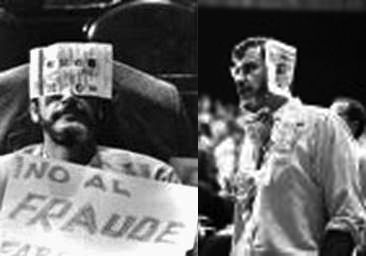 Vicente Fox, then a Deputy, deserves the credit for creative protests in the Chamber. A few days after the disasterous de la Madrid informe, during a debate over accepting Salinas’ alleged victory — doing a Carlos Salinas impersonation, ballots stuck to his ears in imitation of Salinas’ own big ears.
Salinas was mostly able to keep the media from focusing on the shenanigans during his own informes. TV still didn’t show the opposition senators in pig masks, but you could hear the “oinking” in the background. In the interest of decorum (and making democracy boring) oinking in the Chamber was disallowed. And grunting and yelling. The Congress could still boo… and did so regulary. And held up signs… and got on camera. My favorite moment was during one of Fox’s own informes when he was blathering on about better social benefits for the indigenous communities, and a Deputy (young, female, stylishly dressed and from the far left) representing those communities, walked up to the podium and plunked down an oversized funeral wreath in memorium of the people who died because of Fox’s policies. PAN deputies started shouting “TUBO! TUBO!” which is what you normally yell at a pole-dancer when you want her to remove her clothing. That probably cost PAN more than a few women’s votes in the next election.
After Calderon’s (possibly fraudulent) election in 2006 people went to the barricades, and the informe was was a mess. Walkouts, banners, boos… but no pig masks. Calderon, remember, wasn’t even sworn in that December in the normal ceremony, but hustled into Los Pinos at midnight, sworn in. There was every likelihood that he won’t be welcome by the Deputies, even with the boost he’s getting for turning the alarming expontential increase in violent crime during his tenure into a political plus. No way he’s even going to show for this year’s show now.
Calderon won’t even show up. Even with being able to make a poltical show of unity by milking the exponential surge in crime during his tenure, he faces real opposition to his PEMEX, education, business, agricultural and social policies. Maybe it’s the influence of the Beijing Olympics, choreographed to carefully avoid the hint of dissent, rather than the Oscars that are the model this year. Congress will conduct opening ceremonies, but this will make the Informe as boring as they were in the “good old days.” What’s wrong with selling democracy with pizzazz?
(Update: Gobierno Federal has the Informe out on the web (http://www.informe.gob.mx/#) in a series of “informercials” (“un nuevo formato” as Don Felipe tells us at the start of each one… you have to read down the page to find the “un mesaje para ti” section, where the various highlights are broken out into 8 to 10 minute videos) and in PDF for the truely wonkish. The PDF files are are more detailed, especially on possibly very important initiatives like a federal property registy and new copyright laws for electronic media, as well as court changes, environmental regulations, etc.)
Zetas ain’t so tough
Since I expect the Mexican Army will be dispatched to Louisiana in the next few days (after Hurricane Katrina, they went by truck… and showed up a lot sooner than FEMA, but so did just about everyone and everything), I thought I might say something about the annoying tendency in all U.S. news reports to claim “los Zetas” are all former military people, or — laughably — “special forces troops who went over to the dark side.”
Mexico doesn’t have a very large Army (about the same number of soldiers as Chile, a country of 16.5 million … and Mexico’s soldiers also perform a lot of non-military roles — disaster relief, forestry services and medical care in disadvantaged communities among others). However, it does have national service, and being an “ex-soldier” is no particular distinction. And a lot of what are probably called “ex-soldiers” are kids who put in their time in the Servicio Militar (sort of a junior home guard that usually plants trees and does some calethenics) or were among the large number of guys who just quit the service, with or without official permission. In other words, not exactly professional, disciplined military careerists.
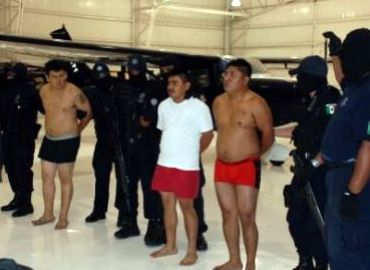
I don’t know how the story started that the Zetas were rogue Special Forces guys in the first place. Mexico’s entire Army Special Forces is only about a hundred guys — about the same number of troopers in the Papal Swiss Guard. That’s a weird comparison, I know, but even the Swiss Guards — who have the probably the strictest personnel vettings on the planet — every once in a while have a rogue member (they had a barracks murder a few years ago). It’s within the realm of possibility that a special forces guy joined the gangsters , but given this photo which was in several Mexican papers today, not likely that there’s more than one, or two of what would be very scary gangsters.
Here are some particularly nasty “zetas” — self-confessed as such — presumably responsible for chopping off a dozen guys’ heads down in the Yucatan. Stripping them down to their skivvies for their mug shots is usually to show that they haven’t been beaten (at least not so you can see it)… but these are not any “special forces” veterans… unless they’ve really gone to seed.
I’ll have more to say on this later, but the myth of a “criminal force” makes them harder to control… and more likely to lead to real abuses than if they are seen for what they are. Stripped down, they’re just thugs… and out of shape thugs at that.
The fleet’s in (the back yard)
The United States Navy’s Fourth Fleet was established in 1943 to patrol the South Atlantic and guard against U-boat attacks during the Second World War. Its mission became redundant after the war, and the fleet was absorbed by the Second Fleet in 1950. This year, it was re-established, with a new threat in mind. At least that is the conclusion of a military and academic panel that recently met in Mexico City.
Alfredo Méndez reported on 27 August about panel’s public discussion for Jornada (my translation).
Experts agree that the announcement by the United States that it is reactivating the Fourth Fleet should set off alarms throughout Latin America.
They believe the intention of the world’s largest economic and military power is to increase their presence in the southern part of the Americas, control natural resources (petroleum and water especially) and stave off central and south American emancipation movements.
Last April 24, the United States announced re-establishment of the Fourth Fleet, under the command of Joseph Kernan, arguing that the move was multi-lateral, creating cooperative ties in the fight against terrorism and/or narcotics trafficking, while strengthening humanitarian work in the nations of the region during eventual natural disasters.The strategy of the neighboring country includes establishing a military base on the Caribbean Island of Curacao [part of the Netherlands Antilles], north of Venezuela.
At a round-table discussion held last Monday at Casa Lamm, academics and experts on Latin American studies, Carlos Fazio, José Steinsleger, José Luis Piñeiro and General José Francisco Gallardo unamously called for the Latin American peoples to wake up to the threat and to not accept United States militarization.
U.S. Sub-secretary of State, Thomas Shannon, says that the Marines are not going to be sent anywhere south of the Rio Grande, nor serve in the territorial waters of any Latin American country, and that the fleet has no offensive capacity.
.
“Do you believe (the Americans)? I don’t. That’s too restrictive,” said General Gallardo, who chaired the discussion, called “The Return of the Fourth Fleet and Pentagon Projections in Latin America.”
The Mexican military officer said that in reality Washington is re-enforcing it’s economic supremacy and attempting to recover it’s geo-political hegemony. The military strategy “lets them bomb any town in Latin America in less than 90 minutes.”José Steinsleger, an expert in international relations and contributor to La Jornada, expounded on “a recent Security Council study on United States foreign relatios that concluded the country had lost it’s hegemony in the regin and had to move in a new direction.” In that context, the re-establishment of the Fourth Fleet makes sense, he said.
There is suspicion about the White House and Pentagon project – which supposedly is for “humanitarian” purposes and “collaboration” with South American nations. “ Rear Admire Joseph Kernan is a member of a SEAL group (special naval forces) of elite commandos, specializing in reconnaissance, counter-insurgency and irregular warfare,” cautioned Carlos Fazio, another specialist in these matters, and also a Jornada contributor.
José Luis Piñeiro, an academic from the Universidad Autónoma Metropolitana said the United States seeks other things, among them reducing the influence of the Venezeulan President, and countering Brazil’s economic development.
Mexican — and other Latin American — military experts have to take the possibility of United States actions seriously. While Mexico’s present administration — unlike those of Bolivia and Venezuela, which have complained of U.S. involvement in separatist movements in resource rich regions of their countries — the United States has invaded — or threatened to invade — Mexico several times when to protect access to its oil supply. Mexico is one of the three largest oil suppliers to the United States (usually second largest, but that varies from month to month), and, changes in the Mexican Administration, or perceived “instability” that might threaten the oil supply would be a logical use for this fleet.
What makes me worry is what the United States will define as “instability”. General James T. Hill, United States Army Commander, United States Southern Command in testimony before the House Armed Services Committee on 24 March 2004 defined “radical populism” as the most serious threat in Latin America. “Radical populism” was a charge thrown against AMLO in the 2006 Presidential elections, and U.S. involvement in his problematic loss is still a question to be resolved. Had AMLO won, would Mexico be a threat to United States security requiring “humanitarian assistance” in the form of the Marines?
In Colombia, “narcotics control” has been used to justify military support which is being used to silence opponents to the regime. If the United States wanted to intervene (or force still more military control over the Mexican people), claiming narcotics were destabilizing the country wouldn’t be surprising.
And.. given what Latin Americans saw of the United States’ inability to provide assistance when one of its own cities was devastated, they are skeptical of the claims that the purpose of a fleet is purely “humanitarian”.
I once asked a Mexican military commander (not that I hang with them, but we used to both have coffee at the same time, at the same Sanborns every day) what the Mexican Army guarded against. With the Cold War a dead issue, there are only three real foreign threats: upheavals in Guatemala might lead to guerrillas seeking sanctuary in Chiapas (as happened in the 1980s) and dealing with refugees; a revolt or civil war in Cuba, which would also create refugees; and an invasion by the United States.
Sunday Reading 31-August-2008
Alex Thurston (The Agonist) on “The Settler Colony Theory“:
I actually think that the US does better with issues of race than Europeans do – and, as the friend I mentioned above says, perhaps it’s easier for them to create a communal ethic because their societies have until recently tended to be more ethnically homogeneous than ours. In fact, with the latest waves of immigration we’ve seen some real cracks in that ethic, or the facade of that ethic, and some real tests for European societies. If nothing else, I think our tortured experience of race and racism in this country has allowed us to begin speaking more honestly about race than in many societies around the world.
But at the same time, there’s been no real reckoning in America. And by that I’m not talking about reparations for African Americans or Native Americans, or affirmative action, or violence, but rather a deep examination – or re-examination – of American identity in a way that would let us say, “we’re all in this together,” and really mean it. Underlying all the struggles that progressives face is the lack of such a mentality, worn down by the constant divisive politics of the right.
Moving forward
In Paraguay, the new President Francisco Lugo, has appointed former finance minister Dionisio Borda to his old post, under the new, supposedly socialist (I’d argue it’s more “liberation theology”) regime. Borda’s success had been in balancing the “free trade” assumptions of the former leadership with the necessity for government-controlled services in the dirt-poor country. He is getting a boost from Nobel Economics Laureate Joseph Steiglitz. Gustavo Setrini’s “Stiglitz Goes To Paraguay: Move Over Chicago, A Cambridge Boy’s in Town” is on the 25-August-2008 Upside Down World site:
With great authority and occasional cheek, Stiglitz enumerated the flaws and misconceptions that characterized the past decade of development thinking. Stiglitz openly declared that bilateral free-trade agreements almost inevitably favor the U.S. and offer few advantages for poorer, agricultural economies such as Paraguay’s, that “trickle-down” economics does not work and has never worked, that land reform was the basis of successful development experiences in East Asia, that privatization is not an automatic or necessarily the best answer to the woes of publicly owned enterprise, that U.S. monetary policy, rather than Latin American industrial policy, was to blame for the region’s “lost decade” in the 1980s, and that public investments form the basis for private dynamism in developing countries as much as in advanced countries like the United States. Stiglitz summarized his basic position, pointing toward the current U.S. mortgage crisis and stating that markets alone produce neither efficient nor socially desirable outcomes but instead provoke periodic crises that erase the gains of growth and hit the poor the hardest.
No-man’s land
Kari Lydersen writes in Upside Down World on an overlooked border dispute, between farmers and developers at a proposed Ciudad Juarez border crossing:
A key chunk in this development is the area known as Lomas de Poleo in Anapra, a community founded in the 1970s largely by migrants from Vera Cruz and other southern parts in search of a humble plot of land to raise a few animals. Over the decades the community – about 400 families at its peak – has petitioned for title to the land under Mexican land reform laws. The land’s ownership chain is a complicated saga including the company Carbonifera, several murky private sales, appropriation by the federal government after tax default, and the current residents’ ongoing claims. At least one federal document proclaims the land national property.
And under land reform laws that allow people to acquire title to unused land if they are farming it, many families have had valid land claims filed with the government for years.
But brothers Jorge and Pedro Zaragoza, from one of the richest business families in northern Mexico, are now claiming the land is theirs, inherited from their father who they say bought it in 1963.
No one showed much interest in the destitute parcels until 2002, when the Jeronimo project plans became public knowledge and the Zaragozas began trying to kick residents out of Lomas de Poleo. Since then the residents and the Zaragoza brothers – scions of local gas, dairy and Corona beer franchises, among other industries – have been locked in a grueling, litigious and often violent struggle over the land. Four years ago the Zaragozas erected a concrete and barbed wire fence around the disputed area, with the roads blocked by guard shacks where armed private security guards allegedly harass residents and prevent visitors and food deliveries.
Foreign Affairs
Laura Carlsen, writing in the 22-August-2008 Counterpunch is more optimistic about changes in U.S. policy towards Latin America under an Obama administration than I am. I don’t think a complete rework of the Merida initiative or of agricultural policy… or any tweaking of NAFTA … is really in the cards, but Carlsen holds out the hope that some things will be better:
Obama’s platform marks a major departure from continuing Bush policy in the region. When John McCain tapped Otto Reich as his Latin America adviser he signaled his intention to continue the very worst of the past policy. This has made blood boil in Latin American countries. Reich alienated Central Americans for his role in the Iran-Contra affair. He infuriated the Venezuelans by supporting the 2002 coup, and angered the Cubans by protecting Orlando Bosch and Luis Posada Carriles, convicted of anti-Cuba terrorist attacks. Everywhere he’s gone he’s left a trail of human rights violations and murky political manipulations a mile wide.
Obama’s foreign policy team, on the other hand, mixes crusty veterans with new thinkers and appears to be in flux. This shows in the Latin America policy proposal, where, for example, hardline support for Plan Colombia stands alongside opposition to the U.S.-Colombia Free Trade Agreement.
Meet the neighbors
I’m hardly the only gringo in Latin America working to explain where I live to outsiders.
Duderingo at Abiding in Bolivia and Tracy Eaton at Along the Malecon try to overcome at least some of the misunderstandings and bone-headed inability of the American media to get things right about their countries — Bolivia and Cuba, respectively.
Ecuador Rising – Hatarinchej and BoRev.net (as in “Bolivarian Revolution”) advocate for the governments of Ecuador and Venezuela … presenting points of view at odds with the U.S. “mainstream media”.
If I could read it, I might be able to tell you something about tetrakihi’s site, Мексика. The mystery wrapped in an enigma that is Mexico for those mysterious enigmatic Russians.
Changing with the times
This probably only affects a small number of individuals, but just making this legal change is more evidence that the image we have of a “Catholic” traditional Mexico isn’t anything like the reality. As it is, transvestites have always been more or less accepted in Mexican society (grudgingly), and — once it became medically possible, transgenders have been around Mexico City for some time. It was “tradition” for transgenders to work off the books (usually as prostitutes) being in the eyes of the law without identity.
 I get a kick out of the concern about criminals taking advantage of the new law. Probably the most famous drag queen of all times was General Santa Ana, who after one failed coup escaped by disguising himself as a nun. And who can forget the Basque hero(ine) Catalina de Erauzo, the “Lieutenant Nun” who lived as a man, working first as a mercenary and hit-man in Peru, and later as a semi-respectable mule driver in Mexico in the early 17th century. Her “memoirs” have been translated and published recently.
(Nacha Cattan, The News)
Transgender individuals in Mexico City will be able to change their name and sex on official documents thanks to a new law passed by the capital’s Assembly on Friday.
A civil court has between three and six months to accept and carry out a request to adjust birth certificates and other legal paperwork, the law states.
City legislators say this is the first time any member of the transgender, transsexual and transvestite community will have the option to alter their documentation to fit their identity.
“Until now people in this condition were essentially undocumented in Mexico City, because they have a physical appearance that does not match their papers,” said Leticia Quezada, a member of the Assembly.
While transgender representatives celebrated the law, they said it did not go far enough.
A previous version of the bill granted free sex-change operations at public hospitals, but that was stricken from the legislation after some left-wing lawmakers said there was not enough support for such a measure to pass the Assembly.
“We celebrate this first step, but it is incomplete,” said Anxelica Risco, who represents the group Eon Transgender Integration. “There is nothing more we can do than demand that the law be extended.”
Risco, however, praised the new measure for not requiring applicants to first undergo surgery or hormone therapy, but rather to prove their identity change to the courts through the testimony of sexologists and psychologists.
These experts, along with proof that the person is a member of the transgender community, will also prevent criminals from masking their identity in order to escape detection, Quezada said.
Take a good look at my face…
Every once in a while, I’ll see on a tourism message board, or hear from someone, a worried query about “fitting in” when they are in Mexico. Other than polishing your shoes and ironing your clothes, it’s simple: SMILE.
MÉXICO (UNIV).-Mexican smile through life, death, good and the bad, but they get angry and cry with the same intensity.The majority try to hide their feelings, pehaps to avoid the reactions of rude people.
A Consulta Mitofsky poll on expressing feelings found 90 percent of respondants smile regularly.
70 percent admit they yell with the same intensity of feeling; 60 percent when irritated. 27 percent of adults admit they shed tears, 5.9 percent of Mexicans do so frequently. However, 18 percent claim they never shed a tear, and 54 percent do so rarely.
The Consulta Mitofsky study found little corrolation between age or socioeconomic status when it comes to tears, though the study found people in the southeast (Campeche, Yucatán, Tabasco and Chiapas) cry more frequently than those from the Bajio (Guanajuanto): 31 percent in the southeast and only 25 percent in the Bajio admit to crying.
Younger adults – those under 30 — “for understandable reasons” , are more likely to smile frequently (61 percent) than those over fifty (43 percent) 8.6 percent of people who smile frequently do so because they’re happy.
People do more than just smile when they’re happy. Mitofsky also asked about dancing. Half of all men will “shake a leg, as will 46.4 percent of women. While there is some correlation to economic status – the higher the status, the more likely a person is to dance – only in the southeast is there a significant percentage (22 percent) who never dance.
A thousand people over 18 were interviewed face to face between 24 and 29 July. The survey has a margin of error of +/- 3.1 percent.
A “socially dangerous” Friday night video
Gorki Aguila, who fronts the Cuban alternative/punk rock band, “Porno para Ricardo” was arrested Monday morning for peligrosidad — being “socially dangerous” — sort of like being charged with vagrancy, though Aguila is employed by a state film board. Peligrosidad would be a damn good name for a Spanish-language punk band. The right-wing blogosphere is doing everything it can to pimp the story (which is kinda amusing… the right not being the kind of people you’d expect to support a guy whose sexual proclivities are exactly those they try to hide, or outlaw.
Le gusta mamar bollo y culo, siempre y cuando huela a jabón nácar o que huela a pipi rico. También le gusta que se la mamen, pero que se la mamen bien, sin mordidas. “El Ciro se hizo hombrecito a mi lado”, afirma sin penas.
 Aguila and “Porno” both regularly appeared on Cuban television though, as the singer and his lyrics have become more politicized and critical of the present government, the music has only been available in Cuba on CDs or though videos produced outside Cuba and distributed over the internet. The band’s promotional material describes Aguila as a “Sagitatarius, not a radical” (El no es un radical; es sagitario).
Karl Marx wrote the Communist Manifesto in Victorian England, and Communists have always been kind of prudish. As prudish as the adherents to that other mid-19th century religion, Mormonism. And despite recent liberalization and the natural bent of the Cuban people towards tolerance, the people running Cuba are a bunch of anal-retentive geezers. Cuban novelist Reinaldo Arenas, said that his sexuality naturally made him a dissident, but when he went into exile, his particular sexual identity (he was a drag queen) and his honesty about the accomplishments of the Revolution, put him at odds with the anti-Castro exiles. Porno para Ricardo is not for the prudish, and celebrating what any good band celebrates — sex, drugs and rock and roll (and food) — expresses a rebellious attitude, but one that doesn’t necessarily translate into a pro-U.S. (or pro-exile) political stance.
According to the Florida-based “Along the Malecon” blog a
…notorious (in the Cuban blogosphere) anti-Castro militant … happens to be making exclusive money off the CDs (and donations). This person (charlie bravo) and his partner (kill castro) hosts PPR’s website, does their PR, and were responsible for getting Gorki’s video played in Miami and interviewed on CNN last year. This most recent “news” broke off their websites and they organized the protest “concert” on the Malecon tonight.
Porno para Ricardo‘s own website clearly states “we are individualists; we receive no funds from any political organization (in or out of Cuba), nor seek any; … and the music and lyrics are not to be used for any political purpose by anyone without the express written consent of Porno para Ricardo.
 None of which stops foreigners from doing just that. This video, is distributed by elveraz.com, an extreme right-wing Cuban dissident website based in Puerto Rico. They may be missing the point that being critical of the Castro brothers does not necessarily translate into buying into corporate capitalism or the old oligarchal/gangster system that was around before 1959.
Aguila, 39, is an outspoken critic of Cuba’s government. “Communism is a failure,” he said in a 2007 interview with CNN. “A total failure. Please. Leftists of the world — improve your capitalism.”
Ulises Jorge Bidó (who is a lot hipper, and younger than I am, and to be thanked for the translation) translated the following from an exchange with the representative “an organization that forms a bridge between the government and Cuban alternative music” and Aguila. Having been told that music should seek solutions to problems, the musician responded:
Why do I have to come with solutions? You are the ones that need to resolve things, the politicians. You are the ones who have the power. Nobody had given me any power. Not even this power [using a hand signal that means “a tiny bit”]. Why do I have to be the one that resolve things? You are the ones with the power. And not only you have the power, you have absolute power…absolute power. How do you want me to resolve things? They are the one that have to resolve things.
But they don’t even give us the right to express that we are against them. And they don’t give us the right to express the mistakes they are making. That’s the cynicism of the people that have the power in this country, cynicism and is just another humiliation.’
It’s only rock-n-roll, but I like it…
UPDATE: Gorki got off with a $28 fine for playing music too loud.
Render unto Caesar…
[Dyslexics Untie! Yup, I’d spelled Caesar wrong… thanks, Otto]
Mexico’s Supreme Court yesterday upheld a law allowing abortion in the capital, handing a victory to leftist city lawmakers over conservative President Felipe Calderon’s government and the Roman Catholic Church. In an 8-3 vote, judges in the world’s second most-populous Catholic country said there were no grounds to overturn a law approved in 2007 by the Mexico City assembly that legalized abortions on demand during the first trimester and established free public abortion clinics.
© The Ottawa Citizen 2008
Guillermo Ortiz Mayagoitia, “Minister-President” (Chief Justice) went further in reading the court’s decision, saying that the way was open to an intense and deep national debate on the issue. The court’s decision took into consideration the possibility that several states will follow the Federal District’s lead in decriminalizing abortion and in setting up state-run clinics.
Given that the narrow legal issue was the Federal District Assembly’s competence in setting health policy, the court ruling goes even further, validating the District’s right — and DUTY — to provide abortions in a safe environment AND to oversee sex education in the district. The Federal Government and the District have been at loggerheads over the Federal Secretary of Education’s reluctance to use more explicit district education department sex education texts. (The Federal Secretary of Education was refusing to use the Mexico City book, though it is distributed in District run schools, and used in other Latin American countries).
With only three ministers in support of overturning the Federal District’s abortion law (nice to know my predictions of an 8-3 ruling were correct) this is another indication that both the Catholic Church and the Calderon administration are out of step with the Mexican mainstream.
Alfredo (Citius64) wrote (my translation) last Monday that:
It seems that the catholic hierarchy is in despair over a probable failure of the Supreme Court to penalize abortion in Mexico City. How else to explain that they paid for advertisements on all the national television networks?
And… who paid for it? The collection plate? I don’t know… they could have been underwritten by the Slim family, or one of the other wealthy families connected with the hierarchy. Javier Flores wrote about the Church’s growing nervousness in Jornada. According to official statistics, Mexicans are leaving the Catholic Church in torrents: ten percent in only 30 years. He must be on to something….
Although most gynecologists do not perform abortions — the law allows for “conscientious objectors” to practice in Federal District health facilities — and have been the largest opponents of the new regulations, U.S. style protests are unknown, nor is there the street theatrics that surrounded the original passage of the bill allowing for abortions in the first trimester. As Elizabeth Malkin and Nacha Cattan write in the The New York Times:
There is one sign of opposition at the clinic. Brenda Vélez and two assistants from the anti-abortion group Pro Vida arrive every day at 11 a.m. to say the rosary and hand out pamphlets.
But unlike the very public battle over abortion in the United States, which is played out on the streets and through the news media, the two sides here have confined much of their argument to the courtroom.
Even the powerful Catholic Church, which threatened legislators with excommunication last year if they approved the law, has muted its political rhetoric. (In the end, the church did not kick any lawmakers out because of their votes.)
There have been a few public protests as the Supreme Court’s decision approaches, but neither side has mobilized massive forces.
I don’t see official, overt anti-clericalism returning to Mexico. PAN — having started life as a clerical party — has carved out a sizable niche in Mexican political life not because of its clericalism, but because of its capitalist market-oriented policies, and its (diminishing) reputation for relative efficiency and honesty. The analogy to the Republican Party in the United States — which also has a “piety wing” (though in the United States it is made up mostly of Evangelicals, not Catholics) — is valid in many respects. In both Mexico and in the U.S., “Christian Conservatives” came into power in localities on the coattails of a popular candidate (Reagan in the U.S., Fox in Mexico) and pushed too far, too fast. And, as with the Republicans in the United States — the pro-business people are often also the social conservatives.
While religion still plays a much larger part in U.S. politics (witness the “debate” between the two Presidential candidates in a church recently — something highly illegal in Mexico), the piety wing in PAN has been losing power since the Fox administration. PAN replaced their party chief with a leader from the secular wing, and even party leaders with ties to the piety wing (like Senate leader Santiago Creel) have lost out to people like and Felipe Calderon’s adherence to the more business-oriented wing of his party.
The Church itself is fighting a rear-guard action, and this ruling blew up in their faces, with consequences yet to be seen.
“Liberal” in Mexico has the historic meaning — as in Benito Juarez’ party — meaning an openness to the free exchange of ideas and goods — more in line with what in the U.S. is called Libertarian. They might be “Liberal” in the U.S. sense (pro-choice, pro-gay rights, etc.), but as PANistas, they are unlikely to push for social changes in their state legislatures. While there are social conservatives on the left (notably gay marriage was delayed in the Federal District because of Andres Manuel Lopez Obrador’s objections) social changes — especially less restrictive abortion laws — are much more likely to come from the PRD and PRI controlled states.
Some might be surprised I include PRI here, but remember that gay marriage became legal because the Coahuila Legislature’s PRI majority backed it, over the objections of PAN, PRD and the Greens. The left may also want to flex their muscle and run through changes in the Federal Congress, but I’m not sure — given the fights over PEMEX and crime that are coming up — they want to take on the challenge.
Assume the position
United States foreign policy has always been motivated by a missionary mentality. But it’s time to vary the missionary position.
James McEnteer, “Death by Paranoia“
One assumes Maj. Gregory Michel must have been seeking to do precisely that when he was arrested early Tuesday morning “causing a disturbance” in a Bolivian whorehouse. How rowdy do you have to be to get Bolivian whores to call the cops, I wonder? The Major was carrying a loaded .45mm handgun with three spare clips and a folded police nightstick (I … don’t …. want… to …. know!) when he was taken — in, shall we say, a state of inebriation (i.e., stinking drunk) to a Santa Cruz police station…
…. where, a scant thirty minutes later, United States Ambassador Philip Goldberg, showed up claiming the Major had diplomatic immunity. Ok… I can buy — sort of — the idea that the head of recruiting for the Mississippi National Guard might go to Bolivia for some legitimate reason. Like getting drunk and rowdy in a provincial whorehouse. But, why does Maj. Michel have diplomatic immunity? And, what was Ambassador Goldberg doing there?
If “Santa Cruz, Bolivia” rings a bell, you might remember it’s the center of a self-proclaimed autonomy movement. It also happens to have a lot of natural gas, which the autonomy leaders claim should benefit their province, not the nation as a whole. The whole issue was raised in a referendum last week in Bolivia, and was soundly defeated, despite U.S. support for the autonomy leaders. Who — by the way — are Fascists. The Ambassador claims he was in Santa Cruz for a public meeting with the governor. Bolivian media caught him going in and out of a PRIVATE meeting (that lasted 90 minutes), but 3:30 AM sounds like a very weird hour for a diplomatic meeting… even in Bolivia.
Meanwhile… slightly north of Bolivia…in Honduras:
President Manuel Zelaya, a logging magnate seen as a moderate liberal, told Reuters that oil-rich Venezuela’s offer to double international aid to the country, one of the poorest in Latin America, is unrivaled.
“I have been looking for projects from the World Bank, the Inter-American Development Bank, Europe and I have received very moderate offers … that forces us to find other forms of financing like ALBA,” Zelaya said in an interview at his presidential palace.
“ALBA” being the Venezuelan-led alternative the Free Trade pacts being pushed in Latin America by the United States. Zelaya’s decision to forge a closer tie to the Latin American group led to some … shall we say… interesting… “suggestions” that such a decision will cause the United States to unceremoniously deport Honduran nationals.
Both of which make it clear what U.S. policy is to Mexico and other Latin American nations (where the threat of relation for non-compliance in making commodities available — oil, gas, cheap labor — are not so subtly underlined with deportations and military threats) has changed since Woodrow “We will teach them to elect good men” Wilson.
Missionary position? Nah… bondage and dominance.

Guaranteed to get there… Manaña
MEXICO CITY -(Dow Jones)- Transportation company FedEx Corp. (FDX) said Wednesday that it will offer domestic shipping service in Mexico starting in early October.
“Mexico is the country we consider to be the most important in the region because of the constant economic development we are seeing,” said Juan Cento, president of the Latin America and Caribbean Division of FedEx Express, at the sidelines of a press conference in Mexico City.
Mexico is the latest country where FedEx will launch domestic shipping, after China, India and the United Kingdom, and is the company’s first domestic-service offering in Latin America, according to a FedEx press release.
DAM…and double DAMN! That dam, damn border fence
Guess where photo was taken…
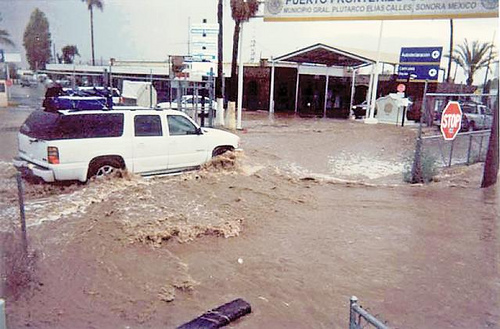
The middle of the Arizona desert!
Yup, that’s right… the brilliant minds who poo-pooed environmental restrictions along the border seem to have forgotten that fences stop not people … but water. It does rain occasionally in desert, and the chain-link fence at Organ Pipe National Park clogged up with debris and … well, you can see the result.
Even stupider ideas are afloat. As Grits for Breakfast notes, the United States is the first country ever to fence itself off from a river… not to worry: Brownsville, McAllen, Laredo, Del Rio, Presidio are likely to get at least occasional flooding, which maybe will provide a little water to offset the complete disruption of agriculture, ranching, tourism, manufacturing… life.


 mexfiles.net