(N)ice photo!

Photo AP, from Milenio
Here’s something you won’t see very often — Mexico City’s Zocalo was turned into a giant ice-skating rink today. Normally, the only place I know of to go ice skating is an indoor rink in a very snooty shopping mall out in Santa Fe.
Josefina Niggli: Novelist, playwright and the reconquestadora who made Ricardo Montalban dance
(Minor date corrections, thanks to commentator Michael Pool, added 02-October-2009)
From John Koelsch in Santigao de Chile comes an introduction to a borderlands author I’m embarrassed to admit I knew nothing about:
From Santiago, Chile:
Hola amigos,
I just finished reading an interesting article in the December edition of AMERICAS, the official magazine of the OAS (Spanish Edition) about the life and works of Josefina Niggli, written by Elizabeth Coonrod Martinez.
According to Martinez, Niggli was a prolific author of literary works, including historical novels and works for the theater. She was born in Monterrey in 1910, and spent her early childhood in Mexico during the Revolution, later relocating to the USA with her American parents in 1925.
Martinez notes that Niggli was a member of the same generation as Dolores Del Rio, Anita Brenner and Frida Kahlo, and that her literary prowess certainly places her within the honored ranks of other great writers of the period, including Mariano Azuela, Martin Luis Guzman and Nellie Campobello. Nonetheless, she wrote in English rather than in Español, and as such, one of her purposes was to try to give the gringo world a better understanding of Mexico and its culture. Her theatrical plays, written in the 1930´s, leaned heavily on the folklore of the Mexican countryside and the people who inhabited it, and often focused on themes that related to the Mexican Revolution.
Her first novel, entitled MEXICAN VILLAGE (1938), was converted into a Hollywood film entitled “Sombrero,” starring Ricardo Montalban and Pier Angeli. Her other works of fiction were also notable, including STEP DOWN, ELDER BROTHER (1947), which was translated into Spanish and published as APARTATE HERMANO in 2004. The work effectively illustrated the growth and transformation of Monterrey in the years following the Revolution, and it also cemented Niggli´s reputation as a giant of Mexican literature within the Latin American literary world. Daniel de la Fuente said the the work begged the “necessity to reevaluate one of the most significant and most ignored writers in Mexican literary history¨” Other works include her BEAT THE DRUM
SLOWLY (unpublished) and the unique A MIRACLE FOR MEXICO (1964), which dealt with the emergence of the iconic image of Mexico in the colonial period with the emergence of the apparition of the Virgen de Guadalupe in 1531. A MIRACLE FOR MEXICO was illustrated by the acclaimed Mexican artist Alejandro Rangel Hidalgo, and usually has been categorized as a work of children´s fiction, although Niggli´s narration reaches far beyond simple childhood themes to present a more universal vision of a new society, which includes African Mexicans, indigenous peoples who speak Nahuatl, along with mestizos and Spaniards as well.
Her most memorable works for theater include CRY OF HIDALGO, SOLDADERA, and A RING FOR GENERAL MACIAS, which all more or less reflect on the Mexican mind and its relation to the Mexican Revolution. SOLDADERA, for instance, presented the image of the
valient Adelita of Revolutionary tradition to the English-speaking world for the first time.
I could go on about the article, but I know that others interested in this story can check out the December edition of the magazine AMERICAS, or they can also investigate Martinez´s recently-published critical biography of Josefina Niggli published by the University of New Mexico Press (Autumn 2007).
Thanks to the handy-dandy (and invaluable) Handbook of Texas On-line I was able to ferret out that Niggli – like the better known Anita Brenner – was born in Mexico to foreign immigrants (Brenner’s parents were Lithuanians, Niggli’s from Texas) but, as refugees from the Revolution, were raised in Texas. Brenner, the New York Times’ first female foreign correspondent, propagandist for the Allies (“The Wind That Swept Mexico”), anthopologist (“Idols Behind Altars”) and probable spy (Leon and Vera Troksy arrived in Mexico in the guise of Anita’s visiting uncle and aunt) had much the more colorful life story, but Niggli’s biography is well worth pursuing.
Niggli ‘s reputation in her own country is that of a popular writer, not a– like Brenner — an intellectual. The novels and plays may be getting more recognition now, but during her lifetime Niggli was a hard-working teacher in North Carolina when she wasn’t turning out everything from TV scripts to children’s literature and short stories. She credited her work habits to Sister Mary Clement at Incarnate Word College, who jump-started the future author’s career by locking her in a dorm room until she finished a short story suitable to enter into Ladies’ Home Journal contest (Niggli won second prize).
Her 1938 “Mexican Village” (published in parts between 1938 and its book publication in 1945) — which I haven’t read – was something of a sensation at the time, Niggli took a chance, writing her first novel not as a semi-autobiography, even though the protagonist, like Niggli herself, is a gringo born in Mexican. Webster’s return to his native village forces him to come to terms with both American racism and Mexican sexism – a daring theme at the time. One odd result is that Niggli, who was born in Monterrey (“Step Down, Elder Brother” deals with the growth of that major city) was often identified in the press as a “native of Hidalgo, Mexico,” when it was Webster who came from there.
To get “Mexican Village” to a wider audience took some compromises. The result was Sombrero, “Mexican Village” morphed into a dancing musical. Just to see Ricardo Montalban dancing and singing might be worth it, though, with Cid Charese, Nina Foch, Pier Angeli and Yvonne De Carlo (yup – Lily Munster herself!) as the girl who’s too good looking to get a man … it’s gotta be worth a look.
 The 1938 novel, along with “Step Down, Elder Brother” and five plays were recently republished as Mexican Village and Other Works (Northwestern University Press, 2007). I suppose Sombrero is available on DVD somewhere.
Niggli’s accomplishments might seem modest, but – even if Zorro (or a dancing Ricardo Montalban) weren’t completely authentic Mexicana her works painlessly presented Mexicans – and Mexican-Americans – as a people with their own quirky folkways and customs, perhaps, but very much part of mainstream America. In her own way, she was a reconquistadora.
O what a tangled web we weave…
Max Blumenthal (Alternet) uncovered an interesting nugget about one of my favorite nutballs:
When Republican Representative Tom Tancredo isn’t railing against the “scourge” of illegal immigration on the presidential campaign trail, he relaxes in the 1053 square foot basement recreation room of his Littleton, Colorado McMansion. There, he and his family can rack up a game of billiards on their tournament size pool table, play pinball, or enjoy their favorite movies in the terraced seating area of a home theater system. Tancredo, who dodged the draft during the Vietnam War by producing evidence that he suffered from mentally illnesses, especially likes entertaining his buddies with classic war movies.
“We have friends over and I have now shown Pearl Harbor about six times,” Tancredo boasted to the Rocky Mountain News about his 102-inch television. “But I mainly just show the attack scene because the sound is so good.”
When Tancredo hired a construction crew to transform his drab basement into a high-tech pleasure den in October 2001, however, he did not express  concern that only two of its members spoke English. Nor did he bother to check the workers’ documentation to see if they were legal residents of the United States. Had Tancredo done so, he would have learned that most of the crew consisted of undocumented immigrants, or “criminal aliens” as he likes to call them. Instead, Tancredo paid the crew $60,000 for its labor and waited innocently for the completion of his elaborate entertainment complex.
During the renovation process, two illegal workers hired by Tancredo were alerted to his reputation for immigrant bashing. They went straight to the Denver Post to complain.
(Read the rest of the story here)
Speaking of crazies, this should make THIS GUY happy (he whined that a Mexican website on Mexican culture, politics and history doesn’t talk enough about Colorado’s Candidate for President of the Confederate States of America. Ok, this is post #5 on the idiot.
Inglés: “sin barreras” will kill you
Speaking English is not the same thing as safe sex. And no, gays are not the only people who need to think about AIDS — If you’re a visitor to Boys’ Town remember this:
Female prostitutes in Tijuana and Ciudad Juarez who catered to American “johns” had a 50 percent higher rate of syphilis or another sexually transmitted disease than those who didn’t, according to a UCSD study.
The women paid by American customers were younger and more likely to speak English than their counterparts, and they were more apt to inject drugs and have unprotected sex, said Steffanie Strathdee, chief of the international health division at the University of California San Diego. She wrote the report, which appears in the current edition of the journal Sexually Transmitted Diseases.
“A lot of (customers) who go to Mexico to have sex may be lulled into a false sense of complacency,” Strathdee said. “They think that if the woman speaks English and looks OK and clean, she is safe. But these are highly vulnerable women. They are being bribed to have unprotected sex.”
The prostitutes with U.S. clients typically received $30 for unprotected sex versus $20 for sex with a condom, she found.
The economic incentive may explain why prostitutes with U.S. clients had higher rates of gonorrhea, syphilis, HIV and chlamydia than women who did not engage in sex for pay with Americans.
…
Health experts had long assumed that STD infection rates in Mexican border towns were relatively low based on a few outdated surveys, Strathdee said.

Her project found a significant increase in the number of prostitutes infected with HIV – 6 percent in 2005, up from 2 percent 10 years ago. A further analysis of HIV prevalence among Mexican prostitutes who injected drugs found that 12 percent had tested positive for HIV.
The researchers’ other findings include:
 Of the prostitutes who catered to Americans, 8 percent tested positive for gonorrhea, 14 percent for chlamydia, 7 percent for HIV and 16 percent for syphilis.
Of the prostitutes who didn’t have sex with Americans, 2 percent tested positive for gonorrhea, 10 percent for chlamydia, 5 percent for HIV and 10 percent for syphilis.
Sixteen percent of Mexican prostitutes who serviced U.S. clients had injected drugs in the past month, compared with 5 percent for those without U.S. customers.
Eighteen percent of the prostitutes with U.S. clients always or often used drugs before or during sex, compared with 7 percent of the prostitutes without U.S. customers.
Acquired Immune Deficiency Syndrome (AIDS) is caused by HIV (human immunodeficiency virus). By killing or damaging cells of the body’s immune system, HIV progressively destroys the body’s ability to fight infections and certain cancers.
If you still think “it can’t happen”, get the facts.
Over one million Americans are living with HIV/AIDS today. Worldwide, the figure is over 40 million. If you don’t know Spanish, at least learn one phrase:
¡USA UN CONDON!
(OO-sah un conDON).

More cultural resources

Holy Virgin Of Guadalupe! There is a lot about Mexican culture that others cover much better than I do, and I’m glad to add them to my “Resource/Recursos” page. Any others I’ve neglected, please email me the link.
History of Mexican Comics (not Cantinflas and Tin Tan… duh!)
Catholics can be proud to be an Okie
But it seems to me an unavoidable concession that they [“illegal” immigrants] have become criminals because we have been content to maintain an outmoded and ill-equipped system of quotas, knowing that we could manipulate the outcome and benefit enormously from the labor of those whom we forbid to work.
“The Suffering Faces of the Poor are the Suffering Face of Christ”
The Most Reverend Edward J. Slattery, Bishop of Tulsa.
The ‘Oklahoma Taxpayer and Citizen Protection Act of 2007″ which went into effect Nov. 1, makes it a felony to knowingly transport illegal immigrants and creates barriers to hiring them and restricts benefits they can receive from the government.
Bishop Slattery — in the 22-page pastoral letter — said that the intention of the law is immoral. It will cause a “intolerable increase in suffering of legal immigrants, and those who must enforce the law.” He added that the new law threatens to put children in danger, punishes the morally innocent, and terrorizes parents who are forced into hiding.
The pastoral letter outlined an action plan that said no illegal immigrants will be denied access to Catholic charitable, pastoral or education programs; that offered them legal assistance; that pledged to seek guardianships and foster care for children whose parents are deported.
In late October, Archbishop Eusebius J. Beltran of Oklahoma City, priests and more than 1,000 laypeople signed a one-page “pledge of resistance” to the law, calling it “unjust and immoral.”
The Oklahoma Baptist General Assembly passed a resolution stating that they would not withhold ministry from “illegal” aliens.
Oklahoma, of course, is the bible belt, but don’t underestimate the importance of the Catholic Church in the state. Oklahoma was originally intended as a refuge for Native Americans, until “illegal immigrants” from the rest of the United States overran the place. The Diocese of Tulsa includes more Catholic Native Americans than any other. With the Baptists appearing to sign on (though I don’t know how many church goers in Oklahoma are members of the Baptist General Assembly) it appears there is some serious resistance to this very bad law.
I’d hate to be the prosecutor who has to try some bishop for giving a ride to a “illegal” taking her kids to the doctor, which is a felony now in Oklahoma. With the tag-team Catholics and Baptists on one side, I don’t think I’d want to be on the receiving end of this holy smack-down. Nice to be on the side of the angels (or at least the Bishops) for a change.
Friday night cruisin’
Jesus’ General has up a post on the wacko Major James Linzey. The Major (like William Randolph Hearst a hundred years ago) believes the yellow hoardes are plotting with the Mexicans to invade the U.S. (in Hearst’s day it was the Japanese) Which might be slightly true, though it isn’t an army that’s coming — but it’s cars not soldiers.
I’m not sure if the cars — or their provinence — is the interesting part of the story:
Construction began Friday on an auto assembly plant in central Mexico that will create thousands of jobs and be the country’s first to produce Chinese cars.
Mexican President Felipe Calderon led groundbreaking ceremonies for the factory, which will be financed by an arm of Mexican conglomerate Grupo Salinas and China’s state-owned FAW Group Corp., one of the nation’s largest automakers.
“Most of the world’s investments used to go to China, and today China has come to invest in our country because it recognizes an enormous opportunity in Mexico thanks to its domestic market” and proximity to the U.S. and Latin America, Calderon said.
Due to open by 2010 in Michoacan state, the plant is expected to churn out 100,000 cars a year for sale in Mexico and Central America, according to a statement from Grupo Elektra, Grupo Salinas’s electronic goods and consumer financing unit.
Grupo Elektra and FAW are investing $150 million to construct the factory, which is expected to employ some 4,000 people and bring up to 20,000 additional jobs to the local economy, Javier Sarro Cortina, head of Grupo Salinas Motors, said Friday.
FAW-line cars will start selling in Mexico early next year for as much as 10 percent less than the current market average, Grupo Elektra said.
The cars will retail for as low as $6,280, Grupo Salinas chairman Ricardo Salinas Pliego said at the groundbreaking.
Chevrolet’s smallest Chevy sedan, one of Mexico’s most affordable cars, sells for about $7,100.
I think what Grupo Electra is going to market are the Jiaxing MPV, with a three-cylinder engine and at least some Toyota parts. They’re probably crappy little cars…. BUT…
- Working families can afford them. This means more Mexicans than ever will join the “car culture” — for good or bad, I can’t say. Certainly, I’d expect poor people to want the stuff that middle-class people have. And one of the great success stories of Mexican business was Prince von Hoheloeh convincing VW to manufacture sedans (i.e., the “bug”) in Mexico… everyone wants to move up, and if the Mexican middle-class couldn’t get exactly the same cars as their neighbors to the north in the 1950s, they could get a car at any rate… and move to the burbs, and tear their hair out commuting, and complain about parking spaces, and…
- Cheap labor does not mean a salable product. The Indian computer (and everything else) giant, Tata, had to move some production to Guadalajara. Mexico’s education system could stand improvement, but it turns out a relatively healthy crop of qualified engineers. India’s system turns out very good engineers (who make more money going abroad) and less-than-adequate ones.
I wrote about Chinese autos once before, when early reports had the cars being built for a “U.S. beachhead” market. Either the original reports were confused, or the business plan wasn’t complete. But moving production to Mexico makes sense. Mexican have been manufacturing reliable cars since the early 1950s (and tractors and trucks much earlier), and FAW has only been around a few years ago, the heir to the company that built those knock-off Checker Cabs the Chinese built to ferry around Maoist leaders (and Richard Nixon). I don’t know if they’ll have a FAW nameplate or something more Mexican, but see no reason they’d be seen as “Chinese” any more than the generic Tsuru (a Mexican version of the Nissan Sentra) is seen as a Japanese car.
- Retailing. This is brilliant. I considered buying a motobike at a Mexican WalMart, and I would have had to pay up front or put it on layaway (they only cost a few thousand pesos) but these are CARS! Grupo Electra pioneered the retail bank in Mexico (Banco Azteca) leaving WalMart and Cheduri to play catch up.
Which means a family can walk in, but a car (and a washing machine and a TV and a sofa and …) take out a bank loan and go on their merry way. Though, of course, it also means the Mexicans will be consuming a lot more of their oil (which is the #1 or #2 — depending on the month — source for our foreign oil) at home. That’s not necessarily a good thing, but what can you do?
Of course, after talking about commies and cars… and it being Friday and all…
What Revolution?
The Mexican Revolution was really three or four revolutions depending on how you define a revolution – but not one of them was a real revolution.
For John Ross, the 1910-20 (plus or minus) Revolution wasn’t “real” because “The class structure remained unaltered”. I’m not sure a change in class structure is the only thing revolutions do, and though the PAN administrations tend to pick leaders from the same old families that were in power before the Revolution (Creels, Terrazas, etc.) in the North, the class structure certainly did change.
It might not have changed the way Zapata or Villa intended (if they had any vision of the future in mind), but Revolutions don’t always work out quite as intended. The French Revolution gave the world Napoleon Bonaparte — which wasn’t exactly what the sans-culottes had in mind when they storned the Bastille, but that’s how Revolutions go… they don’t follow text books (especially text books written after the fact).
And there has been a huge change in “class structure” — Mexico is a middle-class country and it does offer more social mobility than most. Granted, if you’re born poor, you’re likely to stay that way, and — as Malcolm Forbes noted about the United States — the best way to make a large fortune is to inherit one — but families do move from rural poor to lower middle class or from lower to upper middle class quite regularly. Get on the Metro in Mexico City, and you see elderly indigenous grannies being squired by well-dressed (and much taller) grandsons carrying cell phones and the other acourtements of the modern urban middle-class.
The United States has only had one President who wasn’t a wealthy white Protestant (and he was a very wealthy white Catholic) and only a few (Van Buren, the Roosevelts and Eisenhower) who weren’t Anglo-Saxon. I guess the American Revolution never happened either.
How much did Mao’s Revolution really change China? The same bureaucratic elite that have ruled the country (and screwed over the peasants) for the last few millenia still run things, and the bureaucratic elite is doing an even more thorough job of undoing the economic changes brought in by Mao than any worshiper at the altar of NAFTA would envision for Mexico.
First the PRI and now Calderon’s PAN steal one election after another with impunity just like Porfirio Diaz did back in 1910.
SO? It’s a contradiction in terms. Since when do Revolutions permit the opposition to form parties or win elections? Even in the United States, you won’t find a political party that doesn’t buy the prevailing corporate capitalist model allowed on most state ballots. And the Mexican Revolution managed to incorporate some contradictory elements (Mexican businessmen seeking to break foreign control of their markets, urban anarchists, middle-class farmers, intellectuals, etc.), but did not “buy” any particular foreign ideology. If anything, that makes it more authentic a revolution, not less.
Neither the Soviet Union nor the Islamic Republic of Iran have completely fair elections, but I’d be hard pressed to say that the Russian or Iranian Revolutions were “unreal”. And I’m not sure what stolen elections have to do with anything. Although Madero’s 1910 Revolution began with a call for term limits, the electorial process had very little to do with the Revolution. I can’t see where electorial process was necessary to the Revolution — and the term limits were made sacrosanct (the faces change, the parties remain forever). Zapata, for one, never trusted elections (nor do the present-day Zapatistas — that weird amalgamon of Stalinists, Indigenists and reactionaries). I’ve always thought that had Zapata by some fluke been in charge, he would have been the Pol Pot of Mexico — Villa and Zapata’s “celebrated meeting under an Ahuehuete tree on a “chinampa” (floating island) in the southern district of Xochimilco,” may be “… considered the apogee of all the Mexican revolutions.” by Ross, but, c’mon… the purpose of their meeting was to decide who they wanted to eliminate (and they did purge their own ranks).
Pancho Villa was no fan of electorial politics either. If he had any ideology, it was more in line with Leon Trotsky’s call for permanent revolution, using a threat of violence to keep “benign dictators” in line.
I’m a little disappointed in Ross’ article. I think Mexico could have done more, and still should do more — and I have complained about the recent return to “Porfirian” ways. It’s tempting to assume, that because the War of Independence started in 1810 and the Revolution in 1910 that another revolution (one more in line with European and U.S. academic categories) will start in 2010. Sorry, but a series of two does not indicate a trend. It indicates … a series of two.
There is a sizable dissident faction within Mexico, and there could be violent protests (a la Oaxaca 2006… but also a la Bajio 1920, nationwide 1852,1872, 1988…) which says nothing about the 1910 Revolution. And, Mexico’s leadership (those “elites” who are going to come out on top everywhere in the world no matter what — unless, like Haiti or Cambodia, you kill them off) has always worked out a compromise. Sometimes, they’ve been forced to compromise at the point of a gun — as they were between 1910 and 1920 — but that doesn’t mean there weren’t huge changes in Mexican culture and society coming out of the 1910 Revolution.
It was real.
Jesus saves… so we deport him
Manuel Jesus Cordova Soberanes, who found nine-year old Christopher Buztheitner, wandering alone in the Arizona desert and stayed with the boy until help arrived has been deported.
Christopher’s mother was killed when their van ran off a cliff in a remote area north of the Mexican border on Thanksgiving Day. The 26-year old Cordova was about 50 miles from Tuscon when he found the boy, who had walked away from the crash, wearing only a pair of shorts.
Neither Cordova nor Christopher spoke the other’s language, but the boy took the migrant to the edge of a canyon and showed him the accident site.Cordova gave the boy the sweater he was wearing, climbed down to the van, and found chocolate and cookies to feed him.
He then built a bonfire, and the two hunkered down. The boy slept most of the night; Cordova kept watch and tended the fire.
Fourteen hours later, a group of hunters found the pair and called for help. U.S. Border Patrol agents took Cordova into custody, and Christopher was flown to a hospital in Tucson.

At least Adriana Hoyos Rodriguez, Alcada of Magdalena de Kino, Sonora had the good manners to thank the guy, even if no one else did.
What’s to eat?
Wow.. cool!: One Week’s Worth of Food Around Our Planet is a series of photos of families from around the world, posing with a week’s worth of groceries, and a little bit about the family’s eating habits.
The Casales family of Cuernavaca spends an average of 1,862.78 Mexican Pesos and says their favorite foods are pizza, crab, pasta, and chicken.
People are always surprised that Mexicans love pizza (don’t we all) and are fanatical about seafood. I always figured the reason the Catholic Church finally did away with fish on Friday is that the Mexicans looked forward to it — not exactly a sacrifice. Notice that the family groceries include about a dozen 2-liter bottles of Coca-cola. Alas, that’s typical. The boxes stacked on the table in front of the cokes — and on the chair in front of the corn flakes — are milk (which comes in “ultra-pastuerizado” tetra-pack boxes that don’t need refrigeration) has recently gone up in price, but is important in the Mexican diet (as are eggs — I only see about two dozen in the photo). Cheese, and chicken provide most of the rest of the animal protein.
Notice that other than things like cooking oil and coca-cola (and the milk) and a vew canned goods, most of the food is unpackaged. I don’t know if the photo was posed with “ringer” food, but I think it must be. The bollios — bread rolls (in front of the little guy in the blue shirt) — would go stale in a day or two if they were bought by the week. As would the various dulces (pastries) next to the bollios. Mexicans are serious about their pastries: the French invaded in 1828 over an unpaid pastry bill going back to a bunch of army cadets rampaging through a French owned bakery back in 1824 (supposedly scarfing down a few thousand pesos in doughnuts… well, the cadets were teenage boys, so I guess it’s possible).
There are at least two stacks of tortillas — I’d guess about 10 kilos worth. The Casales are not a prosperous family (you can see the bedroom right behind the kitchen), but they are comfortable. Tortillas have gone up in price, but you can’t get through the week — or the day — without at least a half kilo per person.
People usually buy their fruits and vegetables and tortillas by the day… but you can see they eat a lot of them… especially fresh fruit. On the red table are chilies, chayotes, tomatillos (the little round green things) and tomatos — more staples of every day meals. As are the avocados,: all native Mexican plants.
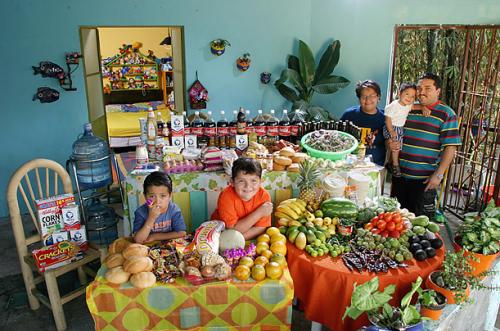
¡Buen provecho, familia Casales!
Hold the pickle, hold the lettuce… one cent more won’t upset us
I wrote about the genuinely heroic Lucas Benitez and the Coalition of Immokalee Workers back in August . At that time, the Coalition had just won a new contract with Yoda Brands (owner of Taco Bell, KFC and several other fast food chains) and was looking for the same contract with Burger King.
Benitez explained the economics of tomato harvesting this way:
Tomato plants are picked three or four time, Lucas explained. “the first time there is a low yield, and filling a basket is dificult. Other times go faster, and it takes five to eight minues to fill one. During the last harvest, you can pick 20 to 30 baskets per day.
After the agreement [with Yoda Brands], the harvesters receive 45 cents for every 32 pound, which presently sell for 77 cents.
This means the workers see an extra 18 or 40 dollars a month… almost enough to take their families to … oh… Burger Kind?
Eric Schlosser, the author of Fast Food Nation, published this in today’s New York Times. I would recommend eating at Taco Bell (and I can’t believe I just said that) if Burger King doesn’t change their ways. .
THE migrant farm workers who harvest tomatoes in South Florida have one of the nation’s most backbreaking jobs. For 10 to 12 hours a day, they pick tomatoes by hand, earning a piece-rate of about 45 cents for every 32-pound bucket. During a typical day each migrant picks, carries and unloads two tons of tomatoes. For their efforts, this holiday season many of them are about to get a 40 percent pay cut.
Florida’s tomato growers have long faced pressure to reduce operating costs; one way to do that is to keep migrant wages as low as possible. Although some of the pressure has come from increased competition with Mexican growers, most of it has been forcefully applied by the largest purchaser of Florida tomatoes: American fast food chains that want millions of pounds of cheap tomatoes as a garnish for their hamburgers, tacos and salads.
In 2005, Florida tomato pickers gained their first significant pay raise since the late 1970s when Taco Bell ended a consumer boycott by agreeing to pay an extra penny per pound for its tomatoes, with the extra cent going directly to the farm workers. Last April, McDonald’s agreed to a similar arrangement, increasing the wages of its tomato pickers to about 77 cents per bucket. But Burger King, whose headquarters are in Florida, has adamantly refused to pay the extra penny — and its refusal has encouraged tomato growers to cancel the deals already struck with Taco Bell and McDonald’s.
This month the Florida Tomato Growers Exchange, representing 90 percent of the state’s growers, announced that it will not allow any of its members to collect the extra penny for farm workers. Reggie Brown, the executive vice president of the group, described the surcharge for poor migrants as “pretty much near un-American.”
Migrant farm laborers have long been among America’s most impoverished workers. Perhaps 80 percent of the migrants in Florida are illegal immigrants and thus especially vulnerable to abuse. During the past decade, the United States Justice Department has prosecuted half a dozen cases of slavery among farm workers in Florida. Migrants have been driven into debt, forced to work for nothing and kept in chained trailers at night. The Coalition of Immokalee Workers — a farm worker alliance based in Immokalee, Fla. — has done a heroic job improving the lives of migrants in the state, investigating slavery cases and negotiating the penny-per-pound surcharge with fast food chains.
Now the Florida Tomato Growers Exchange has threatened a fine of $100,000 for any grower who accepts an extra penny per pound for migrant wages. The organization claims that such a surcharge would violate “federal and state laws related to antitrust, labor and racketeering.” It has not explained how that extra penny would break those laws; nor has it explained why other surcharges routinely imposed by the growers (for things like higher fuel costs) are perfectly legal.
The prominent role that Burger King has played in rescinding the pay raise offers a spectacle of yuletide greed worthy of Charles Dickens. Burger King has justified its behavior by claiming that it has no control over the labor practices of its suppliers. “Florida growers have a right to run their businesses how they see fit,” a Burger King spokesman told The St. Petersburg Times.
Yet the company has adopted a far more activist approach when the issue is the well-being of livestock. In March, Burger King announced strict new rules on how its meatpacking suppliers should treat chickens and hogs. As for human rights abuses, Burger King has suggested that if the poor farm workers of southern Florida need more money, they should apply for jobs at its restaurants.
Three private equity firms — Bain Capital, the Texas Pacific Group and Goldman Sachs Capital Partners — control most of Burger King’s stock. Last year, the chief executive of Goldman Sachs, Lloyd C. Blankfein, earned the largest annual bonus in Wall Street history, and this year he stands to receive an even larger one. Goldman Sachs has served its investors well lately, avoiding the subprime mortgage meltdown and, according to Business Week, doubling the value of its Burger King investment within three years.
Telling Burger King to pay an extra penny for tomatoes and provide a decent wage to migrant workers would hardly bankrupt the company. Indeed, it would cost Burger King only $250,000 a year. At Goldman Sachs, that sort of money shouldn’t be too hard to find. In 2006, the bonuses of the top 12 Goldman Sachs executives exceeded $200 million — more than twice as much money as all of the roughly 10,000 tomato pickers in southern Florida earned that year. Now Mr. Blankfein should find a way to share some of his company’s good fortune with the workers at the bottom of the food chain.
Seven or eight shots… and an hour later you’re sober again
Mexican politicians are demanding action to protect the tequila industry from Chinese competition. The lower house of Congress voted to urge the government to stop Chinese firms patenting maguey – a type of agave cactus used in tequila.
MPs are also worried that Chinese and Japanese firms could target the market in another cactus species, nopal.


