OOPS!
Sorry about the double posting (with slight variations) today… I’m still screwing up some wordpress functions and had some “issues” with the computer last night when copying and pasting.
Nabokov and Mexico? Maybe…
Today is the 126th anniversary of Vladimir Nabokov’s birth. His best know, and most notorious, novel being Lolita, a repost from June 2013:
Lolita, light of my life, fire of my loins: A Mexican?
22 June 2013
tags: Horny middle-aged men
Thanks to Sterling Bennett for this:

Charlie Chaplin married his second wife, actress Lita Grey (real name Lillita Louise MacMurray), in Empalme, Sonora on 26 November 1924 in the offices of Registrar Civil Ignacio Haro. Judge Haro provided three witnesses, Carlos Álvarez, G. Félix and Isidro de Jesús Guerrero, while Chaplin brought along three witnesses of his own, , Charles T. Reissner (who understood Spanish well enough to translate for Chaplin), Edward Manson and Louise S. Curry. Also attending was the bride’s mother, Mexican-born Lilian Spicer. Lilian, something of a classic stage-mother, had pushed the Hollywood born and bred Lillita into the film industry, where she had been working with Chaplin when the girl was 12.
At the time, Empale was both a company town, serving employees of the U.S. owned Compañía del Ferrocarril Sudpacífico, and wealthy Californians seeking a refuge both from prohibition and those pesky State morals laws. Three months pregnant with the future Charles Chaplin Jr. Lita was 16. The groom was 35, and — under California law — liable to be imprisoned for sexual relations with a female under 18 who was not his wife.
To no surprise, the marriage lasted less than two years and became notable mostly because Lillita, aka Lita, received what was at the time the largest divorce settlement in U.S. history (600,000 for Lillita, and a 100,000 trust fund for Charles Chaplin Jr and his brother Sydney, born a year after Charles).

Sue Lyon, the ultimate screen Lolita, 1962… obviously not Mexican
According to Chaplin biographer Joyce Milton, Russian emigre Vladimar Nabokov, transformed the California Mexican Lillita into the New England college town Lolita, being much more interested in the story of a middle-aged European seduced by a young American… or, in this case, Mexican-American.
Saúl Santana Bracamontes, Charles Chaplin; la boda en Empalme (El Tribuna [Cd. Obegón, Sonora] 24 November 2012), Wikipedia, IMDB.
Today is Nabokov’s 126th birthday. In honor of one of the best American writers in Russian (or, Russian writers in American, or just plain writers ever) … a repost from 2013:

Lolita, light of my life, fire of my loins: A Mexican?
22 June 2013
tags: Horny middle-aged men
Thanks to Sterling Bennett for this:
Charlie Chaplin married his second wife, actress Lita Grey (real name Lillita Louise MacMurray), in Empalme, Sonora on 26 November 1924 in the offices of Registrar Civil Ignacio Haro. Judge Haro provided three witnesses, Carlos Álvarez, G. Félix and Isidro de Jesús Guerrero, while Chaplin brought along three witnesses of his own, , Charles T. Reissner (who understood Spanish well enough to translate for Chaplin), Edward Manson and Louise S. Curry. Also attending was the bride’s mother, Mexican-born Lilian Spicer. Lilian, something of a classic stage-mother, had pushed the Hollywood born and bred Lillita into the film industry, where she had been working with Chaplin when the girl was 12.
At the time, Empale was both a company town, serving employees of the U.S. owned Compañía del Ferrocarril Sudpacífico, and wealthy Californians seeking a refuge both from prohibition and those pesky State morals laws. Three months pregnant with the future Charles Chaplin Jr. Lita was 16. The groom was 35, and — under California law — liable to be imprisoned for sexual relations with a female under 18 who was not his wife.
To no surprise, the marriage lasted less than two years and became notable mostly because Lillita, aka Lita, received what was at the time the largest divorce settlement in U.S. history (600,000 for Lillita, and a 100,000 trust fund for Charles Chaplin Jr and his brother Sydney, born a year after Charles).

Sue Lyon, the ultimate screen Lolita, 1962… obviously not Mexican
According to Chaplin biographer Joyce Milton, Russian emigre Vladimar Nabokov, transformed the California Mexican Lillita into the New England college town Lolita, being much more interested in the story of a middle-aged European seduced by a young American… or, in this case, Mexican-American.
Saúl Santana Bracamontes, Charles Chaplin; la boda en Empalme (El Tribuna [Cd. Obegón, Sonora] 24 November 2012), Wikipedia, IMDB
On the substack site, of late:
The “youth vote”: Rebels with a cause
The floundering Gálvez campaign: Dead woman walking?
The Embassy siege and the election: The debate eclipsed by the Embassy siege
The long and winding road… Alan Seeger and family
What unites investment publications, Electric cars, the French Foreign Legion, a Communist, T.S. Eliot, and the American Legion? A dive down rabbit-hole of a Mexican footnote.
While only slightly surreal, considering it’s Mexico City, that bastion of US conservativism … the local American Legion post… not only for a period hosted poetry readings … but was named NOT for a US war hero, but a poet, who … while a war hero… was a FRENCH war hero.
Mexfiles has written before about Alan Seeger, whose poetic style and idealization of war might have, like other poet-soliders of the era, have gone on to a more developed, “mature” style, had his short life not ended with a unromantic, hardly ideal, gutshot in the trenches of the Somme in 1916. “He needed more time to move from a stock and outmoded romanticism to a more distinctive and original style, from a style full of abstractions to one more concrete and personal., as James Hart in the Dictionary of Literary Biography opined.
Seeger was only 28 when he died and had only lived in Mexico City for a few years when he was in his teens. But, considering Mexico was better known for as a safe space for those evading military service in the trenches of Europe, and — while his service was with the French Foreign Legion — he’s probably as close to a US World War I veteran with a Mexican connection you’ll find.
And… his time in Mexico City was not all that long… a few years as a young teen in the twilight of the Porfiriate. His father, Charles Seeger, Sr. is somewhat typical of the “expat community” of the era… a wealthy businessman looking for opportunities to exploit south of the border. What makes Charles Sr. an interesting figure is that what he found to exploit was not minerals, or agricultural products, or even lucrative railroad contracts… not directly, anyway. Seeger was one of the first to hit on the idea of business investment reporting… his bilingual Mexican Financier being a must read for both Mexican and foreign investors and wannabe investors. Perhaps it was dad’s success as a working writer that inspired both Alan, and his younger brother Charles, Jr. to taking up the pen, and publishing from time to time.
Although Mexican Financier ran into management problems in the late 1880s, it was profitable enough to sell, and return a very comfortable return that allowed the Seegers to live more than comfortably, bring the boys back from boarding school in the United States until they were ready for college, and for Charles Sr. to invest in other opportunities.
One of those opportunities… and a somewhat surprising one… was the new and exciting automobile. And not any automobiles: EVs! Yes, in the 1890s and up until 1910, it was a very lucrative business. The Electric Car Company (so much for snazzy corporate names). While somewhat more expensive than gasoline powered autos, they were hugely sucessful in cities (already electrified by this time), and the fleet cars they produced (which ran at a speed of 27 miles per hour or 40 Km per hour) were twice the speed of a trotting horse. They captured the New York City taxi market, and US cities were eager to acquire electric vehicles for their police departments.
The Seegers of Mexico City were… while not the 1% of the era… certainly seen as a brood of outside the box thinkers, with the money to spend on untried and new ideas.
Alan, enrolled at Harvard (as one would expect) turned to poetry, working with fellow student T.S. Eliot at the college’s literary magazine. Tom — the more unconvential poet — would opt for a conventional life, whereas Alan — the conventional poet — went in quite the opposite direction. As you might expect, upon graduation, Alan turned down a job with the Electric Car Company, and headed for… you guessed it, Greenwich Village. Where, of course, he ended up crashing with John Reed… whether Alan’s Mexican connections were a factor in Reed’s own interest in Revolutionary Mexico is debatable, though I’m not the one to start that debate. Both seem to have been in love with danger, and almost welcomed violence, although Reed focused on a romanticized proletarian future, while Alan seems to have internalized a sense of the romance of the past.
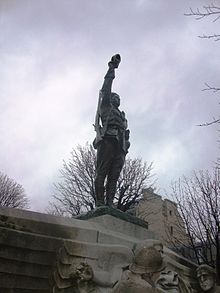
And where else to live in the romantic version of the past in the early 20th century than Paris. Despite the squalor of his digs in Paris (to which he complained in letters to his friends and family), the idealized “gloire” of the days of knighthood and an homorable death seemed to call him. With the outbreak of the First World War, he joined the French Foreign Legion, wrote his poems (and letters much less idealized, detailing the mud and slaughter of trench warfare). And earning a posthumous Croix de Guerre after his death on the fourth of July 1916. And even a statue (Place de Estas-Unis) in Paris.
https://en.wikipedia.org/wiki/Charles_Louis_Seeger_Sr.
While Alan’s posthumous poetry’s publication was largely financed by the family (which also would endow a library in Paris), the most immediate effect was on his younger brother, Charles, Jr. Charles, who had taken a more artistic route to writing than their father, was already becoming a well known music critic and professor.. However, he lost his job over his militantly pacifist objections to the US entry into World War I. Never giving up his pacificism and “internationalism”, Charles Jr. became a scholar of folk music, organized the collection of American folklore and music for the New Deal’s “WPA” and fathered a few radicals and outside the box children of his own, including the singer, songwriter, and peace activist Pete Seeger.
Other than Alan’s name on that building in Hipodromo, there isn’t all that much visible reminder of the Seegers… although with EVs more and more appearing on our streets (including taxis and police vehicles), foreign poets and “boheminans” aplenty, and a committment to peace and neutrality even at the highest levels of government in Mexico… the Seegers may be forgotten but a reminder that our ghosts — even expat ghosts — are reluctant to completely disappear.
Human rights and lefts: finding refuge
Although there are two Mexfiles… this one (mexfiles.net) meant for history and culture discussions and Mexfile.substack.com for political matters, its impossible especially in Mexico of not talking about political events without going into history. The “taking” of the Mexican Embassy in Quito — while unprecedented — calls up a history of Mexican diplomacy and foreign policy going back, if not just to the 1930s, then back to the earliest days of colonialism as well.

Our latest national hero, Roberto Canseco — a long serving diplomat (and, from all appearances not exactly either young, nor robust) — as chargé d’affairs of the Embassy made a futile attempt to physically prevent the Ecuadorian SWAT team from their mission to kidnap the former Eucadorian Vice-President, who had been given asylum in the embassy. It called to mind the (possibly apocraphal, but believable) story of Gilberto Bosques — the no-nonsense Mexican consul in Vichy France — who physically carried a skinny Spanish Republican under Mexican protection from his car and up the gangplank of a Mexican flagged ship right past a waiting phalanx of Vichy police and Gestapo thugs planning to whisk the Spaniard off to a concentration camp — trusting even Nazis would not date violate the inviolability of foreign diplomatic personnel. And, as has been pointed out in the Mexican media (and maybe elsewhere) during the Pinochet coup of 1973, 700 Chileans crowed into the Mexican embassy in Santiago, and the Chileans could do nothing but let them leave under Mexican protection.
Ah… but those few defending Quito claim that whatever it is the former Vice President was charged and convicted of mattered (legally, it doesn’t), or that given the “leftist” slant to the present Mexican adminstration, granting asylum to a wanted fugitive who’d been part of a left-wing administration in his country was “tainted” somehow.
Well, yes, it is true that Mexican asylum has traditionally favored leftists and democrats, just as the United States has been more favorable towards pro-Capitalist and anti-Communist asylum seekers (even including terrorists). As to Argentina in the later half of the 1940 … well.
But going back… while asylum seekers aren’t always in their country’s capital, and know where the embassies of friendly countries might be. it can hardly be said that Mexico’s asylum history is limited to “lefties”. In the early colony, if Skip Lenchek’s Jews in Mexico, A Stuggle for Survival (Mexconnect, 2000) is accurate (and recent scholarship seems to be on Lenchek’s side) the Inquistion of colonial Mexico turned a blind eye to their own “dissidents” … i.e secret Jews” .
While letting gringos settle in Tejas didn’t quite work out as intended, Mexico in the 19th and 20th centuries took in, and assisted, fundamentialist Mormons, displaced Boers, the “Milk Drinkers” (Russian Orthodox “heretics”), Mennonites and other groups one could hardly label as “leftist” in setting up colonies where they could pursue their very unMexican conservative cultural interests. I suppose, even Emperor Maxmilano’s grant of a colonia for Confederate leaders at the end of the US Civil War might be included in our list of not-left political refugees as well.
Add too, during the Second World War, Jews — regardless of their political affiliation or economic value — were assisted in obtaining Mexican refuge, even those that were turned away by that great champion of Democracy to the north. Likewise, Chinese in the 1880s and 90s, unwelcome north of the border. And, let’s remember Hacienda de la Rosa… resettling the (mostly conservative) Polish pre-war bureaucrats and their families — who’d been imprisoned by Stalin, and unwanted by the British who would only take militarily fit men — by train throuth Siberia, across the Caspian to Iran, down to the coast, sailing around the Cape of Good Hope into the Atlantic and via Brazil to Veracruz and onward to refuge in Mexico… all under Mexican diplomatic protection.
While we certainly remember Victor Serge, Leon Trotsky, Jacobo Árbenz, the Hollywood blacklisters, and other “leftists” who found refuge here, we should not forget that Mexico has always taken a proactive role in protecting dissenters, including those not in the favor of our putative allies. As it should.
To see outselves as others see us…

Nellie Bly, the 19th century sometime muckraker, sometime travel writer, published her “Six Months in Mexico”, in 1886, an account of her (well, duh…) six months poking around the country and the capital, exploring not just the sites, but about the “expats” of her day:
Tourists are still flocking to Mexico, many with business intentions, and the United States at present is as well represented as any other foreign country. Yankees are looked on favorably by some of the better and more educated class of Mexicans, but others still retain their old prejudices. However, one can hardly blame them, for, barring a few, the American colony is composed of what is not considered the better class of people at home. They have come down here, got positions away above their standing, and consequently feel their importance; they are more than offensive, they are insulting in their actions and language toward the natives, and endeavor to run things. The natives offer no objections to others coming here and making fortunes in their land, but they have lived their own free and easy life and they do not propose to change it, any more than we would change if a small body of Mexicans would settle in our country; and we would quickly annihilate them if they would offer us the indignities the Americans subject them to here.
Mexfiles has recommended Mauricio Tenorrio-Trillo’s discursive, rambling, and thoroughly documented social history of Mexico City (“I Speak of the City”) before. Although his focus is the changes the city went through with the Revolution and its aftermath, Tenorio-Trillo does not completely overlook the non-human side of the city. While he devotes most of a chapter to some less “respectable” residents… rats and lice — and tends to overlook the still 50% of the city that is non-urban, but there is no way he could avoid writing about the most visible non-human residents of the city… dogs.
Dogs have always been part of the city, The Aztecs who also raised them for food, as necessary companions in life, but a guide to the after-life. Woe betide the soul of those who were mean to dogs: Xolotl… who would deny them entry into Mictlan. And, like other Aztec deities, Xolotl had a dual nature… god of thunder and of the disabled and deformed — though, giving the high regard in Aztec society, like the Romans and Greeks, on physical prowess and beauty, it makes sense in a way… dogs famously empathetic to even the least attactive of us (were humans to hold dogs to such standards!).
And, although throughout the colonial era and beyond (Viceroy revalligio ordered the dog population of the city to be “culled” in 1792, and the dog slaughter continued for another 300 years) there was always resistance.. less from the elites and their pampered pooches, but from their always faithful companions… the street people, the poor, those whose lives might have been said to have gone to the dogs.
Not only the dispossessed, the dogs were, and are, everywhere… wandering the markets, sometimes “infomrally” housed (years ago, a mostly Chow named Canello would join my daily walk with my own dog, Eva Perra, before heading to his next stop in his daily routine of sleeping in an apartment hallway where he received breakfast, accompanying a couple school kids in the morning, hanging out at the newsstand, going for his stroll with Eva, and stopping by in the evening at the corner Farmacia. Who “owned” hims? No one and everyone). And, of course, the starving street mutts.
Perhaps it was the Revolution, perhaps the “4th Transformation, perhaps just changing social attitudes, but with 70% of Mexican households including at least one animal in residence (and of those, 80% are dogs) when Mexico City wrote its new Constitution in 2017, Article 43 (on the habiitablity of the city), section B recognizes dogs, cats, and other animals as “sentient beings” and “therefore, they must be treated with dignity.”
While not specifically related to dogs (the article applies to livestock as well… and one needs to remember that the city still includes extenive agricultural lands and working farms) it does give the state the duty to safeguard the treatment of animals, including “the dignified and respectful treatment of animals”, to “promote a culture of responsible care and guardianship”, and. “Likewise . . . carry out actions to care for animals in abandonment.” Canello’s less fortunate compadres, at least will have a warm place to sleep, and regular meals… or as many as possible anyway.
What brought the up today was that among other new meaures going into effect the first of April, I had to enter Leah’s information in the RUAC database (Registro Unico de Animales Compañarios”) like my own CURP (Clave Única de Registro de Población)… something like my US Social Security Number, or just an acknowedgement that I’m a real, live sentient (human) being. Like the dog.

Souces:
Tenorio-Trillo, “I Speak of the City” (Chicago, 2010), pp. 288-93.
Constitución Policica de la Ciudad de México, 2017
Koen, Madison, “Mexico is #2 in the world for the most household pets” (Mexico News Daily, 15 February 2019)
He wants an old drug…
An article in Wednsday’s Jornada, (“Etnias nayaritas se oponen a que las farmacéuticas comercialicen el peoyte”) reported on the indigenous communities in Nayarit which express objections to so far vague suggestions of commercializing peyote along with other hallucionagenic fungi for pharmeceuticals. While there has been research for years, and some clinical studies suggesting the value of these fungi in treating illnesses like depression, the proposal, by Green Party Senator Alejandra Lagunes (who claims her depression was cured with ayahuasca — which grows in Amazonia, not Mexico) was printed in the Gazeta Oficial back in October 2023. Not that anything has come of it so far.
The objections are not, as one might have expected, on the disruptions to indigenous communities following the “discovery” of possible pharmaceutical value to “magic mushroom” back in the 1950s, when Gordon Watson wrote about Maria Sabina for Life magazine. While Sabina claimed the invasion of the gringos. As Sabina later sadly said:
These young people, blonde and dark-skinned, didn’t respect our customs. Never, as far as I remember, were the saint children eaten with such a lack of respect. For me it is not fun to do vigils. Whoever does it simply to feel the effects can go crazy and stay that way temporarily. Our ancestors always took the saint children at a vigil presided over by a Wise One.
Although, in a way, that is what the wix{arika, naayerij, o’dam and mexikan communities are arguing. To them, peyote has religious and cultural significance, and not a medication, not in the physical sense (unless, perhaps, in the sense that the pope referred to Christian sacraments as “medicine for the soul”). Not to mention the ecological damage (and several of these cultures see the land itself as sacred) caused by outsiders “harvesting” cacti and other desert flora for “medicinal use”.
As it is, some of the fungi and plants once held sacred, or having theraputic uses, have disappeared for one reason or another. Among them, the “Narcotic Rose” … the subject of a rather lyrical article by historian Ernesto Serna, in today’s Milenio. My translation:
In ancient Mexico, something similar to a musician’s jam sessions featured both flowers and songs. The magicians of the word, almost all of noble birth, met at the most elegant brothel in Tenochtitlan — euphemistically called cuicalli (“song houses”) — where they began the session by invoking the muses, singing their poems, and chatting up the good-time dancing girls. Until the spirit moved them to a more carnal release, though the libertines among them probably had their dessert before the soup. No poet declaimed without music. The vibrations of the teponaztli, the percussions of the huéhuetl, the whistle of the flutes, the ululation of the sea snail and the ringing of the tetzícatl (a type of cymbal) marked the meter of the poems, different for each lyrical genre. The music played an important function, “bringing the gods down to earth,” according to the historian Guilhem Olivier. Dance was also essential, and a poet had to dance with grace.
Father Angel María Garibay, a distinguished compiler and translator of Nahuatl poetry, maintained, against all evidence, that in that orgiastic atmosphere the poets did not get drunk. He undoubtedly sought to exonerate them from any fall into perdition, attributing to them an Apollonian serenity incompatible with the induced euphoria, but the very songs that Garibay translated refute his pious conjecture. The “celestial parrots” may have been cautious about ingesting pulque, but not because they were paragons of sobriety: they drank in moderation so as not to cross paths with other substances, since we know that they resorted to artificial paradises to ignite their imagination. They ate, for example, chocolate sprinkled with poyomatli, a rose fungus that apparently drew sumptuous metaphors from their souls. The anonymous author of an elegy in honor of Nezahualcóyotl put fervent praise of that forgotten drug in the poet king’s mouth: “There are flowery songs: let it be said/ I drink flowers that intoxicate,/ the flowers that make you dizzy have arrived, come and you will be glorified/. The drum is already beating: let it be the dance: my heart is dyed with beautiful narcotic flowers.”
Less potent than magic mushrooms, poyomatli mixed with tobacco or dissolved in chocolate was a “controlled substance”, in that it permitted the user some control over their hallucinations, to “put the words on their feet,”according to Miguel León Portilla. Some evidence suggests that the rose fungus had aphrodisiac powers. In a beautiful erotic song by Tlatecatzin, a 14th century poet, carnal pleasure and lyrical impulse seem like two sides of the same coin. After greeting a “sweet, tasty woman, a beautiful flower of toasted corn,” who invites pleasure, Tlatecatzin exclaims “The blossoming cocoa already has foam/ the tobacco flower was distributed. /If my heart liked it/ my life would be intoxicated.”
The praise of flowers in Nahuatl poetry is such a cliché that it can annoy a modern reader. For example, the eagle warriors were a “flower of shields”, the battlefields were watered with “blood flowers” and the poems themselves were attempts to create “unfading flowers, perfecting the task of the gods”. The rose is the poetic flower par excellence, and apparently the ancient Mexicans esteemed it as much as the Europeans. The consumption of poyomatli suggests that roses mixed with foaming cocoa also beautified the gardens of thought. The rose with fungus is a sick rose, but the Mexica sensed, before Baudelaire, the charm locked in the flowers of evil.
As far as I know, poyomatli disappeared along with the pre-Hispanic civilization, since no one consumes it today, unlike peyote or the extensive variety of hallucinogenic mushrooms found throughout Mexico. Did the cultivation techniques introduced by the Spanish eradicate the rose fungus? Did the insecticides kill it off? Is there no way to resurrect it in a laboratory? What has come down to us is combining chocolate with psychotropic substances. There is a black market for chocomushrooms and some eternal teenagers have taken to chocomilk with marijuna, in search of the youth they lost or wasted. It is difficult to imagine the bohemian evenings of pre-Hispanic poets without a nostalgic sigh. The extinction of an artificial paradise may be beneficial in terms of public health, but along with it dies a source of intuitions and dreams that may never return.
Oh give me a home…
Politics is over on substack, but there was an article in the news today about presidential candidate Xochiltl Galvéz saying she would not live in the Palacio Nacional, but would prefer to move into a “cabin” (a very large… as in 500 M2 cabin built during the Fox administration at Los Pinos (now a public cultural center), arguing a “palace” is “imperial” and she’s no emperor.
Well, OK… but Mexico never really had any specific presidential mansion. Early on, either the presidents (especially in those early years, when presidents went in and out of office, sometimes in a matter of monhs), several might have bunked there, and Emperor Maximiliano spent a fortune redecorating the place (after his first night in Mexico City, when discoving the beds weren’t made up for him, slept on a pool table), but Benito Juarez had a small apartment in the building (where he died… you can still see his bed, which has been made up, by the way). Porfiro … at least officially… started living at Chapultepec Castle, but spent most nights at a rented house in the city, and was only there for ceremonial occasions.
Lazaro Cardenas… reportedly because his wife, Amelia Solórzano didn’t think a castle was quite suitable for raising small children… moved into what had been Maximilano’s hunting lodge, Los Pinos. That would become the de facto Presidential home, morphing over the 80+ years into a complex of houses, guest-lodges, a military barracks and offices. One president, the left leaning Adolfo Lopez Mateos, never stayed there, but the rest were free to indulge much more “imperial” tastes than they can at the residency within the Palace now used by the President… a “modest” 300 square meter 2 bedroom apartment, originally installed during the Calderón administration from rooms previously used by the “presidential guard” (since disbanded) for housing some of their officers.
By the way, if you noticed, Galvéz’ prefered lodging… should she be elected… is quite a bit larger than the “imperial palace” apartment. AMLO was asked about the place in an interview, soon after moving in… and gave what has to be the classic Mexico City answer… it’s a shorter commute to work.
Xóchitl Gálvez afirma que de llegar a la Presidencia no vivirá en Palacio Nacional; “no me siento emperador”, dice, El Universal, 25 March 2024
El departamento de Felipe Calderón en Palacio Nacional en el que hoy vive AMLO, Politico MX, 24 August 2023
AMLO muestra el interior del departamento de Palacio Nacional, Expansion, 20 June 2020

Presidential dining room in the palace.
Used book: a little out of my price range
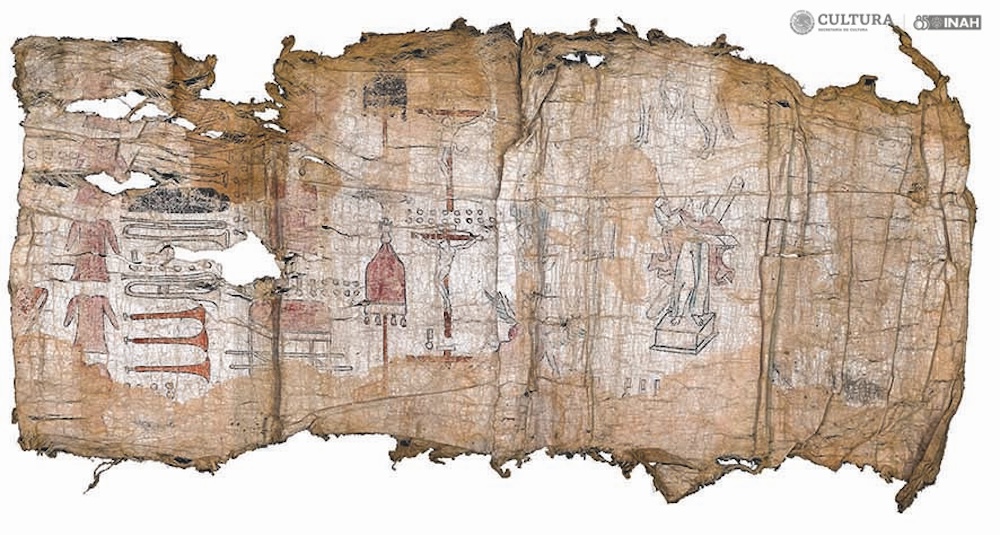
My friends at Librería México Antigüo Libraria México Antigüo are my usual go-to guys for Mexico City history documents… but I can only afford so much, and while I might be willing to spring for some fairly esoteric and hard to find pieces, I’m afraid 9,500,000 pesos (about US$570,000) might be just a little too much for me. But, not for the INAH, National Insitute of Anthropology and History that coughed it up, when they had an offer they couldn’t refuse.
The Codex San Andres Tepilco showed up where least expected… right in Mexico City — Coyoacan to be exact. A 1611 Codex — an Aztec style “book” on amatl bark paper had been sitting in a private collection all along. The work … in Nahautl hiroglypics with Spanish language notes, details the fouding of Tenochtitlan back in the 1300s up through 1611, covering not just the dyanstic history of the Aztec “empire”, but the Spanish Conquest, the destruction and reconstruction of the City as Mexico City.
I’ll have to wait for the Kindle edition… sigh.
Let there be light (and internet connections, and…)
A very nice job by Mexico Listo on what is now the world’s largest urban solar plant:
The Centro de Abasos (Mexico City’s central market) is 85 hectares a building (the Pentagon in Washington has only 29 for comparison), the largest footprint of any single building in the Americas. Besides fulfilling a much more useful function inside than the Pentagon, what’s outside every day is about to provide another benefit beyond what goes in and out of its doors every hour of every day.

Mexico City has just completed a massive project to install over 32,000 photovoltaic modules on the market’s rooftops – making it the largest rooftop solar plant in the world.
220,000 square meters of solar panels, providing 25 gigawatts of electrical power a year, not just powering the market itself, but added to the grid, and reducing Mexico City’s CO2 emissions by an estimated 13,550 tons a year.
As the local city markets are remodeled, solar panels are being installed on the roofs lowering our electrical rates throughout the system.


